Category: charities

  • Top 10 Things Executive Directors Need to Know About Volunteer Services

    cliffsnotes
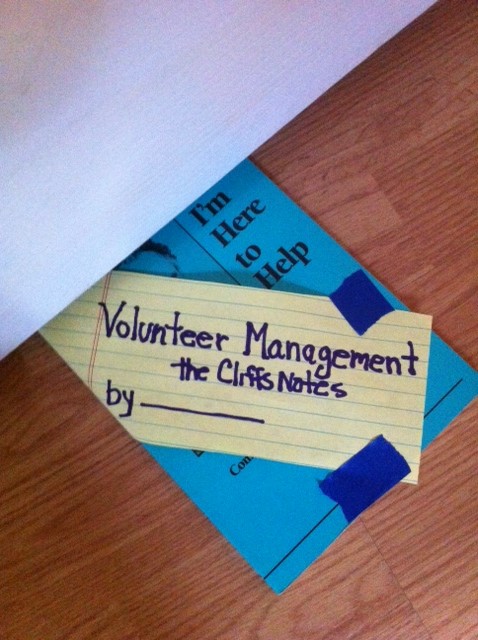
    I’ve always wanted to see a small pamphlet entitled “Volunteer Services for Dummies” or maybe “Volunteer Management, The Cliffs Notes.” Then I could sneak around and slip that bad boy under the door of the executive director while he was at a conference on “How to Get Donors to Donate More.” The pamphlet would have a way to insert whatever author’s name would impress him, like maybe that consultant who he’s recently hired to tell him that he needs to get more donations.

    So, forget the pamphlet. Let’s just list the ten top things that I wish CEOs would understand about volunteer services.

    10. Volunteers do not sit by their phones waiting for us to call. Shocker! We don’t just “order up” volunteers when someone asks for eight volunteers who can work twelve-hour shifts, outside, tomorrow at 8am. Yeah, no one wishes it were that easy more than we volunteer managers. Asking volunteer Charles to prioritize volunteering with us over his other volunteering activities, his trip to Bermuda (that he’s saved years for), his managing of his elderly mother’s affairs, and his scheduled surgery might just be a tad unrealistic. It takes a wise volunteer manager to know how to balance volunteers’ experiences so that volunteering is not burdensome and they look forward to coming in to help.

    9. Managing volunteers is not like managing staff.  Wow, bigger shocker! Unless managing two to ten times the number of very diverse people who only work maybe four hours a week without pay is the same thing. Instead of a paycheck to dangle, volunteer managers must use real leadership skills to inspire and coordinate volunteers. Think of it this way. Volunteers typically spend about 4 hours a week volunteering while you, the Executive Director and your staff spends upwards of 40 or 50 hours a week working for the organization. That’s at least ten times the amount of “plugged in time” you have over volunteers. Do you think that the volunteers spend the other 36 hours thinking about our organization? If not, volunteer managers must be able to “plug-in” volunteers every time they arrive on scene, motivate them to achieve that connection and keep them informed of changes and updates.

    8. Volunteers are everyone’s responsibility.  What?!!! The CEO is thinking, “Then what do I pay YOU, the volunteer manager for?” Staff doesn’t necessarily see working with volunteers as part of their jobs, but any staff can make or break a volunteer’s experience. Look at it this way. What if you, the CEO cultivates a donor by spending your time and sweat to encourage and inform and then another staff member comes along and insults that potential donor? It’s no different with volunteers. We need you, our CEO to set the tone. So if deep down, you are thinking that volunteers are not really time donors but are just fluffy side dishes,  then please stop saying things like “we can’t operate without our volunteers.”

    7. Volunteer managers are real managers. “Hmmm,” the executive director might be thinking, “No way, not in the same way our manager of fund-raising is!” Well, no matter what you call them, coordinators, specialists or team members, volunteer managers are as much a manager as anyone on your staff. The list of skills needed to lead and cultivate a team of volunteers (see #9 and #6 and #4 and #3 and #2 and #1 and oh heck, all of them ) is quite extensive.

    6. Volunteers want meaningful work. “So,” the CEO may be thinking,  “but I often need some meaningless stuff done. Who will do it?” That’s true, but volunteers do not want to just do what the staff doesn’t want to do, they want real jobs that make a difference. And since we don’t pay them, maybe we should consider meaningful work as pay? But, a great volunteer manager with awesome skills can lead volunteers to occasionally do the grunt work if grunt work isn’t all that is offered.

    5. Volunteers want sincere appreciation from more than just the volunteer department. An Executive Director might be thinking, “Hey! I always say that we couldn’t operate without our volunteers, don’t I?” Yeah, you do. But guess what? Volunteers see through the once a year speech at a luncheon that is just lip service. Volunteers want you to make an appearance and say hello, send hand written thank you notes and include their accomplishments the next time you meet with the board of directors. And oh, they would like you to genuinely encourage staff to do these things too. Volunteers are either an integrated valued service or it’s all just talk.

    4. Volunteers are not just little old ladies drinking tea. “But,” a CEO could say, “they sure look like that description ha ha.” Did you know that volunteers are diverse in every way, including age, background, culture and experience and that it takes some major skills to manage a group of very diverse people? But even if some volunteers are older, did you know that they are former executives, professors, leadership experts and full of wisdom and great ideas? And they’re more than willing to share their wisdom for free.

    3. Volunteer managers are not lap dogs.  “Hey,” the Executive Director would protest, “I never said that!” But are the volunteer managers treated that way by staff? Is there an “order up” culture in which volunteer managers are expected to just get volunteers without having any meaningful input into volunteer requests? Volunteer managers have their fingers on the pulse of the organization and are privy to every aspect of the mission via volunteer involvement. Maybe, just maybe, your humble volunteer manager is really a great motivator and leader and not just an order taker. Check them out for some really awesome ideas and managerial skill-sets.

    2. Volunteers are aware and talk. “Sure, so what, that’s great,” a CEO might agree. But, when a volunteer hears negative speak from staff, or sees something less than perfect, guess what? They talk, to each other, to friends, relatives, and the cashier at the Quick-Mart. Volunteer managers keep volunteers motivated and inspired and mediate constantly to make sure the volunteer’s concerns are resolved and their experience is positive. In this world aching for transparency, volunteers are the town criers who can proclaim the worth of an organization or do damage to its reputation.

    1. Volunteers don’t stay forever. “Heresy! They should if the volunteer manager is doing her job,” an Executive Director could counter argue. No, actually volunteers don’t. Does staff stay until they die? No, and neither do volunteers. We should recruit, train and cultivate our volunteers just as we do staff, but not expect them to continue until they’re carted off in an ambulance. And, just like staff, sometimes we don’t want them to stay, so that’s why the professional skill-set of the volunteer manager is so crucial. A volunteer manager’s professional resolution to a challenging situation is an organization’s best chance to avoid negative publicity.

    So, there you have it. I’ll bet you volunteer managers have some really great ideas on other truisms that belong on this list. You have my permission to print out this list, slip it under your leader’s door. Somehow add to it that it was authored by the “Center for Outstanding Management and Maintenance of Organizations and NGO’s” via the report from the “Study on Excellence in Non-profit Structure and Ecosystems” or COMMON SENSE for short.

    -Meridian

  • Defining Success

    coal miners wikipedia wikipedia

    The first time I met Alex many years ago, I noticed his manicured nails. He had the soft hands of wealth. His was not a gaudy proclaiming wealth, but an understated old mixed with new wealth. A retired corporate lawyer, with his much younger wife still working, he wanted to fill his days with something meaningful to do. He’d not had a hospice experience, but he’d heard that hospice was a good organization to volunteer for and he wanted to try it out.

    He stuck out in orientation. From his formal weekend wear to his lawyer inspired questions, he animated the sessions with his analytical take on things. The rest of the diverse but more laid back class was somewhat intimidated by him. (Me too if you must know- and yes I tell myself that I’m no better and no worse than anyone else, but heck, my clothes wouldn’t keep their shape like his did).

    After the six orientation sessions were over, I met with Alex in my office. He was polite and cerebral and together we formulated that with the help of a seasoned volunteer, he could begin volunteering in our care center.
    Alex called me often to ask questions. He would show up at my office door every time he came in to volunteer. Knowing that he was used to doors always opening  when he knocked, I allotted time for him. Was he smart? Oh my, I think I could have applied for 3 credits at a local college after listening to his measured thoughts.
    Since the care center staff had really never seen anyone quite like him, I was peppered with lots of questions and comments. “One of those successful types,” a nurse said one day. “He asks a lot of questions,” another said and added, “you’ve got your work cut out for you.”

    One day, a new patient, Lester came into the care center. A coal miner from West Virginia, Lester was in his late 80’s. His wife had died young and although he had no children, he had an old phonograph that played bluegrass music day and night. We all were used to walking past his room, hearing the lively strains of banjo, fiddle and mandolin drifting up and down the halls as if over the hills of a coal camp. As thin as a pick axe, Lester spoke of a time when his wife scrubbed his coal stained clothes until her hands bled and the chocking black dust laid upon the ground outside his camp house door.

    Alex began to visit with Lester more frequently. He sat in Lester’s room while the phonograph scratched out “Foggy Mountain Breakdown,” and listened to Lester’s stories of moving from job to job until the mines became more mechanized. As time passed, Alex began to place his chair closer to lean over to hear Lester and I would observe him, elbows on knees, straining to catch the flooding memories. Then, one day, the absence of bluegrass music outside Lester’s door spoke volumes. Lester was actively dying and his phonograph had grown quiet. He had turned it off. Alex came to me and tentatively said, “I have an acquaintance who plays the banjo and knows any number of Lester’s favorite songs. Do you think I could ask him to come in and play for Lester?” We checked with the charge nurse and social worker and Alex was given permission to bring his friend in. By this time, Lester had not stirred from bed, but lay peacefully, quietly slipping away.

    I skipped a meeting that day, shut my office door and crept down to the care center. The stomping good sound of the banjo’s strings was glorious. I peeked into the room and saw Alex’s friend’s frenetic fingers pick that banjo, his eyes smiling at  Lester, who was now somehow sitting upright, a look of bliss on his worn face. Alex nodded to me from the very corner of the room. I wondered if Alex consciously picked the color of his shirt that day to blend in with the wall color.

    Lester died two days later. Alex and I sat in my office, the lack of music deafening. He did tell me that his friend was honored to be able to play for someone who breathed those mountain roots. Alex got up to go. It wasn’t the time to badger him with questions about how he was going to process this experience, not yet anyway. Right then it was time to silently let it all sink in.

    What makes a person successful? I’d say Alex pretty much had it all figured out.
    -Meridian

  • Your Spotlight Hurts My Eyes!

    In the Spotlight
    In the Spotlight
    I almost spit out my sip of coffee when I ran across this article a week ago. According to the story, a great grandmother was “sacked” from her nearly 30 year volunteer position at a thrift store for her inability to use a computer. The searing negative light this incident turned on made me cringe because as you can see from the selected comments I pasted below the link, non-profits all get lumped into the big barrel of rotten fish when a charity receives bad press.

    http://www.express.co.uk/news/uk/590346/Volunteer-great-grandmother-sacked-charity-shop-cannot-work-computer

    Here are 3 comments from readers:

    JHR16 days ago
    Charities are beginning to stink to high heaven.

    ycjarman17 days ago
    NEVER help a Charity that doesn’t appreciate what you bring to it !

    JBJB116 days ago
    Strikes me a lot of charities have lost sight of what they are supposed to be doing and more concerned in becoming corporate enterprises

    I’m not jumping on the “get the pitchfork and storm the castle” bandwagon because as I read the article, I began to imagine the different scenarios that led to this unfortunate public airing of an incident involving a volunteer. What really happened? We don’t know, so I’ve put together some possible scenarios based on my own experiences with these types of circumstances.

    1) An organization’s resale shop manager is just plain tired of “dealing” with volunteers who can’t work as efficiently as paid staff and so begins to find a convenient reason to dismiss those volunteers, never mind their years of service.
    2) Volunteers become so entrenched in their jobs that no one has the guts to derail their authoritarian and entitled behavior and everyone kicks that can down the road until there is a blowup.
    3) A volunteer becomes increasingly negative for any variety of reasons (health, circumstance, lack of being heard) and no one clears the air. This negativity builds and spreads until big problems arise.
    4) Change is implemented without careful regard to how it will impact the volunteers. Lack of change awareness leads to grumbling, camp-forming and ultimately mutiny.
    5) Repeated staff turnover leaves a new volunteer manager without any basic information about the volunteers he/she manages. Personality clashes balloon into showdowns with staff.
    6) A shop manager/volunteer manager is burnt out, overworked and under appreciated, pressured to increase profit/sales and is unable to properly cultivate the shop’s volunteers.

    This comment from a reader of the article hits at the perceived lack of volunteer management:

    moanalisa16 days ago
    it’s taken 30 years for them to ask Mrs Brooks to leave – if they were so concerned about Mrs Brooks attitude she should have been told to leave years ago

    So, could this negative press have been prevented? Perhaps, but the point is, whether the volunteer is in the right or in the wrong, the proper handling of their exit is challenging but absolutely crucial, especially in the messiest situations. A curt dismissal letter is a weapon in the hand of the offended.
    Sadly, we all are included in the negative stereotypes of charities as witnessed by the comment section of this article. The “pile-on” comments reinforces any perceived notion that “you know, I’m not so sure my local charity is really that nice. Last time I gave them a check, I never got a thank you. Maybe they’re just not who I thought they were.”

    Our microscope is turned to a higher scrutiny than that of businesses. Why? Because the public perception is that charities are run by people who are nice. It’s a simple perception but one that takes a tremendous amount of attention to detail to continue. Who wrote the letter sent to the volunteer? Was it written out of frustration? Acting out of heightened emotions can get us splayed across media. For every 20 volunteers who perceive they are treated badly, one will go to the press or their circle of acquaintances. (And of course their acquaintances live next door to the CEO or the editor of the local newspaper)

    So, what to do? You may never adequately resolve an issue with a volunteer and have to dismiss them. But, taking the extra time and effort to make the volunteer feel heard can go a long way in dousing the fire of their perception of being wronged. I’m not advocating the acceptance of poor behavior, I’m saying that hearing the volunteer’s side without your agreement or disagreement helps diffuse their anger.

    If you’ve inherited a problem volunteer, it is much trickier. A volunteer whose problem behavior has been overlooked has assumed that the organization is fine with that behavior. It takes real skill to dismiss someone who looks at you as the evil newbie when in fact, you are just cleaning up the mess spilled on the floor years ago that now has mold growing on it. I’ve been in these situations and had hours long conversations with entrenched volunteers. Being respectful but firm, complimentary of their positive skill sets while pointing out negative behaviors and reiterating everyone’s commitment to the mission is helpful. While it took an enormous time and emotional commitment, the end result was always worth it. I never left the conversation until I felt that the volunteer and I were at a calm, reasonable point.

    Having written conduct rules, including the steps for dismissal is critical. Every volunteer should sign a copy for their file. I’ve had to go back and look for that copy on several occasions and the presence of the volunteer’s signature on that document has saved me.

    We all lose when folks reading a negative newspaper article generalize about every charity. Charities have to work harder to maintain the perception that we are ethical, caring, and committed to treating everyone, including volunteers respectfully.
    But then, we signed up to be ethical, caring and committed to treating people respectfully, didn’t we?
    -Meridian