Category: explaining volunteer management

  • It’s Time for Volunteer Fresh

    Is there a soft bias towards volunteers because they only volunteer once a week or month? Volunteers can’t be as committed, as knowledgeable, as valuable or impactful as staff who labor 40 (wait, who are we kidding, like 60-80, most uncounted) hours a week? But in reality, less time spent by volunteers is a gift.

     Volunteers are not burdened by the stress of working for us full-time.

    Volunteers who show up once a week or month are like opening the window. They come in, trailing currents of fresh air. They bring with them new experiences, a taste of outside ideas, and rejuvenated enthusiasm to our stale environments

    What factors contribute to a stale environment?

    Well, for starters, the pandemic for cryin’ out loud! Compassion fatigue, burnout, overwork, repetition, familiarity, slow to change movement, it’s always been done thus mentality, funding worries and stress. Each of these freshness killers lurks in the halls of non-profits, waiting to blow their stale breath into our lungs.

    Pedestal of Perpetual Caring

    There is a pressure on non-profit staff to be “on” at all times. This Pedestal of Perpetual Caring implies that every moment is as intensely compassionate as the first one. Who can live up to that standard when change is everywhere, workloads are increasing, reports are due, projects need attention and budgets are withering?

    Enter Volunteer Fresh

    What benefits do we reap because our volunteers are NOT with us 24/7?

    • Our volunteers, because they are not on a pedestal of caring and are not burdened by the stresses of working with us full-time can and do exhibit the intense compassion every client needs.
    • Our volunteers can focus on a single, crucial task, because they are not being pulled in 50 directions.
    • Our volunteers are out there in the world 98% of the time and bring with them outside opinions, trends, ideas and methods.
    • Our volunteers bring infectious enthusiasm and continually remind us why we love our work. They plug us back into our missions.

    Volunteer Fresh is Circular

    Volunteers are not tools They are living, breathing human beings. They do not volunteer in a vacuum. Instead, they trail portions of us when in the community and bring portions of our community to us every time they volunteer. They bring our mission to the community and the freshness of our communities to us. They are a continuous pipeline or bridge that directly connects us with not only the people we serve, but with the people we want to reach out to for support.

    Some questions to ask your organization when talking about volunteer fresh.

    • Do you want unbiased opinions from the community or do you want the same stale reports?
    • Do you want new, untapped donation streams? (yep, that will get some attention)
    • Do you want to give our clients stress-free compassion or would you rather send in someone who is overworked?
    • Do you actually want diversity or are you just mouthing the desire to be inclusive?
    • Do you want free word of mouth marketing or do you want to stretch the budget?
    • Do you want free expertise or do you want to bring back last year’s consultant who just told you what you wanted to hear? (and charged a hefty fee)
    • Do you want to put together another task force made up of staff who are already overworked, or would you like to hear some diverse opinions? (including thoughts from volunteers who have been recipients of mission services)

    Ok, non-profit people. We’re tired of being indoors. It is time to open the window.

    -Meridian

    in case you want a copy of the volunteer fresh diagram:

    this is an update from a 2017 post
  • The Invisible Lines of Connection

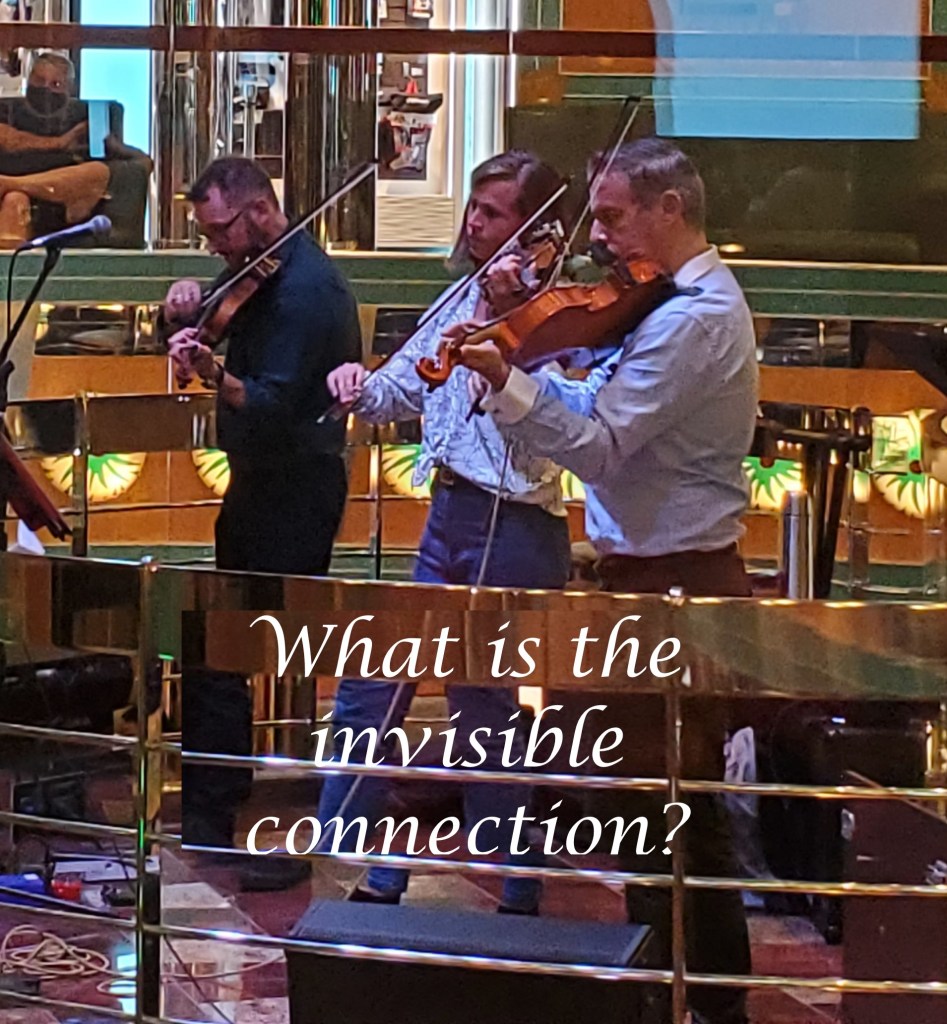
    Electric Waves Trio

    On a trip, mesmerized by the pure sounds of a trio of musicians, I approached them, telling them how much I enjoyed their haunting music. We struck up a conversation that wove in and out of days. I learned about their lives which made me appreciate them more. During their performances, I was riveted, connected to their music. Why? What was it about them?

    This makes me think of the connections I’ve had with certain volunteers. And staff and clients for that matter. What was it that drew me to them, and them to me? Did we share similar backgrounds? Heck no. Did we share similar experiences, thoughts, tastes, preferences? Nope.

    Was this connection instant, like a beaker in a lab, that when the mixture was just right, magic happened? Who knows? Science hasn’t yet thoroughly explained the chemistry or psychic connection we have with others. But it’s real. And it’s not always instant. And luckily for us, volunteer managers we get the opportunity to connect with a lot of people.

    I remember Yaz, the student who interrupted me one day because he “had to get this project done ASAP.” I was exasperated with him, but grew to love him like a son. His chaotic life was infectious.

    There’s Manny who always promised to show up, but seldom did. But every time Manny was around, I stopped everything and basked in his stories about growing up in the desert.

    Then there is Marta who I loved like my favorite aunt and I always found myself gravitating to her work station so I could be around her auntie advice and clucking care.

    Or Romero. I have no idea why I grew so close to this gruff, divorced, me-against-the-world patient, but I did and I was devastated when he died.

    Or Helen who irritated the snot out of me, but I couldn’t get enough of her wise cracking humor and her “take” on this pompous staff member who drove me crazy. We used to sneak off to the ladies room to chortle.

    Or Jose, retired military officer who had the best twinkle in his eye and the best darned chocolate chip cookies ever.

    Or Miriam, a patient who taught me how to listen through her barrage of criticisms, but let me into her world. And oh, what a world that was.

    Or Jay, a fellow staff member. We couldn’t be any more opposite in everything but he’s been one of my best friends for over 20 years. We used to tell people that we were brother and sister, (mom got around) and would then laugh at the shocked expressions.

    I believe as volunteer leaders, we learn to open up to people so we can engage them. We appreciate the complexities of fellow human beings. The chance to connect deeply with another person is a gift we receive through our efforts.

    Part of me would love science to explain why there is this magnetic spark, this connection with certain people. But part of me loves the invisible threads that reach out from me to them and from them to me. Those threads are rather magical.

    And frankly, in a complicated, often challenging world, a little magic goes a long way.

    And, when I sighed over not making much money, or not being understood, I felt the invisible strands linking me to others, like humming ribbons, that told me I was given the gift of connection. And those strands encouraged me in complex ways, to be better, to appreciate the gifts I was given, to fight for volunteer recognition and to grow as a human being.

    I can feel the strands humming around me now, connecting me to so many other amazing human beings. I am thankful for them, love that I have the opportunity to know them, and I hope, a better person for sharing in their incredible lives. Like music, our connections to others fill our lives with joy and inspiration.

    -Meridian

  • I’m Not Nice. Not Really.

    Photo by Dziana Hasanbekava on Pexels.com

    There’s a long-term epidemic plaguing our profession: It’s the idea that Leaders of Volunteers are nice. Like fluffy, sweet as birthday-cake-fudge nice. Like dismissible, non-serious, inconsequential nice.

    Been reading this great post (Abandoning Niceness in Volunteer Engagement) from Sue Carter Kahl and recalling Rob Jackson’s rousing keynote address, “Stop Being So Bloody Nice” at volunteer engagement conferences.

    My “bio” says I was hired for a volunteer management position because I was nice. That is true because niceness was the requirement back in the day. But, what is “nice” anyway?

    Nice: (adj.) pleasing, agreeable

    You know what? I chuckle inside when people tell me I’m nice cause I hide my evil side fairly well. I’m not that gooey, everything is awesome nice. Nope, not at all. Bet you’re not, either. So, why do folks think that? Well, here are the attributes I believe most volunteer managers (VM) have that are consistently confused with niceness.

    Shrewdness: (astute judgement). VMs calculate how to interact with volunteers in the best way to coach and mentor that volunteer so that the volunteer has a meaningful experience and in return, the organization benefits. That doesn’t mean lip-service, it means real work. What looks like niceness is actually a customized form of coaching.

    Caring: (showing compassion). Every VM cares about the volunteers, personally and professionally. Caring takes work to understand the volunteer as a complex human being. It is way beyond and more meaningful than merely asking “how are you” while tuning out the answer. It is investing in the volunteer as a person which is the foundation for engagement.

    Reasonable: (logical). VMs see the bigger picture and can pivot to attain bigger goals. That doesn’t mean agreeing with poor ideas or signing onto flawed requests. It means seeking common ground, working to make sure solutions fit for everyone, taking into consideration the various goals in play. Making sure everybody is happy is nice. Assuring everyone’s goals are met takes skill.

    Flexible: (adaptable). VMs adapt all day long. Not because they “go along to get along” but because they realize give and take is part of volunteer management fluidity and the agile volunteer manager accomplishes more. Flexibility keeps everyone engaged and satisfied that their needs and concerns are heard. The agile volunteer manager then can “bank” the good will they’ve created by adapting to meet staff and volunteer needs. Then, in the future, VMs withdraw some of that goodwill to meet new goals. (yup, we bank that good will and make frequent withdrawals-which makes us incredibly forward thinking)

    Curious: (Inquisitive). VMs want to know things, about volunteers, about staff, about the world. Why? Because VMs stitch information together into a garment that fits a challenge. So, when a VM interviews a volunteer for two hours, or listens to staff gripe about their workload, that’s information gathering for a purpose, not a nice chat or a good gossip session to get out of other duties.

    Effective: (producing results). VMs understand the multiplication principle and how an hour of seemingly meaningless time can equal many hours of productive time. That means listening for an hour to a volunteer chat about personal things will exponentially multiply. Because the end result is, that volunteer, who the VM carved out an extra hour for, ends up working 100 hours, or takes last minute assignments, or recruits 3 outstanding volunteers, or donates money to the cause. Niceness is sitting and listening to a conversation just because. Effective listening begets a positive result.

    Why not nice?

    I was always calculating in my head. Is that manipulative? Maybe. But, see niceness is bland. It produces very little. It’s pleasant and isn’t that why nonprofits tolerate us in the first place? Because they want us to be blandly pliable, aka docile, manageable. They want to order up volunteers but not have to deal with our objections or suggestions or innovations. That’s why volunteer initiatives were created, right? So that there would be a supply of people who happily did whatever was asked while the nice volunteer coordinator made sure the supply never ran out.

    This is 2021, soon to be 2022. We’re going through a freakin’ pandemic for goodness sakes. What “worked” in 1990 no longer works. Volunteer managers must stop allowing the notion that we are nice. No. Not nice. Not pleasant, not cheery, not sweet, not friendly, not genial, and especially not obliging, cheerful, amiable or agreeable. No, we are professionals with goals and proven methods of achieving those goals.

    So, the next time someone tells you you’re nice, smile sweetly and say, “Nope, I’m not nice. I’m effective.”

    -Meridian

    woah, I sort of wrote about this back in 2011- Are we too nice?

  • Volunteer Time Donor or Time Investor?

    Just revisiting this post about volunteer investors from 2017. Semantics aside, we need to change the deep conceptions/misperceptions surrounding volunteers.

    Why Time “donors”

    Time=Money. We all say it and that’s why we call volunteers “time donors.” They donate their time, skills, expertise, talents etc. But is that what they really are? Donors? Maybe there’s a more descriptive word for our volunteers. And what is the difference between the terms donate and invest anyway?

    donate: to present as a gift, grant, or contribution

    invest: to use, give, or devote (money, time) as for a purpose or to achieve something:

    Hmmmm, there’s a subtle, but profound difference in the two definitions.

    Volunteers don’t just show up, give a few hours and walk away. But outdated thinking categorizes them in this way. Doesn’t it feel like investing is closer to what volunteers do? Maybe we should start to rethink this whole time donor idea.

    Why Investors?

    Let’s take this further and examine investors. Investors invest money, right? But why? Why do they invest money in startups. non-profits, real estate, stock markets and other ventures. To make more money? Or is it more than that?

    Money is a currency. So what do investors really invest? Many things. They invest their future, hoping to be financially secure. They invest their dreams, hoping to achieve a goal. They invest their essence, hoping to give back. They invest their good name, hoping to attach to a cause that is worthy of their currency. They invest employee engagement, hoping to attract great employees. They invest their clout, hoping to further a cause that supports their vision.

    Investors invest so many intangibles, and their currency is money. They don’t give startups or organizations money, they devote their money in order to achieve a goal.

    How would this apply to volunteers?

    If money=currency, then time=currency.

    So if volunteers’ currency is time, then what exactly do they invest?

    They invest all of the above and their humanity(the quality or condition of being human)

    Volunteer managers everywhere instinctively know this. We feel this every day when hearing and observing our volunteers’ intangibles. How do we feel this?

    • by the rewards volunteers tell us they personally feel
    • by their belief in us and our missions
    • by the passion exhibited by volunteers
    • by the camaraderie volunteers forge when bonding with like minded citizens
    • by the commitment volunteers show
    • by the enrichment volunteers gain by volunteering with us
    • by the sense of pride volunteers feel in their work
    • by the support and love they extend to us and other staff
    • by the initiative they take when doing word of mouth marketing in their communities
    • by the care they wrap around strangers in need
    • by the desire they exhibit in wanting us to grow and succeed
    • by the pure joy they infuse into our lives
    • by the amount of time they spend away from us helping us off the clock by recruiting, marketing. finding resources, donating, improving themselves, etc.

    What do we get from these Investors?

    • Additional time spent off the clock
    • Additional resources
    • Free marketing-the best kind, word of mouth
    • Support, both organizationally, and personally for any staff member lucky enough to work with volunteers
    • Information from the outside world-pretty darned important when you exist in a non-profit bubble
    • Expertise-think all the accomplished volunteers who willingly give their expertise to help us
    • Fresh ideas
    • Recruitment of like-minded individuals
    • Learning from all walks of life/education
    • Diversity and the ability to make real diverse change
    • Transparency and the ability to proclaim that transparency
    • A chorus of voices and a wide circle of influence

    Investors, according to experts, want the following things from the areas in which they invest:

    • they want to build a relationship
    • they want to partner
    • they want to invest in a “team”
    • they want to see a better future
    • they want to grow
    • they want to understand concepts

    Sounds an awful lot like the wants of our volunteers, doesn’t it? Calling volunteers “time donors” implies that they give time and walk away and are mostly disconnected from us. Nothing could be further from the truth.

    So, do volunteers donate their time or devote their time if devote implies giving for a purpose? I think devote wins hands down.

    For years and years, we have been trying to equate time donation with money donation. Time and money are simply two different types of currencies. And besides, we all know that volunteers do so much more than give their time to a task. They also raise money, find resources, advocate, broadcast, recruit, and market for us. They have chosen to invest a huge chunk of themselves in our missions. They have chosen to connect to us.

    Let’s stop constantly trying to shove volunteers into the round money hole by equating time spent with dollars saved, which isn’t a true measuring stick at all. Let’s erase the idea that volunteers have no more connection with us than a few hours here and there.

    time donors=minimal involvement

    volunteer investors=fully engaged

    Instead, let’s elevate the volunteers’ role as investors. Investors who devote their time, money, skills, talents, resources, passion, commitment, expertise, experience, knowledge, drive, zeal, perspective, and so much more to helping us further our causes.

    Investors.

    What could be more important than that?

    -Meridian

    originally appeared September 2017 here

  • If You Love What You Do, It’s Not Work…Wait, Really?

    Photo courtesy of Gratisography

    There’s a quote out there I hear all the time, attributed to different sources that basically says, “if you love what you do, it’s not work.”

    Sigh. I’ve always detested that saying/quote.

    Clearly, whoever said this, never followed a leader of volunteers around for a day.

    What we do, what YOU do, is hard, hard work. It’s not easy. It’s not fun a lot of the time, like when a haughty senior manager sniffs at the notion that volunteers are capable of running a program. It’s not predictable, or easily explained or rote. It’s a constant “all hands on deck” mental and often physical challenge. It’s WORK.

    And heck, it never stops, because when you’re not “there,” you are thinking about it, planning, worrying about a volunteer, or creating new engagement strategies in your head. It occupies the spaces in our brains, nagging at us to “work harder.” Especially now, since we’re in a pivotal time of change, so more work is required to navigate the shifting landscape.

    And when well-meaning staff or friends giggle about how we get to plan parties and chat all day, we stoically smile and politely try to explain all the various skills it takes to engage volunteers, determine impact, create a sustainable volunteer team, mitigate conflict and everything else while they look off into the distance, their eyes glazing over. And frustrated again, we go on.

    Steve Jobs once said, “You’ve got to find what you love.”

    For us, Love is backwards

    Most of us didn’t seek out volunteer management because we loved it, but stumbled into volunteer management and fell in love with the work. Like a slow-burning romance, we discovered how much it filled us with joy, how much we thought about our new passion, late at night; how much we enjoyed the challenges and envisioned ourselves, holding hands with volunteer engagement as we aged.

    For us, Leadership is seldom a title

    “Leadership is not a title,” according to Vijay Eswaran. You can read his inspiring post here .

    Leading volunteers will probably not become the most coveted job in the world in my lifetime. I’m ok with that. But much progress is being made and that’s where true leadership comes in, because Volunteer Engagement is probably not going to “go viral” anytime soon. True leadership is the day-to-day hard work you do. It’s the passion you feel, the challenges you accept, the example you set, and the belief you have in yourself and your peers that what you love is essential in making our world a better place.

    Leadership is going beyond, by educating yourself, attending conferences, helping your peers, sharing best practices, crafting reports that show volunteer value, demonstrating volunteer value and impact whenever and wherever you are. It’s furthering our profession by caring about it, with all its warts and stinky body odor.

    So, do I agree with the saying, “It’s not work if you love it?” Nope, nope, never. Maybe try this: “It’s a lot of work, because you love it.”

    -Meridian

  • #LoVols, You Are Growing Branches

    I’m guessing you don’t own the 32,000 page book, “Everything You Must Know About Engaging Volunteers, Part 1.” I have a copy, but I’m only on Chapter 73, “Volunteers who ask questions that are not really questions and how to address the criticisms hidden within.”

    (for my take on this thorny issue, see when a question is not a question)

    How do you describe our jobs? Engaging volunteers is in many ways like a growing tree. At first we struggle to understand the job. We’re green and new and easily blown by the wind. But then we grow, fed by the profound differences we see volunteers make, the sunlight of possibilities and the nutrient rich experiences our volunteers bring, not only to the work, but to us personally.

    When one has taken root, one puts out branches

    Jules Verne

    We grow, stronger in our conviction, taller in reaching for the sky, broader in understanding. And then, we develop branches that reach in all directions, adding to the living ecosystem that supports a thriving community.

    What a teddy bear taught me

    I think about volunteer Cara, who sewed memory bears for grieving survivors (memory bears are made from a garment the survivor provides that belonged to the loved one who died). A young man had died while serving in the military, and his family requested a bear be made from his Marine Corps dress blues. I immediately thought of Cara because she was an expert seamstress and her work was impeccable. She accepted, but a few days later, Cara called me with a concern. I assumed her concern had to do with the difficulty in working with the dress blues’ fabric.

    Cara came to see me and sat, tears welling in her eyes and told me that when she picked up the scissors and made the first cut into the uniform, she broke down and couldn’t go on. Her father was a Marine. So was her brother. She deeply understood what the uniform represented and cutting into it brought home the devastation the young man’s family was feeling. It was personal for her.

    From experience, comes growth

    In that moment, I realized that the volunteers who made memory bears didn’t just sew a bear. Through sewing, they entered a person’s life and pain when they cut into the cherished garment. They held a person’s grief in their hands, and stitched a lifetime of memories together in a teddy bear shape that could be hugged and talked to through tears. Those selfless volunteers experienced the aching loss a survivor felt for their loved one. And yet, they continued to sew.

    After that day with Cara, I asked a grief counselor to attend our memory bear volunteer meetings. Not only did the grief counselor share the recipients reactions to receiving the bears, she was able to help the volunteers process their feelings. Had Cara not been brutally honest with me, I might never have thought beyond the volunteers’ ability to sew a stitch. Thanks to her, I began to look at not only the memory bear volunteers and their well-being, but it opened me to look for other ways to support volunteers. I sprouted a branch.

    Hands-on learning grows branches

    Experiential learning teaches us to apply knowledge from doing. It forces us to experiment until we get things right. It propels us to take initiative to solve challenges. It makes leaders of volunteers think like visionaries. It gives us branches that reach high.

    Embrace your experiences. It feels like 2020 has given us way more experiences than we can handle, but it has also caused us to:

    • ask the hard questions
    • rethink systems and procedures and reimagine them in strategic ways
    • take initiatives to keep what is working and redesign what is not
    • be curious
    • look beyond the status quo to find better solutions
    • connect in new ways with peers, with staff, with the community
    • expand possibilities
    • examine our pre-conceived notions about the way things have always been done
    • evaluate our role in leading volunteers

    As I thumb through “Everything You Must Know About Engaging Volunteers, Part 1,” I notice there’s no chapter on “World-wide pandemics and the disruption of volunteering.”

    Maybe that will be addressed in Part 2.

    -Meridian

    P.S. I will be posting twice a month instead of weekly starting January 2021. Happy New Year all. I hope this year brings new joy, new experiences and new hope for our wonderful, complex and growing profession.

  • Hey #LoVols Reputation, Meet Our Self-Identity

    Photo by Pixabay on Pexels.com

    So, what’s next for leaders of volunteers? #WeGetToRevampEveryVolunteerRoleSoVolunteersActuallyWantToVolunteerWithUsWhatAConcept!

    Ok, maybe we should take it one step at a time. To reframe volunteer engagement and impact, we first need listeners who become supporters who then become advocates for our vision.

    Tall order, right? It’s hard enough to get anyone to listen, much less champion the ideas we are advocating for. This is where reputation comes in.

    And who will listen to us if our reputation paints us as:

    • meek and mild
    • having fun
    • doing easy stuff
    • always apologizing
    • always running around putting out fires
    • reactive versus proactive
    • unable to fill requests
    • babbling on and on about how wonderful the volunteers are
    • in charge of the fluff
    • not involved in the nitty gritty planning work
    • going along to get along

    Being known as proactive vs. reactive

    Taking control of the conversation surrounding your volunteer program begins by taking control of your reputation as the leader of volunteers. Look at it like this: Let’s say you go to a bank to open an account. Two bankers are working that day and as you wait, you listen to them talk to clients.

    A tale of two bankers, or who the heck would you trust with your money?

    One banker is animated, showing her client the various accounts available. She points to stats, but doesn’t rattle off numbers. She explains how each statistic impacts the client’s vision for financial success. She offers multiple paths to success so the client can grow their investments. She explains in detail how each account functions, their positives and their challenges and yet assures the client that with her expert guidance, financial success will come.

    Photo by Frans Van Heerden on Pexels.com

    The other banker looks harried. He fumbles through a stack of papers, dropping them on the floor and apologizes for the lack of available options. He grabs a board he obviously made himself that displays the various colors the client can choose for a checkbook cover and points to the blue one, saying “this color is really pretty, don’t you think? “

    Who would you pick? (and if you picked the banker who spent his time showing checkbook cover colors, you’re most definitely a volunteer manager who has spent a lot of time “rescuing people,” am I right?)

    Perceptions are created in the first few minutes.

    And to make matters worse, once a perception is established, people then look for signs that reinforce the perception. (We all do it BTW, which is why I always gave this one pompous marketing executive the incomplete copy of a report-cause I figured he’d never read it and I always waited for him to ask where the rest of the report was, but he never did) So, if you’re perceived as being in charge of fluff, people will notice anything that reinforces that perception. Boom, you now have a reputation because people talk.

    Establish the reputation you deserve

    Start by doing small things that produce big reputation results.

    • Speak up in meetings in an advocating way-most of us get caught off guard in situations so create a few well-crafted opening statements and memorize them. For example, “Volunteers have contributed a lot to that program and here’s how,” or “This is a great opportunity for our volunteers to contribute, let me show you how,” or “Just a reminder that our volunteers are involved in that initiative and so far, they’ve…” Opening statements make it soooooo much easier to quell any jitters about speaking up. And you know what? Pretty soon, when you open your mouth to speak, others will chime in, “yeah, we know, volunteers are contributing because….” But that’s great, because the phrases will cement themselves and your professional reputation improves.
    • explain how volunteers are having fun because you are working at making a welcoming environment for volunteers. Say, “because we don’t pay our volunteers, their reward for a job well done includes having an enjoyable atmosphere in which to work. That’s why I work hard to create fun around them.”
    • explain the work involved in engaging volunteers (see Not So Fast, Captain Obvious for more on explaining volunteer engagement)
    • NEVER, EVER apologize because a volunteer can’t fulfill an assignment (see Volunteer Managers are better than These 3 Phrases for more about re-framing apologies)
    • flip the perception which means emphasize the positive versus reacting to the negative. When staff say, “I have a last minute request, so not sure if you can get someone,” instead of saying, “I’ll try,” say “Most volunteers are willing to do last minute requests because they want to help us reach our goals.”
    • offer solutions with this caveat: we can do more with me at the planning table
    • stop going along to get along to be liked. Instead aim to be respected as a professional. Being respected has little similarity to being liked. Liked is for your friends, family, dog, hamster, hairdresser, maybe the guy who rotates your tires cause he’ll throw an oil change in for free. Respected is the professional’s goal. Respected means you accomplish stuff and do the hard things without complaint. It means you are fair, mission focused and strong.

    Know it or not, YOU are the face of your volunteer program and the perceptions of how your program is run, lies with you. It can feel overwhelming, but once you take control of the perceptions, you emerge with the reputation as… a leader of volunteers.

    I’m not saying it’s easy and I’m not saying it’s instantaneous. But it is doable.

    And besides, when have you, volunteer professionals ever backed down from a challenge? (Uh huh, thought so)

    -Meridian

  • The Volunteer Periphery is Expanding

    Photo by Pixabay on Pexels.com

    The Covid pandemic has forced many active volunteers into furloughs. It has put vital in-person training on hold. It has stalled volunteer-rich projects. It has created a giant periphery of volunteers who revolve around organizations like Pluto orbits the sun, not knowing if it’s a planet or a dwarf planet.

    Unlike HR folks, who contend with active staff, volunteer managers are tethered to every volunteer, whether they are actively volunteering or they’re rotating in the periphery. This includes:

    • potential volunteers
    • retired volunteers
    • volunteers on leave
    • sick or injured volunteers
    • episodic volunteers
    • volunteers awaiting training
    • volunteers awaiting placement
    • student volunteers
    • community service volunteers
    • corporate volunteers

    Often, our volunteer periphery exceeds active volunteers. How do we juggle this giant system? And for those naysayers who tell you, “just purge the roster,” that’s not acceptable. Every volunteer has value. Soooooo, what do we do?

    Organize those pesky lists

    Create categorized email lists: Categorize prospective volunteers, group and corporate volunteers, temporarily inactive volunteers etc. Send targeted messages to each group, such as upcoming training sessions, newsletters, notices about volunteer events or vacancies, etc.

    If a volunteer fits onto more than one list, make sure not to count them twice. Slot them into their primary category and color code or asterisk them on other lists. Send general information to all categories, because recurring communication keeps them engaged.

    Get help

    Recruit volunteers to oversee the periphery: Lists are only helpful if they are accurate. It’s humbling when you take a call telling you that volunteer Dave died a year ago and his family keeps getting mail addressed to him.

    A volunteer or volunteers in charge of overseeing other volunteers on the periphery can keep lists up to date. Volunteers can also make phone calls, conduct interviews, do impromptu surveys, offer new opportunities, gather information and compile statistics. The scope of the potential work can fill a full-time volunteer position or several part-time positions. Besides, a personal check-in from a fellow volunteer creates the team feeling.

    For the love of all that is sane, show your work

    Report your time spent managing peripheral volunteers: Don’t let this be one of the duties we shrug about and mutter, “yeah, it comes with the territory.” Managing the periphery requires your expert time, so report it as part of your volunteer recruitment, retention, and cultivation.

    Capture stats from your efforts to engage “prospective volunteers, retain episodic volunteers, build community awareness, increase visibility, maintain relationships, create partnerships, cultivate donors, supporters, etc. This nuanced area of our work is critical, time consuming, and we must account for it.

    Peripheral volunteers have value

    Volunteers who are not actively working still:

    • share experiences with friends, family, neighbors, clubs, co-workers etc.
    • continue to advocate for our work
    • provide us with community resources
    • share the pulse of the community with us

    A volunteer team is fluid. Savvy volunteer managers know that volunteers on the periphery are valuable assets.

    It’s time our organizations realized peripheral volunteers’ worth. It’s time organizations thought about how to engage peripheral volunteers. Oh, wait, there’s someone in the organization already doing just that:

    The leader of volunteers.

    -Meridian

    this first appeared as:

    The Volunteer Periphery

  • Finding One Another is Our Future

    We, leaders of volunteers (#LoVols) have shared experiences, shared hopes, shared challenges and a shared future. We are a family, a team, a brother/sisterhood. We are a LoVols kindred. When one of us succeeds, all of us succeed and all volunteerism succeeds.

    Forging alliances, finding one another, speaking with shared voices (we don’t have to agree on everything) strengthens us and our volunteers. Recently, Marina Paraskevaidi, Volunteer Manager at the Old Royal Naval College in Greenwich wrote to me and wanted to share her thoughts with all of you in a LoVols kindred moment. Marina hails from Greece, has lived in Italy where she served as a volunteer coordinator with the NGO Service Civil International and since moving to the UK, she works as the Volunteer Manager at the Old Royal Naval College in Greenwich, overseeing the overall strategic direction of the Volunteering Programme.

    Each one of us can share our challenges, successes, questions, frustrations, and hopes with one another because we get each other and guess what? We support each other, want to see each other succeed, and we all are working towards the same thing: Elevating volunteerism. Here is Marina’s message:

    When joining the Old Royal Naval College a little less than a year ago, I could never have imagined our site being closed same time this year due to an unpredictable pandemic that would keep us all at home (like a sci-fi post-apocalyptic movie). But amidst the uncertainty, our communities stay strong.

    The past two weeks have been a rollercoaster of reactions and emotions for all staff and volunteers. First, the uncertainty kicked in when the news spread about COVID-19 cases rising across Europe, while we were still on a let’s-pretend-it’s-all-normal mode on site, planning volunteer-led private tours, organising group reciprocal visits to other museums, conducting volunteer recruitment interviews and preparing upcoming induction training sessions.  Then, following the announced set of restrictions, the situation escalated so quickly, and we had to make swift changes to our everyday lives. A regular day in the beginning of March now feels a distant past. We had to take the decision to close our site to the public, while still processing the prospect of many of us having to isolate for weeks, even months, thinking especially of our volunteers who are in the most vulnerable groups.

    Ten days later, our new home-based routine is the norm and it looks like we are adapting to new virtual ways to keep in touch and support each other in the best way we know: sharing the love. 

    From volunteers asking about their peers’ wellbeing and sending personal warm wishes, to our staff mobilising team efforts to produce resources that can be accessible remotely; from our CEO’s reassuring message, to people going beyond and above to show solidarity and help each other while working remotely with limited resources. 

    It’s the same warm welcoming feeling that sparkles around in the Visitors Centre when volunteers put on their best smile to greet our visitors, it’s this shared love for what we do and who we are that drives solidarity among our communities.

    A lot of things remain uncertain and yet to be figured out: how do we keep in touch with those not online? How do we ensure we look after our staff and volunteer’s mental health? How can we be creative using virtual technology to communicate, offer online learning opportunities and organise local initiatives? How can we continue sharing our history and engage the public while closed? Can we think outside the box and create remote volunteering opportunities?

    The most difficult times might be yet to come, but I have always been a strong believer in the power of communities (and that’s also why I have chosen to work with volunteers): through the challenges we will learn, pave new paths and come out stronger on the other side. 

    Spread the love, Marina

    Thank you Marina for reaching out to all of us. We appreciate your courage, your conviction and your connection. I appreciate your LoVols kindred spirit.

    Spread love, knowledge, support, a shoulder to cry on, a tip on recruitment, a success story, a cautionary tale, an innovative project with each other. Find one another and use this time to build momentum. Volunteers are counting on us.

    It’s not easy, building a movement, but we are in this together.

    -Meridian

  • #LoVols, Our Secret Sauce

    “…it’s so temptingly good!”

    We, volunteer managers have this rare overview of mission operations because our volunteers are involved in many/all departments and services. We know things other staff don’t know. We know Darcy secretly eats pudding at her desk which is why she always needs to swap out her keyboard. We know Lucas watches ninja videos on YouTube while claiming to do research. We know it was Kelly who jealously sabotaged Degan’s report because Degan got to go to that conference in New York.

    But, we also see how siloed everyone is and how much work is disjointed: For example – marketing sends a rep to schmooze a group of potential donors at a civics meeting. A month later, the CEO asks the education coordinator to “teach” a class at this same group. Meanwhile, you have this detail-loving volunteer and you realize they could help marketing and education efficiently merge their efforts.

    The same holds true for endless organizational meetings about a new project that is left simmering because staff is too overworked to get it going. Meanwhile, you know some amazing volunteers who could run with this idea and implement it.

    All throughout your organization, you see where volunteers can add tremendous value. You know what that makes you? (No, not a busy-body). A Visionary. Yep, it does, so let’s own it.

    We have a unique opportunity to offer volunteer value, although speaking up with authority can be downright terrifying. But remember, what is obvious to you is most likely not obvious to everyone else.

    We see where volunteer involvement can tie things together and how collaboration increases effective efficiency (or efficient effectiveness). We can show volunteer value in ways administration hasn’t thought of, but how should we offer?

    The ineffective way of pointing out volunteer help: (Negative Observation = Need Help)

    • Our volunteer heard a presentation given by Marcus at one of her club meetings and she said Marcus mumbled through the whole thing and nobody at her club could hear him so why don’t we use volunteers instead? We’ve got some real chatty volunteers!
    • Our volunteer overheard Gwen in marketing say she is delaying sending Skip the new marketing plan because she’s mad he won the employee of the month award but we have volunteers who are not petty like that so let’s put them in charge of the plan.
    • A volunteer said Jazmine in finance is afraid she’ll lose her job because she is having trouble learning the software, so hey, let’s give her some student volunteers because they all have computer skills.

    We don’t need to share negative tidbits. The visionary approach is to offer the impact of volunteer involvement and remove the objections to it. This is where the secret sauce comes in: It enhances your proposal with volunteer qualifications and the delicious work you have done to develop wonderful people into effective volunteers.

    Think of it this way: Would you feel confident if a staff member said to you, “I see you look stressed and I have someone to help you manage volunteers. They’re really nice.” No, you wouldn’t feel confident, you’d feel anxious. Why? Because negativity breeds anxiety and besides, nice isn’t a qualification. Neither is smart or honest or fun-these are attributes.

    Qualifications are the specific skills that are suitable to the job. (think office skills, public speaking). It’s imperative to ask questions to find what qualifications staff value in volunteers (able to work quietly, self-starter).

    We must offer volunteer help packaged with the volunteer’s qualifications and the background work we’ve done with each volunteer. Our volunteers are a package deal, not some random nice person off the street. We’ve invested time and knowledge in our volunteers and that investment will help open the silo walls.

    The secret sauce way to present developed volunteer help: (Positive observation + volunteer qualifications + secret sauce = win/win)

    • Volunteer Terrence, who is thoroughly vetted (secret saucevetting), has volunteered for five years in several roles (qualification), including working directly with our clients. He has been instrumental in bringing in 3 new donation streams (qualification) and through numerous training sessions (secret saucetraining), is versed in mission verbiage. Under my and marketing director Gwen’s watchful eyes (secret sauce-looping), Terrence can double the number of presentations given and he is ready to pilot a volunteer presentation program.
    • Volunteer Mizrah has been thoroughly vetted (secret sauce-vetting) and briefed (secret sauce-training) on the role in finance. He understands the importance of team and boundaries (a qualification you learned is important to Jazmine by talking with her) and will take the burden off Jazmine so she can focus on other important tasks. I will monitor their working relationship closely (the secret sauce – your leadership in looping, mediating and adjusting) so Jazmine is confident with the help.

    The #LoVols’ secret sauce is the work we do in the back of the organizational kitchen, mixing volunteer ingredients, stirring the pot frequently, tasting and adjusting so wonderful people are developed into effective volunteers: See The VOL E TEAM (vetting, orienting, looping, effectively communicating, training, educating, adjusting and mediating).

    We have a vision for our volunteer initiatives. Our volunteers are qualified. We have the secret sauce for their success. Let’s not keep our sauce so secret anymore.

    -Meridian