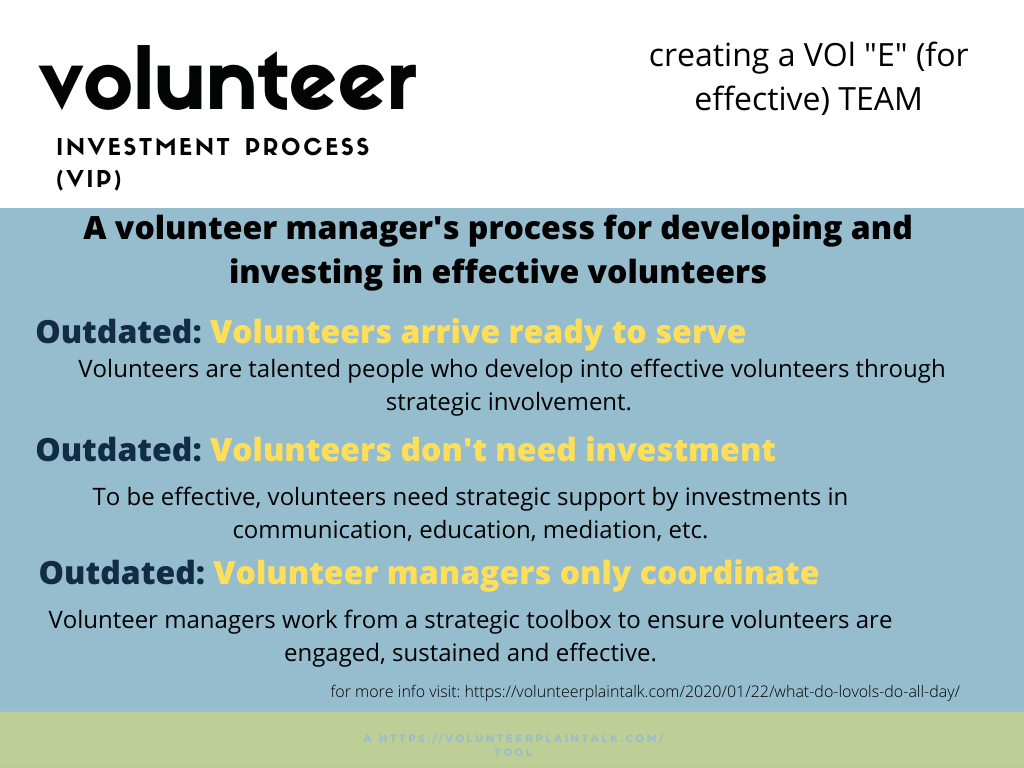
Use this flow chart as a tool when explaining volunteer engagement or keep it in your desk to remind you of all the people-saturated skills you have in your toolbox and remember: Volunteers are wonderful people who develop into effective volunteers through strategic investment. That’s what #LoVols do all day.
Do #LoVols chat up potential volunteers, make a few phone calls and then go home to binge watch Mind Hunter while eating Cheetos and petting the rescue cat? What do we do all day, exactly?
We say things like, “I do a bit of everything,” or “I’m a jack of all trades,” or “depends upon the hour, ha ha,” which gives the impression that we are not in control and have no direction. Here’s the thing though: We are in total control and every portion of our day is devoted to engaging volunteers and creating volunteer impact. It’s time we show the world we are proactive, not reactive. Let’s gather all of our people skills under one term, “volunteer engagement skills” and stop downplaying our role. We’re a Jack of the volunteer engagement trade which consists of all kinds of skills, each one working towards a single purpose: creating an effective volunteer experience and team.
We wear volunteer engagement and impact gear. Our skill set is people- saturated. What looks breezy is calculated. What looks effortless is deliberate. What looks casual is strategic.
We may appear to be socializing but we are establishing a welcoming and meaningful atmosphere through the hard work of making it look effortless so volunteers are engaged and add value. There is method to our madness as we strategically create a team of effective volunteers through each people-saturated element:
vetting
on-boarding and/or orienting
looping
efficiently and effectively communicating
training to position
educating
adjusting or agile thinking
mediating
structuring
let’s look at each element and why it is crucial to volunteer impact:
vetting: includes background checks, reference checks, one on one interviews, sit-downs and all other “getting to know a volunteer” tactics.
Why is this important? Volunteer engagement professionals (LoVols) weed out potential harmful volunteers and redirect volunteers to a fit that works for all stakeholders ensuringclients and staff work with competent people that do no harm and produce results.
onboarding and/or orienting: includes introduction and immersion into the mission. Whether by formal or informal methods, the LoVols connects the new volunteer to the work. Orientation is the emotional glue that binds a volunteer to the organization.
Why is this important? Volunteer engagement professionals ensure each volunteer understands organizational purpose and intent and is in sync with mission goals and objectives, thusequipping a volunteer with the necessary emotional connection to embrace the mission.
looping: includes checking in and checking back with clients, staff and the volunteer in a continuous loop to ensure satisfaction by all stakeholders.
Why is this important? Feedback is key to volunteer, staff and client satisfaction. Continual feedback and adjustments create impactful, working relationships, and prevent missteps, misunderstandings and potential disasters. Unlike employees, volunteers work less time without pay so looping is crucial to volunteer success.
efficiently and effectively communicating: includes emails, chats, phone calls, meetings and all other methods providing information to volunteers.
Why is this important? LoVols balance inspiration and expectations to ensure volunteers understand expectations and organizational direction while reaping the positive benefits of volunteering.
training to position: this includes on the job training for the volunteer role. Unlike onboarding or orientation to mission, this training is specific to job requirements. Whether the LoVols trains personally or has been instrumental in guiding staff to train new volunteers, training to positionensures volunteers are equipped to function within their roles and produce results.
Why is this important? Volunteers free staff to accomplish their objectives. Essential training equips volunteers with the confidence to fulfill their roles and allow staff the additional time to accomplish their objectiveswhich becomes a dual benefit.
educating: this includes newsletters, seminars, workshops, email blasts and other methods to inform volunteers not only about organizational news, but about topics relevant to volunteers’ lives.
Why is this important? Education is high on employee and volunteer lists of desirable perks. Continually educating volunteers equips the volunteer team with correct and current organizational information, especially since volunteers are WOMM (word-of-mouth marketing) ambassadors to the community.Educational offerings speaks volumes about the commitment to the volunteers’ positions within an organization and to their well-being.
adjusting or agile thinking: this includes reevaluating volunteer involvement or placement, utilizing innovative methods of retention, matching volunteers to roles, flexible adjustments and any other method to address individual volunteer needs.
Why is this important? LoVols balance organizational needs with volunteer needs to create a symbiotic relationship that adds value and furthers mission goals.
mediating: this includes intervening when necessary, balancing the advocating for volunteer rights while promoting organizational needs, finding middle ground that satisfies all stakeholders and honors the mission. It includes having difficult conversations with volunteers, putting the mission first, dismissing a volunteer when necessary and advocating for volunteers to be treated with respect.
Why is this important? Improving or salvaging a relationship with a volunteer is crucial. Poor experiences affect volunteers, staff and clients. LoVols mediate to ensure all stakeholders are satisfied so that mission goals are achieved.
structuringstrategically: this includes creating innovative new roles to engage today’s volunteers, revamping outdated volunteer positions, policies, procedures and methods of communication, gathering feedback and involving volunteers in strategies.
Why is this important? As volunteerism evolves, LoVols structure volunteer initiatives to sustain and attract today’s volunteers by creating new roles, offering flex scheduling, sharing jobs, ensuring diversity, engaging virtual and one time volunteers and including volunteers in strategic planning. As demand for volunteers grows, LoVols are busy structuring for future growth and laying the groundwork to attract and sustain a team of effective volunteers whoadd value.
The next time someone stops and says, “gee, it looks like you’re having a lot of fun,” smile and reply, “I’m actually hard at work because one of my volunteer engagement skills includes making fun look effortless. Thanks for noticing.”
P.S. Feel free to share this with anyone who doesn’t understand your job…your grandpa, your snotty cousin Mildred, all your old college roommates, staff at your organization, your CEO…
Ask an astro-physicist “what do you do all day,” and I’ll bet her answer isn’t “I look through a telescope.” Ask a software developer the same question and it’s doubtful he’d say, “I type on a keyboard.” So why do we, #LoVols say, “I work with volunteers?”
Astro-physicists and software developers have complicated jobs producing impressive results that stretch far beyond the simplest terms. Our jobs as #LoVols?…..most people don’t have a clue as to the skills and strategies we use when engaging volunteers and crafting volunteer impact. We need to change that perception.
This doesn’t mean whining, “volunteer Jenny did that amazing work because I spent extra days training her since our staff couldn’t take the time to show her how to do her work and oh, I listened to all her last-minute questions on a Saturday night when I could have gone to see Star Wars at the movies with my now ex-boyfriend who incidentally went without me and showed up with my best friend Carla and yeah, my life is in tatters, but hey, Jenny did a great job, thanks to my sacrifice, didn’t she?” Hmmmm, maybe that’s not quite the way to show our work.
Instead, we can show our strategies in developing effective volunteer teams and by doing so, dispel the myth that volunteers need nothing more than coordination. By laying out the upfront and continual work in developing effective volunteer teams, we accomplish these objectives:
we ingrain the idea that volunteers don’t magically appear, ready to go.
we show that volunteers are people, not tools, and like employees, need continual mentoring and support.
we reinforce the truism that volunteer initiatives are not “herding cats” but are strategically structured for success.
we support our argument that not every volunteer can be interchanged and that thoughtfully matching volunteers to role creates successful outcomes and prevents disasters.
we show that there are processes in play and that even our chatting with volunteers is structured to mentor them for success.
we point to a volunteer’s progression from first contact to integrated volunteer and reinforce the idea that volunteers require continual support, not just from us, but from the entire organization.
we highlight the creative processes in forming innovative volunteer roles that impact the mission.
The acronym, VOL E TEAMS will do nicely here as in, “Let me show you how I develop teams of volunteers who are effective.” You can substitute excellent or efficient for the “E” but I’ll argue why effective is the best choice when talking about VOL E TEAMS. Let’s look at definitions:
Effective: producing the intended result
Efficient: functioning in the best manner without wasting time
Excellent: possessing superior merit
Say a physician recommends her patient take a medication to alleviate symptoms. The physician could say, “this medication is excellent,” or “this medication is efficient,” or “this medication is effective.” Which word speaks to results? Effective. That doesn’t mean our volunteers are not excellent nor efficient. They are and you could also say, “I’m developing volunteers for an effective, efficient and excellent team.”
As we, LoVols report volunteer impact, effective is a key word to support the contributions our volunteers make. Verbiage is crucial and we must use results-type words to describe volunteer value such as effective, outcomes, results, impact, accomplish, contribute to, produce, achieve, implement, enact, create, effect, etc.
So, what does the acronym VOL E TEAMS stand for? (Hint- it stands for the work #LoVols do to create and sustain the volunteer factor.)
vetting
on-boarding and/or orienting
looping
efficiently and effectively communicating
training to position
educating
adjusting or agile thinking
mediating
structuring
Next time: An effective team requires an effective leader. Looking at the components of VOL E TEAMS or it’s time we show our value as Leaders of Volunteers.
You would never think to put the Mona Lisa in an orange plastic frame, would you? Of course not, because frames should enhance a work of art, not detract from it. The right frame borders the image, complimenting the subject and showcasing the work. The right frame makes sense.
Volunteer added value is a complex and beautiful picture. The stories we share about our volunteers connecting with clients, serving our missions and advocating for our organizations are inspired, and meant to be viewed with appreciation. The value our volunteers bring needs the right frame.
However, without the proper frame, throwing out super positive phrases about our volunteers can be like this board. “Volunteers are selfless,”or “Volunteers give so much,” can be so broad and gooey that the meaning is lost. If every message about volunteers is so wonderful, so inspiring, so amazing, so terrific, the message becomes diluted and nothing is wonderful or inspiring anymore. It’s just noise without form. If we make volunteers seem like magic faeries that just rise from the garden and buzz on over to do good work, we diminish the effort they bring and the work we do to develop and ready them.
We have to be honest about volunteer management and its complexities. We need to share the challenges along with the feel-good stories. Volunteer synergy (those pure mission moments when a volunteer connects with a client or helps a staff member or solves a problem) does not occur by happenstance. Those moments are the result of a volunteer manager’s diligence, practice and experience. Synergy occurs because the volunteer manager vetted the volunteer, oriented the volunteer, matched the volunteer’s skills and needs to an assignment, and courageously stepped in to guide the volunteer on a successful path.
We, volunteer managers are the frame. We are the right frame, the best frame, the correct frame. Our attentiveness, our tenacity, our persistence, our determination, our sincerity and our resolve shape the volunteer experience. We surround our volunteers with the knowledge, tools and encouragement volunteers need to create a complex work of art. We “become” the frame each volunteer needs. For some volunteers, we are the ornate, gold frame and for others we are a simple black band receding into the background.
Without our guidance, volunteers are simply pictures taped to organizational walls. These haphazard pictures curl up; they fall off and they yellow. But, when we frame volunteer engagement and impact, we create an art gallery that has a flow, that makes sense, that is ordered and sustainable.
International volunteer managers day was yesterday (November 5). The theme for this year was Change the Tune. We talk about change all the time and I think we need to ask ourselves, “what exactly do we want to change?” How we engage volunteers? How we encourage, develop, inspire and mentor volunteers? How we drop everything to make sure volunteers are successful? How we put volunteering ahead of our own personal needs? We’ve got all that down.
I think what we need to do is to frame our critical role in volunteer engagement and impact. We need to stop allowing organizational leadership to think that engaging volunteers takes little effort. We need to stop allowing organizations to view volunteers as tools and not as complex human beings that require thoughtful management. We need to stop allowing organizational leadership to assume that volunteers don’t need support from every staff member. We need to stop allowing organizational leadership to plan volunteer involvement without our expert input. We need to stop allowing organizations to operate in an outdated normal and instead embrace the here and now by investing in the volunteer manager frame that surrounds volunteer programs.
We are a profession. We deserve recognition befitting our expertise, our hard work and our skills. No one will just magically give it to us. We must stop glossing over the work we put into developing volunteers (by vetting, onboarding, training, supporting, stepping in when necessary, sustaining and encouraging) who successfully support and further organizational missions.
In Rob Jackson’s latest post, he lays out real solutions that will move our profession forward. You can read Rob’s post here.
So, this International Volunteer Manager Day, the change I want to see is one in which we elevate our critical role and become the “frame” around vibrant, contributing volunteer teams.
We’re leaders of volunteers. We got this.
Happy International Volunteer Manager Day to all of you frames out there.
Oh, the feels, right? We’re swimming in them. We empathize, listen and experience the roller coaster emotions of our volunteers, our clients and our staff all the while living our own emotion-filled lives. The last thing we need is a ride full of destructive emotions.
Have you experienced these passive-aggressive behaviors?
staff make snide comments about volunteers’ abilities
emails are copied to department heads in a tattle-tale way
lack of volunteers is a scapegoat for poor planning
staff make side comments about your management
How do we get off this ride? I finally got tired of a few passive aggressive staff who routinely dragged me onto their cart of fun because their manipulative behavior left me tense and angry and unable to empathize with my volunteers. So, I refused to ride along by using these 5 ways to combat passive-aggressive behavior.
Check your emotions and ask why. Why are some folks passive-aggressive? To deflect feelings of inadequacy? To make you act out their anger? To manipulate? Remember, a snarky comment is their way to make you defensive. Don’t go there. Be neutral and professional. Don’t give the passive-aggressive person satisfaction and they will seek other prey. Instead, calmly ask, “why did you say volunteer Ann is always late, and then you rolled your eyes. If this is a problem, I need to know so I can address it.”
Don’t strike back. Emails are like theme parks for passive-aggressive people. If an obviously unreasonable email request for volunteers is copied to department heads and meant to bait you, reply with a cool, unruffled, “Thank you for your confidence in the volunteer department. It is our goal to provide the very best volunteers for each request and to treat our clients with the respect and professional service they deserve. I will keep you posted on our progress.” The passive aggressive staff member is goading you into complaining that the request is unreasonable, so get out of line for that ride.
Prove it. When a staff member complains, “it always takes forever to get a volunteer,” reply with, “Please give me examples of requests that were not met on time. Without specifics, I really cannot make improvements and it is my job to continually improve volunteer services. So, what are those examples?” Broad statements without factual backup are g-force coasters to passive aggressive staff. Make them give you examples you can work with. Arm yourself with your Excalibur Sword-like phrase and wield it with might such as, “Our volunteer program is committed to our mission, therefore….”
Deflect unwarranted blame in a professional way. Called out in a meeting because a staff member did not get something done and they want to blame lack of volunteers? Ugh, the roller coaster that plunges into a dark tunnel. Pick the right moment to stand up and say, “With a day’s notice, we provided 3 outstanding volunteers. I would like to take this opportunity to reiterate that volunteer services takes pride in supplying the right volunteers for all requests. The sooner we get a request, the more time we have to engage our volunteers. Last minute requests will be treated with high importance, but often we have more than one last minute request.” Don’t get into finger-pointing but take the opportunity to educate staff on how to request volunteers.
Counter with the positive. Negativity is the passive-aggressive track of choice so counter with positive stats, stories and mission supporting evidence. Flip the narrative; say, “did you know that last month our volunteers donated a staggering 850 hours which is more than having an extra 5 full time staff?” Or, “last week alone, our volunteers served 300 meals, impacting 80 families in our community?” Or, “because our 4 volunteers came in last minute to help with the event, our mission was able to reach 200 influential community leaders.”
While roller coasters are meant to be fun, a passive-aggressive roller coaster is meant to derail your positive work. Don’t get on one.
“So, you’re a volunteer manager; what do you do, exactly?” We’ve all been asked the question and then that moment follows when we pause and mutter, “ummmmm,” because we really can’t explain volunteer engagement and impact in a few short sentences. Could we explain it in a paragraph or two? A book? An encyclopedia? Probably not, at least not in-depth. So, where does that leave us? Always shrugging our shoulders and feeling misunderstood because no one gets volunteer engagement the way we do?
Maybe we’re approaching this explaining challenge with too many expectations. Maybe we should look at it differently. Instead of an all or nothing approach, i.e. “you get it or you don”t,” why don’t we aim for something more attainable like an appreciation of volunteer engagement and impact. Maybe before we introduce folks to a college course on volunteer management, we should help them appreciate it first.
Think of all the things we appreciate but maybe don’t fully comprehend or understand, such as,
Our vehicles: Sure, we basically get how cars and trucks and SUV’s work, but do we truly understand electric motors versus combustion engines (and what is the four stroke process again)?
A good bottle of wine: Ok, we can pretend all we want, but do we really know what a hint of oakey or buttery (or waxy for all I know-yes I buy wine in the box) means?
Our animal friends: Do we really know why our dog won’t play with the green Frisbee but loves the yellow one or why our cat loudly meows down the hallway at night (jeesh, that can be unsettling) at unseen forces?
No, we pretty much appreciate things without having to know all and everything about them. We can do the same with volunteer management because what do the three examples above have in common? We appreciate transportation and fine wine and animals because they enhance our lives. Vehicles transport us around, open the world to us. Wine gives us pleasure. Animal friends provide us with companionship, entertainment, love etc.
In short, we appreciate the things we deem beneficial. So, the five words to untangle volunteer management from not being understandable to at least being appreciated are: “What’s in it for me?”
The more we show people how they benefit from volunteer involvement, the more appreciation they will have for volunteering, volunteers and the people who make it all happen (that’s us in case you weren’t sure). That’s why I believe we must add volunteer impact into our volunteer engagement conversations because impact holds the key to showing benefits. Instead of continually trying to “educate” others on the complexities of engaging volunteers, let’s show them the “what’s in it for me” volunteer impact first.
Volunteer impact is the concrete result of a volunteer’s time, talents and efforts. And since we, volunteer managers see all the positive results, we can translate these results into impact.
For example, traditional volunteer reporting says to the manager of fundraising, “our volunteer Jenny spent 26 hours last month helping make phone calls and putting together donation packets.” Then we normally add, “we need to keep Jenny engaged so that she continues to do this job.”
But by emphasizing volunteer impact, we point to the benefit of having Jenny volunteer by saying, “because our volunteer Jenny came in regularly last month to make phone calls and put together packets, the fundraising staff was able to spend 26 more hours on cultivating key donors. Last month they brought in 2 new large donations by donors who are now pledging to give regularly.”
Volunteer impact shows a direct correlation between a volunteer’s efforts and beneficial results. A volunteer impact equation looks something like this:
The key here is the addition of outcomes that dive deep into meeting mission goals and objectives.
Instead of skimming the surface by equating hours with money saved or time spent, volunteer impact directly connects a volunteer’s time to the goals of organizational missions. For example:
volunteers create valuable time for staff to accomplish critical work (because volunteer Sheri spent 6 hours this week training event volunteers, our event staff was able to spend 6 more hours preparing for the annual fundraiser, thus assuring a smooth event. The positive comments from attendees include, “such a wonderful event, the volunteer ushers provided us with so much information on the organization. We are impressed.”)
volunteers spend unhampered time working with clients, thus aiding staff in creating an atmosphere in which clinical staff can better do their jobs (because volunteer Juan spent 8 hours last month sitting with our client, Emanuel, clinical staff was able to spend 8 uninterrupted hours with Emanuel’s children, thus equipping the family with the coping tools they need to navigate their situation)
volunteers are “eyes and ears” for busy staff and can alert staff to potential problems, thus reducing valuable staff time spent in fixing problems and free them up to meet objectives (our volunteer Nan, during her docent shift was alerted to a hazard outside an exhibit and due to her quick reporting, saved us from a potential accident with legal implications. This gave staff the ability to quickly rectify the situation in keeping with our objective of providing a safe environment for learning and return to their crucial duties)
Using a volunteer impact equation means going beyond volunteer hours. The equation deep dives and reveals the impact of time donated and is the key to appreciating volunteers. It’s a fundamental shift. Instead of appreciating volunteers for the giving of their time, we are appreciating volunteers for the beneficial impact their volunteer hours have on our missions.
It is up to us to restructure our reporting and connect our volunteers’ time with mission impact. In the examples above, what is the impact?
Jenny’s time resulted in the cultivation of 2 new donors (mission goal: increased donations to continue the work)
Sheri’s time resulted in (documented by comments) a well run event and increased awareness (department objective: well-run event to increase awareness)
Juan’s time resulted in a family’s increased ability to cope (mission goal: equip families with the tools needed to cope)
Nan’s time resulted in a potential accident and lawsuit thwarted (organizational objective: provide a safe environment for learning)
Reporting impact requires a strong connection with staff and departments utilizing volunteer services so that we are privy to goals, objectives and direction. This is actually a good thing, for the more we connect with staff within our organizations, the more we receive helpful feedback, input and suggestions for volunteer involvement. From these connections, we can structure volunteer roles for maximum support. And, when it comes time to report on volunteer hours, we can then show the direct correlation between a volunteer’s time and the attaining of mission goals.
Existing in silos no longer serves us or our volunteers. As leaders, we can demonstrate the way for our organizations to grow is through partnerships between departments. Based on showing how our volunteers meet and exceed objectives and goals, we can then advocate for more volunteer involvement and for better organization wide engagement of our volunteers.
If we work towards an appreciation of volunteerism by answering five simple words, “What’s in it for me,” then, we just might begin to hear 5 other words, “We need to engage volunteers.”
Do you whip out a clever persuasion technique every time you want someone to acknowledge that volunteers don’t sit around by their phones waiting for us to call? Do you have that “special phrase” that always sways people’s opinions like “hey, volunteers don’t grow on trees, you know!”
Being a research junkie, I’ve tried a bunch of persuasion techniques when attempting to explain the complexities of volunteer engagement and impact. I’m not so sure they really work, though.
Some of the persuasion techniques I’ve tried are:
Wear the Power Suit of Authority: My power suit is like a suit of armor and must have been designed by someone who truly hates the human form. It’s uncomfortable, stiff and I sweat profusely in it, so when it came time to stand up at the annual soiree and recount all the glorious volunteer accomplishments, I dropped my notes while walking up to the stage and I tried to bend over to pick them up but the iron power suit wouldn’t budge so I kicked the notes over to the podium, but in the glare of the lights, sweat dripped into my eyes and I couldn’t see the statistics scattered about the floor so I just kinda laughed nervously into the microphone and “winged it” by announcing, “I don’t want to bore you with dry numbers. No, no one wants to hear that our volunteers gave a butt-load of hours last year. And I do mean butt-load! Instead, I want you to channel your inner activist and raise your fists in solidarity of the power of volunteering!” I tried to raise my fist in the air, but the rigid suit sleeve gripped my elbow like a boa constrictor so I ended up doing a weird fist salute which confused the heck out of everyone and they pretty much ended up elbowing each other in the face. Sadly, I got banned from presenting the following year.
Mimic the people you want to persuade: You definitely should use the terms and verbiage that senior management uses when they speak of goals and objectives, but for the love of all that is sacred, don’t mimic a senior manager’s accent or facial ticks or odd mannerisms, because that’s going way too far and you’ll get in trouble. Trust me on this.
Crying: Ok, to be honest, this just happened. This is not a recognized persuasion technique and actually thwarts your attempt to persuade others so maybe just try not to get really upset when people are ignoring you and chatting with each other while you are telling a poignant volunteer story about a cosmic connection that made a huge difference in a client’s life. Yeah, wiping your nose with your sleeve and bursting into tears does make folks notice you, but not in a good way. Oh, and FYI-it will most likely get you a session with one of the counselors.
Enlist Social Influencers: Getting a celebrity to endorse volunteering sounds so wonderfully effective, right? Yep, until that celebrity starts tweeting after a wild night, “Hey, guys, I #LOVEVOLUNTEERING for cash, so send lots to me, LOL! whoooooo!”
Make Volunteers Likeable: Doing a volunteer car wash where volunteers wash staff vehicles can actually do the opposite of making staff appreciate volunteers more. Hard to believe, right? I know because in the budget for the following year, volunteers were penciled in as extra custodial staff and our maintenance man blamed me for his hours being cut.
Use Sensory Imaging: So, misting lavender scented aromatherapy oil around the meeting room while reciting volunteer stats and then asking all the volunteers to wear lavender sprigs does not necessarily make staff remember that volunteers donated 230 hours last month and pretty much got me in trouble because production went down due to the “overuse of relaxing scented influences.”
Make Them Feel Scarcityor Risk Aversion: Uh huh, so maybe standing in front of the building and shouting at incoming staff, “If we don’t appreciate our volunteers more, they will leave! All of them! I’m not kidding!” just might not be the best way to convince someone. But I did get 3 unpaid days off to “go home and think about my actions.”
Compliment Them: Passing out heart shaped notes from grateful volunteers in a staff meeting might normally be effective, but once you stand up and say, “Our volunteers think you guys are the best staff ever, no really, they say that all the other organizations in our town have lousy, rotten staff who don’t love them the way you guys do,” might be going too far. Especially when you are on a roll and excitedly add, “oh, and yeah, you know the soup kitchen on main street? They’re the worst!” Because the CEO of the soup kitchen might turn out to be best friends with your CEO and well, let’s just say going through a “sensitivity training regiment” is pretty embarrassing.
So, how should we persuade others to appreciate volunteer management the way we do? I think I’ve read every book out there on the art of persuasion, including the best selling “Make People Hear You by Shouting Louder Than Everyone Else,” and in all the great advice, I may have found a different take on changing perceptions about volunteers, volunteering and volunteer management. And the funny thing is, it all boils down to 5 words.
Next time: The 5 words that just might hold a key to explainingdescribingillustratingdefining untangling volunteer management (yeah, I know, I’m setting up this big reveal thing and then it’ll be lame and disappointing and well, failure is nothing to be ashamed of–or so they tell me).
Do we, leaders of volunteers suffer from a tortured volunteer manager syndrome? Or, are all our frustrations something we made up?
The tortured artist syndrome loosely refers to an artistic person who becomes frustrated at the lack of understanding and appreciation for what they deem important-i.e., their art. And I’m convinced that what we, leaders of volunteers do is an art.
Does this syndrome sound like us? Are we frustrated because others don’t understand or appreciate volunteerism and all its beauty and complexities the way we do?
Here’s the crazy thing. All the volunteer managers I’ve worked with or spoken to are super creative people. We have to be. No, seriously, we have to be incredibly, artistically creative in order to succeed at our jobs. Sure, we need to be organized. Sure, we need to multi-task. Sure, we need to keep good records. But the bulk of our jobs takes an artist’s touch.
As volunteer engagement artists, our frustrations come from the perception of our jobs. Our jobs are generally viewed as desk jobs, as coordination jobs, as simply making a phone call to a willing volunteer who agrees to do organizational bidding. It’s like saying a teacher just grades papers.
And you know what? We most likely went into our jobs expecting them to be coordination jobs, because that’s what we were told. That’s what the job description said. That’s what everyone assumed. We were told that our jobs consisted of scheduling and keeping track of volunteers. In my first volunteer coordinator interview, I was asked if I could “get along with senior citizens.”
I was never asked if I could create complex programs, or if I understood deep motivations. I was never asked if I could inspire a person who was lonely or discouraged because they’d lost a loved one or a job or a place to be. I was never asked if I could listen intently to hear what was behind the desire to help someone else. I was never asked if I had the skills to match a person to a sensitive position. I was never asked if I could diffuse a potentially ugly situation between a volunteer and our organization. I was never asked if I could diplomatically introduce change to a seasoned volunteer team. I was never asked if I could explain the deep impact each volunteer role had on the mission. I was never asked if I could convince a volunteer that they were truly appreciated when it wasn’t overtly obvious. I was never asked if I could diplomatically answer probing questions or if I could balance organizational policies with volunteer needs. Nope, it was more like, “can you relay information and keep a schedule?”
“Sure,” I thought, “I can do that.” But then, once I got into my job, I was struck by how much creativity and engagement skills the job required. I found that to do the job, I had to dig deep into every people skill I possessed while mastering new skills. I discovered that my job description (like keeping stats, schedulingand getting along with seniors) took up less than 10% of my day and the other 90% was the art of volunteer engagement. I discovered that my job was nothing like the job description.
Most of us volunteer managers were on our own to figure it out. Our jobs literally forced us into this tortured syndrome as we began to see the skills and talents our volunteers brought to our organizations, how complex engaging volunteers could be and how vast were the possibilities for volunteer contributions. We came to understand that engaging volunteers was about as much a desk job as composing a symphony is a transcribing job. We figured out that volunteer engagement is its own art form.
We discovered, through hard work and the desire to produce something great, that volunteers and volunteering is a complex ecosystem. It is naturally miraculous. But it needs the right combination of elements so that it can thrive. It needs a skilled and creative hand (that’s us) to put all those factors into place and when all elements sync, wondrous things happen. Just like art.
And in the process of discovering this artistic ecosystem, we naturally get excited and want to share it with others. When others don’t quite see the complex beauty of it all, we get frustrated. We want everyone to appreciate this wondrous art we’ve discovered.
How could they not see it? Well, I look back and realize that even with 40-60 hours a week, it took me a while to fully get volunteering. So, how could I expect someone who spends the majority of their time away from volunteers to automatically get it? I wondered, “how could they look at this art form and just see a bunch of random colors?” Because volunteer engagement and impact is complex, understanding it is complex. It takes time and a willingness to really see it.
That’s where we come in. Being tortured and frustrated isn’t going to change anything (except burn us out). We have to adapt new strategies or else the 2030 volunteer conferences will be the “Time for Change” conferences again.
We need to take a step back and assess where we can grow stronger. Is it in our communication and the way we frame volunteering? Is it forging a united front? Is it in creating a strong alliance of volunteer managers locally so there are unified voices advocating for volunteerism? Is it in showcasing our successes and then using the capital gained from those successes to advocate for change? Is it in altering our approach and stopping the attempts to “educate” others and instead, trying to forge symbiotic relationships within organizations?
I believe each of us can create change within our own organizations by shedding the “tortured volunteer manager syndrome” and adopting the leader of volunteers mantel. Rooted, permanent change doesn’t happen overnight. But, it can happen with consistent messaging and by showcasing results. It can happen when we successfully show how the art of volunteer engagement is necessary to vibrant organizations and to communities in general. It can happen when we demonstrate how everybody wins through the impact our volunteers have on mission goals.
Then we can look forward to real systemic change when we are not frustrated any longer because everywhere we look, the art of volunteer engagement and the impact of volunteer contributions are celebrated.
Yes, it’s time for change. It’s time we made volunteer engagement and impact understood.
I’ve always wanted to see a shareable pamphlet entitled “Volunteer Management, The Cliffs Notes.” It would list all the things we want organizations and senior management to know about volunteers and volunteer management. Here’s 10 of them:
10. Volunteers do not sit by their phones waiting for us to call. We don’t just “order up” when staff asks for eight volunteers who can work twelve-hour shifts, outside, tomorrow at 8 am. No one wishes it were that easy more than we, volunteer managers. Take volunteer Charles for example. Asking him to volunteer at the last minute when he has a job, other volunteering activities, managing his elderly mother’s affairs, and a family is unrealistic. He can’t drop everything to help us. It takes a wise volunteer manager to know how to sustain volunteers’ involvement so that volunteers are not overwhelmed and look forward to coming in to help.
9. Managing volunteers is not like managing staff. Volunteer managers engage two to ten times the number of paid staff. Instead of a paycheck to dangle, volunteer managers must inspire volunteers. Volunteers typically spend 4 hours a week volunteering while staff spends upwards of 40 or 50 hours a week working for the organization. That’s at least ten times the amount of “plugged in time” staff has over volunteers. Therefore, volunteer managers must be able to “plug-in” volunteers every time they arrive on scene, motivate them to keep that connection and keep them informed of changes and updates.
8. Volunteers are everyone’s responsibility. Staff doesn’t necessarily see working with volunteers as part of their jobs, but any staff can make or break a volunteer’s experience. Let’s make a comparison. What if the CEO cultivates a donor and then another staff member comes along and insults or ignores or abuses that donor? There would be heck to pay. We need our administrations to set the same tone for the treatment of volunteers.
7. Volunteer managers are real managers. No matter what titles are given, coordinators, specialists or team members, volunteer managers are as much a manager as anyone on staff. Volunteer engagement skills are a not a “jack of all trades, master of none” haphazard bunch of chaos skills, but rather a carefully constructed combination of the ability to inspire, listening with empathy, the ability to match talents with opportunities, and so much more.
6. Volunteers want meaningful work. But organizations often need meaningless stuff done. Who will do it? Volunteers do not want to only do things the staff doesn’t want to do, they want experiences that make a difference. And since we don’t pay them, we should consider meaningful work as pay. But, a great volunteer manager with awesome engagement skills can lead volunteers to occasionally do tedious work if tedious work isn’t all that is offered.
5. Volunteers want sincere appreciation from more than just the volunteer department. Volunteers see through the once a year speech at a luncheon that is just lip service. Volunteers want CEO’s and staff to acknowledge their contributions. They want to be included in reports, grant applications, websites, and media coverage as contributing members of the team.
4. Volunteers are not just elderly ladies drinking tea. Volunteers are diverse in every way, including age, background, culture and experience and it requires major skills to manage a group of diverse people. But even if some volunteers are older, they are former executives, professors, leadership experts and full of wisdom and great ideas. And they’re more than willing to share their wisdom for free.
3. Volunteer managers are not lap dogs. Are volunteer managers treated that way by staff? Is there an “order up” culture in which volunteer managers are expected to get volunteers without having any meaningful input into volunteer requests? Volunteer managers have their fingers on the pulse of the organization and are privy to every aspect of the mission via volunteer involvement. A volunteer manager has ideas and solutions that will move the organization forward.
2. Volunteers are aware and talk. When a volunteer hears negative speak from staff, or sees something less than perfect, they talk, to each other, to friends, relatives, and the cashier at the Quick-Mart. Volunteer managers keep volunteers motivated and inspired and mediate constantly to make sure the volunteer’s concerns are resolved and their experience is positive. In this world aching for transparency, volunteers are the town criers who can proclaim the worth of an organization or do damage to its reputation.
1. Volunteers don’t stay forever. No, they don’t. Does staff stay until they die? Neither do volunteers. We should recruit, train and cultivate our volunteers just as we do staff, but not expect them to continue until they’re carted off in an ambulance. And, just like staff, sometimes we don’t want volunteers to stay, so that’s why the volunteer manager’s professional skill-set is crucial. A volunteer manager’s professional resolution to a challenging situation is an organization’s best chance to avoid legal woes and negative publicity.
So, there you have it. Ten things organizations should know about volunteer management.
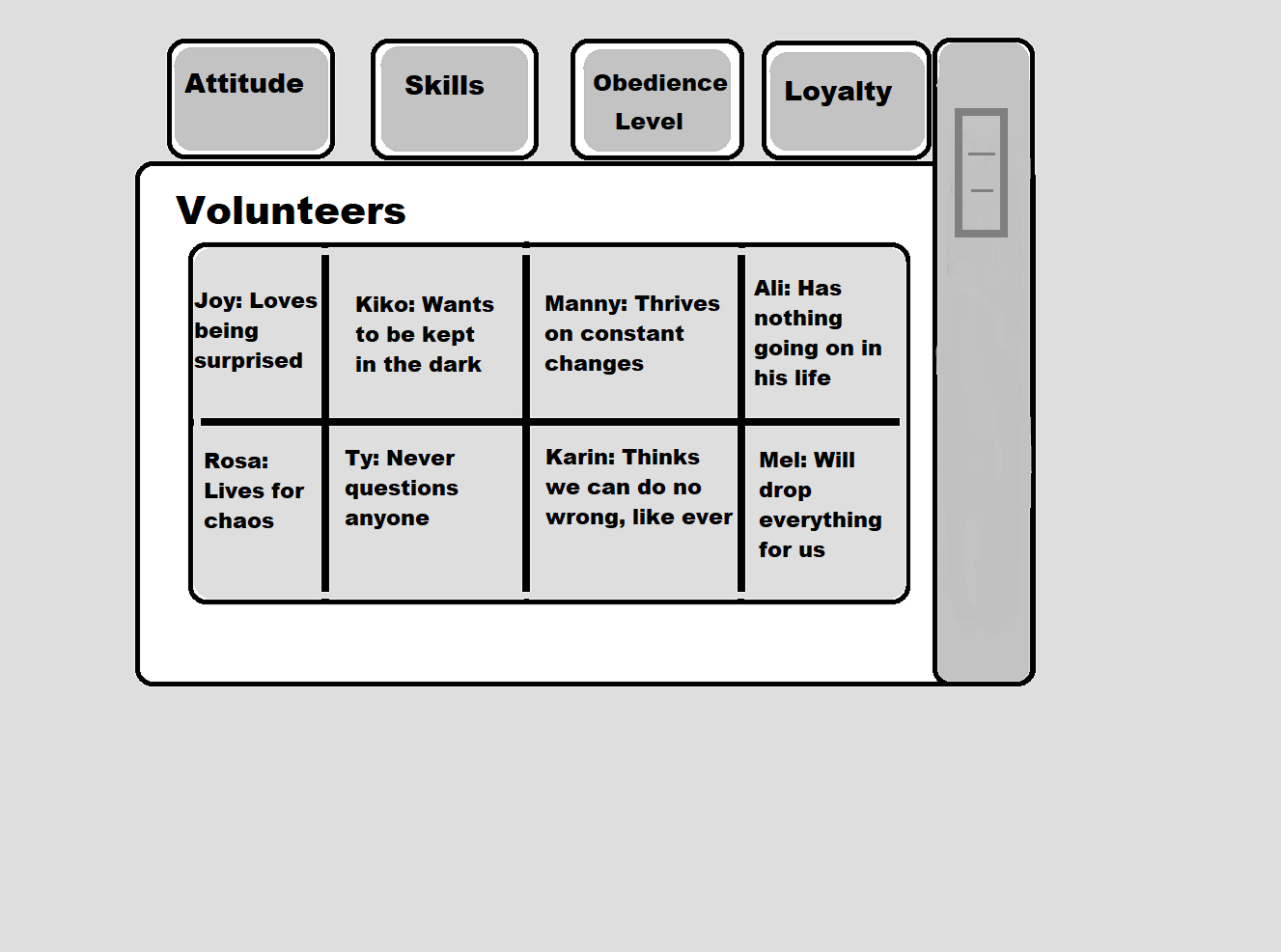
Is this how organizations view requesting volunteers?
If non-profits were a video game, the mechanics would be pretty simple. Everyone in the game would stick to their function. Clinical staff would stick to their missions. Support staff would stay in their lane and build home base. Fundraisers would hold tightly onto asking everyone for money. Volunteers would be the toolbox like the above picture that could be summoned up when needed.
But the world is changing and volunteer programs are the place to test new ideas, pilot new programs and find innovative solutions. Our volunteers are a sandbox gift that non-profits can either set aside or open up to a world of new possibilities.
Innovative companies continually set new directions. They pay employees to pilot initiatives that will help their companies expand and grow. Non-profits don’t have that luxury so they tend to recycle the same methods that may have worked years ago. And tragically, non-profits tend to overlook the impact potential of their volunteer programs.
But the more we push our organizations to view volunteers as solutions, the more we volunteer managers must be able to put reasonable limits on volunteer requests. We can’t do everything. We are not an infinite open world. If we insist that our volunteers want to be creative, expect to be episodic, then our organizations will counter with, “hey, if your volunteers are so creative and skilled, why can’t I find a creative type who will jump at a last minute assignment?” We have to change the narrative.
But what is the current narrative? Volunteers are the ultimate support toolbox, right? They aim to please, right? They think we’re goodness personified so they want to help in any way they can, even if it means putting off necessary surgery for our walk/run, right?
Championing a sandbox does not mean offering an anything goes program. It means redefining the purpose of volunteer involvement. Even open world games have limits and and it is up to the volunteer manager to successfully set volunteer program limits while focusing on the modern volunteer’s role. How do we do that?
Elevate mission priorities. Ask, how does this request further the mission? For example, does asking volunteers to drop everything for a last minute event request rank as high in the mission as placing volunteers with clients? (for more on this, see The Volunteer Department Has Ground Rules)
Be clear about volunteer availability. Don’t lump all volunteers into one vague number. Instead, categorize volunteers into groups based on location, training, interests, etc, which gives a clearer availability picture. (for more on this see The Dangerous Numbers Game)
Push back against unreasonable or frequent changes to volunteer requests. Explain that any change pushes the request back in priority. (for more on this see The Disruptive Volunteer Manager )
The point is, we need not be afraid to offer volunteer solutions based on engaging modern volunteers. We need to realize that our roles as volunteer managers must change from implementing volunteer programs to controlling the direction of volunteer programs. In the non-profit video game, we must take the lead in programming volunteer involvement. If we take the steps towards controlling our programs and the perceptions surrounding our volunteers, then we can offer more volunteer help without being overwhelmed by unreasonable expectations. (for more on this see, Do volunteer managers implement or manage volunteer programs)
Let’s invite the non-profit world to come play in a volunteer sandbox that we create and manage, one that engages today’s volunteers. Let’s forge a new narrative and help further our missions by offering the best our volunteers have to offer.
Let’s move our volunteer programs from one of toolboxes to one that reflects modern volunteers and their tremendous potential.

















 volunteerplaintalk