“What can I get my non-profit staff, especially that mysterious volunteer manager, who seems to run around a lot?” You, my dear ED or CEO have come to the right place.
Forget that self help book, “Criticism is Our Way of Showing Our Appreciation.” Forget that subscription to “How to Be a Team Player by Keeping Opinions to Yourself” digest. Never Mind that “Quotes to Make You Humble” of the month club. Forget that framed picture of the senior management team at their annual retreat, ziplining over the 4 star resort.
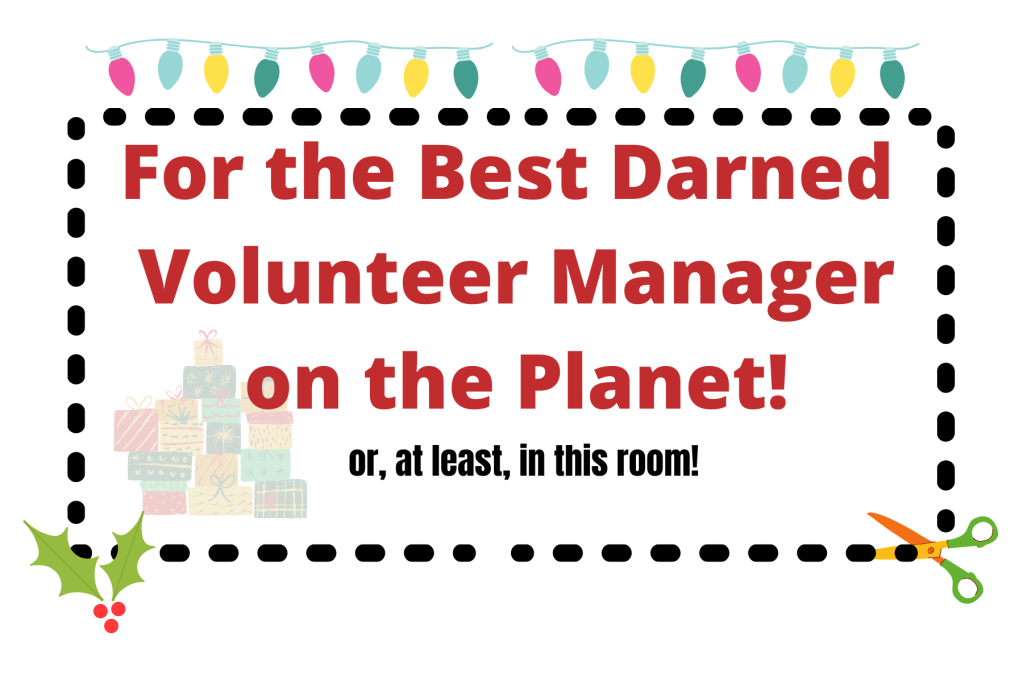
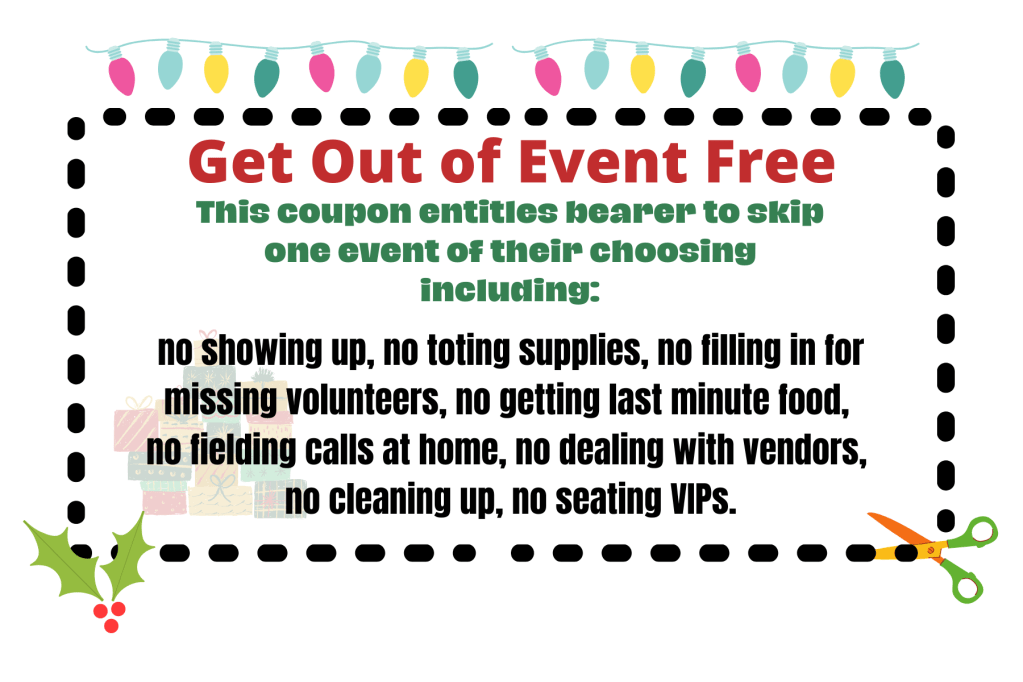
NO! Give a gift that really resonates with your VM. And, the best part is, it doesn’t cost you a thing, only a sheet of paper, a printer and a pair of scissors. And, as a bonus, in typical cooperative volunteer manager style, I’ll even throw in the printable voucher! (what a pal I am, right?)
The Obvious Gift That Every VM Wants:
Be Careful With This One
Oh Yes, Your VM Would Love This
And This, For When Things Normalize a Bit
Well Executive Directors, there you have it, the top four gift coupons for your volunteer manager. A few moments, a pair of scissors and you are done shopping!
And, oh, volunteer managers? Feel free to slip these under the door of your executive director.
Unless you really want another coffee mug that says, “World’s Best Office Worker.” Happy Shopping!
So, last week, I posted a sharable holiday card for volunteers. Nice, huh, cause volunteers love getting cards from organizations, right? Cards mean we care, we appreciate (and we all know volunteer appreciation, no matter what it consists of, especially if it involves balloons, is the key to volunteer retention), we go the extra mile to engage our volunteers. What could be wrong with that?
Volunteers love getting cards, right?
Funny thing. Ironically, as I was sitting at my desk, on my laptop, posting the volunteer card, I was also looking at a pile of holiday cards I received from various nonprofits I’ve volunteered for. And my reaction to some of them? I just laughed. (Not the intended reaction, I’m sure)
I laughed because I’ve been inactive at some nonprofits. I’ve not been contacted, surveyed, or asked what I’d like to do or heaven forbid, why I am not volunteering anymore. I’ve not been offered any “opportunities.” I basically sit on a list, like countless other volunteers. My name is a number.
But, it’s my job, isn’t it?
I have to admit, I’ve been mindlessly guilty of thinking cards mean the same thing to every volunteer. I’d think “hey, I HAVE to keep in touch with each and every person that even so much as breathed the words, “what’s this volunteering about?” I’d think, “how can I keep my hooks into this prospective volunteer?” And I also thought, “if I send this pretty card, surely that will make this inactive (or grieving or ill or suffering or unsure) volunteer whip out their phone and give me a jingle.”
I could picture that volunteer, gazing at the glittery goodness, thinking, “wow, I’ve been so selfish. I need to contact Meridian. It doesn’t matter that the department she assigned me to never followed through. She’ll get me something better, I just know it!”
So what if the message doesn’t resonate, it’s a pretty card!
I knew a CEO who thought that volunteers would feel special getting cards signed personally by her. Never mind she rarely interacted with volunteers during the year.
As a volunteer, I look at the cards from certain organizations as a waste of time and money. I actually feel that instead of connecting me to the organization, it has the opposite effect. The tone-deaf mindset alienates me further.
So, don’t send cards? No, send them, but not mindlessly. Some of the cards I received included timely messages about the organization’s work. I find that more engaging than a simple signature. But a message to me as an active volunteer when I’m not, is tone-deaf.
If I haven’t volunteered of late, messages such as “and thank you for volunteering this year,” reinforces the perception that the organization does not know me, nor cares to. Do I want to volunteer for them now? Eh, probably not, especially if I’ve not felt engaged when I did volunteer.
In simple math, more volunteers=more work
Once there are more than 30-40 volunteers, the ability to track them personally diminishes, which is why every volunteer manager needs his/her own volunteer administrative help to keep track of each volunteer’s status. Then, cards can work when a more personal message is included.
And you know what? If one of the holiday cards I received had simply said, “We miss you,” I’d have felt like they were talking directly to me. I’d have felt guilty, intrigued, pleased, and motivated by those 3 simple words. Keep your glittery goodness. I want to be acknowledged as a human being.
Glitter or Connection? Um, connection please!
I’m involved with a start-up. I’m not getting a card from them. They have no regular meetings, no luncheon and drat, there are no balloons, ever. Everything is chaos. But you know what? They know me. That’s my glittery goodness.
Managing personal connections with volunteers is not easy. It’s not simple. It’s not perfect. However, we can chip away at tone-deaf messages by looking at the causes and by forming solutions such as,
I have too many volunteers to keep track of personally: It’s easy to connect with volunteers who are outgoing, give a lot, are dependable, communicate, ask questions etc. Connecting with the rest of the volunteer team is challenging. Get volunteer administrative help now. Once I did that, things got better. A whole heap better. Here’s my complicated math equation. Every 25-50 volunteers=1 part-time volunteer administrative helper. I also had one designated volunteer to manage prospective volunteers. (she was so busy, she came in twice weekly. But you know what? More prospective volunteers followed through, thanks to her communication skills)
I’munsure of volunteer preferences: Use surveys, whether informal or formal. Explain why you are surveying the volunteer-“because we want your experience to be a meaningful one. It’s a win-win for us, for you and for the people we serve.”
volunteers come and go, so I don’t know who is active, inactive, temporarily unavailable and I can’t create personal messages for everyone: Fair enough, so pay attention to language. What message would resonate or at least not sound tone-deaf? What would an active volunteer, an inactive volunteer and a volunteer who wants to be active, but can’t, all want to hear? Maybe scrap “thank you for volunteering,” and say something like, “every volunteer has contributed to our successes in our fight to eradicate homelessness” or “volunteerism is at the heart of our work and we want to acknowledge your contribution, past, present and hopefully, future.”
I can’t always know that a volunteer is sick, or their loved one died, or they got laid off: We can’t, and although it pains us, all we can do is be honest. “I didn’t know. You are valuable and we want to know your status, not because we want something from you, but because you are one of us.”
some volunteers are not returning calls, emails etc: This goes against every fiber of our volunteer manager hearts, but send the volunteers who are MIA a letter/email/card/call letting them know that they are welcome back anytime they wish to rejoin, but you are removing them from further volunteer updates. Then, remove them from the volunteer list. (OMG, it hurts to type “remove” and volunteer in the same sentence…nooooooooooooo.) Keep them on general lists, because you want that volunteer to continue to be an advocate for your organization.
To send cards, or not to send cards
Are we sending cards because it’s always been done this way? It’s tradition? I’m not saying don’t send, but how much in volunteer management is done because it’s always been done this way? It’s time to re-think volunteer engagement messaging, language and methods.
What resonates with your volunteers? 2020 has given us the opportunity to change the way we engage volunteers. As the leader of volunteer engagement and impact, look at everything with a fresh eye. You got this.
Oh, BTW, here’s the holiday card I’ve always wanted to send:
Happy Holidays everyone, please feel free to download this holiday mp4 and share with your volunteers. You are welcome to add your logo/personal message.
You are welcome to download here; the video comes directly from this wordpress site.
Yup, holiday gatherings are upon us and everyone fears the inevitable politics-driven shouting between grandpa and cousin Timmy, but guess what? Those conversations are nothing burgers compared to what we, volunteer managers must endure. You know what I’m talking about.
You arrive at a party and the snarky attorney guest of a friend of a friend of a friend is introduced to you. She hears “manager of volunteers” and looks down her nose at the scuffs on your Gucci knockoff shoes that you bought at your organization’s thrift store, because, hey, you have a conscience and want to contribute some money instead of just spending it and besides, recycling is the way to go, but you just keep mum and let her rake you over with her eyes like you’re some bargain basement hobo.
So, in the spirit of defending our #lovols profession, here are some comebacks for those inevitable questions that arise when you are introduced to uppity distant cousin Prunella or your best friend’s very successful investment banker neighbor, Chase who is usually alone on holidays.
Q: “So, you’re a volunteer manager, did you say? I’m confused. Does that mean you volunteer for the job or do you actually get paid to do that?”
A: What a great question. It’s complicated. I don’t get paid in money, but I do get to pick from all the stuff that is donated to my organization. Last week I got a case of lentil soup. The cans were out of date, but that’s ok. I’ve not gotten sick from donated food yet, unless you count that time I was throwing up for a week, but I don’t think it was from that out of date cheese, and heck, I picked off all the mold, but you never know. Anyway, I’m hoping for a toaster oven this week. Mine’s like 20 years old and it only toasts on one side so you have to turn it over and run it again.
Q: “Volunteer manager, you say, what’s that? There’s no degree in that, is there, I mean, you’re basically a party planner, right?”
A: You wouldn’t think we’d need any skills, would you? Actually, I have a Bachelor of Science in cat herding, with a minor in balloon animal engineering. It’s a pretty popular degree but the work is intense. I mean I think I’m still suffering the effects of helium-osis (raise your voice’s octave to a squeak) which makes me speak in a higher than normal voice at times. Currently, I have a scholarship at Nancy’s Nonprofit University for a Master’s degree in Little Old Lady Management. I hear the internship is brutal, you know all that tea drinking and knitting and getting shanked by a wayward knitting needle while scrambling for the ball of yarn the 17 cats ran off with. There’s this one class I hear is really hard, it’s ‘The Symbolism in Grandchildren Stories, or Does Grandma Secretly Despise Her Offspring?’
Q: “You work with people who don’t get paid? That’s not really management, is it?”
A: You got me. Don’t let this get out, but when a volunteer signs up, we pretend to give them a tour of the organization and we usher them into the basement and lock them up in a room until they complete their assignment. We all take turns poking them with a stick until they do what we want. Sometimes, and this is the hilarious part, we just poke them for laughs. I have my own special stick made out of hickory. I call it “Ol’ Persuader.” And you’re correct, it’s not management at all, ha ha, it’s so much easier and more fun.
Q: “So, you work for one of those nonprofits, right? You know, they’re always bothering me for money. Don’t you people just get money from the government? Why are you people hounding me?
A: Ha, ha, awww, we can’t fool you, can we? Don’t let this get out, but we actually get millions and I mean millions from the government but since we don’t need money, we invented this game. We like to see if we can get gullible people to donate and we give a prize at the end of the year to the staff member with the most lucrative sob story campaign. And I shouldn’t be telling you this, but do you know what we do with all those extra donations? One word. Stock market. Hey, it’s almost the end of the year. I wonder if I won the award with my “Life Sucks, Give Me Cash, You Cheapskate” campaign.
Q: “Wow, managing volunteers, that must be really easy, right, I mean how hard could that be?”
A: Oh, you, you are so perceptive. It’s hands down the easiest gig I’ve ever had. I’ve got volunteers who bring me coffee in the morning and volunteers who clean the office while I just sit back and watch YouTube videos. I even have volunteers who do my laundry, can you believe that? And, don’t tell anyone but I even have a volunteer who rubs my feet in the afternoon. Yeah, crazy, isn’t it? Crazy good! I’ve been told the foot rubbing and come to think of it, the volunteer who pays my bills violates some sort of fair labor practices, but hey, they volunteered, right? They’re not protected by anything, ha ha ha ha ha!
Well, there you have it. Use these answers in good, holiday health and don’t stress about those absurd questions.
It’s time for resolutions, optimism and time to drop the pounds from all the volunteer homemade goodies, including Anna’s cheese blintzes scarfed down during full stressed-out mode.
Ahhhh, the new year. It’s full of hope. We seldom hope for a year that’s exactly like the one we just completed, right? Instead, we hope for a better year. So, do we look forward or backward or both ways?
Actually, we can do both and connect the past year with a better future. Looking back can be so much more than feeling good or bad about the year. It can be extremely instructive.
Looking back to move forward gives us an action plan, one that ensures a brighter 2019.
Begin by looking back at accomplishments to formulate a plan to continue those accomplishments. Then build upon methods to expand accomplishments in 2019. What went right? What is the blueprint? For example:
Last year, hours by volunteers who were trained to interact with clients increased from the previous year by 10%: So, for 2019, I will fortify and increase training. And for a new accomplishment, I will create a training that can be introduced to increase hours in other areas.
Last year, advocating for more resources produced a recruitment budget increase: So, for 2019, I will hone that method of advocating and for a new accomplishment, present supporting statistics to ask for more resources in other areas.
Last year, several highly skilled volunteers were recruited through networking: So, for 2019, I will continue networking opportunities and for a new accomplishment, I will look for new networking opportunities to find other volunteer skills.
On the flip side, what disappointing things happened? Instead of trying to forget about these instances, analyze them because they can also be valuable in planning for the coming year. It may take longer and you may have to dig deeper to find causes, but there are reasons for the disappointment. What went wrong? What is the blueprint for avoiding something similar? Unlike accomplishments, disappointments will take more effort to root out the cause (without assigning blame) and more work to change future outcomes. For example:
The volunteer appreciation event was kind of lame. Volunteers were once again not properly recognized: For 2019, how can I better show the value of volunteer contributions? How can I set a tone for sincere recognition?
Our huge donor gala was a gigantic headache. Last minute volunteer requests and changes to requests kept me scrambling: For 2019, what systems or ground rules can I put into place to avoid this in the future? (For my take on setting ground rules, see Volunteer Department Ground Rules and the follow-up Attention: The Volunteer Department Now Has Ground Rules.)
Senior management dropped a new “role” for volunteers onto my lap because we are cutting back. New tasks or jobs for volunteers are created without consulting me for any input: For 2019, how can I educate administration on volunteer engagement? How can I present volunteer feedback that shows volunteers want meaningful experiences?
It’s nice to hope that 2019 will be a better year but we can take control of that hope and create blueprints to ensure it will be a better year. By looking back at accomplishments to continue the momentum and looking back at disappointments to formulate a change strategy, we will move our programs forward into the year we wish to see.
Thanksgiving is a time to reflect on everything we are thankful for. We are inspired by volunteers, our community and each other.
But, can we be thankful for challenges? Can we be humbled, yet encouraged by the things that give us fits? For volunteer managers, our challenge lies in the paradox that is our place in the non-profit world.
We’re thankful for the profound connections our volunteers make but not thankful for the twinge in the pit of our stomachs when fellow non-profit staff say things like, “be glad you’re not in management,” or “my son stayed home from school today. Please be a dear and give him some volunteer stuff to do while I work.”
We’re thankful that our efforts produce real solutions, but not thankful when we are expected to fill-in for absent volunteers.
We’re thankful that our community is richer because of our volunteer engagement program but not thankful when we’re told that we are classified as a 40 hour position, yet on our time off we field phone calls from volunteers who weren’t given clear instructions.
We can rage at the moon or we can do something. We can look at our challenges as an opportunity to enact change, one that will elevate our programs, our volunteers and ourselves.
Volunteer managers are the antithesis of the “woe is me” crowd. Action is our middle name. We are in motion all the time.
Let’s take this opportunity to fix the paradox. Let’s do this for our volunteers, for the people we serve, for our communities and for the leaders of volunteers who will come after us.
Let’s be thankful that we, here and now have been given this opportunity. Let’s find one another, unleash a united movement and elevate volunteers, volunteer management and volunteer managers.









 volunteerplaintalk