Category: messaging

  • Horrors! Can a Volunteer Manager Say No?

    close up photography of person s eye
    Photo by Tookapic on Pexels.com

    Carlos took a deep breath and regarded Marty, a long term volunteer who stood before him. “Mr. Jansen really wants to visit his son in Philadelphia.” Marty said. “It’s only a four hour trip from here and I don’t mind taking him. We can do it in a day.”

    Carlos thought about the organizational policies, trying to recall one that forbid volunteers from driving clients on long trips. “I’m not sure that’s such a good idea, Marty,” he said. “I really don’t know if we should do this.”

    Leadership is about doing the right thing, even if it is the hardest thing to do personally and even if it puts you on the spot. As leaders of volunteers, we are faced with doing the right thing every day. We must weigh the right thing for our organizations, for our volunteers, for our vulnerable clients, for our communities and for us.

    Being able to say no is sometimes the right thing to do. While our jobs pretty much paint us as the folks who always say “yes,” we must take into consideration the times we are obligated to say “no.” Some obvious examples are:

    • when a volunteer wants to break policy and jeopardize the safety of himself or a client
    • when a request for a volunteer puts the volunteer at risk
    • when a community service volunteer wants you to sign off on hours not spent volunteering
    • when anyone asks you to embellish volunteer hours

    It’s easier to say no when strict policies back you up, or risk factors are obvious. But sometimes we have to say no, when policy is not a factor and the area is gray. Examples might include:

    • When someone requests a volunteer for a task that volunteers have strongly objected to
    • When a volunteer wants to initiate a project that will take precious time from mission related work
    • When you are asked to fill in for a volunteer on your day off and you already have plans

    How do we artfully say ‘no?’ If we feel pressured to say ‘yes,’ or are backed into a corner, we might stutter and say something like, “I’m not sure.” A weak ‘no’ is really just a soft ‘yes.’ When saying no, you have to actually say no and not want to immediately take it back.

    If you need to, ask for time to think on it. Say, “Let me get back with you on that,” so that you can formulate your response. Getting caught off guard seldom gives you the advantage of putting together a well thought out answer. Remember though, if you don’t get back to the person in a timely matter, they will assume your answer is yes.

    Think of all the reasons you have to say no. It’s not because you just feel like being oppositional, it’s because you know there is a better alternative, or you have information the person asking the question does not have. Listen to your intuition and find all the whys that force you to say no, then explain the whys in decisive terms.

    Present a suitable alternative. Explain why you are saying no, and offer an alternative. If say, a volunteer wants to bring a friend with them on assignment into a client’s home, you can say, “I’m sorry, but that is against our policy. The reason it is against our policy is because no one who has not been background checked and officially entered into our organization can enter the home of our client. (the why you’re saying no) This applies to staff and volunteers alike. I can offer your friend a path to becoming a volunteer so that he can accompany you on assignments. (the alternative) Let’s talk about how to make that happen.”

    Steer the person towards the alternative. If a staff member wants you to find a volunteer for a task the volunteers have repeatedly said no to, you can say, “I will try, but our volunteers have said no in the past so I’m not likely to be able to fill this request. But, we do have volunteers willing to help you in other ways. Let’s discuss the ways they want to be of service and how they can support you.”

    Be clear that a no is not personal. Leadership is about the mission and the team. Point out the mission centric reasons you must say no. “I understand that things change rapidly and that now you are asking for five additional volunteers for tomorrow. I will ask one of our experienced volunteers to make last minute calls and I know that every one of our volunteers who can commit, will commit, so you are in good hands. I however, must continue to work on the annual gala which is next week because volunteers are heavily involved and the gala is extremely important to our organization’s outreach.”

    There’s a reason these responses sound an awful lot like “professional speak.” It’s because they are. Using professional speak is the way to stop others from viewing you as a lightweight, a yes person, a go-fer. Using professional speak forces others to communicate with you on a mission-related level and not on emotional or personal terms.

    Feeling like you can never say no resides on emotional levels. Being able to say no in a professional way resides on logical, thoughtful levels. In order to take control of the conversation, use professional speak that centers on mission centric goals and steer the person away from trying to emotionally manipulate you.

    You can put off a conversation until later when you have the time and energy to discuss it with focus. Take the volunteer who wants to initiate a program that takes time from mission related goals. You can say to that volunteer, “that sounds like an interesting proposal and one that you’ve given considerable thought to. I really want to give you my full attention, so can we set aside a time to discuss it when we can really focus on what you are offering?” Then set aside a time when you are not being bombarded from all directions and can thoughtfully discuss any ideas.

    Saying no is not a failure on our part. It is actually an opportunity to control the direction of our programs and a chance to steer people towards a better way of engaging volunteers by offering more viable alternatives. When done with tact and professionalism, saying “no” can open doors to a better “yes.

    A strong leader is able to say no in a way that assures everyone that the no means listening carefully, then a negotiation, or a revamping or an alternative.  Above all, it indicates a striving for excellence. And that already describes every volunteer manager.

    -Meridian


  • It’s That Time Again for New Words Added to the Volunteer Management Dictionary!

    This Year's New Words Added to the Volunteer Management Dictionary

    Well, it was the yearly meeting time again for the Committee to Define Volunteer Management. This year, the members decided to video conference instead of getting together in person because no one could scrape up the gas money to drive up and back. So, after three hours trying to get the program to work, they all finally called it a night and decided to email each other.

    Once again, none of them could really come up with a statement of less than 3,763 words to define volunteer management, so they decided to quit arguing over whether or not attending volunteers’ birthday celebrations constituted volunteer management and instead, they tackled item number 2 on their agenda and added new words to the volunteer management dictionary. Here are the terms added this year in no particular order of relevance: (or sanity)

    volsplaining: when someone who knows nothing about volunteer engagement but has a grandmother who has been volunteering for 31 years, explains that you “should go to the senior center and talk to those people. Ha, ha, they have nothing better to do.”

    voltriloquist: when a staff member speaks through a volunteer by taking advantage of the volunteer’s kind nature and manipulates the volunteer’s opinions so much that volunteer Betty says to you, “my gosh, have you seen how the records department is so overloaded? I can’t imagine how they get everything done. I try to help these poor, overworked people as much as I can. It’s such a pity they can’t hire more staff. You know, I should get a bunch of volunteers together and march up to the CEO’s office and complain. ”

    GVOAT: Greatest volunteer of all times-you know, you have one. And, sigh, you compare every volunteer to the gvoat. (yeah, wish they would all just be polite and earnest and have this twinkle in their eye when they speak…. oops, sorry, just thought about my gvoat for a minute)

    bogovol: Buy one, get one vol. Some volunteers travel in pairs; they might join as a pair or they might find each other during orientation. They just like to have a buddy to share in their experiences. The bogovol is great when filling requests for multiple volunteers. Also know as 2fervol.

    self-serve volunteering: Volunteering only to enhance a resume, pad a college application, or use the mission to further a goal. You know the ones. Their blinding white smiles and almost superhuman enthusiasm are too good to be true, but hey, you’re not one to judge so you just assume you’ve got a good one, and they arrive the morning of their first assignment, all perfect-looking and they slide a form onto your desk as they plead in their charming way, “can you just fill this out now instead of after I volunteer, it’ll save you time later and well, there’s a deadline to turn this in and I promise I will do everything I said I would do and time got away from me just a bit and besides, I know you don’t want me to miss my deadline, do you?”  Then BAM! No sooner has the ink dried on your signature, they’re out the door before you’ve dropped your promo pen back into your wizard pen holder. Also know as reputation robbers. There’s an old post about this topic here.

    volbot: pre-programmed robotic volunteer. Push the microphone icon, tell it what to do and blip, beep, they whir into action. Staff may not say it to your face, but, oh, they all want one. Need I say more?

    sVaddling: Babying a volunteer because she is friends with your CEO, or the niece of a board member so you’re stuck and you bend the rules and keep her all wrapped up in layers of protection. You can’t tell other volunteers that the reason you’re insulating her is because she will report you to higher management if her feelings are bruised so you just give her lots of slack. You say things like, “Don’t worry, I’ll make sure she turns in her paperwork, maybe it’s just hard for her,” and then you call her up and try to make her understand that paperwork is mandatory but she brushes you off and so you fill out the paperwork yourself. When the CEO passes by in the hall and says, “oh, hey my friend Annabelle likes volunteering but wants to know if she can change her day to Saturday, would you be a sport and come in this Saturday, you know, to make her fee welcomed,” you just clench your teeth and nod. Also know as kid glove volunteer.

    kudo-slap on the wrist: When wimping out of reprimanding a volunteer by setting a meeting and having all your policies ready and even your documented instances of the volunteer’s infraction of the rules and you’re wearing your best business suit jacket, the one you interviewed for this job in, and then Ba-boom! You’ve got the sandwich principle in your head, the one where you first compliment a person, then talk about their shortcomings, then end on a positive note, but you get started on the compliments and the volunteer is looking at you with those volunteer eyes so you go on about how wonderful they are and how you know their heart is in the right place cause gosh, they said that a new volunteer was dumb but trainable, right? You prattle on for so long while the volunteer’s face glows with the syrup of validation that you can’t bring yourself to actually reprimand them and instead, you hastily type up a commendation certificate which makes you end up in a worse place then when you started. (But the volunteer is happy as heck and proudly shows the certificate to all the other, stunned volunteers)

    vacant lot of praise: The throwing out of meaningless phrases like “we love our volunteers” and “we couldn’t operate without our volunteers.” (and when you point out that volunteers would like specific appreciation, you get a vacant stare.)

    egocorporate: A group of corporate vols who want to volunteer, but want you to arrange their involvement to benefit only them. Time-frame, task, juicy assignment all need to work for their day of volunteering. And so, you bend and bend and bend and then, on the day of volunteering, the 13 extra volunteers that show up because they were kind of shamed into coming, are standing around, checking social media and Ivan, a client’s family member who agreed to speak to the group about how the mission helped his family, can’t be heard over all the pockets of conversations and there’s not enough shovels to start that “garden of love” and half of the volunteers are in suits and high heels and it’s hot out and there’s not enough water so you run to your office and call a trusted volunteer who agrees to go out and get some water and then the corporate volunteers who are just standing around start leaving because they showed up, right and that’s pretty much all they agreed to and poor Ivan knows that everything he said fell on deaf ears and now you could kick yourself because you just probably lost this awesome speaker for future events and the garden is half dug and you have to clean up and now the water arrived, but everyone is gone, so your trusted volunteer is bummed and you missed your nephew’s birthday for this debacle and your brother is going to be mad, not to mention the “dirt hole of love” needs to be filled in.

    Well, there you have it! The committee called and asked me to include a round-up of last year’s words and you can see those words here.

    Thank you Committee to Define Volunteer Management. As usual, you did a great job! (wait, that’s a vacant lot of praise, isn’t it? I really should be more specific. Hey, committee, sorry, I meant you clearly have a talent for massacring words.)

    -Meridian

  • What’s So Darned ‘Daring’ About Being Different?

    Whats so darned daring about being different

    How does the statement, “Dare to be Different” make you feel? Does it make you want to dye your hair pink and wear Star Wars Jedi gear to work? Do you immediately want to throw away all your volunteer stats and mundane ways of recruiting volunteers?

    Consider these two quotes about being different:

    “I want to be different. If everyone is wearing black, I want to be wearing red.” …Maria Sharapova

    “Be daring, be different, be impractical, be anything that will assert integrity of purpose and imaginative vision against the play-it-safers, the creatures of the commonplace, the slaves of the ordinary.” …Cecil Beaton

    In the first quote, Maria Sharapova talks about the inner pleasure at being different for just being different. In the second quote, Cecil Beaton puts a purpose, an integrity, and an ethic to being different.

    How do you view being different? Does it conjure up images of selfishness? Does it impose the stress of wild creativity for no good reason other than to stand out?

    Volunteer managers don’t have to dare to be different, because we already are. What unique skills and abilities have you acquired due to managing volunteers? What principles have you discovered while leading volunteer programs? What undeniable truths did you learn from engaging with volunteers?

    The tenets embedded deep in our souls are the things that make us different and it is not daring to hold fast to who we are. It’s simply the right thing to do.

    How are we, volunteer managers so darned different?

    • We are highly aware. We consider all that is around us.
    • We have honed communication into an art form. We are communication hubs and can break information down to clear, impacting messages.
    • We are Visionistas. We develop talents, skills and passions, molding volunteer engagement to benefit both the receiver and the recipient.

    But, along with these stand out qualities, there may be a few things differentiating us that we can work on. For instance,

    • We are selfless which may lead to us shrinking into the background and hiding our skill set.
    • We have a coaching mindset which may lead to our contributions being overlooked and therefore, organizations miss out on implementing our methods in other areas that would benefit from our expertise.
    • ‘We are humble, which may lead to being viewed as lacking in confidence. A perceived lack of confidence falsely implies that you have no confidence in your work. 

    Being “different” means we have a unique space in our organizations, one that carries responsibilities and opportunities, not just for our volunteer programs, but for ourselves.

    The challenges we face are opportunities to showcase the fine tuned skills and talents that make us different. Keeping those talents and skills hidden in the background does a disservice to our volunteers and our programs. It is time for volunteer managers to step out onto the non-profit stage and show everyone our amazing contributions and the ways we achieve those contributions. That’s not daring. That’s what’s needed.

    We are different because what we do matters.

    How we do it matters.

    We matter.

    So, do we, volunteer managers dare to be different? No, because we already own it.

    Now we have to dare to show it.

    -Meridian

  • Need Inspiration? “Progressive Organizations Don’t Want Bosses, They Want Team Leaders and That’s What You Are As a Volunteer Manager.”

    Sally Garrett
    Sally-Ann Garrett

    Do volunteer managers possess the skills required to succeed in the corporate world?

    I recently had the pleasure of interviewing Sally Garrett, a recent leader of volunteers who has taken a managerial position in the world of retail. Sally was the manager of a St. Vincent de Paul depot, an Australian branded “Vinnies” retail thrift store, the highest grossing and net profit store in Western Australia while under her leadership.

    VPT (volunteerplaintalk): Can you briefly describe your current job?

    S (Sally): My Current job is as a Retail Manager of a lifestyle super store with 26 paid staff.

    VPT: How long have you been in this position?

    S: I have been here 1 month.

    VPT: Before this position, what was your job as a volunteer manager?

    S: I ran a large not for profit processing and pick up depot and retail outlet.

    VPT: How long were you in that position?

    S: Two and a half years.

    VPT: What skills do you feel you developed as a volunteer manager and how did they translate to the position you now have?

    S: The biggest skills I developed are empathy, patience, organizing people, time management and being able to teach others that they are more than they believe they are.

    VPT: What skills helped you the most in moving into your new position?

    S: I guess because I had been rostering and managing large volumes of people all doing small roles, the biggest skill that has helped me in my new role is patience. You can’t rush volunteers and you develop a skill of being able to step back and look at the bigger picture all the time, so it became a habit to stop, look and listen. This has helped so much in my present job, because as I have a lot to learn, I am not at all overwhelmed. I am much more rounded in my approach to my team and I listen a lot more and act less, but it’s action with conviction. This means when I do act, it is for the long-term and not the short-term.

    I have already found that many people can sort out problems for themselves and become self autonomous rather than needy. I can quickly detect when people are good at what they do or need better training because I’m watching them and listening. I’m not trying to learn their job so much anymore, but placing acknowledgment in what they can do. This has made my new team feel more confident and then their skills began to shine.

    The second skill is having learned to not take credit for what others do, but rather celebrate their gifts and achievements. I don’t feel the need to own others’ successes. I have developed the ability to lead, not manage.

    The third, most important skill is that I don’t take anything personal. I am impartial to people because I know it is about them not me, and every action someone takes says things about them, not me. So, if someone is frustrated they may call me names or tell me I am not doing my job but this translates into the fact that they are telling me they need more training and are feeling overwhelmed or vulnerable. This took a long time to learn. I always thought I was doing things wrong in this situation until a volunteer pointed out to me that the other 120 people loved what I did and felt supported, so once this skill kicked in it just meant going back to basics and taking time for a cuppa and a chat and getting to the real problem which was 100% of the time the person left feeling vulnerable for some other reason.

    VPT: When you accepted this new position, did you find that your volunteer management experience helped you get the job? Any actual feedback from your new supervisor on your volunteer management experience?

    S: When interviewing for the position I applied for, I was calm and confident as I knew I had become a leader and not a manager so the interview process was easy and effortless. I had nothing to prove; they either wanted my skill set or they didn’t. If I wasn’t a good fit, I didn’t want to be there.

    I was asked to take on a much larger role than I applied for in the interview; the position was in another shop as they felt I would be of value in that role with a larger team and a busier store. As it turns out I came across as soft and compassionate but with a deep knowledge of people. This is what progressive organizations want. They don’t want bosses anymore, they want team leaders and that’s what you are as a volunteer manager.

    VPT: Are there skills that volunteer managers lack, or do not realize are important if they are seeking jobs other than in the world of volunteerism?

    S: Acknowledge your value!

    I believe a volunteer manager is much more qualified at team leadership than anyone gives them credit for, including themselves. It is a huge task being a volunteer manager and when in the role it doesn’t feel it is that important, but you touch the very core of people when they are a volunteer. Because they aren’t there for money, you find out more of what makes people tick so translating that to paid staff roles, you are able to make your staff really feel cared for when they come to work.

    You have developed an ability to shut the work-space out and make eye contact and listen to them and answer their questions. whether it be personal or work related. You have developed the ability to validate people, and that’s what our world needs more of. You are also able to adapt quickly because volunteer management deals with absences regularly.  You know how to get work done with few, if any help. Acknowledging the confidence that you know it will get done when the team is there, gives you a calmness and that drives people to help more and work harder. People love that you are in control and that you  appreciate their efforts rather than stressing and then making them feel less when they are giving more. All volunteer managers develop this skill.

    VPT: How can volunteer managers prepare themselves to enter the world of corporate management?

    S: Be the very best version of yourself, it’s really that simple; being authentic and not promising things you can’t deliver, the rest falls into place. When you develop the calmness of self-confidence, you can learn anything; the skill of managing people is the highest of all skills you need in life and work and you have that in the bag once you are a successful volunteer manager.

    VPT: Is there any advice you would like to give your fellow volunteer managers?

    S: Give them (volunteers) 15 minutes undivided attention and induct, induct, induct!

    Make sure when your volunteers start, you have given them your time whether it is 15 minutes at the start or the whole induction if you can, that time is what the volunteer remembers, because volunteers revere you; they know how hard your job is and they see you as their guiding light. If you only knew how powerful you are you wouldn’t worry about a thing. But that’s where volunteer managers are the most successful. We don’t settle for second best because it always has to be the best. Aiming for the stars on every task is what we do. Landing on the moon is not good enough for us, but it’s great to everyone else. 

    Know you are saving lives!  There is a high number of volunteers that are volunteering due to mental illness preventing them from holding down a paying job. Know that you are potentially providing the healthy, stable and compassionate environment that these people need to gain new skills and give their life purpose. It surprised me to be told on three occasions that it was because of me, personally that three people got up and tried again another day rather than ending their lives. It both shocked me and made me seek help myself to understand my role more fully. The knowledge of each person over my time in Volunteer Management truly made me see how I changed lives and how powerful and responsible my role was and how important it was to be transparent in all I did. I had to understand that it wasn’t my responsibility to take this knowledge on board personally and that it was only a part of the role. But the knowledge was confronting and it changed my dealings with people. Compassion isn’t being weak, it is the exact opposite.

    Relax more and stress less, develop the ability to tell people they can do it on their own. Softly, gently encouraging and convincing people they are wonderful and able, is the greatest skill ever. It is the most productive management tool in the workplace.

    What incredibly inspiring words for leaders of volunteers. Thank you Sally for sharing your wisdom and experience with us. All the best to you in your new position. They are very fortunate to have you on board.

    So, the next time all of you volunteer managers feel under appreciated, remember these words from Sally: I was asked to take on a much larger role than I applied for in the interview; the position was in another shop as they felt I would be of value in that role with a larger team and a busier store.

    Volunteer management matters.

    -Meridian

  • Volunteer or You’ll Lose Everything!

    Volunteer or You'll Lose Everything

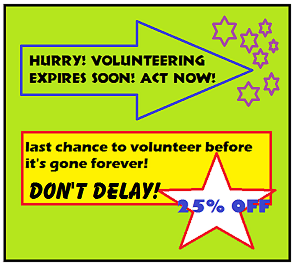
    In decision theory,  a loss aversion  means that the pain of losing something is much greater than the pleasure of making an equivalent gain. Marketers everywhere utilize this theory to hawk their goods.

    “Get it before it’s gone!”

    “Act fast. Limited supplies available!”

    In volunteer management, we prefer the gain theory when marketing to potential volunteers. We use phrases such as “the life you change may be your own,” or “do something meaningful” to entice others to join our cause. But what if these researchers are correct and we are hard wired to respond more to fear of loss?

    How would this advertising trick work with volunteer recruitment ads?. To find out, I stopped in to see my good friend, Svin Dler who runs an ad agency in town. He’s the genius behind such memorable ad campaigns as “Proud to Be Under Federal Investigation” and “Without Our Product, You’re a Worthless Pile of #$%@.”

    I walked into his inexplicably empty office and asked Svin to take some of our volunteer ads and apply the loss aversion theory to them. Here’s what he came up with. (after I passed a ten spot under the table to him-no, really he made me pass it under the table)

    Don’t miss out on this exciting opportunity to file papers! All the beautiful people are doing it. File those papers before they’re gone and then you won’t be beautiful!

    Volunteer now, or our charity will go out of business. Then, when your family needs help, no agency will help you because all agencies share a list of slackers. Don’t get turned away you slacker.

    Volunteer now or keep being your worthless selfish self. BTW, everyone hates you.

    Save the world by volunteering. If you don’t, the world will end and it will be YOUR FAULT.

    Hmmmm, I don’t know if those will work. Well, maybe the third one will….. no, no, they won’t. But can we write worthwhile ads and throw in a bit of the loss aversion theory?

    How about:

    There’s only a limited number of volunteering slots. Call 555-5555 to get started before the good ones are gone.

    Don’t miss our next life changing volunteer orientation. Refer to this coupon code:

    Act now! Don’t lose your chance to be a better person. Call this number:

    Well, that’s soul-less, isn’t it? Maybe loss aversion can’t be applied to volunteer recruitment. But wait. Perhaps if we lightly sprinkled in some loss aversion techniques, we could:

    Create an ad using the wish list and implied loss:

    “Do you wish to be more (circle all that apply): accomplished, social, engaged, in-tune, appreciated, worldly, satisfied, prepared, rejuvenated, self-aware, respected, content, experienced, understood?  Join us next Saturday. We have just three Volunteer Training slots still open. Come, let’s explore your wish list.”

    Create an email reminder for those who have expressed an interest:

    “Our volunteer training is this Saturday at 1pm. Seats are filling up and we would love to see you there. Click here to join our amazing volunteers.” (or diverse, or award winning or whatever adjective fits)

    Use urgency:

    “Our last volunteer training of the year is being held next Saturday at 1pm. As one of our volunteers, Jamal says, Don’t miss out on this life changing experience!”

    So, can we actually use marketing techniques for volunteer recruitment? Is that ok?

    Well, here’s a question: When designing volunteer recruitment ads, do we inadvertently give these impressions:

    There is no limit to the amount of volunteers we take

    Time is never of the essence-we’ll always be there kinda like death and taxes

    The choice volunteer positions never get filled

    Is there a boring and stale element to our ads that imply volunteering is a never-ending constant so heck, why not put it off?

    We are not gimmicky marketers looking to sell something and move on. We deal in cultivating real human beings who offer meaningful involvement, so tricks and slick words are not us. However, we are also not complacent.

    Here’s a recent ad I came across:

    “Join us for a Volunteer Orientation (date) to learn more about our organization and the many different ways you can help us. You will get an overview of our work and learn how you can help improve the lives in need by volunteering. To learn more about our volunteer program, check out our website.”(here)

    Now, let’s re-imagine this ad with a sprinkling of loss aversion theory:

    “A limited number of slots are still available for volunteer orientation on (date). Don’t miss out on exploring the many flexible ways you can help.” Visit our website (here) for a quick sign up. See you on (date)!”

    So, as long as we are truthful about our ads, why can’t we use some marketing techniques to recruit volunteers?

    Try it before it’s too late. (ooops, sorry)

    -Meridian


  • Is it Time to Start Selling Volunteer Perfume?

    is-it-time-to-start-selling-volunteer-perfume

    In 1886 America, a struggling door to door book salesman, David H. McConnell discovered that the small vials of perfume he offered as “door opening” incentives were more popular than books and from that realization, the Avon Company was founded.

    Well, huh. Volunteer managers know that volunteering enhances the lives of those who volunteer with us. We have seen the grief-stricken person begin to socialize again, the quiet student learn to trust their abilities, and the senior come alive with purpose. We’ve seen volunteers learn so much about themselves that we could write a textbook.

    What if we borrowed from Mr. McConnell and compared books and perfume to recruiting and managing a volunteer force?

    The books: volunteer jobs (Volunteers Needed to Stuff Envelopes)

    The perfume: the benefits of volunteering (Learn New Skills) (Socialize with Caring People) (Change Your Life)

    Maybe the time is right to symbolically begin our own perfume company. Many articles are being written and statistics kept on the benefits of volunteering. Since the evidence that we knew all along is overwhelming,  we can become a greater positive force in our communities by looking to not just fill organizational needs, but to help our fellow citizens enrich their lives by volunteering.

    What if we put as much emphasis on our perfume as on our books? Would developing our perfume company create a larger volunteer force of outstanding volunteers and in return, more books would be sold, er volunteer positions would be filled? I’m thinking, yes.

    We have the most fragrant life enhancing perfume. And yet it is secondary, mostly kept in our desk drawers until a class of new volunteers begin. Then we pull it out and spritz it in the air, letting that intoxicating life enhancing scent fill their nostrils with promise. We should be pumping that scent all over town by the gallon.

    What if, besides volunteer coordinators, we also became “life enhancement coordinators?”  How would that look? Well, for starters we would:

    Add a new focus: We would create positions in our organizations that serve our volunteers and in turn, those innovative jobs would help our clients in new creative ways.

    Put volunteers first:  We would partner with other local organizations to share volunteers instead of operating in dark, isolated caves, all trying to lure the same people inside and clinging to the ones we have, even if we can’t offer them a great volunteer experience and someone else can.

     Create new benefits for our organizations: We would create a community of fluid volunteers who could share talents with many organizations and therefore bring fresh ideas to help each organization grow. (or are non-profits really just in competition with one another for the same donations, publicity and volunteers?)

    Lower volunteer attrition: We would end the cycle of volunteers bouncing from organization to organization and giving up because the process is so tedious.

    Expand organizational reach: We would measure the impact on our communities, thus exponentially mushrooming the outreach and standing of our organizations.  Wait, measure perfume?

    What are some measurable volunteer life enhancing statistics?

    • The number of unemployed people who were able to fill in gaps in their resumes and garnered new recommendations from organizational staff.
    • The number of students who used service learning and organizational recommendations to seek entry into the college of their choice.
    • The number of corporate teams who made a commitment to service, learned team building skills and became supporters of a cause (donations, marketing etc).
    • The number of people who were able to garner people skills as they learned about inter-generational connections or diversity because they were paired with someone different from them.
    • The number of people made aware of X disease or Y social issue or Z traumatic experience by peering firsthand into our missions which gave them word of mouth marketing skills.
    • The number of isolated individuals who were able to socialize and connect, thus decreasing their risk for illness and depression.
    • The number of retired people who were able to launch volunteering careers and stay active with meaningful work.
    • The number of seniors who served critical roles and utilized skills which is proven to ward off dementia and Alzheimer’s.
    • The number of students who will become the citizens of the future due to skills learned, such as philanthropy and leadership.

    What if our organizations showcased these statistics as part of their end of year report? How big and beautiful would that report be? And wouldn’t those incredibly heartwarming stats increase each charities’ standing in the community?

    I think the time is right for volunteer managers to come out of the shadows and lead. Think about all the times a prospective volunteer walked through your door and you instinctively sensed they had a secondary reason to volunteer. Think about all the volunteers you have spent time with, tweaking positions until the right fit presented itself. Think about the programs you have created because you had a group of dynamic volunteers that needed something more. How many times have you heard your volunteers tell you that they get so much more out of volunteering than they give?

    Most of the emotional time and commitment we spend cultivating volunteers and meeting their needs never gets reported. This is why the misconceptions abound. “Managing volunteers is easy.” “All you do is have tea parties and socialize”. “Why can’t you just ask? Someone will do it.”

    While we continually struggle to justify the hours we spend with each and every volunteer, we discover that the biggest part of our jobs lies outside the scope of the organizational definition of volunteer management because our jobs as “life enhancement coordinators” is not properly recognized or measured. We possess the tools to change this misconception.

    Instead of continuing to just peddle books while we possess this life changing fragrance, let’s take matters into our own capable hands.

    Let’s sell perfume.

    -Meridian

  • Director of First Impressions Volunteer

    director-of-first-impressions

    Director of First Impressions Volunteer: Wow. What a concise, succinct way to advertise for a front desk or receptionist volunteer. The ad then goes on to talk about how important it is for clients to experience a first impression that is compassionate and helpful. Gosh, I want to be that volunteer.

    So, what verbiage appeals to prospective volunteers? Is it silly, eye-catching titles or serious, touching the heart ads that bring volunteers in? And does the same ad appeal to millennials and baby boomers, working adults and students, community service needing and weekend warrior potential volunteers alike? And anyway, are there foolproof ads that once you’ve created them, you can then just magically sit back and answer the ringing phone?”

    Clearly, marketing has a tremendous impact on companies that sell goods and services. If we think of ourselves as selling goods (enhanced life experiences) and services (ways to help the community), then we can think of our potential volunteers as consumers who can pick and choose where they will spend their valuable time. So, how do we market to them?

    Here are just three creative ways to frame a volunteer ad:
    1. Describe the benefit to the organization.
    2. Describe the benefit to the client served.
    3. Describe the benefit for the volunteer.

    So, let’s take a simple job title such as “volunteer receptionist” and re-imagine it in the above three ways:

    “Director of First Impressions:” The word ‘director’ exudes importance, and ‘first impressions’ neatly describes how this organization genuinely cares for their clients and is striving for excellence with every paid and/or volunteer position.

    “Imagine How Hard It Is To Need Our Help:” This immediately frames the position in the eyes of the client and elicits an empathetic feeling for those who are being served.

    “Where Else Can You Feel Like You Have Thrown Out a Lifeline:” This ad goes right to the heart of volunteerism-making a difference.

    And what law says we can’t use all three ads for one position at the same time? Who knows which approach will attract the kind of person you are looking for because ads exist to quickly capture attention. All three ring true; they are just different ways of framing meaningful volunteer roles in punchy descriptions. If you can combine all three ways without becoming too verbose, then by all means, give it a go.
    But can we even go further and be even more creative?  Why can’t we inject some playfulness? How about an ad that asks, “What Intergallactic Volunteer Character Are You?” (Or another current and popular theme). Create a description for a few popular characters, such as:
    The Scavenger Captain: You’re roguish and free wheeling, this job is flexible. We won’t tie you down!
    The Robot Sidekick: You’re diplomatic and precise, this job needs your attention to detail.
    The Galaxy Princess: You’re strong and smart and destined to lead our rebellion against hunger.

    Want to advertise for a thrift store volunteer? How about “Are You the First One at Garage Sales? Come, Help Sort Through Our Treasures Where It’s A Garage Sale Everyday.”

    Do you need something very specific? Celebrate it! Web help might become, “If You Know What This Is, Call Us: 01101000 01100101 01101100 01110000.”

    There are catchy volunteer ads out there that say, “show off your basketball skills,” “do you love cats and acting,” “do you walk by homeless people not knowing what to do,” “be the role model she’ll remember always,” “50% of school age children in our town go to bed hungry.” A few great ads tell a personal story: “Meet Ed. He will sit alone in his room today unless a volunteer comes to visit. Will you be that volunteer?” “Sarah received a scholarship in part because she volunteered. If you can you use a scholarship, call us!”

    Do you have multiple locations? Tack the location onto the ad so that potential volunteers know they can stay close to home or work or school. You can say, “Be the Role Model She’ll Always Remember in Springfield” or “Calling All You Bristolians Who Dress Up Their Dogs.”

    And if your program has won an award or has been feted in any way, use that to your advantage: “Join our award-winning volunteer program!”

    Refresh your ads frequently. Keep statistics on the more successful ads so that you can start to track what is working and for whom it is working.

    You can also put together a focus group of volunteers to come up with creative ads that they believe will appeal to their peers. Marketing students are also an excellent resource for help in crafting creative and appealing ads.

    Well, then, how can we jazz up that soul-sucking Data Entry Volunteer ad? (and you know what always surprised me, there are people who want to do this kind of volunteering because it’s sort of like washing dishes by hand, it gives them a chance to just quiet the mind).

    “Monotonous, Repetitious Data Entry Volunteer Job For That Amazing Person Who Knows This Work is Critical.  Help Our Clients While Decompressing in a Calm Environment. We’ll Play Some New Age Music.”

    -Meridian

  • The Shackles of Compassion

    My favorite patient at hospice was George. I don’t have any idea why. Maybe it was because he and I discussed sports comfortably. Maybe it was because he was so young and had a brain tumor and it was so darn unfair. Maybe it was because he would forget the name of the pitcher or linebacker or hockey center he was referencing, and then would remember the name the minute I left the room, so he would wheel out and shout down the hallway, “I remember, it was Stan Mikita!” Then the staff would shush him and I would chuckle, and give him a thumbs up. And maybe there’s just no reason why I felt so connected to him.

    George was divorced and had a twelve year old daughter whom he saw infrequently. We talked about his inability to see her grow up. I would leave his room and cry but something made me go back every day. And when his daughter’s birthday approached, a couple of volunteers and I went out and bought presents so that George could give her something. The volunteers had fun wrapping those presents in pink and purple and gobs of glitter.

    I still remember the day George’s daughter was planning to come and see him. I happened to be walking down the hall of the care center, and I peeked in to see if George needed anything else on this joyous occasion. Instead, I saw him sitting in bed, quietly crying, one of the presents at his side. I didn’t want to disturb him, so I looked in for a just a few seconds.

    But in those intimate moments, the veil fell away and I saw the heavy shackles that bound him to us. The massive chains of our compassion tethered him to our desire to help and the heavy links now became visible through his pain.

    shackles

    Were his tears made of joy or sorrow? Did he cry from joy because we helped him or did he cry because he had lost control of everything precious and dear and was now dependent upon the kindness of strangers? Did he feel trapped, allowed to walk only as far as our chains would allow and only in the perimeter of our understanding?

    Do the people we serve once in a while verbally strike out at us and can it be that they sometimes feel shackled to us? Is it kind of like the stranglehold the skydiving instructor has on the newbie skydiver who is strapped in tight and really is just a ride along on the way down? Does our tandem journey through folks’ lives sometimes strap them to our protective helping?

    I went back to my office and closed the door and sat down. I wondered, in all our feel good desire to help, did we rob George of his last shred of dignity? Do we, sometimes in our exuberance, forget that a real person with complex feelings is on the end of that strap?

    I continued to see George until he died. But after that day, I started to see him as more complex, more in charge and more mysterious. I could still see the shackles that bound him to us, but the volunteers and I discussed how to better serve his needs without strengthening the chain.

    It’s true, the shackles were still there, but we tried our darnedest to make sure George had a key.

    -Meridian

  • Of Tires, Stars and Volunteer Organizations

    stars
    In the early 1900s, the Michelin tire company, in an effort to encourage more automobile travel and therefore sell more tires, introduced the Michelin guide. Today, under the cloak of anonymity, the Michelin inspectors visit restaurants and hotels and award stars based on their findings. The Michelin stars have been the most sought after restaurant award for over a century. Advertising a prestigious Michelin star brings in more customers.

    So what does this have to do with volunteerism, you ask. Well, why can’t we create a star rating system for volunteer organizations? This idea occurs to me every time I go to a volunteer seminar or symposium where I attend presentations by organizations discussing their volunteer concepts. I look around and see other volunteer managers. Where are all the CEO’s and administrators? Is volunteerism left to only the volunteer managers or is it deeply integrated into organizational culture?
    And then I begin to wonder, what are the ways the presenters measure their successes? Is it the same way I measure mine? Can I relate to how their volunteer program works? And beyond that, what about their general volunteer retention rate? Or volunteer satisfaction, or use of volunteers in key roles for that matter? Do the presenters have just one program that is successful, or are they doing other amazing work? Can I learn from not only their successes, but their failures as well? Or am I looking at volunteer apples when I work with volunteer oranges?

    It gets me to thinking, if a restaurant claims to serve the best burger in the world, do I take their word for it? No, because I’m skeptical, so I look to Yelp or TripAdvisor or local ratings systems to help substantiate their claim.
    Which brings me to this thought: Would it be helpful to have some sort of volunteer award system for organizations to not only help them integrate volunteerism into their culture, but to also help organizations understand the needs of the volunteer services departments?
    If so, I think an independent reviewing body that could look dispassionately at volunteer programs and create a reward system might just be helpful.

    So, how would this work?
    There are many models, but the one I’m thinking of is the four star award system for Veteran programs in hospices. “We Honor Veterans” is a program started by the National Hospice and Palliative Care Organization that encourages hospices to become veteran centric by earning star ratings (four is the highest). I participated in my organization’s path to achieving four stars and it was an arduous but worthwhile journey of proving several key components. We submitted our checklists and supporting evidence to achieve each level and it forced us to examine and change our culture and behavior towards end of life care for veterans. Hospices who earn stars are allowed to include the stars in any promotional or marketing tools so that they can advertize that they are a veteran centric organization.

    There are many experts in our field who would be excellent at setting up the achievable stars for volunteer organizations based on select criteria implemented. Here is a cursory list of possible criteria off the top of my head: I’m certain that others could improve on this greatly. An organization would apply to earn stars and would be directed to submit documentation that supports key points achieved.

    One Star:
    1. Documented specified training for new volunteers.
    2. Documented recruitment efforts.
    3. Documented volunteer satisfaction (vs. retention) efforts, including exit interviews.
    4. Designated volunteer manager.
    5. Documented volunteer bill of rights.
    6. Documented HR functions, i.e. files, background screenings, etc.

    Two Stars:
    1. Documented continuing specific education for volunteers that are on par with staff education.
    2. Documented job descriptions for volunteers that are distributed to the volunteers.
    3. Documented continuing communication for volunteers e.g. social media, newsletters, meetings, etc that is on par with staff communication.
    4. Documented policies and procedures for volunteers e.g. termination policy, workman’s comp policy, absence policy.
    5. Documented support in management education for designated volunteer manager that is on par with other managers.
    6. Documented volunteer grievance policy.

    Three Stars:
    1. Documented volunteers serving on boards and attending planning meetings.
    2. Documented continuing education of staff on working beside volunteers.
    3. Documented increases in volunteers’ roles and duties.
    4. Documented volunteer satisfaction rate increasing due to planned efforts.
    5. Documented volunteer manager as member of senior management and a member of the planning team.
    6. Documented attendance by senior administration at one volunteer specific symposium per year.
    7. Documented community involvement in volunteer specific partnerships, such as DOVIA (Directors of Volunteers in Agencies) RSVP or other.
    8. Documented use of volunteers in promotional materials, talking points, etc.
    9. Documented understanding and management of varied volunteer types, i.e. episodic, student, intern, etc.
    10. Documented involvement in researching volunteer trends, issues, directions.

    One of the purposes, if not the main purpose of the “We Honor Veterans” awarding of stars is to change the culture of hospices in regards to the unique needs of veterans at end of life. I saw this firsthand while going through the process. I think that we might be able to change the culture of our respective organizations in regards to how they view volunteers and just as importantly, volunteer managers. A volunteer centric star earned may just introduce a new way of thinking to the very organizations that currently keep volunteerism in a nice box.

    I fantasize about the day I see a charity’s brochure adorned with stars declaring the agency “Three Star Volunteer Centric” because using volunteers is one thing; integrating volunteers into the agency’s culture is another. And integrating volunteers is what we are all working towards.
    -Meridian

  • Upstairs, Downstairs Priming

    cinderella_cleaningHannah is a volunteer coordinator at a large hospital system. She oversees many programs, from the gift shop volunteers to pet therapy, afghan makers and information desk greeters. On any given day, twenty to thirty volunteers are at their posts or participating in behind the scene projects. The hospital auxiliary raises tens of thousands of dollars from their gift shop and other volunteer run activities. And yet, Hannah says she is never invited to any upper level planning meetings, but rather is given edicts that are discussed and formulated by her superiors. “I’d love to put my two cents in before they ask for something I know will be difficult to pull off like the time they wanted me to find volunteers to personally deliver the flowers from local florists as they arrived at the front desk. Since I couldn’t pull a greeter off the desk and I couldn’t ask a volunteer to just sit around and wait for an occasional driver to show up, it was a request that made no sense. I tell my supervisor that I would like a seat at planning sessions so I can be proactive and he shrugs and says he’ll see what he can do. And then, he comes back with something new. Meanwhile all the programs that are running smoothly are just forgotten, like they take no special skill or work to keep them running. Sometimes, I feel like a character in Upstairs Downstairs, that great British show about housemaids and servants.”
    Sadly, Hannah feels invisible. Her work, however, is quite visible, and just as the old white glove test catches no dust, her diligent and relentless pursuit of excellence gleams spotless in her array of well run programs. Hannah’s job is to provide volunteers for support and programs, so do her superiors see Hannah as more than that? Does excellence always beget a voice?
    The answer, I think is quite subtle and has to do with the notion of “priming” and association. Does anyone associate volunteer coordinators with upper management? Do organizations automatically look to volunteer staff as go-to people for fresh, new ideas on solving organizational needs? Or, are we viewed as the house servants, not too terribly bright, hard workers for certain, but not privy to paradigms, theories and marketing strategies? Are we consistently overlooked because we are associated with small tasks, not large concepts? Hmmmm, and do we sometimes shoot ourselves in the proverbially feet because we dress and act the part we are associated with?
    “I’m tired of being overlooked,” Hannah continued, “as though I have no worthwhile input. Does my management team not see the number of human beings I manage, the amount of skill and forward thinking it takes to keep up with the changing world of unpaid help? Clearly they have no clue as to the nuances of leadership involved in engaging people in our mission. It’s so frustrating,” Hannah vented. She speaks for many of us, who have been associated with the erroneously simple skills it takes to manage volunteers. The very title, “volunteer coordinator” speaks to the simplicity of telling people where to be on any given day. Ho Hum, must be time to shop on my PC, because there’s really not much to do. The intricate weaving of a vast resource of management skills is not how we are viewed and so, upper management is “primed” to think we plan tea parties and swap recipes with compliant little while haired ladies.
    Hannah sighs. “I’m working hard on changing upper management’s minds about my job and the worth of our volunteers beyond just filling slots. I envision the day when vibrant volunteer help is valued and I am valued for finding and engaging that help. It’s a tall order, but it has to work. I can’t see myself being relegated to the downstairs forever.”
    Volunteer leaders like Hannah will eventually change the landscape of volunteer management. Is it going to be easy? No, because think about all the “Cinderella stories” about servants or low-level workers rising to the top. There is still the residual thought that those stories are just “flukes.” It’s going to take a concerted effort on all our parts to change the mindset of “Upstairs, Downstairs.”
    Can we do it? Heck yeah, we’re used to hard work and challenges.
    As for me, I’m “primed” and ready to fight.
    -Meridian