Category: Mission centric volunteer engagement

  • Just What is the Value of a Volunteer?

    Just what is the value of a volunteer

    Do organizations value volunteer Luis because he has this rare ability to look into the eyes of someone and open his being to receiving their pain? Do organizations value volunteer Mary because she drops everything and comes in when there’s an immediate need? Are all volunteers valued strictly for their volunteering? Or, do you sometimes get the uncomfortable feeling that certain volunteers are more highly thought of than others in your organization?

    It’s kinda true that some volunteers are more likable than others and volunteer managers have a challenge to overcome when staff doesn’t like a volunteer (see When Staff Doesn’t “Like” a Volunteer). But, besides likability, are there other reasons some volunteers are regarded more highly behind the closed wooden doors of organizational structure?

    Does a senior manager get all giddy when a volunteer bequeaths money to the organization (and then stands at your desk with a big smile spreading across her amazed face and says something like, “well, we would have gone to his funeral, but we didn’t know, why didn’t you tell us he died,”) or when a volunteer pays for that new tech equipment or that fridge for the employee lunch room?  Does the board go all a-twitter when they find out one of your volunteers is the mother-in-law of a famous actor and they are high-fiving each other because they just know your volunteer will use her mother-in-law powers to badger this actor into endorsing the organization? (I always kept this type of information buried deep in the secret compartment of my brain, it’s the one where I picture myself as the first officer aboard the star ship Enterprise, ooops – what I mean is they couldn’t pry it out of me if they tried)

    What if a volunteer is married to a prominent lawyer or a politician, or someone who owns the swanky hotel where they have that fabulous banquet hall? Or what if a volunteer has loads of money? Does that volunteer suddenly get the VIP treatment?

    Maybe it’s subtle, but it’s there. Does the volunteer who is an absolute master at soothing clients’ hearts rate the same status or visibility as the volunteer who donates substantial money?

    Ok, ok, I’m being critical, and this is really all about human nature anyway, aka, the “what can you do for me,” expectations we all have. So, if volunteers who donate or bequeath or have connections seem to get better treatment, why don’t we, volunteer managers just use that to our advantage?

    Here’s what I propose:

    Let’s equip every volunteer with a name badge that teases their potential value beyond the amazing volunteer work they are doing.  For example:

    badge3

    “Oh Mary,” a fund-raising specialist would say after reading the name tag, “I heard you just had a birthday. If you don’t mind me asking, I mean, you look so wonderful, how old are you again? Eighty-seven? Perfect.”

    or maybe this one…

    badge4

    “Oh, Jamal,” the social media expert would say as he stopped Jamal in the hallway,” tell me about your family. That’s nice that you have an older brother…. what does he do? Really? In Hollywood? I mean, your last name is, and well, you couldn’t be related to…oh, what, really you’re HIS brother? Bam! I knew it! I mean, how nice…”

    or even this one…
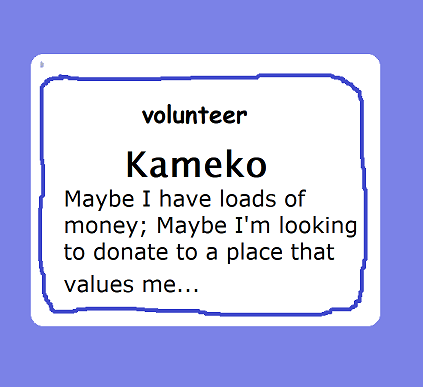
    badge5

    “Kameko,” the harried chief financial officer would coo after going over the financial report, “what adorable shoes you have on. From Italy, oh? You bought them the last time you went there? You travel extensively, I see… and your lovely engagement ring, it is so, so enormous…”

    or maybe a general one might just do:
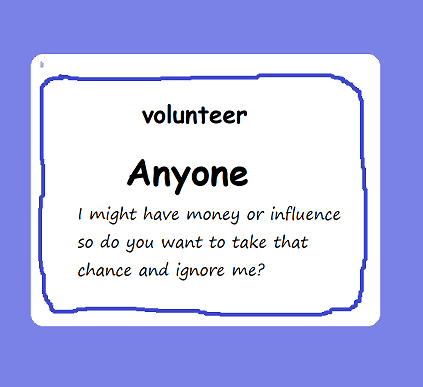
    badge6

    I remember the day my organization got a sizable donation from the best friend of the recipient of our help. It turned out that the best friend was a well-known celebrity. Everyone was surprised at the gift and then a bit relieved that we all had done a good job. I mean any one of us, volunteers included, could have blown receiving that donation.

    There was the usual, “you never know, the person you are serving just might turn out to be someone famous,” talk as if the result of good work is not the work itself, but what it can produce.

    Organizations might get more excited when volunteers have a little extra something to give. Do they donate? Do they have influential contacts?  Will they leave money when they die?

    We, volunteer managers need to remind everyone that volunteers are there to further the mission, whether or not that volunteer has money or influence.

    But the takeaway is this: Volunteers who experience meaningful volunteer engagement and feel integrated into the organization always give more than their volunteer hours. Always.

    That means treating all volunteers as if they have money or influence lest they go elsewhere. And organizations might not want to take that chance.

    -Meridian


    This is an update from a 2016 post: Eureka, I’ve discovered the value of a Volunteer!

     

  • Is Making Volunteers Likable Our Objective?

    black haired man in white crew neck t shirt
    Photo by YesManPro on Pexels.com

    I remember my first days as a volunteer coordinator. There was this one volunteer, Addie. She was a tiny, fit ball of northeastern, direct confrontation, piercing eyed judgmental “I’ve been here since the forefront” terror. Staff couldn’t stand her. But she roamed the halls wielding her trusty sword “Gotcha,” slicing apart our ineptness. She was your crusty grandmother, your 87-year-old history teacher and your noisy neighbor all rolled into one, and oh, with a grip of steel. I know because she would grab my arm to make a point. Yep, I still have phantom bruises there.

    I danced lightly around her. Although staff didn’t like her, she was, I thought, untouchable. They didn’t ask that I do anything about her, so I figured their eye-rolling was the way we dealt with disliked volunteers. After all, she’d earned her right to be a disruption, to be tolerated, to interpret our policies as anything that suited her purpose. She was, (da da daaaaahhhh) emeritus!

    So, what crippling reasons cause us to hide under our desks instead of addressing volunteer behaviors?

    • Lack of specific policy indicators? (for example, policy states theft or inappropriate language is an offense. Policy doesn’t include arrogance or chatty-ness as an official offense)
    • Fear that delivering feedback to a volunteer will be misinterpreted as criticism and the volunteer will quit?
    • Our general fear of confrontation?
    • Volunteer status, such as emeritus? Or staff seems to “put up” with volunteers?
    • Our belief that volunteers are giving of their time, so we should be more accepting of their behavior?
    • The perception that a volunteer is older, wiser, more accomplished, more educated or skilled than we are?
    • Our belief that our jobs are no more than coordination?

    The above reasons hold power over us, power that cripples us and prevents us from truly leading volunteers. How can we then make adjustments so we don’t simply going to continue to sidestep situations that can be remedied?

    The first step is to prioritize the why. Why is this volunteer here? We know there are multiple underlying and nuanced reasons, all of which we take into consideration when matching volunteers to assignments.

    But what is the primary, down to basics reason a volunteer shows up? To complete a task, or fill a role that furthers the mission they believe in. How is this being accomplished?

    Taking the focus off of staff’s and volunteer’s personalities allows us to examine the work being done and by doing so we can analyze how behaviors are affecting work quality.

    Communicating mission focus to everyone, staff and volunteers alike, lays the groundwork for intervention. How do we do that?

    In volunteer orientation or onboarding, emphasize the expectation of excellence. While creating a welcoming atmosphere, stress the importance of volunteers being able to fit within a busy organization. Illustrate the enormous workloads put upon staff. Make clear that while staff appreciates volunteers, the work is most important. Ask your most productive volunteers to speak to and hopefully mentor new volunteers.

    Create policy that gives you an opportunity to mediate. Although we obviously can’t write policy for every little behavior, especially if behavior is opinion based. (one staff member believes a volunteer chats too much) We can, however include six month probationary periods, infractions for inappropriate behavior and the specific understanding that it is in the power of the volunteer manager to determine fit. Fit means that a volunteer’s performance will be evaluated on fit within a specific department and the volunteer can be moved to another position. (This is a two-way street; it also protects the volunteer from being stuck with very demanding or uncooperative staff)

    Communicate your commitment to supporting staff. Before placing a volunteer, speak with staff about your readiness to intervene if a volunteer is behaving in ways that hinder production. Get the idea out in the open that your focus is on helping staff be more productive and you are leading volunteers, not simply placing them.

    Ditch the idea that volunteers will stay because we are nice to them. Instead, remind yourself that volunteers will stay because they are doing work that is meaningful and in order to engage in meaningful work, behavior must align with mission centric goals.

    Bravely follow-up and be willing to intervene. Feedback is not always criticisms that will drive a volunteer away. Mediation means taking into consideration the needs of both sides and finding solutions that best benefit the organization. Being on top of situations ensures that volunteers are valued, not tolerated. Ask both sides questions that direct them towards accomplishments, such as “what path do you envision us adapting to increase our survey input results,” or “what small thing right now will help us improve our client satisfaction?”

    Be willing to be a leader who can do the hard stuff. Just because a volunteer is emeritus, or wiser, or more accomplished does not mean that you are their subordinate. Your volunteer program is a reflection on you. In your organization, are volunteers valued or are they simply considered a necessary nuisance? Are volunteers given juicy tasks or are they relegated to boring minutia? With courageous leadership comes respect for the program.

    Educate staff on working with volunteers. Humanize the volunteers. Stress their character and commitment to the mission. Emphasize their desire to help staff, not hinder them. Highlight volunteer accomplishments with a caveat to staff who embraced them. The more we make staff feel as though they “have to accept volunteers,” the less they will actually accept them. Instead, as leaders, we need staff buy-in and it takes some staff ego massaging to get that buy-in.

    Listen to other volunteers. If volunteers are complaining about a volunteer’s behavior, or worse, quitting because of behavior, there’s a clear problem. How many good volunteers are we willing to lose because we would rather not engage in mediating destructive behavior?

    And most importantly, act quickly. Intercepting a problem before it becomes messy and unmanageable will keep those sleepless nights at bay. Regularly surveying staff and volunteers can unearth budding challenges. Following up on those challenges early gives a higher rate of successful mediation versus allowing patterns of behavior to cement. And, by showing your commitment to creating an excellent program, your leadership value will exponentially rise.

    By focusing on mission goals, we can more clearly see the big picture. Mediating and creating volunteer fit has the following tremendous potentials for a huge return on that investment.

    • More satisfied and engaged volunteers
    • Staff who will champion volunteer engagement
    • Openings to more volunteer roles
    • More recognition for volunteers
    • Respect for the volunteer manager voice
    • More leverage for negotiating new programs, ways to integrate volunteers or eliminating outdated volunteer roles

    While confronting behavioral disputes is down right hard and uncomfortable, we will reap enormous results by bravely tackling this challenge. Each successful attempt at mediation will move the needle closer to a professional and more respected volunteer program.

    Leading is doing the challenging stuff well. It gets easier once you burst that tension bubble and see how satisfying it is to get results.

    After all, we’re not volunteer coordinators who shrug because staff doesn’t seem to like volunteer Addie. We are leaders of vibrant, contributing volunteer programs.

    -Meridian


  • Horrors! Can a Volunteer Manager Say No?

    close up photography of person s eye
    Photo by Tookapic on Pexels.com

    Carlos took a deep breath and regarded Marty, a long term volunteer who stood before him. “Mr. Jansen really wants to visit his son in Philadelphia.” Marty said. “It’s only a four hour trip from here and I don’t mind taking him. We can do it in a day.”

    Carlos thought about the organizational policies, trying to recall one that forbid volunteers from driving clients on long trips. “I’m not sure that’s such a good idea, Marty,” he said. “I really don’t know if we should do this.”

    Leadership is about doing the right thing, even if it is the hardest thing to do personally and even if it puts you on the spot. As leaders of volunteers, we are faced with doing the right thing every day. We must weigh the right thing for our organizations, for our volunteers, for our vulnerable clients, for our communities and for us.

    Being able to say no is sometimes the right thing to do. While our jobs pretty much paint us as the folks who always say “yes,” we must take into consideration the times we are obligated to say “no.” Some obvious examples are:

    • when a volunteer wants to break policy and jeopardize the safety of himself or a client
    • when a request for a volunteer puts the volunteer at risk
    • when a community service volunteer wants you to sign off on hours not spent volunteering
    • when anyone asks you to embellish volunteer hours

    It’s easier to say no when strict policies back you up, or risk factors are obvious. But sometimes we have to say no, when policy is not a factor and the area is gray. Examples might include:

    • When someone requests a volunteer for a task that volunteers have strongly objected to
    • When a volunteer wants to initiate a project that will take precious time from mission related work
    • When you are asked to fill in for a volunteer on your day off and you already have plans

    How do we artfully say ‘no?’ If we feel pressured to say ‘yes,’ or are backed into a corner, we might stutter and say something like, “I’m not sure.” A weak ‘no’ is really just a soft ‘yes.’ When saying no, you have to actually say no and not want to immediately take it back.

    If you need to, ask for time to think on it. Say, “Let me get back with you on that,” so that you can formulate your response. Getting caught off guard seldom gives you the advantage of putting together a well thought out answer. Remember though, if you don’t get back to the person in a timely matter, they will assume your answer is yes.

    Think of all the reasons you have to say no. It’s not because you just feel like being oppositional, it’s because you know there is a better alternative, or you have information the person asking the question does not have. Listen to your intuition and find all the whys that force you to say no, then explain the whys in decisive terms.

    Present a suitable alternative. Explain why you are saying no, and offer an alternative. If say, a volunteer wants to bring a friend with them on assignment into a client’s home, you can say, “I’m sorry, but that is against our policy. The reason it is against our policy is because no one who has not been background checked and officially entered into our organization can enter the home of our client. (the why you’re saying no) This applies to staff and volunteers alike. I can offer your friend a path to becoming a volunteer so that he can accompany you on assignments. (the alternative) Let’s talk about how to make that happen.”

    Steer the person towards the alternative. If a staff member wants you to find a volunteer for a task the volunteers have repeatedly said no to, you can say, “I will try, but our volunteers have said no in the past so I’m not likely to be able to fill this request. But, we do have volunteers willing to help you in other ways. Let’s discuss the ways they want to be of service and how they can support you.”

    Be clear that a no is not personal. Leadership is about the mission and the team. Point out the mission centric reasons you must say no. “I understand that things change rapidly and that now you are asking for five additional volunteers for tomorrow. I will ask one of our experienced volunteers to make last minute calls and I know that every one of our volunteers who can commit, will commit, so you are in good hands. I however, must continue to work on the annual gala which is next week because volunteers are heavily involved and the gala is extremely important to our organization’s outreach.”

    There’s a reason these responses sound an awful lot like “professional speak.” It’s because they are. Using professional speak is the way to stop others from viewing you as a lightweight, a yes person, a go-fer. Using professional speak forces others to communicate with you on a mission-related level and not on emotional or personal terms.

    Feeling like you can never say no resides on emotional levels. Being able to say no in a professional way resides on logical, thoughtful levels. In order to take control of the conversation, use professional speak that centers on mission centric goals and steer the person away from trying to emotionally manipulate you.

    You can put off a conversation until later when you have the time and energy to discuss it with focus. Take the volunteer who wants to initiate a program that takes time from mission related goals. You can say to that volunteer, “that sounds like an interesting proposal and one that you’ve given considerable thought to. I really want to give you my full attention, so can we set aside a time to discuss it when we can really focus on what you are offering?” Then set aside a time when you are not being bombarded from all directions and can thoughtfully discuss any ideas.

    Saying no is not a failure on our part. It is actually an opportunity to control the direction of our programs and a chance to steer people towards a better way of engaging volunteers by offering more viable alternatives. When done with tact and professionalism, saying “no” can open doors to a better “yes.

    A strong leader is able to say no in a way that assures everyone that the no means listening carefully, then a negotiation, or a revamping or an alternative.  Above all, it indicates a striving for excellence. And that already describes every volunteer manager.

    -Meridian


  • Expecting Different Volunteering Results is Organizational Insanity


    Expecting Different Volunteering Results is Organizational Insanity

    Albert Einstein is widely credited with this quote:

    Insanity is doing the same thing over and over again and expecting different results.

    Vern sat down and dropped his notepad on the desk. The meeting had not gone as planned, but then, Vern knew it wouldn’t. He’d gathered his volunteers, served them coffee and donuts and explained the new task to them. He mustered up the enthusiasm to pitch the task and at times, came close to begging. He used phrases like, “we really need,” and “if you could just,” but the words were vinegar on his tongue.

    Asking his volunteers to give more of their time to a task he knew they had no interest in, felt like he was betraying them. A few of the volunteers felt sorry for Vern and even though they were already giving a good chunk of time to client related volunteering, they promised to give the task a try. They told Vern that the only reason they agreed to try was because they wanted to support him. They appreciated how Vern had always treated them with respect, how he shared impact with them and how he matched them to assignments that utilized their skill-sets.  The volunteers knew that if they did not say yes, Vern would get into trouble.

    Vern put his head in his hands. It wasn’t fair to treat the volunteers like pawns in a chess game. It wasn’t fair to ask them to do something they weren’t invested in. It wasn’t fair to the clients, because now, those volunteers were devoting their time to a meaningless task which kept them from their mission centric volunteering.

    This scenario, the one that Vern endured, plays out day after day in organizations everywhere. It is the scenario in which organizational upper management, without the input of the volunteer manager, decides to enlist volunteer help in a task that either a) staff involvement has decreased or b) a new initiative has been created and the “grunt work” needs to be completed or c) a staff member or department has complained that they are overworked and they want to offload the minutia on volunteers.

    So, what is so wrong with that? After all, that’s what volunteers are here for, to do our bidding, right?

    Well, let’s just count the ways this is the perfect example of organizational insanity:

    1. It sends a message to volunteers. Volunteers are not easily duped. Every action an organization takes sends volunteers a message. How many messages that say, “you are nothing more than tools to be used at our discretion” are sent before volunteers leave? Oh, and tell their friends?
    2. It puts the volunteer manager in a terrible position. It reduces the VM to selling a task to volunteers instead of engaging them in ways that excite their passion for the work. It undermines the VM and all the effort in laying a foundation of volunteer trust. Poof! Out the window goes everything the VM has told the volunteers about how the organization is committed to integrating volunteers into mission critical work.
    3. It robs clients of the help we promise them on our slick brochures. Let’s do the math on this. 50 mission centric volunteers – 20 volunteers diverted to meaningless tasks = not 50 mission centric volunteers, that’s for sure. Oh, and let’s do complicated math while we’re at it. 50 mission centric volunteers – 20 volunteers diverted to meaningless tasks x number of volunteers who don’t like the bait and switch thing happening = not many mission centric volunteers at all.
    4. It moves us away from the mission. What are we in existence for? To perpetuate and grow? To pad our coffers? To increase our influence? Growing, padding the coffers and increasing influence are not wrong, in and of themselves, but when they become goals instead of secondary goals for supporting the mission, then we’ve become something unrecognizable to our volunteers. And don’t forget, volunteers are not easily duped.
    5. It establishes a self-defeating pattern. When volunteers say yes out of a sense that the volunteer manager will suffer consequences instead of because they want to do the task, a self-defeating pattern is set. If a few volunteers reluctantly say yes, then more meaningless requests will follow, because it appears that volunteers are happily agreeing to do anything. It becomes much more difficult to explain volunteer objections if volunteers agree to assignments they feel pressured to accept.
    6. It keeps us frozen in outmoded models. When we engage volunteers in the same tired manner from years ago, we will see our volunteer numbers drop.
    7. It wastes everyone’s’ time. Volunteer managers have limited time. Volunteers give limited time. Why are we wasting it with tasks that drive volunteers away?
    8. It sends a message to the volunteer manager. The message from upper management says, “you are nothing more than a mouthpiece, a carnival barker, a conduit for our demands. The skills and time you invest in our volunteers mean little to us.”

    What can a volunteer manager do? Besides quit?

    • Don’t beg volunteers. Offer any task or request as an option. Check your emotions at the door. After all, it is up to the volunteers and we’ve all been surprised by volunteers who are willing to do something we never imagined them wanting to do. But, on the flip side, don’t buy into the “get them to do it” nonsense and don’t share your frustrations with the volunteers. They will say yes because they like you and don’t want to see you get in trouble. And then, the self-defeating pattern is set.
    • Capture volunteers’ objections. Write them down to give to those requesting the task. “that’s not something I’m interested in,” or “it doesn’t fit my needs, or time-frame or skills,” are phrases that show the reason a volunteer is declining the task.
    • Ask the person(s) requesting the task to present it to the volunteers. Take yourself out of the middle.
    • Remind senior management that you are there to engage volunteers, not use them. Share engagement successes and failures in order to support your theories and illustrate the difference between mission centric volunteering and tasks.

    Organizations thrive with engaged volunteers and while it may seem harmless to organizational senior management to ask volunteers to do whatever we want them to do, it actually sends a message. And not a very good one.

    We must take two additional and crucial things into consideration when creating volunteer tasks. How does it impact the mission and how does it impact the volunteer? Without mission centric volunteering, tasks are meaningless chores that sap the volunteer soul. And wear them out. And drive them away.

    What’s the definition of organizational insanity?

    Not listening to nor respecting the insight of the volunteer manager.

    -Meridian


  • 5 Things Your Volunteer Manager Isn’t Telling You


    1. I’m the one who convinces volunteers to stay after they are ignored or are treated poorly. Yep, that’s me calling volunteers to convince them that it was just a one-off or that a staff member had a bad day. It’s me you see when you walk by my office, sitting and having a long heart-to-heart with a volunteer. You may think that I’m just socializing, but in reality, I’m doing my job. I’m retaining a good volunteer who is on the verge of quitting.
    2. I may look like I’m just having fun but I’m hard at work ensuring the volunteers are connected to our mission. Uh, huh, it may look easy, but creating an inclusive, welcoming atmosphere is exhausting. I can’t have a down day; I have to be “up” and empathetic and positive at all times, no matter how I feel. I’m the one running all over town to get the balloons, ordering a cake, creating signs with positive messages that I say come from staff, but really it’s just me making them up because staff is too busy. I make sure I learn about every volunteer, their motivations and interests. I keep dates of volunteers’ birthdays in my head, along with their favorite books, or the heartfelt stories they tell me about clients. I juggle so much information because each volunteer wants to personally connect with our organization and most of the time, I am that connection.
    3. You may think I work 9-5, but actually, I’m recruiting volunteers and answering their questions at all hours, everywhere I go. Um, yes, I recruit at my kids’ soccer game when I meet a dad who has a big heart, at the gym when I meet a lady who is organized, and at my place of worship when I see a person who makes everyone feel welcomed. Besides, my open door policy means I am available to the volunteers whenever they need me. I’m not complaining, but don’t ever think that I’m not working at all hours towards creating an excellent department. I am. I just don’t broadcast all the things I’m doing. It’s not about me, but know I’m doing so much more than you can imagine.
    4. I can’t make volunteers do what they don’t want to do. Sigh. Nope, I can’t. Don’t forget, they’re not paid and I can only encourage, beg, convince, cajole, or promise so much. If your request is something they don’t want to do, well, they won’t. They know when I’m trying to “sell” them on an assignment. Volunteers are quite perceptive and I teach them to have boundaries and to not say yes to everything because it keeps them from burning out and we need them for mission centric work. I’d truly appreciate help with making sure volunteer assignments are worthy of our volunteers’ interests and skills so that we don’t drive them away. And actually, my time is better spent engaging our volunteers with meaningful work than trying to get them to do something no one wants to do.
    5. I know our volunteers’ potential and you need me to plan their involvement. Yes, it’s time you understand this. I know the volunteers inside and out and if you want them to support our mission, then I’m the one who can shape their roles so that it’s a win-win for all. The reality is, only I can design the roles our volunteers want to fill. I can create positions that make volunteers want to do more. I want our organization to succeed, and engaging our volunteers is a leap towards excellence. Let me be of greater service by planning our volunteers’ involvement together, with you.

    There, I said it.

    -Meridian

  • Let’s Design Mission Centric Volunteer Engagement

    Let's Design Mission Centric Volunteer Engagement

    Strategizing priorities when receiving volunteer requests ensures that volunteers are engaged in meaningful, mission critical work. (see Attention: The Volunteer Department Now Has Ground Rules )  By creating a weighted system around organizational priorities, volunteer services becomes focused on mission centric volunteer engagement. But there is one huge caveat that needs to accompany the priorities for volunteer requests. One very big one.

    After strategizing mission centric volunteer engagement priorities, the areas that rise to the top are most likely:

    • working directly with clients
    • supporting the smooth day-to-day running of the organization
    • supporting work with key stakeholders

    These three areas are where organizations spend the vast majority of their time, resources and efforts and the areas where volunteers’ contributions create the biggest impact.

    So, why a caveat in these three areas? What is missing?

    It is the inclusion of the volunteer manager in the planning, creation and continued input into the volunteer positions within these areas. Edicts, directives and mandates that exclude the input of leaders of volunteers are doomed to be ineffective or worse, fail.

    Creating volunteer positions without the volunteer manager’s input is like a team showing up to a baseball game without bats, balls or gloves.  The players just stand there, unable to hit home runs and unable to catch a ball. The gear is integral to playing the game with success. We, volunteer managers possess the gear.

    We, the equipment holders have to take a stand. Our volunteers need us to champion their involvement. Our organizations need our knowledge. Our clients need the excellence only we can provide. When advocating for a seat at this planning table, continually refer to the benefit of having you there.

    My knowledge of our volunteers’ skills and motivations is necessary to strategize the most effective volunteer involvement. I bring our volunteers’ passion and will elevate the ways we can move forward while saving time, money and effort. I will shape these positions so that our volunteers are invested and will not only stay, but want to do more. I have the experience necessary to design each position in order to boost volunteer interest.

    The most important volunteer positions must be defined by the person who leads volunteers, not only to maximize program results, but in order to ensure volunteer satisfaction and sustainability. Volunteer managers have the equipment needed to unlock volunteer potential while increasing results and retaining volunteers.

    What happens when organizations fail to include the volunteer manager in planning volunteer engagement?

    • skilled volunteers quit due to lack of meaningful roles
    • potential game changing programs never get created
    • a vicious cycle of recruiting volunteers as “warm bodies” is perpetuated
    • the organization is viewed as archaic and out of touch
    • highly motivated volunteer managers quit
    • clients are denied excellent support
    • a toxic negativity borne from frustration prevails
    • organizations become stuck in outmoded ways

    We, volunteer managers have to be willing to lobby for our seat at the planning table, not only for ourselves, but for our volunteers, clients and communities. Our organizations promise to deliver quality service and it is up to us to ensure that the volunteer piece provides excellence.

    Mission Centric Volunteer Engagement means strategizing the priorities that further the mission, deliver the most bang for the buck, and ensure volunteer sustainability. None of this can happen without volunteer manager input at the planning table.

    I’ll take my seat now, thank you.

    -Meridian