Category: organizations

  • Mono or Multi? Voluntasking is the Answer

    office mail business work
    Photo by Tookapic on Pexels.com

    Greta’s hand was shaking. Three recent volunteer requests needed her attention. One of her volunteers, Serena, was on the phone with a major problem. End of month reports were due at 5pm and Greta hadn’t gotten the chance to record all the available volunteer hours. Matt, a recent graduate of the latest volunteer orientation was standing in her doorway. He needed a dose of her encouragement. She could feel her heart racing. How would she be able to do it all?

    Multi-tasking vs. single or mono-tasking. A 2009 study of heavy media multitaskers versus light media multitaskers from the Proceedings of the National Academy of Sciences of the United States of America revealed that heavy media multitaskers are more likely to be affected by random, non-essential stimuli. And here’s the surprising results. Heavy media multitaskers performed worse than light media multitaskers on a task-switching ability test, instead of performing better as expected. It seems as though multi-tasking actually hinders our ability to concentrate.

    There is one tremendous benefit we seldom speak of in describing volunteer contributions. Volunteers are more able to focus on a single task than harried staff who are juggling multiple duties at one time. We, volunteer managers know this from experience. Take Greta in the example above. Can she possibly bring her best to each task in front of her? Will she be able to give her undivided attention to Matt, or to Serena? Will she find the concentration necessary to fill the volunteer tasks? Can she actually clear her mind to gather and record the volunteer hours for her report, not to mention adding the additional stats and stories she knows will make her report more impactful? Or will her attention dart back and forth, splitting her cognitive abilities into tiny, unusable pieces?

    No, not with all the external stimuli that fractures her attention. This inability to do superhuman multitasking is one of the reasons we, volunteer managers ask for volunteer help with our workload. We realize that a competent volunteer can do a job that might take us ten times as long to do, because we are in a constant state of being distracted.

    We’ve seen it so many times. Give a volunteer a desk and a light and they will power through an assignment. Volunteers possess the trifecta of task accomplishment:

    • The will or passion
    • The time
    • The focus

    We need to highlight this overlooked asset and properly showcase it as a benefit derived from embracing volunteer help . We can start by asking staff and senior management these questions:

    • If you had two hours a day to focus on one task without interruption, what could you accomplish?
    • Do you often feel like you are being pulled in multiple directions and you can’t concentrate?
    • What would it mean to you if you could offload a portion of your work so that you could give your attention to the tasks you feel are critical to your job and our mission?
    • Do you feel that being pulled in so many directions actually helps or hinders your ability to reach your goals?

    And here’s the kicker question:

    Do you really think that someone who is passionate about helping, can sit and actually focus on the task at hand and is willing to devote the time to getting it done will do a much poorer job than the person who is continuously pulled in every direction?

    If you want to have some fun, at the next staff meeting, ask staff to take out a piece of paper. Announce a phrase, such as “volunteers are great.” Ask staff to spell the phrase out loud while writing their names and addresses on their piece of paper. You’ll get laughs and groans, but it will take a good chunk of time as their brains switch back and forth between tasks. And it won’t help that they are being distracted by the reactions of their fellow staff members around them.

    Now point out that this is their reality. Ask them (in all seriousness) why they wouldn’t want a volunteer, one who is capable, and has the will, time and focus to accomplish tasks more quickly and efficiently, helping them.

    Non-profits are notoriously understaffed and overburdened. The reluctance to seek volunteers’ help is holding missions back from great accomplishments. The mind-destroying multi-tasking world in which non-profit staff find themselves can be alleviated by the help of focused volunteers.

    We can encourage our organizations to take advantage of volunteer help for many reasons, all of them sound. One simple, but overlooked reason is voluntasking: the passion and ability of volunteers to devote the time it takes to focus on one task, thus accomplishing it faster and with more accuracy and freeing up staff to concentrate on mission centric goals.

    Or, we can all continue to cling to our workloads and keep multitasking. But, if we do, we’d better learn to love mediocrity and burnout.

    -Meridian
     

  • Let’s Design Mission Centric Volunteer Engagement

    Let's Design Mission Centric Volunteer Engagement

    Strategizing priorities when receiving volunteer requests ensures that volunteers are engaged in meaningful, mission critical work. (see Attention: The Volunteer Department Now Has Ground Rules )  By creating a weighted system around organizational priorities, volunteer services becomes focused on mission centric volunteer engagement. But there is one huge caveat that needs to accompany the priorities for volunteer requests. One very big one.

    After strategizing mission centric volunteer engagement priorities, the areas that rise to the top are most likely:

    • working directly with clients
    • supporting the smooth day-to-day running of the organization
    • supporting work with key stakeholders

    These three areas are where organizations spend the vast majority of their time, resources and efforts and the areas where volunteers’ contributions create the biggest impact.

    So, why a caveat in these three areas? What is missing?

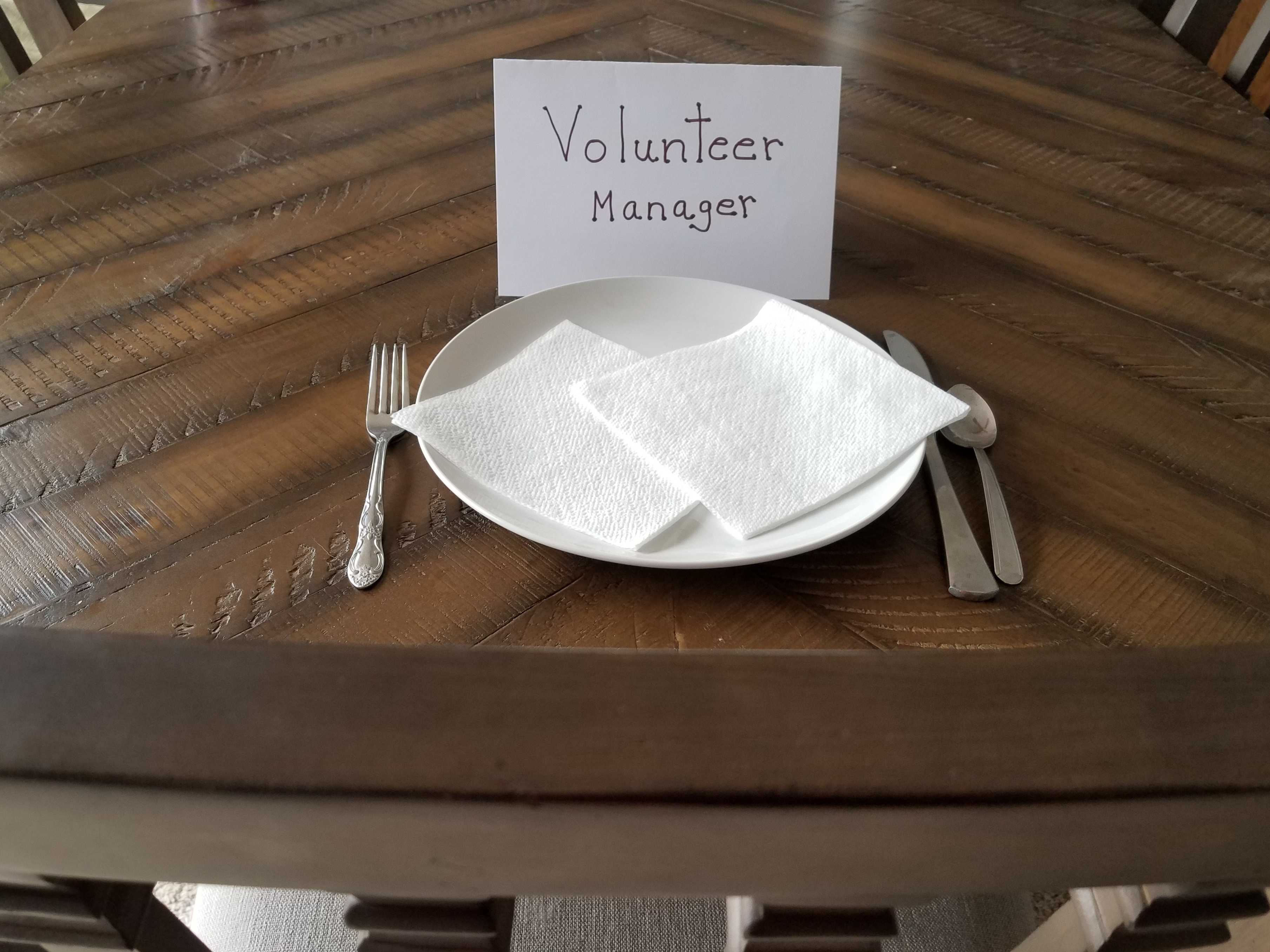
    It is the inclusion of the volunteer manager in the planning, creation and continued input into the volunteer positions within these areas. Edicts, directives and mandates that exclude the input of leaders of volunteers are doomed to be ineffective or worse, fail.

    Creating volunteer positions without the volunteer manager’s input is like a team showing up to a baseball game without bats, balls or gloves.  The players just stand there, unable to hit home runs and unable to catch a ball. The gear is integral to playing the game with success. We, volunteer managers possess the gear.

    We, the equipment holders have to take a stand. Our volunteers need us to champion their involvement. Our organizations need our knowledge. Our clients need the excellence only we can provide. When advocating for a seat at this planning table, continually refer to the benefit of having you there.

    My knowledge of our volunteers’ skills and motivations is necessary to strategize the most effective volunteer involvement. I bring our volunteers’ passion and will elevate the ways we can move forward while saving time, money and effort. I will shape these positions so that our volunteers are invested and will not only stay, but want to do more. I have the experience necessary to design each position in order to boost volunteer interest.

    The most important volunteer positions must be defined by the person who leads volunteers, not only to maximize program results, but in order to ensure volunteer satisfaction and sustainability. Volunteer managers have the equipment needed to unlock volunteer potential while increasing results and retaining volunteers.

    What happens when organizations fail to include the volunteer manager in planning volunteer engagement?

    • skilled volunteers quit due to lack of meaningful roles
    • potential game changing programs never get created
    • a vicious cycle of recruiting volunteers as “warm bodies” is perpetuated
    • the organization is viewed as archaic and out of touch
    • highly motivated volunteer managers quit
    • clients are denied excellent support
    • a toxic negativity borne from frustration prevails
    • organizations become stuck in outmoded ways

    We, volunteer managers have to be willing to lobby for our seat at the planning table, not only for ourselves, but for our volunteers, clients and communities. Our organizations promise to deliver quality service and it is up to us to ensure that the volunteer piece provides excellence.

    Mission Centric Volunteer Engagement means strategizing the priorities that further the mission, deliver the most bang for the buck, and ensure volunteer sustainability. None of this can happen without volunteer manager input at the planning table.

    I’ll take my seat now, thank you.

    -Meridian


  • Attention: The Volunteer Department Now Has Ground Rules

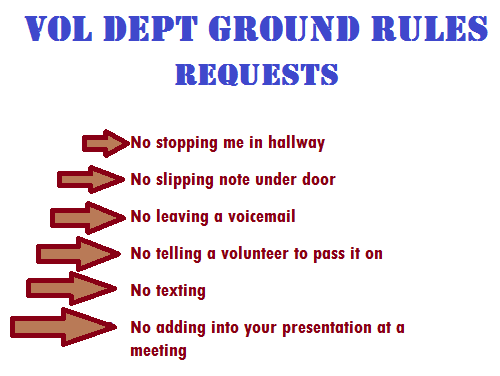
    Ground Rules for Volunteer Departments

    “I need 8 volunteers or maybe 9, no wait,” she says, grabbing your arm in the hallway, “yeah, make it 10, the more the better, right?” Her attention is on the person down the hall, but she glances over her shoulder. “Have them at the Reed Center at 9 tomorrow.”

    Well, hello ground rules. Continuing the conversation from last week, (and a big shout out to everyone who weighed in here and on LinkedIn with great ideas on their excellent ground rules) here are two ways to look at setting them up.

    MY OWN PERSONAL FANTASY GROUND RULES:

    Three staff members request volunteers. Count the number of letters to determine which request gets top priority: The smallest number of letters wins.

    Amy: A

    Roz: R

    Herschel: H


    Ground Rules

    As you can see, Herschel clearly wins even though he only gave 3 days’ notice to find volunteers versus the week Roz gave.  And Amy, well, it will be a cold day in Honolulu before she gets a volunteer, unless it’s the guy that has to do court ordered volunteering, the one that talks incessantly about how he only had two beers when he crashed into that tree. Yep, Amy, I got your back.

    Ok, now for real. What are some of the priorities that can actually be weighed against less important requests? When proposing the adoption of priorities versus non-priorities to upper management, bring a few examples of how you look at prioritizing volunteer engagement.

    And don’t be afraid to drop the “S” word: Strategy. As in, “in order to better serve the mission, let’s strategize our priorities.”

    Your list of examples will spur senior management to adopt a “Priority Principle.” Setting priorities means asking the following questions and assigning a weight to each one. Weight determines priority status.

    Do the clients come first, no matter what? What does the mission say? Clearly, the client’s needs are the reason we exist. This is a great place to start, because weight should be the highest.

    What does the organization need to run smoothly? Volunteers are vital in keeping the organization running. Do volunteers fill in for staff when they are absent? Do volunteers take weekend shifts? Do volunteers occupy roles that must be filled in order to serve clients? The weight here has to be really high.

    Which stakeholders count the most? Donors, dignitaries, potential clients and influencers all carry weight. What events or strategies involve the most bang for the buck? This is where weight will flesh out low priority requests. Staffing a booth at a last-minute  weekend fair carries little weight against an annual festival with high visibility attended by key stakeholders.

    Is the time frame reasonable? Weight needs to balance up and down between last-minute and timely requests.

    Is the request feasible? It may be hard to define feasibility, because we typically entertain all requests. (which does not imply all requests will be met) Having a listing or report outlining the skills, availability and interests of the volunteers can be applied against requests. Weight is equal to feasibility. For example, you can say…

    At this time, we do not have any volunteers who have an interest in washing the board members’ cars as a ‘thank you.’ Time spent trying to convince our volunteers that this activity is more meaningful than engaging with clients or keeping the reception desk staffed will deplete precious time from requests that further our mission.

    What is the amount of work involved when enlisting volunteers? Work=time=there’s only so much, even if you work sixty hour weeks. How many volunteers are requested? How specialized are the skills needed?

    Are any of the following factors within the request out of the norm? (timeframe, location, ability to get to assignment, duties, weather, duration, stress level, etc.) Complicated requests require additional time and if the complicated request holds a high priority, then the weight of other requests is reduced by a factor reflecting the extra effort needed to obtain volunteers.

    How does this engage volunteers? We must add this one into the mix. Volunteer retention or sustainability is directly related to engagement. Strategizing retention must be highly weighted and given top priority.

    We may not agree with all of the decisions made when administration strategizes priorities, but we have to be flexible because having administration’s ‘stamp of approval’ will be worth it the next time a flurry of requests are dropped on your desk.

    Volunteer services is not a buffet of ordering without end. Actually, even buffets have a limited number of choices if you think about it. I can’t get Tantanmen at any of the buffets in my area, although I crave it. So, why should anyone be able to “get” a volunteer to sit outside the chapel “just in case an upset family member should enter?”

    Professional, efficient volunteer departments need ground rules in order to ensure the priority requests are met. After all, at year-end, the organization is no better off because you ‘got’ five volunteers to dress up like clowns at some poorly attended event, right?

    -Meridian


  • Volunteer Department Ground Rules

    volunteer department ground rules

    In this dream you walk up to a woman sitting at a desk. Behind her, a closed-door is visible in an otherwise blank wall. “I need,” you say to her, “two camels, a box of jellied donuts and a ladder.”

    “When?” she says, writing it down.

    “Tomorrow.”

    “I see.” She rips the sheet of paper off the pad and disappears behind the heavy door, closing it with a thud.

    That’s volunteer management. Where has she gone? Are there actually camels back there? Will the donuts be fresh? Is the ladder being used by someone else? Is mine the only order she is filling? Will she be back by tomorrow?

    This is why there are ground rules. Take baseball. If a batter hits a ball that bounces off the left field grass and goes into the bleachers, that’s a ground rule double. It prevents the runner from unfairly advancing and the left fielder from climbing into the bleachers and fighting the fan who picked up the ball. (well, ok, that’s a bit overblown) But without ground rules, how can anyone requesting volunteer help know what goes on behind the closed-door? How can they possibly know priorities, or time frames, or volunteer availability or the feasibility of their request?

    Too often, volunteer departments operate reactively, disappearing behind the door to field multiple requests at a time. Many of those requests are last-minute, some are more complicated than others, and some morph on a daily basis. On top of these requests, the volunteer department is tasked with keeping revolving or permanent volunteer spots filled, spots that are routinely being vacated by volunteers who are absent for a myriad of reasons such as illness, vacation, moving or quitting.

    And sometimes, if we are brutally honest, the most reliable and skilled volunteers are paired with the squeekiest wheel and not the most engaging assignment.

    So, let’s imagine two volunteer spots are vacant. One spot is for a volunteer receptionist on the weekend when the staff receptionist is off. Phones have to be answered. The other spot is for a volunteer to deliver vital equipment to a client, also on the weekend. The client needs the equipment. Which one of these vacant spots takes priority?

    With no ground rules, volunteer managers are expected to fill all spots, every time and in every time frame. It doesn’t matter when the requests are made, or how many volunteers are needed, because there are no ground rules. So what if the volunteer manager is fielding ten requests at once.

    Volunteer departments need ground rules in order to end the scrambling madness. We need to outline the process behind the door in order to organize our systems for the good of everyone. With that in mind, what might these ground rules include?

    Priorities: What volunteer requests are the most important and need be filled first, should all requests come at the same time? Client based? Permanent or recurring roles that fill in for staff? Recurring roles that make the organization work such as kitchen or receptionist help?

    Time frame: Should a request made two days before an event have the same priority as one made weeks in advance? Having a clear chronological order or queue is a necessary ground rule. First asked, first filled will force staff to amend the last-minute request behavior. But wait. What if a volunteer calls in sick last minute for a higher priority position? Does that go to the front of the queue?

    Feasibility of time spent: Requesting 20 volunteers who are willing to wait tables versus 5 volunteers to pass out flyers have differing time investments. How can this be addressed? Does a request requiring more time spent finding volunteers take precedence over one that is simpler? Or does one major event attended by potential donors and stakeholders take precedence over smaller, lesser events?

    Setting ground rules won’t work if the volunteer department simply types them up and hands them out. There must be a buy in from the CEO on down through the department heads and a willingness to support the volunteer manager in the instituting of them. Asking senior management to outline priorities in say, a task force is not unreasonable and may also have the added benefit of encouraging the hierarchy to outline other organizational priorities as well.

    Look at it mathematically. If there are too many requests with too little time frame and not enough skilled volunteers, then some requests will go unfilled, right? With priorities set and ground rules established, the most beneficial, most time worthy and most bang for the buck requests will be filled first.

    How many times have we mused that “no one knows how to do our job until they do it?’ We are like that lady in the dream. We take the order and then disappear behind the closed-door. We are hiding the effort, the juggling, the piecing together, the circling back, the reaching out, the doubling down, the soothing over, the listening to, the rearranging, the sorting, the skills assessing and all the other components needed to engage volunteers. We are tearing our hair out behind the door and then smiling, stepping back outside while covering our bald spots with that crazy hair paint.

    Ground rules are not just for baseball. Next time: Setting ground rules, or how to prioritize what’s going on behind the door.

    Volunteer managers, let’s set some ground rules and play a better game of baseball.

    -Meridian


  • Non-Profits, Your Volunteer Manager Wanted Ads Say A Lot About You

    The Volunteer Manager wanted ads out there remind me of a fish market.  Some offerings are fresh, appealing and beautifully displayed and some just, well, stink.

    Let’s ask some questions, then look at recent ad excerpts and what they say about the organization posting them. How do these organizations view the volunteer manager’s role?

    Do you view your volunteer manager as a leader? Or as someone who simply fills tasks?

    Here is one ad that gets it:

    Your role as an executive overseeing volunteer management is thus an important one as you will be there to work with volunteers and support them in their projects. You will also explore ways to help volunteers grow personally and professionally (e.g. as volunteer leaders) so as to enhance their giving experience.

    This is an exciting opportunity for you to shape an emerging culture and to inspire impactful collaboration, kickstart new projects and ultimately enable better care with and for seniors in our home.

    But then there’s this uninspired ad:

    Manages volunteer scheduling, activities, and screening. Processes incoming volunteers to ensure they meet requirements. Maintains volunteer files and matches volunteers with projects suited to their skills. Manages all aspects of volunteer appreciation events and assists with developing the annual budget. Manages volunteer office to include scheduling, providing information, maintaining records, ordering office supplies and generating appropriate reports.

    Do you understand the skills needed to engage volunteers? Or do you believe it’s about having tea parties?

    In this ad, the appreciation of engagement skills is clearly non-existent: Do they think the leader of volunteers is just one of the volunteers? Or do they mean the VM will not supervise staff, so that tells you something right there, doesn’t it?

    SUPERVISORY RESPONSIBILITIES

    None

    But then, here is an ad for a Director of Volunteer Engagement:

    LEVEL OF AUTHORITY :

    Operates with direction from the President / CEO and is given appreciable latitude for independent action and decisions corresponding with the demonstrated ability for following policy guidelines, department objectives, and applicable laws, rules, and ordinances.

    Are you forward thinking? Or are you content with outdated programs?

    This ad just sounds so dreary: (And they want 5 years of experience-why? Wouldn’t someone with 5 years experience want to take on more leadership?)

    Essential Duties and Responsibilities:

    • Oversee the recruiting, interviewing, hiring, training, and scheduling of volunteer workers.
    • Respond to inquiries, schedule, and train volunteers.
    •  Coordinate volunteers by organizing, planning, and managing the volunteers’ assignments.
    • Coordinate with staff in order to ensure all programming has appropriate and timely volunteer coverage.
    • Manage volunteer software and train volunteers on software usage.
    • Solicit and answer volunteer questions and evaluate volunteer performance and provide constructive feedback and positive recognition.
    • Plan, prepare, and conduct volunteer meetings/continuing education and training seminars at least once annually for volunteers to enhance skills.
    • Manage communications and notifications to volunteers.
    • 5 years of experience in high-level volunteer management.

    But then, look at this ad. Lead STAFF and volunteers? Be still my heart:

     3. Lead staff and volunteers in building a plan of action, including effective service and serving an increased number of clients 4. Involve staff and volunteers in ways that will bring high visibility and public esteem. 5. Cultivate, develop and maintain a close working relationship with the key leadership in each department to help them effectively achieve their goals and objectives. 

    Do you appreciate how passionate and creative volunteer managers are? Or does your volunteer manager take a back seat?

    This ad hints at understanding how dedicated VMs are:

    • Passion for a mission of civic engagement
    • Demonstrates a high level of professionalism at all times across a variety of business sectors
    • Demonstrated ability to build relationships and communicate with a variety of stakeholders and cultivate strategic partnerships
    • Strong conflict management skills
    • Entrepreneurial spirit while maintaining the ability to work as part of a team
    • Ability to think outside the box
    • Capacity to develop and implement new concepts and strategies including creating context setting, educational components to enhance existing events and create new program initiatives
    • Able to recognize and successfully navigate the office dynamics of our clients and stakeholders (Political Savvy)

    This one, not so much:

    • Recruit, schedule, and retain volunteers for various tasks within the organization
    • Ensure that all volunteers have viewed the Safety training video
    • Coordinate parking for volunteers when necessary.
    • Schedule and coordinate volunteer recognition and appreciation events.
    • Maintain Volunteer Manual
    • Manage and participate in the goals, objectives, and policies affecting volunteers
    • Maintain a database of volunteer workers and record hours of work; prepare monthly and annual reports as required

    Do you truly believe in the untapped power of volunteerism? Or is volunteer involvement just “fluff?”

    In this ad, one has to wonder if volunteers are just potential donors:

    • Promote T-shirt sales and donations creating a pipeline for volunteers to donors
    • Contribute to development of department budget.
    • Coordinate Volunteer Calendar
    • Responsible for coordination of court ordered volunteers
    • Provide periodic (weekly, monthly, yearly) reports when needed.
    • Submits volunteer data for Annual Activity Report
    • Other duties as assigned.

    But then, here’s an ad that does believe in volunteerism:

    The Volunteer Program Manager is an important role in our organization. Because our organization values and depends on our volunteers in every facet of what we do, the person in this role will be a key collaborator assisting in the delivery of (our) programs and services.

    Want ads say a lot about an organization. Ads reveal the culture, the expectations, the value placed on the skillset of the applicant, the support offered and the perception of the position.

    What does your ad say about you? 

    -Meridian


  • Don’t. Do. This. Ever.

    Don't Do This Ever
    from: floridastateparks.org

    Sometimes misdeeds are huge, indefensible and devastating. Take the ongoing scandal involving Oxfam for instance. It’s big.

    But slippery slopes lurk everywhere, like alligator eyes floating above the river, waiting to take you down. Misdeeds can begin innocently and maybe they won’t make the front pages, but they will ripple through your water when that gator pulls you under.

    Melanie was a volunteer coordinator who cared deeply for her volunteers. She personally interviewed each one to get to know them and understand their strengths. She attended birthdays, took volunteers to appointments and helped when volunteers needed assistance.

    One of her volunteers Dorothy, was a widow, her husband having died a few years before. Melanie invited Dorothy over for dinner a few times a month and introduced her to her husband and children. They welcomed her, making Dorothy an honorary family member. Taking care of Dorothy made Melanie feel really good about her role as a volunteer manager.

    But one day, Melanie came to work and was called into the CEO’s office. It seems that Dorothy’s daughter, who lived out-of-state, came to visit her mother and went through some of her mother’s finances. She discovered Dorothy had loaned Melanie money to pay for a soccer clinic for the kids. Innocent, right? Melanie was put on probation, paid the money back and more tragically, never recovered her exuberant spirit. She became cautious, bitter, not sure how she could ever be close to her volunteers again. She quit.

    What is your gift/loan/money policy at work? Does it include volunteers? We tend to make sure our volunteers know their boundaries, but do we have policy regarding staff’s (including us, the volunteer manager) boundaries with them? (for an example of employee gift policies, see the balance)

    While we seek to forge deep relationships with our volunteers, we have to keep this in mind: We are the volunteers’ supervisor. Not a peer, not a friend, not a counselor, not a family member, not the fixer of their lives. We are their boss.

    As their boss, we must define gifts to and from a volunteer. Is a card ok? A cup of tea? Seriously, these items all have a monetary value and defining value helps to create policy and creating specific policies regarding gifts between staff and volunteers will save any misinterpretation down the road.

    If a volunteer offers money, or a gift card, tickets to an event, a new blouse they bought but don’t like, say no. All of these items are alligator eyes peering at you from beneath the water. They all have monetary value. Instead, ask that volunteer to donate the money or item to the organization in your name and for heaven’s sakes, ask them to write a note accompanying the donation saying how awesome and ethical you are.

    But NEVER take money from a volunteer for any reason. It’s the grand poobah of slippery slopes. And having that policy in writing gives you all the backup you need to say a polite but firm “no.”

    Some misdeeds will be headline news, will damage a charity’s reputation and set the great work done by so many other dedicated staff and volunteers back by years. That’s a tragedy. These misdeeds may be so egregious that they are obviously wrong to the rest of us, but, then, there are the minor little innocently begun misdeeds that also damage good intent in subtle, but very real and lasting ways. Every day simple mistakes ruin good careers.

    Be involved with and care about your volunteers, but when it comes to money, Don’t. Do. This. Ever.

    -Meridian


  • A Volunteer Manager’s Hidden Cupcake New Year’s Resolutions.

    a volunteer managers hidden cupcake new years resolutions


    New Year’s resolutions? Who keeps them? Anybody?

    There’s a whole science out there that studies why we make resolutions and the deep psychological implications of why we don’t keep them. It’s called FeelGoodForOneMinuteAfterMidnightEveryYearology and researchers have forged careers observing this phenomenon.

    There are so many reasons why we fail to keep our resolutions including:

    1. we have unrealistic expectations
    2. we hate being told what to do, even if we are the person doing the telling
    3. our motivations are not in sync with the resolution
    4. habits are very hard to break
    5. we don’t like change or we’re afraid of change, or we’re resistant to change or we can’t change or we don’t know how to change or we think change will actually change us and we’re pretty much ok with who we are at this point in life. (fine, I made that last one up.)

    The point is, there are lots of factors working against us, even if we have the best of intentions. We make resolutions to feel good, at least for the moment. Hmmmmmm, kind of like that second cupcake hidden under the covers…

    So, if we aren’t going to keep our resolutions anyway and the whole resolution thing is about instant gratification, then why don’t we just make enormous impossible, overblown hidden cupcake resolutions and feel super good for an instant, right? Yeah!

    With that in mind, here are my Volunteer Manager New Year’s ENORMOUS, IMPOSSIBLE, OVERBLOWN HIDDEN CUPCAKE resolutions for 2018.

    1. The next time I’m in a staff meeting and the discussion turns to new year housekeeping which means shredding all the reports that are over seven years old and someone says, ‘I know, let’s get a volunteer to do it,” I’m going to flip the table over, spilling all the caramel macchiatos and cinnamon lattes, and storm out, fist raised, yelling, “I’ll bet you want volunteers to clean up this mess too!”
    2. I’m going to wear a Guy Fawkes mask and make my own protest sign that reads, “Volunteers are No Longer the Tools of Your Authoritarian Requests in 2018” and stand in front of my building every day until my list of demands are met. I won’t bathe, so this should end pretty quickly. My list of demands includes designating all the upfront parking spots, “For Volunteers Only, Because Their Time is Valuable Too” and renaming the office building “Volunteer Towers, The Office that Volunteers Built.”
    3. I’m going to put together a “Staff Appreciation Luncheon” this year instead of a Volunteer Appreciation Luncheon. The volunteers will walk around, and they will flippantly throw out phrases such as “we couldn’t do the work without the help of staff,” and “we love our staff, no really, we do.” The volunteers will all sit together at the front table, eat their lunch while chatting and ignoring everyone else and then they will excuse themselves before any awards are given out, claiming that they have “important work to do.”
    4. I’m going to rip up all my ROI reports and next time I have to present stats, I will calmly get up and say, “in lieu of standard reports, I am going to sing a song about volunteers, in hopes that you feel their value in your heart and not on paper, which really does no justice to all the intangibles they bring.” I’ll proceed to sing “You’ve Got a Friend and change the word friend to volunteer. I’ll sing every verse acapella, although I might be able to coerce volunteer Gordie into accompanying me on his harmonica, just for added effect.

    The lyrics go something like this:

    You just call out my volunteer name, if you know what it is, and you know wherever I am like at work or even at my own wedding
    I’ll come running or maybe I’ll drive or take the bus cause the car’s in the shop to volunteer again

    Winter, spring, summer, or fall or during last-minute events that you forgot to tell me about until the morning of
    All you got to do is call or email or even send me a letter where you misspell my name again and I’ll be there to volunteer
    You’ve got a volunteer

    Ahhh, I’m not going to lie, those resolutions felt pretty darn great, at least for the moment, but I know I won’t be keeping them, except for the hidden cupcake, that is.

    So, now what?

    How about, we just make a resolution to work together to keep the momentum from 2017 going.

    We most definitely can keep that one. Cheers to an even brighter 2018.

    -Meridian


  • Sometimes, You Fight the Good Fight and Sometimes, You Go

    Sometimes, You Fight the Good Fight and Sometimes, You Go

    I had a different post all ready to go, and it just didn’t feel right today, not after the lunch I had yesterday with a very good friend and volunteer manager. Ironically, I had just read the brilliant post by Elisa Kosarin on her blog, Twenty Hats about a note to self: When your volunteer mindset needs a boost.

    Elisa talks about the disparity between a volunteer manager’s salary and the value we assign to ourselves. Are we valued? Can we overcome the perception that we are not worth much?

    But back to my friend. She’s done. She’s looking for another job, outside our field.

    And she is one of the most naturally talented volunteer managers I have ever met. She knows people. She understands motivations. She is passionate about her mission. She embraces projects. She works hard.

    She told me she just wants to be in a place where her talents are cultivated. She just wants to stop having to explain over and over her worth and the worth of her program, just to be shot down when she needs resources. She just wants to feel supported by her supervisors. She said she felt like a prop, one in which her caring face hid all the cavalier attitudes behind her. She just wants to be paid a fair wage.

    It hurt to the core to hear how miserable she is and even though a part of me wanted to say, “But the work! The work is why we do this,” I couldn’t. It would have rung hollow, after all she has been experiencing.

    So I agreed with her. Leave. Find a job where they appreciate your talents. If that is at another non-profit, then great, but if not, go where your soul is happy. We talked about how she could help a for profit company invest in community service. With her list of skills, enthusiasm and creativity, she will shine somewhere if just given the chance.

    Thankfully, not all organizations that engage volunteers are as difficult. Most are serious about cultivating volunteers. Sadly, though, some just give lip service to volunteer programs.

    Now, I wish for my friend a position in a company that recognizes her talents and I weep for the volunteers at the non-profit that caused her to feel this way.

    She deserves better. Their volunteers deserve better.

    Our profession deserves better.

    And what’s really sad is that even though we are making great strides in elevating our profession, it’s too little, too late for my friend.

    Sometimes, you just have to go where you will shine.

    -Meridian

  • The Best of 2017, Volunteer Manager Style

    The Best of 2017 Volunteer Manager Style

    Goodbye 2017! Hello New Year. But wait, was 2017 just another blah year for volunteer managers?

    The biggest take-away from 2017 I believe, is that volunteer managers across the globe are finding and connecting with one another to share, learn and most importantly, become strong advocates for the profession.

    Some pretty amazing events took place in the volunteer manager sector last year. Here are just a few highlights to give us some real hope for the future:

    November 5th was International Volunteer Manager day: The theme for 2017 was “Be The Voice” and volunteer managers world-wide took the pledge to be the voice for volunteer management. Symbolic gestures of solidarity can be the impetus for real change.

    Lisa Dyer, CVA, in conjunction with International Volunteer Manager day and the theme, “Be the Voice,” hosted a Blog Carnival which featured 12 volunteer manager blogs all advocating for volunteer management. We are learning that we share common challenges and goals, which points to more collaboration in the future.

    In July, the Minnesota Association for Volunteer Administration MAVA hosted the National Summit on Volunteer Engagement Leadership in St. Paul Minnesota. Over 500 professionals gathered to learn, connect and brainstorm the future of volunteer engagement leadership. The need to strengthen connections was one of the many take-aways.

    VolunteerMatch continues to provide free resources for volunteer managers on the blog Engaging Volunteers while providing matching opportunities for prospective volunteers and organizations seeking help. Currently, there are 1.3 million monthly visitors.

    Alive, the Association of Leaders in Volunteer Engagement and VolunteerMatch, two dynamic volunteer leadership organizations, are partnering to further volunteer engagement resources. We are looking forward to the future of this pairing.

    Points of Light Conference on Volunteering and Service was held in Seattle in June, and the volunteer engagement track highlighted five trends.  These trends include ‘volunteer management can make or break an organization’ and ‘everyone has a role in volunteer management.’ It is great to hear these trends discussed on a large platform.

    At the Volunteering New Zealand’s annual conference in Auckland, Rob Jackson’s keynote speech centered on stop being so bloody nice. Rob argues for the advancement of our profession by adopting professional attitudes and practices.

    Over and over, we have learned that millennials are attracted to companies with strong cultures of giving which means volunteerism among millennials is a high priority. This up and coming generation gives us hope for the future of volunteerism.

    A Twitter hashtag campaign gave us #volmgmt and #LOVols to tweet about all things related to creating great volunteer programs.

    Everywhere, our neighbors, friends and fellow volunteers rushed to help those in need.

    After Hurricane Harvey, volunteers rushed to help in historic proportions.

    Goodwill exists: An army of volunteers rush to help.

    After Hurricane Irma devastated Puerto Rico, volunteers are still on the ground.

    People step up and volunteer: They fill the need.

    The above events are just a sampling of the enormous strides being made in volunteer engagement and leadership.

    I’m excited for 2018. I hope you are too.

    -Meridian


  • Michael

    Michael

    Do our volunteers connect us to those unexpected moments, the ones that last?

    Greg had volunteered to help Roy, the brother of one of our hospice patients. Roy’s brother had died and as the only living relative, it was Roy’s job to empty out his brother’s house. It was a hot summer afternoon and I left work early to stop by. “Can you use some help?” I asked.  Greg wiped the sweat from his face and said, “yes.”

    Some of the household items went to our thrift store, the bigger ones were given to neighbors and the rest were placed at the curb for trash pickup. As I was carrying a box to the street, I noticed Roy placing a plastic blow mold snowman in the pile. It must have been the way I studied the old Christmas decoration, because Roy looked at me and said, “would you like to have it?’

    I touched the snowman’s hat, the jaunty band of yellow circling the snow-covered brim. “I would if you don’t mind.”

    “My brother Michael loved Christmas,” Roy said wistfully and looked around at the remnants of his brother’s life scattered in so many directions.

    I lifted the snowman, taking in his smile. “If it is all right with you,” I said, “I’m going to name him Michael.”

    Roy nodded. The cars zipped by us, the garbage bags flapping in their wake.

    “And every year, I will bring him out, light him and I will say, Merry Christmas, Michael. Is that ok?”

    Roy put his hand on my shoulder. “I’d like that.” He touched the old plastic face, his fingers tracing a farewell of sorts. I carried the snowman to my car.

    **********

    Every holiday season, for more than 10 years now, I’ve brought out the snowman with the jaunty hat and lit him up.

    Merry Christmas Michael.

    -Meridian

    Have a very happy New Year.