“Carlos is one of those volunteers who just knows what to do,” LeAnne said proudly. “He understands rules and boundaries, doesn’t need much instruction and always, and I mean always,” she laughs, “turns in his reports and attends meetings. My only problem is I can’t clone him. He’s so good, I started to pick his brain, wanting to know the magic thoughts in there and I discovered that he had volunteered for quite some time in another city before he moved here. He told me about that program and how his volunteer coordinator was instrumental in teaching him so much about being a good volunteer.” LeAnne sighed. “I really would love to thank her for that.”
Ahhhhh, volunteers that have volunteered successfully at another organization. It’s like finding a hair stylist with lots of experience and training. (No, wait, it’s actually much better)
I’ve been on both ends of this volunteer exchange. I’ve welcomed volunteers who have had a great experience elsewhere and I’ve heard from volunteers who say their experience with my program helped them in their new endeavors. It makes you realize that our work reaches far beyond our postal code.
So, what if we created a form letter to send to that unsung volunteer manager who taught a new volunteer everything they know? How incredibly validating would it be to hear that a volunteer you’ve mentored went on to successfully volunteer elsewhere? Imagine receiving this letter:
Dear (volunteer coordinator),
I am writing to let you know that your former volunteer (Tom Smith) has joined our organization as a youth advocate volunteer. (Tom) brings incredible skills and exhibits the caring nature necessary to work with and advocate for our clients. He is an outstanding addition to our volunteer program.
Tom speaks highly of the (four) years he spent volunteering at ( your organization) and attributes many of his volunteering qualities to your coaching and guidance. I wanted to personally thank you for all of your time and effort spent in helping develop Tom’s natural talent and (my organization) looks forward to working with him. I give you my pledge to treat Tom with the dignity and respect that you have shown him and hope that one day he will speak as fondly of me as he does of you.
Sincerely,
Me
Wouldn’t it feel really great to receive this letter? Who knows, maybe a relationship between the sender and the recipient might just develop into a peer-to-peer support system. And the volunteers who move on will realize that we, volunteer managers not only recognize their worth, we recognize the worth of each other and each other’s programs.
We truly are in this together. A stamp or email and a form letter is all we need to thank a volunteer manager for all the time and effort they put into mentoring the volunteer that we now have in our program.
The Toms of the volunteering world are coached by caring volunteer leaders. What a wonderful gesture to recognize that work, especially when we benefit from their effort.
Ok, so maybe we, volunteers managers can’t control everything in our little sphere (gasp, but I want to, so, so, so badly). Maybe we sometimes retreat to a fantasy world in our heads that exists across from the “10 super easy ways to get volunteers” list that inhabits our nightmares.
Is that so bad? Well, no, not when you consider that maybe our fantasies are really brightly disguised goals on steroids. Unless of course the fantasies involve the demise of someone at work, then, well, find some help, ok?
But positive fantasies can tell us a lot about our wishes and dreams and dismissing them as nonsense may also help push our goals to the back of our minds (next to the dream of being the first person ever to have dinner with Bigfoot-in the forest, with wine, a nice Chablis, but I digress). So heck, let’s just descend into a positive fantasy world for a moment where we can let our volunteer manager minds run wild. What would we fantasize about?
A volunteer manager is chosen as CEO after the CEO quits in frustration while yelling, “No one, and I mean no one, except that amazing volunteer manager we have, what’s his name again, can do this job!!!”
At the all-staff end of year meeting, the award for ‘Supreme Being of All Things Non-Profit’ which is only given out once in the entire life of the organization, goes to…. YOU! And then, everyone would sit through fourteen hours of long speeches about how volunteer management saved the organization (dinner and yummy rainbow cupcakes would be served, of course, in between speeches).
At the annual volunteer appreciation luncheon, the CEO, when giving the welcome speech, says, “..and we couldn’t do it without our volunteers.” Then she stops and with a wink adds, “Wait, that’s just lip service. We really mean that and I will show you.” At that, the curtain opens and every staff member comes flooding out to mingle with the crowd of happy volunteers. There are hugs and tears and stories and neck massages and homemade cards and selfies that all culminate in the entire room singing “We Are The Champions” with locked arms. And no one would forget about it the next day.
The board of directors, in their quarterly meeting, all stand up in unison, rip up their prepared agendas and with one clear voice declare, “We hereby unanimously elect to increase the salary of our volunteer manager in proportion to the money saved by utilizing volunteer resources. Hey, that looks to be about $76,000, and that means no gala for at least five years, but what the heck, it’s worth it!”
At a new project exploratory meeting, one of the senior managers muses, “We need some fresh thinking from someone who has all the skills necessary to help us get this new project off the ground, someone who is creative, has people-skills, professional management ability, public speaking chops, mediation experience and is a darned nice person to boot!” At which every other manager moans that there is no such person on the planet and that same senior manager lifts up her hands and yells, “yes there is! Our volunteer coordinator!”
Ahhhhhhhhh, I can’t stop smiling. That felt doggone delicious. But anyway, positive fantasies just might be an exaggeration of our heart’s desires. We can shut them out or we can turn them over in our heads and look at them as a springboard to work towards personal goals. Do we want more respect, salary, recognition, voice or any number of positive outcomes? What are your positive professional fantasies and how do you achieve these goals?
Hard work is not something that chases volunteer managers in nightmares. No, hard work is the stuff of our every day working lives. Our fantasy goals, once sorted out in logical thinking, will require that same hard work.
Don’t feel alone in fantasizing about positive changes. There is an entire community all around us of volunteer resource managers working to create positive change.
What is the great question of the ages? Forget about “What is the meaning of life?” Pffft to “is there life on other planets?” Is that all you got to “What really happened to those adorable dinosaurs?” And finally, oh puh-lease to “Is Spam really a food product?”
Here is the question of the ages: Can we possibly make it any harder for people to volunteer?
I thought about this a while back as I chuckled along with this video from musician and songwriter, Dave Carroll: There’s Got to Be a Better Way
In this clever video, Mr. Carroll laments the extra crazy legal steps he has to endure in order to volunteer at his son’s school. Somehow, he shares a birthday with a person who has a criminal record, so, well, you know how that can go. He tries to have his fingerprints taken at a local police department and of course, the LiveScan equipment fails to capture a clear reading, so they advise him to go home and put lotion on his hands while wearing gloves to bed. Mr. Carroll takes that advice to the extreme and tells himself, “it’s for the kids.”
It’s really a cute video and the hilarity illuminates how frustrating and seemingly ridiculous it can be for someone who just wants to volunteer. Or wait, let’s amend that: For someonewho doesn’t have ulterior motives who just wantsto volunteer.
And there you have it. We, volunteer managers, especially those of us who regularly deal with background checks, fingerprinting and drug testing, understand that all the time spent on these legal requirements adds hours to our workweek. But we plod on because we are working to protect our vulnerable populations. And frankly, background checks are here to stay, unlike the vacuous idea that volunteers sit around breathlessly awaiting our calls. (Pick your battles.)
The question, “Can we possibly make it any harder for people to volunteer” has an answer. Yes, we can, and probably will. For any organization that does not yet require volunteers to submit to background checks, enjoy yourselves while it lasts. The first time an unchecked volunteer does something bad, you will be instructed by a senior manager with pulsating temples to institute this requirement. Most likely, we are not going to make it easier to volunteer. So, what do we do?
Explaining the whys of background checks goes a long, long way to assure prospective volunteers that we are not suspicious of them, not unduly peering into their private lives, and not trying to keep them from volunteering. Using verbiage that focuses on the vulnerability of our clients moves the emphasis from volunteer hindrance to client protection. A few ways of framing this shift in focus are:
Would you want us to allow just anyone off the street to volunteer with your child?
If we placed a volunteer with your elderly or sick grandmother, would you want us to be certain that this person is completely vetted?
When you donate money to help a cause, are you comfortable with random persons handling your money?
If just one out of a hundred volunteers is here for nefarious reasons, what if that one volunteer is alone with your son, or daughter?
In a perfect world, everyone volunteers because they want to help. But we don’t live in a perfect world, do we?
If you, or your loved one needed our help, what would you want us to do to make sure our volunteers have altruistic motivations?
Life for volunteer managers would include tea breaks if we weren’t required to make our new volunteers jump through so many hoops. The enormous time and effort we spend on interviewing, checking backgrounds, training and explaining rules and regulations heaps hour upon hour of getting things right.
But no matter how cumbersome vetting volunteers can be, the time and effort spent cleaning up a mess created by an unchecked, untrained volunteer who has done harm to our clients is vastly greater and more importantly, will shake our faith in our ability to provide the best volunteer care.
So the next time a prospective volunteer is asked to complete a background check, think about explaining the whys to them. Because, just as Dave Carroll said, it really is for the kids.
Lionel is the first to admit, he hasn’t been a volunteer manager for very long. “I took this position, because, and I have to be honest, I needed a job and this one sort of fell into my lap. I figured I could work at this a while, you know, use my education to move up into senior management.” Lionel thought for a moment. “Then last Saturday, something really bizarre happened. I had planned on visiting my grandmother in the hospital. It’s a long drive to get there and I had promised her I would come and bring her favorite take out food. She was pretty excited. But then, my friend called and said he had tickets to a concert I really wanted to go to, but that meant blowing off the hospital.” Lionel thoughtfully shook his head. “I was just about to call my grandmother to give her some lame excuse as to why I wasn’t coming, but there was this voice, or thought or feeling, I can’t put my finger on it. I knew I wasn’t going to the concert. I knew I was going to see my grandmother.” Lionel stopped. “The regular guy in me wanted to just have fun and figure it out later. But now, I just can’t explain it. I’m different, I think.”
It’s pretty normal to sometimes hear your mother or uncle or that really tough coach or quirky teacher in your head, telling you to wear clean underwear, or that nothing good ever happens after midnight. But, shhhhh, let’s be honest. (Is the door shut?) Volunteer managers hear lots of voices in our heads.
Spending every working moment inspiring others to do the right thing rubs off on us like the lotion that softens your hands when you massage it onto a loved one’s back. Being an ethical person becomes the mantra that we come to believe, not only for volunteers, but for ourselves as well. And the positive feedback that we receive from clients, volunteers, staff and the community embeds itself deep within our psyche.
It’s akin to having your own Jazz station looping in the background. We feel this choir of voices, all different, all improvising, but somehow tied together by the rhythm of the right thing to do. It is an ethics ensemble that softly invades our thoughts and actions.
Now, don’t get me wrong. We can just as easily become bitter or self-victimizing or burnt out if we only listen to that voice telling us that our work is underappreciated. It’s even possible to become smug while only listening to the praise voices who tell us how wonderful we are or if we only hear the inner voice that claims we are somehow better than the rest of humanity.
But when we steadily and humbly allow the cadence of those impacted by great volunteerism to lead our paths, we tend to pick our own right course. This aspect of volunteer management is not left at the office. It is carried home, a coaching melody shaping our outlook, our actions and our treatment of others.
Sometimes, the best perks are the ones we don’t expect, but find along our way. Hearing all those inspirational voices in our heads is one of those perks.
“Hey there students. We’ve got some pretty fierce things for you to do, that is, when you’re not liking back some other cause, heh, heh. Our aesthetics are cool in our place, you know what I mean?” Kassar shook his head. “I actually said something like that to a class of high school students. Yeah, I don’t know what came over me, but suddenly, when these thirty pair of Gen Z eyes were staring at me, expecting me to connect with them, I just, well, became a cartoon character, trying to speak their language.” Kassar laughed at the memory of himself. “I saw the impression I gave this class of young people. There was the rolling of the eyes and the shifting in the seats. I lost them in the first two minutes of my talk.”
Ohhhhhhh, how that hurts. I’ve done it when speaking to groups, and maybe you have too. In our quest to connect, we sometimes become totally disingenuous by trying to manufacture rapport. We want to show prospective volunteer groups that we ‘get’ them. It usually happens when we are faced with a prospective volunteer group that has some sort of central identifying factor such as age, culture, religion, cause, work, gender, or special interest. But how exhausting is that? And more importantly, how do we accomplish this connection- by cute comments, silly jokes or personal stories?
So, let’s conjure up some possible connection statements to random prospective volunteer groups. Would you actually use one of these presentation lines?
To Retired Law Enforcement: “Hey, I’m hoping you folks can fix my glove box full of parking tickets, ha ha. I think there’s about 200 in there.”
To Girl Scouts: “I can remember being a Girl Scout. Little Heather was in my troop and she always beat me at selling cookies. I got so tired of her winning. But then, Heather always got the most merit badges. It still frosts my cookies, you know what I mean?”
To High School Band Members: “I played a little piano, you know, tickled the old ivories, so I feel your vibe here. I was going to run away and join a band. Ahhh, those were the days.”
Do I detect some groaning from the audience?
When speaking in front of prospective volunteer groups, how do we show them that we get them? Or, wait, is that actually necessary? Maybe groups who are willing to listen to our presentations are looking more to be a part of us, instead of us trying to be a part of them. And why patronize them with caricatures and poorly conceived jokes?
We can’t possibly know everything about every group. So, instead of feeling inadequate or embarrassed because we don’t know what it means to be a retired computer engineer, how about using something more genuine or what I call “sincere ignorance.” Instead of embarassing babbling, we can say, “your profession has always intimidated me a bit and I honestly would like to know more about it. Do you mind if we take a moment so that you can tell me about your group?”
Sincere ignorance means embracing our lack of knowledge and being genuinely curious about the people we are addressing. When asking questions at the beginning of a presentation, not only will the group loosen up, they will probably offer up some tidbit that we can pounce on and tie into the reasons volunteering fits for them.
Groups ultimately prefer us to be ourselves. They want to hear our passion, our experiences, and our compelling evidence as to why they should volunteer with us. We aren’t chameleons who can change color and blend into every new group. We are leaders, whose authentic message resonates with anyone. They want us to invite them to be part of something worthwhile.
So, next time you feel as though you may be inadequate in front of a group because you don’t think you can connect to them, just remember, they are listening because they are hoping to connect to you and the mission.
Groups don’t really want chameleons, they want the sincere us. That’s all the connection we need.
In 1886 America, a struggling door to door book salesman, David H. McConnell discovered that the small vials of perfume he offered as “door opening” incentives were more popular than books and from that realization, the Avon Company was founded.
Well, huh. Volunteer managers know that volunteering enhances the lives of those who volunteer with us. We have seen the grief-stricken person begin to socialize again, the quiet student learn to trust their abilities, and the senior come alive with purpose. We’ve seen volunteers learn so much about themselves that we could write a textbook.
What if we borrowed from Mr. McConnell and compared books and perfume to recruiting and managing a volunteer force?
The books: volunteer jobs (Volunteers Needed to Stuff Envelopes)
The perfume: the benefits of volunteering (Learn New Skills) (Socialize with Caring People) (Change Your Life)
Maybe the time is right to symbolically begin our own perfume company. Many articles are being written and statistics kept on the benefits of volunteering. Since the evidence that we knew all along is overwhelming, we can become a greater positive force in our communities by looking to not just fill organizational needs, but to help our fellow citizens enrich their lives by volunteering.
What if we put as much emphasis on our perfume as on our books? Would developing our perfume company create a larger volunteer force of outstanding volunteers and in return, more books would be sold, er volunteer positions would be filled? I’m thinking, yes.
We have the most fragrant life enhancing perfume. And yet it is secondary, mostly kept in our desk drawers until a class of new volunteers begin. Then we pull it out and spritz it in the air, letting that intoxicating life enhancing scent fill their nostrils with promise. We should be pumping that scent all over town by the gallon.
What if, besides volunteer coordinators, we also became “life enhancement coordinators?” How would that look? Well, for starters we would:
Add a new focus: We would create positions in our organizations that serve our volunteers and in turn, those innovative jobs would help our clients in new creative ways.
Put volunteers first: We would partner with other local organizations to share volunteers instead of operating in dark, isolated caves, all trying to lure the same people inside and clinging to the ones we have, even if we can’t offer them a great volunteer experience and someone else can.
Create new benefits for our organizations: We would create a community of fluid volunteers who could share talents with many organizations and therefore bring fresh ideas to help each organization grow. (or are non-profits really just in competition with one another for the same donations, publicity and volunteers?)
Lower volunteer attrition: We would end the cycle of volunteers bouncing from organization to organization and giving up because the process is so tedious.
Expand organizational reach: We would measure the impact on our communities, thus exponentially mushrooming the outreach and standing of our organizations. Wait, measure perfume?
What are some measurable volunteer life enhancing statistics?
The number of unemployed people who were able to fill in gaps in their resumes and garnered new recommendations from organizational staff.
The number of students who used service learning and organizational recommendations to seek entry into the college of their choice.
The number of corporate teams who made a commitment to service, learned team building skills and became supporters of a cause (donations, marketing etc).
The number of people who were able to garner people skills as they learned about inter-generational connections or diversity because they were paired with someone different from them.
The number of people made aware of X disease or Y social issue or Z traumatic experience by peering firsthand into our missions which gave them word of mouth marketing skills.
The number of isolated individuals who were able to socialize and connect, thus decreasing their risk for illness and depression.
The number of retired people who were able to launch volunteering careers and stay active with meaningful work.
The number of seniors who served critical roles and utilized skills which is proven to ward off dementia and Alzheimer’s.
The number of students who will become the citizens of the future due to skills learned, such as philanthropy and leadership.
What if our organizations showcased these statistics as part of their end of year report? How big and beautiful would that report be? And wouldn’t those incredibly heartwarming stats increase each charities’ standing in the community?
I think the time is right for volunteer managers to come out of the shadows and lead. Think about all the times a prospective volunteer walked through your door and you instinctively sensed they had a secondary reason to volunteer. Think about all the volunteers you have spent time with, tweaking positions until the right fit presented itself. Think about the programs you have created because you had a group of dynamic volunteers that needed something more. How many times have you heard your volunteers tell you that they get so much more out of volunteering than they give?
Most of the emotional time and commitment we spend cultivating volunteers and meeting their needs never gets reported. This is why the misconceptions abound. “Managing volunteers is easy.” “All you do is have tea parties and socialize”. “Why can’t you just ask? Someone will do it.”
While we continually struggle to justify the hours we spend with each and every volunteer, we discover that the biggest part of our jobs lies outside the scope of the organizational definition of volunteer management because our jobs as “life enhancement coordinators” is not properly recognized or measured. We possess the tools to change this misconception.
Instead of continuing to just peddle books while we possess this life changing fragrance, let’s take matters into our own capable hands.
“Well heck,” Ivan said, “the surprises in volunteer management just keep surprising me.” He adjusted his purple framed glasses. “I just had this one volunteer, Julie, who took orientation a couple of months ago. It was a great class, full of people ready to help. They had different interests and skills, and varied ages, but they all got along; we laughed and cried together. It was great and I had high hopes for all of them. Now ours, being that we work with disadvantaged children, is a very intense training. And Julie stood out. She was passionate, and entertaining, really a big personality. She is married to a prominent doctor, and you know how it is. I figured that not only would I have her as a volunteer, but also I would have her telling her influential doctor husband about our program and maybe I’d get some quality speaking engagements out of it as well. So I was pretty pumped about her joining our group.”
Ivan paused. “I paired her with one of my most accomplished volunteers, Sal, who took Julie out on visits. Then, about two weeks later, I get a call from Sal who tells me that all his calls and texts to Julie are going unanswered. So I try and nothing. I asked Sal if anything upset her, but he can’t think of a thing, as a matter of fact, he found her enthusiastic. So, now I’m worried. I send emails, even a written letter and still nothing. Short of becoming a stalker, I just leave her a message that we are very much interested in her continuing with us and I leave it at that.”
Ivan picks up a newspaper clipping on his desk. “Then, last week, one of our volunteers, Della, was at the county fair and sees the pageant for the married women of our county and she tells me that one of our volunteers won. So, I said, who was it and she says, Julie, the new volunteer.” Ivan holds up the newspaper picture. “Here she is and in Julie’s interview she gushes about volunteering with us. Then the article goes on to list other organizations that she is involved with.” At this point Ivan laughs. “I wonder if she did the same thing to them too. But I guess I should take this as a compliment, I’m just not sure.”
Yep, there it is. Should we feel used, or do we take the robbing of our reputation as a compliment, shrug our shoulders, furiously work our worry beads and go on?
Well, there are going to be volunteers who use us to their own gain. Resume padding job seekers, corner cutting students, court avoiding offenders, ebay selling thrifters and even parent hood winking teens all can find a nice warm blanket of self benefit by tacking us on to their veneer. These thankfully few and far between folks are truly different from the volunteers who come to us for other more varied and sometimes multiple reasons.
These Reputation Robbers are singly focused on our good name as a means to their end, and want the name recognition without doing any work. I remember the first time I was plundered by a Purity Pirate. I was so mad that I pumped my fist into the air and yelled, “how dare you!”(at the blank wall of course. The pirate was long gone, having snatched up all the loot he needed, then he paddled away in his rowboat. I think I can still hear him laughing.)
Well, these experiences teach us to expect volunteers to exhibit altruistic motivations but to prepare for occasional leeches on our work. I’ve been burned more than once. It hurts to think that you can be duped, but it happens. So, here are a few things to do if we think that a potential volunteer just wants to write a book, using our clients as subjects, entitled, “I Personally Saved This Hapless Non-Profit From Disaster.”
Do Not Sign Off: Don’t sign off on work done if the work is not done. Ever. And don’t succumb to those sad little baby alligator eyes that see right through your easy kind nature.
Do Not Be Pressured: A senior manager has a neighbor who has this niece, Lita that needs to complete 30 hours of community service. That’s an entire month of your time! Yes, I can do math, well basic anyway. But 30 hours becomes:
Meeting with Lita after she is two hours late and trying not to reach across the table and choke her when she asks whether she’ll be paid.
Calling her repeatedly when she does not show up as scheduled and getting her brother on the phone who makes Lita look like the responsible one.
Trying to explain to her again and again in a nice way (oh heck, just trying not to scream at her to get out) that signing in and leaving does not constitute hours volunteered.
Continually assuring all the other volunteers who happen to work alongside her that you have not, in fact gone completely insane.
Re-doing the event packets Lita totally messed up. It’s the night before the event and you have to miss your best friend’s birthday celebration.
Wooing back the volunteer who quit because he happened to be there the day Lita laughed at the name of an elderly client in front of the client’s son. So, in order to convince the volunteer to return, you host a ‘bagel while begging’ two hour coffee brunch. And then you spend the rest of the day on severe caffeine jitters, pacing the halls, barking at volunteers to “stop looking at me!”
Walking down to the reception area every couple of hours when Lita is actually on property because the receptionist needs you to come up and tell the little pack of Lita’s friends that they cannot hang out here.
And having these surreal phone interruptions with Lita’s parent who chastises you for not making Lita “like it there.”
So, yeah, I stand by it-that’s a month of your professional life that you can’t get back.
Put Policies in Place: Having policies will not stop all reputation robbers and thankfully most folks who need something from us are not purity pirates and honestly want to do something meaningful with their time spent. But, well thought out policies can be used effectively, especially if you discover one of these pirates has sneaked into your midst.
As for Lita? How about policy #2, paragraph #1, sentences #3 and #4: ‘A volunteer shall be counseled if said volunteer does not exhibit the necessary attitude and respect for the mission and program. After due counseling, said volunteer may be dismissed at any given time so as to protect our clients from undue stress.’
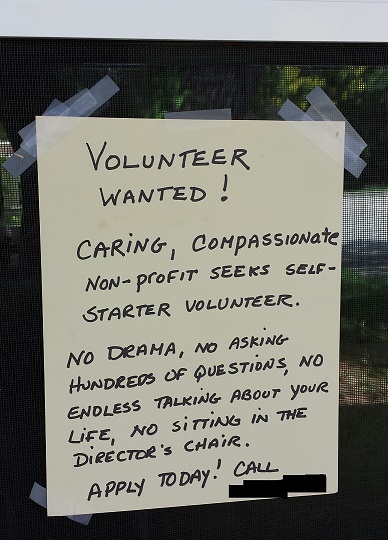
Director of First Impressions Volunteer: Wow. What a concise, succinct way to advertise for a front desk or receptionist volunteer. The ad then goes on to talk about how important it is for clients to experience a first impression that is compassionate and helpful. Gosh, I want to be that volunteer.
So, what verbiage appeals to prospective volunteers? Is it silly, eye-catching titles or serious, touching the heart ads that bring volunteers in? And does the same ad appeal to millennials and baby boomers, working adults and students, community service needing and weekend warrior potential volunteers alike? And anyway, are there foolproof ads that once you’ve created them, you can then just magically sit back and answer the ringing phone?”
Clearly, marketing has a tremendous impact on companies that sell goods and services. If we think of ourselves as selling goods (enhanced life experiences) and services (ways to help the community), then we can think of our potential volunteers as consumers who can pick and choose where they will spend their valuable time. So, how do we market to them?
Here are just three creative ways to frame a volunteer ad:
1. Describe the benefit to the organization.
2. Describe the benefit to the client served.
3. Describe the benefit for the volunteer.
So, let’s take a simple job title such as “volunteer receptionist” and re-imagine it in the above three ways:
“Director of First Impressions:” The word ‘director’ exudes importance, and ‘first impressions’ neatly describes how this organization genuinely cares for their clients and is striving for excellence with every paid and/or volunteer position.
“Imagine How Hard It Is To Need Our Help:” This immediately frames the position in the eyes of the client and elicits an empathetic feeling for those who are being served.
“Where Else Can You Feel Like You Have Thrown Out a Lifeline:” This ad goes right to the heart of volunteerism-making a difference.
And what law says we can’t use all three ads for one position at the same time? Who knows which approach will attract the kind of person you are looking for because ads exist to quickly capture attention. All three ring true; they are just different ways of framing meaningful volunteer roles in punchy descriptions. If you can combine all three ways without becoming too verbose, then by all means, give it a go.
But can we even go further and be even more creative? Why can’t we inject some playfulness? How about an ad that asks, “What Intergallactic Volunteer Character Are You?” (Or another current and popular theme). Create a description for a few popular characters, such as:
The Scavenger Captain: You’re roguish and free wheeling, this job is flexible. We won’t tie you down!
The Robot Sidekick: You’re diplomatic and precise, this job needs your attention to detail.
The Galaxy Princess: You’re strong and smart and destined to lead our rebellion against hunger.
Want to advertise for a thrift store volunteer? How about “Are You the First One at Garage Sales? Come, Help Sort Through Our Treasures Where It’s A Garage Sale Everyday.”
Do you need something very specific? Celebrate it! Web help might become, “If You Know What This Is, Call Us: 01101000 01100101 01101100 01110000.”
There are catchy volunteer ads out there that say, “show off your basketball skills,” “do you love cats and acting,” “do you walk by homeless people not knowing what to do,” “be the role model she’ll remember always,” “50% of school age children in our town go to bed hungry.” A few great ads tell a personal story: “Meet Ed. He will sit alone in his room today unless a volunteer comes to visit. Will you be that volunteer?” “Sarah received a scholarship in part because she volunteered. If you can you use a scholarship, call us!”
Do you have multiple locations? Tack the location onto the ad so that potential volunteers know they can stay close to home or work or school. You can say, “Be the Role Model She’ll Always Remember in Springfield” or “Calling All You Bristolians Who Dress Up Their Dogs.”
And if your program has won an award or has been feted in any way, use that to your advantage: “Join our award-winning volunteer program!”
Refresh your ads frequently. Keep statistics on the more successful ads so that you can start to track what is working and for whom it is working.
You can also put together a focus group of volunteers to come up with creative ads that they believe will appeal to their peers. Marketing students are also an excellent resource for help in crafting creative and appealing ads.
Well, then, how can we jazz up that soul-sucking Data Entry Volunteer ad? (and you know what always surprised me, there are people who want to do this kind of volunteering because it’s sort of like washing dishes by hand, it gives them a chance to just quiet the mind).
“Monotonous, Repetitious Data Entry Volunteer Job For That Amazing Person Who Knows This Work is Critical. Help Our Clients While Decompressing in a Calm Environment. We’ll Play Some New Age Music.”
Every day, potential volunteers peruse volunteer want ads. What do they find? Are they intrigued? Do they dial us up immediately, hoping to not miss the wonderful opportunity we offer? Or do they thumb through ad after ad that says basically the same tired thing?
According to research, the science of naming brands is so much more than just descriptive words. Research and real thought goes into names that resonate with consumers. Clever word coinage, rhymes that fall off your tongue and words that sound like the actual word (think fizz) all play into the careful selection of names. Maybe it’s time we borrowed some of that science and applied it to volunteer recruitment ads.
So what if we rename some common volunteer wanted ad titles, using techniques from this science, such as rhyming words, onomatopoeia, alliteration, and coining words. Here are just a few straight forward volunteer job titles reimagined.
Events Volunteer: Darling of Developement; A Party Hardy; Our Gala Girl; Work Till You Drop Wonk; Jamboreally Need You.
Volunteer Recruiter: Captain of Coercion; Rope ‘Em In Randy; Soul-Snagger; Goodie Two Shoes Gatherer; Codger-Finder; Tenderfoot Tender.
Thumbing through volunteer recruitment ads pretending to be a prospective volunteer looking for potential opportunities can give us a sense of what is and is not appealing. What ad stands out and is at least worth exploring further?
While ad titles such as Program Volunteer, Marketing Assistant, Resource Specialist and the soul-sucking Dracula of all ad titles, Data Entry Volunteer may accurately describe the positions, they lack the enthusiasm and meaning that volunteers wish to experience by spending their precious time with us.
Other outdated, but somewhat descriptive ad titles such as “Caring Volunteer;” “Hold a Hand;” “Make a Difference; “Become a Mentor;” “Friendly Visitor;” can feel like they were written with a chisel on stone and a potential volunteer may just pass them up because they are so “yesterday.” Recruitment ads written once and left up on social media sites gather more dust than my speech written in case I am employee of the year.
Or how about these dusty goodies: “Buddy;” Bring Your Smile; “Inspire Youth.” Picture paging through volunteer ad after volunteer ad that basically heralds the same vague thing no matter what or where the volunteering position.
Writing volunteer ads is passive recruitment and sadly quite often overlooked. Passive recruitment means that the ads we post keep working for us while we are out talking to civic groups or sitting at community fairs or having lunch. That is why spending time and energy on writing these ads and regularly refreshing them is one of the smartest things we can do.
Picture a student, late at night, smart phone in hand, swiping through ads that will enforce their desire to be a change maker. Or picture a retired senior, recently widowed, searching in the still morning for something that will add meaning to a bruised soul. Or a working parent, sneaking a peek at ads while helping with homework, looking to spend some me time helping others. What will speak to each one of them?
Volunteer recruitment ads should be working every bit as hard as you do.
-Meridian
Next time: A volunteer ad that says it all and 3 ways to re-imagine volunteer ads.
“That is the ugliest thing I’ve ever seen,” Raelinn huffed as she stared at the cacophony of colors and fabrics hanging before her eyes. “I mean, who would ever think that was art?”
Her best friend, Edna, slowed her pace and was at first taken aback. This quilt, entry #37, was indeed a mess. Irregular shapes, jumbled colors and materials ran every which way over the body of the cover, rendering it a shreeking noise in a choir of lilting quilt voices. But as she peered closer, she noticed a cat with an umbrella on a powder blue patch that had come from a baby blanket. She scanned the oddness and found another sort of large circular patch that must have been an old stained t-shirt from a wine tasting trip. It proclaimed, “Wine Not?” There was a somber black piece of cloth next to a tattered lace collar with the tiniest of stitching. She leaned in and saw the remains “Mothe” embroidered on the faded lace. Looking over the rest of the quilt, she took in the snippet of army uniform, the worn apron, the wedding dress, the graduation robe, the bloodied football jersey, the funeral attire.
As Raelinn pulled at her arm to go, Edna felt the the ugly quilt tug back and she smiled, thinking of all her volunteers. She gave a quick nod and the smallest of curtsies to the intimately messy display of the quiltmaker’s life and followed her friend.
When we field a request for volunteers, does the requesting person think they will get a volunteer who is a soft, new smelling fluffy comforter? Do they imagine the perfection of a perfectly laid out and sewn quilt?
We, who work with volunteers, know that each and every volunteer is really a wildly irregular patchwork quilt. These folks who volunteer their time are the cumulation of their life experiences to date and most are looking to add another patch to their diverse collection. Some volunteers want us to sew up gaping holes in their quilts, while others want us to erase the stains that mar their perception of beauty. A few have blank spots they want us to fill with something inspiring. Once in a while. someone would like to rip apart everything on their quilt and start over, hoping that we have the skilled hands to help them sew something redeeming.
But after all, we are a cumulation of who we are and who we have been. No volunteer is a fresh from the package down comforter that we can shake free and fluff to meet expectations. Edna, who looked into the details of the ugly quilt and found meaning in each and every patch possesses the ability to recognize the complexities of volunteers’ motivations and needs. She understands that volunteers are not manufactured fluffy comforters but are individually sewn quilts of textures and fabrics.
That is why volunteer managers are so good at placing the rightbestcorrect most deliberately chosen volunteer in every position and situation. It is our job to see the many patches and know how they will affect a volunteer’s performance and experience. The more compounded and complicated the job, the more relevant those patches become.
One of the greatest challenges facing volunteer managers today is enlightening our fellow staff on the nuances of volunteer recruitment and retention. Pulling a fluffly comforter off a shelf of hundreds of fluffy comforters is never what we do.
A patchwork human being takes a lifetime of experiences to create. Reading the meaning behind those patches requires a tremendous amount of perception and skill.
And when a quilt wraps a bed in harmonious warmth, it is then that the volunteer manager can stand aside and admire the perfect pairing.








 volunteerplaintalk