Category: part time volunteer manager

  • Captains of Our Destiny: Strategic Key Volunteer Account Management

    Captains of Our Destiny Strategic Key Volunteer Account Management

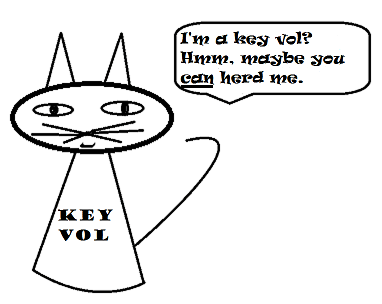
    So, here’s the question: If we identify key volunteer accounts, how will this help us in the management of all volunteers and correct the misconception that we herd cats?

    By reclassifying our work in terms of strategically managing volunteer accounts and key volunteer accounts, we will:

    • explain in recognized professional terms the vast work involved in cultivating and engaging volunteers
    • begin to prioritize our time in order to do the “key duties” such as recruiting, creating volunteer programs, relationship marketing, retention implementation, in-depth training and staff education
    • illustrate that focusing on key duties produces sustainable volunteer participation
    • more successfully require that all staff learn to manage volunteers, especially one time and episodic volunteers, therefore freeing us up to do the key duties
    • show potential volunteers that becoming key volunteers carries tremendous perks
    • free up the time necessary to educate ourselves, create programs and contribute in a more productive way
    • be able to demonstrate that not all volunteers produce the same results and that key volunteer account management creates key volunteers who will not only do the bulk of the work, but will also contribute in multiple other ways such as increased donations, resource allocating, community awareness, marketing, planning, trend setting, awards won, social media championing, recruiting, and program development
    • show that key volunteers will lighten staff workloads and free staff to work smarter
    • strategize the future instead of “handling” the present


    As we move from herding cats to a more modern and professional structure, what are some differences between outdated volunteer management and the new strategic volunteer account and key volunteer account management?


    Outdated Volunteer Management Strategic Volunteer Account Management Strategic Key Volunteer Account Management
    Vols fill jobs defined by org Steps to assure vol role is successful Partner with key vols to assure mutual org growth
    Retention by yearly luncheon, hours reported Vol contributions highlighted with real stats Key vols contribute to implementing programs of worth
    Vols view volunteering as “I get more than I give” and that’s enough Vols are integrated as essential members of team Key vols are integrated as shaping future of org
    All vols are just here to do org bidding Vol roles are created to meet changing needs of volunteers Key vols help shape the roles they wish to play
    Vols should be grateful to be volunteering Orgs should show gratitude to vols for volunteering Orgs value key vol input, skills and ideas in a win-win situation
    Fear that vols may “take over” or do something to harm org


    Allow vols to accompany staff on important assignments Trusting key vols to utilize their proven skills and desire to further org mission

    In order to be classified as a “key volunteer,” we most likely will be choosing those volunteers who are already known and trusted by fellow staff. This trust in a proven volunteer is the example you already possess to showcase the benefit for key volunteer designation.

    In many ways, there is an iron grip of thought relating to volunteers and volunteer management. Words and terms mean something and by referring to our work in professional, respected terms, we will begin to show the in-depth work and skill necessary to create a sustainable volunteer program. We will also begin to illustrate that freeing us from herding cats to concentrate on key duties will produce a stronger, better volunteer program. (everyone in the organization is responsible for engaging and managing volunteers-the volunteer manager does not have time to run around putting out fires)

    Let’s not be left behind in modernizing our profession. We are the Captains of our destinies.

    -Meridian


  • Captains of Our Destiny: The Key Volunteer Account Manager

    Captains of Our Destiny The Key Volunteer Account Manager

    As Captains of our destinies, we looked at some of the terms that define our work as Volunteer Account Managers. Now, let’s look at the responsibilities of the account manager and redefine them to fit our profession:

    Volunteer account manager responsibilities:

    • Serve as the point of contact for all volunteer account management matters.
    • Build and maintain strong, long-lasting volunteer relationships.
    • Develop opportunities and programs for volunteer engagement.
    • Mediate volunteer challenges.
    • Communicate the mission and policies of the organization to all volunteers and prospective volunteers.
    • Recruit new volunteers, volunteer groups and develop relationships with all volunteers through education, feedback, and progressive opportunities.
    • Forecast and track account metrics through volunteer feedback, community involvement, bench marking, research and continual participation in conferences and symposiums relevant to subject.
    • Prepare reports on volunteer contributions and trends.
    • Advocate for system changes when necessary.

    Interpersonal skill set of the Volunteer Account Manager: (partial list)

    • Solution oriented
    • Communicates clearly
    • Innovative
    • Professionalism
    • Mediation skills
    • Detail oriented
    • Relationship marketer
    • Ability to research, monitor and predict trends

    We can still go one step further and look at how organizations and businesses divide up the management of accounts. Does one person manage all accounts? Are some accounts afforded more attention than others?

    In account management, the key account has emerged and with it, the key account manager. So if we are volunteer account managers,  what would be a key volunteer account?

    Redefining a key account in terms of a volunteer key account yields: A key volunteer account is the volunteer or volunteer group who volunteers substantially in a sustainable manner and/or contributes greatly to organizational success. 

    This begs the question: Do we have key volunteer accounts?

    Do we spread ourselves too thin when we spend our time in a non-strategic soup? Do we run around, putting out fires, jumping from one scenario to the next trying to make sure each and every second of volunteer time is perfect? Are we really just herding cats?

    Can we maximize our time by identifying and explaining the steps necessary to cultivate key volunteer accounts?

    What are a few categories that might catapult a volunteer or volunteer group into key volunteer status?

    • dedicated on-going scheduled work that is vital to operations.
    • years of service and hours given.
    • the successful recruiting of additional volunteers and/or a community engagement champion.
    • leadership skills and/or the assumption of a leadership role.
    • dependability and the willingness to step up when needed.
    • highly trained or skilled in the mission and the ability to handle challenges.

    We all have these volunteers. They are what we wish every volunteer could be. If we apply the Pareto principle (80% of the output comes from 20% of the input), then approximately 20% of our volunteers are producing 80% of the vital work. Is this true? And what about new volunteer potential? Should we not spend our time in the soup, cultivating everyone in case we might lose that potentially great volunteer? Should we just herd cats in hopes that a few of those cats turn out to be key volunteer cats or should we begin to think in terms of key accounts and key strategies?

    Next time: How can strategic key volunteer account management help us manage all volunteers?

    -Meridian


  • Captains of Our Destiny: Captain Obvious Part 2

    Captains of Our Destiny

    Ha, ha, working with volunteers is like herding cats. …non-profit staff member.

    It is time we become captains of our own destiny. It is true that our work is not glaringly evident to all, so we can’t be Captain Obvious.

    So, now what? We can captain our future and redefine our work in terms that befit its importance while illuminating our professional skill set. It’s on us to redefine volunteer services, to flip it from one of cutesy, fluffy extra touches to a dynamic and professional service.

    How? Well, first off, we have to change the loose descriptions of volunteer engagement and instead use the professional terms they deserve. To do this, let’s look at two highly regarded and compensated jobs and re-imagine our profession in those terms and descriptions.

    Instead of volunteer managers, what if we were called Volunteer Account Managers? In reality, volunteers open accounts with us, in the same way as donors or clients. (an account is something of value or worth-in this case a volunteer’s time, expertise, resources, knowledge, sweat equity, donations, word of mouth marketing, etc)

    As such, we would use these terms:

    Volunteer Account Management: the management of volunteer accounts, including the relationship with volunteers and the pursuit of volunteer satisfaction.

    Volunteer expectations: the value a volunteer seeks from our organizations, such as training opportunities, positive feedback, admittance to the team, creative outlets etc.

    Volunteer centric: the emphasis an organization places on volunteer involvement, including timely appreciation, seats at planning meetings, designated volunteer managers who are supported, educational opportunities, partnership opportunities.

    Volunteer journey: the steps a volunteer goes through to become a viable and satisfied member of the organization.

    Volunteer journey mapping: the process by which a volunteer manager maps the journey a volunteer takes from first contact to integration through onboarding-and more importantly, the ability to reconfigure the steps when necessary.

    Volunteer profile: the ongoing process by which a volunteer manager educates staff about volunteers, including their needs, their changing dynamics, their skill levels, their rate of participation and their future involvement.

    Volunteer satisfaction levels: measuring and reporting the satisfaction levels of volunteers through one on one interviews, surveys, questionnaires, etc. And more importantly, the ability to change areas in which volunteers lack satisfaction.

    Volunteer benchmarking: the continual process of improving the relationship with volunteers. There are many methods of benchmarking, such as:

    • do volunteers choose our organization over others and why or why not?
    • do volunteers make time for us over other activities and why or why not?
    • do volunteers recommend our organization to their circle of influence and why or why not?
    • do volunteers increase visibility, donations and resources and how? (we all know instinctively that this is true, but benchmarking will prove it)

    Volunteer benchmarking will then be a tool to change the processes that need change, in the same way fundraising evolves.

    In order to Captain our own destiny, we must begin to flip volunteer services from the outdated idea that volunteers are summoned to fill a job and volunteer coordinators “herd those funny cats around, lol, isn’t that cute.”

    Instead:  Volunteers hold an account with us and we are responsible for cultivating that account by continually improving our relationship with the volunteers. And this is where the highly skilled volunteer account manager comes in.

    Next week: KAVM-the key account volunteer manager-what does this mean for us?

    -Meridian

  • Not So Fast, Captain Obvious

    Not So Fast Captain Obvious

    Suki is an events coordinator and part-time volunteer manager.

    She says, “I work hard, oftentimes 50 to 60 hours a week. I treat the volunteers as essential team members and make sure they are respected. I have a better than average return rate as my volunteers come back time and time again to help with events.

    My supervisor, Ellen just conducted my yearly review. One of my areas to work on was follow-up. I was shocked. I follow-up with each and every volunteer. I follow-up with vendors, locations, donors and staff. I asked her where that “needs improvement” came from and when pressed, she said it was because one of our managers overheard a group of volunteers mention that they weren’t sure which assignments they had at an event last year.  I told Ellen that the banquet manager had changed a few things last-minute and that I was sorting it out at the time of the comment. I mean, seriously, I would think all of my other hard work should stand for itself.”

    Sadly, Suki, no it does not. And here’s the lesson. What we think should be obvious to everyone never really is.  We work hard to engage and cultivate volunteers. Isn’t that evident? Ehhh, maybe not. Let’s compare a couple of scenarios and see if they are obvious to everyone.

    • An excellent volunteer is not sure if he wants to continue. He comes in to see you and you get coffee or tea for both of you. (a sign that he is worthy of your undivided attention). You sit at a table and listen to all his concerns. You take the time to explore what is going on in his life. You laugh, you listen, you probe, you assure him and with some tweaking of schedules or duties, you retain him. Obvious, right? But what does this actually look like?

    To you: One hour spent upfront retaining an essential volunteer = hundreds of hours of quality work from that volunteer.

    To observer: The volunteer manager has time to sit around and have coffee for an hour with a volunteer that really doesn’t need managing because they are already a great volunteer. Why can’t I get a volunteer when I need one?

    • One of your volunteers invites you to her daughter’s college soccer game. You go because you are going to meet the coach who is interested in having the entire team participate in volunteer activities.

    To you: This is a chance to recruit a group of volunteers. It’s an opportunity to set up a program that could last year after year. It also could be an in to an entire college system with access to other teams, clubs, classes etc. It’s a huge opportunity.

    To observer: The volunteer manager hangs out with her volunteers. She’s been seen going to birthday celebrations, picnics and now team sports. She runs the volunteer department like a sorority. We need volunteers who come to work, not to socialize.

    So, what do we do if our hard work is not self-explanatory? We must advocate for ourselves and our profession. We must become better at explaining the cultivation of volunteers. Whether we use algorithms or stories or a daily work flow, we need to be able to translate our work into concrete facts.

    How do we do that? Well, we can try:

    Create signs for your office door or cubicle that read “Volunteer Interview in Progress” or “Volunteer Engagement in Progress” or “Volunteer Feedback in Progress.” Put them on your door when sitting with any volunteer for a session.

    Develop a chart to track the hours needed to engage volunteers for maximum output. Does it take four or twelve or twenty hours spent one on one with a volunteer to produce two hundred volunteer hours a year? (approximately 4 hours per week) How many volunteers do you manage? Add all those engagement hours to show how much one on one time it takes to retain valuable volunteers.

    Begin to label your work. Instead of using terms such as “spent time with” or “sat down with” label the time spent with volunteers as retention, development, engagement, targeted recruiting, gathering feedback, role definitions, corrective action etc. Creating an understanding of the nuances of our work as essential building blocks is crucial. Our time spent with volunteers is necessary to volunteer development and it’s time we referred to this work in professional terms.

    While we are obviously super nice to our volunteers, we are nice with a purpose. Our profession must redefine our work to elevate it in terms of professional development. Calling the “spending of time” with a volunteer “targeted recruitment” does not change our methods, only the misconception of our work.

    And why should we frame everything we do in professionalism? So it does become obvious.

    -Meridian


  • Volunteer Fresh


    Volunteer Fresh

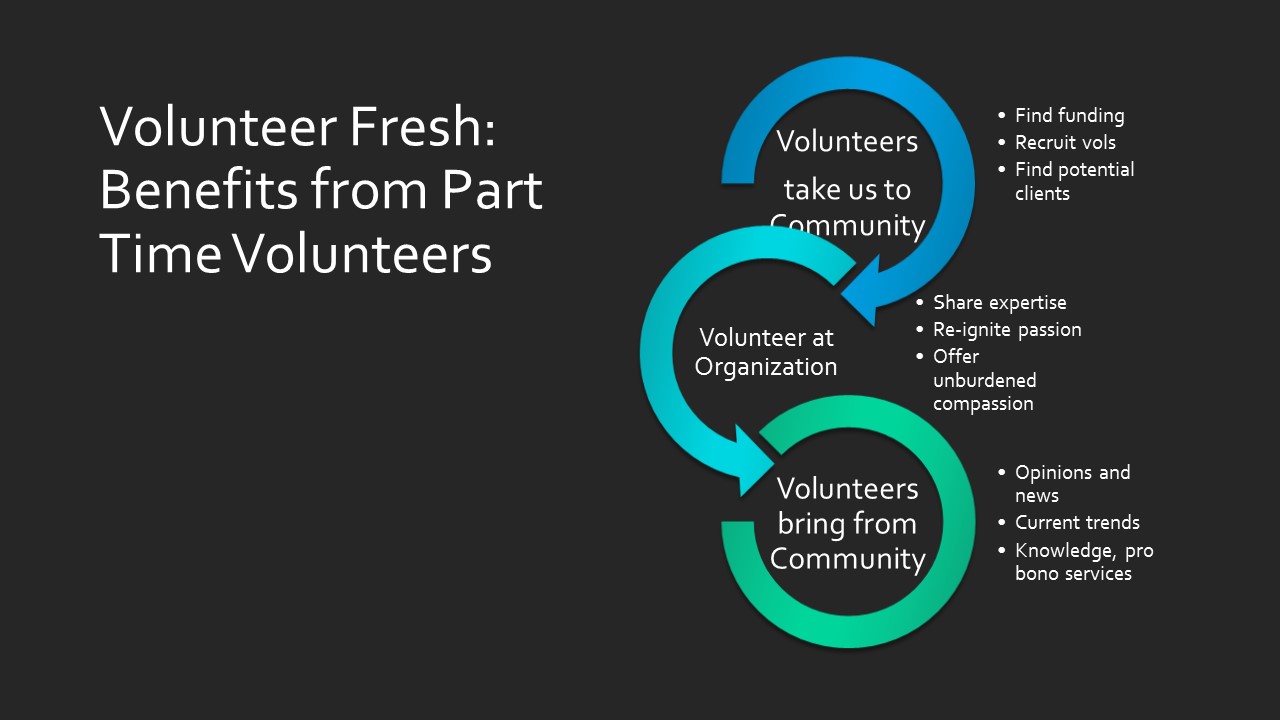
    Every day, volunteer managers witness the passion brought by volunteers. We marvel at their skill. We see their pure work, unencumbered by thoughts of pay, or chains to the financial burden of staying somewhere not fulfilling.

    But there is another positive that we can attribute to our volunteers. The number of hours they volunteer a week or month is often misconstrued as a shortcoming, but in reality is a gift: Volunteers are not burdened by the stress of working for us full-time.

    Volunteers who show up once a week or month are like opening the window to let in the breeze. They come in, trailing currents of fresh air. They bring with them new experiences, a taste of outside ideas, and rejuvenated enthusiasm to our stale environment.

    What factors contribute to a stale environment? Compassion fatigue, burnout, overwork, repetition, familiarity, slow to change movement, it’s always been done thus mentality, funding worries and stress. Each of these freshness killers lurks in the halls of non-profits, waiting to blow their stale breath into our lungs.

    There is an under current of pressure on non-profit workers to be “on” at all times. This Pedestal of Perpetual Caring implies that every moment is as intensely compassionate as the first one. Who can live up to that standard when reports are due, projects need attention and budgets are withering?

    Enter Volunteer Fresh:

    Our volunteers, unburdened by the stresses of working with us full-time can and do exhibit the intense compassion every client needs.

    Our volunteers are out there in the world 98% of the time and bring with them outside opinions, trends, ideas and methods.

    Our volunteers bring infectious enthusiasm and continually remind us why we love our work. They plug us back into our missions.

    Marketing Volunteer Fresh: (or, at your next staff meeting, use gimmicky but visual aids to encourage your organization to embrace volunteers as more than just those people who fill preconceived slots)

    Bring a sandwich from a vending machine along with a fresh sandwich from wherever staff loves to eat. Use each ingredient of the fresh sandwich to explain the layers of volunteer fresh and compare the two.

    Videotape volunteers speaking from the heart. Show staff the infectious enthusiasm volunteers bring. Remind them that opening up to each volunteer re-ignites their own passion.

    Use a radiating circle of connections chart to show the connections our volunteers are making within the community. Use arrows in both directions to illustrate the wide swath of information and influence our volunteers create, both coming and going.

    volunteer fresh pp


    Here are some concrete ways to offer Volunteer Fresh:

    Schedule “sit downs” between community engagement officers and volunteers. The engagement officer can ask volunteers to take the pulse of the community by asking pertinent questions of their friends, neighbors, civic groups, church members etc and then report back.

    Create a campaign via WOMM (word of mouth marketing). Marketing can release a sub-campaign via volunteers to reach out into the community on a specific hot topic. Equip volunteers with flyers, business cards, etc. to launch campaign and monitor feedback.

    Engage volunteers in stress relief. Create a team of volunteers to develop a stress relief program for staff and other volunteers. This volunteer team can institute ways to help over burdened staff cope with burnout.

    Volunteers are a gift of freshness. How fortunate we are to be able to incorporate fresh ideas, enthusiasm, and passion into our culture by people who offer all of this for free.

    Let’s encourage our organizations to open the window and let the freshness in.

    -Meridian

  • Volunteer or You’ll Lose Everything!

    Volunteer or You'll Lose Everything

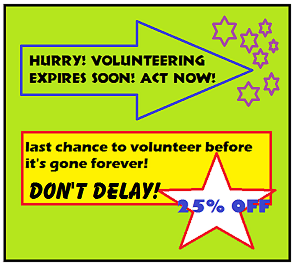
    In decision theory,  a loss aversion  means that the pain of losing something is much greater than the pleasure of making an equivalent gain. Marketers everywhere utilize this theory to hawk their goods.

    “Get it before it’s gone!”

    “Act fast. Limited supplies available!”

    In volunteer management, we prefer the gain theory when marketing to potential volunteers. We use phrases such as “the life you change may be your own,” or “do something meaningful” to entice others to join our cause. But what if these researchers are correct and we are hard wired to respond more to fear of loss?

    How would this advertising trick work with volunteer recruitment ads?. To find out, I stopped in to see my good friend, Svin Dler who runs an ad agency in town. He’s the genius behind such memorable ad campaigns as “Proud to Be Under Federal Investigation” and “Without Our Product, You’re a Worthless Pile of #$%@.”

    I walked into his inexplicably empty office and asked Svin to take some of our volunteer ads and apply the loss aversion theory to them. Here’s what he came up with. (after I passed a ten spot under the table to him-no, really he made me pass it under the table)

    Don’t miss out on this exciting opportunity to file papers! All the beautiful people are doing it. File those papers before they’re gone and then you won’t be beautiful!

    Volunteer now, or our charity will go out of business. Then, when your family needs help, no agency will help you because all agencies share a list of slackers. Don’t get turned away you slacker.

    Volunteer now or keep being your worthless selfish self. BTW, everyone hates you.

    Save the world by volunteering. If you don’t, the world will end and it will be YOUR FAULT.

    Hmmmm, I don’t know if those will work. Well, maybe the third one will….. no, no, they won’t. But can we write worthwhile ads and throw in a bit of the loss aversion theory?

    How about:

    There’s only a limited number of volunteering slots. Call 555-5555 to get started before the good ones are gone.

    Don’t miss our next life changing volunteer orientation. Refer to this coupon code:

    Act now! Don’t lose your chance to be a better person. Call this number:

    Well, that’s soul-less, isn’t it? Maybe loss aversion can’t be applied to volunteer recruitment. But wait. Perhaps if we lightly sprinkled in some loss aversion techniques, we could:

    Create an ad using the wish list and implied loss:

    “Do you wish to be more (circle all that apply): accomplished, social, engaged, in-tune, appreciated, worldly, satisfied, prepared, rejuvenated, self-aware, respected, content, experienced, understood?  Join us next Saturday. We have just three Volunteer Training slots still open. Come, let’s explore your wish list.”

    Create an email reminder for those who have expressed an interest:

    “Our volunteer training is this Saturday at 1pm. Seats are filling up and we would love to see you there. Click here to join our amazing volunteers.” (or diverse, or award winning or whatever adjective fits)

    Use urgency:

    “Our last volunteer training of the year is being held next Saturday at 1pm. As one of our volunteers, Jamal says, Don’t miss out on this life changing experience!”

    So, can we actually use marketing techniques for volunteer recruitment? Is that ok?

    Well, here’s a question: When designing volunteer recruitment ads, do we inadvertently give these impressions:

    There is no limit to the amount of volunteers we take

    Time is never of the essence-we’ll always be there kinda like death and taxes

    The choice volunteer positions never get filled

    Is there a boring and stale element to our ads that imply volunteering is a never-ending constant so heck, why not put it off?

    We are not gimmicky marketers looking to sell something and move on. We deal in cultivating real human beings who offer meaningful involvement, so tricks and slick words are not us. However, we are also not complacent.

    Here’s a recent ad I came across:

    “Join us for a Volunteer Orientation (date) to learn more about our organization and the many different ways you can help us. You will get an overview of our work and learn how you can help improve the lives in need by volunteering. To learn more about our volunteer program, check out our website.”(here)

    Now, let’s re-imagine this ad with a sprinkling of loss aversion theory:

    “A limited number of slots are still available for volunteer orientation on (date). Don’t miss out on exploring the many flexible ways you can help.” Visit our website (here) for a quick sign up. See you on (date)!”

    So, as long as we are truthful about our ads, why can’t we use some marketing techniques to recruit volunteers?

    Try it before it’s too late. (ooops, sorry)

    -Meridian


  • Sometimes, There Is No Parade

    Sometimes, There is No Parade
    Awww, you shouldn’t have.


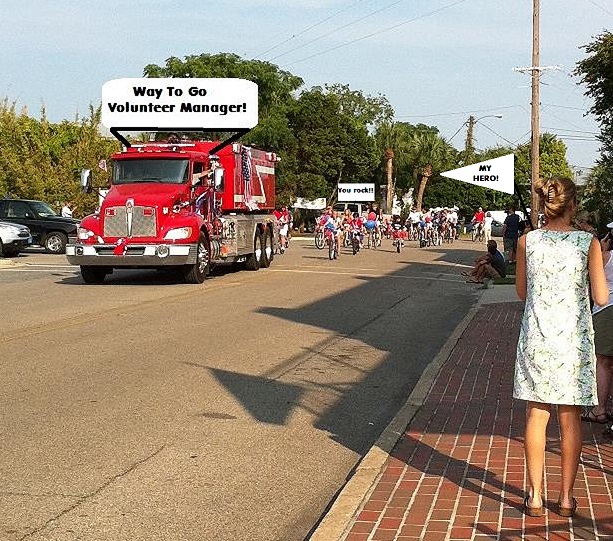
    Not everything volunteer managers do will be visible. Rather, in reality, most of our meaningful work is not about measurable numbers or stats. For this out of view work, there will be no awards, no pay raises and no parades. Yet, when recalling the moments that matter, these are the ones that usually spring into our minds.

    Helga was a volunteer who came to America after WWII. She married an American soldier, left her home in Germany to forge a new life in a new country with her new husband. Helga still retained her German accent. She was a tiny woman with a smile that reached up to her eyes, even after her beloved husband had died. I asked her to take a shift on the reception desk.

    We were in the process of initiating fingerprinting (Level 2) for our volunteers. It is a cumbersome and tedious process and the digital prints are hard to capture. Until this point, I submitted background checks (Level 1), read each report and challenged every anomaly I found. With Level 2, a central system approved or disapproved our volunteers, taking it out of my hands.

    We slowly filtered all of our volunteers, new and existing through the fingerprinting process. And, Helga was rejected. The rationale was that fingerprinting picks up “things” that a level 1 does not. I had to call Helga and tell her. I remember calling her and asking her to come in and talk to me. She knew immediately that it had to do with her fingerprints. She started to cry.

    We made an appointment for the next day. I hung up and felt…….. enraged. I wanted to know why this beautiful lady was being rejected, so I found an empty office and began to call the reporting agency, bouncing from person to person. It took the afternoon to get through to someone who could spend a minute to help me. She put me on hold, then came back on the line. “What’s her social security number again?” she asked. I told her. After another long hold, she came back. “Well, it seems it was a computer error. Your person has a clean record.”

    I called to tell Helga the good news, but something told me to keep our appointment. She did not answer so I left the message to please come in so I could explain in person what had happened.

    Helga came in the next day. I found a secluded spot to talk with her. We sat, knees to knees and I explained to her that it was a computer glitch. She burst into tears, crying deep and long as though a dam had given way. I hugged her. “Are you sure it was a mistake?” She asked.

    I wondered if this was about something other than her volunteering. “It was just a mistake, Helga. Do you trust me?” I said. “I would not lie to you.”

    She nodded and dabbed at her eyes. “I thought you might,” she said, “think I was a Nazi.”

    Suddenly, the present fell away.  I could see her, a young hopeful bride after the war was over, arriving in her new home. I could feel her trying to ignore the suspicions while desperately proving she was a good person. I could imagine that the past did not lie buried.

    We cried together for a good, long time. I called her the next day. “Helga, do you still believe me? Do you really, honestly know how much we love you?” At that point, I did not care how much time I had to spend convincing her.

    “Yes,” she said in a clear voice that removed my doubt. We did not speak of it again.

    That day I learned, for most of the time we spend doing our work, there will be no parade.

    But, my heart does not really want parades. It wants to hug Helga.

    -Meridian

  • The 1pinion Effect

    the-1pinion-effect

    “Our CEO has a next door neighbor who has a son who got into minor trouble,” Marlee, a volunteer manager says. “The neighbor asked our CEO if his son could do community service at her organization. I called the son repeatedly, left messages, but he never returned my calls. Wouldn’t you know it, my manager told me our CEO was annoyed because the neighbor blames me for not connecting with the son. My manager said our CEO made the comment that volunteers never seem to be able to get started here.” Marlee sighed. “I can’t win.”

    Ehhhhhhhhhh. How can one opinion or circumstance create a belief? Why didn’t the CEO say, to her neighbor, “that’s certainly not typical of OUR volunteer department.” How could she seemingly frame an entire belief on one opinion?

    There is something known as Confirmation Bias, an effect that feeds our assumptions. So maybe, Marlee’s CEO might have simply felt that her neighbor’s son was just one more example of the volunteer department’s failure to properly onboard volunteers because she already believed it to be true.

    Where did this belief come from? Did the CEO hear other examples (and it doesn’t matter how accurate they are, it’s the perception) of volunteers not onboarding quickly while not hearing enough success stories? Or maybe it has nothing to do with Marlee. Perhaps the CEO had a poor experience volunteering when in college. Maybe the CEO heard horror stories at networking events and applied those stories to all volunteer departments.  Is that fair? No, and even worse, perceptions are really hard to change.

    So what should the strong volunteer leader do when hearing these 1pinion comments?

    Don’t get mad or hurt-get curious: What is fueling these opinions? Do some research via surveying the staff or a one on one chat with senior management to find the sources of these perceptions. Say, “I heard something that concerns me. I think there is a perception that I don’t get in touch with new volunteers and I’d like to find out what happened to create that perception.” Then, be prepared to act! Refuting assumptions is one route to take, but there are better ways as in…

    Double down on positive reporting: Counter negative perceptions by offering facts supporting positive volunteer department accomplishments. Review your stats to find areas that are lacking. Create new categories of reporting to freshen up the numbers. But, again, this is somewhat akin to refuting, so there is another thing to try…

    Create your own performance improvement plan: No one wants to be unfairly criticized, so if there is a perception floating around that volunteers are not being contacted in a timely manner, embrace it on your terms. Let go of the frustration at having been unfairly labeled. A self-imposed performance improvement plan accomplishes two really important things.

    One, it says a great deal about you-that you are always willing to improve (and here it’s not about being unfairly labeled, it’s about always striving for excellence).  Say, “If there is a perception that new volunteers are not called back in a timely manner, well it came from somewhere and I’m here to change that. I don’t want one prospective volunteer to slip through the cracks.” This approach shows that you don’t harbor an us (volunteer department) versus them (upper management) attitude, that you are solution-oriented, and that you are proactive and approachable.

    Two, it allows you to create a new narrative by moving forward from this point of misconception.  (It’s so much easier to create new impressions, than fix old ones). By acknowledging the old perception, you are not positioning yourself for a fight. You are forging a new, cooperative path, one in which your future statistics will be embraced in a positive light. And you will find your critics becoming supporters along this journey.

    We are all prone to confirmation bias. As proactive leaders, we must put aside our personal feelings when hearing negative perceptions, and work to change those perceptions by creating new, positive ones.

    Let’s face it. Opinions are not facts. Opinions can be unfair. While we may not be able to control each and every negative opinion, as proactive leaders, we certainly can control what we do about them. And the thing we do best is understand people and their motivations.

    When confronted with 1pinions, we can gear up for a pointless fight or we can use our strengths to create new and more positive realities.

    -Meridian

  • Interview With A Volunteer: Ellie

    contacts

    We all know volunteer feedback is invaluable, during and after projects and assignments. There is also value in gathering feedback from former volunteers who have had the time to process their experiences and take aways.

    Recently I was able to catch up with a retired volunteer, Ellie, and I asked her to look back on her years of volunteering for a hospice.

    VolunteerPlainTalk (VPT): How many years did you volunteer?

    Ellie (E): (laughs) “oh about 18.”

    VPT: That’s a long time.

    E: It was a long time, but it was good.

    VPT: What was your favorite part of volunteering?

    E: Hmmm, my favorite part. I liked the idea of giving and I always felt that I was receiving so much in return, but I guess you hear that a lot.

    VPT: Do you remember the beginning?

    E: Yes. I remember my training. At the end of training, the volunteer trainer handed me my first assignment. She told me that she believed I was ready. And she took me over to the window and pointed to the house of the person I was assigned to. She sort of let me know that it wasn’t far away and I would be close to help if I needed it.

    VPT: How did that go?

    E: I was nervous, but I felt prepared.

    VPT: Was your first assignment the impetus that kept you going?

    E: Actually, it was my first long-term patient, who came right after. We became incredibly close. Before she passed away, she said that she had added one more daughter to her family. And shortly before she died, she called me in and said that she needed to know that I was going to be ok. The extent of our connection was something I never expected.

    VPT: How much of a role did your volunteer manager play in your success?

    E: Oh my goodness, so much. The fact that my trainer and my supervisor, Jim trusted me, had faith that I could do this was huge. And, I always felt that if I had a question, he would be there. I remember I was sitting with one patient whose wife had a part-time job. He had a morphine drip and he thought it wasn’t working and he said to me, I don’t understand why this is not working, can you find out? Now, I have no medical knowledge at all, but I immediately got on the phone and my supervisor got me to the right person. That went a long way to building my self-confidence.

    VPT: So, having someone to contact was hugely important.

    E: Absolutely. I always counted on being able to knock on his door, go in and receive the support I needed.

    VPT: You are also a thirty year now retired school teacher. Why did you volunteer at a hospice and not with children?

    E: (laughs) I think I needed to do something different. After my husband died so young, I felt like I wanted to do something that was meaningful.

    VPT: Did his death influence your decision to volunteer for a hospice?

    E: I don’t think so. It was over three years between his death and my decision to volunteer.

    VPT: How did you find hospice?

    E: I saw this ad, and I knew right then it was a way to fill my life with some meaning.

    VPT: So, there was no magic formula for recruiting you?

    E: Sorry, no.

    VPT: Many people think hospice volunteering is depressing. Were you burdened with sadness?

    E: No. It was quite the opposite. It was fulfilling.

    VPT: Was there any opportunity for fun?

    E: Oh, my yes. I had so much fun with the staff. We let loose all the time. The seriousness of our work was a contrast to the silliness we experienced. I remember the time we made over 100 pumpkin pies for a Thanksgiving dinner in our care center. We laughed the whole time. Having that fun kept us wanting to do more, you know what I mean?

    VPT: I do. Was having fun a good use of your volunteer supervisor’s time do you think?

    E: Absolutely. Life is full of balances. The balance between serious work and letting off steam goes a long way to bond us together. It strengthened our team.

    VPT: I’m pushing here, but I wonder. Have you ever connected your losing your husband, the man you had planned on retiring with, and your work in hospice?

    E: Ehh, no. I just know that I had a lot of years to give and it was a way to fill my life with some meaningful work.  But I do remember one year, I signed up to volunteer at a children’s grief camp.  That day, while driving on the way to camp, I thought about all the little kids who were coming. They had all lost someone important in their lives and I had a little meltdown. I missed my husband.

    VPT: That must have been tough.

    E: I thought about these kids and it occurred to me that I went through this years ago. It brings something home. While I was there, we had a ceremony at night. I was really grieving for my husband. It comes when you least expect it. Sometimes you have an epiphany to a particular circumstance you’ve been through. It was almost like a total realization I had been through a significant loss and I released that.

    VPT: I’m at a loss for words.

    E: I even had grief counseling after his death. But my meltdown shocked me. I thought I had processed the grief.

    VPT: So, in retrospect, did your volunteering have a personal positive impact on you?

    E: Oh my, yes.

    Next time: Part 2 of this interview. Ellie moved away from her hospice, but she stopped volunteering before she moved. Why?

    -Meridian

  • Two Upcoming Events

    Where can you learn from the world’s best authorities on volunteer management? At the 2017 National Summit on Volunteer Engagement Leadership scheduled for July 26-28, 2017 in St. Paul, Minnesota. Here, experts will share their wisdom and experiences in over 100 breakout sessions during the three day summit. Choosing the sessions to attend will be an incredibly difficult undertaking, given the excellent lineup of foremost authorities in volunteer engagement. Here is a partial list of the presenting superstars:

    Susan J. Ellis-Energize Inc., Rob Jackson-Rob Jackson Consulting , Elisa Kosarin- Twenty Hats, Betty Stallings, Barry Altland-Head, Heart And Hands Engagement , Tony Goodrow-Better Impact , Liza Dyer-Liza’s blog, Tobi Johnson-VolunteerPro, Jennifer Bennett-VolunteerMatch , Beth Steinhorn-JFFixler Group  

    I am honored to also be presenting a workshop on elevating volunteer management by focusing on creating the building blocks for a volunteer leader’s personal brand. You are after all, the face of your program. I am so exited to be part of this amazing summit. I would love for you to join me if you are attending. The breakout will be interactive, fun and you will leave with concrete tools to utilize in strengthening your leadership. The session particulars are:

    Breakout 1-Wednesday, July 26th, from 2:15-3:45pm

    Track: Professional Development see track here

    From Manager to Leader: Elevating Volunteer Management
    Meridian Swift, Author and Blogger | volunteerplaintalk.com
    Join this interactive session that focuses on developing your own personal leadership brand. Explore the six building blocks that define proactive versus reactive volunteer management. Awaken the leader within to advance your program’s standing within your organization through re-imagined thinking.

    Hopefully we will see you in Minnesota in July.

    The other exciting event is a joint venture between myself and Elisa Kosarin (see above list of superstars) from Twenty Hats. Because we are both passionate about supporting all the great volunteer managers who work tirelessly in our profession, Elisa came up with this wonderful idea for a national retreat to be held in the fall of 2018. I was more than happy to get on board. But wait! A contest is involved! Here are the particulars from Elisa:

    On the board of your volunteer managers association or DOVIA? We have a contest for you!

    Volunteer Management Pros Meridian Swift of Volunteer Plain Talkand Elisa Kosarin of Twenty Hats are teaming up. They would like to host a weekend-long retreat just for volunteer managers.
    This first-ever national retreat would include two days of workshops, conversation, and fun to help you revitalize your professional passion. This is not a conference! Elisa and Meridian are providing the setting and the coaching for you to discover new insights into your path, career, and personal goals.

    The event is planned for the fall of 2018 — but they need your help in finding an awesome spot to hold the retreat.

    And that’s where the CONTEST comes in:

    If you are a Leader of Volunteers who sits on the board of your volunteer manager association, please help find the venue for the 2018 retreat!
    The association that finds the winning venue receives the benefit of THREE FREE REGISTRATIONS for this event. In addition, the winning association will receive a special discounted price for any other members who would like to attend.
    Is your organization in?  If yes,here are the specs for the retreat venue:
    • Available for two nights, Friday and Saturday
    • Time frame is a weekend in October 2018
    • Large enough to accommodate 30-50 guests
    • Meals provided, or list of catering options provided
    • At least two meeting spaces available
    • Price average $150 per day, if meals provided

    If you represent an organization that’s game for this contest, email Elisa at Twenty Hats to enter.

    The deadline to identify a venue is May 31.

    Email Elisa if you have any questions and happy searching!

    Thank you for all you do.

    -Meridian