Category: recruitment

  • Eureka! I’ve Discovered the Value of a Volunteer!

    volunteer badge

    Volunteer manager Lilly looked up to see the CEO standing in her doorway. “I’m trying to remember our volunteer, Gladys Williams, can you tell me about her?”

    “Oh,” Lilly said, “Gladys was a wonderful volunteer who did office work in finance. She volunteered there for about 12 years, even before I got here. I attended her funeral last month.”

    “I think I remember her. Small lady, white hair?”

    “Ahhh, yes,” Lilly said thinking that description fit any number of office volunteers and added, “she always wore a purple ribbon in memory of her husband.”

    “I think so. Well, we were just told that she left us $25,000 in her estate. I thought you should know.” The CEO paused for a moment. ” Now I’ll have to let finance know too.”

    I read an article recently about the generous surprise gift  bequeathed to a Detroit museum from the estate of a 19 year volunteer. While the incredibly benevolent support of her organization speaks volumes, the tone of the article made me wonder how this volunteer would have been remembered (beyond the staff that obviously cared about her) had she not given such a sizable donation. And exactly how much does a volunteer have to give before the fundraising arm of our charities becomes giddy?

    We all know our volunteers regularly donate money and goods, which seems to now be a trendy topic among the fund-raising gurus who gleefully point to these stories as if they’ve discovered a whole new vein of gold. But again, how much do volunteers have to give in order to be smiled at and afforded that extra bit of silky attention normally reserved for the donor crowd? Is it $1,000, $10,000, $24,999 or more? Will $50,000 pressure upper management into inviting a volunteer to an exclusive luncheon?   Will $27,856 make the organization really, sincerely interested in the wonderful work that volunteer is doing?

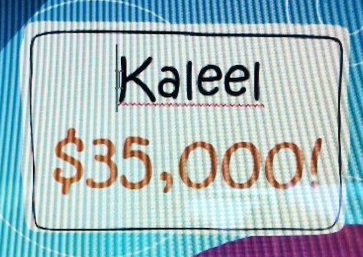
    So, I’ve hatched a plan in the basement laboratory of my brain. I think all volunteer managers should include an estate planned giving form with our volunteer applications. We should coerce our volunteers into committing to an amount they will bequeath after they die. Then, that amount should be printed in bold type on their badge. On a really valuable volunteer, it will look something like this:

    volunteer badge2

    That way, at a glance, everyone in the organization can see the worth of that volunteer. Now granted, those, like volunteer Mary above, who are not giving very much may be relegated to the nameless rabble heap, but hey, at least some of our volunteers will achieve recognition.

    And so, when volunteer Imani holds the hand of that distraught client and gently dries flowing tears while staying that extra two hours until family members arrive, her pledged gift of $14,000 might just get some notice.
    After all, it’s all about the money, er work, isn’t it?
    -Meridian


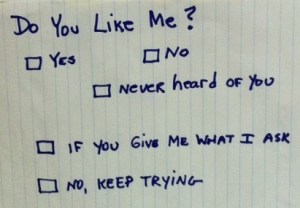
  • If I Say No Will You Stop Liking Me or Can We Negotiate?

    like me
    Taylor, a petite millennial, manages volunteers for an agency that pairs mentors with children struggling in elementary school. Taylor recruits, schedules and places the reading buddies who help seven and eight year olds improve their reading skills. One staff meeting day, she was asked to provide volunteers at an upcoming cocktail party given for the mayor and several dignitaries and key donors. Taken aback, Taylor said she didn’t think that her group of volunteers would want to serve drinks.
    “The senior managers looked at each other as if I had declared a mutiny. One snidely asked me if it was too much for me to try or if I was too busy. I couldn’t believe it, but I kind of stammered that I would ask.” Taylor adjusted her glasses and paused. “Ever since that day, they have treated me differently. It’s subtle, but I can feel a coldness about them. It’s as if I committed the ultimate betrayal, although they seem to have no problem questioning each others’ ideas. I guess it’s ok for them, but not for me.”

    Ahh, I can still remember twenty years ago being told that I got the job as a volunteer manager mainly because I was so nice. “Yes!” I shouted in my head.(but not too loudly so as to offend my other thoughts) “I am nice,” I pumped my fist (not too threateningly, more like a sweet hello wave). I prided myself on being nice and after all, that’s what was expected of me, wasn’t it? Yep, what a great job, can’t wait to be nice to some volunteers!
    Well, it didn’t take too long for me to figure out that nice was a personality trait and not a skill. I found I needed some mad skills to actually manage volunteers. “Dang,” my nice self said over a cold beer, “this is much more complicated than I thought!”
    And after a few years, I began to wonder if those random “you’re so nice” comments might just be code for some other concept. Are the following definitions of “nice” the secret meanings of the word?
    Nice=invisible
    Nice=doormat
    Nice=timid, placid, submissive, weak, docile, spineless, wishy-washy
    Nice=quiet, never offering opinion, robotic
    Nice=unable to see the big picture like those in charge.

    Hmm, can nice volunteer managers say no as in “no, the volunteers will not go out in the blizzard to put flyers all over town for your event because you forgot to mail them out?” And, if we say no, will we be disliked?

    Well, it’s not about whether senior management likes us (and really, we know deep down that doormats are not liked, they’re used), it’s about doing our jobs. It’s about being a team player but also an expert in our volunteer base. We know our volunteers and their capabilities and we should not be afraid to voice our opinions on utilizing them. So, in between Dolly Doormat or Negative Ned, is the logical negotiator.

    For example, Negative Ned might shout, “No way dude! Seriously, you want me to round up volunteers right now? Do I look like I have nothing else to do? If you honestly think volunteers just sit around waiting for me to call, then you’re nuts!”
    Or Dolly Doormat might nod her head and smile. “Yes, ma’am, I’ll cancel that presentation at the Ladies’ Auxiliary I had lined up for this afternoon and get right on it. I’m sure those 200 potential volunteers won’t mind my last minute no-show. I’ll just apologize profusely to them and try to explain in my monthly report why there are no new recruited volunteers.”

    Instead, here’s how Noble the Negotiator would answer: “Let me see if I understand this correctly. You need five volunteers in two hours to man a booth at a last minute fair. (re-state the request) That sounds like an important task.(acknowledge that the requester feels the request is important) I have an important presentation today that could possibly give our organization an ‘in’ with the Ladies Auxiliary and have put a lot of effort into making this happen so you can see that I have to be there. (nicely point out that you have work you must do and why it’s important) But let’s figure this out. Can a staff member set up the fair and stay until our first volunteer arrives? (involve the requester or offer alternatives if the request can’t be wholly fulfilled) I will put a trusted volunteer on the phone right now and give him a list to call. Since I will be out in the field, I will have that volunteer keep you updated until I return.” (fulfill the request without owning the lateness or mistake or circumstances that make the request difficult to fulfill)

    There is a danger when we, volunteer managers look at requests from our own emotional prism. When we deem requests “stupid” or “unreasonable,” we lose the objectivity needed to operate in a professional manner. Besides, volunteers deserve to make up their own minds as to whether to drop everything and come in or to subjugate themselves to what we may perceive as a demeaning task. It’s their choice.

    But if we are seeing patterns of refusal, then we can arm ourselves with the data to justify a “no volunteer will do that job” scenario. Keep detailed records of volunteer responses to requests. It can be as simple as “when we call during the day, 82% of our volunteers are already engaged in other activities and cannot come in,” or “of the 43 volunteers called, 100% said no, they were not comfortable serving drinks to donors at a party. Five of them even called it and I quote, ‘inappropriate’.”

    Data always trumps vague, emotional claims such as, “volunteers don’t want to do that!” Knowledge and data are the capital with which to negotiate. We don’t have to be afraid to voice our expert opinion in such a way that we are not perceived as pushing-back or lazy or negative.

    If we become a noble negotiator, we may or may not be liked, but we will be respected.
    -Meridian

  • Hands On Network Tokyo: The Ease of Volunteering

    IMG_2321
    http://www.handsontokyo.org/en/home

    I was incredibly fortunate to have spent the month of September in Japan visiting my daughter who teaches English as a second language. While visiting this amazing and beautiful country, I was honored to be able to spend some time at Hands On Tokyo, the volunteer center affiliated with the Hands On Network and the only Points of Light affiliate in Japan.

    The Japanese people are incredibly kind, generous and considerate, from the man who left his train car to steer my husband and I to our destination to the couple who shared their dinner with us at the Hanshin Tigers’ baseball game. I imagined that the directors of Hands On Tokyo would be welcoming, and they were not only welcoming, but enthusiastic and infectious.

    My gracious hosts, Mimi Yoshii, Co-Director and Aya Higa, Co-Director warmly welcomed me to their office in the Minato area of Tokyo. The office was bright, full of schedules and deadlines and event planning. But these two dynamic ladies took time from their busy schedules to tell me about Hands On Tokyo’s many activities.

    Hands on Tokyo was founded in 2006 by a group of volunteers including a woman who had been active at Hands On Atlanta. The really neat thing about Hands on Tokyo is their model of partnering the needs of the community with their 5,000+ corporate and individual volunteers. Mimi Yoshii said with understandable pride, “we are unique in that we are the go between for corporate projects and those who need help.” Hands On Tokyo is also distinguished by Japanese and foreign nationals volunteering side by side and as Aya Higa related, “about 60% of volunteers are foreigners living in Japan.”

    Interest in Hands On Tokyo really took off after the devastating Tohoku earthquake and tsunami in 2011. Many foreigners stepped forward to offer help, which, under the dire circumstance, was quickly accepted. I asked if the foreigners were viewed in a positive light and Aya Higa stated that the Japanese recipients of help truly appreciated all the faces from other lands. I could only imagine the monumental tasks this organization faced at that time.

    I asked about the challenges they face today and as you would expect, they have the same challenges we all face. Background checks are becoming a necessity as is the need for new and meaningful projects. They too experience lopsided periods of time in which there are more volunteers than projects.

    Mimi Yoshii emphasized their desire to create an ease of volunteering to encourage the Japanese people to become more involved. One of the barriers to volunteering is the desire by the Japanese people to not shame their friends and neighbors by highlighting the fact that they are in need, a practice referred to as the “culture of shaming.” It reminded me to be more careful when working with clients, so as not to let our desire to help overshadow clients’ need to be treated with dignity and respect.

    Mimi and Aya lit up when talking about the interns they work with primarily during summer. These young volunteers, even though they may initially join to work in the office, bring fresh new ideas, something Hands On Tokyo loves to cultivate. One intern, they recalled, a dancer, began a program that brought dance into a nursing home. The residents not only loved it, they asked “when can we do it again?” It quickly became a staple at that nursing home.

    Hands On Tokyo cultivates their volunteers by encouraging them to become volunteer leaders. Every project has a volunteer leader on hand. These volunteers demonstrate leadership abilities and possess the skills and experience needed to lead a team. Every month team leaders meet to discuss issues, challenges and methods of motivating and keeping the volunteers on track. A few of the many projects include Special Olympics bowling and basketball, senior home activities, English lessons for the blind, assistance to farmers, rice ball making for single mothers and excursions for Down syndrome children.

    Crane made and given to me by a total stranger
    Crane made and given to me by a total stranger

    Hands On Tokyo volunteers can conveniently sign up for an activity through the website portal. Besides the ongoing projects, there are volunteering events such as “A Taste for Volunteering,” and the “Spring charity concert for Tohoku.”

    Recruitment for Hands On Tokyo is through their website and by corporate partners providing interested employees. Aya Higa said that in Japan, if a crowd of people is asked to volunteer, no one will raise their hand, and so their strategy is for volunteers to ask people they know directly, face to face, a practice that yields much better results.

    All in all, it was encouraging to find volunteer management in Japan mirroring the same challenges and solutions that we face in the US. I was deeply impressed by the dedication, excitement and pure joy of Hands On Tokyo’s co-directors, Aya Higa and Mimi Yoshii. Their hospitality was so appreciated.

    Thank you ladies for sharing your passion for volunteerism with me and for showing me that the rewards and challenges of volunteer management are universal. Visiting Hands On Tokyo is a treasured moment from a wonderful trip to an amazing country.

    Arigatou gozaimasu!

    -Meridian

  • Face It: Fit, Attitude, Change, Expectations, by Intervention within a Timeline Part 2

    “Tenderness and kindness are not signs of weakness and despair, but manifestations of strength and resolution.”
    …Kahlil Gibran

    You have a volunteer that is problematic and you are at the point where you believe you have done everything possible to integrate that volunteer. You’ve examined your personal feelings on the situation and feel that you have removed emotion from the equation and are dealing with the challenge in a logical way. So, now what to do?
    Well, think of this acronym- Face It:  Fit, Attitude, Change Adaptability, and Expectations through Intervention within a Timeline. I know it’s a mouth and mindful but hopefully it will help in remembering how to go about working with challenging volunteers. When integrating a volunteer becomes difficult, use this acronym to see if, after interventions within a timeline, there is improvement. Let’s look at each letter in FACE IT.

    Fit: How well does the volunteer fit, not only within the organization, but in her role, with other volunteers, and in the mission? Is the job just the wrong fit or does her philosophy not mesh with the organization’s mission? Does her personality clash with all other volunteers and staff? Is she there for some underlying agenda?

    Attitude: Does the volunteer have a troublesome attitude? Does he incessantly complain? Does he undermine? Is he excessively negative? Is he disrespectful to his supervisors and co-workers? Does he feel that he is superior to the tasks and to the mission?

    Change Adaptability: Is the volunteer able to weather change? Does she dig in her heels when faced with a new policy? Does she refuse to adjust and claims that because it was always done a certain way, you have no right to progress? Does she subvert the mission because she cannot accept new ways and new people?

    Expectations: Is the volunteer meeting clearly defined expectations? Is he chronically late or a no-show? Does he ignore rules and regulations? Does he do whatever he wants without regard to organizational needs? Does he feel that it is not important to communicate with you? Is he a Lone Ranger, but without the white hat?

    These are four pillars of excellent volunteering. When one or more pillars become troublesome, an intervention with that volunteer is necessary. Sometimes it’s just life’s stress that causes great volunteers to go off course. Intervention is never mean but instead, indicates that you notice a change in the volunteer’s behavior and that you respect this volunteer’s contributions and want to help him succeed.

    But help without clear objectives and timelines is futile, so let’s look at the second word in the acronym and the steps of implementation.

    Intervention:
    1. Meet with the volunteer to discuss the area(s) that need(s) improvement.
    2. Point to your rules and regulations, policies and procedures to illustrate your concerns.
    3. Present your evidence, but emphasize your desire to help the volunteer succeed. While note keeping on volunteers may seem underhanded, without details on egregious behavior, your “case” is broad and hearsay.  Besides, specifics help a volunteer see the exact behavior that needs improvement.
    4. Reiterate your commitment to working with this volunteer and then lay a course for how the volunteer can improve.

    Timeline: I can’t emphasize this enough-Timelines are critical. How long do we give a volunteer to improve? Having a clear deadline is effective. Having some random phantom goal in the future will doom your intervention every time.
    1. Set follow up meetings at intervals to monitor improvement.
    2. Make sure you collect evidence of the volunteer’s performance for further steps.
    3. Always meet on premise.
    4. Have at least one other staff member present. This not only gives you another set of eyes and ears, but limits the “he said, she said” aspect and shows the volunteer that you have the support of the organization.
    5. Always leave interventions after asking if the volunteer understands the steps outlined, because if you don’t, that volunteer can easily say that he did not comprehend what was being discussed.

    Interventions are usually enough to motivate a volunteer to succeed, especially if the volunteer is new (having a clear six month probationary period for all new volunteers helps too). But for the minute number of volunteers who do not improve, a “parting as friends” and a “wishing you well” is in order.

    Without upfront, clear instruction and expectations, no manager can assume that volunteers know what is expected of them.
    Rules, job descriptions, termination policies and the steps of intervention must be written and signed by each and every volunteer.
    Infractions must be recorded and addressed immediately with volunteers.
    Often, we view ourselves as too nice to point out egregious behavior. But really, we are not being too nice, we are just practicing confrontation avoidance.
    Instead, the nice thing to do is to help a volunteer excel, not languish, unable to improve, isolated and ostracized by staff and peers.
    The nice thing to do is to create an atmosphere of excellence, of lofty expectations, of volunteer quality so that your volunteers are proud to contribute and your clients are served by the very best.

    Yes, I want to be tender and kind, and I will by being strong and resolute.
    -Meridian

    Oh, next time: Collecting Evidence

  • Horror! Should I Pull the Plug on a Volunteer? Part 1

    plug

    Ebony is in charge of a busy thrift store. The only staff member, Ebony manages sales, donations, store appearance, supply ordering, advertisement and the twenty volunteers who help her throughout the week. She has precious little time for drama or nonsense. Because her volunteers are a tight-knit team, when Bernice, a new volunteer signed up, Ebony placed her on the day the most welcoming volunteers worked. But a month later, those volunteers began to openly complain about Bernice’s attitude. Bernice had quit another resale shop volunteer position and was vocal about her perception that Ebony’s shop did not run as efficiently as her former store. Bernice complained about pricing, merchandising, advertising and lack of volunteer perks such as sizable discounts on merchandize.

    Unused to volunteer conflict, Ebony had several heart to heart talks with Bernice and moved her to a different day. The complaints continued. Frustrated, Ebony hoped the volunteers would work things out, but her stalwart volunteers began to call out sick and take longer vacations.  The once hard-working team became listless, negative and unproductive. Two volunteers quit, giving broad reasons. The other volunteers refused to fill in on the day Bernice worked. Ebony found her team crumbling. Too late she realized that one volunteer could destroy months and years of team building.

    When do we pull the plug on a volunteer? How much trying to integrate one person is too much? This is a dilemma that we all face at some point in our careers. And while we may erroneously feel that we have failed if not every volunteer becomes successfully integrated, we have to weigh the time and effort spent working with a volunteer and their impact on other volunteers versus keeping someone just to keep them.

    I remember a volunteer, Dot from my first years as a volunteer coordinator. She was a retired professional and not only belonged to many clubs and organizations but attained leadership roles in most. She was highly intelligent, but authoritarian and demanding. Her air of superiority was off-putting to volunteers and staff. I once complimented her on her outfit and she said, “I have a doctor’s appointment today and I want to make sure he is intimidated by me.” Everyone tiptoed around her because Dot put her own importance above the mission.  Being new to volunteer management, I didn’t think we could dismiss Dot, but I asked. My senior managers were already afraid of what she might do, and sure enough, one day she went to the board of directors to threaten a volunteer walkout over a policy she disagreed with. Eventually the senior managers realized that something had to be done and she was let go. It was messy. She wrote a letter to the other volunteers imploring them to quit in solidarity, which thankfully, they did not.

    What could Ebony or I have done to integrate Bernice and Dot? Did we miss something? Would spending more of our time have helped? Or is there a point when parting ways with a volunteer is the right thing to do? Can we stop blaming ourselves if occasionally, a volunteer does not work out no matter how hard we try?

    The answer is yes, there is a point when the amount of work spent keeping a volunteer is incredibly lopsided against the benefit in having that volunteer. In weighing whether to continue to try to keep a problematic volunteer, you have to ask yourself these questions:

    Do I spend more time on this volunteer than on any other?
    Do I field more negative feedback about this volunteer than positive?
    Do I find other good volunteers and staff refusing to work with this volunteer?
    Do I find myself worrying what might go wrong when this volunteer is present?
    Do I find myself bending rules and expectations in order to avoid confrontation with this volunteer?

    But, hang on, before we can ask the questions above, we have to do some soul-searching of our own deep feelings on the matter to see if there are some personal perceptions that are keeping us unable to meet the challenge head on.

    By being brutally honest with ourselves when working with problematic volunteers, we can move away from emotion based analysis and into logical resolution.

    Am I petrified of confrontation even though I see there is no forward movement with this volunteer?
    Am I afraid that I will just give in and not stick to my convictions?
    Am I looking at this as a failure on my part?
    Am I thinking that this will make me a mean person?
    Am I clinging to my vision that volunteering is perfect? And that I must be perfect?
    Am I just afraid of the unpleasantness of it all? Do I just want volunteering to be sunshine and kittens and not involve the hard stuff like requiring excellence and management?

    The first set of questions refers to the problem at hand while the second set deals with our own emotions. And lets face it, we have feelings too. But, we can learn to acknowledge our feelings so as to view problematic volunteers in a logical and yet kind way. Sure, our stomach feels like the spin cycle of a washing machine when we are faced with unpleasant conversations, but just remember, by avoiding the issue, it only gets worse, not better. And besides, volunteer success or failure should never be about our feelings, but about the volunteer and the mission.

    Next week, part two: FACE It: An acronym to remember when dealing with a challenging volunteer.

    -Meridian

  • Gobble, Gobble, Good God I’m Frazzled!

    pumpkin2
    Willow, a new volunteer manager for a small organization providing aid to the homeless population in her town, answered her phone the day before Thanksgiving. She had spent long hours that week, organizing and recruiting volunteers to help prepare the annual meal held at a local high school auditorium. Exhausted, her brain overloaded, she tried to muster up enough energy to sound human on the incoming call.

    The caller identified himself as Harry, the coach of a soccer team consisting of 15-year-old boys. “I’d like to get these boys involved in helping others,” he told Willow. “We’d like to come out and feed the homeless tomorrow.”

    Willow felt a throbbing in her forehead. “How many players are we talking about?”

    “Not the whole team, mind you, about 7 or 8.”

    Tears filled her eyes like the bubbles in a natural spring. The volunteer slots were set in stone. It had taken every fiber of her new volunteer manager being to accomplish that. She was bone weary and wondered, why did this man wait until now to call? How could he think that there was no coordination in putting together something so incredibly complicated? Why does no one understand?

    It’s happened to all of us. Often, people call at the last moment to help, especially at holiday times. After it happens, you begin to expect it and it is incredibly frustrating to have to tell a group of willing helpers that they are not needed because they procrastinated or called on a whim. They are, after all, potential volunteers. Granted, most might never volunteer again, but there’s always that little voice in our heads that sneers, “there goes a group that might just have been the greatest group of volunteers known to man. And you denied them. Tsk, tsk.”

    So, what to do if you are not able to just dust off those last-minute potential holiday volunteers? If you feel that a part of your job is to give people the chance to experience the deep, satisfying joy in volunteering, then you will feel a twinge of guilt or sadness when having to refuse someone, even if they called too late. We all know that holidays bring out the desire to help and that each “drop in” volunteer might become an advocate for our organizations.  Can we accommodate those late comers without making the holidays a nightmare for ourselves?

    Yes, there is a way. It’s not perfect mind you, but it’s better than feeling overwhelmed and guilty at the same time. And it takes implementing now.

    So that the future you is not caught in a holiday trap, prepare for the season right now. Before the holidays creep up on you, create some projects that last-minute folks can do. Don’t save the work that must be done but be ready with some extra projects that are off premises and not in direct contact with clients. (No background checks needed). You can invite these one time volunteers to become official volunteers at a later time.

    Start now by asking everyone in your organization for fantasy projects. Ask, “If you had 3 or 5 or 10 volunteers over the holidays, what could they do?” Does marketing fantasize about hundreds of distributed holiday flyers? Does the thrift store secretly salivate over a huge deep cleaning and resorting for the season? Does finance have a tired office that cries for a fresh coat of paint? Is there a corner where an extra decorated tree would look lovely? Do you partner with other agencies and can you ask them if they have projects? I’ve always been able to find a nursing home that was extremely grateful for some extra help during the season.

    You can also create your own meaningful projects. Go to social workers and ask if they have a family that needs Christmas presents because of financial need and then create a “gift tree” with the ages and sizes of family members on paper ornaments. Buying a gift for someone who is going through a tough time is a very satisfying introduction to volunteering. Don’t be afraid to create a project in which the participants will have to spend a bit of money. That never seems to matter.

    One time volunteers can certainly write holiday cards and wishes to older clients or children. They can have a card writing party off premise. Ask a willing volunteer to attend to explain how much these cards mean to your clients. The point is to be creative. You know the difference between meaningless work and projects that can actually enhance the holidays. Have an extra tree to decorate, or paper place mats to color (good for youth groups to do). Ask your existing volunteers if they would be willing to mentor a group when necessary. Stock up on craft supplies now.

    Then, when someone calls last-minute, instead of having to say, “sorry, but there’s nothing I can give you,” you can invite the late comers to get their feet wet by tackling a small but worthwhile project. If the latecomer says no, at least you offered something. I’ve had folks tell me that my organization was the only one  who even tried to place them. That good feeling can translate to future volunteers.

    You, by virtue of being a volunteer manager, take care of everyone around you. Take care of yourself this holiday season by preparing now for those inevitable 12th hour but sincere calls to help. Your future self will thank you.

    -Meridian

  • Press “1” If You’re Perfect

    keypad.JPG

    Sometimes when I’m reaching for that smashed granola bar way back in the desk drawer I think, “how can I steal more time?” Is there like a soul-selling website that guarantees 15 more minutes in each day? If so, I’m in. Or maybe I can cut corners by creating an automated interview system for prospective volunteers. Eliminating that personal touch by interviewing and cultivating each new volunteer would save, what 16.9 years of my life? Hmmm, if I did create an automated system, would it sound something like this?

    “Hello, you have reached the volunteer hotline. Please listen carefully to our menu and select the number that best describes your desire to volunteer and someone will get back with you shortly. As demand is great for our volunteer positions, your expected wait time is 3 minutes. (this is a blatant lie, but it’s the old marketing scheme that makes it sound like the volunteer positions are popular and you’d better get one now before they run out).

    Press 1 if you have the sincere desire to help. You have no underlying reasons to volunteer other than you want to give back. You listen to directions, offer constructive criticisms and are punctual. You communicate well, take your volunteer position seriously and love being part of a team. Your expected call back time is 5 minutes or less. Actually, please wait by your phone, a volunteer coordinator will pick up right now.

    Press 2 if you also have the sincere desire to help. You are a bit hesitant, unsure of what you are getting into, would like to bond with similarly minded volunteers and are willing to do what it takes to learn. You would appreciate having a social experience here. Your expected call back time is 20 minutes or less.

    Press 3 if you also want to help and feel the need to be needed. Pressing the “like” button on Facebook makes you happy, especially when it’s about cute puppies or kitties doing incredibly cute things. You get a thrill when someone thanks you, and praise words like “couldn’t have done it without you” makes you tingly all over. Your expected call back time is 2 days or less.

    Press 4 if you are the leader of a group such as a club, team or service organization and want your group to experience the substantive worth of volunteering. You really don’t know where to begin, what your group’s availability will be nor the number of participants at any given time. You are really flying blind here and kind of trust that one of our volunteer coordinators will have all the answers and that group volunteering is fairly easy and there are immediate opportunities just waiting to be filled. Your expected call back time is 2 weeks or less.

    Press 5 if you have court ordered community service or you are under 18 and your mom is making you do this. You really hate the idea of being forced to endure all this feel good hokum and you honestly think that we non-profit types are full of sh… sugary sweet stuff that will gag you and rob you of your bad boy edginess. Your expected call back time is 10 weeks or less, no wait, maybe 10 weeks or a lot more.

    Press 6 if you say you want to help but pretty much you want to force your will on all of us. You have the need to control and criticize and really want to run the show. You are unwilling to apply for a job in this organization, but would rather back door yourself in as a volunteer, cleverly thinking that we would never fire a volunteer, no matter how destructive they might turn out to be. Like an Olympic hammer throw, you love to sling passive-aggressive phrases such as, “you really think that’s a good idea,” and “no wonder it’s chaos in here.” You burrowed into your last volunteer position and waited, trap door spider style until an unsuspecting staff member or other volunteer walked into your verbal stings.  Your expected call back time is, well, I will leave your information for the person who someday will replace me. On second thought, I don’t want to be mean to my eventual replacement so your information will just magically get lost into a trap door of our own.

    I love fantasies, but as I’m munching on the incredibly old granola bar, I realize that forcing volunteers into neat little categories is never a good idea. So, as the great Emily Litella (Gilda Radner, Saturday Night Live) once said, “Never mind.”

    -Meridian

  • ProPer Tweets and Other Social Media

    twitterIsabella couldn’t wait to get back to the volunteer office and tweet. It had been a long day at her organization and 17 volunteers showed up at 5am to prepare packets, man booths, hand out water, snacks and awards at the annual Run for Awareness campaign. Staff members complimented her on the volunteers’ professionalism and how much they had contributed.

    She thanked each volunteer as they helped with cleanup and then, thoroughly spent, she returned to her office where she shut the door and collapsed into her chair.  She then pulled out her phone, accessed her account, @IsabellaVolMgr77 and tweeted:

    #VoteYesOnProp37 Just met a guy at our 5K He is organizing a 5K next year to support Prop37 more details later!

    What you ask? What does this have to do with her volunteers? Exactly! See, Isabella is very passionate about an upcoming election issue in her community and she tweets about her support for proposition 37 frequently.

    So, all right, big deal, what’s the harm? Well, prop 37 is a divisive issue in her town and half of the towns’ folks are strongly opposed to it. (which means half of her active volunteers and prospective volunteers could be put off by her sharing of support for this cause.)

    In another part of town, Randy, a volunteer manager for a small start up charity checked his twitter account @RandyHelpforNeedyOrg and smiled. His last series of tweets were pretty clever he thought. His tweets were:
    #firstdatesareevil Getting ready for first date. Perspiration stains on shirt oh no!
    #firstdatesareevil Almost there, salmon on grill, I’m feeling flaky too!
    #firstdatesareevil Burned the salmon, dropped a drink, I’m doomed!

    Am I getting picky here? Maybe. Because our jobs require emotional intelligence, we can understandably view volunteers as friends, compatriots and even followers on social media. It’s easy to regale them with our personal lives and our passions because they look to us as their bosses. But how much do we really want to draw our volunteers into our personal lives and views?

    I’ve noticed over the years that there is a segment of the volunteer population, albeit a small one, that really wants to operate on a strictly professional level. They are the volunteers who are not interested in my family, my funny mishaps or my secret passions. I take no offense, because it’s literally not personal. They’re the ones who discreetly roll their eyes in orientation when I get too “cutesy” and want me to stick to the professional task at hand.

    But back to tweeting and social media. Is there a fine line that we walk between acting in a professional manner and allowing our warm, engaging personalities to still come through? Can Pro(professional) and Per(personal) ever be ProPer? Absolutely. Let’s look at some examples of Per (personal) tweets and ways to seize an opportunity to rephrase them for volunteers and therefore make them do double duty and more Pro (professional):

    Per tweet: Sigh, 3 car accident made me late to work today.
    ProPer Tweet: Accident made me late to work today, makes me appreciate all the vols who consistently show up on schedule!

    Per tweet: Hey guys, here’s my favorite funny cat video!
    ProPer Tweet: Here’s my favorite funny cat video, humor is a great stress relief, don’t forget to take care of yourselves!

    Per tweet: I’m voting for Candidate Jones!
    ProPer tweet: Met volunteers at a candidate Jones rally, they are passionate and committed, reminded me of our volunteers who btw are the best!

    Per tweet: Guy in line just argued with cashier who wasn’t fast enough. #jerksareeverywhere
    ProPer tweet: Guy in line just argued with cashier for being slow. Reminds me to again thank our vols for being so patient when I forget to call back!

    The sharing of ourselves-our humor, our love, our very humanity is a great way to connect with volunteers. And if you turn the personal (Per) into a message about them (Pro), you’ve successfully engaged the volunteers once again, which is a very proper thing to do.
    -Meridian

  • Click, Click, Clique!

    Don’t you just hate it when everything becomes such a fine line? I’ve never encountered more fine lines than in volunteer management, except maybe when trying to decide a reasonable curfew for a teenager.

    Cheryl is new to volunteering. She took a job that afforded her some free time so she wanted to give back. Scouring online ads for the perfect volunteer place, she decided to take training at a local chapter of a large organization. “I was excited, really excited, because I could picture myself actually helping people in my community. I never volunteered before, never had time before and I was nervous because I didn’t know what to expect. So I went to training which was pretty good and then I went to my first volunteer meeting. It was in the evening, and as I looked around at the volunteers coming in, I saw people who looked like they worked too, so that made me feel a bond with them. I took a seat in the back. It was fairly crowded and I spoke briefly to the man next to me. He said he was relatively new too, hadn’t gotten an assignment yet, but was looking forward to starting. The meeting began with the chapter’s director showing a power point highlighting the stats from a previous quarter. Then there were general announcements. I noticed that the same small group of volunteers spoke up with stories or questions and they seemed to continually refer to each other. I figured they were the long-term volunteers. Then they asked one of those volunteers to come up and talk about the upcoming needs. She listed several events and assignments and asked for folks to volunteer. I started to raise my hand, but she pointed at her group and before I knew it, they had all laughingly worked out the assignments. I looked at the man next to me and he rolled his eyes. I guess I should have been more forceful, I don’t know. I thought they wanted new volunteers, but now I’m not sure.”

    Ahhh, the volunteer clique. It happens because of that fine line. When we need groups of volunteers to take on assignments, especially on-going assignments, we work extra hard to find personalities that will mesh. We introduce hand picked volunteers to each other and hope that the team will “click.” I know I get all tingly when I drop in on a group and they are chatting away, enjoying themselves and each other. It’s a real perk to volunteering. You can almost hear the team bonding as each person joins. Click, click, click. It’s wonderful. But then, because of that fine line, some teams, not most thankfully, will click so well that they become exclusive. They shut new volunteers out. They become suspicious of and sometimes actually sabotage the newbies.

    New volunteers are as varied as long-term volunteers. Some are forceful, some are timid. But even under the best of circumstances, being new is challenging. So, what to do when introducing a new volunteer to an established group of seasoned volunteers in order to prevent cliquish behavior?
    Here are a few things I learned by making mistakes with group culture. I hope these observations help you too.

    1. Do not just drop the new volunteer into the group, even if it is only temporary. Talk about getting stiff behavior-I brought a new volunteer into a group one day and I thought I had walked into a meat locker, the response was so cold. Alert the group beforehand, talk to them in person, or call to keep from putting them on the spot.
    2. Talk about the awesomeness of the group to the newbie and vice versa. Let the group know that this new person considers it an honor to join such a fantastic well-functioning group.
    3. Appeal to the group’s sensibilities. I’ve said to groups, “I wanted Doug to join you because he’s anxious to do well and I couldn’t think of a volunteer group better able to show him the ropes.”
    4. Make it temporary at first. I’d say, “Doug will be learning from you and then I hope that he can join a group of his own once he’s ready.” Sometimes the group will just love the newbie and take them in because the decision was their’s to make. If a newbie is not forced upon them, the group is often more receptive.
    5. Check in often. Observing the dynamics of the group will tell you everything about how well the integration is working. Check in to let the group and the newbie know that you care about their success and how they feel about each other.
    6. Reiterate that the organization wants to be inclusive of new folks. I’ve used phrases like, “we don’t want to be the best kept secret,” and “we want everyone to be able to have a meaningful experience. With your help, we can do that with our new volunteers.”

    But what happens if all else fails? I’ve had groups that, when a member or two is out for extended periods of time get angry because the temporary newbie doesn’t operate just like good old Janet or Bob or whomever is missing. Then, when several newer volunteers tell me that they won’t work with that group because of the way they are treated, I know I have a problem, and it’s time for a heart to heart. And here’s where one of the biggest lessons I’ve learned comes into play: Don’t ignore a problem. Ignoring a problem only makes it fester.
    The group and I will have a chat about change. (On their time and turf is best I’ve found so I “drop in”). Change and volunteers is like buying a smaller size skirt and hoping it will be good enough to wear at a presentation. Something usually pops.
    So, we chat. The group may be worried that their missing member is sick and will never return. They may think that new volunteers will come in and critique them. They may feel like they’re not doing a good enough job, because if someone new needs to come in, what does that say about them?

    But back to Cheryl and her experience. As volunteer managers, it’s our responsibility to monitor who gets called to service. We need to especially look out for new people and integrate them into the team. It’s better to look at everyone in the room when speaking and not appear to have favorites by chuckling over inside jokes or discussing past events in front of new people without explaining the context to them. Everything can be an inclusive and teachable moment.
    It’s a shame that Cheryl’s volunteer coordinator did not approach the long-term volunteers prior to the meeting and ask if they would “show the ropes” to the newer volunteers. He/she could have asked, “is there anyone here tonight that is new and would like to join our wonderful seasoned volunteers who are happy to help you acclimate here?”

    Then, Cheryl and maybe the man next to her would have had an assignment. And that organization would be one step closer to having another enthused ready to go volunteer.
    -Meridian

  • Looking Back

    I’m on vacation this week visiting family. In typical volunteer manager fashion, I figured I’d be searching the yellow pages for and interviewing volunteer managers in a new and different town. But, I’ve subjected my family to so much work intrusion throughout their lives as I’m sure you have too. It’s time to just simply enjoy them.
    So, I got up before everyone this morning, fired up the coffee and looked back, found this very early post and copied it. I hope you don’t mind. It made me feel good, because I know this visit with family will come to an end and I will be sad because life is not perfect, but it is a balance of work and home, success and failure, joy and pain, curiosity and fear. And in it all lies meaning; meaning for those we serve and meaning for us. Here is the post from four years ago:

    You know how some days just feel wrong?  Today was one of those days. I had been reading some very interesting articles about volunteer management and started getting ideas that I could adopt for the volunteers I work with when a little voice said, “It’s Friday. Who cares? You’re overworked, underappreciated and tired of the struggle. Give it up.” I wasn’t happy to see any of the volunteers today. I wasn’t all that funny or nice or anything. I was blah.

    As I was sitting there, staring at the computer, willing it to make me feel better, the phone rang. I don’t know about you, but when it rings on blah days, I sometimes let voicemail pick it up and then I call back later. It makes me feel more in control I guess. But for some reason I reached for it. Must be habit.

    I answered and it was Monroe calling from Des Moines where he now lives with his mother. Monroe used to volunteer with us. He is 23 years old. He moved to our area with his Mom to look for work. They lived in an apartment a block from my office with no car, no job and little resources except a grandmother who lived in the area.

    He came into my office three years ago and asked to volunteer. He is one of these really, really quiet types; you know the ones who answer in monosyllables. He speaks in a voice that barely breaks a decibel and looks down as he talks. He is covered with tattoos and piercings and wears nothing but black. He has a goatee.

    To be honest, I took one look at him and wondered why on earth he would want to volunteer and would he scare staff, clients and other volunteers? I gave him the information for the next orientation and thought no more about it. Not only did he show up, he came to all six sessions, and participated, albeit in monosyllables. The other volunteers started to like him.

    Monroe started volunteering in the office. He told me a little about his situation. I could lie and say he opened up, but he did give me some tidbits here and there. I happened to be working with some volunteers on a music project and I mentioned that to Monroe. He said he wanted to help. Now this is a project that a very select few volunteers who have extensive musical experience work on, but I brought Monroe along for a meeting and practice. He not only did anything asked of him, he asked to do more. He informed me that music was his passion.

    From that day forward, Monroe became our go to guy for anything musical, whether it be production, setting up, getting snacks or toting heavy equipment. He became one of us very quickly and every single volunteer took him under a wing. I have to admit I drove him a few places and so did other volunteers. He was always very grateful. I got to see his apartment one afternoon when I gave him a ride home. He was very proud of his room.

    His Mom could not find work and so they had to go back to family in Des Moines. I am not lying when I say I really miss him and so do the volunteers who worked with him.

    After I happily greeted him on the phone, I asked him how he was doing and in typical Monroe fashion, he said “good.” I tried to extract more, but I did get that his mom had a job and so did he. He was working on writing music and doing well. He told me that he wanted to keep in touch with us and I was relieved. I asked him if he found a place to volunteer and he said that he had thought about it, but no, it wouldn’t be the same. He then told me that we were family to him.

    We all have the chance to impact the lives of those we serve by providing the best volunteers we can. We all have those nuggets of success when a volunteer does a great job. But this is different. Monroe is a personal slice of joy for me. I don’t know how much his volunteering experience impacted him, but I can guess that we had a very positive impact on his self-esteem and psyche. I hope we did, and I hope that I never forget that everyone has something to offer. Volunteer managers are fortunate enough to be able to discover and cultivate the talents and desires of the folks we manage. The heck with blah. I’ve been reminded that it’s good.

    -Meridian