Category: staff and volunteer relationships

  • Mono or Multi? Voluntasking is the Answer

    office mail business work
    Photo by Tookapic on Pexels.com

    Greta’s hand was shaking. Three recent volunteer requests needed her attention. One of her volunteers, Serena, was on the phone with a major problem. End of month reports were due at 5pm and Greta hadn’t gotten the chance to record all the available volunteer hours. Matt, a recent graduate of the latest volunteer orientation was standing in her doorway. He needed a dose of her encouragement. She could feel her heart racing. How would she be able to do it all?

    Multi-tasking vs. single or mono-tasking. A 2009 study of heavy media multitaskers versus light media multitaskers from the Proceedings of the National Academy of Sciences of the United States of America revealed that heavy media multitaskers are more likely to be affected by random, non-essential stimuli. And here’s the surprising results. Heavy media multitaskers performed worse than light media multitaskers on a task-switching ability test, instead of performing better as expected. It seems as though multi-tasking actually hinders our ability to concentrate.

    There is one tremendous benefit we seldom speak of in describing volunteer contributions. Volunteers are more able to focus on a single task than harried staff who are juggling multiple duties at one time. We, volunteer managers know this from experience. Take Greta in the example above. Can she possibly bring her best to each task in front of her? Will she be able to give her undivided attention to Matt, or to Serena? Will she find the concentration necessary to fill the volunteer tasks? Can she actually clear her mind to gather and record the volunteer hours for her report, not to mention adding the additional stats and stories she knows will make her report more impactful? Or will her attention dart back and forth, splitting her cognitive abilities into tiny, unusable pieces?

    No, not with all the external stimuli that fractures her attention. This inability to do superhuman multitasking is one of the reasons we, volunteer managers ask for volunteer help with our workload. We realize that a competent volunteer can do a job that might take us ten times as long to do, because we are in a constant state of being distracted.

    We’ve seen it so many times. Give a volunteer a desk and a light and they will power through an assignment. Volunteers possess the trifecta of task accomplishment:

    • The will or passion
    • The time
    • The focus

    We need to highlight this overlooked asset and properly showcase it as a benefit derived from embracing volunteer help . We can start by asking staff and senior management these questions:

    • If you had two hours a day to focus on one task without interruption, what could you accomplish?
    • Do you often feel like you are being pulled in multiple directions and you can’t concentrate?
    • What would it mean to you if you could offload a portion of your work so that you could give your attention to the tasks you feel are critical to your job and our mission?
    • Do you feel that being pulled in so many directions actually helps or hinders your ability to reach your goals?

    And here’s the kicker question:

    Do you really think that someone who is passionate about helping, can sit and actually focus on the task at hand and is willing to devote the time to getting it done will do a much poorer job than the person who is continuously pulled in every direction?

    If you want to have some fun, at the next staff meeting, ask staff to take out a piece of paper. Announce a phrase, such as “volunteers are great.” Ask staff to spell the phrase out loud while writing their names and addresses on their piece of paper. You’ll get laughs and groans, but it will take a good chunk of time as their brains switch back and forth between tasks. And it won’t help that they are being distracted by the reactions of their fellow staff members around them.

    Now point out that this is their reality. Ask them (in all seriousness) why they wouldn’t want a volunteer, one who is capable, and has the will, time and focus to accomplish tasks more quickly and efficiently, helping them.

    Non-profits are notoriously understaffed and overburdened. The reluctance to seek volunteers’ help is holding missions back from great accomplishments. The mind-destroying multi-tasking world in which non-profit staff find themselves can be alleviated by the help of focused volunteers.

    We can encourage our organizations to take advantage of volunteer help for many reasons, all of them sound. One simple, but overlooked reason is voluntasking: the passion and ability of volunteers to devote the time it takes to focus on one task, thus accomplishing it faster and with more accuracy and freeing up staff to concentrate on mission centric goals.

    Or, we can all continue to cling to our workloads and keep multitasking. But, if we do, we’d better learn to love mediocrity and burnout.

    -Meridian

     

  • Don’t. Do. This. Ever.

    Don't Do This Ever
    from: floridastateparks.org

    Sometimes misdeeds are huge, indefensible and devastating. Take the ongoing scandal involving Oxfam for instance. It’s big.

    But slippery slopes lurk everywhere, like alligator eyes floating above the river, waiting to take you down. Misdeeds can begin innocently and maybe they won’t make the front pages, but they will ripple through your water when that gator pulls you under.

    Melanie was a volunteer coordinator who cared deeply for her volunteers. She personally interviewed each one to get to know them and understand their strengths. She attended birthdays, took volunteers to appointments and helped when volunteers needed assistance.

    One of her volunteers Dorothy, was a widow, her husband having died a few years before. Melanie invited Dorothy over for dinner a few times a month and introduced her to her husband and children. They welcomed her, making Dorothy an honorary family member. Taking care of Dorothy made Melanie feel really good about her role as a volunteer manager.

    But one day, Melanie came to work and was called into the CEO’s office. It seems that Dorothy’s daughter, who lived out-of-state, came to visit her mother and went through some of her mother’s finances. She discovered Dorothy had loaned Melanie money to pay for a soccer clinic for the kids. Innocent, right? Melanie was put on probation, paid the money back and more tragically, never recovered her exuberant spirit. She became cautious, bitter, not sure how she could ever be close to her volunteers again. She quit.

    What is your gift/loan/money policy at work? Does it include volunteers? We tend to make sure our volunteers know their boundaries, but do we have policy regarding staff’s (including us, the volunteer manager) boundaries with them? (for an example of employee gift policies, see the balance)

    While we seek to forge deep relationships with our volunteers, we have to keep this in mind: We are the volunteers’ supervisor. Not a peer, not a friend, not a counselor, not a family member, not the fixer of their lives. We are their boss.

    As their boss, we must define gifts to and from a volunteer. Is a card ok? A cup of tea? Seriously, these items all have a monetary value and defining value helps to create policy and creating specific policies regarding gifts between staff and volunteers will save any misinterpretation down the road.

    If a volunteer offers money, or a gift card, tickets to an event, a new blouse they bought but don’t like, say no. All of these items are alligator eyes peering at you from beneath the water. They all have monetary value. Instead, ask that volunteer to donate the money or item to the organization in your name and for heaven’s sakes, ask them to write a note accompanying the donation saying how awesome and ethical you are.

    But NEVER take money from a volunteer for any reason. It’s the grand poobah of slippery slopes. And having that policy in writing gives you all the backup you need to say a polite but firm “no.”

    Some misdeeds will be headline news, will damage a charity’s reputation and set the great work done by so many other dedicated staff and volunteers back by years. That’s a tragedy. These misdeeds may be so egregious that they are obviously wrong to the rest of us, but, then, there are the minor little innocently begun misdeeds that also damage good intent in subtle, but very real and lasting ways. Every day simple mistakes ruin good careers.

    Be involved with and care about your volunteers, but when it comes to money, Don’t. Do. This. Ever.

    -Meridian


  • “We want to work with staff who have drunk the Kool-Aid,” an interview with Laura Rundell, CVA


    An Interview with Laura Rundell, CVA
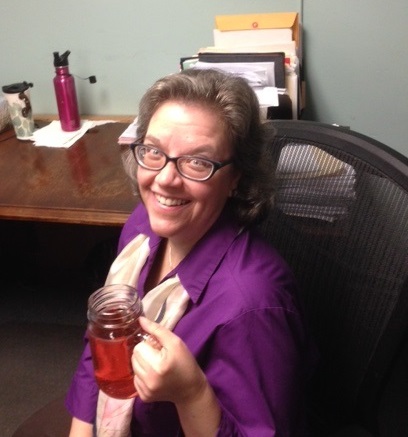
    Laura Rundell, CVA with a mug of Kool-Aid


    Recently I had the pleasure in chatting with Laura Rundell, CVA, the Volunteer Coordinator at LifeBridge Community Services in Bridgeport, Connecticut.

    VPT: Laura, tell us a little bit about your background in the volunteer management sector.

    L: I’ve been involved in the volunteer sector since 1999.  During grad school where I received my Master’s in History, I worked part-time for the Park service. I have also worked for several other organizations, including the Spellman Museum of Stamps and Postal History in Weston, Massachusetts, the Phipps Conservatory in Pittsburgh. Pennsylvania and I am currently the Volunteer Coordinator at Life Bridge Community Services in Bridgeport, Connecticut.

    VPT: And how long have you been at Life Bridge?

    L: I’ve been here since 2014.

    VPT: What brought you to volunteer services?

    L: It was at the Phipps Conservatory that I began to fall in love with volunteer management. I had come from a smaller organization to Phipps and found out they had over 500 names on their volunteer list, so the scope changed dramatically.

    VPT: And how did you come to be at Life Bridge?

    L: I moved to Connecticut and landed at Life Bridge in 2014.

    VPT: You’ve had a number of experiences thus far. What have they taught you?

    L: Not all my experiences were perfect. An already challenging job is much harder when the goals for the program and the roles for volunteers are less defined.

    I appreciate where I am as a volunteer manager now and loved my time at Phipps because they support the volunteer program and there are clear expectations and specific roles for volunteers.

    VPT: Can you give us an example?

    L: Yes. When I was invited for an interview at Life Bridge, I noted that the person who would be my supervisor had the CVA credential. It was clear they had put thought into their volunteer program and knew what it would take to make it successful. In my third interview, I was sitting at a table with all of the staff who would utilize volunteers in their programs. I was really impressed that they put so much thought and effort into recruiting for this position and knew then it was an organization I really wanted to work for. I was delighted to be offered the position.

    VPT: That is impressive.

    L: And, just recently, our Executive Director asked for a volunteer to be involved in researching best practices for a project. That shows commitment to engaging volunteer help at all levels of our organization.

    VPT: I’ve noticed you are weighing in on articles and blog posts more and more and that is great; we need more voices. What do you feel is the future of volunteer management?

    L: I see so many non-profits stretched thin and need more volunteers to take on a greater role.

    VPT: That’s a good thing for increased volunteer participation, right?

    L:  Yes it sure is, but I think the number one challenge for most volunteer coordinators is recruitment. It will be an even bigger challenge moving forward to keep filling those roles with qualified and committed volunteers. It means we all have to “step up our game”.

    VPT: Are you seeing changes in the volunteers who are stepping forward?

    L: There are more episodic volunteers, more students who are seeking career experience, and more individuals in the midst of a career change seeking resume enhancers and references. There are also more opportunities to recruit corporate and college groups.

    VPT: Are there inherent challenges with episodic volunteers?

    L:  We have had some really great short-term volunteers. Not every role is appropriate for someone who may only be with us a short time though. Some roles require clearances that can take 4 weeks to get back, so we really hope the person in that role can stay with us for at least a year. We’ve also gotten some really great college and corporate groups. However, walking that balance between offering the flexibility large groups may require and making it a meaningful opportunity that adds value to the organization is a challenge.

    VPT: What have you discovered about recruiting volunteers that you can share with us?

    L: You have to respond promptly when an applicant contacts you. When I relocated to Pittsburgh from Massachusetts, I contacted several organizations to volunteer and never got a return call. That was really frustrating.  After that first contact though, the applicant has to be invested — it has to be their choice to move forward. I have learned you can waste a lot of time spinning your wheels if an applicant doesn’t respond to a request to meet with you, doesn’t show up for an appointment or doesn’t follow up afterwards.

    VPT: Changing direction, do you feel as though volunteer managers are starting to build a community with one another?

    L: By the time I became a CVA, I was linked to a community of volunteer managers. But, often, a volunteer manager is a department of one and is isolated. When I was in Pittsburgh, I reached out to similar volunteer organizations and we volunteer managers would get together a couple of times a year to have lunch and share best practices. Here in Connecticut, we have Volunteer Square and they have done a wonderful job in creating a Professional Development Series for volunteer managers. I’m honored to serve on their advisory board.

    VPT: So, there are some steps being taken.

    L:  You know there is an Association of Fundraising Professionals (www.afpnet.org/) for those who are in the fundraising end but we have no association for volunteer managers.  I wish we had one nationwide organization. Not everyone can attend a national conference, but if we had a national association, we could have branches in our areas that we could connect with and could set national standards for our profession.

    VPT: What do you see as future challenges for our profession?

    L: As non-profit funding continues to decline, there will be more and more dependence on volunteer programs to pick up the slack and organizations will be utilizing volunteer services more. As everyone scrambles for a piece of the ever-shrinking pie, we need to have a unified voice instead of competing against one another for limited resources. For instance, if we all required that courts who refer mandated community service applicants to our agencies provide the funding necessary to fully vet, train and supervise these applicants, we might make some real changes in how court mandated service is assigned nationally.

    VPT: What advice do you have for new volunteer managers?

    L: After I moved to Connecticut, I remember talking to a volunteer I worked with in Pittsburgh and the volunteer said, “We want to work with staff who have drunk the Kool Aid.” If staff is unhappy, or does not believe in the work, then volunteers pick up on that. If an agency has a lot of turnover and has difficulty retaining paid staff, than recruiting and retaining volunteers may be an uphill battle.

    L: I would also say, make sure you connect with other volunteer managers in your area. I have learned so much from my colleagues. Just an hour spent talking with another volunteer coordinator over lunch or coffee can be invaluable. You can learn “It’s not just me…others have this problem too” Also, obtaining the CVA (certified volunteer administrator) is very helpful. I feel like the CVA credential has given me more of a standing in my organization. The CVA gives me ethical standards to adhere to and by virtue of my having it, my volunteer program is elevated.

    L: Also, you need to have rules and policies in place and stick to them. If someone wants you to waive the requirements for a new volunteer, remember this: There are bad actors who seek out vulnerable populations. This is why we don’t bend the rules. Make sure you have a volunteer manual, written policies, and an agreement letter for the volunteer to sign.

    VPT: What makes a difference for you?

    L:  I feel blessed to do what I do. Yes, there are challenges, yes there are frustrations, but a well-run volunteer program can leverage the passion and talent of volunteers.

    L:  I’ll leave you with my favorite story about a volunteer. Before I was at Phipps, I was in charge of an exhibition opening of student art work in Pittsburgh. The students, their parents and the artist they worked with were all on their way, along with a volunteer to help at the reception. Right before the event, we had a severe storm warning and most of our staff left the building. Meanwhile, our volunteer drove through the storm to be there. The kids and their parents all had a great time at the exhibition opening because the volunteer made a commitment and the storm wasn’t going to stop her from coming! That is just one of the stories that keeps me motivated and gets me up in the morning.

    VPT: Thank you Laura for your insights and for sharing with us today. We look forward to hearing more of your voice in the volunteer management arena.


  • A Volunteer Manager’s Hidden Cupcake New Year’s Resolutions.

    a volunteer managers hidden cupcake new years resolutions


    New Year’s resolutions? Who keeps them? Anybody?

    There’s a whole science out there that studies why we make resolutions and the deep psychological implications of why we don’t keep them. It’s called FeelGoodForOneMinuteAfterMidnightEveryYearology and researchers have forged careers observing this phenomenon.

    There are so many reasons why we fail to keep our resolutions including:

    1. we have unrealistic expectations
    2. we hate being told what to do, even if we are the person doing the telling
    3. our motivations are not in sync with the resolution
    4. habits are very hard to break
    5. we don’t like change or we’re afraid of change, or we’re resistant to change or we can’t change or we don’t know how to change or we think change will actually change us and we’re pretty much ok with who we are at this point in life. (fine, I made that last one up.)

    The point is, there are lots of factors working against us, even if we have the best of intentions. We make resolutions to feel good, at least for the moment. Hmmmmmm, kind of like that second cupcake hidden under the covers…

    So, if we aren’t going to keep our resolutions anyway and the whole resolution thing is about instant gratification, then why don’t we just make enormous impossible, overblown hidden cupcake resolutions and feel super good for an instant, right? Yeah!

    With that in mind, here are my Volunteer Manager New Year’s ENORMOUS, IMPOSSIBLE, OVERBLOWN HIDDEN CUPCAKE resolutions for 2018.

    1. The next time I’m in a staff meeting and the discussion turns to new year housekeeping which means shredding all the reports that are over seven years old and someone says, ‘I know, let’s get a volunteer to do it,” I’m going to flip the table over, spilling all the caramel macchiatos and cinnamon lattes, and storm out, fist raised, yelling, “I’ll bet you want volunteers to clean up this mess too!”
    2. I’m going to wear a Guy Fawkes mask and make my own protest sign that reads, “Volunteers are No Longer the Tools of Your Authoritarian Requests in 2018” and stand in front of my building every day until my list of demands are met. I won’t bathe, so this should end pretty quickly. My list of demands includes designating all the upfront parking spots, “For Volunteers Only, Because Their Time is Valuable Too” and renaming the office building “Volunteer Towers, The Office that Volunteers Built.”
    3. I’m going to put together a “Staff Appreciation Luncheon” this year instead of a Volunteer Appreciation Luncheon. The volunteers will walk around, and they will flippantly throw out phrases such as “we couldn’t do the work without the help of staff,” and “we love our staff, no really, we do.” The volunteers will all sit together at the front table, eat their lunch while chatting and ignoring everyone else and then they will excuse themselves before any awards are given out, claiming that they have “important work to do.”
    4. I’m going to rip up all my ROI reports and next time I have to present stats, I will calmly get up and say, “in lieu of standard reports, I am going to sing a song about volunteers, in hopes that you feel their value in your heart and not on paper, which really does no justice to all the intangibles they bring.” I’ll proceed to sing “You’ve Got a Friend and change the word friend to volunteer. I’ll sing every verse acapella, although I might be able to coerce volunteer Gordie into accompanying me on his harmonica, just for added effect.

    The lyrics go something like this:

    You just call out my volunteer name, if you know what it is, and you know wherever I am like at work or even at my own wedding
    I’ll come running or maybe I’ll drive or take the bus cause the car’s in the shop to volunteer again

    Winter, spring, summer, or fall or during last-minute events that you forgot to tell me about until the morning of
    All you got to do is call or email or even send me a letter where you misspell my name again and I’ll be there to volunteer
    You’ve got a volunteer

    Ahhh, I’m not going to lie, those resolutions felt pretty darn great, at least for the moment, but I know I won’t be keeping them, except for the hidden cupcake, that is.

    So, now what?

    How about, we just make a resolution to work together to keep the momentum from 2017 going.

    We most definitely can keep that one. Cheers to an even brighter 2018.

    -Meridian


  • Volunteer Fresh


    Volunteer Fresh

    Every day, volunteer managers witness the passion brought by volunteers. We marvel at their skill. We see their pure work, unencumbered by thoughts of pay, or chains to the financial burden of staying somewhere not fulfilling.

    But there is another positive that we can attribute to our volunteers. The number of hours they volunteer a week or month is often misconstrued as a shortcoming, but in reality is a gift: Volunteers are not burdened by the stress of working for us full-time.

    Volunteers who show up once a week or month are like opening the window to let in the breeze. They come in, trailing currents of fresh air. They bring with them new experiences, a taste of outside ideas, and rejuvenated enthusiasm to our stale environment.

    What factors contribute to a stale environment? Compassion fatigue, burnout, overwork, repetition, familiarity, slow to change movement, it’s always been done thus mentality, funding worries and stress. Each of these freshness killers lurks in the halls of non-profits, waiting to blow their stale breath into our lungs.

    There is an under current of pressure on non-profit workers to be “on” at all times. This Pedestal of Perpetual Caring implies that every moment is as intensely compassionate as the first one. Who can live up to that standard when reports are due, projects need attention and budgets are withering?

    Enter Volunteer Fresh:

    Our volunteers, unburdened by the stresses of working with us full-time can and do exhibit the intense compassion every client needs.

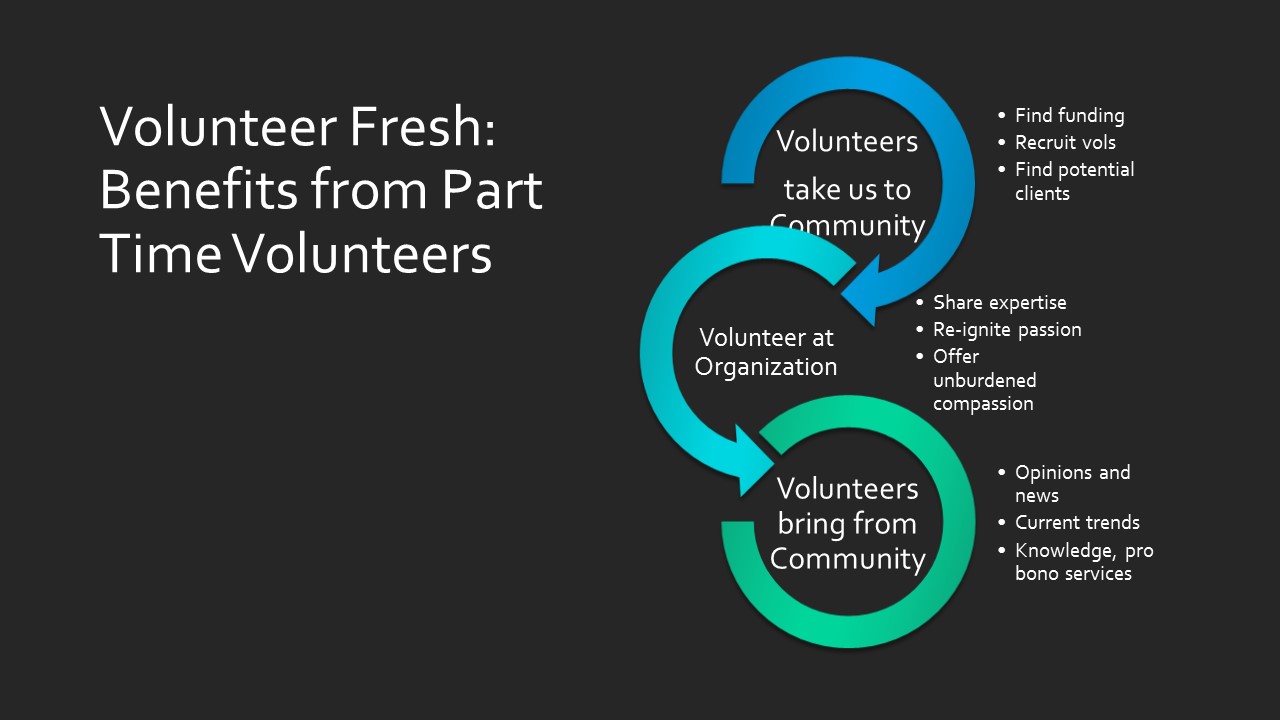
    Our volunteers are out there in the world 98% of the time and bring with them outside opinions, trends, ideas and methods.

    Our volunteers bring infectious enthusiasm and continually remind us why we love our work. They plug us back into our missions.

    Marketing Volunteer Fresh: (or, at your next staff meeting, use gimmicky but visual aids to encourage your organization to embrace volunteers as more than just those people who fill preconceived slots)

    Bring a sandwich from a vending machine along with a fresh sandwich from wherever staff loves to eat. Use each ingredient of the fresh sandwich to explain the layers of volunteer fresh and compare the two.

    Videotape volunteers speaking from the heart. Show staff the infectious enthusiasm volunteers bring. Remind them that opening up to each volunteer re-ignites their own passion.

    Use a radiating circle of connections chart to show the connections our volunteers are making within the community. Use arrows in both directions to illustrate the wide swath of information and influence our volunteers create, both coming and going.

    volunteer fresh pp


    Here are some concrete ways to offer Volunteer Fresh:

    Schedule “sit downs” between community engagement officers and volunteers. The engagement officer can ask volunteers to take the pulse of the community by asking pertinent questions of their friends, neighbors, civic groups, church members etc and then report back.

    Create a campaign via WOMM (word of mouth marketing). Marketing can release a sub-campaign via volunteers to reach out into the community on a specific hot topic. Equip volunteers with flyers, business cards, etc. to launch campaign and monitor feedback.

    Engage volunteers in stress relief. Create a team of volunteers to develop a stress relief program for staff and other volunteers. This volunteer team can institute ways to help over burdened staff cope with burnout.

    Volunteers are a gift of freshness. How fortunate we are to be able to incorporate fresh ideas, enthusiasm, and passion into our culture by people who offer all of this for free.

    Let’s encourage our organizations to open the window and let the freshness in.

    -Meridian

  • The 1pinion Effect

    the-1pinion-effect

    “Our CEO has a next door neighbor who has a son who got into minor trouble,” Marlee, a volunteer manager says. “The neighbor asked our CEO if his son could do community service at her organization. I called the son repeatedly, left messages, but he never returned my calls. Wouldn’t you know it, my manager told me our CEO was annoyed because the neighbor blames me for not connecting with the son. My manager said our CEO made the comment that volunteers never seem to be able to get started here.” Marlee sighed. “I can’t win.”

    Ehhhhhhhhhh. How can one opinion or circumstance create a belief? Why didn’t the CEO say, to her neighbor, “that’s certainly not typical of OUR volunteer department.” How could she seemingly frame an entire belief on one opinion?

    There is something known as Confirmation Bias, an effect that feeds our assumptions. So maybe, Marlee’s CEO might have simply felt that her neighbor’s son was just one more example of the volunteer department’s failure to properly onboard volunteers because she already believed it to be true.

    Where did this belief come from? Did the CEO hear other examples (and it doesn’t matter how accurate they are, it’s the perception) of volunteers not onboarding quickly while not hearing enough success stories? Or maybe it has nothing to do with Marlee. Perhaps the CEO had a poor experience volunteering when in college. Maybe the CEO heard horror stories at networking events and applied those stories to all volunteer departments.  Is that fair? No, and even worse, perceptions are really hard to change.

    So what should the strong volunteer leader do when hearing these 1pinion comments?

    Don’t get mad or hurt-get curious: What is fueling these opinions? Do some research via surveying the staff or a one on one chat with senior management to find the sources of these perceptions. Say, “I heard something that concerns me. I think there is a perception that I don’t get in touch with new volunteers and I’d like to find out what happened to create that perception.” Then, be prepared to act! Refuting assumptions is one route to take, but there are better ways as in…

    Double down on positive reporting: Counter negative perceptions by offering facts supporting positive volunteer department accomplishments. Review your stats to find areas that are lacking. Create new categories of reporting to freshen up the numbers. But, again, this is somewhat akin to refuting, so there is another thing to try…

    Create your own performance improvement plan: No one wants to be unfairly criticized, so if there is a perception floating around that volunteers are not being contacted in a timely manner, embrace it on your terms. Let go of the frustration at having been unfairly labeled. A self-imposed performance improvement plan accomplishes two really important things.

    One, it says a great deal about you-that you are always willing to improve (and here it’s not about being unfairly labeled, it’s about always striving for excellence).  Say, “If there is a perception that new volunteers are not called back in a timely manner, well it came from somewhere and I’m here to change that. I don’t want one prospective volunteer to slip through the cracks.” This approach shows that you don’t harbor an us (volunteer department) versus them (upper management) attitude, that you are solution-oriented, and that you are proactive and approachable.

    Two, it allows you to create a new narrative by moving forward from this point of misconception.  (It’s so much easier to create new impressions, than fix old ones). By acknowledging the old perception, you are not positioning yourself for a fight. You are forging a new, cooperative path, one in which your future statistics will be embraced in a positive light. And you will find your critics becoming supporters along this journey.

    We are all prone to confirmation bias. As proactive leaders, we must put aside our personal feelings when hearing negative perceptions, and work to change those perceptions by creating new, positive ones.

    Let’s face it. Opinions are not facts. Opinions can be unfair. While we may not be able to control each and every negative opinion, as proactive leaders, we certainly can control what we do about them. And the thing we do best is understand people and their motivations.

    When confronted with 1pinions, we can gear up for a pointless fight or we can use our strengths to create new and more positive realities.

    -Meridian

  • Interview With A Volunteer: Ellie

    contacts

    We all know volunteer feedback is invaluable, during and after projects and assignments. There is also value in gathering feedback from former volunteers who have had the time to process their experiences and take aways.

    Recently I was able to catch up with a retired volunteer, Ellie, and I asked her to look back on her years of volunteering for a hospice.

    VolunteerPlainTalk (VPT): How many years did you volunteer?

    Ellie (E): (laughs) “oh about 18.”

    VPT: That’s a long time.

    E: It was a long time, but it was good.

    VPT: What was your favorite part of volunteering?

    E: Hmmm, my favorite part. I liked the idea of giving and I always felt that I was receiving so much in return, but I guess you hear that a lot.

    VPT: Do you remember the beginning?

    E: Yes. I remember my training. At the end of training, the volunteer trainer handed me my first assignment. She told me that she believed I was ready. And she took me over to the window and pointed to the house of the person I was assigned to. She sort of let me know that it wasn’t far away and I would be close to help if I needed it.

    VPT: How did that go?

    E: I was nervous, but I felt prepared.

    VPT: Was your first assignment the impetus that kept you going?

    E: Actually, it was my first long-term patient, who came right after. We became incredibly close. Before she passed away, she said that she had added one more daughter to her family. And shortly before she died, she called me in and said that she needed to know that I was going to be ok. The extent of our connection was something I never expected.

    VPT: How much of a role did your volunteer manager play in your success?

    E: Oh my goodness, so much. The fact that my trainer and my supervisor, Jim trusted me, had faith that I could do this was huge. And, I always felt that if I had a question, he would be there. I remember I was sitting with one patient whose wife had a part-time job. He had a morphine drip and he thought it wasn’t working and he said to me, I don’t understand why this is not working, can you find out? Now, I have no medical knowledge at all, but I immediately got on the phone and my supervisor got me to the right person. That went a long way to building my self-confidence.

    VPT: So, having someone to contact was hugely important.

    E: Absolutely. I always counted on being able to knock on his door, go in and receive the support I needed.

    VPT: You are also a thirty year now retired school teacher. Why did you volunteer at a hospice and not with children?

    E: (laughs) I think I needed to do something different. After my husband died so young, I felt like I wanted to do something that was meaningful.

    VPT: Did his death influence your decision to volunteer for a hospice?

    E: I don’t think so. It was over three years between his death and my decision to volunteer.

    VPT: How did you find hospice?

    E: I saw this ad, and I knew right then it was a way to fill my life with some meaning.

    VPT: So, there was no magic formula for recruiting you?

    E: Sorry, no.

    VPT: Many people think hospice volunteering is depressing. Were you burdened with sadness?

    E: No. It was quite the opposite. It was fulfilling.

    VPT: Was there any opportunity for fun?

    E: Oh, my yes. I had so much fun with the staff. We let loose all the time. The seriousness of our work was a contrast to the silliness we experienced. I remember the time we made over 100 pumpkin pies for a Thanksgiving dinner in our care center. We laughed the whole time. Having that fun kept us wanting to do more, you know what I mean?

    VPT: I do. Was having fun a good use of your volunteer supervisor’s time do you think?

    E: Absolutely. Life is full of balances. The balance between serious work and letting off steam goes a long way to bond us together. It strengthened our team.

    VPT: I’m pushing here, but I wonder. Have you ever connected your losing your husband, the man you had planned on retiring with, and your work in hospice?

    E: Ehh, no. I just know that I had a lot of years to give and it was a way to fill my life with some meaningful work.  But I do remember one year, I signed up to volunteer at a children’s grief camp.  That day, while driving on the way to camp, I thought about all the little kids who were coming. They had all lost someone important in their lives and I had a little meltdown. I missed my husband.

    VPT: That must have been tough.

    E: I thought about these kids and it occurred to me that I went through this years ago. It brings something home. While I was there, we had a ceremony at night. I was really grieving for my husband. It comes when you least expect it. Sometimes you have an epiphany to a particular circumstance you’ve been through. It was almost like a total realization I had been through a significant loss and I released that.

    VPT: I’m at a loss for words.

    E: I even had grief counseling after his death. But my meltdown shocked me. I thought I had processed the grief.

    VPT: So, in retrospect, did your volunteering have a personal positive impact on you?

    E: Oh my, yes.

    Next time: Part 2 of this interview. Ellie moved away from her hospice, but she stopped volunteering before she moved. Why?

    -Meridian

  • Luncheon and Food for Thought…

    Luncheon and Food for Thought 001

    Get your dancing shoes on! This year, volunteer appreciation week in the US is April 23-29. It’s coming up in May for Australia, and June for the UK and New Zealand.

    If you have a luncheon planned, you’ve long ago selected the venue and contacted the speakers. You’ve ordered the cute online mini calculators for giveaways. (of course your calculators were shipped late because the vendor mixed up your order with one from the company, “Meals on Wheelies” who is actually a pizza delivery joint in Appleton Wisconsin) You will give up your Friday night tickets for the punk concert, “Zombie Brains Munchfest” and instead, you will sit alone, wrapping the calculators in cute purple tissue paper (which serves nicely to dab your tears) because your friends and family say they are tired of being unpaid labor.

    Volunteer appreciation events vacuum up our time and emotional energy like giant tornadoes trailing balloons. Expectations are high. Is the food great? Are the speeches sincere? Will I be able to make each volunteer feel special? But what about the volunteers who are out-of-town or are ill or just can’t come? What about the day after the event? The week? The year? Do the speeches and chocolate fountains last?

    I’m not against events. Not at all. I am though, for grabbing any opportunity to improve volunteer engagement. What if we made volunteer week a kickoff, rather than a stand alone event?

    Why not use volunteer week as a brightly colored launch to enlist staff support for acknowledging volunteers all year-long? It makes sense to jump on the festive events as a springboard for a volunteer recognition calendar. With our orchestration, ongoing volunteer appreciation can become a learned behavior within organizations.

    While the “we heart volunteers” posters are up, the splashy balloons float in the hallways, and the staff is sampling that star shaped cherry cheesecake, it’s time to pounce! As these vibrant visuals draw attention to your volunteers, it’s the perfect time to visit each department and share your recognition calendar for the year.
    A sample calendar can look something like this:

    The Volunteer Department Yearly Calendar of Volunteer Recognition!
    Every first of the month I will pass around birthday cards for the volunteers who are celebrating birthdays. I would appreciate your signature. The cards will then be mailed to the volunteers. These simple but effective cards remind each volunteer that the entire organization appreciates them on their special day. Individual recognition goes a long way towards volunteer retention.

    Every third Wednesday of each month I will visit one department to write down testimonials from staff on the incredible impact volunteers have on supporting our mission. These testimonials will be published in our volunteer newsletter which is shared with all volunteers. In addition, the testimonials will serve to recruit prospective volunteers as well. Here is the list of scheduled departments for the next twelve months. Please be thinking about our volunteers and their contributions. Your testimonials serve to reinforce the volunteer support your department deems beneficial. (Bonus: keep all the testimonials for other purposes such as recruitment ads, speeches to groups etc.)

    Every quarter I will be videotaping several staff members expressing a simple ‘thank you’ to our volunteers and I will be showing the videos at the beginning of our volunteer meetings. These videos will serve to remind the volunteers that they are important members of our team. (Bonus-you can show all of the videos at next year’s luncheon)

    I will remind everyone in an email blast the first of each month. Thank you for participating in our plan to retain our valuable volunteers and to encourage new volunteers. Staff appreciation is a motivating factor in cultivating a supportive team.

    Your written plan can include:
    A-what and when (the schedule)
    B-how (the particulars)
    C-why (the benefit to volunteers and organization)                                                                       D-in addition, your reminder schedule

    Volunteer recognition is meaningful and fun on event day. We serve up praise along with chicken salad and we may even give awards for volunteer of the year. But awards look backwards. Let’s also look forwards. Let’s develop a plan to set the tone of appreciation for the coming year. Heck, maybe announce that at next year’s luncheon, there will be an additional award for the staff members who excel at engaging and recognizing volunteers.

    Now wouldn’t that be something to truly celebrate?
    -Meridian

  • New Words Added to the Volunteer Management Dictionary

    Added to the Volunteer Management Dictionary

    It’s that time of year when the Committee to Define Volunteer Management gets together at a back table in Pete’s Bar, Grill and Bait Shop. Together, these brave members scratch their heads over several pints and attempt to come up with a succinct explanation of volunteer management. This year, they gave up once again after rejecting the phrase “herding cats,” but they decided to add the following words to the dictionary of volunteer management.

    Volvorce: When a volunteer divorces the organization as in “No, I just can’t go get new volunteer Dinesh, because since no one called him back about getting started after I introduced him to finance, he volvorced us.”

    Meetcolepsy: When too many meetings cause you to simply fall into a stupor at the thought of another talk-fest as in “No, I couldn’t make that fourteenth meeting about using the volunteers to stand by the back door in case someone gets confused because I contracted meetcolepsy. Want to see my doctor’s slip?”

    Latespectation: A last-minute request for volunteers that is expected to be filled as if you were given weeks to prepare, as in “Oh, so you need 5 volunteers tomorrow morning for an assignment that you said was extremely important? Your latespectation is showing.”

    Creditjacking: When another staff member takes credit for a successful endeavor that you or your volunteers accomplished as in “Yes, I’m glad you praised that project during the senior managers’ meeting, but let’s not creditjack the volunteers’ work, ok?”

    Duhtistics: Stats that are so incredibly obvious, like volunteers are super nice as in “I won’t bore the board with duhtistics that you’ve heard before. No, instead I want to point out some new and exciting projects we are undertaking.”

    AVOL: A volunteer who inexplicably does not return calls, emails or letters as in “I’m glad you noticed volunteer Myrna has been missing lately. I’m trying everything in my power to get in touch with her. Right now she’s AVOL.”

    Volunteer Lite: A request for a volunteer to do a menial, mindless task as in, “You’re asking me for one of our highly trained volunteers to clean out the storage closet so you can use it for your supplies? You don’t want a full-bodied volunteer, you want a volunteer lite.”

    Miracalls: Calls made to volunteers for an especially challenging or late request as in, “Woah, that’s a really challenging request (or time frame). I’ll be holed up in my office for the rest of the day, making miracalls.”

    Informashunned: (pronounced in-for-may-shunned) Not given the essential information needed to properly place a volunteer as in “I have recruited four of our best volunteers for that assignment, but my pleas for crucial information have been ignored. Right now, our volunteers are informashunned.”

    Nopinion: Volunteers wanted, but not their opinions as in, “I’m glad you were able to use volunteer Mark’s expertise, but he felt rebuffed when he offered additional knowledge. I guess you really want an expert but nopinion volunteer.” 

    Vombie: That volunteer everyone is afraid of and no one wants to council or fire, as in, “I know Janey is a handful and she’s been here for what, twenty years now. I guess she’s been allowed to attain Vombie status and now that I’m here, I will deal with it in a professional manner.”

    Callwaiter: The notion that volunteers sit by the phone just waiting to hear from us as in, “It is Friday afternoon and most of our volunteers have already made plans for tomorrow. I’ll make some miracalls, but our vibrant and diverse volunteers aren’t callwaiters.”

    Marathonitor: The running around, checking, double-checking and rechecking to ensure that volunteers have all the information and tools they need to succeed as in “Our fifteen volunteers are ready for Saturday’s important annual event, but in order for them to excel, I will be marathonitoring their involvement, so I won’t be attending any meetings tomorrow or making miracalls to fill latespectation requests.”

    Well, there you have it. As one of the senior members of the Committee to Define Volunteer Management said after several glasses of Pinot Grigio, “Dang, defining volunteer management is really impifficult.”

    -Meridian

  • What Am I Thankful For? Fantasies

    what-am-i-thankful-for

    Ok, so maybe we, volunteers managers can’t control everything in our little sphere (gasp, but I want to, so, so, so badly). Maybe we sometimes retreat to a fantasy world in our heads that exists across from the “10 super easy ways to get volunteers” list that inhabits our nightmares.

    Is that so bad? Well, no, not when you consider that maybe our fantasies are really brightly disguised goals on steroids. Unless of course the fantasies involve the demise of someone at work, then, well, find some help, ok?
    But positive fantasies can tell us a lot about our wishes and dreams and dismissing them as nonsense may also help push our goals to the back of our minds (next to the dream of being the first person ever to have dinner with Bigfoot-in the forest, with wine, a nice Chablis, but I digress). So heck, let’s just descend into a positive fantasy world for a moment where we can let our volunteer manager minds run wild. What would we fantasize about?

    • A volunteer manager is chosen as CEO after the CEO quits in frustration while yelling, “No one, and I mean no one, except that amazing volunteer manager we have, what’s his name again, can do this job!!!”
    • At the all-staff end of year meeting, the award for ‘Supreme Being of All Things Non-Profit’ which is only given out once in the entire life of the organization, goes to…. YOU! And then, everyone would sit through fourteen hours of long speeches about how volunteer management saved the organization (dinner and yummy rainbow cupcakes would be served, of course, in between speeches).
    • At the annual volunteer appreciation luncheon, the CEO, when giving the welcome speech, says, “..and we couldn’t do it without our volunteers.” Then she stops and with a wink adds, “Wait, that’s just lip service. We really mean that and I will show you.” At that, the curtain opens and every staff member comes flooding out to mingle with the crowd of happy volunteers. There are hugs and tears and stories and neck massages and homemade cards and selfies that all culminate in the entire room singing “We Are The Champions” with locked arms. And no one would forget about it the next day.
    • The board of directors, in their quarterly meeting, all stand up in unison, rip up their prepared agendas and with one clear voice declare, “We hereby unanimously elect to increase the salary of our volunteer manager in proportion to the money saved by utilizing volunteer resources. Hey, that looks to be about $76,000, and that means no gala for at least five years, but what the heck, it’s worth it!”
    • At a new project exploratory meeting, one of the senior managers muses, “We need some fresh thinking from someone who has all the skills necessary to help us get this new project off the ground, someone who is creative, has people-skills, professional management ability, public speaking chops, mediation experience and is a darned nice person to boot!” At which every other manager moans that there is no such person on the planet and that same senior manager lifts up her hands and yells, “yes there is! Our volunteer coordinator!”

    Ahhhhhhhhh, I can’t stop smiling. That felt doggone delicious. But anyway, positive fantasies just might be an exaggeration of our heart’s desires. We can shut them out or we can turn them over in our heads and look at them as a springboard to work towards personal goals. Do we want more respect, salary, recognition, voice or any number of positive outcomes? What are your positive professional fantasies and how do you achieve these goals?

    Hard work is not something that chases volunteer managers in nightmares. No, hard work is the stuff of our every day working lives. Our fantasy goals, once sorted out in logical thinking, will require that same hard work.

    Don’t feel alone in fantasizing about positive changes. There is an entire community all around us of volunteer resource managers working to create positive change.

    And we all fantasize too.

    -Meridian