Category: strategies and goals

  • Are You a Steel Trap, A Sieve or A Spigot?

    Working for a nonprofit, I quickly learned that unless stuff was written in a memo, information was pretty much filtered through the staff person or volunteer sharing it. I also learned the hard way, whom I could trust and who blabbed upon leaving my office. I actually identified 734 different types of info spreaders, which I compiled into a book entitled “The Industrial Psychology of Spreading Information:” but since I am not a clinical psychologist, the book was widely rejected. Anyway, we’ll only look at the top 5. Which ones do you recognize?

    The Sieve

    The Sieve leaks information in a nice way, to share good news, etc. but they are often misguided. The Sieve is a good person and when the sieve hears someone being maligned, they will step in with any information entrusted to them to “help that person out.”

    Sieve Example:

    Staff person: “Volunteer Doris was 30 minutes late again. Is she really reliable?”

    Sieve: “Well, did you know that Doris is late sometimes because she takes in stray cats. She has like 136 cats in her home that she has to take care of, so she’s kinda busy with fighting the city, because they’ve condemned her home, so let’s give Doris a break, OK? Oh, and you might want to take some allergy medication with you when you work with Doris.”

    The Spigot

    The tap is always on with the spigot. They broadcast everything to everyone because they….wait, honestly, I don’t know why they do it. But they are always lurking, ready to share, so never, ever tell them in a moment of weakness that you wear Groot jammies to bed.

    Spigot Example:

    Volunteer Manager (noticing a staff member still at their desk): “Hey, c’mon, there’s a fire in the microwave in the breakroom, so let’s go, we gotta exit the building.”

    Spigot: (getting up) “I’ll bet it was Betta; she’s burned 4 microwave popcorn packs this month. Did you know she has this weird idea that eating popcorn makes you concentrate more?” (Volunteer manager grabs spigot’s arms, yanks them to the door) “Speaking of fire, did you know that Monty in accounting’s son is serving time for arson?”

    The Mold Maker

    With the mold maker, information goes in raw, comes out according to how the mold maker perceived it. Remember the old kids’ game telephone where you would whisper a message in the ear of the kid next to you and by the time it got to the end it was mangled? The mold maker perceives everything according to their world view or whether they’re constipated, I’m not sure which.

    Mold Maker Example:

    Volunteer Manager: “I’ll set up a meeting with our finance director to discuss that new program. Right now I believe he’s in a meeting.”

    Mold Maker Volunteer: “Oh, yes, the poor finance director; he’s probably talking to his divorce lawyer. I heard from Janey in records that he was going through a nasty divorce. You know,(Mold Maker Volunteer whispering) his wife left him because he works too much, stays here so late. Let that be a lesson to you. You shouldn’t work so much, tsk, tsk.”

    The Shredder

    The Shredder massacres the message because the shredder does not listen well, or at all, so you can never, ever expect the message to arrive in the same condition you sent it.

    Shredder Example:

    Volunteer Manager: “Look, this is extremely important. Please tell the CEO that the volunteers are willing to dress up as wait staff and serve at that black-tie donor event, but they would need gas money reimbursement to drive the 87 miles to the country club at Lake Hilda.”

    Shredder to CEO: “Yeah, Madame CEO, the volunteer manager said something about the volunteers wanting you to serve them Thai food at the banquet. Oh, and they’re afraid of falling into an 80 foot deep lake and for some reason, they think your name is Hilda.” (shrugs). “Volunteers, jeesh, they’re a funny bunch, right?”

    The Steel Trap

    For a Steel trap, everything in, nothing out. I tried to be a steel trap at work. I always viewed information shared in confidence as akin to a possession. That info is not mine. It’s belongs to the person sharing. If I spread it, I’ve stolen it.

    And here’s the thing about being a steel trap-you get to hear all kinds of helpful stuff. When you’re a trusted source, people will seek you out, because sometimes, they just gotta share, right? So, you hear things like “there’s going to be a huge change to policy, no one knows it yet.” Or you might hear something that is a key to someone’s motivation. Or that there’s a backlog in finance or marketing is fighting with one another. Since we, LoVols are typically info junkies, there’s quite the upside to being a steel trap.

    Steel Trap Example

    Staff Member: “Hey, Lazo talks to you all the time. What’s going on with him leaving for an hour at lunch?”

    Steel Trap: “That’s Lazo’s business. Go ask him.”

    Or:

    Volunteer: “What’s going on with volunteer Jemma? I heard she’s sick.”

    Steel Trap: “Thanks for your concern. What Jemma shared with me is confidential. I’m sure if you shared confidential information with me, you would expect me to respect your wishes.”

    Information is a valuable commodity. For us, volunteer engagement professionals, knowing the filter in which you hear information can save a lot of time and trouble. And being a trusted steel trap can just be your ticket to hearing all the stuff that gives you a leadership edge.

    Happy Listening!

    -Meridian

  • Becoming Volunteer to Organization (V2O)

    Let’s pretend volunteers are a type of consumer. They search for a volunteer experience that fits for them, kinda like looking for that certain shirt for the next Zoom meeting. Organizations advertise volunteer jobs in an O2V (organization to volunteer) model. Orgs basically say, “Here’s what we have to offer, take it or leave it. Go ahead, shop around, there’s nothing better out there.”

    But, social media has changed everything. Customers now can buy direct from one another in a C2C (customer to customer) model. We are seeing this shift in our sector as volunteers bypass formal volunteering and mobilize directly through social media. They’ve cut out the cumbersome organizational middle man in an new, V2V (volunteer to volunteer) model.

    But now, businesses are seeing an additional shift to a C2B (customer to business) model. In this model, customers’ value increases. Customers offer businesses talent for hire through numerous websites such as Upwork. Customers with a social media following advertise products. Customers review products online and participate in surveys and by doing so, add value by helping design the next product.

    But how would a V2O (volunteer to organization) model look? Can we adopt this growing trend or are nonprofits stuck in an archaic model that sells their volunteering experiences in a take it or leave it fashion while the world moves on?

    The point of V2O: Recognizing and embracing volunteer value.

    Demonstrating volunteer impact is one way of showing volunteer value. Embracing the additional ways volunteers add value takes us into a V2O model.

    For more on volunteer value also see:

    Older posts such as the volunteer investor or the value of a volunteer is $#.@S

    So, how do we adopt a V2O model without breaking the system?

    Soliciting Feedback:

    Encourage volunteers to review their experience. But wait, what about negative comments? Here’s the interesting thing about negative reviews. Businesses have found that negative comments do not deter customers, it’s the way businesses respond to negative comments that turn people off.

    So, that volunteer comment that states, “I didn’t like my assigned job,” becomes an opportunity for the organization to respond, “thank you for your comment and we are committed to improving volunteer roles. Let us show you other roles that may be a better fit for you.” The negative comment becomes a vehicle for the organization to advertise their dedication to working with volunteers. It’s a powerful opportunity.

    Focus Groups, Surveys and the like

    Volunteers offer diverse opinions. Many volunteered because they also benefited from mission resources and are a wealth of information on the mission experience. (see more in The Disruptive Volunteer Manager) Volunteers have a wide circle of influence and bring in breaths of fresh air from the communities we serve.

    Volunteer In-demand Talent

    Freelancing is here to stay and volunteers are moving from committed volunteering to freelancing. It’s time we sought out volunteer candidates on sites such as Linkedin. Remember the old, but true survey result that the number 1 reason people didn’t volunteer was because no one asked? Well, it’s time we paid attention by searching out the people we feel would add value and ask them to volunteer.

    Volunteer-generated content

    Volunteers are an untapped, rich source of content. In a study by TurnTo, USG (user generated content) bests traditional marketing by influencing 90% of consumer purchasing decisions. Whuh-what?

    Organizations shy away from “letting” volunteers speak on behalf of the organization. “But, we can’t control what they will say.” This iron fist clinging to the message is short-sighted. As with negative comments, organizations can quickly correct any misinformation given by a volunteer (or staff BTW-let’s not pretend staff give out correct information all the time, am I right?) on sites. By holding tight to messaging, organizations are missing the marketing content volunteers provide.

    And think about this for a minute. If a volunteer says their organization is doing good work, it’s more convincing, considering the volunteer is unpaid and not afraid of losing a job (whereas a staff member is perceived as having to be biased).

    V2O is simply embracing volunteer value in ways that sustain volunteering. As leaders of volunteers, we can move towards V2O by:

    • recording and analyzing volunteer impact
    • seeking out volunteer candidates who add value
    • soliciting volunteer opinions, testimonials, quotes, etc.
    • advocating for volunteer voices
    • streamlining volunteer onboarding
    • using volunteer focus groups to create new volunteering opportunities
    • reaching out to volunteer grassroots groups
    • partnering with fellow volunteer leaders in our communities to form coalitions that speak with one, strong voice and share volunteers, volunteer resources etc. (more in the Disruptive Volunteer Manager)

    Leaders of volunteers are tuned in to the ever-changing volunteer mindset and are adapting practices based on what today’s volunteers want. As volunteers leave the organization to volunteer (O2V) model, we can create a volunteer to organization (V2O) environment that engages modern volunteers.

    Or, we can just continue to be a V-Mart. (“go ahead, shop around, we may not have the volunteer experience you’re looking for, but nobody else does either.”)

    -Meridian

  • Moving from O2V to V2V to V2O

    Photo by Pixabay on Pexels.com

    Friends, we are behind the times. Way behind. You can feel movement like cool air that flows down a mountain. Can we define it?

    Businesses are rapidly changing because they feel it and see it. They are moving out of a B2C (business to consumer) model. You know, the “hey, Target has a sale, I’ll see if they have a shirt I can wear during zoom meetings.”

    But there’s nothing I want at Target. So I look at a marketplace like Etsy for something unique. (Etsy is a C2C-consumer to consumer model). I purchase a fun shirt I love directly from a designer.

    What is our current nonprofit volunteer model?

    Organization to Volunteer or Volunteer to Organization?

    Let’s say I’m a volunteer looking to join an organization. My first experience with an organization is reading an ad, or looking at a website. What catches my eye?

    From an actual current volunteer ad:


    Have you ever wanted to do something AMAZING to change the world but didn’t know where to start? Here is an opportunity to help underprivileged children, to help under-served children, to help ALL children displaced from school due to COVID-19, and even to help many adults.

    I then look at this organization’s website and find no volunteer information. No volunteer prompt. No volunteer pictures or information on how volunteering will enhance my life. Just Crickets. But donations are welcomed.

    Above is an example of an O2V (organization to volunteer) concept. It goes like this: “We, the organization, want XYZ from you, the volunteer.” Or, more simply, “buy our product (volunteering). We designed it and you’re going to have to buy it because that’s all you have to choose from.”

    But wait, there are volunteer choices now.

    People are bypassing formal volunteering and exploring solutions through social media on their own. Why choose a volunteer job that is cumbersome and just ok when you can find real satisfaction from joining a group on social media?

    There’s a monumental shift afoot from O2V to V2V (volunteer to volunteer)

    We see this all the time. My last podcast highlighted two amazing young women who started their own organization while in high school. They are now in the process of procuring donations, creating corporate partnerships and recruiting volunteers.

    https://www.buzzsprout.com/605416/4850183-episode-11-interview-with-samantha-and-sydney-high-school-students-who-founded-balance-boxes

    The nonprofit veil has lifted.

    We see this every time a disaster strikes. Volunteers find one another on social media and they band together and act. They bypass formal organizations and change their communities by forming their own grass-roots groups. Nonprofits no longer have the monopoly on solving issues.

    Next time: Businesses are moving from B2C to C2C to C2B. What would V2O look like?

    -Meridian

  • Is Compassion a Velvet Chain?

    This is updated from a post back in 2015:

    The Shackles of Compassion

    compassion has its own frame of reference

    Patients at hospice taught me many things, especially that I come equipped with a frame of reference and I need to put my frame aside and keep learning.

    Our patient George, was long divorced and rarely saw his twelve year old daughter. I was drawn to George. He was an iron worker, loved sports, hated our food and I wanted to “help him.” We would have these talks, and eventually he shared thoughts on his approaching death and the realization that he wouldn’t see his daughter grow up. I would leave his room and cry for his wasting body and diminishing chances at a life.

    When his daughter’s birthday approached, I, along with volunteers, went to our local Target and bought presents for George to give her. The volunteers giggled over wrapping the presents in pink and purple with gobs of glitter. It felt so good.

    I remember the day George’s ex-wife brought his daughter to visit him at our care center. I peeked in to see if George needed anything else on this joyous occasion. I stopped, for instead of seeing happy anticipation, I saw him hunched over in bed, quietly crying, one of the presents at his side. I didn’t want to disturb him, so I tiptoed away.

    In that intimate moment, the veil fell away and I saw the velvet chain that bound him to us. Our “help” tethered him to our compassion and the heavy links became visible through his pain.

    “I have always depended on the kindness of strangers”…Blanche DuBois in A Streetcar Named Desire

    Did he cry because we helped him or did he cry because he had lost control of everything precious and was now dependent upon the kindness of strangers? Did he weep at the ridiculous presents that were as handy as a hot dog stand at a funeral? Did he feel trapped, allowed to walk only as far as our chains would allow and only in the perimeter of our idea of what he needed?

    strapped to feel-good moments

    Do the people we serve feel shackled to us? Is it kind of like the stranglehold the skydiving instructor has on the newbie skydiver who is strapped in tight and really is just along on the way down? Does our tandem journey through folks’ lives sometimes bind them to our feel-good moments?

    I went back to my office and closed the door and sat down. I wondered, in all my desire to help, did I rob George of his last shred of dignity? Do we, sometimes in our exuberance to do good, forget that a real person with complex feelings is on the other end of our help? Do we see them through our feel-good lens and wonder why they are not exuberant with us?

    After that day, I started to see George as more complex, and my desire to help as more self-serving. I continued to visit with him until he died. I still struggle mightily with “trying to help,” “knowing what people need,” “having answers.”

    is “helping people” so great?

    Here’s the thing. I think we must stop telling volunteers that “helping people” will make them feel good. I think that top-down idea inadvertently gives us the power to decide what that help looks like and demeans the person who receives the help. It puts that person at the mercy of our kindness.

    What instead?

    We must stop media from using headlines describing volunteer involvement such as, “volunteers put smiles on the faces of” (fill in the blank here with any group of depressed people who magically forget all their challenges because a fun volunteer showed up) or “volunteers cheer up”… (fill in the blank here with all the sad people who are just waiting for some stranger to come along and make them happy). Oh, and let’s just assume that what people really, really, really want is to become happy when faced with challenging times. Yep, a volunteer with a smile is just what they need.

    When I heard a few volunteers or staff complain that a recipient of help wasn’t grateful, I began to take note. I saw how uncomfortable it was for people to be demeaned by eager “helpers.” I saw that the volunteers (thankfully the vast majority of them extensively oriented to the mission) who were successful, were the ones who wanted to bond, to converse, to be humble. They didn’t want to hold any power over the people they connected with.

    if helping doesn’t make us feel good, what does volunteering make us feel?

    Volunteering does wonders for our well-being. But not because we are “helping” someone in a top-down approach and somehow we feel good because, “gosh, gee, I’m reminded that I have it so much better.” It’s because we are getting out of our bubble, we are connecting with people, we are learning and growing. I truly believe that volunteering makes us more human by connecting us on a one-to-one level.

    so, what do we tell volunteers?

    Instead of advertising that helping people makes us feel good, we can tell our volunteers that volunteering is about connecting, learning, and understanding. We can tell them that it will nurture their soul and teach them to be better people. We can stop encouraging them (even subtly) to “help” people who are “less fortunate.”

    In my experience, the most successful volunteers were the ones who didn’t go home and patted themselves on the back because they “helped” someone. No, the true volunteer spirit goes home and quietly processes everything they’ve experienced. They hope they are not an added burden. They hope they haven’t done any harm. They hope to be better the next day. This is the true volunteer spirit.

    We, leaders of volunteers can be the fearless leaders in the non-profit realm and re-mold the “helper’s high” image into something truer, more ….better. We can orient a volunteer team that understands they have no power over anyone else.

    Because even a velvet chain is still a chain.

    -Meridian

    .

  • Volunteer Flow Strategy

    Volunteers move in and out of our organizations and unlike staff who have defined hours and pay, volunteers ebb and flow like water in an ecosystem. A simple volunteer flow statement is used to track this flow and then predict future flows based on factors that engage volunteers verses factors that block the volunteer flow. Let’s create a basic flow statement for volunteer recruitment efforts.

    simple, but effective

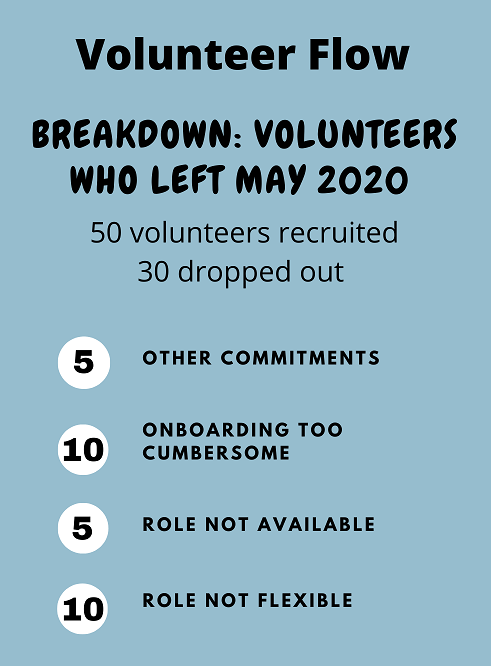
    Example: Month of May: We recruited 50 volunteers who signed up. Of those, 20 volunteers followed through and are now officially volunteering.  The other 30 volunteers did not follow through. The volunteer base has now increased by 20 volunteers. Sounds great if you simply say, “we gained 20 volunteers this month. 

    But let’s go further. What about the 30 volunteers who left after recruitment? Here’s where you can explain the reasons volunteers leave and predict that more volunteers will leave due to these same reasons. Not so great, after all, is it?

    Percentages are calculated from stats gathered – for example, exit surveys or interviews.

    Percentages break down this way:

    • 16% of volunteers who left in May had other commitments
    • 33% of volunteers who left in May found on-boarding too cumbersome
    • 16% of volunteers who left in May did not find a role that suited them
    • 33% of volunteers who left in May needed more flexibility

    When projecting volunteer recruitment in the future, we can now predict:

    For every 10 volunteers we recruit, only 4 (or 40%) will stay. ( based on the above stats, 50 volunteers recruited – 30 volunteers that left = 60% of new volunteers will leave before they even start. Now, 20 new volunteers doesn’t sound so great when the number could have been 45, right? (not 50 because you can’t control the 5 who had other commitments)

    Explain why volunteers leave by showing causation:

    Of the volunteers who left:

    • only 16% left due to unavoidable reasons
    • over 80% left due to factors we can modify or change

    We need to change…

    We can now infer from the statistics that changes will likely increase the number of recruited volunteers who follow through. Changes include:

    • on-boarding needs to be less cumbersome
    • roles need to be more flexible
    • roles need to be expanded

    A strategic Volunteer Flow sheet shows the reasons volunteers leave or stay. (causation). These “causes” are the reasons you have experienced all along and have been advocating for. Volunteer flow is a way to form your knowledge into a measurable report and more importantly, predict the future with statistical information.

    Instead of the notion that a volunteer manager should “work harder” to “get volunteers,” we need to place the reasons volunteers leave or never get started squarely on the outdated systems that no longer work.

    By predicting the same results in the future, you are illustrating that without the changes you are advocating for, volunteers will continue to leave before they even get started. You can use this method to show volunteer retention and causation as well.

    show what you know

    Volunteers flow in and out of our organizations for hundreds of reasons. The reasons we can control must work for the volunteer and by showing causation, we can more effectively advocate for the changes that will increase volunteer engagement.

    Modern volunteers need modern programs that meet their needs. Our communities are ecosystems and volunteers flow in and around looking for the right opportunity to offer their skills and passions.

    Let’s strategically advocate so that when volunteers flow our way, they find a place to stay.

    -Meridian

  • Predicting Volunteer Flow

    Predicting Volunteer Flow

    What freezes the flow of volunteers?

    What is a volunteer flow? It is the movement of volunteers in and out of an organization, much like a cash flow in business. Like any resource, volunteers are a people-resource that is rich in skills, passions, marketing reach, knowledge, experience, dedication, and in ability to procure donations and other desired resources. As such, our volunteers must be viewed as just as valuable a resource as a donation flow.

    Can we, volunteer managers predict our volunteer flow, especially in uncertain times such as we face today? Before we say no way, (mainly because we have all experienced surprises when it comes to who actually will volunteer), let’s ask this question: Would it benefit us, Leaders of Volunteers, to create a volunteer flow statement?

    As a fan of mathematical equations (even when I mangle them), our aim is: UPV (under promise volunteer resources) < OPV (over produce volunteer resources).

    We know that there are thousands of factors that influence volunteer recruitment and sustainability and we know that challenges have increased exponentially due to the pandemic. So, how can we possibly predict how many volunteers we will gain, retain or lose in the next few months?

    We can’t predict with certainty, but we can estimate with causation. And this is actually a good time to introduce the idea that volunteers ebb and flow not only with changing times, but with any negative or positive experiences within our organizational structure. Volunteers aren’t something we “order up” or people who magically appear when needed and never question their assignments. This is the time to introduce the factors that freeze or free up a volunteer flow.

    What is our objective?

    Our aim is to create a consistent flow of highly engaged and productive volunteers who positively impact our organization’s goals, objectives and mission. Our job is to recruit these volunteers, and to develop them into contributing members of our teams. For more on development, see:

    #LoVols, This Needs to Change Now

    What do #LoVols do all day?

    Download Volunteerplaintalk Tools

    Will volunteers return after being furloughed? Will more virtual volunteers sign-up and then we are caught without enough meaningful roles for them? Will corporate and other groups want to continue their philanthropy? How will virtual training affect volunteer sustainability? These are questions we don’t have all the answers for, but based on what we are experiencing, we can create a volunteer flow strategy statement.

    Next time: What goes into this strategy?

    -Meridian

  • What We Do Know

    Uncertainty sucks big time, but guess what? We, volunteer managers deal in uncertainty all the time. Think about it. Everyday we wonder…

    • Will anyone who attends my speech at the local Classic Car Collector’s Guild on Saturday actually sign up to volunteer? Will one or two attendees fall asleep in the back and snore so loudly I have to shout over the noise?
    • Can I trust that Magda in event planning will communicate the revised meet-up spot to the volunteers and not forget again? Will I get a frantic call from a volunteer asking where he should be while I’m at my son’s violin recital and then I get shame-shushed by snarky Heather who always sits behind me?
    • Will volunteer Trevor stop bringing his herbal supplements to clients’ homes or do I have to have another conversation with him? Will he ever stop trying to sell his energy pills to everyone? (huh, maybe that’s why I’m so jittery...)
    • Will I come in to work this morning and find a volunteer has once again written a letter to the editor of the local paper, calling out the lack of volunteer department budget? (after I’ve patiently explained that going to the press ensures WE WILL NEVER GET THE MONEY NOW!)
    • Will the A/V equipment break in the middle of my presentation to the chamber of commerce and then I’m stuck drawing a graph on volunteer impact from memory on a chalkboard? (and I hastily draw a graph that resembles male body parts
    • Will I have to carpool volunteers to the luncheon because finance did not pay for the bus and driver I reserved? (and we arrive late because volunteers have to stop to use the restroom along the way)
    • Will the printing company get this year’s appreciation theme correct and not print 400 balloons saying, “Volunteers have no heart.”

    We, volunteer managers routinely operate in an uncertain world so we’re already positioned to navigate these times.  But wait. Not everything is uncertain so let’s look at what we do know.

    • People want to help: If anything tell us that volunteerism is alive and well, this pandemic proves it. From neighbors helping neighbors to social media groups that mobilize participants to 750,000 people signing up in the UK for the NHS, people are still volunteering. The spirit of volunteering is alive. 
    • We know there will be an end: There’s always an end. Sure, there will be a new normal with new challenges so this is the time to start strategically planning for the new normal in a way that benefits you, your volunteers, and your volunteer initiative. How do you envision yourself coming out of this? Better equipped to speak up and mold your volunteer program for this new normal? 
    • Change is an opportunity. No one is more adaptable than a volunteer manager. We can come out of this with the adaptations that fit the modern volunteer. Change can be an opportunity, so let’s make it work for us.

    • Priorities rise to the top: What does that look like for you? Communicating with volunteers, serving clients or revamping archaic systems? Challenging circumstances have a way of exposing flaws and outdated methods while highlighting the greatness of the things working well. Now is the time to sort through and document what is working, what is not working and why, so that moving forward, you have supporting information that will back-up your plans moving forward. 

    • We are in this together. Yep, we are, because we, volunteer managers have a common purpose. Let’s take this time to find each other, band together and further our goals. Volunteer organizations are forced to stream their volunteer award events. These are the events we can all support by virtually attending or commenting on in a show of solidarity. 

    We are no strangers to uncertainty and the same strength, courage and resolve we employ everyday will see us through these times. We will come out of this stronger, more resilient and more determined to see volunteerism and our volunteers elevated. 

    We will come out of this more connected to one another, more supportive of one another, and more able to speak as unified voices. One thing we can do to create a swell of united support is to stream more. Let’s use this time to record, stream, and create videos showing volunteer impact so we can build an audience that sees the work firsthand. Let’s not relegate volunteer awards to a nice lunch at a moderately priced hotel, seen only by attendees. Let’s share volunteer value and impact with the world. Let’s go big and take our message to everyone. 

    Because our message is crucial.

    Of this, we are certain.

    -Meridian 

  • You Can Water Plastic Flowers, But They Won’t Grow

    In a volunteer manager’s chaotic day, volunteer impact is difficult to plan, hard to complete and often impossible to execute. We laughingly describe our chaos in phrases like, “herding cats,” “wearing many hats,” and “controlled chaos.” But, the inability to move ourselves and our volunteers forward due to chaos is no laughing matter.

    I’d like to add another phrase to the lexicon: “Watering plastic flowers,” which means time spent on futile activities. But wait, futile is a strong word; it means “pointless,” or “incapable of producing results.”

    So, let’s eliminate the word futile, because there’s always hope right? As volunteer managers, we hold hope in our hands: Hope for that volunteer who is hurting and wants to help, but keeps canceling. Hope that our impassioned speech about volunteer value changes minds. Hope that today we will fill a role no volunteer wants to do.

    Instead, let’s look at ROI-return on investment. When our time investment does not produce enough results to continue, this doesn’t mean we must stop reaching out to that volunteer who never shows up; it means we have to weigh how much time we spend doing it.

    And remember, for every minute we spend on something with little ROI, we miss spending that minute on something with a large ROI that has impact and moves us in the direction we want to go.

    What steps can we take to determine where we should invest our time?

    • Volunteer ads: Analyze ads’ effectiveness and spend more time on effective ads. Relegate lesser producing ads to your office volunteers to manage. (and if you don’t have a team of volunteers helping you in every aspect of your job description, what the heck are you waiting for?)
    • Volunteers who are unreliable: Set a tolerance number-I will contact a volunteer X number of times and after no response, I will send them a letter/email/message thanking them, inviting them to contact us when ready.
    • Conflict challenges: If a challenging volunteer repeats egregious behaviors, craft a policy on expectations and stick to it. Make sure every volunteer is given a copy, reads and signs the copy and is aware of your policies and the final dismissal step.
    • Educating staff on the many aspects of volunteerism: Start with one important point and repeat, repeat, repeat; then build on that one concept. Too many concepts dilutes the ability to absorb it all.
    • Staff who improperly manage a volunteer’s time: Move the volunteer to a department that effectively engages volunteers. Make no apologies for moving volunteers to departments or positions that meet the volunteer’s needs.
    • Report, speak and substantiate the why: Want change? Infuse the why (specifics) into everything you say and do. For example, “We have an opportunity to partner with a local florist whose employees want to volunteer and potentially donate flowers, fund-raise for us and help advocate for our services. This will lead to other business partnerships so I need support from multiple departments.” Or, “I moved volunteer Tess to finance because her skills were underutilized in client records.”
    • Close your open door: Set aside planning time and remove yourself from distractions. With any repeated behavior, people will grow accustomed to “oh, yeah, Julie’s out right now. It’s planning time. She’ll be back in an hour.”

    Overloaded volunteer managers have no time for weak ROI. Under our careful cultivation, we need flowers that bloom and grow into effective volunteer engagement and impact.

    So, watch out for plastic flowers; they may look colorful, but water them all you want and they still won’t grow.

    Instead, water the flowers blooming with impact and watch your garden grow into a lush volunteer initiative.

    -Meridian

  • Volunteer Management in The Past Decade

    Photo by Christina Morillo on Pexels.com

    Ahh, the 2010s. In looking back over the past 10 years, what ideas took hold and where do we need to go?

    I decided to do a look at volunteer management terms and see how often they appeared in a “google search.” I chose to search “news” with a date range. Warning: This is in no way scientific (mainly because I don’t own a lab coat, but I did wear my goats in Santa hats bathrobe during the search so maybe that counts) nor do I claim to be a qualified researcher (more like a nosey, busy body-just ask my neighbor) but anecdotally, I found some interesting tidbits (especially if you count that sale on orthopedic inserts that keeps popping up).

    I researched these terms- “volunteer impact,” “volunteer factor,” “still volunteering at,” “corporate volunteering,” “volunteers impacted the mission,” and “volunteer engagement,” all with quotation marks. The results are:

    still volunteering at

    Photo by Roman Carey on Pexels.com
    • 2010 2 results
    • 2011 9 results
    • 2012 25 results
    • 2013 27 results
    • 2014 28 results
    • 2015 49 results
    • 2016 58 results
    • 2017 95 results
    • 2018 116 results
    • 2019 219 results

    It bugs the heck out of me that a bulk of stories on volunteer activity center around a volunteer who is still volunteering at 99 years old. Before you groan at me, sure, this is great, but where is the focus on the value this 99 year old brings to the mission? Or, better yet, where is the evidence that volunteering benefits this volunteer’s well-being (helping them remain active at 99) which explains why she/he is still able to volunteer at 99? These articles for the most part miss the point and that needs to change.

    corporate volunteering”

    Photo by Fox on Pexels.com
    • 2010 1 result
    • 2011 3 results
    • 2012 10 results
    • 2013 23 results
    • 2014 32 results
    • 2015 50 results
    • 2016 73 results
    • 2017 82 results
    • 2018 123 results
    • 2019 251 results

    There’s a clear direction here; a direction that needs our immediate attention as more companies become involved with corporate volunteering which includes group volunteering and allowing employees paid time off to volunteer. For more information on corporate volunteering, see Removing the Headache from Corporate Volunteering, the second part, Creating Partnerships from Corporate Volunteering. and finally Volunteer Manager Strategy and CSR.

    volunteer engagement

    Photo by Marta Ortigosa on Pexels.com
    • 2010 5 results
    • 2011 8 results
    • 2012 27 results
    • 2013 32 results
    • 2014 50 results
    • 2015 99 results,
    • 2016 140 results
    • 2017 119 results
    • 2018 242 results
    • 2019 245 results

    Ok, so the steady increase in articles mentioning volunteer engagement shows that engaging volunteers is becoming part of our lexicon. Good.

    “volunteer impact”

    Photo by Japheth Mast on Pexels.com
    • 2011 3 articles
    • 2012 3 articles
    • 2013 4 articles
    • 2014 6 articles
    • 2015 7 articles
    • 2016 6 articles
    • 2017 9 articles
    • 2018 28 articles
    • 2019 53 articles

    A bit of an uptick the past two years for the term “volunteer impact” is encouraging but there is much work to do because we are leaders of volunteer engagement and impact. We not only engage volunteers, but we guide and lead the impact that volunteers have on the outcomes. The two terms go hand-in-hand. When volunteers are engaged, they positively impact our missions and vice versa. These two terms have a symbiotic relationship which means one increases the other and to integrate volunteer engagement into our nonprofit culture, we must show volunteer impact in order to expect more volunteer engagement. I’d draw an impressive flowchart, but heck, it’s basically just a circle.

    “volunteer factor”

    Photo by Christina Morillo on Pexels.com
    • 2010 0 results
    • 2011 0 results
    • 2012 0 results
    • 2013 0 results
    • 2014 1 result
    • 2015 1 result
    • 2016 0 results
    • 2017 no results
    • 2018 1 result
    • 2019 9 results

    The term, “volunteer factor” sounds so right for us, doesn’t it? Factor’s definition includes “influence that contributes to a result or outcome.” Bingo! Think X factor. Or the “It” factor. Now think about hearing your CEO tell a reporter, “and now let’s talk about the volunteer factor.” We can make the 2020’s the decade of the volunteer factor.

    volunteers impacted the mission“: no results, when removing quotes 368 results for the entire decade.

    Ok, so there’s work to do here.

    We’re on our way to making the 2020’s the decade when volunteer programs take center stage. The roots of change are already sprouting such as:

    • Research pointing to volunteering as a vital component of wellbeing.
    • Corporate entities looking to be socially responsible.
    • Grassroots volunteering taking hold.
    • Research showing employees want to have paid volunteering time.
    • Volunteers wanting to use their skills and talents in innovative ways.

    Here’s to the next 10 years. We are making inroads, but we have more work to do. And if there’s anything I know in my gut about volunteer managers, it’s that we are not afraid of hard work. As a matter of fact, we eat hard work for breakfast and throw it up by lunchtime. Wait, ewwww, that’s not right, is it?

    What do I wish to see by 2030? I’m convinced that together, our efforts will produce the results we want and all the volunteer manager conference themes for 2029 will no longer be “Time for Change,” but will rather proclaim, “Holy Hell, We Did It!”

    -Meridian

  • Volunteer Management Chess


    black and white chess pieces on chess board
    Photo by Charlie Solorzano on Pexels.com

    Do you ever dream you’re playing a game of chess and your volunteers are (wait, you were going to say the pawns, weren’t you-I see where you’re going with this) the pieces? You murmur, “still think our volunteers are sweet,” as you dream you’re capturing the king with your mighty diverse volunteers.

    Maybe some volunteers are the knights and others are the bishops and the office volunteers are the rooks. Do you ever lie awake at night and plot your next move? I’m guessing probably not, but let’s ask this question. Should strategy play a part in managing a volunteer initiative?

    Well, only if you have a vision for your volunteers. And I’ll bet you do.

    We all say things like, “I wish people understood how important volunteers are,” or “I want staff to recognize volunteers on a par with donors,” or “I wish volunteers were treated with more respect and given more meaningful roles.” Aha, you know what? There’s a vision lurking in each of those statements.

    Strategy is comprised of the calculated moves that bring you closer to your vision.  When we, volunteer managers have unfulfilled visions, we can end up running around in chaos wondering why things are the way they are. Visions are what we strive to accomplish. Strategies focus on how we get there.

    Imagine your vision coming true. The first step in seeing your vision materialize is to formulate a strategy. Picture yourself as this genius chess player who skillfully moves each piece with an end game in mind. Each move brings you closer to capturing that elusive goal.

    Let’s say your vision is for your organization to utilize volunteer skills in better ways. A tech firm has contacted you and offered pro-bono services. Your organization is hesitant to let these folks into the inner sanctum (they are outsiders) (see Resting on Nonprofit Laurels) so your immediate supervisor says, “Let them do some data entry in finance.”

    “No,” your thoughts race in your mind. “Here’s an opportunity to engage some volunteers who bring expert help. Have you actually looked at our website lately?”

    Now you could simply offer the tech firm the data entry, knowing that they are capable of doing so much more or you can see them as important pieces in your strategy. What concrete and measurable tactics can I employ with this tech firm to show my organization that engaging volunteer skills is beneficial?

    So, you move your pawn and ask them to do minimal data entry to get them in. But then, you move the knight by devising a way to show the benefits this tech firm brings. You ask the firm to do a social media analysis for you. They work up a sample social media campaign that would benefit your organization.

    You move your bishop by testing the social media campaign on your volunteers and their friends who overwhelmingly give it positive feedback. You move your rook by reporting to senior management that data entry is going well and the firm is helping reduce the amount of late data by 30%.

    And then it’s time to move the queen. You tell senior management that the tech firm is honored to be working with your organization and would love to help further. That’s when you present the compelling statistics on the sample campaign and explain the small to large steps the tech firm is willing to do.

    Pawns are the simpler things we sacrifice (like agreeing to ask corporate volunteers to do data entry in the above example) in order to move your vision forward. Your real power lies in strategizing your other, more powerful pieces such as impact reports, feedback, influences and outcomes.

    When you create a vision and focus on a strategy, your tactics will fall into place. How do I get to where I want to be? It’s important that we have visions for our volunteer initiatives because it makes us work hard towards elevating our volunteers instead of just working hard.

    Strategy has an important place in our profession. The next time you wish something would change, envision it changing. Then focus on creating a strategy to capture it with carefully calculated moves.

    Checkmate.

    -Meridian