Category: sustainable volunteering

  • Volunteer or Partner, and What is the Difference?

    It always went something like this. When someone showed an interest in volunteering, I would:

    • Interview the prospective volunteer.
    • Tell them all about the amazing roles we had available.
    • Invite them to an open house.
    • Sign them up for training.
    • Conduct a post-training interview and discuss placement.
    • Contact their chosen department and introduce them to their new supervisor and role. (Unless I kept them in the volunteer department-which I highly recommend doing sometimes, because you need great people too).

    Along the way, we would discuss rules, regulations, and expectations; not only what we expected of them, but what they could expect of us.

    I’d give new volunteers a policies and procedures manual and also a volunteer bill of rights. It covered all bases, didn’t it? But what was the message? “Here’s what we expect from you. And here is what you can expect from us.” While thorough, these two documents subtly read “separation.”

    It made me think about all the ways we keep volunteers in a separate (and unequal) box. It also reminds me of a time when a fellow staff member, whose position was on an equal rung of the organizational ladder as me, introduced me to a group of people and said, “I’m so glad she and her people are here to assist me.”

    Now, I’m being picky and petty, but that statement smacked of separation and condescension. I probably would have ignored it, but for the prickly feeling under my skin that always flared when volunteering was treated as an “other” or a “nuisance” or “just fluff.” The point is not my fragile little feelings, but the perception that all things related to volunteering are less than, lower than, outside of, and therefore, not equal, which is sadly pervasive in the things we say and present to volunteers.

    Why a partnership? Aren’t we supposed to fill jobs?

    I’ve heard of some organizations creating a contract with volunteers, but is a contract the right idea? What about an understanding? A covenant? Or a pact? How about a partnership?

    If everything boils down to the mission statement, then isn’t everyone who makes the mission succeed working towards the same goal? Currently, we model volunteer engagement partly on how companies hire someone to do a specific job that creates a product or service and offers payment in return. A volunteer fills a slot, (job) such as packing boxes of food (product or service). In return for their good work (payment), we recognize the volunteer.

    But the differences in volunteering vs. working render our current engagement models difficult to sustain, mainly because volunteers have shifted their view of formal volunteering; what they want for it and from it. Enter the rise of informal volunteering, which is immediate, more flexible and offers the ability to create a role that fits the volunteer’s skill-set and creativity. Add to this the growing distrust of institutions and how they not only manage time and money, but how they cling to the power they possess.

    Volunteers no longer blindly accept our volunteering model. Their “payment” is no longer as simple as feeling good about doing good (They can get that feeling every time they help a neighbor, let someone with only one item cut in line, return a dropped pacifier to a harried parent, or click a “like” in social media). Volunteers don’t see themselves as second citizens, filling the roles their superiors deem necessary. The status quo disheartens them. They view themselves as capable, willing to share skills and enthusiasm, happy to help on their terms and eager to share their good ideas. So, why don’t we embrace this modern volunteer?

    Are there deeply embedded considerations in a status quo that have shaped non-profit work over the many years? Are non-profits tightly managed systems that operate more on processes than outcomes? And are these processes clutched so tightly that we suffer from the inability to let in new ideas, new ways of doing things, and new people? What fears can stop us from innovation? Maybe…

    • pride (Only I can do this well, I know how, have been at it so long, etc.)
    • change aversion (we’ve done it this way, and it’s worked for the most part. Why go through all that upheaval?)
    • donor input (what will our donors say or think if we make even subtle changes, we can’t risk upsetting them)
    • fear of being out-performed (I am de-valued if someone else does the job better than me)
    • mission possessiveness (Someone else can’t care as much as me. Look at how hard I work, all I’ve accomplished)
    • overworked condescension (I’m here 50 hours a week, how can someone here 2 hours do anything better?)
    • fear of replacement or being devalued (if all these outside people come in, eventually they won’t need any of us anymore)
    • run amok fear (if we just tear everything apart, let all these new people in, everything we’ve accomplished will be for nothing and our organization will descend into chaos)

    Volunteers Can and Should Lead

    What about the long-standing ideas we can’t trust volunteers to do the job as well as staff, or can’t handle sensitive information, or don’t understand what is at stake? Sure, but every staff member starts at square one. Until they prove themselves, we don’t know if they can do the job, or if we can trust them, or if they understand what’s at stake. The same is true of volunteers. I would never assign a new, untested volunteer to the most sensitive, complex assignment. Throwing new volunteers into a sensitive assignment was not only unfair to the mission; it was unfair to the volunteer.

    Nonprofit work is emotionally and mentally taxing, and it’s callous to drop someone new into an emotionally heavy situation. Proper training, diligent observation and monitoring, feedback from supervising staff, as well as a great mentor program, will ensure the new volunteer is ready for complex roles. I remember one volunteer, a gentleman who took over a year before he felt ready to even attempt interacting with patients. But that year paid off. He became a marvelous volunteer. The notion that volunteer managers throw any old body at a role is ridiculous and insulting. We know what is at stake and we vet and mentor volunteers thoroughly and carefully.

    Don’t Hide Your Dilligence

    We have to be better at making sure everyone in the organization knows our processes in vetting, onboarding and training volunteers. They won’t know unless we show them the lengthy steps and stop-gap measures we have in place. They will have doubts about allowing volunteers to do more unless we assure them we continually monitor volunteers, especially those who work with vulnerable populations. Our professionalism and dedication to quality over quantity and expediency will satisfy their doubts.

    During one of my most successful volunteering projects, I quickly realized that I needed to step back and give the volunteers space to make the project succeed. Did I want to be in control? Heck yeah. Did I want all the glory? (Especially when it was a complete success). Did it bother me when the acknowledgements passed me right by and went to those who deserved it? Surprisingly, not really. Watching something thrive because the right people made it happen was much more satisfying than a fleeting praise thrill. Although not the same, I kind of equated it to watching a child succeed. That feeling of pure joy is unmatched.

    But why partnership? I’ve referred to and heard others call volunteers all kinds of things. Helpers, advocates, customers, aides, extras, the heart of, add-ons, etc. But none of those terms implies an equal footing. And isn’t it time to acknowledge that someone who gives their time to ensure our organizations succeed is equally valuable, whether paid or unpaid, or are we more invested in processes than results?

    People freely lob skepticism at volunteers-criticising them for lacking investment, needing hours for a service project, or simply wanting to get out of the house, but don’t some non-profit employees just need a job or clock out at 4:55 no matter what, or cause havoc in untold ways? (Heck, there were days I didn’t want to be at my job so I didn’t give 100%, so why was that ok?) The point is, can we stop assuming that pay automatically equates to passion and dedication, that pay guarantees there will be no missteps?

    Should we move towards creating more partnerships with volunteers? Honestly, I think we have to. We are recruiting, training and attempting to keep volunteers based on a system that worked thirty years ago. One of the most frustrating things in my long career has been onboarding a volunteer who had so much potential, so many skills to offer, only to see them shelved. All that wasted potential just evaporated, along with the many ways our mission might have been better served.

    The subtlety of partnerships

    So, how do we ease into a partnership? First things first: Let’s stop using old phrases, such as, “help us cure X disease or eradicate homelessness.” Instead, let’s say, “Together, we will combat social isolation.” Or, “Partner with us in our quest to provide food security.”

    Should we do a pinky swear? Maybe symbolically? One keyword in defining a partnership is “participation.” Volunteers certainly fit that term. They take part in accomplishing mission goals. But we can make no mistake. Participation no longer means “tell me what to do and I will do that.” Participation encompasses a say in how and what the volunteer will do.

    So, as we, leaders of volunteers strive to create more flexibility, more options, more roles that fit a volunteer’s vision of how they will become involved, isn’t that a partnership rather than a top-down relationship? For years, we’ve had to push back against volunteers who want to have a hand in defining their involvement. We had set roles and if a volunteer, no matter how brilliant and creative or how much influence or resources they brought, wanted something other than what we advertised, we rejected them, or worse, cajoled them into shredding papers (Hello, WWII generation).

    How do policies and procedures work in a partnership? If we understand volunteers are generally governed by the same rules and regulations, as well as have the same rights as paid staff, then we should embrace that fact. Instead of a separate but mostly equal divide, we can craft policies and procedures from the existing policies staff must abide by. With few exceptions, they will apply to volunteers. We can word them as: No one at Organization X will violate anyone’s right to privacy. No one at Organization X will steal funds from our donations. We all will respect the rights of the people we serve, including the right to religious beliefs and the right to cultural traditions. It’s a simple shift, but it sends an inclusive message.

    Are volunteers the fluffy extra?

    I recently read an article, comparing volunteers to worker bees: Why Are We Ignoring One-Sixth of the Nonprofit Workforce? (if there are worker bees, that means there’s a queen and we all serve her-sorry but founder’s syndrome aside, I’ll ask again, are we about processes or outcomes?). I think comparing anyone to worker bees is highly insulting. As a volunteer myself, I’m highly insulted. Today’s volunteers do not see themselves as worker bees or fluffy extras. They see themselves as contributing partners, people of value, and worthy of being treated as partners, not cookie cutter “helpers” who serve the perpetuated system.

    So, the question then becomes, “how do we present the subtle idea of partnerships to staff and senior management?” Won’t they balk at giving volunteers a perceived elevated status? Possibly. Would this give a few volunteers the wrong idea that they can critique everyone and everything in the organization? Sure, but you know what? In my experience, that occasionally happened anyway. And here’s the thing. Does paying staff magically prevent them from overstepping boundaries? Of course not. I’ve seen finance staff criticize clinical staff and vice versa. Human beings will act like human beings, no matter their title.

    Everyone is Subject to Rules and Policies

    We explain that everyone, whether paid or a volunteer, can use established channels or procedures to raise concerns or offer suggestions on any matter, regardless of whether it relates to their specific areas of work. Rules and common decency apply to everyone. This reminds me of several volunteers who did such an outstanding job, my organization hired them. These volunteers were already under the same policies and procedures as staff and could transition more easily.

    If we think about the rules for staff and the rules for volunteers, they mirror each other. A partnership means rules and policies are for all, including volunteers. A partnership is about leveling the field, being inclusive, not patronizing, not treating volunteers like children or worker bees, not excessively stroking their egos so they don’t quit, but welcoming them as responsible partners. And treating them with the respect that rules and regulations imply. Rules say, “you are one of us and we are holding you to the same high standards we expect of everyone in our organization.” There’s power and pride in expecting excellence. None of us enjoys disciplining or rejecting a volunteer. But if we do not set an excellence standard, why should a volunteer provide excellence?

    Partnership Benefits

    Let’s look at what we can offer organizations when forging volunteer partnerships.

    • Successful partnerships rely on the strengths of each partner in order to create something better. Our organization gains the skills, knowledge and expertise a volunteer brings while the volunteer gains experience, a sense of belonging and accomplishment when given the opportunity.
    • Partnerships accomplish mission goals more quickly. With partnership help, goals, whether lofty and broad, or specific and time sensitive, can be reached more quickly with skilled partners who share the vision. Volunteer impact not only accomplishes goals, it becomes a marketing tool that showcases how our organizations are community-minded, open and inclusive, and care more about mission outcomes than organizational processes.
    • The community is better served. When community partners are engaged, the community is engaged. Existing in silos is no longer an organizational winning strategy. Communities talk. They know which organizations operate from a “we know best” approach versus those who invest in being a true community partner that respects and encourages direction from the people they serve.
    • The community becomes more involved. We know volunteers talk. They talk to family, friends, clubs, other organizations, neighbors, associations, acquaintances, church groups, and anyone they encounter. What will they say? When we embrace them as partners versus worker bees, their assessment of their experience will bring in more resources, donations and more volunteers.

    Change doesn’t have to be a hammer

    Any change needs systems in place to prevent headaches or going off the rails. Encouraging volunteers to be partners means fielding more input from volunteers. I always found a volunteer advisory council was a great way to manage all the innovative ideas and feedback from volunteers. It is a way to channel enthusiasm and suggestions through a filter: the expertise of other, experienced volunteers, understand organizational hierarchy, and can make sound recommendations. If a volunteer has a great idea, the council can recommend a pilot project to test that idea. I have to admit, pilot projects were my happy place. Some didn’t work, but many did. And pilot projects that are temporary, experimental, and quickly discarded if not viable, are much easier to implement and sell to upper management than a permanent project. These successful projects, run by volunteers, were partnerships. My organization did not create the roles or the objectives, both short and long-term. The volunteers created them out of seeing a need, or having experience in creating solutions, or from hearing about another way of accomplishing a goal. The volunteers determined how to run the projects, including measuring success or failure, and the most efficient way of delivering results. That is a partnership. (and the old adage is true: Success can breed more success)

    Partnerships do not exclude accountability

    But make no mistake. Any volunteer within these partnership projects went through training, completed a background check, and was subject to rules and policies. Having a partnership project did not mean becoming lax, or not paying attention to risk. I’d always laughingly say, “I’m a risk management specialist who dabbles in volunteerism.” Mildly amusing but there’s an important truth here in the message, “if you are one of us, a partner passionate in fulfilling our mission, you will integrate by taking our training, signing our forms, abiding by our rules, just as every one of us must do.”

    Formal volunteering (aka volunteering with an organization and abiding by its constraints vs. taking matters into your own hands when becoming involved) is losing its appeal. Please take a moment and read this article; “Volunteering is thriving – Just not where you’ve been looking.” It succinctly explains where volunteering is headed. For years, many experts in the volunteer engagement field have been sounding a warning that volunteer expectations have been shifting, and the older models of volunteering are losing their appeal. We cannot keep doing the same thing over and over and expect the same results.

    Do we truly want to see our missions succeed?

    We can make changes to better position ourselves to attract good, competent partners, whether individual volunteers or groups or other organizations who believe in our missions and will bring their passion, creativity and innovation. We just have to decide what is more important: Outcomes, goals and mission or systems and status quo.

    -Meridian

  • Yay, Another Holiday Card From a NonProfit!

    https://gratisography.com/

    So, last week, I posted a sharable holiday card for volunteers. Nice, huh, cause volunteers love getting cards from organizations, right? Cards mean we care, we appreciate (and we all know volunteer appreciation, no matter what it consists of, especially if it involves balloons, is the key to volunteer retention), we go the extra mile to engage our volunteers. What could be wrong with that?

    Volunteers love getting cards, right?

    Funny thing. Ironically, as I was sitting at my desk, on my laptop, posting the volunteer card, I was also looking at a pile of holiday cards I received from various nonprofits I’ve volunteered for. And my reaction to some of them? I just laughed. (Not the intended reaction, I’m sure)

    I laughed because I’ve been inactive at some nonprofits. I’ve not been contacted, surveyed, or asked what I’d like to do or heaven forbid, why I am not volunteering anymore. I’ve not been offered any “opportunities.” I basically sit on a list, like countless other volunteers. My name is a number.

    But, it’s my job, isn’t it?

    I have to admit, I’ve been mindlessly guilty of thinking cards mean the same thing to every volunteer. I’d think “hey, I HAVE to keep in touch with each and every person that even so much as breathed the words, “what’s this volunteering about?” I’d think, “how can I keep my hooks into this prospective volunteer?” And I also thought, “if I send this pretty card, surely that will make this inactive (or grieving or ill or suffering or unsure) volunteer whip out their phone and give me a jingle.”

    I could picture that volunteer, gazing at the glittery goodness, thinking, “wow, I’ve been so selfish. I need to contact Meridian. It doesn’t matter that the department she assigned me to never followed through. She’ll get me something better, I just know it!”

    So what if the message doesn’t resonate, it’s a pretty card!

    I knew a CEO who thought that volunteers would feel special getting cards signed personally by her. Never mind she rarely interacted with volunteers during the year.

    As a volunteer, I look at the cards from certain organizations as a waste of time and money. I actually feel that instead of connecting me to the organization, it has the opposite effect. The tone-deaf mindset alienates me further.

    So, don’t send cards? No, send them, but not mindlessly. Some of the cards I received included timely messages about the organization’s work. I find that more engaging than a simple signature. But a message to me as an active volunteer when I’m not, is tone-deaf.

    If I haven’t volunteered of late, messages such as “and thank you for volunteering this year,” reinforces the perception that the organization does not know me, nor cares to. Do I want to volunteer for them now? Eh, probably not, especially if I’ve not felt engaged when I did volunteer.

    In simple math, more volunteers=more work

    Once there are more than 30-40 volunteers, the ability to track them personally diminishes, which is why every volunteer manager needs his/her own volunteer administrative help to keep track of each volunteer’s status. Then, cards can work when a more personal message is included.

    And you know what? If one of the holiday cards I received had simply said, “We miss you,” I’d have felt like they were talking directly to me. I’d have felt guilty, intrigued, pleased, and motivated by those 3 simple words. Keep your glittery goodness. I want to be acknowledged as a human being.

    Glitter or Connection? Um, connection please!

    I’m involved with a start-up. I’m not getting a card from them. They have no regular meetings, no luncheon and drat, there are no balloons, ever. Everything is chaos. But you know what? They know me. That’s my glittery goodness.

    Managing personal connections with volunteers is not easy. It’s not simple. It’s not perfect. However, we can chip away at tone-deaf messages by looking at the causes and by forming solutions such as,

    • I have too many volunteers to keep track of personally: It’s easy to connect with volunteers who are outgoing, give a lot, are dependable, communicate, ask questions etc. Connecting with the rest of the volunteer team is challenging. Get volunteer administrative help now. Once I did that, things got better. A whole heap better. Here’s my complicated math equation. Every 25-50 volunteers=1 part-time volunteer administrative helper. I also had one designated volunteer to manage prospective volunteers. (she was so busy, she came in twice weekly. But you know what? More prospective volunteers followed through, thanks to her communication skills)
    • I’m unsure of volunteer preferences: Use surveys, whether informal or formal. Explain why you are surveying the volunteer-“because we want your experience to be a meaningful one. It’s a win-win for us, for you and for the people we serve.”
    • volunteers come and go, so I don’t know who is active, inactive, temporarily unavailable and I can’t create personal messages for everyone: Fair enough, so pay attention to language. What message would resonate or at least not sound tone-deaf? What would an active volunteer, an inactive volunteer and a volunteer who wants to be active, but can’t, all want to hear? Maybe scrap “thank you for volunteering,” and say something like, “every volunteer has contributed to our successes in our fight to eradicate homelessness” or “volunteerism is at the heart of our work and we want to acknowledge your contribution, past, present and hopefully, future.”
    • I can’t always know that a volunteer is sick, or their loved one died, or they got laid off: We can’t, and although it pains us, all we can do is be honest. “I didn’t know. You are valuable and we want to know your status, not because we want something from you, but because you are one of us.”
    • some volunteers are not returning calls, emails etc: This goes against every fiber of our volunteer manager hearts, but send the volunteers who are MIA a letter/email/card/call letting them know that they are welcome back anytime they wish to rejoin, but you are removing them from further volunteer updates. Then, remove them from the volunteer list. (OMG, it hurts to type “remove” and volunteer in the same sentencenooooooooooooo.) Keep them on general lists, because you want that volunteer to continue to be an advocate for your organization.

    To send cards, or not to send cards

    Are we sending cards because it’s always been done this way? It’s tradition? I’m not saying don’t send, but how much in volunteer management is done because it’s always been done this way? It’s time to re-think volunteer engagement messaging, language and methods.

    What resonates with your volunteers? 2020 has given us the opportunity to change the way we engage volunteers. As the leader of volunteer engagement and impact, look at everything with a fresh eye. You got this.

    Oh, BTW, here’s the holiday card I’ve always wanted to send:

    let’s be real

    -Meridian

  • The Volunteer Periphery is Expanding

    Photo by Pixabay on Pexels.com

    The Covid pandemic has forced many active volunteers into furloughs. It has put vital in-person training on hold. It has stalled volunteer-rich projects. It has created a giant periphery of volunteers who revolve around organizations like Pluto orbits the sun, not knowing if it’s a planet or a dwarf planet.

    Unlike HR folks, who contend with active staff, volunteer managers are tethered to every volunteer, whether they are actively volunteering or they’re rotating in the periphery. This includes:

    • potential volunteers
    • retired volunteers
    • volunteers on leave
    • sick or injured volunteers
    • episodic volunteers
    • volunteers awaiting training
    • volunteers awaiting placement
    • student volunteers
    • community service volunteers
    • corporate volunteers

    Often, our volunteer periphery exceeds active volunteers. How do we juggle this giant system? And for those naysayers who tell you, “just purge the roster,” that’s not acceptable. Every volunteer has value. Soooooo, what do we do?

    Organize those pesky lists

    Create categorized email lists: Categorize prospective volunteers, group and corporate volunteers, temporarily inactive volunteers etc. Send targeted messages to each group, such as upcoming training sessions, newsletters, notices about volunteer events or vacancies, etc.

    If a volunteer fits onto more than one list, make sure not to count them twice. Slot them into their primary category and color code or asterisk them on other lists. Send general information to all categories, because recurring communication keeps them engaged.

    Get help

    Recruit volunteers to oversee the periphery: Lists are only helpful if they are accurate. It’s humbling when you take a call telling you that volunteer Dave died a year ago and his family keeps getting mail addressed to him.

    A volunteer or volunteers in charge of overseeing other volunteers on the periphery can keep lists up to date. Volunteers can also make phone calls, conduct interviews, do impromptu surveys, offer new opportunities, gather information and compile statistics. The scope of the potential work can fill a full-time volunteer position or several part-time positions. Besides, a personal check-in from a fellow volunteer creates the team feeling.

    For the love of all that is sane, show your work

    Report your time spent managing peripheral volunteers: Don’t let this be one of the duties we shrug about and mutter, “yeah, it comes with the territory.” Managing the periphery requires your expert time, so report it as part of your volunteer recruitment, retention, and cultivation.

    Capture stats from your efforts to engage “prospective volunteers, retain episodic volunteers, build community awareness, increase visibility, maintain relationships, create partnerships, cultivate donors, supporters, etc. This nuanced area of our work is critical, time consuming, and we must account for it.

    Peripheral volunteers have value

    Volunteers who are not actively working still:

    • share experiences with friends, family, neighbors, clubs, co-workers etc.
    • continue to advocate for our work
    • provide us with community resources
    • share the pulse of the community with us

    A volunteer team is fluid. Savvy volunteer managers know that volunteers on the periphery are valuable assets.

    It’s time our organizations realized peripheral volunteers’ worth. It’s time organizations thought about how to engage peripheral volunteers. Oh, wait, there’s someone in the organization already doing just that:

    The leader of volunteers.

    -Meridian

    this first appeared as:

    The Volunteer Periphery

  • Volunteer Flow Strategy

    Volunteers move in and out of our organizations and unlike staff who have defined hours and pay, volunteers ebb and flow like water in an ecosystem. A simple volunteer flow statement is used to track this flow and then predict future flows based on factors that engage volunteers verses factors that block the volunteer flow. Let’s create a basic flow statement for volunteer recruitment efforts.

    simple, but effective

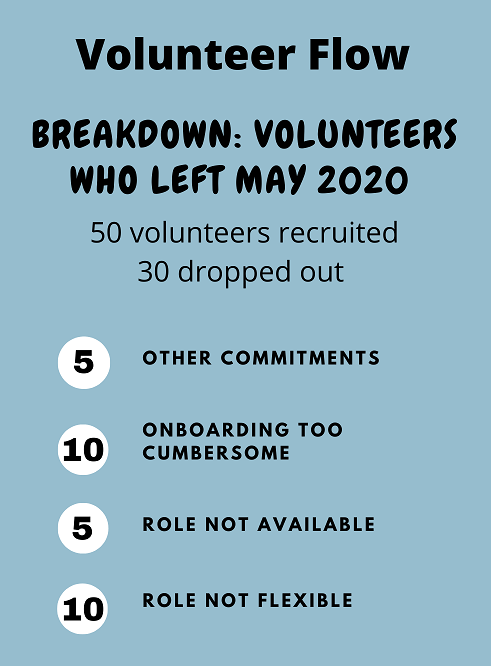
    Example: Month of May: We recruited 50 volunteers who signed up. Of those, 20 volunteers followed through and are now officially volunteering.  The other 30 volunteers did not follow through. The volunteer base has now increased by 20 volunteers. Sounds great if you simply say, “we gained 20 volunteers this month. 

    But let’s go further. What about the 30 volunteers who left after recruitment? Here’s where you can explain the reasons volunteers leave and predict that more volunteers will leave due to these same reasons. Not so great, after all, is it?

    Percentages are calculated from stats gathered – for example, exit surveys or interviews.

    Percentages break down this way:

    • 16% of volunteers who left in May had other commitments
    • 33% of volunteers who left in May found on-boarding too cumbersome
    • 16% of volunteers who left in May did not find a role that suited them
    • 33% of volunteers who left in May needed more flexibility

    When projecting volunteer recruitment in the future, we can now predict:

    For every 10 volunteers we recruit, only 4 (or 40%) will stay. ( based on the above stats, 50 volunteers recruited – 30 volunteers that left = 60% of new volunteers will leave before they even start. Now, 20 new volunteers doesn’t sound so great when the number could have been 45, right? (not 50 because you can’t control the 5 who had other commitments)

    Explain why volunteers leave by showing causation:

    Of the volunteers who left:

    • only 16% left due to unavoidable reasons
    • over 80% left due to factors we can modify or change

    We need to change…

    We can now infer from the statistics that changes will likely increase the number of recruited volunteers who follow through. Changes include:

    • on-boarding needs to be less cumbersome
    • roles need to be more flexible
    • roles need to be expanded

    A strategic Volunteer Flow sheet shows the reasons volunteers leave or stay. (causation). These “causes” are the reasons you have experienced all along and have been advocating for. Volunteer flow is a way to form your knowledge into a measurable report and more importantly, predict the future with statistical information.

    Instead of the notion that a volunteer manager should “work harder” to “get volunteers,” we need to place the reasons volunteers leave or never get started squarely on the outdated systems that no longer work.

    By predicting the same results in the future, you are illustrating that without the changes you are advocating for, volunteers will continue to leave before they even get started. You can use this method to show volunteer retention and causation as well.

    show what you know

    Volunteers flow in and out of our organizations for hundreds of reasons. The reasons we can control must work for the volunteer and by showing causation, we can more effectively advocate for the changes that will increase volunteer engagement.

    Modern volunteers need modern programs that meet their needs. Our communities are ecosystems and volunteers flow in and around looking for the right opportunity to offer their skills and passions.

    Let’s strategically advocate so that when volunteers flow our way, they find a place to stay.

    -Meridian

  • You Can Water Plastic Flowers, But They Won’t Grow

    In a volunteer manager’s chaotic day, volunteer impact is difficult to plan, hard to complete and often impossible to execute. We laughingly describe our chaos in phrases like, “herding cats,” “wearing many hats,” and “controlled chaos.” But, the inability to move ourselves and our volunteers forward due to chaos is no laughing matter.

    I’d like to add another phrase to the lexicon: “Watering plastic flowers,” which means time spent on futile activities. But wait, futile is a strong word; it means “pointless,” or “incapable of producing results.”

    So, let’s eliminate the word futile, because there’s always hope right? As volunteer managers, we hold hope in our hands: Hope for that volunteer who is hurting and wants to help, but keeps canceling. Hope that our impassioned speech about volunteer value changes minds. Hope that today we will fill a role no volunteer wants to do.

    Instead, let’s look at ROI-return on investment. When our time investment does not produce enough results to continue, this doesn’t mean we must stop reaching out to that volunteer who never shows up; it means we have to weigh how much time we spend doing it.

    And remember, for every minute we spend on something with little ROI, we miss spending that minute on something with a large ROI that has impact and moves us in the direction we want to go.

    What steps can we take to determine where we should invest our time?

    • Volunteer ads: Analyze ads’ effectiveness and spend more time on effective ads. Relegate lesser producing ads to your office volunteers to manage. (and if you don’t have a team of volunteers helping you in every aspect of your job description, what the heck are you waiting for?)
    • Volunteers who are unreliable: Set a tolerance number-I will contact a volunteer X number of times and after no response, I will send them a letter/email/message thanking them, inviting them to contact us when ready.
    • Conflict challenges: If a challenging volunteer repeats egregious behaviors, craft a policy on expectations and stick to it. Make sure every volunteer is given a copy, reads and signs the copy and is aware of your policies and the final dismissal step.
    • Educating staff on the many aspects of volunteerism: Start with one important point and repeat, repeat, repeat; then build on that one concept. Too many concepts dilutes the ability to absorb it all.
    • Staff who improperly manage a volunteer’s time: Move the volunteer to a department that effectively engages volunteers. Make no apologies for moving volunteers to departments or positions that meet the volunteer’s needs.
    • Report, speak and substantiate the why: Want change? Infuse the why (specifics) into everything you say and do. For example, “We have an opportunity to partner with a local florist whose employees want to volunteer and potentially donate flowers, fund-raise for us and help advocate for our services. This will lead to other business partnerships so I need support from multiple departments.” Or, “I moved volunteer Tess to finance because her skills were underutilized in client records.”
    • Close your open door: Set aside planning time and remove yourself from distractions. With any repeated behavior, people will grow accustomed to “oh, yeah, Julie’s out right now. It’s planning time. She’ll be back in an hour.”

    Overloaded volunteer managers have no time for weak ROI. Under our careful cultivation, we need flowers that bloom and grow into effective volunteer engagement and impact.

    So, watch out for plastic flowers; they may look colorful, but water them all you want and they still won’t grow.

    Instead, water the flowers blooming with impact and watch your garden grow into a lush volunteer initiative.

    -Meridian

  • Volunteer Chaos Theory: If a butterfly flaps its wings, will Jeremy volunteer?

    pexels-photo-587085.jpeg

    I’m on a short vacation this week, so I’m revisiting a post I wrote in 2015 and tweaking it just a bit.

    Volunteering needs to have its own chaos theory:  You know, the one that starts with “if a butterfly flaps it’s wings in Brazil, will it spawn a tornado in Texas…”  because engaging volunteers can be quite chaotic.
    Have you noticed that a lot of really smart people look at volunteerism in a very linear way? Their volunteering theory in no way takes into account any chaotic variables that affect whether a potential volunteer follows through, or an existing volunteer stays. Instead, it all depends upon how well volunteer managers “sell” the program.
    Their linear theory  goes something like this:
    Volunteer Manager (VM) sitting at desk. A long line of prospective volunteers stand outside the door patiently waiting for their turn to do good.

    VM: Who’s next? May I help you?

    New Volunteer Jeremy (J): Hi, I’m answering your ad for volunteer help. Can you tell me more about it? I really want to do good and I can’t do good on my own so I came here.

    VM: Why yes, we need someone to do good by helping put up supplies.

    J: Oh my gosh, this is unbelievable, I have a Master’s Degree in putting up supplies! I’ve put up supplies for most of my life. I love nothing more than to put up supplies! When can I start to do some good?

    VM: Well, you first have to go through some orientation and training. There’s four sessions starting tomorrow. That might be a bit last-minute.

    J: Tomorrow, huh? Well I had some important surgery scheduled for tomorrow, but I think I’ll reschedule that. To do good by putting up supplies is far more important. I can take the pain a little longer for the chance to volunteer here.

    VM: Wonderful. After that we need to do a background check. It needs to be done before you come to training. That just gives you this afternoon to get it done.

    J: This afternoon, huh? I actually have an interview for the job of my dreams this afternoon. It’s a job in putting up supplies, but hey, I’ll bet they’ll understand if I don’t come. I’m sure another job of my dreams will come along in another decade or so. After we speak, I will go to the police station and do the background check. I’ll pay for that myself. While I’m there, do you want me to pay for some other volunteers?

    VM: No, that’s not necessary, thank you. Let me check the schedule for the all-important supply put-uppers. Are you available to work on Tuesdays?

    J: Wow, Tuesdays, huh? That’s the only day I have to take my elderly Mother out of the nursing home. She really loves our outings, but hey, what the heck, putting up supplies for you guys is so much more important. I can maybe write my mom some letters. I’ll be here every Tuesday doing good! By the way, what kind of supplies are we talking about?

    VM: Well, our organization gets shipments of office paper supplies on Tuesdays. No one here is willing to do that work.

    J: Office paper supplies, huh? I’m violently allergic to office paper, but you know, my college thesis was on the body mechanics of putting up office paper supplies! That’s where I learned I was allergic. But, I’ll just go to my doctor after the background check and get some stronger medication. Is there an emergency room close by here, just in case the medicine doesn’t work?

    VM: There’s a hospital about five miles from here.

    J: That’s fine, I’m sure they have ambulances.

    VM: You do know, Jeremy that you will have to work alone in a hallway closet. There’s not much light or air, but that’s where the supplies are kept. Is that all right?

    J: I do have a fear of the dark, but what the heck! My minor in college was working alone in a closet, where I learned I had a fear of the dark, but I’ll just bring my own flashlight.

    VM: Great, we will see you tomorrow. Thanks so much for volunteering. Next!

    So, in this linear theory, volunteers pretty much show up, then set aside and overcome any and all barriers to volunteering, because nothing will stand in their way. But, in reality, even the most well-intentioned and eager volunteer can be thwarted by outside factors.

    Have you ever recruited the most promising, amazing human being, only to have a change in job status, unexpected move or family circumstance steal them from you before they even get started? It can shake you and make you feel that all your hard work has been wasted.

    Chaos surrounds volunteerism. Unlike a paid position, any extenuating circumstance can interfere with a volunteer’s commitment to follow through. The tenuous bond volunteers establish with us can fray at any moment due to events beyond our control.

    It happens to all of us and when it does, it feels like that chaos butterfly is slapping us in the face with their wings. There’s no point in obsessing over the stories of “the volunteers that got away,” so we dust ourselves off and continue on, hoping that chaos will smile on us and allow the next eager volunteer to actually get a chance to become a valued member of our team.

    We keep that potential volunteer’s information in a drawer. Sometimes we get lucky and the butterfly wings flap in our direction. When the volunteer is able to return, they will, because we didn’t guilt them about a family member falling ill or a child of theirs needing help and instead, made them feel as though we understood that circumstances kept them from us.

    It’s those nuanced moments that can affect the direction our chaos takes us. Treating volunteers as more than bodies to fill tasks leaves a lasting impression on them. And even if circumstance never permits them to return, they will spread the message to others that our program cares about volunteers as people with real lives.

    Maybe we have to endure more chaos than most. And maybe it’s difficult explaining the variables that keep volunteers from following through.

    But maybe, in this chaotic world, the next great volunteer is waiting for us to find them.

    -Meridian

  • Attention: The Volunteer Department Now Has Ground Rules

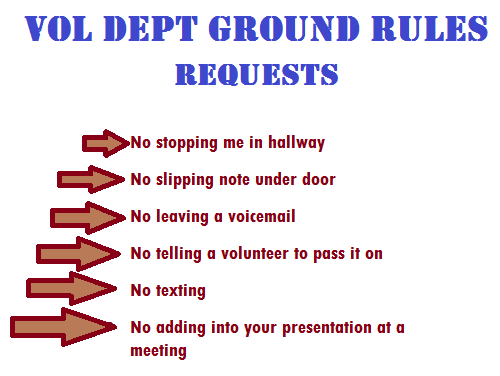
    Ground Rules for Volunteer Departments

    “I need 8 volunteers or maybe 9, no wait,” she says, grabbing your arm in the hallway, “yeah, make it 10, the more the better, right?” Her attention is on the person down the hall, but she glances over her shoulder. “Have them at the Reed Center at 9 tomorrow.”

    Well, hello ground rules. Continuing the conversation from last week, (and a big shout out to everyone who weighed in here and on LinkedIn with great ideas on their excellent ground rules) here are two ways to look at setting them up.

    MY OWN PERSONAL FANTASY GROUND RULES:

    Three staff members request volunteers. Count the number of letters to determine which request gets top priority: The smallest number of letters wins.

    Amy: A

    Roz: R

    Herschel: H


    Ground Rules

    As you can see, Herschel clearly wins even though he only gave 3 days’ notice to find volunteers versus the week Roz gave.  And Amy, well, it will be a cold day in Honolulu before she gets a volunteer, unless it’s the guy that has to do court ordered volunteering, the one that talks incessantly about how he only had two beers when he crashed into that tree. Yep, Amy, I got your back.

    Ok, now for real. What are some of the priorities that can actually be weighed against less important requests? When proposing the adoption of priorities versus non-priorities to upper management, bring a few examples of how you look at prioritizing volunteer engagement.

    And don’t be afraid to drop the “S” word: Strategy. As in, “in order to better serve the mission, let’s strategize our priorities.”

    Your list of examples will spur senior management to adopt a “Priority Principle.” Setting priorities means asking the following questions and assigning a weight to each one. Weight determines priority status.

    Do the clients come first, no matter what? What does the mission say? Clearly, the client’s needs are the reason we exist. This is a great place to start, because weight should be the highest.

    What does the organization need to run smoothly? Volunteers are vital in keeping the organization running. Do volunteers fill in for staff when they are absent? Do volunteers take weekend shifts? Do volunteers occupy roles that must be filled in order to serve clients? The weight here has to be really high.

    Which stakeholders count the most? Donors, dignitaries, potential clients and influencers all carry weight. What events or strategies involve the most bang for the buck? This is where weight will flesh out low priority requests. Staffing a booth at a last-minute  weekend fair carries little weight against an annual festival with high visibility attended by key stakeholders.

    Is the time frame reasonable? Weight needs to balance up and down between last-minute and timely requests.

    Is the request feasible? It may be hard to define feasibility, because we typically entertain all requests. (which does not imply all requests will be met) Having a listing or report outlining the skills, availability and interests of the volunteers can be applied against requests. Weight is equal to feasibility. For example, you can say…

    At this time, we do not have any volunteers who have an interest in washing the board members’ cars as a ‘thank you.’ Time spent trying to convince our volunteers that this activity is more meaningful than engaging with clients or keeping the reception desk staffed will deplete precious time from requests that further our mission.

    What is the amount of work involved when enlisting volunteers? Work=time=there’s only so much, even if you work sixty hour weeks. How many volunteers are requested? How specialized are the skills needed?

    Are any of the following factors within the request out of the norm? (timeframe, location, ability to get to assignment, duties, weather, duration, stress level, etc.) Complicated requests require additional time and if the complicated request holds a high priority, then the weight of other requests is reduced by a factor reflecting the extra effort needed to obtain volunteers.

    How does this engage volunteers? We must add this one into the mix. Volunteer retention or sustainability is directly related to engagement. Strategizing retention must be highly weighted and given top priority.

    We may not agree with all of the decisions made when administration strategizes priorities, but we have to be flexible because having administration’s ‘stamp of approval’ will be worth it the next time a flurry of requests are dropped on your desk.

    Volunteer services is not a buffet of ordering without end. Actually, even buffets have a limited number of choices if you think about it. I can’t get Tantanmen at any of the buffets in my area, although I crave it. So, why should anyone be able to “get” a volunteer to sit outside the chapel “just in case an upset family member should enter?”

    Professional, efficient volunteer departments need ground rules in order to ensure the priority requests are met. After all, at year-end, the organization is no better off because you ‘got’ five volunteers to dress up like clowns at some poorly attended event, right?

    -Meridian


  • And The Gold Medal Goes To…

    And the gold medal goes to

    By any chance, did you watch the Volunteer Manager Olympics last night? Oh my gosh, it was exhilarating. Volunteer managers from all over the globe participated in events showcasing the best practices in engaging volunteers. In case you didn’t get a chance to see it, these are a few of the event highlights:

    Negative News Delivery to a Volunteer Curling: Wow, this is a tough event that takes skill, straight forward delivery, an eye for “spot on” results and messages that stick. Volunteers had to slide their “message stone” onto the button and curl around the “objection stones” in their way.

    Volunteer Manager Juan deftly took gold by sliding his message stone onto the button (bullseye) when he took an errant volunteer aside and showed her a copy of the policies and procedures manual outlining the reasons she couldn’t accept jewelry from the client. He curled around her “objection stone,” her objection being that “the client insists and I don’t want to seem rude.” His stone was spot on because, when he explained the importance of clear boundaries, the volunteer not only understood the policy without getting angry, she vowed to help educate other volunteers on boundaries. Go Juan!

    Volunteer Manager Darise took silver when she curled around a teen volunteer’s snide objection stone (“Don’t forget, my mom’s a senior manager!”) and stood her ground, saying, “no, you are not allowed to bring all your friends to hang out here, this is an organization doing meaningful work and we expect everyone to comply.” Darise said that she often practices in the mirror before having difficult conversations. Sure seems like that practice paid off!

    Avoiding Disruptions and Setting Priorities Giant Slalom: This is an event that rings true for all volunteer managers. Barreling downhill towards a finish line, these Olympians had to get by the gates of distraction.

    Volunteer Manager Gwen took her first gold medal in this event. She deftly navigated around the distraction gates by posting a sign on her closed-door that read, “Volunteer Planning Session 1:00-2:00 in progress. I will be available at 3:00.” This year she added a new skill and only checked her email twice in a day, which meant that she actually got some work done on a project. When Gwen accepted her medal she said, “I’m accepting this for all those volunteer managers out there who are struggling with constant disruptions and want them to know that they too, can set priorities.”

    Volunteer Recruitment Snowboarding Halfpipe: This crowd pleasing event shows off volunteer managers’ creativity and flexibility. On the halfpipe of volunteer recruitment, volunteer managers perform their best tricks.

    The gold went to Volunteer Manager Amir after the judges scored a record 95.7 for his recruitment run. Putting down tricks such as ‘creating a volunteer recruitment task force’ and ‘revamping the organization’s website to include easier access for prospective volunteers’ gave him a solid start. But the biggest cheer was when Amir threw in his signature trick, the “Amir Woo a Volunteer” where he equips staff and volunteers with business cards that read, “We Want You to Volunteer, call this number.” Amir told reporters, “trying new ideas paved the way for my gold medal run. Not everything works, but I’ll try it and see what does.” Thanks Amir, you make me want to try something new!

    Volunteer Sustainability Ice Dancing: In this visually stunning event, pairs of volunteer managers from unrelated organizations perform a volunteer retention ice dance together to inspire volunteer sustainability. It is the epitome of cooperation and working in unison for volunteer engagement.

    Two newcomers and this year’s gold medalists, Volunteer Manager Jason and Volunteer Manager Yumiko took the arena by storm when they ice danced to “We Are Family” by Sister Sledge. Jason, who manages volunteers at a museum and Yumiko, who leads volunteers at a woman’s shelter performed a magical twizzle. They cooperatively shared volunteers by assessing their volunteers’ talents and referring idle volunteers to each other. They also alternated providing training and continuing education to both groups of volunteers which built a camaraderie and inspired volunteers to help both organizations. Jason and Yumiko received a standing ovation.  At the podium, a joyful Yumiko said, “It’s so great to see our volunteers working to help both of our organizations. It makes Jason and I proud when our volunteers get together and share ideas.” Jason agreed as he hugged Yumiko. “We feel it’s about thinking of the volunteers’ needs and not about being selfish.” Congrats Jason and Yumiko, you two are the future of our sport.

    Wow, I’m hoarse from cheering. What a great representation of our sport, er profession. The future of volunteer engagement is looking bright.

    -Meridian


  • “We want to work with staff who have drunk the Kool-Aid,” an interview with Laura Rundell, CVA


    An Interview with Laura Rundell, CVA
    Laura Rundell, CVA with a mug of Kool-Aid


    Recently I had the pleasure in chatting with Laura Rundell, CVA, the Volunteer Coordinator at LifeBridge Community Services in Bridgeport, Connecticut.

    VPT: Laura, tell us a little bit about your background in the volunteer management sector.

    L: I’ve been involved in the volunteer sector since 1999.  During grad school where I received my Master’s in History, I worked part-time for the Park service. I have also worked for several other organizations, including the Spellman Museum of Stamps and Postal History in Weston, Massachusetts, the Phipps Conservatory in Pittsburgh. Pennsylvania and I am currently the Volunteer Coordinator at Life Bridge Community Services in Bridgeport, Connecticut.

    VPT: And how long have you been at Life Bridge?

    L: I’ve been here since 2014.

    VPT: What brought you to volunteer services?

    L: It was at the Phipps Conservatory that I began to fall in love with volunteer management. I had come from a smaller organization to Phipps and found out they had over 500 names on their volunteer list, so the scope changed dramatically.

    VPT: And how did you come to be at Life Bridge?

    L: I moved to Connecticut and landed at Life Bridge in 2014.

    VPT: You’ve had a number of experiences thus far. What have they taught you?

    L: Not all my experiences were perfect. An already challenging job is much harder when the goals for the program and the roles for volunteers are less defined.

    I appreciate where I am as a volunteer manager now and loved my time at Phipps because they support the volunteer program and there are clear expectations and specific roles for volunteers.

    VPT: Can you give us an example?

    L: Yes. When I was invited for an interview at Life Bridge, I noted that the person who would be my supervisor had the CVA credential. It was clear they had put thought into their volunteer program and knew what it would take to make it successful. In my third interview, I was sitting at a table with all of the staff who would utilize volunteers in their programs. I was really impressed that they put so much thought and effort into recruiting for this position and knew then it was an organization I really wanted to work for. I was delighted to be offered the position.

    VPT: That is impressive.

    L: And, just recently, our Executive Director asked for a volunteer to be involved in researching best practices for a project. That shows commitment to engaging volunteer help at all levels of our organization.

    VPT: I’ve noticed you are weighing in on articles and blog posts more and more and that is great; we need more voices. What do you feel is the future of volunteer management?

    L: I see so many non-profits stretched thin and need more volunteers to take on a greater role.

    VPT: That’s a good thing for increased volunteer participation, right?

    L:  Yes it sure is, but I think the number one challenge for most volunteer coordinators is recruitment. It will be an even bigger challenge moving forward to keep filling those roles with qualified and committed volunteers. It means we all have to “step up our game”.

    VPT: Are you seeing changes in the volunteers who are stepping forward?

    L: There are more episodic volunteers, more students who are seeking career experience, and more individuals in the midst of a career change seeking resume enhancers and references. There are also more opportunities to recruit corporate and college groups.

    VPT: Are there inherent challenges with episodic volunteers?

    L:  We have had some really great short-term volunteers. Not every role is appropriate for someone who may only be with us a short time though. Some roles require clearances that can take 4 weeks to get back, so we really hope the person in that role can stay with us for at least a year. We’ve also gotten some really great college and corporate groups. However, walking that balance between offering the flexibility large groups may require and making it a meaningful opportunity that adds value to the organization is a challenge.

    VPT: What have you discovered about recruiting volunteers that you can share with us?

    L: You have to respond promptly when an applicant contacts you. When I relocated to Pittsburgh from Massachusetts, I contacted several organizations to volunteer and never got a return call. That was really frustrating.  After that first contact though, the applicant has to be invested — it has to be their choice to move forward. I have learned you can waste a lot of time spinning your wheels if an applicant doesn’t respond to a request to meet with you, doesn’t show up for an appointment or doesn’t follow up afterwards.

    VPT: Changing direction, do you feel as though volunteer managers are starting to build a community with one another?

    L: By the time I became a CVA, I was linked to a community of volunteer managers. But, often, a volunteer manager is a department of one and is isolated. When I was in Pittsburgh, I reached out to similar volunteer organizations and we volunteer managers would get together a couple of times a year to have lunch and share best practices. Here in Connecticut, we have Volunteer Square and they have done a wonderful job in creating a Professional Development Series for volunteer managers. I’m honored to serve on their advisory board.

    VPT: So, there are some steps being taken.

    L:  You know there is an Association of Fundraising Professionals (www.afpnet.org/) for those who are in the fundraising end but we have no association for volunteer managers.  I wish we had one nationwide organization. Not everyone can attend a national conference, but if we had a national association, we could have branches in our areas that we could connect with and could set national standards for our profession.

    VPT: What do you see as future challenges for our profession?

    L: As non-profit funding continues to decline, there will be more and more dependence on volunteer programs to pick up the slack and organizations will be utilizing volunteer services more. As everyone scrambles for a piece of the ever-shrinking pie, we need to have a unified voice instead of competing against one another for limited resources. For instance, if we all required that courts who refer mandated community service applicants to our agencies provide the funding necessary to fully vet, train and supervise these applicants, we might make some real changes in how court mandated service is assigned nationally.

    VPT: What advice do you have for new volunteer managers?

    L: After I moved to Connecticut, I remember talking to a volunteer I worked with in Pittsburgh and the volunteer said, “We want to work with staff who have drunk the Kool Aid.” If staff is unhappy, or does not believe in the work, then volunteers pick up on that. If an agency has a lot of turnover and has difficulty retaining paid staff, than recruiting and retaining volunteers may be an uphill battle.

    L: I would also say, make sure you connect with other volunteer managers in your area. I have learned so much from my colleagues. Just an hour spent talking with another volunteer coordinator over lunch or coffee can be invaluable. You can learn “It’s not just me…others have this problem too” Also, obtaining the CVA (certified volunteer administrator) is very helpful. I feel like the CVA credential has given me more of a standing in my organization. The CVA gives me ethical standards to adhere to and by virtue of my having it, my volunteer program is elevated.

    L: Also, you need to have rules and policies in place and stick to them. If someone wants you to waive the requirements for a new volunteer, remember this: There are bad actors who seek out vulnerable populations. This is why we don’t bend the rules. Make sure you have a volunteer manual, written policies, and an agreement letter for the volunteer to sign.

    VPT: What makes a difference for you?

    L:  I feel blessed to do what I do. Yes, there are challenges, yes there are frustrations, but a well-run volunteer program can leverage the passion and talent of volunteers.

    L:  I’ll leave you with my favorite story about a volunteer. Before I was at Phipps, I was in charge of an exhibition opening of student art work in Pittsburgh. The students, their parents and the artist they worked with were all on their way, along with a volunteer to help at the reception. Right before the event, we had a severe storm warning and most of our staff left the building. Meanwhile, our volunteer drove through the storm to be there. The kids and their parents all had a great time at the exhibition opening because the volunteer made a commitment and the storm wasn’t going to stop her from coming! That is just one of the stories that keeps me motivated and gets me up in the morning.

    VPT: Thank you Laura for your insights and for sharing with us today. We look forward to hearing more of your voice in the volunteer management arena.


  • The Volunteer Ripple Effect


    I’m convinced. We, Leaders of Volunteers (#LOVols) hold in our hands more power to affect positive change than we can even imagine.

    We have the opportunity to impact the world beyond filling tasks and adding to our volunteer base. The intuitive feelings within each of us are spot on: There’s so much more going on than our excel spreadsheets show.

    I remember long ago struggling to find volunteers who could be with clients while loved ones attended church or synagogue or temple or mosque. I would look for volunteers of that same faith and hoped that they would be willing to give up their own attendance to help someone in need. It was the way it had always been done and it was frankly, exhausting.

    Then one day, a volunteer stepped forward. Hannah offered to sit with Christian clients on a Sunday morning. (I’d love to take credit for thinking this solution up, but, no, it came from this wonderful, selfless volunteer.) Bam! The light went on.

    I feared that mixing faiths (or cultures, or beliefs) would be a challenge in itself, but you know what? (Of course you know what comes next) It ended up uniting people in mutual respect and a desire to understand one another. The mere act of reaching across a cultural or spiritual divide created its own sense of wonder.

    And here’s the thing. For the volunteers, it was never about, “oh, I’m so enlightened that I want to transcend these differences.” No, it was, “you know what? I’m free on a Sunday morning and you need someone, so what could be a better fit?”

    The deep meaningful by-products of volunteering are seldom the initial goals. They just naturally evolve because the volunteer ripple brings out the best in everyone: Clients, families, volunteers, volunteer managers, staff, neighbors, community, everyone.

    Think about that. Volunteer programs impact society in rippling positive ways beyond the delivering of meals, or escorting a tour group or passing out information. Our programs share love. Our programs open the doors for unity, connection and understanding to naturally take hold, and not just during holidays.

    We often witness a profound change in people. We glimpse moments of powerful interconnection through the simplest of assignments. We stand, watching that small pebble create ripples of inspiring stories.

    As you are running around this holiday season, scrambling to fill tasks, stop for a moment and think about the societal change you are helping to bring about. Because you value the innate worth of each human being and believe in their ability to transcend, you are spreading that change like a ripple in a vast sea.

    Volunteerism is a rippling movement.

    And leaders of volunteers are tossing the pebble into the water.

    -Meridian