I think we, leaders of volunteers hold ourselves to this inner higher standard. Not that we think we’re better or more noble, but because we believe the volunteers and our missions deserve a steward who believes in higher purposes. But sometimes, well…
So, there’s senior managers and then there’s favored senior managers, right? Maybe they’re legacy managers because they’ve been around so long and they’re like pets now, or maybe they tell the CEO exactly what needs to be heard, like “no one gets how brilliant you are, but me.”
I recall one favored senior manager (FSM) had some questionable taste in decorating. (not my words, but pretty much everyone else’s). She loved to decorate our main care center. (Actually everyone did, can you say teal and mauve explosion?) One day, some pretty influential donors were coming for a tour and my boss asked if the volunteers (which was me, really) to tidy up the front lobby. I went the extra mile and did the communal bathroom too. Someone had placed this hideous arrangement of faded silk flowers on the sink, so I took them out and tossed them in the dumpster.
Not more than 20 minutes later, the FSM burst into my office asking where the flower arrangement in the bathroom went. “Did the volunteers disturb it?” Uh oh. Turns out these pale flowers were given to her by her dear, late mother and they meant the world to her. (why she didn’t keep them at home, but rather, subjected the rest of us to them, who knew–wait, theyhad a teal container, oh, now I get it ). Mouth hanging open, I stuttered, “I’ll take a look, maybe the volunteers are washing them, you know to make a good impression on the donors.”
That seemed to satisfy her. So, I bolted out the back door and crawled into the dumpster while staff went by, watching me throwing garbage around, but I managed to find the arrangement under a load of lunch leftovers. I went back inside and washed the flowers, loaded with spaghetti sauce in the sink, scrubbing the sauce away. (yeah, white flowers were now pinkish–was that mauve I was seeing?) I put the arrangement back into the bathroom and hurried off to find the FSM. “That’s what happened,” I said, breathless, as she got up to go meet the arriving donors. “The volunteers wanted everything to look wonderful, so they washed the arrangement.”
Satisfied, she waved me off. I went back to work, breathing a sigh of relief. However, an hour later, the FSM was in my office again. “While I appreciate the volunteers washing my arrangement, one flower is missing. Do you know where it is?”
Yes, I knew. It was in the dumpster. “Ahhh, I think they said it broke when they washed it.” I lied. “They said they were really, really sorry because it is just so beautiful.”
“Well, next time, have them ask before they touch the decorations.” She turned. “The volunteers are well meaning, but sometimes they think they know better than the actual people who work here.”
I stared at her for a long moment, a tick on my eyelid pulsing. “You know, you are so right. I just hate it when they think they know more than us.”
So, this is my formal apology. Uh, sorry volunteers, I threw you all under the bus.
I’m revisiting an old post from 2013 because Volunteer Appreciation Weeks are upon us and one way we can appreciate volunteers is to give them the gift of loving the mission. And by that, I mean, shielding them from nonsense.
Volunteers: A head-pat will do
I remember this incident vividly, because organizations often view volunteers as “our little helpers” and not as members of a professional team. It’s easy to pat volunteers on the head, and toss the “Boundaries and Good Practices for Dummies” book aside when dealing with volunteers because, hey, they are so cuddly (codeword-ignorant and therefore, harmless), they don’t need to be treated with anything resembling….intelligence and professionalism.
A few years back, I sat in a meeting with long-term, respected volunteers Darla and Jo, and the supervisor of their department, Cindy. I was shocked when Darla and Jo brought out a list of complaints against Kay, their immediate supervisor. They hadn’t brought any issues to me before this meeting, so I was a bit skeptical, especially when they produced a list of Kay’s shortcomings, including how she treated staff unfairly. (Hmmmmmmmmmm)
Volunteers: Professional team or pawns?
During the conversation. Darla and Jo mentioned they often went out for drinks with a couple of staff members under Kay’s supervision. (Really?) And those staff members shared their difficulties with Kay. (Well, how convenient) So, what that means is, when out socially, away from work, these staff members let loose and talked about the organization and other employees in front of volunteers, drawing volunteers into the politics of their department. (What a great way to make volunteers feel part of the team, right?)
In private, I said to Cindy, “It’s a terrible idea for staff to socialize with select volunteers and air grievances. If staff is going to invite the volunteers to a function, then they’d better invite all of them and they’d better not make the volunteers pawns in some personal battle with their supervisor.”
So, Cindy, who is the supervisor of all in question, shrugged and said, “they’re on their own time, what can I do?” (Really? How would you like it if the CEO invited a couple of staff members out for drinks and they trashed you?) (oh, and then enlisted volunteers to file a complaint?)
Go on record…really go on record
I then said. “I’m going on record as saying that allowing staff members to fraternize with select volunteers on off time and discuss work issues makes for a harmful work environment and should be stopped immediately.” (And, I will be noting this conversation for the time this all goes south, which we know it will.)
Taking care of the volunteers is everyone’s business, not just the volunteer department’s. Write a policy that says your employees will treat volunteers with respect and will not suck volunteers into conflicts. They don’t deserve that. (And this chess game is what you get. It won’t resolve itself on its own.)
I had a volunteer who helped me in my office. From day one, I said to her that “it’s not that I don’t want you to be privy to things, it’s that I don’t want you to be burdened with junk. You’re here to do good work and you deserve to be shielded from the nonsense.” She took that to heart and ever after, when I had a conversation with someone in front of her and it got a bit deep, she excused herself before I had a chance to, and she laughingly said, “I don’t need to be a part of this.” (Bravo to her!) But, you know what? She knew staff had political conflicts, personality clashes, and sometimes back-stabbing incidents, but she chose not to become embroiled in them, which lead to more love for the work.
Let volunteers love the mission
The question becomes, “for whom does our volunteer volunteer for? Um, the organization, right? But often, volunteers’ loyalties can be steered away from the mission and to select staff or other volunteers. This is why boundaries exist; to ensure volunteers are connected to mission impact and not to any cult of personality borne from feeling sorry for or loyal to one or more individuals.
So, when staff thinks they’re being nice or cute or they just want some pawns in their game of complaints, they need to realize that fraternizing might be great for them, but it’s always a bad idea for the volunteers. Let the volunteers see the greatness of the organization, not the back room where stuff is all chaos and disjointed and frankly sometimes back-stabbing. And if staff want to grouse about their jobs, then make sure that volunteers are left out of it.
Emma set her cup down on the table and opened her laptop. She could hear the kids arguing upstairs as they got ready for school. Jenna needed to be picked up after soccer practice, and Harvey still needed to finish his science project or he’d get an incomplete. Emma’s phone pinged. Her mother’s tests came back. The cancer had returned. Holding back the tears, Emma scrolled through her news feed. She clutched at her life spinning out of control, desperately grasping at something to ground her. She read the headlines. So much political in-fighting. Too many vapid celebrity news stories. One heading came from her local newspaper: Volunteer Receives City Council Award. Emma paused for a second, and then scrolled on.
For years, I thought that any story on a volunteer would produce a tsunami of people trampling each other to join our team. “I want to be just like Herman, or Zafir, or Maria,” they’d proclaim, their fresh smiling faces eager to give back. “Pick me! OOOOOhhh, pick me!” They’d come in wearing t-shirts sporting the face of my smiling volunteer. It would be cult-like, but so what, my volunteer was a star!
Having press cover volunteers was so rare, that once a reporter showed up, I was slobbery grateful for any mention at all. I grovelled at the reporter’s Birkenstocks. And so, stories about volunteers receiving some plaque or attaining some milestone were all I could get. I never challenged the content and I always suspected the reporter was being punished by doing a “filler” or “human interest” story and really wanted to get on to digging out news stories about that bank robber wearing the Nixon mask or the mayor’s brother suddenly being awarded a lucrative city contract.
While scrolling through news-feeds this week, it felt like the I was back in the 90’s. I could hear Alanis Morissette singing in the background. Ironically, the overwhelming majority of volunteer news stories are identical to the ones written about my volunteers 20 years ago. Here are some news-feed headlines from just two days worth of searching articles: (names and places removed)
Seniors recognized for volunteer work
Doing what comes next: Man keeps working, volunteering
Volunteering “immensely rewarding” for local woman
Duo shares gifts through volunteering
Local woman finds volunteering a positive influence
Local man honored for volunteering by Service Center
Couple’s love of volunteering keeps them on the go
SENIOR SPOTLIGHT: Volunteering can have numerous benefits
Volunteer receives medal for dedication
These volunteers provide help, friendship
Have you nodded off yet? And to think I used to titter excitedly, “my volunteer in the newspaper, wow, we’re at the summit of the recruitment mountain! Break out the oxygen!” Seriously, what was wrong with me?
I’ve been reading targeted news-feeds for years. Anything of real substance I share on my Pinterest site, Volunteer Management Talk. But most articles on actual volunteers by actual reporters are frothy little yawn-fests. Yes, they’re positive. Yes, they paint volunteerism in a good light.
But where are the meaty stories that outline the results of volunteering? Where are the intriguing headlines that proclaim, “These Volunteers are Alleviating Homelessness,” or “These Volunteers Are Creatively Saving the Wetlands,” instead of “These Volunteers Have Really Big Hearts and Are as Boring as Their Organization’s Website.” (ok, sure, I made up the last part-sorta)
I was wrong about the recruitment potential of the few articles that were published in my local press. There was no mad rush to volunteer. I didn’t see our phone lines light up, or volunteers stampede in with news that their friends and neighbors were outside, clamoring to join our awesome team. I didn’t yell, “Put more coffee on, guys, it’s going to be a long night!”
In retrospect, I failed to get the real message out. The real message is the impact.
Volunteer managers everywhere are fighting to elevate the volunteer role by changing the perception of volunteer contributions and volunteers. If we want volunteers to be recognized for their work, we have to take volunteers out of the “human interest” column and push it into the “news” division. But, how?
When a reporter shows up to cover that award or story about Jane and Hermione, partners and your volunteers for 10 years, ask the reporter these questions:
“Where does this story fit in your publication’s divisions? Why?”
“What is the end game of this story? What do you want readers to take away?”
“Do you want to know the bigger story, that of the impact on our community?” (be prepared to offer relevant information and if you can, an interview with someone helped by your volunteer)
“Can you come back and do a follow-up story on the results of the volunteers’ work? We have some juicy human interest stories to share about the people who have been impacted by our volunteers.
If the reporter is doing a story on a particular volunteer or volunteers, (let’s take life partners, Jane and Hermione) prepare some eye-opening stats about them. “Yes, it’s true that Jane and Hermione have been here for 10 years, but here are the stats and stories on the impact they’ve had on our homeless population and by the way, that’s the reason they’ve been here for 10 years. “
I know you’ve experienced this. A volunteer is chosen as the subject of a local newspaper piece because of an award or milestone. The humble volunteer doesn’t want to be the center of attention. The reporter is just on an assignment. You convince the volunteer to do it because it will inspire others to volunteer. You tell them that whatever they say will be inspiring, because hey, they are a great representative of the work, right? Well, maybe they really don’t know what to say.
Well, why not take it one step further and plan with the volunteer what he/she will talk about? Pick out real impact stories to focus on and explain to the volunteer that these stories are the impetus for encouraging others to get involved. Tell them to turn the interview message around from “you can be like me,” to “you can impact our clients too, in these ways.” And throw in, “we can sure use more help.”
Why not help the reporter see that they could turn the story into something more, something with real substance? Plant that “juicy” story in their heads.
There’s a complex mathematical equation that explains the phenomena surrounding news stories about volunteers: It’s tricky and complicated, but it goes like this:
Press Stories on Volunteer+Fluff=Where are the new volunteers?
We have more than just our organizations needing to be convinced that volunteers are not just decorative marshmallows of pillowy goodness. We also have to target press, media and the community.
I’m disappointed and sorry I didn’t do anything about this disconnect before. But, the perception of volunteer contributions needs to change, both within and without. I think that together, we can change this perception, one story at a time.
Do volunteer managers possess the skills required to succeed in the corporate world?
I recently had the pleasure of interviewing Sally Garrett, a recent leader of volunteers who has taken a managerial position in the world of retail. Sally was the manager of a St. Vincent de Paul depot, an Australian branded “Vinnies” retail thrift store, the highest grossing and net profit store in Western Australia while under her leadership.
VPT (volunteerplaintalk): Can you briefly describe your current job?
S (Sally): My Current job is as a Retail Manager of a lifestyle super store with 26 paid staff.
VPT: How long have you been in this position?
S: I have been here 1 month.
VPT: Before this position, what was your job as a volunteer manager?
S: I ran a large not for profit processing and pick up depot and retail outlet.
VPT: How long were you in that position?
S: Two and a half years.
VPT: What skills do you feel you developed as a volunteer manager and how did they translate to the position you now have?
S: The biggest skills I developed are empathy, patience, organizing people, time management and being able to teach others that they are more than they believe they are.
VPT: What skills helped you the most in moving into your new position?
S: I guess because I had been rostering and managing large volumes of people all doing small roles, the biggest skill that has helped me in my new role is patience. You can’t rush volunteers and you develop a skill of being able to step back and look at the bigger picture all the time, so it became a habit to stop, look and listen. This has helped so much in my present job, because as I have a lot to learn, I am not at all overwhelmed. I am much more rounded in my approach to my team and I listen a lot more and act less, but it’s action with conviction. This means when I do act, it is for the long-term and not the short-term.
I have already found that many people can sort out problems for themselves and become self autonomous rather than needy. I can quickly detect when people are good at what they do or need better training because I’m watching them and listening. I’m not trying to learn their job so much anymore, but placing acknowledgment in what they can do. This has made my new team feel more confident and then their skills began to shine.
The second skill is having learned to not take credit for what others do, but rather celebrate their gifts and achievements. I don’t feel the need to own others’ successes. I have developed the ability to lead, not manage.
The third, most important skill is that I don’t take anything personal. I am impartial to people because I know it is about them not me, and every action someone takes says things about them, not me. So, if someone is frustrated they may call me names or tell me I am not doing my job but this translates into the fact that they are telling me they need more training and are feeling overwhelmed or vulnerable. This took a long time to learn. I always thought I was doing things wrong in this situation until a volunteer pointed out to me that the other 120 people loved what I did and felt supported, so once this skill kicked in it just meant going back to basics and taking time for a cuppa and a chat and getting to the real problem which was 100% of the time the person left feeling vulnerable for some other reason.
VPT: When you accepted this new position, did you find that your volunteer management experience helped you get the job? Any actual feedback from your new supervisor on your volunteer management experience?
S: When interviewing for the position I applied for, I was calm and confident as I knew I had become a leader and not a manager so the interview process was easy and effortless. I had nothing to prove; they either wanted my skill set or they didn’t. If I wasn’t a good fit, I didn’t want to be there.
I was asked to take on a much larger role than I applied for in the interview; the position was in another shop as they felt I would be of value in that role with a larger team and a busier store. As it turns out I came across as soft and compassionate but with a deep knowledge of people. This is what progressive organizations want. They don’t want bosses anymore, they want team leaders and that’s what you are as a volunteer manager.
VPT: Are there skills that volunteer managers lack, or do not realize are important if they are seeking jobs other than in the world of volunteerism?
S: Acknowledge your value!
I believe a volunteer manager is much more qualified at team leadership than anyone gives them credit for, including themselves. It is a huge task being a volunteer manager and when in the role it doesn’t feel it is that important, but you touch the very core of people when they are a volunteer. Because they aren’t there for money, you find out more of what makes people tick so translating that to paid staff roles, you are able to make your staff really feel cared for when they come to work.
You have developed an ability to shut the work-space out and make eye contact and listen to them and answer their questions. whether it be personal or work related. You have developed the ability to validate people, and that’s what our world needs more of. You are also able to adapt quickly because volunteer management deals with absences regularly. You know how to get work done with few, if any help. Acknowledging the confidence that you know it will get done when the team is there, gives you a calmness and that drives people to help more and work harder. People love that you are in control and that you appreciate their efforts rather than stressing and then making them feel less when they are giving more. All volunteer managers develop this skill.
VPT: How can volunteer managers prepare themselves to enter the world of corporate management?
S: Be the very best version of yourself, it’s really that simple; being authentic and not promising things you can’t deliver, the rest falls into place. When you develop the calmness of self-confidence, you can learn anything; the skill of managing people is the highest of all skills you need in life and work and you have that in the bag once you are a successful volunteer manager.
VPT: Is there any advice you would like to give your fellow volunteer managers?
S: Give them (volunteers) 15 minutes undivided attention and induct, induct, induct!
Make sure when your volunteers start, you have given them your time whether it is 15 minutes at the start or the whole induction if you can, that time is what the volunteer remembers, because volunteers revere you; they know how hard your job is and they see you as their guiding light. If you only knew how powerful you are you wouldn’t worry about a thing. But that’s where volunteer managers are the most successful. We don’t settle for second best because it always has to be the best. Aiming for the stars on every task is what we do. Landing on the moon is not good enough for us, but it’s great to everyone else.
Know you are saving lives! There is a high number of volunteers that are volunteering due to mental illness preventing them from holding down a paying job. Know that you are potentially providing the healthy, stable and compassionate environment that these people need to gain new skills and give their life purpose. It surprised me to be told on three occasions that it was because of me, personally that three people got up and tried again another day rather than ending their lives. It both shocked me and made me seek help myself to understand my role more fully. The knowledge of each person over my time in Volunteer Management truly made me see how I changed lives and how powerful and responsible my role was and how important it was to be transparent in all I did. I had to understand that it wasn’t my responsibility to take this knowledge on board personally and that it was only a part of the role. But the knowledge was confronting and it changed my dealings with people. Compassion isn’t being weak, it is the exact opposite.
Relax more and stress less, develop the ability to tell people they can do it on their own. Softly, gently encouraging and convincing people they are wonderful and able, is the greatest skill ever. It is the most productive management tool in the workplace.
What incredibly inspiring words for leaders of volunteers. Thank you Sally for sharing your wisdom and experience with us. All the best to you in your new position. They are very fortunate to have you on board.
So, the next time all of you volunteer managers feel under appreciated, remember these words from Sally: I was asked to take on a much larger role than I applied for in the interview; the position was in another shop as they felt I would be of value in that role with a larger team and a busier store.
Time=Money. We all say it and that’s why we call volunteers “time donors.” They donate their time, and of course, skills, expertise, talents etc. But is that what they really are? Donors? Maybe there’s a more descriptive word for our volunteers. And what is the difference between the terms donate and invest anyway?
Hmmmm, there’s a subtle, but profound difference in the two definitions.
Volunteers don’t just show up, give a few hours and walk away. But outdated thinking categorizes them in this way. Doesn’t it feel like investing is closer to what volunteers do? Maybe we should start to rethink this whole time donor idea.
Let’s take this further and examine investors. Investors invest money, right? But why? Why do they invest money in startups. non-profits, real estate, stock markets and other ventures. To make more money? Or is it more than that?
Money is a currency. So what do investors really invest? Many things. They invest their future, hoping to be financially secure. They invest their dreams, hoping to achieve a goal. They invest their essence, hoping to give back. They invest their good name, hoping to attach to a cause that is worthy of their currency. They invest employee engagement, hoping to attract great employees. They invest their clout, hoping to further a cause that supports their vision.
Investors invest so many intangibles, and their currency is money. They don’t give startups or organizations money, they devote their money in order to achieve a goal.
How would this apply to volunteers?
If money=currency, then time=currency.
So if volunteers’ currency is time, then what exactly do they invest?
They invest their humanity. (thequalityorconditionofbeinghuman)
Volunteer managers everywhere instinctively know this. We feel this every day when hearing and observing our volunteers’ intangibles. How do we feel this?
by the rewards volunteers tell us they personally feel
by their belief in us and our missions
by the passion exhibited by volunteers
by the camaraderie volunteers forge when bonding with like minded citizens
by the commitment volunteers show
by the enrichment volunteers gain by volunteering with us
by the sense of pride volunteers feel in their work
by the support and love they extend to us and other staff
by the initiative they take when doing word of mouth marketing in their communities
by the care they wrap around strangers in need
by the desire they exhibit in wanting us to grow and succeed
by the pure joy they infuse into our lives
by the amount of time they spend away from us helping us off the clock by recruiting, marketing. finding resources, donating, improving themselves, etc.
Investors, according to experts, want the following things from the areas in which they invest:
they want to build a relationship
they want to partner
they want to invest in a “team”
they want to see a better future
they want to grow
they want to understand concepts
Sounds an awful lot like the wants of our volunteers, doesn’t it? Calling volunteers “time donors” implies that they give time and walk away and are mostly disconnected from us. Nothing could be further from the truth.
So, do volunteers donate their time or devote their time if devote implies giving for a purpose? I think devote wins hands down.
For years and years, we have been trying to equate time donation with money donation. Time and money are simply two different types of currencies. And besides, we all know that volunteers do so much more than give their time to a task. They also raise money, find resources, advocate, broadcast, recruit, and market for us. They have chosen to invest a huge chunk of what makes them human in our missions. They have chosen to connect their precious humanity to us.
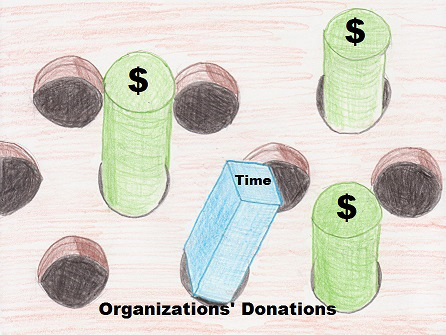
Let’s stop constantly trying to shove volunteers into the round money hole by equating time spent with dollars saved, which isn’t a true measuring stick at all. Let’s erase the idea that volunteers have no more connection with us than a few hours here and there.
time donors=minimal involvement
volunteer investors=fully engaged
Instead, let’s elevate the volunteers’ role as investors. Investors who devote their time, money, skills, talents, resources, passion, commitment, expertise, experience, knowledge, drive, zeal, perspective, and so much more to helping us further our causes.
We all know volunteer feedback is invaluable, during and after projects and assignments. There is also value in gathering feedback from former volunteers who have had the time to process their experiences and take aways.
Recently I was able to catch up with a retired volunteer, Ellie, and I asked her to look back on her years of volunteering for a hospice.
VolunteerPlainTalk (VPT): How many years did you volunteer?
Ellie (E): (laughs) “oh about 18.”
VPT: That’s a long time.
E: It was a long time, but it was good.
VPT: What was your favorite part of volunteering?
E: Hmmm, my favorite part. I liked the idea of giving and I always felt that I was receiving so much in return, but I guess you hear that a lot.
VPT: Do you remember the beginning?
E: Yes. I remember my training. At the end of training, the volunteer trainer handed me my first assignment. She told me that she believed I was ready. And she took me over to the window and pointed to the house of the person I was assigned to. She sort of let me know that it wasn’t far away and I would be close to help if I needed it.
VPT: How did that go?
E: I was nervous, but I felt prepared.
VPT: Was your first assignment the impetus that kept you going?
E: Actually, it was my first long-term patient, who came right after. We became incredibly close. Before she passed away, she said that she had added one more daughter to her family. And shortly before she died, she called me in and said that she needed to know that I was going to be ok. The extent of our connection was something I never expected.
VPT: How much of a role did your volunteer manager play in your success?
E: Oh my goodness, so much. The fact that my trainer and my supervisor, Jim trusted me, had faith that I could do this was huge. And, I always felt that if I had a question, he would be there. I remember I was sitting with one patient whose wife had a part-time job. He had a morphine drip and he thought it wasn’t working and he said to me, I don’t understand why this is not working, can you find out? Now, I have no medical knowledge at all, but I immediately got on the phone and my supervisor got me to the right person. That went a long way to building my self-confidence.
VPT: So, having someone to contact was hugely important.
E: Absolutely. I always counted on being able to knock on his door, go in and receive the support I needed.
VPT: You are also a thirty year now retired school teacher. Why did you volunteer at a hospice and not with children?
E: (laughs) I think I needed to do something different. After my husband died so young, I felt like I wanted to do something that was meaningful.
VPT: Did his death influence your decision to volunteer for a hospice?
E: I don’t think so. It was over three years between his death and my decision to volunteer.
VPT: How did you find hospice?
E: I saw this ad, and I knew right then it was a way to fill my life with some meaning.
VPT: So, there was no magic formula for recruiting you?
E: Sorry, no.
VPT: Many people think hospice volunteering is depressing. Were you burdened with sadness?
E: No. It was quite the opposite. It was fulfilling.
VPT: Was there any opportunity for fun?
E: Oh, my yes. I had so much fun with the staff. We let loose all the time. The seriousness of our work was a contrast to the silliness we experienced. I remember the time we made over 100 pumpkin pies for a Thanksgiving dinner in our care center. We laughed the whole time. Having that fun kept us wanting to do more, you know what I mean?
VPT: I do. Was having fun a good use of your volunteer supervisor’s time do you think?
E: Absolutely. Life is full of balances. The balance between serious work and letting off steam goes a long way to bond us together. It strengthened our team.
VPT: I’m pushing here, but I wonder. Have you ever connected your losing your husband, the man you had planned on retiring with, and your work in hospice?
E: Ehh, no. I just know that I had a lot of years to give and it was a way to fill my life with some meaningful work. But I do remember one year, I signed up to volunteer at a children’s grief camp. That day, while driving on the way to camp, I thought about all the little kids who were coming. They had all lost someone important in their lives and I had a little meltdown. I missed my husband.
VPT: That must have been tough.
E: I thought about these kids and it occurred to me that I went through this years ago. It brings something home. While I was there, we had a ceremony at night. I was really grieving for my husband. It comes when you least expect it. Sometimes you have an epiphany to a particular circumstance you’ve been through. It was almost like a total realization I had been through a significant loss and I released that.
VPT: I’m at a loss for words.
E: I even had grief counseling after his death. But my meltdown shocked me. I thought I had processed the grief.
VPT: So, in retrospect, did your volunteering have a personal positive impact on you?
E: Oh my, yes.
Next time: Part 2 of this interview. Ellie moved away from her hospice, but she stopped volunteering before she moved. Why?
Get your dancing shoes on! This year, volunteer appreciation week in the US is April 23-29. It’s coming up in May for Australia, and June for the UK and New Zealand.
If you have a luncheon planned, you’ve long ago selected the venue and contacted the speakers. You’ve ordered the cute online mini calculators for giveaways. (of course your calculators were shipped late because the vendor mixed up your order with one from the company, “Meals on Wheelies” who is actually a pizza delivery joint in Appleton Wisconsin) You will give up your Friday night tickets for the punk concert, “Zombie Brains Munchfest” and instead, you will sit alone, wrapping the calculators in cute purple tissue paper (which serves nicely to dab your tears) because your friends and family say they are tired of being unpaid labor.
Volunteer appreciation events vacuum up our time and emotional energy like giant tornadoes trailing balloons. Expectations are high. Is the food great? Are the speeches sincere? Will I be able to make each volunteer feel special? But what about the volunteers who are out-of-town or are ill or just can’t come? What about the day after the event? The week? The year? Do the speeches and chocolate fountains last?
I’m not against events. Not at all. I am though, for grabbing any opportunity to improve volunteer engagement. What if we made volunteer week a kickoff, rather than a stand alone event?
Why not use volunteer week as a brightly colored launch to enlist staff support for acknowledging volunteers all year-long? It makes sense to jump on the festive events as a springboard for a volunteer recognition calendar. With our orchestration, ongoing volunteer appreciation can become a learned behavior within organizations.
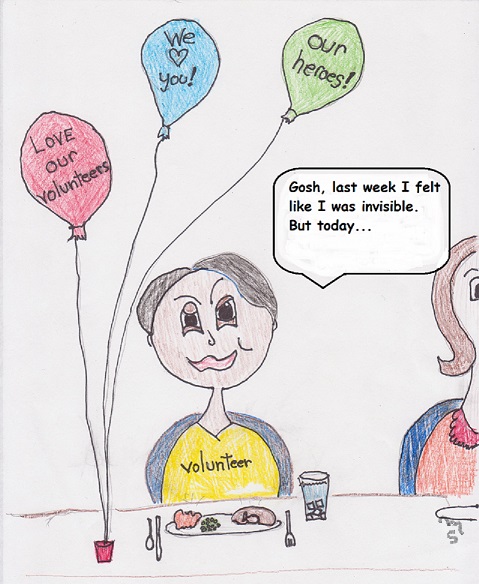
While the “we heart volunteers” posters are up, the splashy balloons float in the hallways, and the staff is sampling that star shaped cherry cheesecake, it’s time to pounce! As these vibrant visuals draw attention to your volunteers, it’s the perfect time to visit each department and share your recognition calendar for the year.
A sample calendar can look something like this:
The Volunteer Department Yearly Calendar of Volunteer Recognition!
Every first of the month I will pass around birthday cards for the volunteers who are celebrating birthdays. I would appreciate your signature. The cards will then be mailed to the volunteers. These simple but effective cards remind each volunteer that the entire organization appreciates them on their special day. Individual recognition goes a long way towards volunteer retention.
Every third Wednesday of each month I will visit one department to write down testimonials from staff on the incredible impact volunteers have on supporting our mission. These testimonials will be published in our volunteer newsletter which is shared with all volunteers. In addition, the testimonials will serve to recruit prospective volunteers as well. Here is the list of scheduled departments for the next twelve months. Please be thinking about our volunteers and their contributions. Your testimonials serve to reinforce the volunteer support your department deems beneficial. (Bonus: keep all the testimonials for other purposes such as recruitment ads, speeches to groups etc.)
Every quarter I will be videotaping several staff members expressing a simple ‘thank you’ to our volunteers and I will be showing the videos at the beginning of our volunteer meetings. These videos will serve to remind the volunteers that they are important members of our team. (Bonus-you can show all of the videos at next year’s luncheon)
I will remind everyone in an email blast the first of each month. Thank you for participating in our plan to retain our valuable volunteers and to encourage new volunteers. Staff appreciation is a motivating factor in cultivating a supportive team.
Your written plan can include:
A-what and when (the schedule)
B-how (the particulars)
C-why (the benefit to volunteers and organization) D-in addition, your reminder schedule
Volunteer recognition is meaningful and fun on event day. We serve up praise along with chicken salad and we may even give awards for volunteer of the year. But awards look backwards. Let’s also look forwards. Let’s develop a plan to set the tone of appreciation for the coming year. Heck, maybe announce that at next year’s luncheon, there will be an additional award for the staff members who excel at engaging and recognizing volunteers.
Now wouldn’t that be something to truly celebrate?
-Meridian
“I couldn’t stop, not after I’d been with her for so long.” Volunteer Jill spoke of her decision to keep seeing the client assigned by her volunteer manager, even though the client was no longer on the program. “Aren’t we supposed to be helpful? I mean, I have a strong connection with her and her family. I can’t just pull the plug.”
“I didn’t see the harm,” said Miranda, Jill’s volunteer coordinator. “I felt it would be cruel to keep Jill from continuing this great connection. But then, my CEO summoned me the day this former client called in to complain. It seems that Jill gave the client some advice and the client thought she was back on our program.”
What do we do with volunteers who want to stay with clients after the client no longer is receiving our services? If we’ve made a meaningful match between volunteer and client, then we understand how hard it is for the volunteer to pull back. Severing the relationship seems cruel. Besides, don’t volunteers have free will?
Although this situation appears muddy, it really is crystal clear: The relationship forged with the client belongs solely to the organization. Staff, contractors, and volunteers all participate in the organization’s relationship with a client. None of us would have created a connection with this client on our own, therefore we do not have a personal relationship. When the organization severs that relationship, we are done.
It is one of those tricky realms where clear boundaries, policies and documentation is crucial. If you no longer provide support for the volunteer’s efforts because the client is not in your care, the volunteer is then free to establish their own boundaries and set their own limitations.
Here’s the question: Should a mishap occur, will the family have a clear understanding that the volunteer is not representing your organization? That lack of understanding can become a liability nightmare.
What steps do we need to take when a volunteer feels they must continue to help a former client or family member?
Include organizational ties vs. personal ties during orientation, induction and training. Make sure each and every volunteer is aware that they are part of a team, and not individually forming relationships with your clients.
Have a clear policy already on paper. The strictest policy would be to fire the volunteer. Or, you may place the volunteer on a temporary leave. Or you might place the volunteer on suspension. Or, you could trust the volunteer to act in a professional manner and monitor their behavior. The point is, have a policy to follow.
Communicate with everyone involved. Communicate your policies and boundaries with your volunteer.
Speak to the former client. Explain that your volunteer is continuing to be involved as a private citizen, but this means your organization does not support or back the volunteer’s actions.
Explain to staff. Be up front, tell appropriate managers and staff and show them the steps you have taken to ensure no harm will befall the organization, client or volunteer.
Document every step of this process. Draft a letter to the client outlining the conversation you had with them and keep a copy in the volunteer’s file. Have the volunteer sign a statement absolving you of all responsibility concerning their actions.
Connecting volunteers with clients is one of the most satisfying outcomes of our profession. Witnessing a bond formed between volunteer and client is immensely gratifying. Having to cut those ties can be frustrating and painful.
But we have to remember that not all aspects of our jobs will be easy. At times, we must do the hard things, the necessary things in order to maintain a professional program.
Leadership means developing the strength to confront and manage the harder parts of engaging volunteers. And elevating volunteer management means becoming a strong leader.
Two volunteer managers, Jessup and Chloe were both excited when the brought in new volunteers.
Jessup, who manages volunteers for a start-up, said, “I was asked to find volunteers to help with our kick off campaign. I brought in a trio of talented volunteers and one of our marketers patiently showed them what needed to be done. The volunteers did exceptionally well, but they didn’t stay with us very long. I had to recruit again and again.”
Chloe, meanwhile, who manages volunteers at a different start-up said, “I recruited a few volunteers to help with our kick-off. I was a bit worried because the volunteers were from varied backgrounds and had really different talents. But, you know, although it took them a bit to get going, all the staff here helped out. Those volunteers are still with us today.”
Volunteer retention is a nuanced and complicated concept. Some parts of it can be controlled and some cannot. But one thing we can control is induction and orientation. Why does a seemingly perfect volunteer become disinterested? Why does another volunteer fit in like a glove? How do volunteers gel with the mission?
Let’s look at induction and orientation: Can we get away with offering one and not the other?
Induction is the formal process in which to introduce a volunteer to their job. (the mechanics)
Orientation is the integration of the volunteer into the organization. (the gel)
Jessup’s organization lost volunteers because they did not orient them. Chloe’s on the other hand, used both induction and orientation.
As volunteer managers, we need to use both induction and orientation to retain great volunteers. And, our entire organizations must be involved. Here is an example:
Induction:
Volunteer manager shows volunteer where break room is, supplies are kept, what the policies are, etc.
Staff member who best knows the job shows volunteer how to do the work, where bathroom nearest station is located, etc.
Orientation:
Volunteer manager welcomes, presents organizational goals, history etc.
CEO welcomes volunteers to organization, emphasizes contributions from volunteers.
A seasoned volunteer is paired with newbie to mentor and encourage.
Staff introduces themselves to volunteer, thanks, offers assistance, assures volunteer they are appreciated and part of team.
Both induction and orientation are vital to engaging volunteers. If we make them feel a part of the team, but do not give them the knowledge and equipment to do their jobs, they will leave. If we give them all the training in the world, but do not integrate them into our mission, they will also leave.
And here’s the thing. Most of us toy with the idea of having a volunteer sign a one year commitment. But maybe that’s just backwards. What we might do instead is ask our entire organization to sign a commitment for each and every volunteer. This commitment would look something like this:
I, the undersigned, ___________________________ commits to do my part in orienting, inducting and engaging each and every new volunteer for as long as that volunteer is ethically representing our organization and mission.
Ask the CEO to require each staff member to sign this commitment. And maybe if you are feeling a bit ambitious, you can point out that volunteer engagement should be part of each employee’s yearly evaluation.
Or, in reality, “The Horrible, No-Good, Very Bad, Completely Upsetting, “Don’t Make Me Do It,” “I Think I’m Going to Be Sick” Day. Yes, that should pretty much cover it.
Having that conversation with a volunteer-you know the one, the one where you have to discuss a complaint during that mean chat that will forever label you a terrible, cold person for hurting the helpless volunteer. You may as well burn the volunteer’s house down too while you’re at it-that’s how soul-less you are.
So, how do we start a difficult conversation with a volunteer after a complaint has been made? And how do we prepare ourselves to have the confidence to do the right thing without melting down into mush? For what it’s worth, here are a few suggestions that I hope help you.
Remember that you are the best person for this challenge: You have recruited and cultivated this volunteer. You care about them and will do what is necessary to see them succeed. And leaving them to fail is ultimately more cruel than helping them remain on track. Tip: Keep reminding yourself that clearing the air and guiding a volunteer is a growing experience for all of you and you will get through this.
Practice your opening line: “I wanted to sit down with you today and chat about how things are going,” is fine, but volunteers really need us to get to the point. The more you dance around the topic, the more uncomfortable it becomes for you and the volunteer. It’s better if you nicely state the complaint up front. “Emma, I wanted to meet with you today, because one of the visitors to our museum called us to say that last Friday you were too busy to show their disabled son where the bathroom was located. You are one of our finest docents and have been for over five years now and I want to hear your side of the story. Do you recall this particular incident?” Tip: Tell yourself to use the exact words of the complaint-don’t water them down because the volunteer deserves the opportunity to respond to the exact charges that were brought.
Don’t apologize for the conversation: Starting out with “I’m so sorry to call you in for this,” or “I hate that we have to talk about this” creates the impression that your organization’s ethical standards are meaningless. Tip: Tell yourself that being neutral, not apologetic helps the volunteer think and respond more clearly.
Assure the volunteer that you are open-minded and fair but don’t put words in their mouth: “Emma, we want to hear your side of the story,” or, “Emma, let’s talk about what happened,” is better than saying, “I’m sure the complaint is unfounded,” or “this must be a misunderstanding.” Tip: Tell yourself that if the complaint is indeed a misunderstanding, then it will surely become obvious and not to worry. If the complaint is well founded, then you have an amazing opportunity to help this volunteer regain their footing.
Don’t diminish the person(s) who made the complaint: Saying, “don’t worry, this person complains about everyone,” or “they probably just had a bad day,” negates the actual complaint. Tip: Tell yourself that bridging relationships is one of your strong skill sets and seeing both sides validated is a chance to bring both sides together.
Allow ample time for discussion: Here is the area in which you will excel at nice-guy volunteer management. These conversations ebb and flow-but the savvy volunteer manager rides the spoken waves with the recurring message that the volunteer’s time and effort is invaluable and their concerns are worth hearing and discussing, even if their actions are in the wrong. Tip: Trust your instincts to tell you when you know the volunteer is satisfied that their feelings, opinions and aspirations are validated. That is when you can move forward with a resolution.
Follow up with diligence: This step takes you from a manager to a leader. Speak with both parties after your initial conversation to ensure that the resolution works for both and that there are no lingering issues. Tip: Use your best mediation skills to assure both parties that your goal is to provide the finest volunteer involvement possible and that you believe in each person. Keep following up periodically until you see the resolution has been met.
We can view difficult conversations in the same way we view traveling to a new place. We can tell ourselves that we will hate the new place by thinking things like “It’s going to be too hot,” “I will hate the food,” “the people are too strange,” etc. That usually becomes a self fulfilling prophecy. Or, like the person who welcomes traveling somewhere out of the comfort zone, we can entertain the idea that this new experience will help us grow, both as a manager and leader.
Choosing to grow and embrace challenging conversations will strengthen not only your program, but yourself as well. So, while it is perfectly normal to dread a difficult conversation, don’t let the opportunity to excel go to waste.






 volunteerplaintalk