Category: treatment of volunteers

  • But What Are The Values?

    light switch
    When Amar answered the ad for a volunteer coordinator, he was certain that he could fulfill the stated requirements. “It was pretty straightforward,” he said, “and although I had not managed volunteers previously, I did have experience in non-profit work. So, I applied and was hired. I worked there for four years, and now, when looking back at that recruitment ad, I wonder why they included along with all the skills required, the phrase, ‘and uphold the values of the organization’. In retrospect, I left that job because I came to really wonder what their values were.”

    Amar continued, “our mission was very clear. Our service delivery was excellent. Recruiting and training volunteers was going well and I felt that their contributions were generally regarded as meaningful. But internally, our organization was a mess. People routinely stabbed one another in the back. The CEO practiced rampant favoritism, set exclusionary rules and so morale was pitifully low, even though everyone worked hard at their jobs. It was as if our organization had a community face for our recipients, donors and general public and then behind closed doors, this dark side emerged. I began to wonder which face was actually the real face of the organization and what really were the values. Fairness? Not that I saw. Inspiration? No, staff was pretty much left to find inspiration where they could. It became a place where you took pride in your work, although you hated coming to work.”

    Can those of us who work in the non-profit world turn our kindness off and on? Can our volunteers also turn it off and on? If we treat clients with tenderness while treating other staff or volunteers with disdain, is it truly genuine? I often wondered that when working with a few volunteers who had a nasty side. I wondered, “how can honest kindness be selective?”

    Amar left his job and found another one. “I walked into a new place that did not speak openly about their values, but instead, showed them daily. Staff was genuinely kind and supportive of each other. Volunteers responded in that atmosphere and accomplished so many amazing things. I took a pay cut, but could not be happier. A value based organization that lives their values is far more rewarding than a larger paycheck accompanied by the stress of working with mean-spirited people.”

    Mahatma Gandhi once said,  “The greatness of a nation can be judged by the way its animals are treated.” That makes me wonder if  the greatness of an organization can be judged by the way everyone within and without is treated, including its staff, volunteers, the delivery people, visitors, the repairmen or even someone who wanders in off the street.

    Is a culture of kindness so thin that it is able to be turned on and off? If so, then it’s a veil and not really a culture, isn’t it?

    -Meridian

  • See, Hear, Then Feel

    fingertips
    “I walked into this position without any experience,” says Miriam, a tiny freckled redhead with sea blue glasses. “I had no idea what to expect since I had never worked with volunteers before. My supervisor told me to come in with a purpose, to take charge. They gave me a volunteer manual so that I could train new volunteers and a list of rules.” Miriam sighed. “No one encouraged me to listen to the existing volunteers, to hear their stories, to get their history. Actually, a couple of long-term volunteers wanted me to shadow them, to see what it is they do but I felt like my manager wanted me to establish the program without too much volunteer input. For whatever reason, I didn’t shadow those volunteers and now I think I regret that.”

    Oh boy. Walking into an established program is tough. How do you meet the expectations of the organization yet give power to the volunteers? How much weight do you give to how things were done before? How much immediate control do you need to establish? Is there a happy medium?

    I remember the day I walked into an established program. I was scared because I had no idea how the volunteers did what they did. How can someone who knows nothing, tell them how to volunteer? How could I train new volunteers with no idea of what it was like?

    Fortunately, a lifesaver named Mary took pity on me. Mary had been volunteering for some time and she saw how lost I was and because, luckily she wanted me and the program to succeed, she burst into the office one day and took my arm. “C’mon,” she said, “I want to take you with me to meet my hospice patient.”

    She drove me to this nondescript house. Mary explained, “the caregiver is a neighbor who took the patient into her home after the patient’s husband died. They had no children.” We knocked and entered the modest home which to me, felt like a labyrinth of secrets and unknown societies. The patient, Emma, a child’s smile touching the corners of her lips, watched as Mary greeted her caregiver and neighbor, Francine. I was introduced to both and I folded myself inconspicuously into a corner to observe. Francine, who was going out on errands while we sat with Emma, whirled around the living room, searching for keys, lists of groceries, and gathering papers to drop at the bank. Mary’s visit was her once a week chance to get her errands done. With a manic intensity, Francine showed Mary where everything she could possibly need was located, all the while assuring us that she would return as quickly as possible. There was this wild energy in the room. I couldn’t look away from the enormous responsibility of Francine.

    But then I watched calm Mary, who had been gently stroking Emma’s hand while steadily gazing into her eyes. “Just a moment,” Mary said to her as she got up from Emma’s side. She walked over to Francine who had just checked her purse again and was opening the door to leave, still mumbling over and over that she wouldn’t be gone long. Mary gently wrapped her arm around Francine’s shoulders and said, “you are doing a remarkable job. We can all see how difficult this is and you are doing it with grace. You need to know what a blessing you are to Emma.”

    And then it happened. I heard the catch in Francine’s voice. I saw her shoulders rise and her expression change. I felt the waves of encouragement wash over her. I experienced the renewal she felt.
    And in that brief moment, in that tiny living room, Mary opened up the world of volunteering to me.

    Being able to connect with our volunteers as they change the lives of those we serve is a precious gift. The moments we are privileged to witness inspire us, teach us and equip us to enlist others in important work.

    Our volunteers are teachers too. From them we learn to see, to hear and to feel. And then, armed with those gifts in our fingertips, we can put our rules and expectations in place.

    -Meridian

  • 5 Ways to Get Off the Passive Aggressive Roller Coaster

    Kumba_at_Busch_Gardens_Tampa


    Glenda, an office manager and volunteer coordinator for a public school enjoys a good working relationship with the rest of the school staff, except for Ms. Riley,  the vice principal. As Glenda recalls,  “One day the vice principal, Miss Riley complained about our volunteers in a PTA meeting. She claimed that none of the volunteers were signing in and that we were losing most of our volunteer hours. Honestly, I was shocked when she said it. Instead of coming to me to ask about it, she chose to throw it out and make me look like I wasn’t doing my job. Besides, only two volunteers out of fifty did not sign in for that month and someone happened to mention that insignificant statistic to Miss Riley and she just assumed all the volunteers were not signing in. I was so frustrated I didn’t know what to say so I just sat there. I wished I had a good comeback.”

    Yes, Glenda, we’ve all experienced insufferable passive aggressive managers and staff. Snide little comments, copying department heads on jabbing emails and rehashing a volunteer error in staff meetings are their emotional roller coasters that just go off track and belittle volunteer managers. So what can we do? Do we have to ride this frustrating coaster or can we simply just get off?

    Well, for what it’s worth,  I finally got really tired of a few passive aggressive staff who routinely dragged me onto their caustic car and I decided to say no to their desire to control my emotions with their passive aggressive behavior. So, here are my suggestions on ways to respond to these staff members who want to get a “rise” out of you.

    1. Check your emotions. The point of the passive aggressive staff member’s snarky behavior is to get you emotionally involved. Quash those emotions and become professionally detached. The staff member who loves to goad people will get no satisfaction from your neutral demeanor and will seek other prey.
    2. Don’t strike back. If you don’t like the tone of an unreasonable emailed request that is copied to department heads and meant to bait you, begin your reply with a cool, unruffled, “Thank you for your confidence in the volunteer department. It is always our goal to provide the very best volunteers for each situation and to treat our clients with the respect and professional service they deserve. Because I view this request with the same importance as every request, I will keep you posted on our progress every step of the way.” The passive aggressive staff wants you to complain that the request is unreasonable, so don’t jump on that ride.
    3. Make them prove it. When a staff member complains that “the volunteer requests are not being met on time,” pin them down with, “Can you give me concrete examples of requests that were not met on time? Without specifics, I really cannot make improvements and it is my sincere desire to continually improve volunteer services. So, what are those examples?” Broad statements without factual backup are a favored route of the passive aggressive staff so make them give you something that you can work with.
    4. Deflect unwarranted blame in a professional way. Called out in a meeting because a staff member did not get something done and they want to blame lack of volunteers? Pick the right moment to stand up and say, “While it is unfortunate that we were only able to get 3 volunteers for this request, I would just like to take this opportunity to reiterate that volunteer services will do everything in our power to supply the right volunteers for all requests. Obviously the sooner we get a request, the more time we have to engage our volunteers.  Last minute requests will be treated with high importance, but sometimes we have more than one last minute request.” Don’t get into finger-pointing but take the opportunity to educate staff on how to request volunteers.
    5. Defend the volunteers in a professional manner. Passive aggressive staff that “joke” about volunteer mistakes or qualifications can be reminded that volunteers are real people who give of their time and accomplish much for clients. Try saying, “While yes, volunteer Mary didn’t send that visitor to the right station yesterday, did you know that she is caring for her seriously ill husband right now and is admittedly, a little scattered? It’s amazing that she takes her volunteer job so seriously that she continues to come in for her shift, don’t you think? And even more amazing is that Mary donated over 300 hours last year in our reception area.”  Staff members need to see volunteers as real human beings who donate valuable service time.

    The sad reality about passive aggressive staff is they are not really serious about teamwork and solutions. They are not interested in honest communication but instead, want to manipulate our emotions and drag us along on their melodramatic trek.

    With some staff members you have to stick to a strictly professional, emotionless communication. When they realize that they cannot involve you in pointless emotional back and forth, they will move on.

    While it’s unfortunate that some folks have little interest in teamwork and solutions, you don’t have to indulge them. Volunteer managers have far too much meaningful work to do to get caught up in mind games.

    Even though roller coasters are meant to be fun, passive aggressive roller coasters are neither fun nor productive. You don’t have to get on one.

    -Meridian

  • Face It: Fit, Attitude, Change, Expectations, by Intervention within a Timeline Part 2

    “Tenderness and kindness are not signs of weakness and despair, but manifestations of strength and resolution.”
    …Kahlil Gibran

    You have a volunteer that is problematic and you are at the point where you believe you have done everything possible to integrate that volunteer. You’ve examined your personal feelings on the situation and feel that you have removed emotion from the equation and are dealing with the challenge in a logical way. So, now what to do?
    Well, think of this acronym- Face It:  Fit, Attitude, Change Adaptability, and Expectations through Intervention within a Timeline. I know it’s a mouth and mindful but hopefully it will help in remembering how to go about working with challenging volunteers. When integrating a volunteer becomes difficult, use this acronym to see if, after interventions within a timeline, there is improvement. Let’s look at each letter in FACE IT.

    Fit: How well does the volunteer fit, not only within the organization, but in her role, with other volunteers, and in the mission? Is the job just the wrong fit or does her philosophy not mesh with the organization’s mission? Does her personality clash with all other volunteers and staff? Is she there for some underlying agenda?

    Attitude: Does the volunteer have a troublesome attitude? Does he incessantly complain? Does he undermine? Is he excessively negative? Is he disrespectful to his supervisors and co-workers? Does he feel that he is superior to the tasks and to the mission?

    Change Adaptability: Is the volunteer able to weather change? Does she dig in her heels when faced with a new policy? Does she refuse to adjust and claims that because it was always done a certain way, you have no right to progress? Does she subvert the mission because she cannot accept new ways and new people?

    Expectations: Is the volunteer meeting clearly defined expectations? Is he chronically late or a no-show? Does he ignore rules and regulations? Does he do whatever he wants without regard to organizational needs? Does he feel that it is not important to communicate with you? Is he a Lone Ranger, but without the white hat?

    These are four pillars of excellent volunteering. When one or more pillars become troublesome, an intervention with that volunteer is necessary. Sometimes it’s just life’s stress that causes great volunteers to go off course. Intervention is never mean but instead, indicates that you notice a change in the volunteer’s behavior and that you respect this volunteer’s contributions and want to help him succeed.

    But help without clear objectives and timelines is futile, so let’s look at the second word in the acronym and the steps of implementation.

    Intervention:
    1. Meet with the volunteer to discuss the area(s) that need(s) improvement.
    2. Point to your rules and regulations, policies and procedures to illustrate your concerns.
    3. Present your evidence, but emphasize your desire to help the volunteer succeed. While note keeping on volunteers may seem underhanded, without details on egregious behavior, your “case” is broad and hearsay.  Besides, specifics help a volunteer see the exact behavior that needs improvement.
    4. Reiterate your commitment to working with this volunteer and then lay a course for how the volunteer can improve.

    Timeline: I can’t emphasize this enough-Timelines are critical. How long do we give a volunteer to improve? Having a clear deadline is effective. Having some random phantom goal in the future will doom your intervention every time.
    1. Set follow up meetings at intervals to monitor improvement.
    2. Make sure you collect evidence of the volunteer’s performance for further steps.
    3. Always meet on premise.
    4. Have at least one other staff member present. This not only gives you another set of eyes and ears, but limits the “he said, she said” aspect and shows the volunteer that you have the support of the organization.
    5. Always leave interventions after asking if the volunteer understands the steps outlined, because if you don’t, that volunteer can easily say that he did not comprehend what was being discussed.

    Interventions are usually enough to motivate a volunteer to succeed, especially if the volunteer is new (having a clear six month probationary period for all new volunteers helps too). But for the minute number of volunteers who do not improve, a “parting as friends” and a “wishing you well” is in order.

    Without upfront, clear instruction and expectations, no manager can assume that volunteers know what is expected of them.
    Rules, job descriptions, termination policies and the steps of intervention must be written and signed by each and every volunteer.
    Infractions must be recorded and addressed immediately with volunteers.
    Often, we view ourselves as too nice to point out egregious behavior. But really, we are not being too nice, we are just practicing confrontation avoidance.
    Instead, the nice thing to do is to help a volunteer excel, not languish, unable to improve, isolated and ostracized by staff and peers.
    The nice thing to do is to create an atmosphere of excellence, of lofty expectations, of volunteer quality so that your volunteers are proud to contribute and your clients are served by the very best.

    Yes, I want to be tender and kind, and I will by being strong and resolute.
    -Meridian

    Oh, next time: Collecting Evidence

  • Horror! Should I Pull the Plug on a Volunteer? Part 1

    plug

    Ebony is in charge of a busy thrift store. The only staff member, Ebony manages sales, donations, store appearance, supply ordering, advertisement and the twenty volunteers who help her throughout the week. She has precious little time for drama or nonsense. Because her volunteers are a tight-knit team, when Bernice, a new volunteer signed up, Ebony placed her on the day the most welcoming volunteers worked. But a month later, those volunteers began to openly complain about Bernice’s attitude. Bernice had quit another resale shop volunteer position and was vocal about her perception that Ebony’s shop did not run as efficiently as her former store. Bernice complained about pricing, merchandising, advertising and lack of volunteer perks such as sizable discounts on merchandize.

    Unused to volunteer conflict, Ebony had several heart to heart talks with Bernice and moved her to a different day. The complaints continued. Frustrated, Ebony hoped the volunteers would work things out, but her stalwart volunteers began to call out sick and take longer vacations.  The once hard-working team became listless, negative and unproductive. Two volunteers quit, giving broad reasons. The other volunteers refused to fill in on the day Bernice worked. Ebony found her team crumbling. Too late she realized that one volunteer could destroy months and years of team building.

    When do we pull the plug on a volunteer? How much trying to integrate one person is too much? This is a dilemma that we all face at some point in our careers. And while we may erroneously feel that we have failed if not every volunteer becomes successfully integrated, we have to weigh the time and effort spent working with a volunteer and their impact on other volunteers versus keeping someone just to keep them.

    I remember a volunteer, Dot from my first years as a volunteer coordinator. She was a retired professional and not only belonged to many clubs and organizations but attained leadership roles in most. She was highly intelligent, but authoritarian and demanding. Her air of superiority was off-putting to volunteers and staff. I once complimented her on her outfit and she said, “I have a doctor’s appointment today and I want to make sure he is intimidated by me.” Everyone tiptoed around her because Dot put her own importance above the mission.  Being new to volunteer management, I didn’t think we could dismiss Dot, but I asked. My senior managers were already afraid of what she might do, and sure enough, one day she went to the board of directors to threaten a volunteer walkout over a policy she disagreed with. Eventually the senior managers realized that something had to be done and she was let go. It was messy. She wrote a letter to the other volunteers imploring them to quit in solidarity, which thankfully, they did not.

    What could Ebony or I have done to integrate Bernice and Dot? Did we miss something? Would spending more of our time have helped? Or is there a point when parting ways with a volunteer is the right thing to do? Can we stop blaming ourselves if occasionally, a volunteer does not work out no matter how hard we try?

    The answer is yes, there is a point when the amount of work spent keeping a volunteer is incredibly lopsided against the benefit in having that volunteer. In weighing whether to continue to try to keep a problematic volunteer, you have to ask yourself these questions:

    Do I spend more time on this volunteer than on any other?
    Do I field more negative feedback about this volunteer than positive?
    Do I find other good volunteers and staff refusing to work with this volunteer?
    Do I find myself worrying what might go wrong when this volunteer is present?
    Do I find myself bending rules and expectations in order to avoid confrontation with this volunteer?

    But, hang on, before we can ask the questions above, we have to do some soul-searching of our own deep feelings on the matter to see if there are some personal perceptions that are keeping us unable to meet the challenge head on.

    By being brutally honest with ourselves when working with problematic volunteers, we can move away from emotion based analysis and into logical resolution.

    Am I petrified of confrontation even though I see there is no forward movement with this volunteer?
    Am I afraid that I will just give in and not stick to my convictions?
    Am I looking at this as a failure on my part?
    Am I thinking that this will make me a mean person?
    Am I clinging to my vision that volunteering is perfect? And that I must be perfect?
    Am I just afraid of the unpleasantness of it all? Do I just want volunteering to be sunshine and kittens and not involve the hard stuff like requiring excellence and management?

    The first set of questions refers to the problem at hand while the second set deals with our own emotions. And lets face it, we have feelings too. But, we can learn to acknowledge our feelings so as to view problematic volunteers in a logical and yet kind way. Sure, our stomach feels like the spin cycle of a washing machine when we are faced with unpleasant conversations, but just remember, by avoiding the issue, it only gets worse, not better. And besides, volunteer success or failure should never be about our feelings, but about the volunteer and the mission.

    Next week, part two: FACE It: An acronym to remember when dealing with a challenging volunteer.

    -Meridian

  • Top 10 Things Executive Directors Need to Know About Volunteer Services

    cliffsnotes
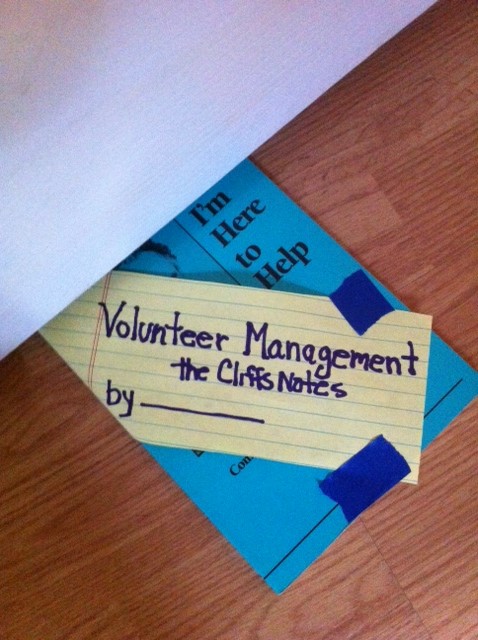
    I’ve always wanted to see a small pamphlet entitled “Volunteer Services for Dummies” or maybe “Volunteer Management, The Cliffs Notes.” Then I could sneak around and slip that bad boy under the door of the executive director while he was at a conference on “How to Get Donors to Donate More.” The pamphlet would have a way to insert whatever author’s name would impress him, like maybe that consultant who he’s recently hired to tell him that he needs to get more donations.

    So, forget the pamphlet. Let’s just list the ten top things that I wish CEOs would understand about volunteer services.

    10. Volunteers do not sit by their phones waiting for us to call. Shocker! We don’t just “order up” volunteers when someone asks for eight volunteers who can work twelve-hour shifts, outside, tomorrow at 8am. Yeah, no one wishes it were that easy more than we volunteer managers. Asking volunteer Charles to prioritize volunteering with us over his other volunteering activities, his trip to Bermuda (that he’s saved years for), his managing of his elderly mother’s affairs, and his scheduled surgery might just be a tad unrealistic. It takes a wise volunteer manager to know how to balance volunteers’ experiences so that volunteering is not burdensome and they look forward to coming in to help.

    9. Managing volunteers is not like managing staff.  Wow, bigger shocker! Unless managing two to ten times the number of very diverse people who only work maybe four hours a week without pay is the same thing. Instead of a paycheck to dangle, volunteer managers must use real leadership skills to inspire and coordinate volunteers. Think of it this way. Volunteers typically spend about 4 hours a week volunteering while you, the Executive Director and your staff spends upwards of 40 or 50 hours a week working for the organization. That’s at least ten times the amount of “plugged in time” you have over volunteers. Do you think that the volunteers spend the other 36 hours thinking about our organization? If not, volunteer managers must be able to “plug-in” volunteers every time they arrive on scene, motivate them to achieve that connection and keep them informed of changes and updates.

    8. Volunteers are everyone’s responsibility.  What?!!! The CEO is thinking, “Then what do I pay YOU, the volunteer manager for?” Staff doesn’t necessarily see working with volunteers as part of their jobs, but any staff can make or break a volunteer’s experience. Look at it this way. What if you, the CEO cultivates a donor by spending your time and sweat to encourage and inform and then another staff member comes along and insults that potential donor? It’s no different with volunteers. We need you, our CEO to set the tone. So if deep down, you are thinking that volunteers are not really time donors but are just fluffy side dishes,  then please stop saying things like “we can’t operate without our volunteers.”

    7. Volunteer managers are real managers. “Hmmm,” the executive director might be thinking, “No way, not in the same way our manager of fund-raising is!” Well, no matter what you call them, coordinators, specialists or team members, volunteer managers are as much a manager as anyone on your staff. The list of skills needed to lead and cultivate a team of volunteers (see #9 and #6 and #4 and #3 and #2 and #1 and oh heck, all of them ) is quite extensive.

    6. Volunteers want meaningful work. “So,” the CEO may be thinking,  “but I often need some meaningless stuff done. Who will do it?” That’s true, but volunteers do not want to just do what the staff doesn’t want to do, they want real jobs that make a difference. And since we don’t pay them, maybe we should consider meaningful work as pay? But, a great volunteer manager with awesome skills can lead volunteers to occasionally do the grunt work if grunt work isn’t all that is offered.

    5. Volunteers want sincere appreciation from more than just the volunteer department. An Executive Director might be thinking, “Hey! I always say that we couldn’t operate without our volunteers, don’t I?” Yeah, you do. But guess what? Volunteers see through the once a year speech at a luncheon that is just lip service. Volunteers want you to make an appearance and say hello, send hand written thank you notes and include their accomplishments the next time you meet with the board of directors. And oh, they would like you to genuinely encourage staff to do these things too. Volunteers are either an integrated valued service or it’s all just talk.

    4. Volunteers are not just little old ladies drinking tea. “But,” a CEO could say, “they sure look like that description ha ha.” Did you know that volunteers are diverse in every way, including age, background, culture and experience and that it takes some major skills to manage a group of very diverse people? But even if some volunteers are older, did you know that they are former executives, professors, leadership experts and full of wisdom and great ideas? And they’re more than willing to share their wisdom for free.

    3. Volunteer managers are not lap dogs.  “Hey,” the Executive Director would protest, “I never said that!” But are the volunteer managers treated that way by staff? Is there an “order up” culture in which volunteer managers are expected to just get volunteers without having any meaningful input into volunteer requests? Volunteer managers have their fingers on the pulse of the organization and are privy to every aspect of the mission via volunteer involvement. Maybe, just maybe, your humble volunteer manager is really a great motivator and leader and not just an order taker. Check them out for some really awesome ideas and managerial skill-sets.

    2. Volunteers are aware and talk. “Sure, so what, that’s great,” a CEO might agree. But, when a volunteer hears negative speak from staff, or sees something less than perfect, guess what? They talk, to each other, to friends, relatives, and the cashier at the Quick-Mart. Volunteer managers keep volunteers motivated and inspired and mediate constantly to make sure the volunteer’s concerns are resolved and their experience is positive. In this world aching for transparency, volunteers are the town criers who can proclaim the worth of an organization or do damage to its reputation.

    1. Volunteers don’t stay forever. “Heresy! They should if the volunteer manager is doing her job,” an Executive Director could counter argue. No, actually volunteers don’t. Does staff stay until they die? No, and neither do volunteers. We should recruit, train and cultivate our volunteers just as we do staff, but not expect them to continue until they’re carted off in an ambulance. And, just like staff, sometimes we don’t want them to stay, so that’s why the professional skill-set of the volunteer manager is so crucial. A volunteer manager’s professional resolution to a challenging situation is an organization’s best chance to avoid negative publicity.

    So, there you have it. I’ll bet you volunteer managers have some really great ideas on other truisms that belong on this list. You have my permission to print out this list, slip it under your leader’s door. Somehow add to it that it was authored by the “Center for Outstanding Management and Maintenance of Organizations and NGO’s” via the report from the “Study on Excellence in Non-profit Structure and Ecosystems” or COMMON SENSE for short.

    -Meridian

  • Your Spotlight Hurts My Eyes!

    In the Spotlight
    In the Spotlight
    I almost spit out my sip of coffee when I ran across this article a week ago. According to the story, a great grandmother was “sacked” from her nearly 30 year volunteer position at a thrift store for her inability to use a computer. The searing negative light this incident turned on made me cringe because as you can see from the selected comments I pasted below the link, non-profits all get lumped into the big barrel of rotten fish when a charity receives bad press.

    http://www.express.co.uk/news/uk/590346/Volunteer-great-grandmother-sacked-charity-shop-cannot-work-computer

    Here are 3 comments from readers:

    JHR16 days ago
    Charities are beginning to stink to high heaven.

    ycjarman17 days ago
    NEVER help a Charity that doesn’t appreciate what you bring to it !

    JBJB116 days ago
    Strikes me a lot of charities have lost sight of what they are supposed to be doing and more concerned in becoming corporate enterprises

    I’m not jumping on the “get the pitchfork and storm the castle” bandwagon because as I read the article, I began to imagine the different scenarios that led to this unfortunate public airing of an incident involving a volunteer. What really happened? We don’t know, so I’ve put together some possible scenarios based on my own experiences with these types of circumstances.

    1) An organization’s resale shop manager is just plain tired of “dealing” with volunteers who can’t work as efficiently as paid staff and so begins to find a convenient reason to dismiss those volunteers, never mind their years of service.
    2) Volunteers become so entrenched in their jobs that no one has the guts to derail their authoritarian and entitled behavior and everyone kicks that can down the road until there is a blowup.
    3) A volunteer becomes increasingly negative for any variety of reasons (health, circumstance, lack of being heard) and no one clears the air. This negativity builds and spreads until big problems arise.
    4) Change is implemented without careful regard to how it will impact the volunteers. Lack of change awareness leads to grumbling, camp-forming and ultimately mutiny.
    5) Repeated staff turnover leaves a new volunteer manager without any basic information about the volunteers he/she manages. Personality clashes balloon into showdowns with staff.
    6) A shop manager/volunteer manager is burnt out, overworked and under appreciated, pressured to increase profit/sales and is unable to properly cultivate the shop’s volunteers.

    This comment from a reader of the article hits at the perceived lack of volunteer management:

    moanalisa16 days ago
    it’s taken 30 years for them to ask Mrs Brooks to leave – if they were so concerned about Mrs Brooks attitude she should have been told to leave years ago

    So, could this negative press have been prevented? Perhaps, but the point is, whether the volunteer is in the right or in the wrong, the proper handling of their exit is challenging but absolutely crucial, especially in the messiest situations. A curt dismissal letter is a weapon in the hand of the offended.
    Sadly, we all are included in the negative stereotypes of charities as witnessed by the comment section of this article. The “pile-on” comments reinforces any perceived notion that “you know, I’m not so sure my local charity is really that nice. Last time I gave them a check, I never got a thank you. Maybe they’re just not who I thought they were.”

    Our microscope is turned to a higher scrutiny than that of businesses. Why? Because the public perception is that charities are run by people who are nice. It’s a simple perception but one that takes a tremendous amount of attention to detail to continue. Who wrote the letter sent to the volunteer? Was it written out of frustration? Acting out of heightened emotions can get us splayed across media. For every 20 volunteers who perceive they are treated badly, one will go to the press or their circle of acquaintances. (And of course their acquaintances live next door to the CEO or the editor of the local newspaper)

    So, what to do? You may never adequately resolve an issue with a volunteer and have to dismiss them. But, taking the extra time and effort to make the volunteer feel heard can go a long way in dousing the fire of their perception of being wronged. I’m not advocating the acceptance of poor behavior, I’m saying that hearing the volunteer’s side without your agreement or disagreement helps diffuse their anger.

    If you’ve inherited a problem volunteer, it is much trickier. A volunteer whose problem behavior has been overlooked has assumed that the organization is fine with that behavior. It takes real skill to dismiss someone who looks at you as the evil newbie when in fact, you are just cleaning up the mess spilled on the floor years ago that now has mold growing on it. I’ve been in these situations and had hours long conversations with entrenched volunteers. Being respectful but firm, complimentary of their positive skill sets while pointing out negative behaviors and reiterating everyone’s commitment to the mission is helpful. While it took an enormous time and emotional commitment, the end result was always worth it. I never left the conversation until I felt that the volunteer and I were at a calm, reasonable point.

    Having written conduct rules, including the steps for dismissal is critical. Every volunteer should sign a copy for their file. I’ve had to go back and look for that copy on several occasions and the presence of the volunteer’s signature on that document has saved me.

    We all lose when folks reading a negative newspaper article generalize about every charity. Charities have to work harder to maintain the perception that we are ethical, caring, and committed to treating everyone, including volunteers respectfully.
    But then, we signed up to be ethical, caring and committed to treating people respectfully, didn’t we?
    -Meridian

  • Dialogue? You Call This Dialogue?

    GPS-IIRM wikipediaOne day several wise men were challenging each others thinking over tea. “If you were given the opportunity to sacrifice yourself for world peace,” the first man asked the group, “would you do it?”
    “Yes, of course,” the second man said. The third man agreed. “If I were guaranteed world peace, I would do it, surely as it would be the right thing to do.” The fourth man rubbed his chin. “What do you mean by world peace?”
    “Just that, world peace,” the first man said.
    “Well, if world peace meant only for one day, then no, I wouldn’t do it,” the fourth man said.

    Do we know what staff members, CEO’s, volunteers, and the community mean when they use certain phrases and concepts? And do those concepts mirror what we, volunteer managers define them as?
    One day when I was feeling particularly feisty (or truth be told, downright crabby from hearing that a volunteer was sent home from an assignment at a health fair because a marketer brought her children to man the booth), I heard a staff member say, “we couldn’t do what we do without our volunteers.” Now, I know this is a lovely platitude, but being cranky, I asked, “really, that’s so nice, what do you think would actually happen if we didn’t have volunteers?”
    She looked at me like I was a pompous jerk (and maybe I was). “Well, we probably couldn’t accomplish as much as we do.”
    “Do you think we’d close?”
    “Don’t be silly,” she said and walked away, I’m sure thinking that I was nuts and a pompous jerk.
    But what is meant by common concepts that are continually used? What do some of the phrases we hear actually mean?
    “We love our volunteers.” What does that mean? We love them individually and will bring them soup when they are ill or we love the idea that we have them? Or we love them as long as they don’t create any problems for us or take up our time or ask questions when we are busy?
    “We’re volunteer friendly.” Really? How? Explain that to me. Do we hang out with our volunteers on a Saturday afternoon along with our good friends? Do we let them call us at home? Do we confide in them? Do we smile at them when we walk in but don’t notice that they have a broken arm because we are late for a meeting?
    “Volunteers are the heart of our organization.” Hmm, are we talking about a crucial organ or a warm fuzzy feeling? Do we mean they truly inspire us to be more compassionate or is the term “volunteer” an abstract idea that we cherish, not real, breathing human beings that come in every day?

    See, if you say volunteer engagement to a volunteer coordinator, there is a complex burst of ideas that go off in their heads, including the idea that engagement is a two way street. Ask any random staff member “what is volunteer engagement” and you may get a totally different view that does not include volunteers in leadership roles or the challenges in managing volunteers. And here is where an awful lot of volunteer manager angst lives.

    So, the challenge is, how do we beat the concept of volunteer engagement into everyone’s heads?
    Wait, did I really say, that, whoah, I must have let that rabid little voice take over for a minute. Whew.
    But seriously, we have bent ourselves into pretzel shapes for years trying to “educate” organizations on the true nature of volunteer engagement. Sometimes we’re kinda like the folks who show up at your door unannounced, either selling something, or trying to get you to accept their pamphlets on their religious and political beliefs. I know I have been like that.
    Me: Knock, knock.
    Staff: Who is it?
    Me: Volunteer Services here to educate you on volunteers!
    Staff: Um, I’m really busy, what with just coming from three meetings and my work is piled up. I just attended a seminar last week on fund raising so I’m a bit overwhelmed.
    Me: Well, if you’ll just open the door, it won’t take more than 20 minutes.
    Staff: Can you come back later?
    Me: But this is important. Don’t you want to know about volunteers?
    Staff: I already do, they’re great, gotta go, my phone is ringing.

    Hmmm, if the knock knock method doesn’t work, now what? Well, maybe we should try a dialogue. I know, dialogue is one of those buzz words, but
    we could seriously try asking organizational stakeholders the meaning (in their own words) of concepts that we think are important to bettering communication between volunteer services and staff. And if we do this with sincere intentions to learn where we differ from staff in how we view volunteer services, we might be able to begin work on closing the gap.
    Hearing a senior manager’s explanation of volunteer engagement may make you angry and think, “how can he be so ignorant? How can she think that’s all there is to it?” But, if we put aside that anger and look at the disparity in thought, then perhaps we can begin to free ourselves to analyze how to make volunteer engagement better understood within our respective organizations.
    With the keen desire to understand, we can try asking, “how do you view the volunteers’ role? What does the term volunteer engagement mean to you? What about volunteer involvement?”
    Be prepared to hear some surface answers and some surprise answers and be prepared to question (in a non-judgmental way) those answers. “What makes you think that?”
    We can ask, “what do you think the most important job a volunteer manger does and what are the challenges volunteer managers face?” Hearing the answers may initially make you defensive but in stepping back, may just make you see where the misconceptions lie between what the volunteer department actually does and the perceptions of the rest of the staff.
    Again, this is dialogue, not mandates to change the way we view or do our work. How can we work together with staff to help them learn more about the challenges and organizational responsibilities of volunteer engagement?
    If we want to get to a place where staff view volunteer engagement the way we do in all its complexities, perhaps we need a street map to get there. Discovering the diversity of ideas within our own organizations on common volunteer concepts and terms may just be the first step to the GPS we need to arrive together at that place where volunteer engagement is understood by everyone the exact same way in which we understand it.
    -Meridian

  • “Is It Too Much to Ask?”

    lock“Is it too much to ask?” Calista queries while wiping grape jelly off the hands of her five-year old. She smiles and pats him on the head as he runs off to join his three older sisters in the yard. She drops the rag on the counter and sits down on the bar stool. “I’m not a high maintenance person, not at all. But, I mean, I do need some consistency and direction.”

    Calista started volunteering for her PTA after some pretty heavy pressure by the PTA officers. “Maybe it’s because I have four kids in that school,” she laughs, “but I became a target for their recruitment. Maybe it’s because I’m a loan officer at the bank which makes everyone assume I’m the goddess of paperwork. And I know every volunteer group has their share of paperwork!”

    Feeling the need for parents to step up, Calista agreed to volunteer and she set aside time for the next meeting. “I’m fortunate because my husband, Josh is great and encouraged me to get involved so I did. After dinner one night, I headed out for my first meeting. I was introduced to the President, a nice lady named Jenna and I met all the other officers as well. They seemed very pleased to have me join the group.” Calista leaned back. “They had quite a number of projects going, including holiday events, fund-raisers and volunteering in the classroom. After the meeting was over, I realized they had gotten me to sign up for a call tree and also as a member of the awards committee.” Calista giggled. “Oh, they were good. I kind of liked the two areas I signed up for. The call tree I could easily do from home and the awards committee sounded fun. At the end of the year there would be awards for students, teachers, parents and even office staff. I have to admit, I was hooked.”

    Calista thought for a moment. “Every month I would faithfully attend the meeting. Jenna, the president took me aside and asked if I would research prices on awards for the award ceremony, present my findings at the next meeting and I agreed. I wasn’t being utilized on the call tree and I just figured that no calls needed to be made, but at the next meeting I was armed with the awards information. I had spent a good amount of free time gathering prices, guarantees, choices, etc. But when I got to the meeting, I found that the president had already contracted with a company to create the awards. When I asked the president about my research, she said that it may come in handy next year, but that she had to act fast on a promotion that someone sent her. I gotta tell you, I was annoyed. She could have emailed me so that I didn’t waste my time.”

    Calista was a victim of Lack of Communication (LOC).

    I’m ashamed to admit it, but I have been guilty of the LOC malady. And I had no good excuse for my lack of communication. Now here’s the thing about committing a LOC on volunteers. A real volunteer’s time and effort is disrespected by misdirection, no call back or no follow through. Running into a volunteer that is awaiting your call is like rounding the cat food aisle to see someone you owe 20 bucks to and forgot to pay. When we see this volunteer do we say, “Yeah, I could have called you to tell you that the project you were so excited to be part of has been scrapped but I chose the cowardly way by ignoring it and you.”

    Being mindful of volunteers’ time and effort is crucial to volunteer retention. We can’t give a volunteer an assignment or tell them we will call them without following through on that promise, because it is a promise, a promise to treat them as a valued member of our team. And, as if we didn’t have enough work, we cannot let other staff members commit a LOC either. We have to be on top of their treatment of volunteers too.

    But what about those conversations in a hallway, or on your day off in the store when you promise something to a volunteer but don’t write it down or store it in your phone? If I had a dollar for every time that happened to me I’d have a nice little nest egg right now. When I’d finally given up on the idea that I could remember everything (yep, you’re right, control issues), I began to be more honest. “Well, Donna, I’m so glad we ran into each other here in the feminine hygiene aisle and we got to talk about your wanting to get involved in that new project. I can’t tell you how excited I am to have you work with us, thank you so much. Can I ask you a favor? I’m afraid that because it’s a Sunday evening and I don’t have a notepad with me, I might let this conversation slip and I would be mortified if I didn’t call you tomorrow with that information. Would you mind calling me tomorrow to remind me? You would? Thank you, you’re the best!”

    Now, when Donna calls the next day, I can chuckle and say, “Thank you for calling me. I was so excited that I was just about to call you, but sometimes I forget. You are unforgettable of course, but now let’s talk about your involvement.”

    If a volunteer calls and says, “I haven’t heard from you…” that is red flag territory. For whatever reason, that volunteer was handed a LOC. Open it with honesty.

    Honesty goes a long way. Sincerity gallops right along with honesty. I’ve had to say, “I didn’t call you because I’m an idiot,” and “I didn’t get that information because I let time get away from me and I sincerely apologize.” Ouch, It’s sobering to realize that I’m not super volunteer coordinator. But, I am human and I do care about volunteers’ time and energies.

    Calista sighed deeply. “You know, it would have been ok had I gotten some sort of acknowledgement that my effort was for naught. An apology, a reason I wasn’t informed, something. That would have gone a long way to make me feel valued.”

    Volunteers do not expect us to be perfect. However, they do expect their time and efforts to be valued. Communicating is about valuing them. And too many sloppy LOCs will produce a volunteer LOC out!
    -Meridian

  • Two Strikes and You’re Out

    imagesI’ve been attending a weekly six part volunteer orientation at a local organization with a friend. Last Monday we arrived at the appropriate office a little before the 6:30pm start time. We were attending part five of the six parts and feeling pretty good about being on the home stretch. “See,” my friend said, “you actually have made it this far and after tonight, we only have one more session to go. Yay!”
    Yes, I’ll admit it, I conjured up every excuse I’m sure volunteers have devised when faced with coming to my training sessions. “I’m tired, the season finale of the Big Bang Theory or Finding Bigfoot is on, the weather is bad, no one will miss me, why did I sign up anyway, or I don’t feel good and it’s too far to go.” Excuses aside, I went.
    But, when we arrived, we noticed the other new volunteers milling around the parking lot. We’ve gotten to know them, so we approached, expecting enthused conversation. Instead we walked into some pretty negative grumbling.
    “The door’s locked,” one said. “The place is deserted.”
    “Don’t know where the instructor is,” another one chimed in. “Usually they are here by now.”
    “Did you get an email telling you class was cancelled?” Someone asked.
    “Man, I could have been home studying,” the student volunteer lamented.
    “I didn’t get an email cancelling and I’ve been home all day,” the first volunteer said. “Did anyone else?”
    I immediately pulled out my phone and pulled up my email. Nope, no email message. And I did give my correct email address on each of the sign in sheets so I know someone has it.
    “I drove 25 miles to be here. Jeesh.” The second volunteer added.
    “Does anyone have Betsy, the coordinator’s cell phone number?” The first volunteer asked.
    “No,” someone said, “but I have the number for Claire, the office manager.”
    “Good, would you call her?”
    The volunteer next to me said, “You know, there’s the 20 minute rule.”
    “What’s that?” I asked.
    “You give the moderator or leader 20 minutes to show up and then you just leave.” Hmmm, I didn’t know that. So, mental note to me.

    While a call was being placed to Claire, the rest of the increasingly annoyed group began to muse about some other shortcomings of the organization, from the lack of continuity to one really unlikeable staff member.
    “Don’t ever work with her, she has no people skills at all.” One volunteer said.
    “I know, she basically ignored me when I walked in the door the first time,” another added.
    “I’ll bet she was responsible for notifying us of the cancellation,” a third chimed in. As the group nodded I pictured pitchforks and torches and the burning of Dr. Frankenstein’s castle.

    Claire was unavailable and so at the 30 minute mark, we all left, a bit more bonded to each other, but much less to the organization.
    “That was a waste of time,” my friend said to me on the drive back. She sort of chewed on her lip and offered, “maybe it couldn’t be helped.”

    Now here’s where I politely disagree. Someone, anyone should have called each one of us to let us know the instructor was not coming. I know because I have scars from this happening to me. I learned the hard way a long time ago when I could not make a training session and did not have the list of volunteers on me at the time. The thing is, those volunteers, although put out, were able to see past the inconvenience. But here’s the kicker. Two of those same new volunteers were stood up by a staff member on their first assignment.

    So as you can imagine, those two volunteers did not wait for the third strike. They each made a different gracious excuse to quit, and no amount of convincing changed their mind.

    So, where did that leave me? Forget the statistics, forget the amount of time spent recruiting and orienting these two volunteers. I felt personally responsible for failing them. So, from that day on, I made it my two strike rule to not let volunteers be inconvenienced more than once. Did it always work? No, of course not, but the self-imposed hard fast rule forced me to carry lists of volunteers’ contact numbers, drive to work on a Sunday night to make phone calls, and have multiple back up plans. And when an inconvenience did happen, I made sure to offer a personal phone call apology the next day to the volunteers who were impacted by events oftentimes out of my control.

    Did this add to my workload? Yes, by an unbelievable amount. I even learned to do double checks with staff to make sure volunteers did not arrive at an assignment without proper instructions. I’ve found that slogging through all the upfront work is ultimately preferable to trying to make amends for the sloppy treatment of volunteers. And I take volunteers’ experiences personally. Can’t help it, it’s how volunteer managers are wired, I think.

    Oh, update. It WAS the responsibility of the staff member the volunteers were trashing to call everyone and cancel. We never got a call and have yet to get an apology from her, although we did get an apology from a different staff member at this week’s orientation.
    Cue the pitchforks?
    -Meridian