Category: Volunteer

  • The Evolution of Thought

    2014-09-29 11.46.26

    All things evolve, says science and who am I to disagree although I frankly wish scientists would figure out how the brain can answer emails during REM sleep. (Don’t bother me now with your question, I’m flying! Hey! Is that a pig?) Anyway, it’s interesting to note how much volunteerism has evolved over the years and keeping up with trends is now a large part of a volunteer manager’s job. I often think back to how I viewed things twenty years ago and compare that to how I view things today. For better or worse, you can’t help but marvel at how your thoughts evolve with the times. In particular, I’m referring to the concept of good old risk management.

    Risk management is one of those things that we must pay attention to, like it or not. It’s kinda like the caloric information on a caramel smoothie or your mother’s voice in your head when you’re about to follow that stray dog down a dark alley. (“But ma, he might need a home!”)

    I’ve learned to view everything through the lens of risk management, no matter how corporate and sell-out it seems.  I was never too happy being hauled up into the CEO’s office because a volunteer stole a client’s credit cards and went to Vegas. Nope, would rather not have to explain that one.

    So, I looked back at my years as a volunteer manager and here’s how risk management evolved in my thought processes.

    20 years ago: “Wow, you want to volunteer, that is so amazing, thank you, thank you, thank you! I can’t tell you how thrilled I am you chose us. My gosh, look at you, you are so wonderful! What? You want to bring your gun with you when you volunteer? Ummm, I don’t see the harm in that, the point is, you want to volunteer, I am so happy!! And have I said thank you?!”

    15 years ago: “Hello and thank you for volunteering, we certainly can use a person with your skills. You are going to do so well here, I am convinced of it. What’s that? You wanted to tell me about your recent incarceration for grand theft? That is so honest of you, thank you for sharing that with me. Well, yes, we do a teensie background check, but we really want you to volunteer, so I will make sure that we get you started.”

    10 years ago: “Welcome to our volunteering orientation. According to our volunteers, it is a privilege and honor to work with our clients and I trust you will feel the same. Now let’s learn a little about you. Uh huh, uh huh, what was that? Oh, you have made some mistakes in the past, I see, well, let’s move forward and I must tell you that we do background checks, but we will see what happens and deal with it when we have to. But now, let’s talk about how excited we are to have you volunteer.”

    5 years ago: “Hello and welcome, I am so glad you are taking this first step towards volunteering with our great organization. Why don’t we take this opportunity to go over our rules and regulations. Because our volunteers are crucial members of the team, we do require them to pass background checks, fingerprinting and abide by the guidelines that allow all of us, myself included, to work with our clients in a professional manner. We are so glad you are here and want you to be at your best because that’s what our clients deserve and what will make your experience memorable.”

    1 year ago: “Hello and let me preface this by saying that we only take squeaky clean volunteers here. You will be put through a rigorous screening, including drug testing, psychological profiling and searches every time you come on property. You will obey the rules at all times. Any infraction will require immediate termination. Do you understand? Now give me some hair strands for the drug test. You heard me, pull ’em out!”

    All right, that last one was a bit exaggerated. And even though I still cringe when my first thoughts are, “what is the risk involved here,” I have learned to live with my corporate shill side. I still am thankful for each and every volunteer, and still feel warm and fuzzy towards the magic of volunteering.

    I’ve just learned that when you expect excellence from volunteers, they step up and provide it. And any risk in striving for excellence is well worth it.

    Hmmm, evolution doesn’t have to hurt so much.
    -Meridian

  • The Shackles of Compassion

    My favorite patient at hospice was George. I don’t have any idea why. Maybe it was because he and I discussed sports comfortably. Maybe it was because he was so young and had a brain tumor and it was so darn unfair. Maybe it was because he would forget the name of the pitcher or linebacker or hockey center he was referencing, and then would remember the name the minute I left the room, so he would wheel out and shout down the hallway, “I remember, it was Stan Mikita!” Then the staff would shush him and I would chuckle, and give him a thumbs up. And maybe there’s just no reason why I felt so connected to him.

    George was divorced and had a twelve year old daughter whom he saw infrequently. We talked about his inability to see her grow up. I would leave his room and cry but something made me go back every day. And when his daughter’s birthday approached, a couple of volunteers and I went out and bought presents so that George could give her something. The volunteers had fun wrapping those presents in pink and purple and gobs of glitter.

    I still remember the day George’s daughter was planning to come and see him. I happened to be walking down the hall of the care center, and I peeked in to see if George needed anything else on this joyous occasion. Instead, I saw him sitting in bed, quietly crying, one of the presents at his side. I didn’t want to disturb him, so I looked in for a just a few seconds.

    But in those intimate moments, the veil fell away and I saw the heavy shackles that bound him to us. The massive chains of our compassion tethered him to our desire to help and the heavy links now became visible through his pain.

    shackles

    Were his tears made of joy or sorrow? Did he cry from joy because we helped him or did he cry because he had lost control of everything precious and dear and was now dependent upon the kindness of strangers? Did he feel trapped, allowed to walk only as far as our chains would allow and only in the perimeter of our understanding?

    Do the people we serve once in a while verbally strike out at us and can it be that they sometimes feel shackled to us? Is it kind of like the stranglehold the skydiving instructor has on the newbie skydiver who is strapped in tight and really is just a ride along on the way down? Does our tandem journey through folks’ lives sometimes strap them to our protective helping?

    I went back to my office and closed the door and sat down. I wondered, in all our feel good desire to help, did we rob George of his last shred of dignity? Do we, sometimes in our exuberance, forget that a real person with complex feelings is on the end of that strap?

    I continued to see George until he died. But after that day, I started to see him as more complex, more in charge and more mysterious. I could still see the shackles that bound him to us, but the volunteers and I discussed how to better serve his needs without strengthening the chain.

    It’s true, the shackles were still there, but we tried our darnedest to make sure George had a key.

    -Meridian

  • Top 10 Things Executive Directors Need to Know About Volunteer Services

    cliffsnotes
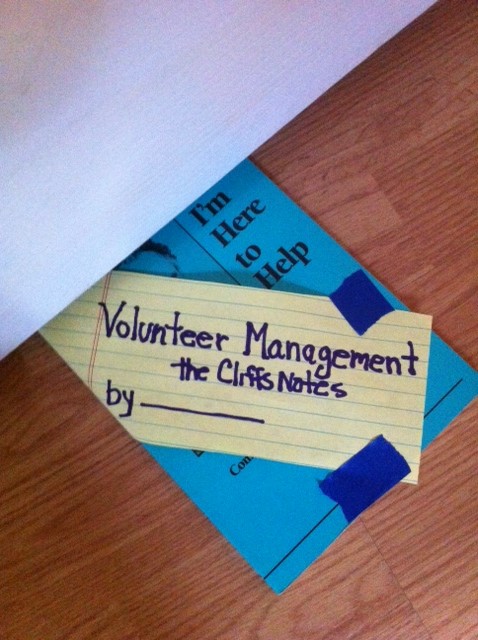
    I’ve always wanted to see a small pamphlet entitled “Volunteer Services for Dummies” or maybe “Volunteer Management, The Cliffs Notes.” Then I could sneak around and slip that bad boy under the door of the executive director while he was at a conference on “How to Get Donors to Donate More.” The pamphlet would have a way to insert whatever author’s name would impress him, like maybe that consultant who he’s recently hired to tell him that he needs to get more donations.

    So, forget the pamphlet. Let’s just list the ten top things that I wish CEOs would understand about volunteer services.

    10. Volunteers do not sit by their phones waiting for us to call. Shocker! We don’t just “order up” volunteers when someone asks for eight volunteers who can work twelve-hour shifts, outside, tomorrow at 8am. Yeah, no one wishes it were that easy more than we volunteer managers. Asking volunteer Charles to prioritize volunteering with us over his other volunteering activities, his trip to Bermuda (that he’s saved years for), his managing of his elderly mother’s affairs, and his scheduled surgery might just be a tad unrealistic. It takes a wise volunteer manager to know how to balance volunteers’ experiences so that volunteering is not burdensome and they look forward to coming in to help.

    9. Managing volunteers is not like managing staff.  Wow, bigger shocker! Unless managing two to ten times the number of very diverse people who only work maybe four hours a week without pay is the same thing. Instead of a paycheck to dangle, volunteer managers must use real leadership skills to inspire and coordinate volunteers. Think of it this way. Volunteers typically spend about 4 hours a week volunteering while you, the Executive Director and your staff spends upwards of 40 or 50 hours a week working for the organization. That’s at least ten times the amount of “plugged in time” you have over volunteers. Do you think that the volunteers spend the other 36 hours thinking about our organization? If not, volunteer managers must be able to “plug-in” volunteers every time they arrive on scene, motivate them to achieve that connection and keep them informed of changes and updates.

    8. Volunteers are everyone’s responsibility.  What?!!! The CEO is thinking, “Then what do I pay YOU, the volunteer manager for?” Staff doesn’t necessarily see working with volunteers as part of their jobs, but any staff can make or break a volunteer’s experience. Look at it this way. What if you, the CEO cultivates a donor by spending your time and sweat to encourage and inform and then another staff member comes along and insults that potential donor? It’s no different with volunteers. We need you, our CEO to set the tone. So if deep down, you are thinking that volunteers are not really time donors but are just fluffy side dishes,  then please stop saying things like “we can’t operate without our volunteers.”

    7. Volunteer managers are real managers. “Hmmm,” the executive director might be thinking, “No way, not in the same way our manager of fund-raising is!” Well, no matter what you call them, coordinators, specialists or team members, volunteer managers are as much a manager as anyone on your staff. The list of skills needed to lead and cultivate a team of volunteers (see #9 and #6 and #4 and #3 and #2 and #1 and oh heck, all of them ) is quite extensive.

    6. Volunteers want meaningful work. “So,” the CEO may be thinking,  “but I often need some meaningless stuff done. Who will do it?” That’s true, but volunteers do not want to just do what the staff doesn’t want to do, they want real jobs that make a difference. And since we don’t pay them, maybe we should consider meaningful work as pay? But, a great volunteer manager with awesome skills can lead volunteers to occasionally do the grunt work if grunt work isn’t all that is offered.

    5. Volunteers want sincere appreciation from more than just the volunteer department. An Executive Director might be thinking, “Hey! I always say that we couldn’t operate without our volunteers, don’t I?” Yeah, you do. But guess what? Volunteers see through the once a year speech at a luncheon that is just lip service. Volunteers want you to make an appearance and say hello, send hand written thank you notes and include their accomplishments the next time you meet with the board of directors. And oh, they would like you to genuinely encourage staff to do these things too. Volunteers are either an integrated valued service or it’s all just talk.

    4. Volunteers are not just little old ladies drinking tea. “But,” a CEO could say, “they sure look like that description ha ha.” Did you know that volunteers are diverse in every way, including age, background, culture and experience and that it takes some major skills to manage a group of very diverse people? But even if some volunteers are older, did you know that they are former executives, professors, leadership experts and full of wisdom and great ideas? And they’re more than willing to share their wisdom for free.

    3. Volunteer managers are not lap dogs.  “Hey,” the Executive Director would protest, “I never said that!” But are the volunteer managers treated that way by staff? Is there an “order up” culture in which volunteer managers are expected to just get volunteers without having any meaningful input into volunteer requests? Volunteer managers have their fingers on the pulse of the organization and are privy to every aspect of the mission via volunteer involvement. Maybe, just maybe, your humble volunteer manager is really a great motivator and leader and not just an order taker. Check them out for some really awesome ideas and managerial skill-sets.

    2. Volunteers are aware and talk. “Sure, so what, that’s great,” a CEO might agree. But, when a volunteer hears negative speak from staff, or sees something less than perfect, guess what? They talk, to each other, to friends, relatives, and the cashier at the Quick-Mart. Volunteer managers keep volunteers motivated and inspired and mediate constantly to make sure the volunteer’s concerns are resolved and their experience is positive. In this world aching for transparency, volunteers are the town criers who can proclaim the worth of an organization or do damage to its reputation.

    1. Volunteers don’t stay forever. “Heresy! They should if the volunteer manager is doing her job,” an Executive Director could counter argue. No, actually volunteers don’t. Does staff stay until they die? No, and neither do volunteers. We should recruit, train and cultivate our volunteers just as we do staff, but not expect them to continue until they’re carted off in an ambulance. And, just like staff, sometimes we don’t want them to stay, so that’s why the professional skill-set of the volunteer manager is so crucial. A volunteer manager’s professional resolution to a challenging situation is an organization’s best chance to avoid negative publicity.

    So, there you have it. I’ll bet you volunteer managers have some really great ideas on other truisms that belong on this list. You have my permission to print out this list, slip it under your leader’s door. Somehow add to it that it was authored by the “Center for Outstanding Management and Maintenance of Organizations and NGO’s” via the report from the “Study on Excellence in Non-profit Structure and Ecosystems” or COMMON SENSE for short.

    -Meridian

  • Defining Success

    coal miners wikipedia wikipedia

    The first time I met Alex many years ago, I noticed his manicured nails. He had the soft hands of wealth. His was not a gaudy proclaiming wealth, but an understated old mixed with new wealth. A retired corporate lawyer, with his much younger wife still working, he wanted to fill his days with something meaningful to do. He’d not had a hospice experience, but he’d heard that hospice was a good organization to volunteer for and he wanted to try it out.

    He stuck out in orientation. From his formal weekend wear to his lawyer inspired questions, he animated the sessions with his analytical take on things. The rest of the diverse but more laid back class was somewhat intimidated by him. (Me too if you must know- and yes I tell myself that I’m no better and no worse than anyone else, but heck, my clothes wouldn’t keep their shape like his did).

    After the six orientation sessions were over, I met with Alex in my office. He was polite and cerebral and together we formulated that with the help of a seasoned volunteer, he could begin volunteering in our care center.
    Alex called me often to ask questions. He would show up at my office door every time he came in to volunteer. Knowing that he was used to doors always opening  when he knocked, I allotted time for him. Was he smart? Oh my, I think I could have applied for 3 credits at a local college after listening to his measured thoughts.
    Since the care center staff had really never seen anyone quite like him, I was peppered with lots of questions and comments. “One of those successful types,” a nurse said one day. “He asks a lot of questions,” another said and added, “you’ve got your work cut out for you.”

    One day, a new patient, Lester came into the care center. A coal miner from West Virginia, Lester was in his late 80’s. His wife had died young and although he had no children, he had an old phonograph that played bluegrass music day and night. We all were used to walking past his room, hearing the lively strains of banjo, fiddle and mandolin drifting up and down the halls as if over the hills of a coal camp. As thin as a pick axe, Lester spoke of a time when his wife scrubbed his coal stained clothes until her hands bled and the chocking black dust laid upon the ground outside his camp house door.

    Alex began to visit with Lester more frequently. He sat in Lester’s room while the phonograph scratched out “Foggy Mountain Breakdown,” and listened to Lester’s stories of moving from job to job until the mines became more mechanized. As time passed, Alex began to place his chair closer to lean over to hear Lester and I would observe him, elbows on knees, straining to catch the flooding memories. Then, one day, the absence of bluegrass music outside Lester’s door spoke volumes. Lester was actively dying and his phonograph had grown quiet. He had turned it off. Alex came to me and tentatively said, “I have an acquaintance who plays the banjo and knows any number of Lester’s favorite songs. Do you think I could ask him to come in and play for Lester?” We checked with the charge nurse and social worker and Alex was given permission to bring his friend in. By this time, Lester had not stirred from bed, but lay peacefully, quietly slipping away.

    I skipped a meeting that day, shut my office door and crept down to the care center. The stomping good sound of the banjo’s strings was glorious. I peeked into the room and saw Alex’s friend’s frenetic fingers pick that banjo, his eyes smiling at  Lester, who was now somehow sitting upright, a look of bliss on his worn face. Alex nodded to me from the very corner of the room. I wondered if Alex consciously picked the color of his shirt that day to blend in with the wall color.

    Lester died two days later. Alex and I sat in my office, the lack of music deafening. He did tell me that his friend was honored to be able to play for someone who breathed those mountain roots. Alex got up to go. It wasn’t the time to badger him with questions about how he was going to process this experience, not yet anyway. Right then it was time to silently let it all sink in.

    What makes a person successful? I’d say Alex pretty much had it all figured out.
    -Meridian

  • Looking Back

    I’m on vacation this week visiting family. In typical volunteer manager fashion, I figured I’d be searching the yellow pages for and interviewing volunteer managers in a new and different town. But, I’ve subjected my family to so much work intrusion throughout their lives as I’m sure you have too. It’s time to just simply enjoy them.
    So, I got up before everyone this morning, fired up the coffee and looked back, found this very early post and copied it. I hope you don’t mind. It made me feel good, because I know this visit with family will come to an end and I will be sad because life is not perfect, but it is a balance of work and home, success and failure, joy and pain, curiosity and fear. And in it all lies meaning; meaning for those we serve and meaning for us. Here is the post from four years ago:

    You know how some days just feel wrong?  Today was one of those days. I had been reading some very interesting articles about volunteer management and started getting ideas that I could adopt for the volunteers I work with when a little voice said, “It’s Friday. Who cares? You’re overworked, underappreciated and tired of the struggle. Give it up.” I wasn’t happy to see any of the volunteers today. I wasn’t all that funny or nice or anything. I was blah.

    As I was sitting there, staring at the computer, willing it to make me feel better, the phone rang. I don’t know about you, but when it rings on blah days, I sometimes let voicemail pick it up and then I call back later. It makes me feel more in control I guess. But for some reason I reached for it. Must be habit.

    I answered and it was Monroe calling from Des Moines where he now lives with his mother. Monroe used to volunteer with us. He is 23 years old. He moved to our area with his Mom to look for work. They lived in an apartment a block from my office with no car, no job and little resources except a grandmother who lived in the area.

    He came into my office three years ago and asked to volunteer. He is one of these really, really quiet types; you know the ones who answer in monosyllables. He speaks in a voice that barely breaks a decibel and looks down as he talks. He is covered with tattoos and piercings and wears nothing but black. He has a goatee.

    To be honest, I took one look at him and wondered why on earth he would want to volunteer and would he scare staff, clients and other volunteers? I gave him the information for the next orientation and thought no more about it. Not only did he show up, he came to all six sessions, and participated, albeit in monosyllables. The other volunteers started to like him.

    Monroe started volunteering in the office. He told me a little about his situation. I could lie and say he opened up, but he did give me some tidbits here and there. I happened to be working with some volunteers on a music project and I mentioned that to Monroe. He said he wanted to help. Now this is a project that a very select few volunteers who have extensive musical experience work on, but I brought Monroe along for a meeting and practice. He not only did anything asked of him, he asked to do more. He informed me that music was his passion.

    From that day forward, Monroe became our go to guy for anything musical, whether it be production, setting up, getting snacks or toting heavy equipment. He became one of us very quickly and every single volunteer took him under a wing. I have to admit I drove him a few places and so did other volunteers. He was always very grateful. I got to see his apartment one afternoon when I gave him a ride home. He was very proud of his room.

    His Mom could not find work and so they had to go back to family in Des Moines. I am not lying when I say I really miss him and so do the volunteers who worked with him.

    After I happily greeted him on the phone, I asked him how he was doing and in typical Monroe fashion, he said “good.” I tried to extract more, but I did get that his mom had a job and so did he. He was working on writing music and doing well. He told me that he wanted to keep in touch with us and I was relieved. I asked him if he found a place to volunteer and he said that he had thought about it, but no, it wouldn’t be the same. He then told me that we were family to him.

    We all have the chance to impact the lives of those we serve by providing the best volunteers we can. We all have those nuggets of success when a volunteer does a great job. But this is different. Monroe is a personal slice of joy for me. I don’t know how much his volunteering experience impacted him, but I can guess that we had a very positive impact on his self-esteem and psyche. I hope we did, and I hope that I never forget that everyone has something to offer. Volunteer managers are fortunate enough to be able to discover and cultivate the talents and desires of the folks we manage. The heck with blah. I’ve been reminded that it’s good.

    -Meridian

  • Dialogue? You Call This Dialogue?

    GPS-IIRM wikipediaOne day several wise men were challenging each others thinking over tea. “If you were given the opportunity to sacrifice yourself for world peace,” the first man asked the group, “would you do it?”
    “Yes, of course,” the second man said. The third man agreed. “If I were guaranteed world peace, I would do it, surely as it would be the right thing to do.” The fourth man rubbed his chin. “What do you mean by world peace?”
    “Just that, world peace,” the first man said.
    “Well, if world peace meant only for one day, then no, I wouldn’t do it,” the fourth man said.

    Do we know what staff members, CEO’s, volunteers, and the community mean when they use certain phrases and concepts? And do those concepts mirror what we, volunteer managers define them as?
    One day when I was feeling particularly feisty (or truth be told, downright crabby from hearing that a volunteer was sent home from an assignment at a health fair because a marketer brought her children to man the booth), I heard a staff member say, “we couldn’t do what we do without our volunteers.” Now, I know this is a lovely platitude, but being cranky, I asked, “really, that’s so nice, what do you think would actually happen if we didn’t have volunteers?”
    She looked at me like I was a pompous jerk (and maybe I was). “Well, we probably couldn’t accomplish as much as we do.”
    “Do you think we’d close?”
    “Don’t be silly,” she said and walked away, I’m sure thinking that I was nuts and a pompous jerk.
    But what is meant by common concepts that are continually used? What do some of the phrases we hear actually mean?
    “We love our volunteers.” What does that mean? We love them individually and will bring them soup when they are ill or we love the idea that we have them? Or we love them as long as they don’t create any problems for us or take up our time or ask questions when we are busy?
    “We’re volunteer friendly.” Really? How? Explain that to me. Do we hang out with our volunteers on a Saturday afternoon along with our good friends? Do we let them call us at home? Do we confide in them? Do we smile at them when we walk in but don’t notice that they have a broken arm because we are late for a meeting?
    “Volunteers are the heart of our organization.” Hmm, are we talking about a crucial organ or a warm fuzzy feeling? Do we mean they truly inspire us to be more compassionate or is the term “volunteer” an abstract idea that we cherish, not real, breathing human beings that come in every day?

    See, if you say volunteer engagement to a volunteer coordinator, there is a complex burst of ideas that go off in their heads, including the idea that engagement is a two way street. Ask any random staff member “what is volunteer engagement” and you may get a totally different view that does not include volunteers in leadership roles or the challenges in managing volunteers. And here is where an awful lot of volunteer manager angst lives.

    So, the challenge is, how do we beat the concept of volunteer engagement into everyone’s heads?
    Wait, did I really say, that, whoah, I must have let that rabid little voice take over for a minute. Whew.
    But seriously, we have bent ourselves into pretzel shapes for years trying to “educate” organizations on the true nature of volunteer engagement. Sometimes we’re kinda like the folks who show up at your door unannounced, either selling something, or trying to get you to accept their pamphlets on their religious and political beliefs. I know I have been like that.
    Me: Knock, knock.
    Staff: Who is it?
    Me: Volunteer Services here to educate you on volunteers!
    Staff: Um, I’m really busy, what with just coming from three meetings and my work is piled up. I just attended a seminar last week on fund raising so I’m a bit overwhelmed.
    Me: Well, if you’ll just open the door, it won’t take more than 20 minutes.
    Staff: Can you come back later?
    Me: But this is important. Don’t you want to know about volunteers?
    Staff: I already do, they’re great, gotta go, my phone is ringing.

    Hmmm, if the knock knock method doesn’t work, now what? Well, maybe we should try a dialogue. I know, dialogue is one of those buzz words, but
    we could seriously try asking organizational stakeholders the meaning (in their own words) of concepts that we think are important to bettering communication between volunteer services and staff. And if we do this with sincere intentions to learn where we differ from staff in how we view volunteer services, we might be able to begin work on closing the gap.
    Hearing a senior manager’s explanation of volunteer engagement may make you angry and think, “how can he be so ignorant? How can she think that’s all there is to it?” But, if we put aside that anger and look at the disparity in thought, then perhaps we can begin to free ourselves to analyze how to make volunteer engagement better understood within our respective organizations.
    With the keen desire to understand, we can try asking, “how do you view the volunteers’ role? What does the term volunteer engagement mean to you? What about volunteer involvement?”
    Be prepared to hear some surface answers and some surprise answers and be prepared to question (in a non-judgmental way) those answers. “What makes you think that?”
    We can ask, “what do you think the most important job a volunteer manger does and what are the challenges volunteer managers face?” Hearing the answers may initially make you defensive but in stepping back, may just make you see where the misconceptions lie between what the volunteer department actually does and the perceptions of the rest of the staff.
    Again, this is dialogue, not mandates to change the way we view or do our work. How can we work together with staff to help them learn more about the challenges and organizational responsibilities of volunteer engagement?
    If we want to get to a place where staff view volunteer engagement the way we do in all its complexities, perhaps we need a street map to get there. Discovering the diversity of ideas within our own organizations on common volunteer concepts and terms may just be the first step to the GPS we need to arrive together at that place where volunteer engagement is understood by everyone the exact same way in which we understand it.
    -Meridian

  • Hands-On? That’s Only the Beginning

    hands.JPGThere is the phrase, “hands-on” which is something that applies to volunteer managers everywhere. We cannot sit in some glass enclosed office barking orders through a microphone to legions of willing, robotic folks who live for every word that drips off of our lips. (Woah, was that a fantasy I just slipped into there?)
    No, we are always involved with the work our volunteers are asked to do. We stuff envelopes alongside the volunteers instead of making calls because someone got sick and couldn’t come in and now we have a deadline, so we drop everything and stuff envelopes at the table too, making jokes and keeping the work light. We ring the doorbell of a client in the field and accompany the volunteer that is unsure of an assignment because we are there to provide support and keep that excellent volunteer coming back. We lift the boxes of brochures in the hot sun at a fair because we don’t think the 70 something volunteer should have to do that and there is no one else willing to help. We delay eating our lunch because a volunteer making phone calls was not given enough information and we’ve seen what happens when volunteers feel inadequately prepared to complete an assignment so we grab the list, fingers dripping mayo and get to work.

    Yes, next to “hands-on” in the dictionary is a picture of a volunteer manager. While “hands-on” is a no brainer, I want to talk about some new phrases for us. What about “minds-on”? Do volunteer managers have the luxury to let our minds wander while at work and to leisurely think about what we will do on our day off? Will you ever find a volunteer manager at the computer, scrolling through the internet looking for the best deal on the next flight to Brazil or searching for the latest video game to buy for a six-year-old? Actually, you will, because as the volunteer manager scrolls through flights, there is a volunteer peering over their shoulder. Why, because the volunteer manager is looking up information for that volunteer whose home computer is being repaired, that’s why. Volunteer managers don’t do “personal stuff” on work computers, unless it’s personal stuff for volunteers.

    Not only are volunteer managers “minds-on” at work, we are “minds-on” even on days off. We run into volunteers at the grocery store and discuss assignments. We meet a person who would be perfect for volunteering and stop to recruit. We see an opportunity for our organization to get involved and interrupt whatever we were doing to make sure we get the information to bring back to work. We talk to a person who knows a person who knows another person who might need our organization’s services and we make sure to listen with empathy, and get their information, all the while knowing that we are late to pick up our spouse who has been waiting by the side of the road for us to come. Our minds are seldom our own and even on vacations we are planning and producing.

    So, in the dictionary of made up phrases, next to “minds-on” there is a picture of, wait for it, a volunteer manager!

    But what about “feet-on”? We run up and down the corridors, making sure volunteer Anna is getting along with cranky volunteer Grace. We roam the hallways patting volunteers on the back, encouraging them to do their best while praising them for giving their time. We pace the hospital floor while a volunteer is being checked over because she fainted in the lobby. We walk a volunteer to their car in the rain, holding an umbrella because they forgot one. We run out to get water bottles, because the volunteers manning the booth are thirsty and we really don’t believe in letting them fend for themselves. We walk along side a volunteer who is tentative about their first assignment. We dance at volunteer functions to bond and let loose and get that party started. We jump through hoops to make sure volunteers are recognized and appreciated.

    Well, what about “eyes-on?” We watch a group of volunteers working and get a swell of pride. We peer around a corner to see how a volunteer is being treated, ready to step in if need be. We scan a volunteer’s face for clues into his sudden sadness. We observe the tender way a volunteer is interacting with a child and we step back, not wanting to break that bubble of perfection.
    Or “ears-on” as we listen for any mention of skills and interests that we can help volunteers tap into. We strain to hear the nuances of a client’s needs so that we can find the right volunteer for her.

    And there is yet another phrase to consider. While we are “hands-on”, “minds-on”, “feet-on”, “eyes-on” and “ears-on” we are also very much “hearts-on.” Does your heart not ache when your volunteer walks in and sits down, holding back tears to tell you their spouse or child or parent died? Does your heart not soar when your volunteer is flush with excitement because he had a moving experience with a client? Does your heart not sing with pride when a student volunteer is accepted into a prestigious university and you are one of the first people to know? Does your heart not cry when a volunteer suffers from depression or a debilitating disease? Does your heart not melt when you listen to a volunteer describe how they fell in love with their spouse of 50 years at a chance encounter? Does your heart not bleed when a volunteer tells you over lunch that they are dying and they want to continue volunteering? Does you heart not beat stronger when a volunteer tells you that you have made a difference in their life by your mentoring? Does your heart not care about your volunteers so much it is almost embarrassing?

    Yes, in the dictionary of phrases, next to “hands-on,” “minds-on,” “feet-on,” “eyes-on”, “ears-on” and “hearts-on” there is a picture of a volunteer manager. Hmmmm, maybe there should also be a really big obnoxious picture of a volunteer manager next to the phrase, “giving it your all.”
    -Meridian

  • “Is It Too Much to Ask?”

    lock“Is it too much to ask?” Calista queries while wiping grape jelly off the hands of her five-year old. She smiles and pats him on the head as he runs off to join his three older sisters in the yard. She drops the rag on the counter and sits down on the bar stool. “I’m not a high maintenance person, not at all. But, I mean, I do need some consistency and direction.”

    Calista started volunteering for her PTA after some pretty heavy pressure by the PTA officers. “Maybe it’s because I have four kids in that school,” she laughs, “but I became a target for their recruitment. Maybe it’s because I’m a loan officer at the bank which makes everyone assume I’m the goddess of paperwork. And I know every volunteer group has their share of paperwork!”

    Feeling the need for parents to step up, Calista agreed to volunteer and she set aside time for the next meeting. “I’m fortunate because my husband, Josh is great and encouraged me to get involved so I did. After dinner one night, I headed out for my first meeting. I was introduced to the President, a nice lady named Jenna and I met all the other officers as well. They seemed very pleased to have me join the group.” Calista leaned back. “They had quite a number of projects going, including holiday events, fund-raisers and volunteering in the classroom. After the meeting was over, I realized they had gotten me to sign up for a call tree and also as a member of the awards committee.” Calista giggled. “Oh, they were good. I kind of liked the two areas I signed up for. The call tree I could easily do from home and the awards committee sounded fun. At the end of the year there would be awards for students, teachers, parents and even office staff. I have to admit, I was hooked.”

    Calista thought for a moment. “Every month I would faithfully attend the meeting. Jenna, the president took me aside and asked if I would research prices on awards for the award ceremony, present my findings at the next meeting and I agreed. I wasn’t being utilized on the call tree and I just figured that no calls needed to be made, but at the next meeting I was armed with the awards information. I had spent a good amount of free time gathering prices, guarantees, choices, etc. But when I got to the meeting, I found that the president had already contracted with a company to create the awards. When I asked the president about my research, she said that it may come in handy next year, but that she had to act fast on a promotion that someone sent her. I gotta tell you, I was annoyed. She could have emailed me so that I didn’t waste my time.”

    Calista was a victim of Lack of Communication (LOC).

    I’m ashamed to admit it, but I have been guilty of the LOC malady. And I had no good excuse for my lack of communication. Now here’s the thing about committing a LOC on volunteers. A real volunteer’s time and effort is disrespected by misdirection, no call back or no follow through. Running into a volunteer that is awaiting your call is like rounding the cat food aisle to see someone you owe 20 bucks to and forgot to pay. When we see this volunteer do we say, “Yeah, I could have called you to tell you that the project you were so excited to be part of has been scrapped but I chose the cowardly way by ignoring it and you.”

    Being mindful of volunteers’ time and effort is crucial to volunteer retention. We can’t give a volunteer an assignment or tell them we will call them without following through on that promise, because it is a promise, a promise to treat them as a valued member of our team. And, as if we didn’t have enough work, we cannot let other staff members commit a LOC either. We have to be on top of their treatment of volunteers too.

    But what about those conversations in a hallway, or on your day off in the store when you promise something to a volunteer but don’t write it down or store it in your phone? If I had a dollar for every time that happened to me I’d have a nice little nest egg right now. When I’d finally given up on the idea that I could remember everything (yep, you’re right, control issues), I began to be more honest. “Well, Donna, I’m so glad we ran into each other here in the feminine hygiene aisle and we got to talk about your wanting to get involved in that new project. I can’t tell you how excited I am to have you work with us, thank you so much. Can I ask you a favor? I’m afraid that because it’s a Sunday evening and I don’t have a notepad with me, I might let this conversation slip and I would be mortified if I didn’t call you tomorrow with that information. Would you mind calling me tomorrow to remind me? You would? Thank you, you’re the best!”

    Now, when Donna calls the next day, I can chuckle and say, “Thank you for calling me. I was so excited that I was just about to call you, but sometimes I forget. You are unforgettable of course, but now let’s talk about your involvement.”

    If a volunteer calls and says, “I haven’t heard from you…” that is red flag territory. For whatever reason, that volunteer was handed a LOC. Open it with honesty.

    Honesty goes a long way. Sincerity gallops right along with honesty. I’ve had to say, “I didn’t call you because I’m an idiot,” and “I didn’t get that information because I let time get away from me and I sincerely apologize.” Ouch, It’s sobering to realize that I’m not super volunteer coordinator. But, I am human and I do care about volunteers’ time and energies.

    Calista sighed deeply. “You know, it would have been ok had I gotten some sort of acknowledgement that my effort was for naught. An apology, a reason I wasn’t informed, something. That would have gone a long way to make me feel valued.”

    Volunteers do not expect us to be perfect. However, they do expect their time and efforts to be valued. Communicating is about valuing them. And too many sloppy LOCs will produce a volunteer LOC out!
    -Meridian

  • Let’s Just Have Tea, Shall We?

    teaMarlene has been a volunteer coordinator for ten years. She’s adventurous, loves rock climbing, extreme sports and her idea of a pleasant evening is a demolition derby. It’s only natural that she would bring her sense of adventure to volunteer management.

    “I like to try new things all the time,” she says with the tiny grin of a child caught in the act. “I like to see the things others are doing and try to incorporate that into my volunteer program. Here at my hospital, it’s easy to get into a complacent stage where you think all people who come to volunteer in a hospital setting are pretty much the same type of person. I’m constantly being told to find retired nurses and health care workers, because they would naturally want to continue their line of work after retiring, wouldn’t they?” She laughs easily. “I mean it’s this kind of thinking that breeds a stale environment. Now don’t get me wrong, I understand that a retired nurse would be easy to train because she knows the system so well and can follow the rules. But,” she adds with a mischievous gleam in her eye, “what about the retired nurse who was so fed up with obeying the rules, and she wants to volunteer to break the constraints wide open? Huh, what about that?”

    Marlene has a great point. Organizational administrations who tend to lump potential volunteers together will most likely also make the mistake of lumping actual volunteers together in a “them” mentality. Ignoring the subtle complexities of volunteer management will foster this stale and outdated thinking.

    “When it comes to interviewing potential volunteers,” Marlene continued, “I’ve tried everything from quizzes to group interviews to structured questions. Sometimes these techniques work, and sometimes they don’t. We’re in an age when background checks are not enough, not if you really want to get to know the motivations of the volunteers working within your system. Do background checks uncover mental illness? Does a quick call to a reference on an application reveal the tendency to get over-involved with children? Will an interview question about the reason a person comes to volunteer actually produce the real answer?” Her grin widens. “And what is the real answer, now that is the question?”

    Marlene has had some experiences she wanted to share with us. “Look, I tried a list of good, solid questions, but what I often found was that I immediately put the volunteer on the defensive. For instance, I asked a man why he wanted to volunteer with us and he shrank back like I hit him with a bat. I could see in his eyes that he was searching for to the correct thing to say, so I knew right then that I wouldn’t be getting an honest answer. Now, mind you, this man became a great volunteer, but that interview question did not help me in any way. Actually, it hindered the rest of the interview and it took some time to get to know him.”

    Marlene looked for the right words. “But, I knew that I wanted answers to certain questions so I started experimenting with peppering the questions into a casual conversation. The whole process took a bit longer, but I found that in the majority of cases, it was well worth it. My mother was born in England and so I began to create in my mind what I termed the ‘spot of tea’ scenario. I would invite potential volunteers in for a twenty-minute chat and a cup of tea or coffee.

    At first I started by asking them simple questions and I found that even that put them a bit on the defensive so I experimented with trying to put them at ease. And now I begin by first explaining our program to them. It works so much better and puts them at ease. I start by introducing myself and talk about how the program works, our volunteer jobs, and some of the benefits of volunteering. I make sure that I tell them how rewarding our existing volunteers find their work to be. Then, and only then, do I start to ask some questions in a conversational manner. I’ll reword the questions every time so that it doesn’t sound so rehearsed.” Marlene laughs. “If you don’t think most potential volunteers can spot a canned question, then you don’t know volunteers!”

    She continued, “when people are comfortable, they will naturally open up, much more than when they are put on the spot by invasive questions like why are you here?” Marlene then recalled an incident during the beginnings of her ‘spot of tea’ interview. “I remember one young man who came in. We were talking, really getting to know one another and he told me that he had been fired from his last job. Because a red flag went up in my head, I carefully asked him what had happened and he told me. I was shocked that he confided in me, but it turned out to be a reason that prevented us from taking him as a volunteer. A background check would not have revealed that information to me. He did.”

    Assessing potential volunteers is something all volunteer managers want to do well. There really is no perfect question, technique or method involved in getting to know volunteers. Whether you have a set of specific questions or not, Marlene advocates first putting prospective volunteers at ease. “Make them comfortable with you so that they can be honest. That way, you’ll not only get some honest answers, but you’ll also have a leg up on figuring out a fit for them. And besides, it’s gratifying learning the volunteers’ stories. It helps you and it makes them feel a part of the organization right from the start.”

    This is why volunteer managers are so incredibly good at their jobs. Even the simplest of tasks such as interviewing a prospective volunteer is viewed as crucial to organizational success. Volunteer managers like Marlene may not try to be perfect, but in striving to do the best possible job in every situation is surely as professional as it gets.
    -Meridian

  • When Our Own Heart is Breaking

    cherry blossoms
    As I am writing this, my son and his family are moving more than a thousand miles away for new jobs and my heart feels like a vessel of dust.
    You see, volunteer managers take good care of clients and volunteers but occasionally we, too, endure heartbreak. Loved ones dying, divorce, pets put to sleep, infidelities, family members in trouble, fires and floods all befall us as well. So how do we continue to do our jobs when our souls feel like they’ll break if we even try to get out of bed?

    I remember when my father died many years ago, I was managing an all volunteer run resale shop. I really had no backup emergency staff and so I returned to work after one day off. My family told me that I was crazy for going back so quickly, but I did it more out of rote than anything else. Through the haze of shock and grief, my feet pulled the rest of me to work. See, my Father lived with me the last years of his life at a time when my husband and I had three teens in the house, their friends occasionally crashing with us, several animals, and demanding jobs. But I had made a promise to myself years ago and come hell or generational clashing, I was going to keep that promise.
    My Dad grew up an orphan, back when orphans were disposable goods. He went from farm to farm where he worked in exchange for a roof (usually in the attic where the only heat rose off the main floor) and food and the promise to send him to school. (He made it through grade six). And because my Father was a wonderful father, I promised myself he would not spend the last years of his life the way he spent the first.
    So, when the time came, we moved him into our home. He had dementia, a thing so potent that I first recognized its insidious burrowing when I got a call from him that he had lost his car in a parking lot. The dementia grew bigger, my kids and their friends got used to “Grandpa” and we managed, although my daughter, new to the teenage role, was thoroughly embarrassed at outings.
    Yeah, I got kicked out of a mall because my Dad refused to put out a cigarette and almost came to blows with the security guard. I had to go back and return the items he “lifted” from stores when I wasn’t looking, had to keep the kid lock on the windows because he would throw his half drunk milkshake out for fun and had to stand between him and the teenaged friends of my sons that came over because he was after all, back in the days when he scrapped with the neighborhood kids in Chicago.

    But I digress. I think I returned to work because I needed the arms around me of those volunteers I had come to love. After all, they understood. They took one look at me and knew and they wrapped my pain soaked body in their soft dry towel.
    There is the Carl Jung term, “wounded healer.” Simplistically, it refers to people who choose to help others because they, themselves are wounded by life’s events.
    I don’t think that term necessarily applies to volunteer managers. I think volunteer managers are like the cherry blossoms of spring. Let me explain if I can. I think we come into our jobs, maybe thinking that we will get to direct some really nice people and then we start to see the complexities of our jobs and that forces us to open ourselves up, more and more and more to the arching vast sweep of humanity. We open like a blossom to the human experience and we become unafraid to feel what we must feel, because we’ve been through it so many times with our volunteers. We feel with them and we feel for them and when our time comes to feel, we walk into that burning fire resolute, but prepared. And when a steady hand reaches out to calm our shaking, we grasp it firmly, and feel the gratitude.
    Does this knowledge make my heart hurt less? No, but I choose to remain open, because if I close, I close myself in with my pain and I’d rather open to loving arms that see me through.

    Walking along the edge of a sword,
    Running along an ice ridge,
    No steps, no ladders,
    Jumping from the cliff with open hands.’
    ~Zen verse

    Take good care of yourselves. A part of our lives is the knowledge that things will happen to us too. You’re part of humanity, vulnerable to suffering, but remember, there are people out there who care about you.
    -Meridian