Category: volunteer project

  • Burning Out? Take On More Work! Wait, What?

    Photo by Pixabay on Pexels.com

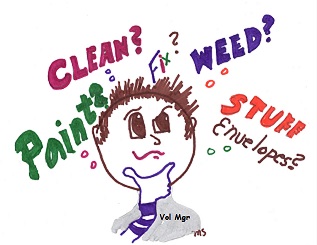
    Volunteer managers: We are a sick bunch, aren’t we? We cry during the movie “Ghostbusters” because we feel bad for the ghosts. We stop and get out of our car to shooo a squirrel across the street even though he looks at us like, “hey, I’m walking here, crazy human.” We smile through pain and wonder how we can be better. Sigh. But no, I’m not suggesting using toilet paper to hastily scribble a “things to do list” with that pen tucked behind your ear while you’re..well you get the idea.

    Jeez Louise, what extra work can help then, if I don’t mean staying late and spot checking those packets the new volunteer, Kira put together, because, frankly you don’t trust that she did them perfectly and mainly because you’re so tired of hearing that little huff sound from the events planner when she speaks of volunteers?

    Burnout can occur when we feel like we’re not in control. Requests are pouring in from all departments. Volunteers need additional training. Recruitment has been spotty lately. There’s that volunteer that “needs a good talking to,” according to the director of operations. It’s overwhelming.

    Some things we can ignore or put on the back burner, but they don’t go away, not completely. No, they are still there. That stuff rattles around in our heads along with things like forgetting to give back the dollar a staff member hastily gave you the day when the snack machine ate your money and you started pounding the life out of it.

    So why take on more? The key here is to infuse yourself with an emotion other than the one that is crushing your spirit. The key is to be in control of something, something that lifts you up, that sparks your creativity, that gives you satisfaction. Something you own.

    I’m convinced that one of the main reasons I stayed in this profession so long was the freedom to create something (and honestly, nobody gave me that freedom, I just took it). For me, volunteer management sometimes felt like trudging down a long, dark alleyway that eventually opened up onto a fertile plot of ground. I could see the fruits of possibilities taking root there: The trees, the flowers, and heck, sometimes the giant fountain of playful dolphins spurting water in all colors (if I had a really ambitious project in mind).

    Creating a project that reflects your creativity, your passion, your idea of wonder injects hope into your veins. Just go to Disney World with a small child and look into their face. Magic does exist. We just need to find it in something we can call our own. We need to find it when we’re frustrated we can’t place highly skilled volunteers because there’s no pre-designed role for them. We need to find it when we see the possibilities our volunteers can offer our clients to make their lives better. We need to find it when our volunteers want to do more. We need to find it when the daily grind wears us down.

    I recall the rush of emotions at the implementation of new projects. I felt terror, anxiety and doubt. But more than anything, I was exhilarated. And that exhilaration allowed me to view all my other duties in a different light. The mundane or challenging duties lost their power to crush me. And in my new mindset, I was able to find creative solutions to challenges that previously wore me down.

    Successful projects you’ve created give you a new perspective, one in which you are a capable leader. Instead of waiting for some miracle day when everyone recognizes all your hard work, take it upon yourself to show how capable you are. How innovative you are. How committed and talented you are. Don’t wait for overwhelmed staff to give you this boost. Give it to yourself.

    Because feeling like we’re not in control leads to burnout. All those mundane duties rattling around in our heads drag us down. But you know what else drags us down? Knowing, and I mean really knowing that a project, or a new way of engaging volunteers would work wondrously and then not doing anything about it. That’s the most soul crushing of all.

    Sometimes, (not always-I’ve had a few projects fall flat but I learned from them and started another, better one) a new project, one you own with your passionate heart and creative soul can help put that wonderment back into your life.

    It’s ironic. More work = less burnout? Our best hope for encouragement = us?

    Yeah, we may be a sick bunch. Wired a little differently. We lift up everyone else. Let’s lift up ourselves. Let’s take control.

    -Meridian
  • The Volunteer Ripple Effect


    I’m convinced. We, Leaders of Volunteers (#LOVols) hold in our hands more power to affect positive change than we can even imagine.

    We have the opportunity to impact the world beyond filling tasks and adding to our volunteer base. The intuitive feelings within each of us are spot on: There’s so much more going on than our excel spreadsheets show.

    I remember long ago struggling to find volunteers who could be with clients while loved ones attended church or synagogue or temple or mosque. I would look for volunteers of that same faith and hoped that they would be willing to give up their own attendance to help someone in need. It was the way it had always been done and it was frankly, exhausting.

    Then one day, a volunteer stepped forward. Hannah offered to sit with Christian clients on a Sunday morning. (I’d love to take credit for thinking this solution up, but, no, it came from this wonderful, selfless volunteer.) Bam! The light went on.

    I feared that mixing faiths (or cultures, or beliefs) would be a challenge in itself, but you know what? (Of course you know what comes next) It ended up uniting people in mutual respect and a desire to understand one another. The mere act of reaching across a cultural or spiritual divide created its own sense of wonder.

    And here’s the thing. For the volunteers, it was never about, “oh, I’m so enlightened that I want to transcend these differences.” No, it was, “you know what? I’m free on a Sunday morning and you need someone, so what could be a better fit?”

    The deep meaningful by-products of volunteering are seldom the initial goals. They just naturally evolve because the volunteer ripple brings out the best in everyone: Clients, families, volunteers, volunteer managers, staff, neighbors, community, everyone.

    Think about that. Volunteer programs impact society in rippling positive ways beyond the delivering of meals, or escorting a tour group or passing out information. Our programs share love. Our programs open the doors for unity, connection and understanding to naturally take hold, and not just during holidays.

    We often witness a profound change in people. We glimpse moments of powerful interconnection through the simplest of assignments. We stand, watching that small pebble create ripples of inspiring stories.

    As you are running around this holiday season, scrambling to fill tasks, stop for a moment and think about the societal change you are helping to bring about. Because you value the innate worth of each human being and believe in their ability to transcend, you are spreading that change like a ripple in a vast sea.

    Volunteerism is a rippling movement.

    And leaders of volunteers are tossing the pebble into the water.

    -Meridian

  • Is Volunteer Management a Science?

    Is Volunteer Management a Science

    In 1959, novelist and scientist, C. P. Snow gave a lecture entitled  The Two Cultures. Essentially Snow argued that the humanities and science were split into opposing cultures, each one not understanding the other.

    Most of us would probably categorize volunteer management as a humanity.  In the post  The Volunteer Investor I likened volunteers to humanity investors.  But while humanity is at the heart of volunteering, isn’t the management of volunteers a science? And, by treating it as a science, does that automatically remove the humanity?

    Well, what if we look at other science based professions that serve humanity?

    • Does the researcher seeking a cure for cancer not dream about the potential millions of people saved?
    • Does the engineer developing a new prosthetic not imagine the first time an amputee puts on that device and walks?
    • Does a safety engineer never think about the children she may keep safe?

    Re-framing volunteer management as a science will not remove the humanity. Instead, it will elevate the skills volunteer managers possess. 

    So, then how can we re-frame volunteer management to reflect the science of it? Do we stop talking about the heartfelt work volunteers do? Do we become invested in cold stats? Or, can we do both? Can we still convey the humanity while highlighting the precise steps taken to achieve outcomes?

    When we, leaders of volunteers separate the volunteers’ incredible outcomes from the systematic steps needed to achieve those outcomes, then we can begin to identify and speak to the science of volunteer management.

    How? Well, we can, as volunteer management professionals begin to:

    • Temper human stories with solution stories and the steps necessary to achieve results
    • Speak in management language when discussing volunteer engagement and challenges
    • Remove emotion when dealing with difficult situations and instead, utilize scientific methods such as observation, gathering of data, testing and logical thinking to solve problems
    • Re-evaluate programs based on priorities, time involved and solutions achieved
    • Re-think in terms of humanely leading volunteers, but managing projects
    • Tout the science of volunteer engagement in terms of strategies, social metrics and road-maps
    • Categorize the skills used to engage volunteers, such as motivating, knowledgeable delegating (not just delegation because anybody can delegate), problem solving, results orienting, relationship building, strategical planning, innovating and big picture thinking
    • Chronicle the methodical steps necessary to engage volunteers
    • Create data that leads to goals, such as maps, diagrams etc
    • Experiment and innovate

    The perception that we coordinate volunteers who require nothing more than a phone call negates the methods required to fully engage these investors in our missions.

    Do we do ourselves a disservice when we blur the lines between the hearts of our volunteers and the hard work we do? Do we sometimes become so emotionally invested in our volunteers’ humanity that we lose our management voices?

    The results of volunteer involvement is humanity’s crowning achievement but the skills, knowledge and sheer hard work is the science of getting to those results.

    If we project our profession as a science with a humanity outcome, we can then elevate the precise, nuanced methodology required to achieve our humanitarian goals.

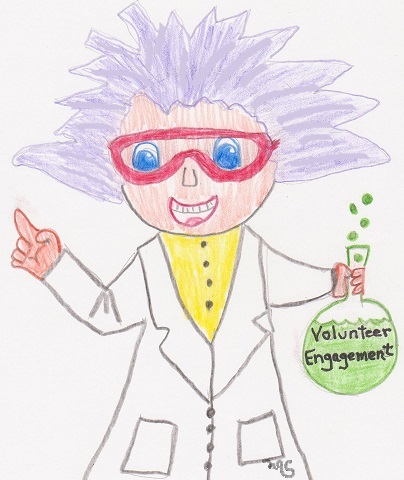
    Lab coat anyone?

    -Meridian


  • Sustainability and Volunteerism

    Sustainability and Volunteerism

    Retention: the continued possession, use, or control of something.

    Does that sound like the volunteerism you know? Not to me either. Maybe it’s time to rethink using the phrase “volunteer retention,” because it conjures up images of a stagnant retention pond. It also rhymes with detention which is closely related to imprisonment. (shudder)

    So, if we stop using that phrase, then do we have to rethink the old principles behind it such as:

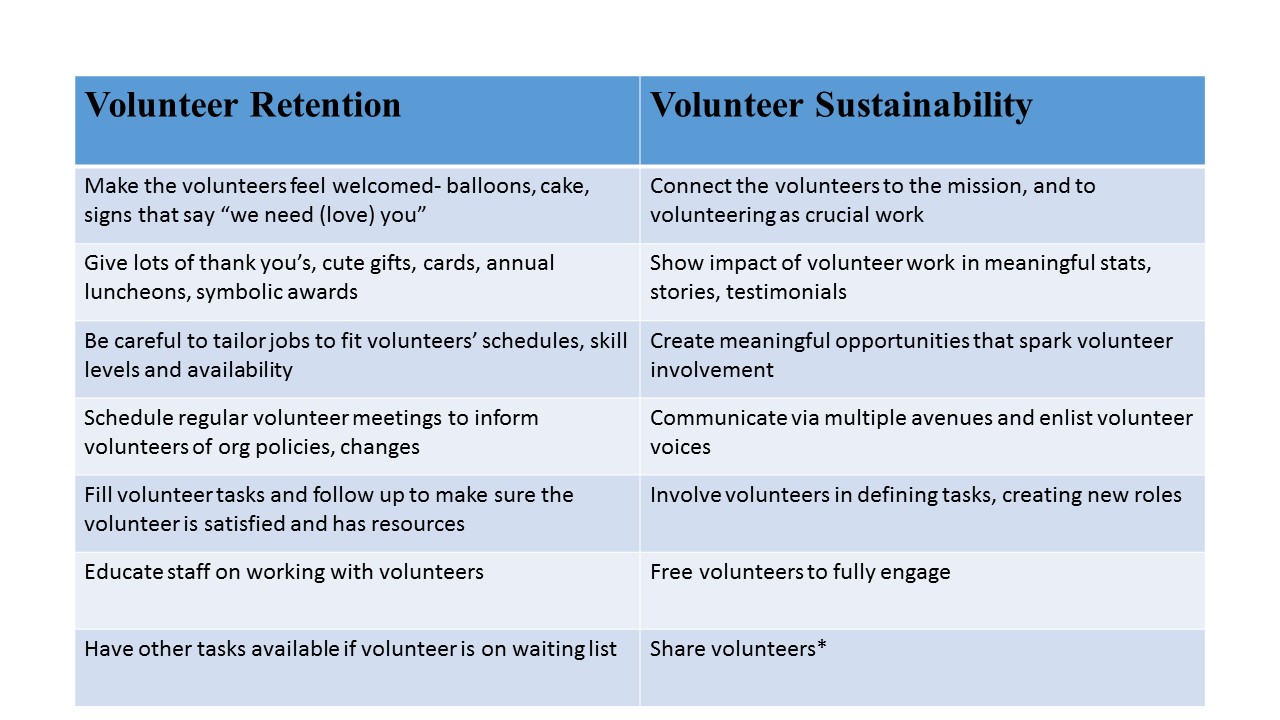
    • make the volunteers feel welcomed
    • say thank you a lot
    • be mindful of their time

    What???? But wait. Just because these principles are fluffy and nice, it  doesn’t mean they are still the best for the changing landscape of volunteerism. Maybe it’s time to retire volunteer retention and instead, embrace volunteer sustainability. Ok, so swapping phrases does not make for innovation. I get that.

    What is the difference then, between retention and sustainability? Well, we’ve all been moving away from the strategies that worked with the WWII generation for some time now.  Why not update our verbiage to match the creative ideas being implemented out there by so many forward thinking visionaries. And while we are embracing these changes, let’s go even further.

    Volunteer Sustainability vs Volunteer Retention

    *This is where sustainability is radically different from volunteer retention. Sustainability, unlike retention is the ability to maintain a healthy balance while avoiding depletion.  Sustainability, as it is being applied to agriculture, economics and ecosystems implementation implies that there is a larger network to be considered. It implies that resources are not hoarded (retention) and depleted.

    What larger network is there to consider when engaging volunteers? The larger network is all volunteer organizations and individual volunteer satisfaction. With that in mind, let’s ask these questions:

    • Why do we keep volunteers on waiting lists if we cannot use them in a timely manner or cannot find roles for their passions?
    • Why do more volunteers equal better volunteer engagement even if some volunteers are in name only?
    • Why do we stuff volunteers with specialized skill sets and interests into non-matching roles? Or try to tweak a role just to keep the volunteer?
    • Why do we cling to volunteers as though they are 23 year old offspring and we just can’t bear to see them fly?
    • Why do we blame ourselves when volunteers leave?

    It is time we, volunteer managers, think of other volunteer managers, our volunteers, all volunteer opportunities, all clients in our area, and all missions as a network serving the greater good.

    It is time we viewed volunteerism as a regenerating community garden that needs tending by all of us so that the bounty of volunteers is nurtured, regrown and sustained.

    It is time we added collective volunteer engagement, sharing and referral to our innovative methods in order to cultivate volunteer sustainability.

    How many times does a volunteer get frustrated and drop out when they have to wait too long to share their time and skill? Or how many volunteers quit because their passion is not being fully utilized? How are we serving our communities when we deplete our volunteer base by clinging to the archaic notion of volunteer retention?

    Next time: We can be the leaders of a sustainable movement. (Innovation and Sustainable Volunteering)

    -Meridian

  • Hey Corporate Volunteers, Where Are You From Again?

    EPSON MFP image

    “Uh Meridian, you really blew it! You missed a whole point about corporate volunteers,” a friend of mine said on the phone a couple of days ago. “You talked about thanking groups and connecting them to the work, which is great, but you completely forgot a big one and guess what? It just happened to me.”

    Ouch. What did I forget? Tell me what happened.

    “Well, it was our corporate retreat and twenty of us just completed a one day team building volunteer event at a local organization.”

    That’s great. How did it go and what did I miss?

    “Well, it was ok for the most part, but honestly we’ve done other projects and had better experiences.”

    What went wrong?

    “Well, nothing went really wrong, but let me explain. We all drove to an organization that gives cribs to families in need. Our firm had purchased about forty unassembled cribs and we drove to this warehouse to put together the cribs we bought.”

    And how did that go?

    “Well, we were met by the woman in charge. She kind of acted like we were interrupting her day. She gave us some quick directions and left. She would come and go. But there was something that bothered me a lot. She kept getting the name of our firm wrong. And she kept referring to us as bankers. None of us are bankers. Our company is an accounting firm. Granted, we work in the financial industry, but we are not bankers. It just felt like she didn’t even take the time to learn who we are or what we do. I mean, we reached out to her organization, why didn’t she ask a few questions? I felt, I don’t know… used. Am I being too sensitive and picky?”

    No, my friend you are not being too picky. Because if a group walks away from a project feeling like they were just ancillary labor, then the next time they look for a project, they will most likely look elsewhere. Pure and simple. We can argue all we want that a group is too needy, or picky, or they just don’t understand. The feeling they walk away with will determine whether or not they come back.

    It all boils down to: Do we want them to come back? Do we want them to spread a good word? Do we want them to become partners or champions or supporters? If not, then we should not waste their time or ours. That’s why limiting episodic volunteer groups to a manageable number versus taking everyone is the better way to go.

    And since I did miss that big one when listing things we can do to connect our group volunteers to our projects and missions, let’s list it now.

    • Learn something about the group. At least we can call them by their correct name. We can know a little about their work. (an application process asking pointed questions should help)
    • Be genuinely curious about the people who are helping. Ask questions throughout the duration of the project. Let them tell you who they are, what they value etc. This also helps you to tailor your stories and feedback to fit within their culture.
    • Send a follow up survey and gather feedback on the project. Ask questions to help you hone future group projects.
    • Thank them for their input. So much research has been done on the increased by-in of groups who participate in planning and improving work conditions. Why not apply this to episodic volunteers and encourage them to help you plan new projects by asking for feedback?

    Connecting episodic volunteers to our missions ensures they walk away as new supporters.

    But, after all, we can take our own advice when engaging episodic volunteers. They’re people, not tools.

    -Meridian

  • Hey Corporate Volunteers: How Great is Weeding?

    EPSON MFP image

    A recent article from Business News Daily cites a study finding that “89 percent of employees think organizations that sponsor volunteer activities offer a better overall working environment. In addition, 70 percent believe volunteer activities are more likely to boost staff morale than company-sponsored happy hours, with more than three-quarters saying volunteering is essential to employee well-being.”

    But here’s the kicker from the article: “Three-quarters of the millennials surveyed said they would volunteer more if they had a better understanding of the impact they were making, compared to 61 percent of those of all ages.”

    Huh. So, it isn’t obvious that volunteering for a homeless shelter actually helps homeless people is it? Or wait. Maybe it isn’t obvious that weeding the garden at the homeless shelter actually helps the homeless.

    Oh, yeah, now I get it. Maybe for corporate volunteers, the cleanup or painting or weeding the garden doesn’t scream “OMG, this made all the difference in the world to our clients! You have changed lives like no one else ever has in the history of volunteering! Ka-bam!”

    We, volunteer managers, can be caught in a nether world of finding projects while assuring these episodic volunteers that we really need them. And once you manufacture a project just to accommodate a group, is that truly meaningful work?

    So what can we do since corporate and episodic group volunteering will most certainly grow in the future?

    Well, we need to do some serious planning, be methodical about our episodic volunteers and complete the legwork before we take on groups. We can:

    • Create a plan before accepting groups. Decide how many group members can be accommodated at a time, the age range you are comfortable working with, the time frame that works for you, what supplies the group needs to bring, the number of groups per month or year you can accept, etc.
    • Create an application process for group volunteering: Gather information on the group, ask pointed questions on the application that will help you understand their motivation, interests, skills etc. Then decide if and when they will fit into the projects you have or can create.
    • Create an impression that you value quality over quantity and busy work: We don’t have to take everyone. As each group you engage comes away with a positive experience, word will spread that your organization is the one to contact for quality volunteering.
    • Develop a narrative to go along with each project. Prepare impact stories to accompany each project. Highlight the contribution and results of the project.
    • Utilize client testimonials to recruit and thank corporate volunteers. Tie these into the activity. It may take some creative interviewing to elicit these testimonials, but it will be worth it.
    • Follow up with a letter outlining the impact of the completed work. Reiterate the improvements for clients, staff and other volunteers.
    • Send a thank you letter from your CEO to the corporate CEO or group leader. It can be a general thank you created ahead of time and tweaked for each group. But, have the CEO sign it each time and encourage them to write a personal note.
    • Take pictures-make memes, add text boxes, thought clouds etc. Send them to the group, post them on all social media outlets.

    No matter what, the connection between the project and the impact on clients is critical. Take weeding the garden at the homeless shelter. We can say to our corporate volunteer group, “Imagine the first night you are homeless. Imagine what that feels like, having nowhere to go, no stability, no safety and you arrive at our shelter and all you see are the weeds in an unkempt garden. It says to you that we don’t care. It reminds you of the tangles that threaten your existence. How would you feel? Remember, every little thing can be the one big thing that makes someone feel safe.” Then read testimonials from clients who felt safe.

    A lot has been said over the years about making corporate volunteering fun. While fun is important, it is secondary to meaningful work. Corporate and episodic volunteers deserve to know that even by pulling weeds in the garden, they have created a beautiful safe space for those facing a difficult time in their lives.

    We know the impact of each job, no matter how inconsequential it may seem at first. If we are thoughtful about episodic volunteering and prepare well for group volunteers, we can create a win-win for everyone.

    -Meridian


  • Captains of Our Destiny: Captain Obvious Part 2

    Captains of Our Destiny

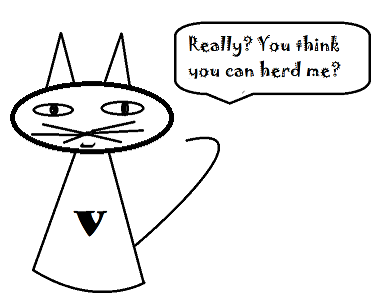
    Ha, ha, working with volunteers is like herding cats. …non-profit staff member.

    It is time we become captains of our own destiny. It is true that our work is not glaringly evident to all, so we can’t be Captain Obvious.

    So, now what? We can captain our future and redefine our work in terms that befit its importance while illuminating our professional skill set. It’s on us to redefine volunteer services, to flip it from one of cutesy, fluffy extra touches to a dynamic and professional service.

    How? Well, first off, we have to change the loose descriptions of volunteer engagement and instead use the professional terms they deserve. To do this, let’s look at two highly regarded and compensated jobs and re-imagine our profession in those terms and descriptions.

    Instead of volunteer managers, what if we were called Volunteer Account Managers? In reality, volunteers open accounts with us, in the same way as donors or clients. (an account is something of value or worth-in this case a volunteer’s time, expertise, resources, knowledge, sweat equity, donations, word of mouth marketing, etc)

    As such, we would use these terms:

    Volunteer Account Management: the management of volunteer accounts, including the relationship with volunteers and the pursuit of volunteer satisfaction.

    Volunteer expectations: the value a volunteer seeks from our organizations, such as training opportunities, positive feedback, admittance to the team, creative outlets etc.

    Volunteer centric: the emphasis an organization places on volunteer involvement, including timely appreciation, seats at planning meetings, designated volunteer managers who are supported, educational opportunities, partnership opportunities.

    Volunteer journey: the steps a volunteer goes through to become a viable and satisfied member of the organization.

    Volunteer journey mapping: the process by which a volunteer manager maps the journey a volunteer takes from first contact to integration through onboarding-and more importantly, the ability to reconfigure the steps when necessary.

    Volunteer profile: the ongoing process by which a volunteer manager educates staff about volunteers, including their needs, their changing dynamics, their skill levels, their rate of participation and their future involvement.

    Volunteer satisfaction levels: measuring and reporting the satisfaction levels of volunteers through one on one interviews, surveys, questionnaires, etc. And more importantly, the ability to change areas in which volunteers lack satisfaction.

    Volunteer benchmarking: the continual process of improving the relationship with volunteers. There are many methods of benchmarking, such as:

    • do volunteers choose our organization over others and why or why not?
    • do volunteers make time for us over other activities and why or why not?
    • do volunteers recommend our organization to their circle of influence and why or why not?
    • do volunteers increase visibility, donations and resources and how? (we all know instinctively that this is true, but benchmarking will prove it)

    Volunteer benchmarking will then be a tool to change the processes that need change, in the same way fundraising evolves.

    In order to Captain our own destiny, we must begin to flip volunteer services from the outdated idea that volunteers are summoned to fill a job and volunteer coordinators “herd those funny cats around, lol, isn’t that cute.”

    Instead:  Volunteers hold an account with us and we are responsible for cultivating that account by continually improving our relationship with the volunteers. And this is where the highly skilled volunteer account manager comes in.

    Next week: KAVM-the key account volunteer manager-what does this mean for us?

    -Meridian

  • Volunteer Fresh


    Volunteer Fresh

    Every day, volunteer managers witness the passion brought by volunteers. We marvel at their skill. We see their pure work, unencumbered by thoughts of pay, or chains to the financial burden of staying somewhere not fulfilling.

    But there is another positive that we can attribute to our volunteers. The number of hours they volunteer a week or month is often misconstrued as a shortcoming, but in reality is a gift: Volunteers are not burdened by the stress of working for us full-time.

    Volunteers who show up once a week or month are like opening the window to let in the breeze. They come in, trailing currents of fresh air. They bring with them new experiences, a taste of outside ideas, and rejuvenated enthusiasm to our stale environment.

    What factors contribute to a stale environment? Compassion fatigue, burnout, overwork, repetition, familiarity, slow to change movement, it’s always been done thus mentality, funding worries and stress. Each of these freshness killers lurks in the halls of non-profits, waiting to blow their stale breath into our lungs.

    There is an under current of pressure on non-profit workers to be “on” at all times. This Pedestal of Perpetual Caring implies that every moment is as intensely compassionate as the first one. Who can live up to that standard when reports are due, projects need attention and budgets are withering?

    Enter Volunteer Fresh:

    Our volunteers, unburdened by the stresses of working with us full-time can and do exhibit the intense compassion every client needs.

    Our volunteers are out there in the world 98% of the time and bring with them outside opinions, trends, ideas and methods.

    Our volunteers bring infectious enthusiasm and continually remind us why we love our work. They plug us back into our missions.

    Marketing Volunteer Fresh: (or, at your next staff meeting, use gimmicky but visual aids to encourage your organization to embrace volunteers as more than just those people who fill preconceived slots)

    Bring a sandwich from a vending machine along with a fresh sandwich from wherever staff loves to eat. Use each ingredient of the fresh sandwich to explain the layers of volunteer fresh and compare the two.

    Videotape volunteers speaking from the heart. Show staff the infectious enthusiasm volunteers bring. Remind them that opening up to each volunteer re-ignites their own passion.

    Use a radiating circle of connections chart to show the connections our volunteers are making within the community. Use arrows in both directions to illustrate the wide swath of information and influence our volunteers create, both coming and going.

    volunteer fresh pp


    Here are some concrete ways to offer Volunteer Fresh:

    Schedule “sit downs” between community engagement officers and volunteers. The engagement officer can ask volunteers to take the pulse of the community by asking pertinent questions of their friends, neighbors, civic groups, church members etc and then report back.

    Create a campaign via WOMM (word of mouth marketing). Marketing can release a sub-campaign via volunteers to reach out into the community on a specific hot topic. Equip volunteers with flyers, business cards, etc. to launch campaign and monitor feedback.

    Engage volunteers in stress relief. Create a team of volunteers to develop a stress relief program for staff and other volunteers. This volunteer team can institute ways to help over burdened staff cope with burnout.

    Volunteers are a gift of freshness. How fortunate we are to be able to incorporate fresh ideas, enthusiasm, and passion into our culture by people who offer all of this for free.

    Let’s encourage our organizations to open the window and let the freshness in.

    -Meridian

  • New Words Added to the Volunteer Management Dictionary

    Added to the Volunteer Management Dictionary

    It’s that time of year when the Committee to Define Volunteer Management gets together at a back table in Pete’s Bar, Grill and Bait Shop. Together, these brave members scratch their heads over several pints and attempt to come up with a succinct explanation of volunteer management. This year, they gave up once again after rejecting the phrase “herding cats,” but they decided to add the following words to the dictionary of volunteer management.

    Volvorce: When a volunteer divorces the organization as in “No, I just can’t go get new volunteer Dinesh, because since no one called him back about getting started after I introduced him to finance, he volvorced us.”

    Meetcolepsy: When too many meetings cause you to simply fall into a stupor at the thought of another talk-fest as in “No, I couldn’t make that fourteenth meeting about using the volunteers to stand by the back door in case someone gets confused because I contracted meetcolepsy. Want to see my doctor’s slip?”

    Latespectation: A last-minute request for volunteers that is expected to be filled as if you were given weeks to prepare, as in “Oh, so you need 5 volunteers tomorrow morning for an assignment that you said was extremely important? Your latespectation is showing.”

    Creditjacking: When another staff member takes credit for a successful endeavor that you or your volunteers accomplished as in “Yes, I’m glad you praised that project during the senior managers’ meeting, but let’s not creditjack the volunteers’ work, ok?”

    Duhtistics: Stats that are so incredibly obvious, like volunteers are super nice as in “I won’t bore the board with duhtistics that you’ve heard before. No, instead I want to point out some new and exciting projects we are undertaking.”

    AVOL: A volunteer who inexplicably does not return calls, emails or letters as in “I’m glad you noticed volunteer Myrna has been missing lately. I’m trying everything in my power to get in touch with her. Right now she’s AVOL.”

    Volunteer Lite: A request for a volunteer to do a menial, mindless task as in, “You’re asking me for one of our highly trained volunteers to clean out the storage closet so you can use it for your supplies? You don’t want a full-bodied volunteer, you want a volunteer lite.”

    Miracalls: Calls made to volunteers for an especially challenging or late request as in, “Woah, that’s a really challenging request (or time frame). I’ll be holed up in my office for the rest of the day, making miracalls.”

    Informashunned: (pronounced in-for-may-shunned) Not given the essential information needed to properly place a volunteer as in “I have recruited four of our best volunteers for that assignment, but my pleas for crucial information have been ignored. Right now, our volunteers are informashunned.”

    Nopinion: Volunteers wanted, but not their opinions as in, “I’m glad you were able to use volunteer Mark’s expertise, but he felt rebuffed when he offered additional knowledge. I guess you really want an expert but nopinion volunteer.” 

    Vombie: That volunteer everyone is afraid of and no one wants to council or fire, as in, “I know Janey is a handful and she’s been here for what, twenty years now. I guess she’s been allowed to attain Vombie status and now that I’m here, I will deal with it in a professional manner.”

    Callwaiter: The notion that volunteers sit by the phone just waiting to hear from us as in, “It is Friday afternoon and most of our volunteers have already made plans for tomorrow. I’ll make some miracalls, but our vibrant and diverse volunteers aren’t callwaiters.”

    Marathonitor: The running around, checking, double-checking and rechecking to ensure that volunteers have all the information and tools they need to succeed as in “Our fifteen volunteers are ready for Saturday’s important annual event, but in order for them to excel, I will be marathonitoring their involvement, so I won’t be attending any meetings tomorrow or making miracalls to fill latespectation requests.”

    Well, there you have it. As one of the senior members of the Committee to Define Volunteer Management said after several glasses of Pinot Grigio, “Dang, defining volunteer management is really impifficult.”

    -Meridian

  • The Inner Volunteer

    The Inner Volunteer

    Do the words, skilled volunteers make you shudder?

    One day Marcel reported his recruitment efforts to the executive action committee. “I had just reported on the addition of several new corporate groups when the executive director stopped me and asked why I couldn’t just get public school teachers to come in on Saturdays and read to the children at our shelters.”

    The CEO asked, “wouldn’t it be a lot easier because teachers already have the skill set?”

    Marcel continued, “In my head I wanted to ask her if, after a hectic week directing a charity organization, why didn’t she go on her day off and volunteer to run a startup charity organization. I mean, yes, I’m recruiting teachers because of their skill sets, but so many other types of volunteers passionately want to read to our clients’ children. To me, passion is what makes for a great volunteer.”

    Skilled volunteers are often equated with perfect volunteers. Often, the term skilled volunteer becomes synonymous with the notion that volunteers are easy to recruit. Why not just get a lawyer, or a carpenter or an IT technician? But we know it isn’t so simple. Does a person with a certain desirable credential want to use that credential in volunteering? Sometimes, but of course, not always.

    We’ve all had volunteers who wanted to forgo their professional skill set. We’ve seen them unlock their inner volunteer and utilize a side that would never appear on paper, but one that excites them and ultimately serves us so well. For example:

    The FBI agent that becomes a hand holder for older male clients, This agent’s inner skill set came from having to listen carefully when interviewing suspects. Now he uses that skill in a new and gentle way.

    The IT professional that creates an art therapy program. While her left digital brain is writing code, her right analog brain thirsts for the inner creativity she passionately exercises while volunteering. Ironically this volunteering outlet makes her better at her IT job.

    The Stay at Home Mom who takes charge of a new program and excels at giving direction and getting results. At home, her inner manager directs her family’s activities, finances, and schedules with a precision borne out of love and necessity. She brings these honed skills to the program and treats her fellow volunteers as beloved family. They flourish under her direction.

    And on the flip side, what about the skilled volunteer who taps into their inner director or educator and looks for more ways to help? What if they offer their expert advice and opinion on the workings of our organizations? Are our organizations prepared to accept this advice? For instance:

    • The teacher who wants to replace the reading program at the shelter because it is outdated and insensitive.
    • The carpenter who advises that the repairs on a project are unsafe and non-compliant with code.
    • The attorney who suggests that policies and procedures are antiquated, potentially a risk management nightmare and need a complete overhaul.
    • The marketing expert who points out that the latest campaign is fraught with errors and tired themes.

    This begs these questions:

    • How does an organization define a skilled volunteer?
    • Are organizations willing to accept the advice that comes with experienced and accomplished people?  
    • Do organizations view skilled volunteers as peers, useful tools or something else?

    This is why clarification is so important. When an organization asks for skilled volunteers, we need to ask these questions:

    • Do we value skill over passion and commitment?
    • Who is responsible for a skilled volunteers’ mistakes? Are these volunteers’ licenses or credentials at risk?
    • What are the legal ramifications of utilizing volunteers in a professional capacity?
    • Who is going to field expert questions from skilled volunteers? The CEO?

    As organizations ask volunteer managers to recruit skilled volunteers for expert help, clarification is essential. Clarification goes far beyond a simple job description. It goes to the very core of the inner volunteer. Passion vs. skill. Sideline expertise vs. full skill set participation. Legal consideration vs. a laissez-faire attitude. Hands on vs. hands off risk management.

    With skill there is ramification. Are we prepared legally to engage volunteers with licenses and certifications?

    With skill comes expert advice. How much skilled advice are we willing to accept?

    Or, are we just throwing out a poorly defined concept?

    -Meridian

    For a great article on skilled volunteering, please see Rob Jackson’s post on this subject.