Category: volunteer recruitment

  • Gig Volunteering and Intellectual Property: Do We Own Volunteer Work?

    How much do we “own” volunteer work? Is it all about the legal (and don’t we know, when it comes to anything bad happening on a volunteer’s watch, legal becomes oh-so important). But what of the talents and abilities a volunteer brings? This viral story on TikTok about a woman who watermarked her work (because her boss kept stealing it) has a different lesson, hidden under the obvious one: keeping your work safe. But how does this apply to volunteers?

    Shifting Trends To Watch

    Before the pandemic, the gig economy and freelance work had already been growing (Freelance work accounts for 35% of the global workforce. Source: financeonline.com), and company loyalty has been shrinking. Today, recognition and personal satisfaction may come from social media followers instead of within the hierarchy of your boss saying you’re a swell employee or volunteer (company or organization). In the above, the woman who watermarked her work was replaced (fired?) and had to find another job, but her video was viewed over 3.7 million times with many “followers” offering support.

    The support from 3.7 million peers overwhelmingly helped the sting of retaliation from a few petty bosses Volunteering is not static. It is rapidly changing (despite Covid and sped up by the pandemic) and reflects the societal shifts we are seeing. So will volunteers become freelancers? Gig volunteers? Can they watermark their work? Do they have 2,000 followers from whom they derive support and satisfaction and so, our lovely pats on the back can’t hold a candle to all that positive feedback? Are we foolish to ignore the idea that volunteers have their own intellectual property? (Intellectual property is a broad categorical description for the set of intangible assets owned and legally protected by a company or individual from outside use or implementation without consent) Source: Investopedia.

    What Do We Own Exactly?

    Our volunteer organizations own our training, our processes, our mentorship, our educational information, our mission goals, our policies, and the work performed under our umbrella, but what about the unique skills, talents and abilities our volunteers bring, such as spot-on empathy, crazy good listening skills, mad technical skills, drool-worthy organizational abilities, soothing voices, or Shakespearean writing chops? I’m pretty sure we don’t teach volunteers those innate abilities, but, we recognize and put those abilities to good use.

    While I am not even remotely suggesting that volunteers will rise up and fight to own the volunteer work they do under an organization, I think we can extrapolate some insights from gig work, and the TikTok story, because as society shifts, so will volunteering.

    We Have Already Shifted Away From Old Models:

    In the ancient past (like 1998), orgs pretty much used these volunteering edicts:

    • we need this, so you will fill this role
    • we determine what works, so take it or leave it
    • we are the experts on our mission focus, so don’t bring untried ideas
    • it’s the tasks we value, not what you bring to our table
    • you are a tool, so act like one

    Gig workers create resumes highlighting their skills, experience and talents. Why can’t a volunteer do the same thing? We know that student volunteers are increasingly looking for volunteer opportunities that teach them new skills, allow them to test leadership abilities and give them something in which to enhance their resumes and better themselves. Why don’t we help volunteers create their own Intellectual/Empathetic/Skill Property resumes?

    Leaders of Volunteers already recognize volunteers’ unique talents and skills. When interviewing, we look for those talents and note skills when placing volunteers. We worm our way into volunteers’ hearts and minds, not because we’re nosey (tell that to my husband), but because we need to know the volunteer inside and out. What makes them tick? What are they so freaking good at? And ultimately, what makes them an outstanding and effective volunteer?

    We are lavish with our praise, especially for a volunteer’s unique contributions. So, who cares? Well, what if volunteers had resumes that highlighted their unique talents, complete with endorsements and examples? What if you were searching for a volunteer who could not only speak Arabic, but had this unique talent of bringing out the buried stories in someone’s life? Wouldn’t finding that volunteer be magic?

    I had lists and lists of volunteers and their skills, such as speaking another language, artistic talents, engineering background, etc. But only in my head did I know who was sensitive enough to bond with an aching heart, or was astute enough to keep quiet while someone grieved in their own way. See, intangible stuff is like a beautiful sunrise. We appreciate it, but we don’t always know how to include it in concrete ways. Maybe we should.

    No Longer Harnessed

    Volunteers have moved away from the “I’m a tool of the organization” mindset. They freelance now, and reject the notion that organizations know best how to use their unique skills. Just look at any unfolding disaster and see the informal volunteers pour out.

    Here’s the thing: As volunteer engagement professionals, we scratch our heads and ask ourselves, “how do we harness the enthusiasm we find when disasters strike and how do we keep the volunteer mojo going?” Right there is the problem: Volunteers don’t want to be harnessed. They want to be engaged. And maybe for just a short time or for the adrenaline rush. Maybe for the autonomy or for the comradery found within a social network. Could be for the praise from followers or the immediate satisfaction. Can we supply that going forward? Must we?

    There will always be volunteers who fit so well, they stay at an organization. Thankfully, like in a magical fantasy, these volunteers have found the synergy that makes them want to keep at it. But for the rest of the volunteers out there, being harnessed isn’t what they have in mind. For them, it may be about using their unique talents or having some autonomy, or receiving support from social media rather than organizational structure. Does that make them selfish? Not really. And if we are truly interested in diversity and equity, we will open ourselves to a changing society and accept new thoughts. And most times, it means getting out of the way.

    What Their Property Means for Us

    From Indeed.com: “A gig worker is a professional who, instead of receiving a regular income, receives wages based on the one-time projects, or “gigs,” that they complete. This makes for a flexible work environment, where employers can offer payment for only the work that’s available for a gig worker to perform. The gig economy is the work and career environment in which these professionals work.”

    So what does this mean for us? For one thing, we can structure volunteer wanted ads to reflect our commitment to understanding volunteers are unique and we offer reciprocating benefits to volunteering. Instead of advertising “jobs” let’s advertise opportunities. For instance:

    • Engage your empathetic property in this manner (Subtle? Yes.)
    • Bring your unique talents
    • Put your skills to work
    • Enhance your abilities
    • Develop your leadership
    • Grow with us
    • See where this takes you
    • Our clients are unique and so are you

    In the future, volunteers will opt for their own volunteering resumes which they may use on social media or for job hunting. No longer will hours or tasks count. I can see a volunteer in the future, recording their experiences on their resumes this way:

    • With my ability to organize and motivate, I enlisted five volunteers to man the food bank during a power outage which resulted in no interruption of service to clients. The volunteer administrator said about me, “Without Jordan’s expertise, 30 families would have gone hungry that day.”
    • Because of my extensive software knowledge and ability to work under pressure, I fixed a bug in the keynote speaker’s presentation at the annual funder’s benefit, thus saving the keynote address. As the keynote speaker quipped, “I’m indebted to Anvi for her skill and especially for her calm during the chaos.”
    • My ability to structure partnerships was called upon when I sat on a task force to brainstorm encouraging STEM in schools. It was my partnering model that created a successful program. According to the principle at Main Street High, “our partnership with Computer Alliance Corp has led to a 30% increase in students choosing STEM universities.”

    No Swell Heads

    There is a risk in that too much praise can lead to swelled heads, but you know what? That risk already exists, because we praise volunteers a lot (at least in my experience). Somehow, many of us, myself included, feel like praise is a way to keep volunteers coming back. That’s not exactly accurate, so why not be less fluffy and broad and overly effusive about praise and be more specific in pointing out exactly why this volunteer is effective? Praise then becomes tangible and we can more easily attach meaning to something tangible and concrete than to broad phrases like “you’re so good with people.”

    To which a volunteer would ask, “how am I so good with people?” Um, well, yeah. Sometimes intangibles are just obvious, which makes them hard to define. It’s the feeling you get when you interview an exceptional volunteer; that “there’s something about this person” tingle that crawls up your arm. So, define it, especially when you see it in action. “Drake has this unique ability to put people immediately at ease.” How is Drake’s empathetic property valuable? Holy moly, how many times did I look for that quality in a volunteer when working with clients who were scared, abused, or closed up? And when I had a Drake in my midst, you bet Drake was on speed dial. (is that a thing anymore?)

    The Change Train Keeps Rolling

    We realize we must adapt to an ever-changing world. One way we can sustain (as opposed to retain or harness) volunteers is to help them chronicle their unique contributions to our work. By doing so, we give them the tangible evidence they need to find meaning in their volunteering. The two hours are not what it’s about. It’s about the volunteer’s unique ability to listen without judgement or the volunteer’s skill in teaching a child how to draw or the volunteer’s sense of humor that broke through to a client who didn’t get along with other staff or volunteers.

    I realize this is not a ground-breaking change. But, as we navigate the changing world, it will be the subtle shifts we make that position us to keep engaging volunteers. Ears to tracks on the ground, we can hear the train coming before it runs over us.

    With volunteer appreciation weeks coming up all over the globe, we are determined to appreciate volunteers for numerous reasons. Instead of trying to retain and harness volunteers, let’s engage them by giving them what they seek and appreciate them for the unique intellectual/empathetic/skilled properties they bring.

    Those unique properties are what we engage anyway.

    -Meridian

  • Stock Pictures or the LoVols Picture on Volunteer Websites?

    Photo by Artem Beliaikin on Pexels.com

    Stock photos are just so……..stock

    Stock pictures are the visual equivalent of “volunteers give from the heart,” or “volunteers are priceless.”

    Or my all time favorite, “volunteers are the sprinkles atop our caring cupcake.” MMMMMM, I feel so warm and squishy inside.

    Photos of real volunteers in action on your website do double duty. They show potential volunteers their peers at work and the types of jobs available. But think about a potential volunteer’s questions when navigating your site. “Who is the first person I will meet? Who will train me, direct me, encourage me, coach me, teach me what I need to know to succeed? Who will be there for me when I have an issue?”

    Hint: It’s not this guy.

    Stock photos or worse, no photos on your site lacks the personal touch. But again, the potential volunteer is wondering, “who will lead me?” A personal welcome from you is inviting and eases the potential volunteer’s crucial first step: Walking through the front door, not knowing what to expect.

    I’ve observed that entering the building for the first time was the hardest part of a new volunteer’s journey. Let’s make that less intimidating. Go further and film a short video in which you personally welcome a potential volunteer, and dispel some of their fears.

    Kapow! you’ve just saved time.

    Bam! In that short video, you’ve gifted yourself all the time you’d have to spend soothing potential volunteers. You know what I’m talking about. A new volunteer nervously arrives into those awkward minutes when they size you up and down, wondering what you’ll say, what you’re like, whether you’re warm or cold, authoritarian or encouraging. Now multiply those awkward minutes by each potential volunteer and thank yourself for making that welcome video.

    After watching your welcome video, a new volunteer arrives to meet someone they’re already comfortable with. Be authentic, and be yourself. You can write a script that gives you the opportunity to say all the things you want potential volunteers to know without having to remember and repeat each time someone contacts you.

    Look, we are all on zoom now and all used to regular folks on camera so now is the opportune time to film that video. Make it fun. Make it warm. Make it you.

    I made a sample video here:

    Ok, maybe that sample video wasn’t perfect, but don’t let that stop you.

    It’s about putting a face to volunteering at your organization. Your picture, your quotes about volunteering, your experiences and assurances all serve to quell the trepidation volunteers feel when mulling over whether they should take that first step.

    We want volunteers to feel welcomed. We want volunteers to know that we’ll walk with them on this journey. We want volunteers to know we’ve got their backs.

    Let’s show them in that first moment when they click on our websites.

    -Meridian

  • Volunteer Flow Strategy

    Volunteers move in and out of our organizations and unlike staff who have defined hours and pay, volunteers ebb and flow like water in an ecosystem. A simple volunteer flow statement is used to track this flow and then predict future flows based on factors that engage volunteers verses factors that block the volunteer flow. Let’s create a basic flow statement for volunteer recruitment efforts.

    simple, but effective

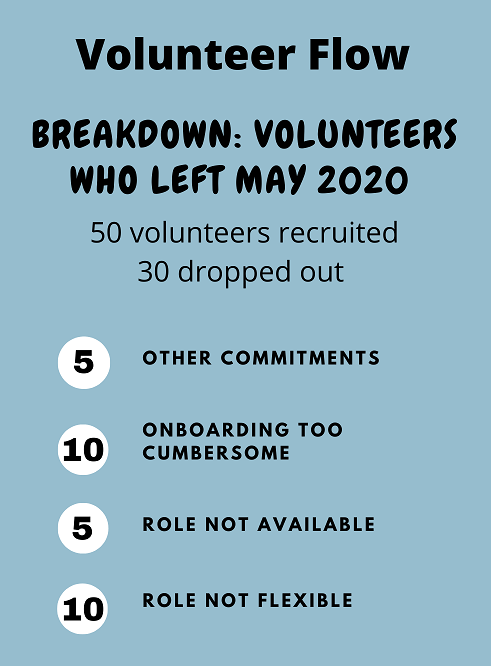
    Example: Month of May: We recruited 50 volunteers who signed up. Of those, 20 volunteers followed through and are now officially volunteering.  The other 30 volunteers did not follow through. The volunteer base has now increased by 20 volunteers. Sounds great if you simply say, “we gained 20 volunteers this month. 

    But let’s go further. What about the 30 volunteers who left after recruitment? Here’s where you can explain the reasons volunteers leave and predict that more volunteers will leave due to these same reasons. Not so great, after all, is it?

    Percentages are calculated from stats gathered – for example, exit surveys or interviews.

    Percentages break down this way:

    • 16% of volunteers who left in May had other commitments
    • 33% of volunteers who left in May found on-boarding too cumbersome
    • 16% of volunteers who left in May did not find a role that suited them
    • 33% of volunteers who left in May needed more flexibility

    When projecting volunteer recruitment in the future, we can now predict:

    For every 10 volunteers we recruit, only 4 (or 40%) will stay. ( based on the above stats, 50 volunteers recruited – 30 volunteers that left = 60% of new volunteers will leave before they even start. Now, 20 new volunteers doesn’t sound so great when the number could have been 45, right? (not 50 because you can’t control the 5 who had other commitments)

    Explain why volunteers leave by showing causation:

    Of the volunteers who left:

    • only 16% left due to unavoidable reasons
    • over 80% left due to factors we can modify or change

    We need to change…

    We can now infer from the statistics that changes will likely increase the number of recruited volunteers who follow through. Changes include:

    • on-boarding needs to be less cumbersome
    • roles need to be more flexible
    • roles need to be expanded

    A strategic Volunteer Flow sheet shows the reasons volunteers leave or stay. (causation). These “causes” are the reasons you have experienced all along and have been advocating for. Volunteer flow is a way to form your knowledge into a measurable report and more importantly, predict the future with statistical information.

    Instead of the notion that a volunteer manager should “work harder” to “get volunteers,” we need to place the reasons volunteers leave or never get started squarely on the outdated systems that no longer work.

    By predicting the same results in the future, you are illustrating that without the changes you are advocating for, volunteers will continue to leave before they even get started. You can use this method to show volunteer retention and causation as well.

    show what you know

    Volunteers flow in and out of our organizations for hundreds of reasons. The reasons we can control must work for the volunteer and by showing causation, we can more effectively advocate for the changes that will increase volunteer engagement.

    Modern volunteers need modern programs that meet their needs. Our communities are ecosystems and volunteers flow in and around looking for the right opportunity to offer their skills and passions.

    Let’s strategically advocate so that when volunteers flow our way, they find a place to stay.

    -Meridian

  • Please volunteer for us, you caring person :-)

    You’re gonna love it!

    Picture a potential volunteer skimming through volunteer ads, and they come upon yours. Are they intrigued? Do they shout “Golly gee, this is fabulous,” and run for the phone, desperate for the wonderful opportunity? Or do they keep looking?

    According to research, the science of naming brands is more than descriptive words. Clever word coinage, rhymes that fall off your tongue and words that sound like the actual word (think fizz) all play into choosing a name.

    What if we rename common volunteer-wanted ad titles, using these techniques? But wait, let’s add a dose of job realism, shall we? For example, instead of:

    Office volunteer wanted:  Let’s use (and include a tagline)…

    • Mundane-Loving Myrtle; Boredom is the new black
    • Stays-In-The-Cubicle Carmen; see no evil, hear no evil, report no evil
    • Filing-Fool Fiend: keep your head and your hopes down

    Marketing/Fundraising Volunteer wanted: 

    • Shake-Em-Down Shirley; we’re all about the money, er the mission
    • Beggar Bonnie; sucking up to the donors so we don’t have to
    • Stay-In-Your-Lane Larry; we’re the experts here, silly, not you

    Events Volunteer wanted: 

    • Pack-Mule Pete; Hee-haw, following your dreams is so yesterday
    • No-Instructions-Needed Nell; Confusion is the spice of life
    • Stand-And-Wait Stanley; it’s just like being in line at Disney World except there’s no fun ride at the end

    General Volunteer Help wanted:

    • Obedient Ozzie; cause we don’t want no backtalk or new ideas
    • No-Personal-Life Latasha; stay by your phone, we might need something
    • Squeaky-Clean Shaquille; we can’t afford background checks

    While ad titles like Front desk volunteer, Office volunteer and the soul-sucking Dracula of all ad titles, Data Entry Volunteer may describe the positions, they lack the meaning that volunteers crave.

    Other outdated ad titles such as “Caring Volunteer,” or “Friendly Visitor,” feel like they were written with a chisel on stone. Recruitment ads forgotten on social media sites gather more dust than the speech I wrote in case I’m voted employee of the year.

    Or how about these dusty goodies: Bring Your Smile! Hold a Hand. They’re as effective as an ad for a VCR.

    Volunteer ads are passive recruitment which means they work for us while we are out talking to civic groups or sitting at community fairs or having lunch. Spending time and energy on writing these ads and regularly refreshing them is one of the most effective things we can do.

    Picture a student, late at night, phone in hand, swiping through ads that will fulfill their desire to be a change maker. Or a senior, recently widowed, searching in the still morning for something that will add meaning to a bruised soul. Or a working parent, sneaking a peek at ads while helping with homework, looking to spend some me time helping others. What speaks to them?

    Dive deep and find the meaning in your volunteer roles and convey that to potential volunteers. Try:

    • ask existing volunteers to help write ads
    • include quotes or testimonials from volunteers, staff, clients that get to the essence of why this job is important
    • use what I call the 3-way method: describe the job, describe what it means to clients/org and describe what benefits volunteers will reap
    • experiment with funny ads, pop-culture reference ads, or mimic current events
    • create a targeted volunteer profile and write for that person
    • write a question into your volunteer application that asks, “how did you find us,” and include a choice for ads, asking-“which one spoke to you and why?” Evaluate the feedback

    You work hard to recruit volunteers. Volunteer recruitment ads should work as hard as you.

    -Meridian

    This is an update from an old, old, old, dusty post: Caring Volunteers Wanted, Well duh.

  • Volunteer Reviews: Our Overlooked BFF

    Volunteer Reviews: Our Overlooked BFF

    group of people doing star handsign
    Photo by rawpixel.com on Pexels.com

    I don’t know about you, but when I travel, I tend to pick local restaurants based on reviews. I get a sense of what to expect from reading the accounts of people who have eaten there. Does a restaurant serve great regional food? How much will I have to pay? Is the service friendly?

    So, are organizations kinda like restaurants? Do volunteers learn anything from volunteer reviews? What good are reviews anyway? In searching for volunteer opportunities, reviews are personal endorsements from people who have experienced volunteering firsthand. The reviewers have already been through the first assignment, the training, the fitting in. They’ve done the work.

    And here’s the bonus. Reviews immediately answer the common questions potential volunteers have:

    1. will I find something meaningful to do?
    2. will they respect my time and talents?
    3. will I like it?
    4. how will they prepare me?

    Consider these actual reviews on VolunteerMatch:

    “(Organization name) is a magical place. It is a family style community where everyone gets the opportunity to participate and work together in the many fun activities and craft workshops. I had the greatest joy meeting new people.”

    “I feel as if I’m a part of something that is really making a difference. I’m glad a program like this exists. They treat their volunteers very well.”

    I’d definitely give those organizations a second look. Now imagine if there were 10 or 15 reviews that painted your organization in a positive light. How many more hesitant people would contact you based on 10 good reviews that answer their initial questions?

    Besides reviews, there are testimonials, recommendations and endorsements: No matter what you call them, they serve a purpose in encouraging potential volunteers to try volunteering.

    Don’t just ask volunteers to submit a review. That’s too vague and most won’t bother. Go mining for testimonials. Explain to volunteers how important it is for potential volunteers to have their fears allayed. Don’t put words in the volunteers’ mouths, but help them frame their thoughts by suggesting areas to talk about. Again, think of questions potential volunteers might have.

    I created a volunteer recruitment brochure filled with volunteer testimonials that each tackled a different area. One recommendation spoke of how valuable the training was. Another endorsement talked about how specialized skills were utilized. Still another lauded the flexible schedule.  Each recommendation answered a potential question with actual volunteer words instead of corporate blather.

    Just as great volunteer recruitment ads work night and day for us, volunteer reviews also produce with the added benefit of answering the upfront questions that might keep potential volunteers from following through.

    Put reviews on your website. Encourage volunteers to share on social media. The more chat from actual volunteers in their own words, the more prospective volunteers will feel comfortable with your organization. They will feel as though they already know the existing volunteers, which is an incentive to join.

    More reviews mean diverse opinions and more areas covered. More volunteer reviewers mean similar messages are worded differently.  This increases the chances that the wording in one of those messages will resonate with someone who is contemplating joining your volunteer team.

    Consider organization A with one review, albeit a good one.

    • “It is a great place to work. I love it here.”

    Now consider organization B:

    • “I can come in when I have extra time.”
    • “I got the training I needed.”
    • “We all look forward to seeing one another. It’s like family.”
    • “I go home knowing I’m really helping.”
    • “I’ve learned so much.”

    Organization B’s reviews answer more initial questions, don’t they? Again, don’t write reviews for volunteers or give them a script. Their own words (and not the ones crafted by us) will speak volumes to potential volunteers. Ask volunteers unbiased, open questions like, “What would you say about our training? Your first day here? Your role?”

    I often asked volunteers to come and speak at open houses or presentations or training sessions. I would stand back and give them an uninterrupted platform to speak.

    Sometimes I would cringe at what they shared and want to step in but I stopped myself. Why? Because their honest accounting did more to encourage prospective volunteers than my carefully worded talks. After all, it was my job to paint volunteering in a positive light. An added bonus was my standing back accomplished two things:

    1. It showed how much we respected our volunteers’ opinions.
    2. It gave prospective volunteers a chance to ask questions and learn what volunteering was like from a peer’s perspective.

    How important are reviews? Picture a potential volunteer who wants to get involved, late at night, sitting in bed, scrolling through websites or volunteer ads, feeling a little overwhelmed and shy. They chance upon your ad and read through the reviews by your volunteers. One of your volunteer reviewer states, “I didn’t know what to expect but I was instantly made to feel welcomed.”

    All of our carefully worded recruitment ads describing volunteer duties and all the adjectives we use to describe the volunteers we want like “enthused” or “flexible” do not answer the questions potential volunteers have.

    Think again about that potential volunteer, late at night, scrolling through ads. There was just one question that potential volunteer had, a question that kept them from following through. But then, they chanced upon the above review by your volunteer. Your volunteer answered their question: Will I be made to feel welcomed?

    Now picture that same potential volunteer. Because their initial question was answered in a review, they follow through and contact you.

    -Meridian


  • Those Adjectives That Turn Off Prospective Volunteers

    Those Adjectives That Turn Off Prospective Volunteers

    Adjectives That Turn Off Prospective Volunteers

    Everywhere you see Volunteer Recruitment Ads that begin with “Energetic Volunteer Wanted.” Or “Caring volunteer.” Or even “Friendly volunteer.” Maybe “Enthusiastic,” “Flexible,” or “Compassionate” appears. But does “Detail Oriented” float your boat? Does “Organized volunteer” send you running in to help sort an organization out of their accounting mess?

    The point is, how can a volunteer be enthusiastic about a role they have not yet undertaken? And what does flexible indicate? That a volunteer will be called at 3 am? Or that they have to drive 50 miles just to participate?

    What about caring? How much can a volunteer already care about people they have not met?

    What does energetic mean anyway? That a volunteer will have to run back and forth at an event, carrying 30 pound boxes of give-aways?

    The World War II generation responded to these adjectives. They were after all, people who believed in humble service and assumed that they had to fit in with an organization, not vice versa. Today’s volunteers view things differently and our recruitment ads need to reflect a more updated approach.

    In place of asking for vague qualifications, our volunteer recruitment ads need to spell out who we are and what the volunteer will gain by giving us their precious time. What impact will their donated time have on the mission? What personal benefit will they gain by joining the cause? Why should they bother with us at all?

    Our volunteer ads are potentially our most potent recruitment tool. They are passive recruitment which means they are working when we are out talking to potential volunteer groups, while we are training new volunteers and even while we are sleeping. Recruitment ads are a way to encapsulate all the positive aspects of volunteering for our organizations and they have only a moment to speak to volunteers who are scrolling for something that sparks their interest.

    Try to look at it from the prospective volunteer’s point of view. Imagine this volunteer late at night, looking at volunteer ads, wondering what they can do to make a difference. They know nothing about your organization. If you had 10 seconds, what would you tell them to make them respond?

    Recruitment ads are elevator pitches and most of us write them aimed at what kind of volunteer we are looking for instead of aiming at what the volunteer is looking for from us. I know because I didn’t give ads much thought at the beginning either. Then I started to ask prospective volunteers how they heard about the organization and what made them take that first step. I found that recruitment ads needed to go way beyond a description of the job. They needed to have appeal.

    By flipping our ads to reflect what we offer, we will entice volunteers to contact us. Positives to include in ads:

    • Quotes from actual volunteers: Example: “I am made to feel that my contributions are important.”
    • Flexibility of assignments: Ex: Volunteer when your schedule allows.
    • Any trial periods or the message that you don’t judge people who don’t find a suitable fit: Ex: “Give us a try to see if we’re worthy.
    • Statistical impact: Ex: Our volunteers helped 750 people find housing last year.
    • Quotes from clients: Ex: “My volunteer helped me to…”
    • Humor or lighthearted messages or it’s not all doom and gloom: Ex: Do you get all giddy over other people’s junk?
    • Humanizing messages or we’re also new to this and we welcome you: Ex: We would love your help in creating new programs to…
    • Craft a tagline: (I love taglines…just saying) Ex: Where passion meets purpose.

    come in we re awesome sign
    Photo by Artem Bali on Pexels.com

    Volunteer recruitment ads are like having a personal robot assistant helping you. It never sleeps. It never stops. Program it wisely and it will work tirelessly. But a robot needs a tune-up once in a while just as our recruitment ads need updating so check yours to see if they sound fresh.

    For more really great tips on volunteer recruitment, see this post by Eileen at Volunteering Counts: A Volunteer’s eye view of recruitment.

    Today’s volunteers respond to modern recruitment ads. They need to be shown the reasons why they want to volunteer. So, if your volunteer wanted ad says, “Flexible, energetic and obedient volunteers needed to support our work. One year commitment required or you need not apply. Background check a must! Copy this number to your flip phone and download our application to your floppy disc,”……..

    …you might want to rewrite that one.

    -Meridian


  • Volunteer Motivation: Past, Present and Future

    architecture building city concrete
    Photo by Juhasz Imre on Pexels.com

    Alana clicked the wireless presenter and the slide advanced. “Here,” she said, “we have a list of awards our volunteers have won.” Photos of volunteers holding certificates popped up on the screen. “As you can see,” Alana said, “the work we do is impressive.”

    A young trainee in the front row raised his hand. “When did they win those awards?” He pointed at the picture of a smiling lady, her silver hair shining in the stage lights.

    Alana glanced at the screen. “I wasn’t here at the time, but Marge won that award in 1999 I believe.”

    For some volunteers, 1999 might as well be 1899. Past performances are the equivalent of telling your children that “when I was your age, I walked to school. Five miles. Uphill. In the snow. Both ways.”

    It’s old news. But woah, hold on, wait a minute. So, when recruiting and on-boarding volunteers, should we just ditch mentioning our volunteer awards and heck while we’re at it, should we just forget about talking about our accomplishments too, because that stuff happened last week? Should we hide our best volunteers in the closet because hey, they’re so yesterday?

    No, that’s not even close to what I mean. I am all for showcasing awards and accomplishments and sharing volunteer achievements with anyone and everyone. I am all for nominating volunteers for awards. In a previous post, Awards: The Bridge to Inspire I listed reasons for nominating inspiring volunteers. I am all for exposing new volunteers to passionate and inspiring experienced volunteers. So, what do I mean?

    Past awards and achievements are like a building’s foundation. They illustrate the strength of mission worth and goals achieved. They show the new volunteer that your organization has a solid base and has worked hard to lay down an infrastructure on which to continue building.

    One thing I discovered when parading “accomplished” volunteers through training sessions was, there seemed to be a growing sense among the new volunteers of “what do the accomplishments of this seasoned volunteer mean for me? Am I supposed to duplicate their ways or will I have my own volunteering path and is there anything left to be done?”

    The modern volunteer needs to get excited about their volunteering journey. Much more than in years past, volunteers are looking at the future instead of being content with the present. It’s a subtle, but significant shift.

    What does that mean for us then, when it comes to recruiting, retaining and on-boarding new volunteers? It means balancing past volunteer awards and accomplishments with present goals and visions of the future. It means setting the foundation and then inspiring new volunteers to put up the walls, or decorate the interior or construct another floor. It means focusing on continually moving forward.

    Getting in on the ground floor of any enterprise is always exciting. There’s a sense of ownership, of possibilities, of seeing an idea take flight. As a society, we love start-up successes because those stories are filled with grit and vision and frankly, we imagine that those people could be us.

    Even though we may not work for a start-up organization, we can capture that feeling by introducing expansion, new programs and future vision to the new volunteer who may be sitting there wondering, “why, exactly do you need me when you already have all these great volunteers doing all this great work?”

    By balancing accomplishments with future goals, we infuse a sense of organizational history with a vision for the future. And nothing is more infectious than an inspiring vision. It gives new volunteers their own identity. It means that they won’t feel as though they have to mimic past volunteers in order to win an award. Instead, they will look forward to making their unique mark.

    Past infused with future looks something like this:

    “As you can see, our volunteers have won numerous awards for their work, something we are extremely proud of. Now, let me tell you about the exciting direction and future plans for our organization, which needs your passion and help to accomplish.”

    “Our volunteers have given over 70,000 hours in the past 5 years. It’s a testament to their belief in our mission. That’s why we are expanding our programs. These new programs are innovative and we’re really psyched about all the future possibilities. That’s where you come in.”

    “Thank you for listening to our volunteer, Kenya. She has been instrumental in getting that program off the ground. You may choose to volunteer in her area, or we have some new and I think, pretty out-of-the-box opportunities in the infancy stage you may find suit your skills and interests.”

    New volunteers learn a great deal about mission work and goals from the past, but they are motivated by the excitement of what’s to come and how they fit into visionary plans.

    They want to own the future. Let’s make sure we give it to them.

    -Meridian


  • Should Our Volunteer Ads Be More “Real?”

    Should Volunteer Ads Be More Real
    courtesy of https://gratisography.com/

    Opening her laptop, Yvonne peered at a tiny picture in the daily feed. She studied the photograph of the child in a hospital bed and something inside of her clicked so she opened a new tab and searched for “hospital volunteers needed.” Numerous volunteer ads popped up.

    “Volunteer with us, bring your caring heart.”

    “The life you change may just be your own.”

    “Our volunteers are priceless.”

    “Take that first step and volunteer to help.”

    Yvonne took in the photos of volunteers working together, triumphant smiles on their busy faces. She imagined how dynamic these volunteers must be, and here she was, shy, insecure, and full of doubts. She wasn’t like them. They were so…amazing and who was she kidding, she was just stumbling through life. With a wistful sigh, Yvonne closed the tab and moved on.

    Social comparisons: How do we know if we’re good, or smart or accomplished? We compare. We look for people who are similar to us or are in a similar arena. We look at our lives and the lives of others around us and sometimes we win and sometimes we fail miserably. (all in our heads of course)

    There are a huge variety of reasons folks don’t volunteer. Heck, volunteer managers twist into knots trying to make everything perfect to attract volunteers. Beyond the changing volunteer needs such as flexible schedules, meaningful experiences and episodic or virtual opportunities, is Yvonne’s reason another one to consider?

    I remember a conversation I had a while back with a friend, Judy. I had been trying to get Judy to volunteer for years. She would be perfect, I always thought. Funny, no-nonsense, industrious, she would bring an air of authenticity.

    “No,” she said emphatically. “I’m not volunteering. You guys are all so, I don’t know, smiley.” At the time I laughed, but Judy’s perception stayed in my head. And it made me wonder if there were others like Judy out there.

    Do they think “That’s not me. I’m not that selfless, or happy or giving or whole. I look at volunteer pictures on websites, or Facebook and see volunteers, arms around each other as they pose in front of the playground they built or the building they painted or the kids they saved and I think, “I can’t be that. I’m flawed.”

    Do they read the newspaper and see volunteers receiving awards and think, “Good for them. They must be perfect. It’s too hard for me.”

    Does posting pictures of our photographic moments set up some people to fail at social comparison? Do we sometimes erroneously assume anyone who looks at the pictures will automatically want to be one of those volunteers? Maybe we could add in some other words or images to connect with hesitant prospective volunteers.

    Today in advertising, real people have mostly replaced the old, stereotypical perfect people. Is there a way to re-imagine popular volunteer slogans to appeal to the “I’m not perfect like them” prospective volunteer?

    • Volunteering, a Work of Heart = Volunteering is not easy, it can be sad and frustrating and exhilarating all at the same time. Nothing is perfect, not the work, not the clients, not the organization, and we don’t expect you to be perfect either. That’s the real beauty of it. It’s real, just like you.
    • Help Others, Help Yourself or The Life You Change Might Be Your Own = We kinda think volunteering can be a great experience, but we can’t promise it. We can promise though, that we’ll work with you to make sure you get something pretty awesome from it. It’s sort of like a treasure hunt, we don’t exactly know what you’ll get out of it, but it could be pretty great like meeting some fascinating new people, finding out some neat stuff about yourself, or discovering how people, even thought they may seem vastly different are pretty much alike when you boil it all down. 
    • Volunteers are Priceless = Yeah, this is pretty meaningless, we know. We do pledge however, to not waste your time because your time is valuable and we want to make sure that you feel as though your time was spent wisely.
    • A Volunteer Journey Begins With a Single Step = Ok, this is true. We all took that first step. It wasn’t easy, we were scared, and didn’t know what to expect. But once we took that step, it got a little easier. You can bail out anytime, so keep that in mind. We’re not superhuman and don’t expect you to be either. Trust me, you’re not alone, we will take that first step with you. 
    • Just Bring a Caring Heart = Look, it’s a fallacy that all these volunteers are so perfect and love everybody all the time. We all do rotten things once in a while, have lousy thoughts, get mad and grumpy too. But together we can figure it out because we are humans, flawed and imperfect and maybe that’s the point.

    I’d like to offer another ad here. This one isn’t based on some traditional volunteer slogan. It’s based on something I’ve observed over many years of on-boarding volunteers: The new volunteer who is hesitant, unsure, somewhat nervous about his/her abilities, the one who took a little longer to feel comfortable usually turned out to be an outstanding volunteer. So this “pitch” is for them.

    Hello you. I’m speaking to you. You may see yourself as inadequate, unable and unworthy. What do we see? We see someone who is open and thoughtful and considerate.

    You may imagine that you’ll fail at volunteering because there’s some magical skill you need and you don’t have it. What do we imagine? That you’ll bring a unique perspective to our mission, that you’ll fit in because all of us here are unique too. A lot of us are downright quirky and stumbling if you want the honest truth.

    You may think we want you to be perfect. What do we want? We want to do some good in this crazy world and we don’t have all the answers. We’re not looking for perfection. We’re looking for you.  

    So, should we now just post pictures of volunteers milling around looking lost and unhappy? (maybe snap a few pics of volunteers trying to find where they’re supposed to be stationed at the next big function)

    No, but just as we don’t view ourselves as one-dimensional, prospective volunteers see themselves as complex too. And a few of them might need to know that volunteers aren’t these super human people who have it all together all the time.

    There might just be a message for prospective volunteers like Yvonne: We want you-imperfect and quirky and full of potential.

    Kinda like the rest of us.

    -Meridian

    This is an update from a post in 2015: Dieting, Models and Volunteering

  • Volunteering and the Goldilocks Margins

    Volunteering and the Goldilocks Margins
    photo courtesy of https://gratisography.com/

    Do volunteers wander from organization to organization, sampling the volunteer porridge or sitting in different volunteering task chairs, looking for the opportunity that is “just right?”

    Some volunteers do exactly that, while others might taste a cold volunteer encounter and walk away for good, equating all volunteering with their one, less-than-perfect experience. Some volunteers are undeterred and will continue searching for an opportunity that fits. The point is, the more we set a foundation for finding a “just right” volunteer experience, the more volunteers will at least try us out.

    Our earth exists in the Goldilocks zone, the habitable area around the sun. In this zone, conditions are optimal to sustain life such as presence of liquid water, luminosity of the central star, gasses etc. In other words, there are variables, which when combined, create the optimal backdrop for life to form and thrive.

    Can this be applied to volunteer engagement? Do we need more than a friendly face to recruit volunteers, and to sustain them?

    Well, let’s examine these common statements about “getting volunteers”:

    • “Just ask.”
    • “There are lots of people out there with time on their hands.”
    • “You can’t tell me that a few hours on a Saturday is a big deal.”

    What is so wrong with the above statements? For one thing, they are simplistic extremes (like hot and cold porridge) and do not take into consideration the conditions that must exist for volunteer engagement. Volunteering conditions, like the Goldilocks principle have to fall within certain margins in order to attract and sustain volunteers.

    Just as distance from star, liquid water and atmosphere are the major conditions for a habitable planet, there are major conditions for engaging volunteers. When our volunteer programs fall within the optimal margins in the following three conditions, we have created a volunteering Goldilocks zone.

    1. Volunteering must be seamless. Not easy, but seamless: A prospective volunteer needs a response within 24 hours (48 on weekends) or else our “urgent need” is meaningless. Steps to volunteering must be clear, relatively simple and able to be completed in a timely manner. Any glitches, or unreasonably long waiting periods will dim a volunteer’s enthusiasm. This doesn’t mean we need to accept any person without reservation, vetting or orientation. It means the process must make sense to the volunteer and not fraught with unnecessary obstacles. If we proclaim we want volunteers, we have to show it by a seamless onboarding process. We must not advertise volunteer roles and then use bait and switch to get volunteers to fill roles we need to fill. We can’t over-onboard or under-onboard volunteers. We need a system that is practical, understandable and frankly adaptable.
    2. There must be meaning in the volunteer work: Volunteers want to make a difference. Every task or role needs a direct connection to the mission. Every task or role must be explained so volunteers clearly understand why their help is crucial, why their time is valuable and why we wanted them in the first place. Even less exciting volunteering roles support the mission. It is imperative we convey the impact roles and tasks have on furthering our work. Not enough conveying of meaning drives volunteers away, but so does gushing over them and treating them as though anything they do is the most amazing thing in the history of volunteering. Volunteers need meaning that focuses on the work and how they have contributed.
    3. Communication is crucial: This is probably the most basic condition. Volunteer communications must be clear and on point. Impact on mission, appreciation for their time, clear instructions, organizational policies, changes in org policies are all examples of the areas that volunteers need clear and direct communication. Obviously too little communication begets disaster but bombarding volunteers with too many emails, or phone calls also can turn them away.

    These margins are only the beginning. Just as in the Goldilocks zone where other, more subtle influences determine if and how life can be supported, there are unique volunteering influences that can impact whether a volunteer decides to share his/her time with us. Some of these variables are:

    • Does the task fit within an acceptable time frame?
    • What skills are necessary to do the task?
    • How far away is the task site?
    • Is the task recurring, one time or sporadic?
    • What support can be expected?
    • How much training is involved?
    • What responsibility level is involved?

    Each one of the above variables contributes to a volunteer’s commitment. When the “just right” foundation is in place, then the above variables can be adjusted for an optimal experience.

    Volunteering needs a Goldilocks zone, one in which careful planning creates the favorable conditions for engagement. It’s not about luck, or happenstance or just asking anymore. It’s about the creation of an engaging atmosphere, followed by attention paid to all the other, unique conditions that might drive a volunteer away.

    It takes a knowledgeable, experienced and fearless volunteer manager to push an organization into the volunteer Goldilocks zone. Optimal margins for volunteer engagement require the participation and buy in from the entire organization, not just the volunteer department.

    So, as we consider the conditions in which volunteering engagement is optimal, we can begin to lay our Goldilocks foundation.

    Let’s be a habitable volunteer planet. Let’s be just right.

    -Meridian

  • And The Gold Medal Goes To…

    And the gold medal goes to

    By any chance, did you watch the Volunteer Manager Olympics last night? Oh my gosh, it was exhilarating. Volunteer managers from all over the globe participated in events showcasing the best practices in engaging volunteers. In case you didn’t get a chance to see it, these are a few of the event highlights:

    Negative News Delivery to a Volunteer Curling: Wow, this is a tough event that takes skill, straight forward delivery, an eye for “spot on” results and messages that stick. Volunteers had to slide their “message stone” onto the button and curl around the “objection stones” in their way.

    Volunteer Manager Juan deftly took gold by sliding his message stone onto the button (bullseye) when he took an errant volunteer aside and showed her a copy of the policies and procedures manual outlining the reasons she couldn’t accept jewelry from the client. He curled around her “objection stone,” her objection being that “the client insists and I don’t want to seem rude.” His stone was spot on because, when he explained the importance of clear boundaries, the volunteer not only understood the policy without getting angry, she vowed to help educate other volunteers on boundaries. Go Juan!

    Volunteer Manager Darise took silver when she curled around a teen volunteer’s snide objection stone (“Don’t forget, my mom’s a senior manager!”) and stood her ground, saying, “no, you are not allowed to bring all your friends to hang out here, this is an organization doing meaningful work and we expect everyone to comply.” Darise said that she often practices in the mirror before having difficult conversations. Sure seems like that practice paid off!

    Avoiding Disruptions and Setting Priorities Giant Slalom: This is an event that rings true for all volunteer managers. Barreling downhill towards a finish line, these Olympians had to get by the gates of distraction.

    Volunteer Manager Gwen took her first gold medal in this event. She deftly navigated around the distraction gates by posting a sign on her closed-door that read, “Volunteer Planning Session 1:00-2:00 in progress. I will be available at 3:00.” This year she added a new skill and only checked her email twice in a day, which meant that she actually got some work done on a project. When Gwen accepted her medal she said, “I’m accepting this for all those volunteer managers out there who are struggling with constant disruptions and want them to know that they too, can set priorities.”

    Volunteer Recruitment Snowboarding Halfpipe: This crowd pleasing event shows off volunteer managers’ creativity and flexibility. On the halfpipe of volunteer recruitment, volunteer managers perform their best tricks.

    The gold went to Volunteer Manager Amir after the judges scored a record 95.7 for his recruitment run. Putting down tricks such as ‘creating a volunteer recruitment task force’ and ‘revamping the organization’s website to include easier access for prospective volunteers’ gave him a solid start. But the biggest cheer was when Amir threw in his signature trick, the “Amir Woo a Volunteer” where he equips staff and volunteers with business cards that read, “We Want You to Volunteer, call this number.” Amir told reporters, “trying new ideas paved the way for my gold medal run. Not everything works, but I’ll try it and see what does.” Thanks Amir, you make me want to try something new!

    Volunteer Sustainability Ice Dancing: In this visually stunning event, pairs of volunteer managers from unrelated organizations perform a volunteer retention ice dance together to inspire volunteer sustainability. It is the epitome of cooperation and working in unison for volunteer engagement.

    Two newcomers and this year’s gold medalists, Volunteer Manager Jason and Volunteer Manager Yumiko took the arena by storm when they ice danced to “We Are Family” by Sister Sledge. Jason, who manages volunteers at a museum and Yumiko, who leads volunteers at a woman’s shelter performed a magical twizzle. They cooperatively shared volunteers by assessing their volunteers’ talents and referring idle volunteers to each other. They also alternated providing training and continuing education to both groups of volunteers which built a camaraderie and inspired volunteers to help both organizations. Jason and Yumiko received a standing ovation.  At the podium, a joyful Yumiko said, “It’s so great to see our volunteers working to help both of our organizations. It makes Jason and I proud when our volunteers get together and share ideas.” Jason agreed as he hugged Yumiko. “We feel it’s about thinking of the volunteers’ needs and not about being selfish.” Congrats Jason and Yumiko, you two are the future of our sport.

    Wow, I’m hoarse from cheering. What a great representation of our sport, er profession. The future of volunteer engagement is looking bright.

    -Meridian