Category: volunteer statistics

  • Leading Volunteers Takes Both Sides of the Brain

    When a volunteer connects, it’s the best feeling, right? We, volunteer managers love the whole ethereal, elusive, empathetic realm, don’t we? (I can hear meditation music’s lilting strains right now, ahhhhhhhhhhh)

    Wait. I’ve always tried to explain these intangible moments to others. I’ve told stories, dimmed the lights, set the mood, lit candles (yeah, that didn’t go over well, you know, fire code and all) and painted pictures. My audience felt warm and fuzzy. But you know what was missing? No, not wine, I tried that too. Hard data was missing.

    Data is like looking at a night sky. It’s vast and complicated. It’s hard to see patterns and even harder to track. But think about every tech giant out there and how they wrangle data to their benefit. (which is why I keep getting those ads for “look 10 years younger.”) Mining data is hugely important because it shows correlation.

    We, leaders of volunteers exist in a data-starved realm. We typically record volunteer hours, and volunteer numbers. We tell stories. We offer examples. Thankfully most us us are moving into recording volunteer impact. But, there is so much more we can utilize to our benefit.

    Data speaks

    Loudly. Successfully. At a change-making volume. Every minute, data scientists are mining our data to find patterns and formulate paths to harness that data for benefit. (I know, cause I just clicked on “miracle cream guaranteed to erase years.” Woah, only $115?)

    We, leaders of volunteers need to use both the logical and emotional sides of our brain and harness data to successfully advocate for the changes that will further our goals. Let’s look at advocacy language. What argument do you think holds more weight?

    Advocacy language

    “The volunteers I talk to want more flexible ways to volunteers. They will stay longer if we offer them more flexibility.” (mood music and lit candles probably won’t help get the point across)

    “Over 95% of our volunteers stated that flexibility is the number one challenge they face as volunteers and 92% fear that lack of flexibility will force them to resign.”

    Stats and percents are not mathematically difficult to capture. Figuring out what stats to capture is what makes this difficult and finding the patterns to explore is what makes this challenging. (but since when do volunteer managers shrink away from challenges?)

    Begin by checking your gut. (not for digestive reasons-there’s products for that-trust me, I get the ads for those). What nagging issue does your gut instinct rumble about? That volunteers want flexibility? That volunteers don’t feel properly integrated? That volunteers want more meaningful roles?

    Formulate questions on the subject. Be careful not to “lead” volunteers into saying what you want them to say, but rather, explore their opinions.

    Examples of leading questions:

    • Should we get rid of our cumbersome, time-consuming background checks?
    • Should valuable volunteer time be spent on reporting hours?
    • What do you like best about your hard-working volunteer manager? (um, I like this question, but yeah, it’s leading)
    • How unhappy are you with our volunteer appreciation luncheon?

    I’ve been surprised many times by volunteer opinions after I’ve asked open questions and they helped me readjust my thinking to more accurately reflect volunteer needs.

    But avoid just looking for the negative. Both negative and positive results are helpful statistics when you see patterns. For example:

    • 80% of new volunteers stated that orientation helped them integrate. (I can champion orientation based on this)
    • 97% of new volunteers felt having a volunteer mentor made their integration smoother. (I can push for more volunteer mentoring and show correlation between successful volunteering and time spent up-front developing volunteers)
    • 42% of volunteers want online orientation only. (This is a split-needs more exploring)

    Surveys aren’t the only source of data: Participation patterns

    Analyzing recruitment strategies, messaging, successes of additional training all can be done by seeing the patterns in participation. For example:

    • only 13% of new volunteers this month saw that ad in the local newspaper
    • 81% of new volunteers this month scanned the volunteer information on our website (so advocating for more input into the website is warranted here)
    • 37% of volunteers attended an in-person meeting this year
    • 61% of volunteers attended a virtual meeting (so combining virtual with in-person may be the way to go)

    We ask our volunteers’ opinions all the time, because we want to make sure they are engaged. And honestly, our volunteers give us their opinions all the time through their participation. It’s time we analyzed opinions and participation and used the patterns to support our advocating for real change.

    Successfully advocating for your volunteer initiative means ditching broad sentiments like “we have to treat volunteers better.” Instead, hone in on specifics that are backed by hard data you’ve gathered and analyzed. Look for patterns in opinions and participation.

    Connect the dots: For example, 20% of volunteers say the volunteer luncheon makes them want to volunteer more, but 80% of volunteers say additional training makes them want to volunteer more. Spending $750 on the luncheon and only $100 on training makes no sense.

    We have a logical and emotional side and both are essential to a vibrant volunteer program.

    So, once you convince them with stats, then hook them with the mood music and candles.

    -Meridian
  • Is Volunteer Management a Science?

    Is Volunteer Management a Science

    In 1959, novelist and scientist, C. P. Snow gave a lecture entitled  The Two Cultures. Essentially Snow argued that the humanities and science were split into opposing cultures, each one not understanding the other.

    Most of us would probably categorize volunteer management as a humanity.  In the post  The Volunteer Investor I likened volunteers to humanity investors.  But while humanity is at the heart of volunteering, isn’t the management of volunteers a science? And, by treating it as a science, does that automatically remove the humanity?

    Well, what if we look at other science based professions that serve humanity?

    • Does the researcher seeking a cure for cancer not dream about the potential millions of people saved?
    • Does the engineer developing a new prosthetic not imagine the first time an amputee puts on that device and walks?
    • Does a safety engineer never think about the children she may keep safe?

    Re-framing volunteer management as a science will not remove the humanity. Instead, it will elevate the skills volunteer managers possess. 

    So, then how can we re-frame volunteer management to reflect the science of it? Do we stop talking about the heartfelt work volunteers do? Do we become invested in cold stats? Or, can we do both? Can we still convey the humanity while highlighting the precise steps taken to achieve outcomes?

    When we, leaders of volunteers separate the volunteers’ incredible outcomes from the systematic steps needed to achieve those outcomes, then we can begin to identify and speak to the science of volunteer management.

    How? Well, we can, as volunteer management professionals begin to:

    • Temper human stories with solution stories and the steps necessary to achieve results
    • Speak in management language when discussing volunteer engagement and challenges
    • Remove emotion when dealing with difficult situations and instead, utilize scientific methods such as observation, gathering of data, testing and logical thinking to solve problems
    • Re-evaluate programs based on priorities, time involved and solutions achieved
    • Re-think in terms of humanely leading volunteers, but managing projects
    • Tout the science of volunteer engagement in terms of strategies, social metrics and road-maps
    • Categorize the skills used to engage volunteers, such as motivating, knowledgeable delegating (not just delegation because anybody can delegate), problem solving, results orienting, relationship building, strategical planning, innovating and big picture thinking
    • Chronicle the methodical steps necessary to engage volunteers
    • Create data that leads to goals, such as maps, diagrams etc
    • Experiment and innovate

    The perception that we coordinate volunteers who require nothing more than a phone call negates the methods required to fully engage these investors in our missions.

    Do we do ourselves a disservice when we blur the lines between the hearts of our volunteers and the hard work we do? Do we sometimes become so emotionally invested in our volunteers’ humanity that we lose our management voices?

    The results of volunteer involvement is humanity’s crowning achievement but the skills, knowledge and sheer hard work is the science of getting to those results.

    If we project our profession as a science with a humanity outcome, we can then elevate the precise, nuanced methodology required to achieve our humanitarian goals.

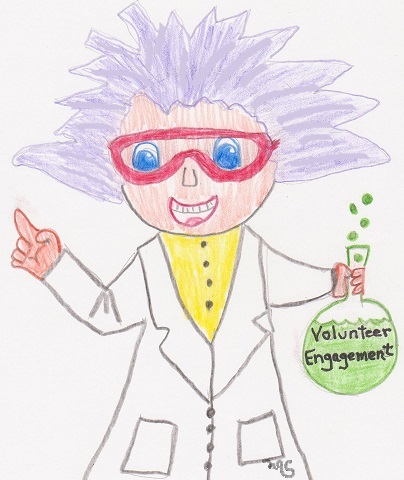
    Lab coat anyone?

    -Meridian


  • The 1pinion Effect

    the-1pinion-effect

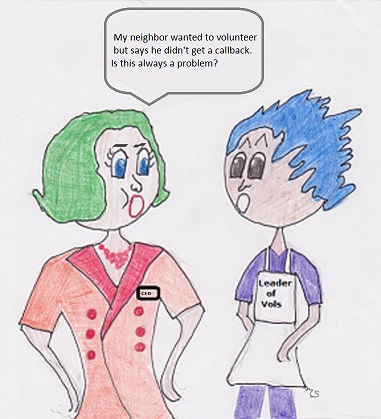
    “Our CEO has a next door neighbor who has a son who got into minor trouble,” Marlee, a volunteer manager says. “The neighbor asked our CEO if his son could do community service at her organization. I called the son repeatedly, left messages, but he never returned my calls. Wouldn’t you know it, my manager told me our CEO was annoyed because the neighbor blames me for not connecting with the son. My manager said our CEO made the comment that volunteers never seem to be able to get started here.” Marlee sighed. “I can’t win.”

    Ehhhhhhhhhh. How can one opinion or circumstance create a belief? Why didn’t the CEO say, to her neighbor, “that’s certainly not typical of OUR volunteer department.” How could she seemingly frame an entire belief on one opinion?

    There is something known as Confirmation Bias, an effect that feeds our assumptions. So maybe, Marlee’s CEO might have simply felt that her neighbor’s son was just one more example of the volunteer department’s failure to properly onboard volunteers because she already believed it to be true.

    Where did this belief come from? Did the CEO hear other examples (and it doesn’t matter how accurate they are, it’s the perception) of volunteers not onboarding quickly while not hearing enough success stories? Or maybe it has nothing to do with Marlee. Perhaps the CEO had a poor experience volunteering when in college. Maybe the CEO heard horror stories at networking events and applied those stories to all volunteer departments.  Is that fair? No, and even worse, perceptions are really hard to change.

    So what should the strong volunteer leader do when hearing these 1pinion comments?

    Don’t get mad or hurt-get curious: What is fueling these opinions? Do some research via surveying the staff or a one on one chat with senior management to find the sources of these perceptions. Say, “I heard something that concerns me. I think there is a perception that I don’t get in touch with new volunteers and I’d like to find out what happened to create that perception.” Then, be prepared to act! Refuting assumptions is one route to take, but there are better ways as in…

    Double down on positive reporting: Counter negative perceptions by offering facts supporting positive volunteer department accomplishments. Review your stats to find areas that are lacking. Create new categories of reporting to freshen up the numbers. But, again, this is somewhat akin to refuting, so there is another thing to try…

    Create your own performance improvement plan: No one wants to be unfairly criticized, so if there is a perception floating around that volunteers are not being contacted in a timely manner, embrace it on your terms. Let go of the frustration at having been unfairly labeled. A self-imposed performance improvement plan accomplishes two really important things.

    One, it says a great deal about you-that you are always willing to improve (and here it’s not about being unfairly labeled, it’s about always striving for excellence).  Say, “If there is a perception that new volunteers are not called back in a timely manner, well it came from somewhere and I’m here to change that. I don’t want one prospective volunteer to slip through the cracks.” This approach shows that you don’t harbor an us (volunteer department) versus them (upper management) attitude, that you are solution-oriented, and that you are proactive and approachable.

    Two, it allows you to create a new narrative by moving forward from this point of misconception.  (It’s so much easier to create new impressions, than fix old ones). By acknowledging the old perception, you are not positioning yourself for a fight. You are forging a new, cooperative path, one in which your future statistics will be embraced in a positive light. And you will find your critics becoming supporters along this journey.

    We are all prone to confirmation bias. As proactive leaders, we must put aside our personal feelings when hearing negative perceptions, and work to change those perceptions by creating new, positive ones.

    Let’s face it. Opinions are not facts. Opinions can be unfair. While we may not be able to control each and every negative opinion, as proactive leaders, we certainly can control what we do about them. And the thing we do best is understand people and their motivations.

    When confronted with 1pinions, we can gear up for a pointless fight or we can use our strengths to create new and more positive realities.

    -Meridian

  • New Words Added to the Volunteer Management Dictionary

    Added to the Volunteer Management Dictionary

    It’s that time of year when the Committee to Define Volunteer Management gets together at a back table in Pete’s Bar, Grill and Bait Shop. Together, these brave members scratch their heads over several pints and attempt to come up with a succinct explanation of volunteer management. This year, they gave up once again after rejecting the phrase “herding cats,” but they decided to add the following words to the dictionary of volunteer management.

    Volvorce: When a volunteer divorces the organization as in “No, I just can’t go get new volunteer Dinesh, because since no one called him back about getting started after I introduced him to finance, he volvorced us.”

    Meetcolepsy: When too many meetings cause you to simply fall into a stupor at the thought of another talk-fest as in “No, I couldn’t make that fourteenth meeting about using the volunteers to stand by the back door in case someone gets confused because I contracted meetcolepsy. Want to see my doctor’s slip?”

    Latespectation: A last-minute request for volunteers that is expected to be filled as if you were given weeks to prepare, as in “Oh, so you need 5 volunteers tomorrow morning for an assignment that you said was extremely important? Your latespectation is showing.”

    Creditjacking: When another staff member takes credit for a successful endeavor that you or your volunteers accomplished as in “Yes, I’m glad you praised that project during the senior managers’ meeting, but let’s not creditjack the volunteers’ work, ok?”

    Duhtistics: Stats that are so incredibly obvious, like volunteers are super nice as in “I won’t bore the board with duhtistics that you’ve heard before. No, instead I want to point out some new and exciting projects we are undertaking.”

    AVOL: A volunteer who inexplicably does not return calls, emails or letters as in “I’m glad you noticed volunteer Myrna has been missing lately. I’m trying everything in my power to get in touch with her. Right now she’s AVOL.”

    Volunteer Lite: A request for a volunteer to do a menial, mindless task as in, “You’re asking me for one of our highly trained volunteers to clean out the storage closet so you can use it for your supplies? You don’t want a full-bodied volunteer, you want a volunteer lite.”

    Miracalls: Calls made to volunteers for an especially challenging or late request as in, “Woah, that’s a really challenging request (or time frame). I’ll be holed up in my office for the rest of the day, making miracalls.”

    Informashunned: (pronounced in-for-may-shunned) Not given the essential information needed to properly place a volunteer as in “I have recruited four of our best volunteers for that assignment, but my pleas for crucial information have been ignored. Right now, our volunteers are informashunned.”

    Nopinion: Volunteers wanted, but not their opinions as in, “I’m glad you were able to use volunteer Mark’s expertise, but he felt rebuffed when he offered additional knowledge. I guess you really want an expert but nopinion volunteer.” 

    Vombie: That volunteer everyone is afraid of and no one wants to council or fire, as in, “I know Janey is a handful and she’s been here for what, twenty years now. I guess she’s been allowed to attain Vombie status and now that I’m here, I will deal with it in a professional manner.”

    Callwaiter: The notion that volunteers sit by the phone just waiting to hear from us as in, “It is Friday afternoon and most of our volunteers have already made plans for tomorrow. I’ll make some miracalls, but our vibrant and diverse volunteers aren’t callwaiters.”

    Marathonitor: The running around, checking, double-checking and rechecking to ensure that volunteers have all the information and tools they need to succeed as in “Our fifteen volunteers are ready for Saturday’s important annual event, but in order for them to excel, I will be marathonitoring their involvement, so I won’t be attending any meetings tomorrow or making miracalls to fill latespectation requests.”

    Well, there you have it. As one of the senior members of the Committee to Define Volunteer Management said after several glasses of Pinot Grigio, “Dang, defining volunteer management is really impifficult.”

    -Meridian

  • The Dangerous Numbers Game

    the-dangerous-numbers-game

    “So, exactly how many volunteers do we have?” The director of planned giving stopped Penny in the hallway. Penny hesitated for a moment and the director sighed. “It’s a simple question,” she said, clearly growing impatient.

    Oh, but is it that simple? What should Penny say? “We have 300 volunteers.” And then the standard question from the director is, “why can’t I get just one when I need one?”

    Most all organizations that utilize volunteers typically report on their numbers. But, what do the numbers mean? Recently, a CivilSociety article by David Ainsworth questioned the validity of reported volunteer numbers. He has a valid point. Do we all report numbers the same way? Or, because we have no reporting template, is there a perception that we don’t really know how many volunteers we have or that we fudge the numbers?

    It can be a source of pride to claim that “we have over 1200 volunteers. “However, when a staff member requests 60 volunteers for the event next week, well, it’s not so easy. But if we think about this in terms of only numbers, then to that requesting staff member, 60 volunteers is not unreasonable. Why? Because the requested 60 is only .05% of the weighty 1200 volunteers on the books.

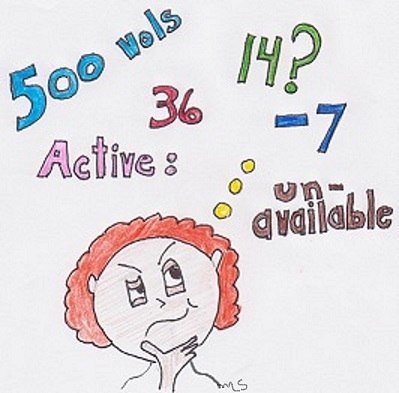
    The pressure to report significant numbers of volunteers often stems from the notion that this important recruitment figure indicates the success of a volunteer manager’s program. But, these figures become a double-edged sword when a percentage of these volunteers are active, but temporarily unavailable. And we all know there are myriads of reasons as to why volunteers are unavailable at any given moment.

    Take this request for a volunteer: Event manager Ethan requests a volunteer for a community fair. Volunteer manager Penny has 300 volunteers on the books. Why is it difficult to obtain just one volunteer for next week?

    Well, because:

    35 volunteers are on vacation (265)

    12 volunteers are virtual and live out-of-state (253)

    30 are having health issues (223)

    43 volunteers work during that time (180)

    17 volunteers are physically unable to help at events (163)

    22 volunteers are in limbo-not returning recent messages (141)

    18 volunteers are part of episodic teams only (123)

    12 new volunteers-have not been mentored yet (111)

    This means Penny is essentially looking for 1 volunteer out of 111, not 1 out of 300. However, Penny will look for that 1 volunteer from the 300 because she is a great manager and knows that volunteer circumstances and willingness change daily. She will email blast, use a phone tree and her social media accounts to reach all 300 of her volunteers in hopes that someone has returned from vacation, or has gotten well. Her chances, though, diminish to 1 out of 111 because 189 volunteers are in essence temporarily unavailable for this particular assignment due to the above circumstances.

    How do we report then? Reporting numbers of volunteers without caveats or categories can create huge headaches or the wrong impression. A blanket number (300) is impressive but misleading. A reduced number (111) is less remarkable but more accurate. When reporting numbers of volunteers, it is advantageous to report in categories. These categories can indicate how many volunteers are currently active or temporarily inactive, how many work with clients, how many work in marketing, or how many are virtual, etc.

    Penny must make it clear that she reaches out to every volunteer for requests. She must say that she is fully aware that the volunteer in the client category may just like to do an event once in a while and vice versa. And most importantly, she must make clear that her job as a volunteer manager is not about one vague number, but about how she cultivates, engages and matches each breathing human being within that vague number.

    Numbers can mislead. If it looks like Penny’s recruited 50 new volunteers this year, then yay, she is doing her job. But if 61 volunteers moved or died or got sick or quit, she is now at -11 and by numbers alone, she appears to be going backwards.

    One proactive idea is for Penny to create a centralized location where departments can see the ranks of her volunteer force. Perhaps she has a shared drive, or a bulletin board or newsletter that she can utilize to inform staff on the changing numbers of volunteers. Utilizing the categories that support her narrative will go a long way to educate everyone on real-time availability of the volunteers. And regularly surveying volunteers on their availability not only helps report accurately, but encourages volunteers to branch out and add other areas in which they will help.

    Heck, maybe even she can include this category:

    Number of on-boarded volunteers with specialized skills who have been introduced to departments, but are still awaiting an assignment from said departments. Now that would be an eye-opener, wouldn’t it?

    Maybe another category could be:

    Volunteers who quit because they were not being properly utilized.

    Or how about this one:

    Volunteers who quit because they were not treated well.

    Perhaps a few of these categories peppered in might begin to light a fire under senior management to demand proper volunteer engagement from all staff, and not just the volunteer department.

    When volunteer managers hesitate at being asked “how many volunteers do you have,” it’s not because they don’t know, it’s because it’s a fluid and ever changing figure. Each volunteer assignment is unique and the numbers of available volunteers are unique to that assignment.

    Reporting in categories can be one method to help paint a clearer picture of how many volunteers are available.

    Today. This hour. This moment.

    -Meridian

  • Huggable Book of Volunteering Stats or Why a Kiddie Pool Can’t Explain the Ocean

    kiddie pool

    “Stats, reports, time management sheets, I’m sick of all of them,” Clara lamented. “None of these truly depicts my day. When I include activities for volunteer retention on my day book, the entries look so superfluous. Unless I write paragraphs as to why spending time with a volunteer is necessary to retain them, it just sounds like I’m having a coffee break all day.” Clara laughs, “sometimes I think I’m just viewed as a caffeine junkie.”

    Yes, stats,  the way we justify our actions. If you, like I, have struggled with showcasing the complex work involved with attaining, training and retaining volunteers, you feel Clara’s pain. Volunteer managers everywhere keep stats on all sorts of activities-impact, volunteer retention, volunteers trained, return on investment (ROI), clients served, events staffed, recruitment efforts, etc. We include anecdotal stories, quotes, pictures and anything else to illustrate the impact of our volunteers on organizational missions and the efforts required to support that work. (Sometimes it feels like bringing a kiddie pool filled with water to describe the ocean.)

    In a recurring fantasy, my Day book  is covered with glittery gold stars and smiley faces and called, “The Doing the Right Thing Day Book.” It is frayed and loved and cherished by the CEO because she believes in doing the right thing above immediate numbers and simplistic reports . Of course in this fantasy I’m also 30 years younger and I actually know how to catch a Pikachu, but I’m off topic here.

    So what if we could report stats that revolved around doing the right thing, even if that meant traditional reporting occasionally fell short? How would that huggable soft leather day keeper look? (Sorry, in my fantasy, the day book is paper based, ’cause you can’t hug excel)

    Here is an excerpt from Week 26 in the “Do the Right Thing” Day book:

    DAY 1 at 9AM:     Trusted my instincts to spend extra time with a 5 year volunteer whose partner has just been diagnosed with cancer. I can see he needs to take some time off and I have placed him on the inactive list thus reducing the number of active volunteers. He may or may not resume volunteering, but, due to his positive experiences volunteering so far, will remain a friend to our organization forever. I will be spending some time to check in on him periodically because I truly hope he returns to volunteering, but also, because I care about him as a person.

    Day 2 at 2PM:  Realized that a situation requiring a volunteer was overwhelming for just one volunteer so took the extra time (three days) to find and enlist the right two volunteers who could support one another while dealing with a very difficult and challenging assignment. Did not meet goal of finding a volunteer in 24 hours, but instead, created a workable solution that avoided one of our excellent volunteers becoming embroiled in a difficult situation, thus retaining two good volunteers for the future and ensuring our client received excellent care.

    Day 3 at 11AM: Temporarily removed a marketing volunteer from staffing events because of recent health challenges. Although volunteer insists that he is physically able to carry boxes, his wife informed me that his doctor has prescribed no lifting or standing for three months. As a result, I reduced the number of available marketing volunteers but salvaged this volunteer’s future potential and eliminated the substantial risk for a workman’s comp situation should this volunteer injure himself while under his doctor’s orders. More importantly, we sent a message to all volunteers that their health and well-being is important to us and we view them as valuable assets. 

    Day 4 at 3:15pm: Spent 45 minutes with a prospective volunteer who admittedly can’t volunteer until sometime next year. This prospective volunteer’s father was helped by our organization and she is interested in giving back, although current commitments are preventing her from taking training. I have set reminders in my calendar for scheduled contact with her throughout the year as I perceived her as an excellent future volunteer. Rushing her at this time will only increase her overload of responsibilities and will cause her to quickly quit. As a result, no new volunteer stat has increased but time spent will pay off in future because this potential volunteer also belongs to several key civic groups that I have been recruiting.

    Day 5 at 6pmAttended funeral of long-term volunteer who retired due to health reasons more than two years ago. No stat will be affected, but please folks, this is the right thing to do.

    When you think about it, this fantasy Day Book is really a book about trust-trust that volunteer managers everywhere know how to spend their time wisely. VM’s know what to do and how to do it in order to ensure a volunteer program built on excellence, not just for the present, but for the future as well.

    If Executive Directors and CEO’s would just trust their volunteer managers to do the right thing, then stats will fluctuate at times, but will also naturally increase due to the good and hard work put into a volunteer program.

    It’s a huggable fantasy, isn’t it?

    -Meridian


  • Half a Cup of Meaningful Sugar Please

    book cover


    Measuring the Impact of Volunteers

    Roger nervously waited his turn. “This time I hope I can get their attention,” he told himself. As the CEO called him forward for his ten minute report slot, Roger knew from experience that he had exactly one minute to engage his audience. Staff wasn’t interested in seven new volunteers. They smiled politely at his “Sally filled in an extra hour at her job” stories. After about one minute, he observed, they would begin to check their phones while he reported hours volunteered, money and salaries equated and clients served.
    So this day, Roger stepped to the podium and began to report on a new project the volunteers had initiated. He spoke passionately of the impetus for the idea, the endless committee meetings and the hard work of the involved volunteers. As his enthusiasm grew, he looked around. Some of the staff had pulled out their phones. Some were starting to chat with others around them. The CEO’s executive assistant smiled encouragingly at him but the CEO was checking his watch. Deflated, Roger quickly gave his report on hours and statistics. He sat down as the meeting came to an end. “What is it going to take?” he mumbled.

    Statistics regarding volunteer involvement is an area that is challenging for most volunteer departments. What are we asked to report? Do those statistics tell the whole story? Are the statistics meaningful and support the mission? Do they show that volunteers are an integral part of services provided?

    We can pepper volunteer stories and examples into our reports, but if these examples exist only as a sugary “awwwww” moment, then they, too can be meaningless.

    A new book from Energize entitled, “Measuring the Impact of Volunteers” tackles this important subject. The innovative Volunteer Resources Balanced Scorecard introduced in this well researched book is a tool in which to not only create meaningful reporting, but to also create and evaluate volunteer involvement.

    If only we, volunteer managers know the excellent and mission supporting work volunteers do every day, then just as we tell our volunteers when emphasizing the importance of turning in their reports, “if it’s not reported correctly, it didn’t happen.”

    I highly recommend this book as an introduction to professionally reporting volunteer involvement as more than just volunteer hours and money supposedly saved. Let’s elevate the way our volunteers are viewed from sugary cute add ons to mission supporting crucial members of our organization’s teams.

    For us, it’s mission critical.
    -Meridian