Tag: charities

  • Let’s Leave Volunteer Management in Better Shape Than We Found It

    word-cloud-final-session.jpg
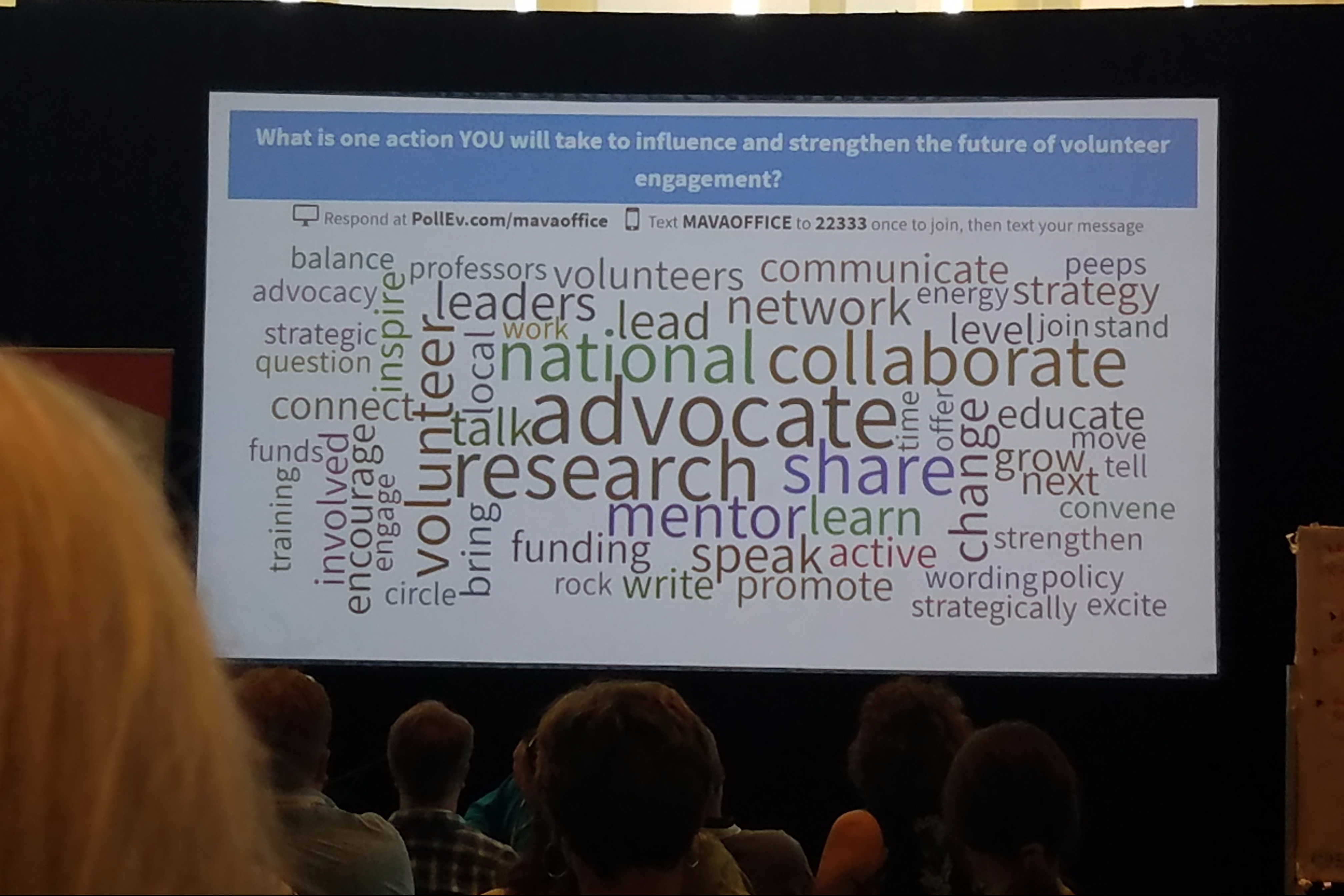
    Action words to strengthen the future of volunteer management

    For three days, leaders of volunteers came together at The 2017 National Summit on Volunteer Engagement Leadership to collectively share and brainstorm the future. This summit actually extends far beyond “national” as we were joined by leaders from other countries such as Rob Jackson from the UK.

    This energy of collective purpose is akin to swigging a chilled bottle of sports drink after a long grueling run through the blistering desert. Sometimes we can feel isolated. Often we may feel that progress is slow. Many times we feel as though we make no perceptible difference in the scheme of things.

    But, each one of us makes an impression on our surroundings. Each one of us creates ripples that travel in circles radiating outwards. Each of us eventually leaves our profession behind. How will we leave it?

    Recently I said this in a post: “What we say and how we treat our volunteers, no matter how brief our encounter, has a lasting effect on them and ultimately on us.”

    But wait. I think those of us who engage volunteers can take this one step further.

    Just as we impact each volunteer we encounter, we also leave a lasting effect on our profession.

    What might that effect be? Do we owe it to each other and future leaders of volunteers to leave the profession in better shape than we found it? Do we owe it to our volunteers?

    Even if the title “manager of volunteers” is temporary, or a stepping stone, or a detour in a career, there is an entire network of individuals working diligently to elevate this profession. So what can each of us do?

    • Don’t remain isolated. Join a peer group in town, find leaders online to connect with, web groups to join etc.
    • Advocate professionally. Use your voice to advocate for resources and the tools you require.
    • Share your impressions and experiences. Blog, comment on posts, add your expertise to articles on non-profits. If you read a post on non-profits that blatantly ignores volunteer engagement, point that out in the comment section.
    • Use your influence. When you do leave, remember your time as a leader of volunteers and use your influence to advocate for this profession.


    Your professional essence is left behind as you move on, retire, or seek other opportunities. How you treat this “job” goes far beyond your own perceptions and needs at the time. And while it might seem so, we are not working in silos.

    If each one of us leaves volunteer management in better shape than we found it, imagine the future of volunteer engagement.

    -Meridian


  • The Volunteer Whisperer


    The Volunteer Whisperer

    Ahhhh Nicknames! Those memorable, defining little monikers that people give others. Do you have one at work? If you don’t, what would you imagine yours to be?

    Here’s a creepy thought. Are there mean kids in your organization? Behind their creaky passive-aggressive doors, are they hunched over their cauldrons of electronic devices, cackling cruel names as they toss the hair strands plucked from sweet volunteers into the pot? Do they call you something unnatural behind your back?  Think:

    Sir Plays All Day as in “Sir Plays All Day just got his shipment of Astrobright colored copy paper. Must be nice.”

    Tea Party Tess as in “Wouldn’t it be great to plan tea parties for a living like that Tea Party Tess? I mean, do volunteers even need a tea party? Volunteering in my department is reward enough.”

    Fluffy McFlufferson as in “Oh, look balloons in the lobby that say thank you volunteers. Fluffy McFlufferson is at it again.”

    Invisible Inez as in “This volunteer isn’t working fast enough. Who’s in charge of them anyway?”

    The Geriatric Guider as in “Think I’ll come back here and volunteer when I retire. Ha, then maybe I could be the Geriatric Guider. It would be so much easier than my job.”

    The Cat Shepherd as in “That event is Sunday and I have to deal with all those volunteers. Make sure the Cat Shepherd has to be there too.”

    Trivial Ted as in “I’m too busy. Who can we get to move that desk? I know, Trivial Ted!”

    But wait. Nicknames can give us power, almost like donning a suit of armor-think of these famous nicknames and how it must have felt to put on these names when confronting the world:

    The Great One-Wayne Gretzky-arguably the greatest hockey player ever.

    The Queen of Soul-Aretha Franklin-anytime you’re dubbed queen, you’ve done something remarkable.

    Ol’ Blue Eyes-Frank Sinatra-the definition of cool.

    Fab Four-the Beatles-simple, yet fabulous.

    The Land Down Under-Australia-who wouldn’t want to visit a land with a name like that?

    So, before you are handed one, choose your own nickname, one that acts as a buffer against misconceptions. Then gather your volunteers and cleverly ask them to begin to refer to you as your chosen nickname.

    By cleverly, I mean, announce in the next volunteer meeting, that from now on, you will not be answering any questions on where the flipping copier is located, listening to any stories about prodigy grandchildren or clicking on any emails about dogs opening refrigerator doors from anyone who does not refer to you as:

    The Goddess of Goodness

    The Adorable Accomplisher

    Ned Stark Raving Awesome

    He Who Must Not Be Blamed

    Git Er Done Gabe

    Han So-lo Down Amazing

    Katniss Cleverdeen

    Lord of the Volunteer Things

    You Can Call Me Queen B: Why? Because I Will Be Your Ruler (eh, maybe that’s too long)

    Ok, perhaps we’ll never be called “The Greatest” like Mohammed Ali. Maybe they’ll just continue to call us by our given names.

    Maybe. But, when the lights are low and the family is all gently snoring and I’m tucked in under my Minions comforter, that’s when I’ll turn on my little book light and refer to myself as “Fifty Shades of Great.”

    -Meridian

    Hope to see you at the National Summit On Volunteer Engagement Leadership in St. Paul next week!


  • You Are That Person

    WordItOut-word-cloud-2261827


    “It’s one of those universal truths,” Desmond sighed. “I can tell my children how brilliant and wonderful they are, but it never really sinks in until one of their teachers or coaches say it.”

    It’s kinda true. When a relative says you’re great, well, they’re a relative, right? They have to say it, sorta like they have to show up at your graduation and yawn through the speeches while you endure all the cheek pinching.

    But when a non-related member of society says you’re great, like a teacher or coach or crabby neighbor, then those praises really mean something. That one person who looks you in the eye at a particular moment and tells you that you have worth can change an entire lifetime of self doubt. That person might be the violin teacher, or physical therapist or volunteer or……. volunteer manager.

    Every day, volunteer managers are changing the perspective of people who volunteer. Every day, we look at the value of the human being in front of us and encourage the qualities and talents we observe. It’s our jobs, but it’s so much more because oftentimes you have no idea that you have changed someone’s perspective. Oh, you might have an inkling now and then. You may be honestly praising someone when you see a spark, and as your words of encouragement travel deep into that volunteer’s soul, you see the clouds of self-doubt part for an instant. Yeah, it’s that moment that you cherish.

    What we say and how we treat our volunteers, no matter how brief our encounter, has a lasting effect on them and ultimately on us. (We get to fill up our knapsack of positive energy by the cultivation of others)

    Every day, a volunteer manager tells or shows:

    • A struggling student that they are smart and capable.
    • A shy introvert that we hear them and their opinions are valid.
    • A stressed out parent that they’ve done a good job because their child is a pleasure to work with.
    • A person feeling worthless that clients adore them.
    • A hesitant comic that their joy is infectious.
    • A disheartened creative type that their ideas are inspired.
    • A mother who wonders whether she’s more than a bottle washer that she is brilliant.
    • A broken-heart that love is all around.
    • A grieving soul that they are surrounded by gentleness.
    • A beaten down worker that their contributions are valuable.
    • A lonely person that they are not alone.
    • A rejected artist that their creations are appreciated.
    • A dispirited job seeker that their skills are needed.
    • A lost person that they don’t have to walk alone.

    Volunteer managers are individuals who can and will literally change another person’s perspective. How amazing is that?

    So, just remember, especially when you look at your hectic day and wonder what it all means and what you have accomplished…

    …  you are that person.

    -Meridian


  • Captains of Our Destiny: Strategic Key Volunteer Account Management

    Captains of Our Destiny Strategic Key Volunteer Account Management

    So, here’s the question: If we identify key volunteer accounts, how will this help us in the management of all volunteers and correct the misconception that we herd cats?

    By reclassifying our work in terms of strategically managing volunteer accounts and key volunteer accounts, we will:

    • explain in recognized professional terms the vast work involved in cultivating and engaging volunteers
    • begin to prioritize our time in order to do the “key duties” such as recruiting, creating volunteer programs, relationship marketing, retention implementation, in-depth training and staff education
    • illustrate that focusing on key duties produces sustainable volunteer participation
    • more successfully require that all staff learn to manage volunteers, especially one time and episodic volunteers, therefore freeing us up to do the key duties
    • show potential volunteers that becoming key volunteers carries tremendous perks
    • free up the time necessary to educate ourselves, create programs and contribute in a more productive way
    • be able to demonstrate that not all volunteers produce the same results and that key volunteer account management creates key volunteers who will not only do the bulk of the work, but will also contribute in multiple other ways such as increased donations, resource allocating, community awareness, marketing, planning, trend setting, awards won, social media championing, recruiting, and program development
    • show that key volunteers will lighten staff workloads and free staff to work smarter
    • strategize the future instead of “handling” the present


    As we move from herding cats to a more modern and professional structure, what are some differences between outdated volunteer management and the new strategic volunteer account and key volunteer account management?


    Outdated Volunteer Management Strategic Volunteer Account Management Strategic Key Volunteer Account Management
    Vols fill jobs defined by org Steps to assure vol role is successful Partner with key vols to assure mutual org growth
    Retention by yearly luncheon, hours reported Vol contributions highlighted with real stats Key vols contribute to implementing programs of worth
    Vols view volunteering as “I get more than I give” and that’s enough Vols are integrated as essential members of team Key vols are integrated as shaping future of org
    All vols are just here to do org bidding Vol roles are created to meet changing needs of volunteers Key vols help shape the roles they wish to play
    Vols should be grateful to be volunteering Orgs should show gratitude to vols for volunteering Orgs value key vol input, skills and ideas in a win-win situation
    Fear that vols may “take over” or do something to harm org


    Allow vols to accompany staff on important assignments Trusting key vols to utilize their proven skills and desire to further org mission

    In order to be classified as a “key volunteer,” we most likely will be choosing those volunteers who are already known and trusted by fellow staff. This trust in a proven volunteer is the example you already possess to showcase the benefit for key volunteer designation.

    In many ways, there is an iron grip of thought relating to volunteers and volunteer management. Words and terms mean something and by referring to our work in professional, respected terms, we will begin to show the in-depth work and skill necessary to create a sustainable volunteer program. We will also begin to illustrate that freeing us from herding cats to concentrate on key duties will produce a stronger, better volunteer program. (everyone in the organization is responsible for engaging and managing volunteers-the volunteer manager does not have time to run around putting out fires)

    Let’s not be left behind in modernizing our profession. We are the Captains of our destinies.

    -Meridian


  • Captains of Our Destiny: The Key Volunteer Account Manager

    Captains of Our Destiny The Key Volunteer Account Manager

    As Captains of our destinies, we looked at some of the terms that define our work as Volunteer Account Managers. Now, let’s look at the responsibilities of the account manager and redefine them to fit our profession:

    Volunteer account manager responsibilities:

    • Serve as the point of contact for all volunteer account management matters.
    • Build and maintain strong, long-lasting volunteer relationships.
    • Develop opportunities and programs for volunteer engagement.
    • Mediate volunteer challenges.
    • Communicate the mission and policies of the organization to all volunteers and prospective volunteers.
    • Recruit new volunteers, volunteer groups and develop relationships with all volunteers through education, feedback, and progressive opportunities.
    • Forecast and track account metrics through volunteer feedback, community involvement, bench marking, research and continual participation in conferences and symposiums relevant to subject.
    • Prepare reports on volunteer contributions and trends.
    • Advocate for system changes when necessary.

    Interpersonal skill set of the Volunteer Account Manager: (partial list)

    • Solution oriented
    • Communicates clearly
    • Innovative
    • Professionalism
    • Mediation skills
    • Detail oriented
    • Relationship marketer
    • Ability to research, monitor and predict trends

    We can still go one step further and look at how organizations and businesses divide up the management of accounts. Does one person manage all accounts? Are some accounts afforded more attention than others?

    In account management, the key account has emerged and with it, the key account manager. So if we are volunteer account managers,  what would be a key volunteer account?

    Redefining a key account in terms of a volunteer key account yields: A key volunteer account is the volunteer or volunteer group who volunteers substantially in a sustainable manner and/or contributes greatly to organizational success. 

    This begs the question: Do we have key volunteer accounts?

    Do we spread ourselves too thin when we spend our time in a non-strategic soup? Do we run around, putting out fires, jumping from one scenario to the next trying to make sure each and every second of volunteer time is perfect? Are we really just herding cats?

    Can we maximize our time by identifying and explaining the steps necessary to cultivate key volunteer accounts?

    What are a few categories that might catapult a volunteer or volunteer group into key volunteer status?

    • dedicated on-going scheduled work that is vital to operations.
    • years of service and hours given.
    • the successful recruiting of additional volunteers and/or a community engagement champion.
    • leadership skills and/or the assumption of a leadership role.
    • dependability and the willingness to step up when needed.
    • highly trained or skilled in the mission and the ability to handle challenges.

    We all have these volunteers. They are what we wish every volunteer could be. If we apply the Pareto principle (80% of the output comes from 20% of the input), then approximately 20% of our volunteers are producing 80% of the vital work. Is this true? And what about new volunteer potential? Should we not spend our time in the soup, cultivating everyone in case we might lose that potentially great volunteer? Should we just herd cats in hopes that a few of those cats turn out to be key volunteer cats or should we begin to think in terms of key accounts and key strategies?

    Next time: How can strategic key volunteer account management help us manage all volunteers?

    -Meridian


  • Captains of Our Destiny: Captain Obvious Part 2

    Captains of Our Destiny

    Ha, ha, working with volunteers is like herding cats. …non-profit staff member.

    It is time we become captains of our own destiny. It is true that our work is not glaringly evident to all, so we can’t be Captain Obvious.

    So, now what? We can captain our future and redefine our work in terms that befit its importance while illuminating our professional skill set. It’s on us to redefine volunteer services, to flip it from one of cutesy, fluffy extra touches to a dynamic and professional service.

    How? Well, first off, we have to change the loose descriptions of volunteer engagement and instead use the professional terms they deserve. To do this, let’s look at two highly regarded and compensated jobs and re-imagine our profession in those terms and descriptions.

    Instead of volunteer managers, what if we were called Volunteer Account Managers? In reality, volunteers open accounts with us, in the same way as donors or clients. (an account is something of value or worth-in this case a volunteer’s time, expertise, resources, knowledge, sweat equity, donations, word of mouth marketing, etc)

    As such, we would use these terms:

    Volunteer Account Management: the management of volunteer accounts, including the relationship with volunteers and the pursuit of volunteer satisfaction.

    Volunteer expectations: the value a volunteer seeks from our organizations, such as training opportunities, positive feedback, admittance to the team, creative outlets etc.

    Volunteer centric: the emphasis an organization places on volunteer involvement, including timely appreciation, seats at planning meetings, designated volunteer managers who are supported, educational opportunities, partnership opportunities.

    Volunteer journey: the steps a volunteer goes through to become a viable and satisfied member of the organization.

    Volunteer journey mapping: the process by which a volunteer manager maps the journey a volunteer takes from first contact to integration through onboarding-and more importantly, the ability to reconfigure the steps when necessary.

    Volunteer profile: the ongoing process by which a volunteer manager educates staff about volunteers, including their needs, their changing dynamics, their skill levels, their rate of participation and their future involvement.

    Volunteer satisfaction levels: measuring and reporting the satisfaction levels of volunteers through one on one interviews, surveys, questionnaires, etc. And more importantly, the ability to change areas in which volunteers lack satisfaction.

    Volunteer benchmarking: the continual process of improving the relationship with volunteers. There are many methods of benchmarking, such as:

    • do volunteers choose our organization over others and why or why not?
    • do volunteers make time for us over other activities and why or why not?
    • do volunteers recommend our organization to their circle of influence and why or why not?
    • do volunteers increase visibility, donations and resources and how? (we all know instinctively that this is true, but benchmarking will prove it)

    Volunteer benchmarking will then be a tool to change the processes that need change, in the same way fundraising evolves.

    In order to Captain our own destiny, we must begin to flip volunteer services from the outdated idea that volunteers are summoned to fill a job and volunteer coordinators “herd those funny cats around, lol, isn’t that cute.”

    Instead:  Volunteers hold an account with us and we are responsible for cultivating that account by continually improving our relationship with the volunteers. And this is where the highly skilled volunteer account manager comes in.

    Next week: KAVM-the key account volunteer manager-what does this mean for us?

    -Meridian

  • Not So Fast, Captain Obvious

    Not So Fast Captain Obvious

    Suki is an events coordinator and part-time volunteer manager.

    She says, “I work hard, oftentimes 50 to 60 hours a week. I treat the volunteers as essential team members and make sure they are respected. I have a better than average return rate as my volunteers come back time and time again to help with events.

    My supervisor, Ellen just conducted my yearly review. One of my areas to work on was follow-up. I was shocked. I follow-up with each and every volunteer. I follow-up with vendors, locations, donors and staff. I asked her where that “needs improvement” came from and when pressed, she said it was because one of our managers overheard a group of volunteers mention that they weren’t sure which assignments they had at an event last year.  I told Ellen that the banquet manager had changed a few things last-minute and that I was sorting it out at the time of the comment. I mean, seriously, I would think all of my other hard work should stand for itself.”

    Sadly, Suki, no it does not. And here’s the lesson. What we think should be obvious to everyone never really is.  We work hard to engage and cultivate volunteers. Isn’t that evident? Ehhh, maybe not. Let’s compare a couple of scenarios and see if they are obvious to everyone.

    • An excellent volunteer is not sure if he wants to continue. He comes in to see you and you get coffee or tea for both of you. (a sign that he is worthy of your undivided attention). You sit at a table and listen to all his concerns. You take the time to explore what is going on in his life. You laugh, you listen, you probe, you assure him and with some tweaking of schedules or duties, you retain him. Obvious, right? But what does this actually look like?

    To you: One hour spent upfront retaining an essential volunteer = hundreds of hours of quality work from that volunteer.

    To observer: The volunteer manager has time to sit around and have coffee for an hour with a volunteer that really doesn’t need managing because they are already a great volunteer. Why can’t I get a volunteer when I need one?

    • One of your volunteers invites you to her daughter’s college soccer game. You go because you are going to meet the coach who is interested in having the entire team participate in volunteer activities.

    To you: This is a chance to recruit a group of volunteers. It’s an opportunity to set up a program that could last year after year. It also could be an in to an entire college system with access to other teams, clubs, classes etc. It’s a huge opportunity.

    To observer: The volunteer manager hangs out with her volunteers. She’s been seen going to birthday celebrations, picnics and now team sports. She runs the volunteer department like a sorority. We need volunteers who come to work, not to socialize.

    So, what do we do if our hard work is not self-explanatory? We must advocate for ourselves and our profession. We must become better at explaining the cultivation of volunteers. Whether we use algorithms or stories or a daily work flow, we need to be able to translate our work into concrete facts.

    How do we do that? Well, we can try:

    Create signs for your office door or cubicle that read “Volunteer Interview in Progress” or “Volunteer Engagement in Progress” or “Volunteer Feedback in Progress.” Put them on your door when sitting with any volunteer for a session.

    Develop a chart to track the hours needed to engage volunteers for maximum output. Does it take four or twelve or twenty hours spent one on one with a volunteer to produce two hundred volunteer hours a year? (approximately 4 hours per week) How many volunteers do you manage? Add all those engagement hours to show how much one on one time it takes to retain valuable volunteers.

    Begin to label your work. Instead of using terms such as “spent time with” or “sat down with” label the time spent with volunteers as retention, development, engagement, targeted recruiting, gathering feedback, role definitions, corrective action etc. Creating an understanding of the nuances of our work as essential building blocks is crucial. Our time spent with volunteers is necessary to volunteer development and it’s time we referred to this work in professional terms.

    While we are obviously super nice to our volunteers, we are nice with a purpose. Our profession must redefine our work to elevate it in terms of professional development. Calling the “spending of time” with a volunteer “targeted recruitment” does not change our methods, only the misconception of our work.

    And why should we frame everything we do in professionalism? So it does become obvious.

    -Meridian


  • Volunteer Fresh


    Volunteer Fresh

    Every day, volunteer managers witness the passion brought by volunteers. We marvel at their skill. We see their pure work, unencumbered by thoughts of pay, or chains to the financial burden of staying somewhere not fulfilling.

    But there is another positive that we can attribute to our volunteers. The number of hours they volunteer a week or month is often misconstrued as a shortcoming, but in reality is a gift: Volunteers are not burdened by the stress of working for us full-time.

    Volunteers who show up once a week or month are like opening the window to let in the breeze. They come in, trailing currents of fresh air. They bring with them new experiences, a taste of outside ideas, and rejuvenated enthusiasm to our stale environment.

    What factors contribute to a stale environment? Compassion fatigue, burnout, overwork, repetition, familiarity, slow to change movement, it’s always been done thus mentality, funding worries and stress. Each of these freshness killers lurks in the halls of non-profits, waiting to blow their stale breath into our lungs.

    There is an under current of pressure on non-profit workers to be “on” at all times. This Pedestal of Perpetual Caring implies that every moment is as intensely compassionate as the first one. Who can live up to that standard when reports are due, projects need attention and budgets are withering?

    Enter Volunteer Fresh:

    Our volunteers, unburdened by the stresses of working with us full-time can and do exhibit the intense compassion every client needs.

    Our volunteers are out there in the world 98% of the time and bring with them outside opinions, trends, ideas and methods.

    Our volunteers bring infectious enthusiasm and continually remind us why we love our work. They plug us back into our missions.

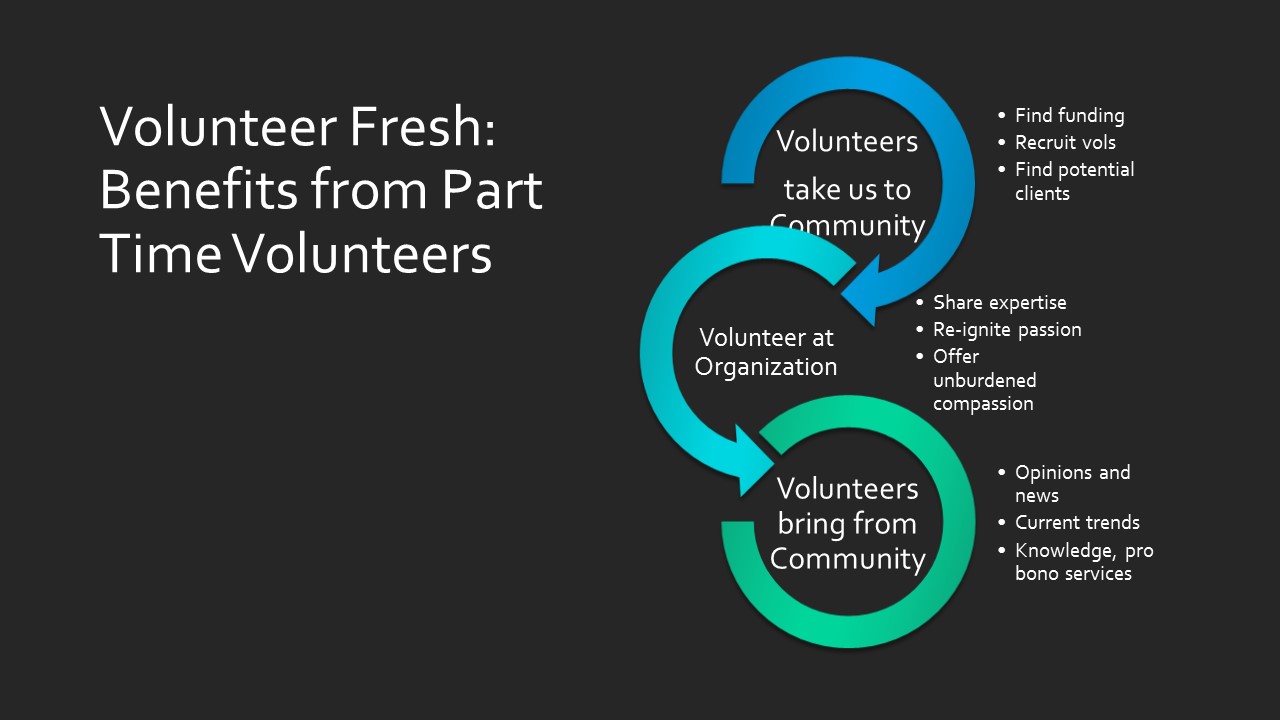
    Marketing Volunteer Fresh: (or, at your next staff meeting, use gimmicky but visual aids to encourage your organization to embrace volunteers as more than just those people who fill preconceived slots)

    Bring a sandwich from a vending machine along with a fresh sandwich from wherever staff loves to eat. Use each ingredient of the fresh sandwich to explain the layers of volunteer fresh and compare the two.

    Videotape volunteers speaking from the heart. Show staff the infectious enthusiasm volunteers bring. Remind them that opening up to each volunteer re-ignites their own passion.

    Use a radiating circle of connections chart to show the connections our volunteers are making within the community. Use arrows in both directions to illustrate the wide swath of information and influence our volunteers create, both coming and going.

    volunteer fresh pp


    Here are some concrete ways to offer Volunteer Fresh:

    Schedule “sit downs” between community engagement officers and volunteers. The engagement officer can ask volunteers to take the pulse of the community by asking pertinent questions of their friends, neighbors, civic groups, church members etc and then report back.

    Create a campaign via WOMM (word of mouth marketing). Marketing can release a sub-campaign via volunteers to reach out into the community on a specific hot topic. Equip volunteers with flyers, business cards, etc. to launch campaign and monitor feedback.

    Engage volunteers in stress relief. Create a team of volunteers to develop a stress relief program for staff and other volunteers. This volunteer team can institute ways to help over burdened staff cope with burnout.

    Volunteers are a gift of freshness. How fortunate we are to be able to incorporate fresh ideas, enthusiasm, and passion into our culture by people who offer all of this for free.

    Let’s encourage our organizations to open the window and let the freshness in.

    -Meridian

  • Sometimes, There Is No Parade

    Sometimes, There is No Parade
    Awww, you shouldn’t have.


    Not everything volunteer managers do will be visible. Rather, in reality, most of our meaningful work is not about measurable numbers or stats. For this out of view work, there will be no awards, no pay raises and no parades. Yet, when recalling the moments that matter, these are the ones that usually spring into our minds.

    Helga was a volunteer who came to America after WWII. She married an American soldier, left her home in Germany to forge a new life in a new country with her new husband. Helga still retained her German accent. She was a tiny woman with a smile that reached up to her eyes, even after her beloved husband had died. I asked her to take a shift on the reception desk.

    We were in the process of initiating fingerprinting (Level 2) for our volunteers. It is a cumbersome and tedious process and the digital prints are hard to capture. Until this point, I submitted background checks (Level 1), read each report and challenged every anomaly I found. With Level 2, a central system approved or disapproved our volunteers, taking it out of my hands.

    We slowly filtered all of our volunteers, new and existing through the fingerprinting process. And, Helga was rejected. The rationale was that fingerprinting picks up “things” that a level 1 does not. I had to call Helga and tell her. I remember calling her and asking her to come in and talk to me. She knew immediately that it had to do with her fingerprints. She started to cry.

    We made an appointment for the next day. I hung up and felt…….. enraged. I wanted to know why this beautiful lady was being rejected, so I found an empty office and began to call the reporting agency, bouncing from person to person. It took the afternoon to get through to someone who could spend a minute to help me. She put me on hold, then came back on the line. “What’s her social security number again?” she asked. I told her. After another long hold, she came back. “Well, it seems it was a computer error. Your person has a clean record.”

    I called to tell Helga the good news, but something told me to keep our appointment. She did not answer so I left the message to please come in so I could explain in person what had happened.

    Helga came in the next day. I found a secluded spot to talk with her. We sat, knees to knees and I explained to her that it was a computer glitch. She burst into tears, crying deep and long as though a dam had given way. I hugged her. “Are you sure it was a mistake?” She asked.

    I wondered if this was about something other than her volunteering. “It was just a mistake, Helga. Do you trust me?” I said. “I would not lie to you.”

    She nodded and dabbed at her eyes. “I thought you might,” she said, “think I was a Nazi.”

    Suddenly, the present fell away.  I could see her, a young hopeful bride after the war was over, arriving in her new home. I could feel her trying to ignore the suspicions while desperately proving she was a good person. I could imagine that the past did not lie buried.

    We cried together for a good, long time. I called her the next day. “Helga, do you still believe me? Do you really, honestly know how much we love you?” At that point, I did not care how much time I had to spend convincing her.

    “Yes,” she said in a clear voice that removed my doubt. We did not speak of it again.

    That day I learned, for most of the time we spend doing our work, there will be no parade.

    But, my heart does not really want parades. It wants to hug Helga.

    -Meridian

  • Interview With a Volunteer: Ellie Part 2

    contacts

    Part two of an interview with Ellie, a volunteer for 18 years with a hospice.

    VPT: Let’s look at things in retrospect now. What advice do you have for volunteer managers? How can we keep someone like you?

    E: I’d say that having someone a volunteer can count on is important.

    VPT: In what way?

    E: It’s trust. I trusted my supervisor and he trusted me.

    VPT: You moved away. But you stopped volunteering before you moved. Was it because you were contemplating the move?

    E: (pauses) No.

    VPT: What was it then?

    E: Things were changing.

    VPT: In what way?

    E: Well, my supervisor was taking on more and more work. I began to realize that when I needed support or a chance to talk, I may go to his office and he would not be available or at another location.

    VPT: That support was important.

    E: Well, yes, because I wanted to make sure that I was doing the right thing. I did not want to do anything wrong.

    VPT: And so, you saw change happening.

    E: Yes.

    VPT: Ok, I am asking you to be honest here. As volunteer managers, we’ve all done this. We sometimes share our frustrations at the amount of extra work with our volunteers, although we don’t mean to do that. Did your supervisor start sharing his frustrations with you?

    E: No, not at all. See, the type of relationship I had with my volunteer supervisor was so successful. He didn’t have to say a word to me. I instinctively knew that he was overburdened all on my own.

    VPT: Do you think it is harder for new volunteers if they don’t forge that deep relationship with their volunteer manager?

    E: I don’t know because I can’t compare it to anything I experienced. I would ask though, are volunteers getting what they need? I know I had it pretty good, and by the same token, I wonder if volunteers who don’t receive the same vote of confidence will stay.

    VPT: So when did you decide to stop volunteering?

    E: I had this patient, Joy, the sweetest lady you’d ever meet. I would go to her house and take her to do her shopping. We had so much fun together, But one day, I went to her house. I was tired, out of sorts I guess and I felt a bit like I didn’t want to go to the store. Joy said to me, Are you all right? Have I done anything to upset you? Well, I assured Joy that she could never upset me and I apologized over and over. I thought long and hard about that moment.

    VPT: And that had something to do with your leaving?

    E: I knew then, that I was done. How? It was my attitude and reactions that told me. I knew that it was time. I had nothing more to give. And if I can’t give 100%, then I’m not doing any good for the people I’m supposed to be helping.

    VPT: How did that make you feel?

    E: (sighs) It made me sad, because it had been such a good ride.

    VPT: Eighteen years. That’s a long time. Did you feel any guilt over leaving?

    E:  No, no guilt because I gave my all while I was there. It was just time.

    VPT: How do you look back on it, now?

    E: I wouldn’t trade it for the world. It was enlightening, rewarding, and was almost like a second carer.

    VPT: What advice would you give to volunteers?

    E: You get out what you put in. And, it is crucial to ask if you have questions and to share problems and experiences with your supervisor.

    VPT: Any advice for volunteer managers?

    E: Yes. Supervisors need to know that volunteers go through what I went through. They need to realize and look for signs that volunteers are going through a period of ineffectiveness and they need to address that. Nurture the volunteers you have.

    VPT: Would you go back now that you’ve had some time off?

    E: No. That is in the past now.

    VPT: Thank you Ellie, for your honesty, your insights and your incredible volunteering.

    E: My pleasure.

    -Meridian