Tag: executive director

  • Volunteer Managers Are Better Than These 3 Phrases

    Volunteer Managers Are Better Than These 3 Phrases

    sticky note with apology
    Photo by Suzy Hazelwood on Pexels.com

    Words are pictures formed in the mind. The art of communication is drawing those word pictures so the other person sees things our way.

    If we, volunteer managers want to change the perceptions of us, our work and our volunteers, we need to eliminate words and phrases that negatively picture us. We need to adopt communication that rewires the way people perceive us and our work.

    Consider this conversation:

    • Senior manager: “Where are you on getting those volunteers for tomorrow’s event?”
    • Volunteer manager: “Well, I couldn’t get all five volunteers, but I did manage to get three.”

    or this conversation:

    • Staff member: “Were you able to place a volunteer with our client?”
    • Volunteer manager: “I tried everyone but right now, no one is available. I’ll try again next week.”

    or this one:

    • Volunteer: “Were you able to get the answers to my questions?”
    • Volunteer manager: “There’s a couple of people I still have to talk to and they are hard to pin down. I’m doing the best I can.”

    I used these phrases all the time. They just naturally came out. So, what’s wrong with them?

    Phrases like I can’t, I tried, and I’m doing the best I can, are apologies.

    What are the natural reactions to these apologies?

    • I can’t or couldn’t: “You let us down.”
    • I tried: “You should have tried harder.”
    • I’m doing the best I can: “You should do better.”

    How many times have staff said things like, “Why don’t you just go down to the senior center and recruit those people?” Or “well, if you just put an ad in the paper, I’m sure folks would come.” Each time we say, “I couldn’t” or “I tried but,” we draw a picture that says: “I’m sorry, I failed.”

    This does not mean shifting blame to anyone else, especially volunteers. It means don’t apologize, but rather answer in a positive and explanatory way. Let’s look at the first conversation again.

    • Senior manager: “Where are you on getting those volunteers for tomorrow’s event?”
    • Volunteer manager: “I have three of our best event volunteers lined up and ready to go.  Two of them rearranged their schedules after I made clear the importance of the event. All other qualified volunteers explained they have prior commitments they cannot break. I have new orientation this month and we will have even more volunteers for future events.

    A bit wordy? Yes, I’ll give you that. But communicating with non-apologetic positive explanations eliminates the notion that the volunteer manager can’t get the job done.

    Structure your non-apologetic communication to include three things:

    Always use “I” with the positives:

    • “I have three of our best event volunteers lined up.”
    • “…after I made clear the importance of the event.”
    • “I have new orientation this month.”

    Explain the work being done:

    • “All other qualified volunteers explained they have prior commitments.” (It’s obvious you contacted all the volunteers)
    • “…after I made clear the importance of the event” (shows the amount of work you did with each volunteer)

    Reasons:

    • “All other qualified volunteers explained they have prior commitments they cannot break.”
    • “…we will have even more volunteers for future events.” (not enough volunteers to choose from at this point in time)

    Rewiring people’s perceptions of us and our work is never easy, but with a shift away from apologetic responses (emphasis on the personal) to professional communication (emphasis on the workpositives, explanations, reasons) we can uplift ourselves and therefore, our programs.

    So, rethink the ways you communicate information and save your apologies for the times you actually do something wrong.

    -Meridian


  • Volunteer Clicks or Cliques?

    arms bonding closeness daylight
    Photo by rawpixel.com on Pexels.com

    One of the most prolific skills volunteer managers possess is the art of matching volunteers to not only roles, but to each other. We work hard to pair volunteer personalities that will mesh. We introduce hand picked volunteers to each other knowing that the team will “click.”

    I remember getting all tingly when I dropped in on a team and they were chatting away, enjoying the camaraderie with one another. It’s a real perk to volunteering. You can almost hear the team bonding as each person joins. Click, click, click. But some teams will click so well that they shut new volunteers out.

    Being a new volunteer is challenging, especially when dropped into an established group of volunteers. The group is an entity unto its own. The group has a rhythm, methods of interaction, unspoken rules and shared history.

    Individually, the group members may be welcoming, but group dynamics dictate actions. So, what can we do to encourage socialization among volunteers but at the same time be cognizant of group think?

    1. 1. Do not just drop a new volunteer into the group unannounced, even if it is only temporary. I brought a new volunteer into a group one day and I thought I had walked into a meat locker, the response was so cold. Alert the group beforehand, talk to them in person, or call to keep from putting them on the spot.
      2. Play up about the awesomeness of the group to the newbie and vice versa. Let the group know that this new person considers it an honor to join such a fantastic well-functioning group.
      3. Appeal to the group’s sensibilities. Say to groups, “I wanted Doug to join you because he’s anxious to do well and I couldn’t think of a volunteer group better able to show him the ropes.”
      4. Make it temporary at first. Say, “Doug will be learning from you and I hope that he can join a group of his own once he’s ready.” Sometimes the group will just love the new person and take them in because the decision was their’s to make. If a newbie is not forced upon them, the group is more receptive.
      5. Check in often. Observing the dynamics of the group will tell you everything about how well the integration is working. Check in to let the group and the new volunteer know that you care about their success.
      6. Make it clear that the organization wants to be inclusive of new folks. I’ve used phrases like, “we don’t want to be the best kept secret,” and “we want everyone to be able to have a meaningful experience. With your help, we can do that with our new volunteers.”

    But what if the group still rejects new volunteers? I’ve had groups that, when a member or two is out for extended periods of time get angry because the temporary volunteer doesn’t operate like good old Janet or Bob or whomever is missing. Then, when several newer volunteers tell me that they won’t work with that group because of the way they were treated, I know I have a problem, and it’s time for a volunteer intervention.

    Have a chat about change (On their time and turf is best). Invest in members’ feelings. The members of the volunteer group may:

    • be worried that their missing member is sick and will never return.
    • be upset that their missing member is cavalierly being replaced.
    • think that new volunteers will come in and critique them.
    • feel like they’re not doing a good enough job, because if someone new needs to come in, what does that say about their competence?

    Assure the group that you care about the missing member. Reinforce the group’s strengths. Make inclusion a source of accomplishment.

    Here’s another part to this: Do we, volunteer managers sometimes play favorites without knowing it? It’s natural to engage volunteers who are “super volunteers,” but it’s our responsibility to look out for new people and integrate them into the team. How can we show that we are inclusive?

    • look at everyone in the room when speaking.
    • when chuckling over inside jokes, explain the context to everyone and make everyone part of the fun.
    • when discussing past events, give a synopsis of the event. (and heck, even long-term volunteers don’t know everything about every event)
    • introduce new volunteers in meetings.
    • when asking questions, call on new volunteers.
    • use welcoming and inclusive verbiage.
    • speak to accomplishing mission goals together.
    • enlist long-term volunteers into mentoring new volunteers.

    There’s a delicate balance between “clicking” and “clique-ing” and integrating new volunteers into established volunteer groups takes nuanced persuasion.

    But then again, ‘Nuanced Persuasion’ is our middle name.
    -Meridian

    This post is an update from a 2015 post, Click, click, clique


  • It’s 38 Degrees Outside, But It Sure Feels Like 19

    Its 38 degrees outside but it sure feels like 19

    Brrr, when its bitter cold outside, we dress for the “feels like” temperature index, right? This apparent temperature takes into consideration the way wind speed, relative humidity and actual temperature feel like on the human body. If humidity is low and the wind is strong, 38 degrees feels like 19 degrees.

    Maybe we, volunteer managers need our own “feels like” index based on the “feels like” temperature index utilized in weather forecasts. Let’s call it the “Intent Index.”

    Our “feels like” intent index is based on the addition of tone, (TO) and preconceived notions (PN).

    So, in other words, what someone says to us can feel quite different from their words alone convey, based on their tone and preconceived notions. We, volunteer managers are really used to hearing these underlying intents.

    Some examples are:

    Volunteer Todd: So, that was an interesting assignment. I suppose you had a good reason for putting Humphrey in charge of us.  (did you just feel the temperature drop?)

    click to hear what Todd is really saying:

    Marketing staff member Zoe: Thank you for getting those five volunteers last-minute. We managed to muddle through. (get your coat, it’s getting colder in here)

    click to hear what Zoe is really saying:

    Corporate volunteering partner Dana: I’ve already been told by other volunteer coordinators that volunteer organizations can’t accommodate fifty people on short notice. I guess we can send twenty. I’m sure our CEO will understand. (oh my, the temperature just plummeted!)

    click to hear what Dana is really saying:

    When you feel the tone and preconceived notions at play, the question then becomes, should we ignore the intent index and just let these things go? Or, just as we dress for the “feels like” temperature outside, shouldn’t we be prepared to address conversations that have underlying messages?

    What to do? Well, when we feel someone utilizing tone and preconceived notions as a not so subtle message, it’s ok to ask about it, to get these intents out in the open so as to find their origin, dispel the myths and clear the air.

    We can counter with statements and questions such as:

    • “Thank you for that feedback, but I’m hearing something else too. Can you tell me what you felt went wrong?”
    • “That’s very helpful. But I’m wondering about your other statement which seems to imply something else. Did you experience something or hear someone’s negative experience that makes you think that?”
    • “I’m glad you brought that up. I’m perceiving some dissatisfaction and it’s my goal to provide excellent volunteer experiences. I’d love for you to share with me the reasons you are dissatisfied.”

    Now, none of these responses mean that we have to fix or agree with everything we hear. These are simply meant to open a dialogue so as to understand these underlying intents. From openness, we can begin to show, educate, resolve and repair.

    When it feels like 19 degrees outside, we get out the gloves and mittens. There’s no reason we can’t also prepare ourselves for the drop in meaning when confronted with the “intent index,” and take charge to address the intent.

    Feels like something a leader of volunteers would do.

    -Meridian


  • Top 10 Things Executive Directors Need to Know About Volunteer Services

    cliffsnotes
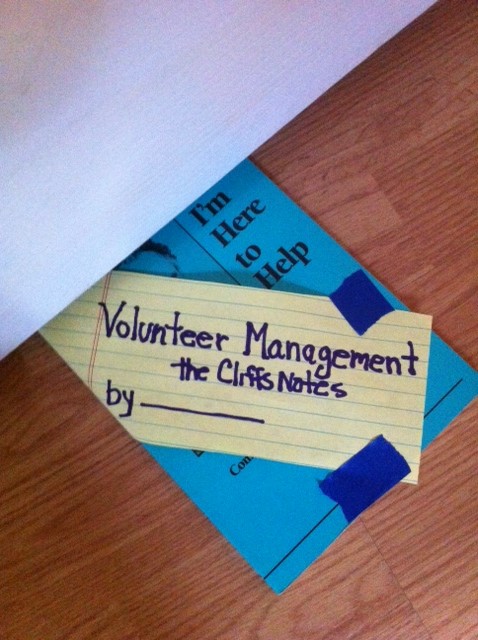
    I’ve always wanted to see a small pamphlet entitled “Volunteer Services for Dummies” or maybe “Volunteer Management, The Cliffs Notes.” Then I could sneak around and slip that bad boy under the door of the executive director while he was at a conference on “How to Get Donors to Donate More.” The pamphlet would have a way to insert whatever author’s name would impress him, like maybe that consultant who he’s recently hired to tell him that he needs to get more donations.

    So, forget the pamphlet. Let’s just list the ten top things that I wish CEOs would understand about volunteer services.

    10. Volunteers do not sit by their phones waiting for us to call. Shocker! We don’t just “order up” volunteers when someone asks for eight volunteers who can work twelve-hour shifts, outside, tomorrow at 8am. Yeah, no one wishes it were that easy more than we volunteer managers. Asking volunteer Charles to prioritize volunteering with us over his other volunteering activities, his trip to Bermuda (that he’s saved years for), his managing of his elderly mother’s affairs, and his scheduled surgery might just be a tad unrealistic. It takes a wise volunteer manager to know how to balance volunteers’ experiences so that volunteering is not burdensome and they look forward to coming in to help.

    9. Managing volunteers is not like managing staff.  Wow, bigger shocker! Unless managing two to ten times the number of very diverse people who only work maybe four hours a week without pay is the same thing. Instead of a paycheck to dangle, volunteer managers must use real leadership skills to inspire and coordinate volunteers. Think of it this way. Volunteers typically spend about 4 hours a week volunteering while you, the Executive Director and your staff spends upwards of 40 or 50 hours a week working for the organization. That’s at least ten times the amount of “plugged in time” you have over volunteers. Do you think that the volunteers spend the other 36 hours thinking about our organization? If not, volunteer managers must be able to “plug-in” volunteers every time they arrive on scene, motivate them to achieve that connection and keep them informed of changes and updates.

    8. Volunteers are everyone’s responsibility.  What?!!! The CEO is thinking, “Then what do I pay YOU, the volunteer manager for?” Staff doesn’t necessarily see working with volunteers as part of their jobs, but any staff can make or break a volunteer’s experience. Look at it this way. What if you, the CEO cultivates a donor by spending your time and sweat to encourage and inform and then another staff member comes along and insults that potential donor? It’s no different with volunteers. We need you, our CEO to set the tone. So if deep down, you are thinking that volunteers are not really time donors but are just fluffy side dishes,  then please stop saying things like “we can’t operate without our volunteers.”

    7. Volunteer managers are real managers. “Hmmm,” the executive director might be thinking, “No way, not in the same way our manager of fund-raising is!” Well, no matter what you call them, coordinators, specialists or team members, volunteer managers are as much a manager as anyone on your staff. The list of skills needed to lead and cultivate a team of volunteers (see #9 and #6 and #4 and #3 and #2 and #1 and oh heck, all of them ) is quite extensive.

    6. Volunteers want meaningful work. “So,” the CEO may be thinking,  “but I often need some meaningless stuff done. Who will do it?” That’s true, but volunteers do not want to just do what the staff doesn’t want to do, they want real jobs that make a difference. And since we don’t pay them, maybe we should consider meaningful work as pay? But, a great volunteer manager with awesome skills can lead volunteers to occasionally do the grunt work if grunt work isn’t all that is offered.

    5. Volunteers want sincere appreciation from more than just the volunteer department. An Executive Director might be thinking, “Hey! I always say that we couldn’t operate without our volunteers, don’t I?” Yeah, you do. But guess what? Volunteers see through the once a year speech at a luncheon that is just lip service. Volunteers want you to make an appearance and say hello, send hand written thank you notes and include their accomplishments the next time you meet with the board of directors. And oh, they would like you to genuinely encourage staff to do these things too. Volunteers are either an integrated valued service or it’s all just talk.

    4. Volunteers are not just little old ladies drinking tea. “But,” a CEO could say, “they sure look like that description ha ha.” Did you know that volunteers are diverse in every way, including age, background, culture and experience and that it takes some major skills to manage a group of very diverse people? But even if some volunteers are older, did you know that they are former executives, professors, leadership experts and full of wisdom and great ideas? And they’re more than willing to share their wisdom for free.

    3. Volunteer managers are not lap dogs.  “Hey,” the Executive Director would protest, “I never said that!” But are the volunteer managers treated that way by staff? Is there an “order up” culture in which volunteer managers are expected to just get volunteers without having any meaningful input into volunteer requests? Volunteer managers have their fingers on the pulse of the organization and are privy to every aspect of the mission via volunteer involvement. Maybe, just maybe, your humble volunteer manager is really a great motivator and leader and not just an order taker. Check them out for some really awesome ideas and managerial skill-sets.

    2. Volunteers are aware and talk. “Sure, so what, that’s great,” a CEO might agree. But, when a volunteer hears negative speak from staff, or sees something less than perfect, guess what? They talk, to each other, to friends, relatives, and the cashier at the Quick-Mart. Volunteer managers keep volunteers motivated and inspired and mediate constantly to make sure the volunteer’s concerns are resolved and their experience is positive. In this world aching for transparency, volunteers are the town criers who can proclaim the worth of an organization or do damage to its reputation.

    1. Volunteers don’t stay forever. “Heresy! They should if the volunteer manager is doing her job,” an Executive Director could counter argue. No, actually volunteers don’t. Does staff stay until they die? No, and neither do volunteers. We should recruit, train and cultivate our volunteers just as we do staff, but not expect them to continue until they’re carted off in an ambulance. And, just like staff, sometimes we don’t want them to stay, so that’s why the professional skill-set of the volunteer manager is so crucial. A volunteer manager’s professional resolution to a challenging situation is an organization’s best chance to avoid negative publicity.

    So, there you have it. I’ll bet you volunteer managers have some really great ideas on other truisms that belong on this list. You have my permission to print out this list, slip it under your leader’s door. Somehow add to it that it was authored by the “Center for Outstanding Management and Maintenance of Organizations and NGO’s” via the report from the “Study on Excellence in Non-profit Structure and Ecosystems” or COMMON SENSE for short.

    -Meridian

  • Are You Hearing This or Are You Just Listening Impaired?

    On Thursday I was fortunate enough to be in a room with 50 volunteers who were taking part in the National Volunteer Leadership symposium put on by the National Hospice and Palliative Care Organization via the web. Throughout the day, these volunteers were attentive, focused and (horrors) POSITIVE. Why, horrors?

    Staff these days are bankrupt of positivity. Everyone is overworked, everyone is stretched too thin, everyone would like to do more on the job, but can’t. It is the grim reality of the hospice industry and most likely of every organization out there. Complaining is the norm. Stress related time off from work is the norm. Passive-aggresive behavior is a coping mechanism. Cynicism rules.

    Our CEO, to his credit, stepped into the room for a short time. He introduced himself to the volunteers and listened as I led a group discussion. And out of the blue, one volunteer commented, “you know, what I take away from this national presentation, is that the volunteer end of our organization is doing everything pretty well.”

    Whoa! Can you say that again? Can we tape you saying that? Another volunteer chimed in (without prompting, I swear), “you guys in the department really do a great job getting us information” to which there were nodded heads all over.

    The volunteers feel good about not only their jobs, but about how we are managing them. The morose feelings of being abused were lacking in this venue. The atmosphere was uplifting and positive and the comments were thoughtful and heartfelt. So, why am I frustrated?

    Did you hear that, Mr. Executive Director? No, did you REALLY hear that? In a lot of ways, managing volunteers is akin to managing staff, although it’s in many ways harder. Instead of paying outside consultants, looking to some mythical “expert” in another state, or creating more focus groups that don’t include volunteers or volunteer managers, how about for once, looking internally at a program that has results? Is this too novel an idea, or is it that, once again, you heard the comments and have mentally patted us on the head?

    Are we professionals who are doing a very difficult job well, or are we just lucky? Is that how our upper management team view us? Why not ask us how we get those results? If you don’t like the answer, fine, but at least be just a teeny bit interested, ok? Maybe there is a nugget of wisdom in how we do what we do.

    Sigh. It’s hard living in a fantasy world, one in which volunteer managers are appreciated. And no, I don’t mean treated as though we are really good at the fluff.
    I mean true respect for the human resources professionals and management experts that we are.

    Oops, I feel that cynicism creeping in. Maybe I’ll go do something passive-aggressive like sticking my head in the next manager’s meeting and saying something like, “oh sorry, I thought I heard cries of help coming from this room, but I guess you don’t want to acknowledge what you have right under your noses.”

    ehhhhhhhh, maybe not.

    -Meridian