Tag: groups

  • Hey Corporate Volunteers, Where Are You From Again?

    EPSON MFP image

    “Uh Meridian, you really blew it! You missed a whole point about corporate volunteers,” a friend of mine said on the phone a couple of days ago. “You talked about thanking groups and connecting them to the work, which is great, but you completely forgot a big one and guess what? It just happened to me.”

    Ouch. What did I forget? Tell me what happened.

    “Well, it was our corporate retreat and twenty of us just completed a one day team building volunteer event at a local organization.”

    That’s great. How did it go and what did I miss?

    “Well, it was ok for the most part, but honestly we’ve done other projects and had better experiences.”

    What went wrong?

    “Well, nothing went really wrong, but let me explain. We all drove to an organization that gives cribs to families in need. Our firm had purchased about forty unassembled cribs and we drove to this warehouse to put together the cribs we bought.”

    And how did that go?

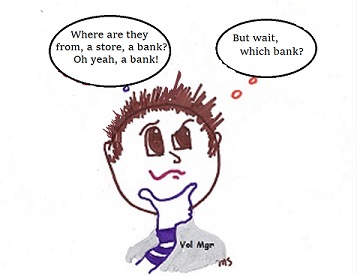
    “Well, we were met by the woman in charge. She kind of acted like we were interrupting her day. She gave us some quick directions and left. She would come and go. But there was something that bothered me a lot. She kept getting the name of our firm wrong. And she kept referring to us as bankers. None of us are bankers. Our company is an accounting firm. Granted, we work in the financial industry, but we are not bankers. It just felt like she didn’t even take the time to learn who we are or what we do. I mean, we reached out to her organization, why didn’t she ask a few questions? I felt, I don’t know… used. Am I being too sensitive and picky?”

    No, my friend you are not being too picky. Because if a group walks away from a project feeling like they were just ancillary labor, then the next time they look for a project, they will most likely look elsewhere. Pure and simple. We can argue all we want that a group is too needy, or picky, or they just don’t understand. The feeling they walk away with will determine whether or not they come back.

    It all boils down to: Do we want them to come back? Do we want them to spread a good word? Do we want them to become partners or champions or supporters? If not, then we should not waste their time or ours. That’s why limiting episodic volunteer groups to a manageable number versus taking everyone is the better way to go.

    And since I did miss that big one when listing things we can do to connect our group volunteers to our projects and missions, let’s list it now.

    • Learn something about the group. At least we can call them by their correct name. We can know a little about their work. (an application process asking pointed questions should help)
    • Be genuinely curious about the people who are helping. Ask questions throughout the duration of the project. Let them tell you who they are, what they value etc. This also helps you to tailor your stories and feedback to fit within their culture.
    • Send a follow up survey and gather feedback on the project. Ask questions to help you hone future group projects.
    • Thank them for their input. So much research has been done on the increased by-in of groups who participate in planning and improving work conditions. Why not apply this to episodic volunteers and encourage them to help you plan new projects by asking for feedback?

    Connecting episodic volunteers to our missions ensures they walk away as new supporters.

    But, after all, we can take our own advice when engaging episodic volunteers. They’re people, not tools.

    -Meridian
  • Hey Corporate Volunteers: How Great is Weeding?

    EPSON MFP image

    A recent article from Business News Daily cites a study finding that “89 percent of employees think organizations that sponsor volunteer activities offer a better overall working environment. In addition, 70 percent believe volunteer activities are more likely to boost staff morale than company-sponsored happy hours, with more than three-quarters saying volunteering is essential to employee well-being.”

    But here’s the kicker from the article: “Three-quarters of the millennials surveyed said they would volunteer more if they had a better understanding of the impact they were making, compared to 61 percent of those of all ages.”

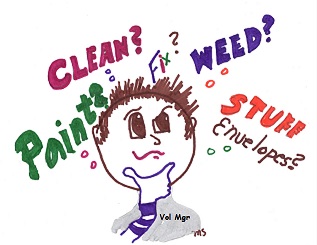
    Huh. So, it isn’t obvious that volunteering for a homeless shelter actually helps homeless people is it? Or wait. Maybe it isn’t obvious that weeding the garden at the homeless shelter actually helps the homeless.

    Oh, yeah, now I get it. Maybe for corporate volunteers, the cleanup or painting or weeding the garden doesn’t scream “OMG, this made all the difference in the world to our clients! You have changed lives like no one else ever has in the history of volunteering! Ka-bam!”

    We, volunteer managers, can be caught in a nether world of finding projects while assuring these episodic volunteers that we really need them. And once you manufacture a project just to accommodate a group, is that truly meaningful work?

    So what can we do since corporate and episodic group volunteering will most certainly grow in the future?

    Well, we need to do some serious planning, be methodical about our episodic volunteers and complete the legwork before we take on groups. We can:

    • Create a plan before accepting groups. Decide how many group members can be accommodated at a time, the age range you are comfortable working with, the time frame that works for you, what supplies the group needs to bring, the number of groups per month or year you can accept, etc.
    • Create an application process for group volunteering: Gather information on the group, ask pointed questions on the application that will help you understand their motivation, interests, skills etc. Then decide if and when they will fit into the projects you have or can create.
    • Create an impression that you value quality over quantity and busy work: We don’t have to take everyone. As each group you engage comes away with a positive experience, word will spread that your organization is the one to contact for quality volunteering.
    • Develop a narrative to go along with each project. Prepare impact stories to accompany each project. Highlight the contribution and results of the project.
    • Utilize client testimonials to recruit and thank corporate volunteers. Tie these into the activity. It may take some creative interviewing to elicit these testimonials, but it will be worth it.
    • Follow up with a letter outlining the impact of the completed work. Reiterate the improvements for clients, staff and other volunteers.
    • Send a thank you letter from your CEO to the corporate CEO or group leader. It can be a general thank you created ahead of time and tweaked for each group. But, have the CEO sign it each time and encourage them to write a personal note.
    • Take pictures-make memes, add text boxes, thought clouds etc. Send them to the group, post them on all social media outlets.

    No matter what, the connection between the project and the impact on clients is critical. Take weeding the garden at the homeless shelter. We can say to our corporate volunteer group, “Imagine the first night you are homeless. Imagine what that feels like, having nowhere to go, no stability, no safety and you arrive at our shelter and all you see are the weeds in an unkempt garden. It says to you that we don’t care. It reminds you of the tangles that threaten your existence. How would you feel? Remember, every little thing can be the one big thing that makes someone feel safe.” Then read testimonials from clients who felt safe.

    A lot has been said over the years about making corporate volunteering fun. While fun is important, it is secondary to meaningful work. Corporate and episodic volunteers deserve to know that even by pulling weeds in the garden, they have created a beautiful safe space for those facing a difficult time in their lives.

    We know the impact of each job, no matter how inconsequential it may seem at first. If we are thoughtful about episodic volunteering and prepare well for group volunteers, we can create a win-win for everyone.

    -Meridian


  • A Corporate Volunteering Interview Part 2


    corporate-volunteering-interview

    Part 2 of the interview with Sadie on corporate volunteering-the day of the event.


    VPT: So, on the day of the event, you and several other employees met up at the location. How did it go?

    S: Well, we had an issue with parking. There were street parking spots, but a sign said ‘two hour parking only.’ We parked anyway. It was a four-hour shift so we figured we would have to come out and move the cars. Later, when we asked, they told us that the city had waived that rule and we could stay in our spots.

    VPT: After you parked, you went in and what happened?

    S: The building was a warehouse type of building and we had no idea how to get in.

    VPT: What did you do?

    S: We went around back, found a back door and went in through there.

    VPT: And then what?

    S: We found the makeshift kitchen where there was coffee and donuts and we announced ourselves to the people in there. They asked if this was our first year and we said yes, so they got another person to come and train us.

    VPT: Were they volunteers or staff? How did you know they were part of the event?

    S: I honestly don’t know if they were paid or not. But they wore stick on name badges.

    VPT: Did they greet you?

    S: They seemed stressed. It felt like they didn’t know what to do with us. They consulted the printed out sign up sheet and saw that we were listed so they said they would try to find a spot for us.

    VPT: What did the training consist of?

    S: About two minutes worth of what we were supposed to do.

    VPT: And that was….

    S: We were to walk around with the clients. They would have a shopping cart and we would go from station to station where they would pick out toys according to how many children they had and their ages. Then we would escort them to the stations where they would get boxes of donated food. I will say, the person who showed us what to do was very nice.

    VPT: How were the stations?

    S: The stations were very well set up, and organized. You could tell they had done this many times before.

    VPT: Were you given any information on how to act around the clients, anything about sensitivity or confidentiality?

    S: (laughs). At one point we were told to try to get stories of hardship from the clients so that we could direct them to a station that had extra toys. They had more toys than they needed, so I guess that’s a good thing.

    VPT: Did someone check in with you during your shift to see if everything was ok.

    S: Not with me, I don’t know about the others.

    VPT: And you were there for four hours.

    S: Longer. One of our group, Justin, who was helping at a food station, was told he could not leave until his replacement showed up. After thirty minutes of waiting, we just left. Some of us rode together and had to go.

    VPT: Did anyone acknowledge you when you left?

    S: No. Justin told his station manager and we left.

    VPT: How was it working with the clients?

    S: That was great. The people were very grateful and appreciated our being there to help.

    VPT: Were you comfortable with the clients, given you had minimal training?

    S: Surprisingly, yes. It felt very natural.

    VPT: Did your firm get any acknowledgement, thank you, write-up, mention on website, anything?

    S: No, nothing that I am aware of. In hindsight, we should have worn company t-shirts or brought something for them to use. They didn’t ask, though.

    VPT: Did you have some sort of follow-up meeting with your fellow employees after the event?

    S: No, we probably should have done that. But I did check in with them individually.

    VPT: What feedback did you get from the other employees?

    S: They thought it was worthwhile. They felt like they made a connection with the people being helped.

    VPT: Will you be back next year?

    S: Yes.

    VPT: What will bring you back?

    S: As much as I didn’t appreciate how it was run, it is about the people I was helping and it makes me feel good to help them. I wasn’t able to volunteer until I was a point in my life where I felt I was able to help others. Now that I can do that I feel like I’m also able to take on obstacles such as the people running the show. Maybe they started off like me, caring about the people more, and they never transitioned over to caring for the volunteers that help the people in need. I’m not sure, but I do feel like it comes with the territory.

    VPT: Anything else?

    S: Second reason I’ll go back is because it might not be the best environment to make me feel appreciated, but I’m comfortable now. I do have a busy life and I chose this organization for a reason. To find another one like it is time-consuming and what if it was just the same or worse? I feel comfortable at this organization now and next year I will be able to walk in, do what I came to accomplish and leave.

    VPT: Thank you Sadie for sharing your experience with us.

    Huh. Well, that was definitely eye-opening. So, I guess the takeaway is we should be relieved when volunteers put up with us because it’s just too darned time-consuming to find another place to spend their time and talents. And luckily for us, that new place might be worse.

    And hey, here’s a thought. Maybe we should thank the people we serve for being needy. Maybe we could just give them a reward for keeping our volunteers coming back. We could call it the “Sob Story of Retention” award.

    Or maybe we could just do better.

    -Meridian

  • Twas the Night Before the Holidays

    twas-the-night-before-the-holidays

    Grab a cup of hot cocoa and please allow me to read my wish for your holiday season:

    T’was the Night Before the Holidays:

    ‘T’was the night before the holidays, when all thro’ the organization
    Not a marketer was stirring, not even administration;
    The recruitment ads were out in the media with care,
    In hopes that new volunteers soon would be there;
    Staff members were nestled all snug in their beds,
    While worries of slim budgets danc’d in my head.

     And I at my keyboard, pulled up the volunteer requests,                

    “Eight volunteers for tomorrow? Oh gosh, now I’m stressed.”
    When out in the parking lot there arose such a clatter,
    I sprang from my cubicle to see what was the matter.
    To the window I flew over piles of work,
    Tore open the miniblinds, and moved the whiteboard with a jerk.
    The blinking of messages on my cell phone screen,
    Made the unfinished filing an eerie green;
    When, what to my wondering eyes should appear,
    But a tall group leader who gave a big cheer
    With a youth group in tow, so lively and quick,
    I knew in a moment it must be Coach Nick.
    More welcome than lunch breaks his team they came,
    And he whistled, and shouted, and call’d them by name:
    “Now! Danny, now! Derek, now! Pujesh and Vinnie,
    “On! Carlos, on! Carrie, on! Deidre and Minnie;
    “To the files! To the clients! To the hosting of the gala ball!
    “Now dash away! Get in the fray! Dash away all!”
    As dollars from donors to marketing fly,
    The work that needs doing, this team will supply;
    So into the building, now one, two, three run,
    With no complaints‍—‌they said this was fun:
    And then in a twinkling, I was so beguiled
    To see that each stack of reports had been filed.
    No questions they asked, they just got so busy,
    While Coach Nick came to me as I was feeling dizzy:
    He was dress’d all in uniform, from his head to his knees,
    And he said, “how can we help you some more, if you please”;
    He brought volunteer applications dusted with glitter,
    And said he had read my volunteer ad on Twitter:
    Our cause made his team feel like they should be giving,
    Then he looked at me and said, “now you make a living
    helping others all day and so we’ll help you.
    You’re an unsung hero, one of just a few
    who work so hard to give others a chance,
    to feel loved and not burdened by their circumstance.”
    He signed in as requested which gave me a fright
    That now I had good help-at least for this night:
    He got back to work, and didn’t complain,
    And the team he brought with him all seemed quite sane;
    They whisked through data entry and none were left brain dead
    And soon I knew I had nothing to dread.
    Nick gathered his team and encouraged them with meaning,
    And they finished putting together packets; and even did some cleaning,
    Then looking around, and seeing it was complete
    They took a few selfies and sent out a tweet.
    He sprung to his SUV, where he waved out the door,
    And happily the volunteers flew, while still looking for more:
    But I heard him exclaim, ere he drove out of sight‍—‌

    “Happy Holidays to all, we’ll be back another night.”

    -Meridian


  • I Get You, So Why Are You Not Volunteering?

    i-get-you-so-why-are-you-not-volunteering

    “Hey there students. We’ve got some pretty fierce things for you to do, that is, when you’re not liking back some other cause, heh, heh. Our aesthetics are cool in our place, you know what I mean?” Kassar shook his head. “I actually said something like that to a class of high school students. Yeah, I don’t know what came over me, but suddenly, when these thirty pair of Gen Z eyes were staring at me, expecting me to connect with them, I just, well, became a cartoon character, trying to speak their language.” Kassar laughed at the memory of himself. “I saw the impression I gave this class of young people. There was the rolling of the eyes and the shifting in the seats. I lost them in the first two minutes of my talk.”

    Ohhhhhhh, how that hurts. I’ve done it when speaking to groups, and maybe you have too. In our quest to connect, we sometimes become totally disingenuous by trying to manufacture rapport. We want to show prospective volunteer groups that we ‘get’ them. It usually happens when we are faced with a prospective volunteer group that has some sort of central identifying factor such as age, culture, religion, cause, work, gender, or special interest. But how exhausting is that? And more importantly, how do we accomplish this connection- by cute comments, silly jokes or personal stories?

    So, let’s conjure up some possible connection statements to random prospective volunteer groups. Would you actually use one of these presentation lines?

    To Retired Law Enforcement: “Hey, I’m hoping you folks can fix my glove box full of parking tickets, ha ha. I think there’s about 200 in there.”

    To Girl Scouts: “I can remember being a Girl Scout. Little Heather was in my troop and she always beat me at selling cookies. I got so tired of her winning. But then, Heather always got the most merit badges. It still frosts my cookies, you know what I mean?”

    To High School Band Members:  “I played a little piano, you know, tickled the old ivories, so I feel your vibe here. I was going to run away and join a band. Ahhh, those were the days.”

    Do I detect some groaning from the audience?

    When speaking in front of prospective volunteer groups, how do we show them that we get them? Or, wait, is that actually necessary? Maybe groups who are willing to listen to our presentations are looking more to be a part of us, instead of us trying to be a part of them.  And why patronize them with caricatures and poorly conceived jokes?

    We can’t possibly know everything about every group. So, instead of feeling inadequate or embarrassed because we don’t know what it means to be a retired computer engineer, how about using something more genuine or what I call “sincere ignorance.” Instead of embarassing babbling, we can say, “your profession has always intimidated me a bit and I honestly would like to know more about it. Do you mind if we take a moment so that you can tell me about your group?”

    Sincere ignorance means embracing our lack of knowledge and being genuinely curious about the people we are addressing. When asking questions at the beginning of a presentation, not only will the group loosen up, they will probably offer up some tidbit that we can pounce on and tie into the reasons volunteering fits for them.

    Groups ultimately prefer us to be ourselves. They want to hear our passion, our experiences, and our compelling evidence as to why they should volunteer with us. We aren’t chameleons who can change color and blend into every new group.  We are leaders, whose authentic message resonates with anyone. They want us to invite them to be part of something worthwhile.

    So, next time you feel as though you may be inadequate in front of a group because you don’t think you can connect to them, just remember, they are listening because they are hoping to connect to you and the mission.

    Groups don’t really want chameleons, they want the sincere us. That’s all the connection we need.

    -Meridian

  • The Shackles of Compassion

    My favorite patient at hospice was George. I don’t have any idea why. Maybe it was because he and I discussed sports comfortably. Maybe it was because he was so young and had a brain tumor and it was so darn unfair. Maybe it was because he would forget the name of the pitcher or linebacker or hockey center he was referencing, and then would remember the name the minute I left the room, so he would wheel out and shout down the hallway, “I remember, it was Stan Mikita!” Then the staff would shush him and I would chuckle, and give him a thumbs up. And maybe there’s just no reason why I felt so connected to him.

    George was divorced and had a twelve year old daughter whom he saw infrequently. We talked about his inability to see her grow up. I would leave his room and cry but something made me go back every day. And when his daughter’s birthday approached, a couple of volunteers and I went out and bought presents so that George could give her something. The volunteers had fun wrapping those presents in pink and purple and gobs of glitter.

    I still remember the day George’s daughter was planning to come and see him. I happened to be walking down the hall of the care center, and I peeked in to see if George needed anything else on this joyous occasion. Instead, I saw him sitting in bed, quietly crying, one of the presents at his side. I didn’t want to disturb him, so I looked in for a just a few seconds.

    But in those intimate moments, the veil fell away and I saw the heavy shackles that bound him to us. The massive chains of our compassion tethered him to our desire to help and the heavy links now became visible through his pain.

    shackles

    Were his tears made of joy or sorrow? Did he cry from joy because we helped him or did he cry because he had lost control of everything precious and dear and was now dependent upon the kindness of strangers? Did he feel trapped, allowed to walk only as far as our chains would allow and only in the perimeter of our understanding?

    Do the people we serve once in a while verbally strike out at us and can it be that they sometimes feel shackled to us? Is it kind of like the stranglehold the skydiving instructor has on the newbie skydiver who is strapped in tight and really is just a ride along on the way down? Does our tandem journey through folks’ lives sometimes strap them to our protective helping?

    I went back to my office and closed the door and sat down. I wondered, in all our feel good desire to help, did we rob George of his last shred of dignity? Do we, sometimes in our exuberance, forget that a real person with complex feelings is on the end of that strap?

    I continued to see George until he died. But after that day, I started to see him as more complex, more in charge and more mysterious. I could still see the shackles that bound him to us, but the volunteers and I discussed how to better serve his needs without strengthening the chain.

    It’s true, the shackles were still there, but we tried our darnedest to make sure George had a key.

    -Meridian

  • Top 10 Things Executive Directors Need to Know About Volunteer Services

    cliffsnotes
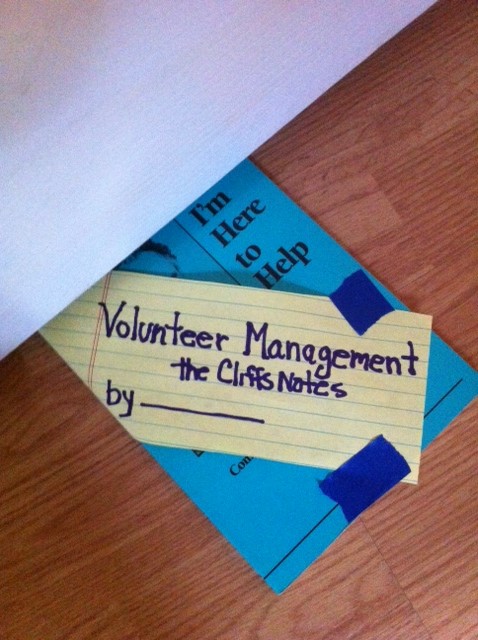
    I’ve always wanted to see a small pamphlet entitled “Volunteer Services for Dummies” or maybe “Volunteer Management, The Cliffs Notes.” Then I could sneak around and slip that bad boy under the door of the executive director while he was at a conference on “How to Get Donors to Donate More.” The pamphlet would have a way to insert whatever author’s name would impress him, like maybe that consultant who he’s recently hired to tell him that he needs to get more donations.

    So, forget the pamphlet. Let’s just list the ten top things that I wish CEOs would understand about volunteer services.

    10. Volunteers do not sit by their phones waiting for us to call. Shocker! We don’t just “order up” volunteers when someone asks for eight volunteers who can work twelve-hour shifts, outside, tomorrow at 8am. Yeah, no one wishes it were that easy more than we volunteer managers. Asking volunteer Charles to prioritize volunteering with us over his other volunteering activities, his trip to Bermuda (that he’s saved years for), his managing of his elderly mother’s affairs, and his scheduled surgery might just be a tad unrealistic. It takes a wise volunteer manager to know how to balance volunteers’ experiences so that volunteering is not burdensome and they look forward to coming in to help.

    9. Managing volunteers is not like managing staff.  Wow, bigger shocker! Unless managing two to ten times the number of very diverse people who only work maybe four hours a week without pay is the same thing. Instead of a paycheck to dangle, volunteer managers must use real leadership skills to inspire and coordinate volunteers. Think of it this way. Volunteers typically spend about 4 hours a week volunteering while you, the Executive Director and your staff spends upwards of 40 or 50 hours a week working for the organization. That’s at least ten times the amount of “plugged in time” you have over volunteers. Do you think that the volunteers spend the other 36 hours thinking about our organization? If not, volunteer managers must be able to “plug-in” volunteers every time they arrive on scene, motivate them to achieve that connection and keep them informed of changes and updates.

    8. Volunteers are everyone’s responsibility.  What?!!! The CEO is thinking, “Then what do I pay YOU, the volunteer manager for?” Staff doesn’t necessarily see working with volunteers as part of their jobs, but any staff can make or break a volunteer’s experience. Look at it this way. What if you, the CEO cultivates a donor by spending your time and sweat to encourage and inform and then another staff member comes along and insults that potential donor? It’s no different with volunteers. We need you, our CEO to set the tone. So if deep down, you are thinking that volunteers are not really time donors but are just fluffy side dishes,  then please stop saying things like “we can’t operate without our volunteers.”

    7. Volunteer managers are real managers. “Hmmm,” the executive director might be thinking, “No way, not in the same way our manager of fund-raising is!” Well, no matter what you call them, coordinators, specialists or team members, volunteer managers are as much a manager as anyone on your staff. The list of skills needed to lead and cultivate a team of volunteers (see #9 and #6 and #4 and #3 and #2 and #1 and oh heck, all of them ) is quite extensive.

    6. Volunteers want meaningful work. “So,” the CEO may be thinking,  “but I often need some meaningless stuff done. Who will do it?” That’s true, but volunteers do not want to just do what the staff doesn’t want to do, they want real jobs that make a difference. And since we don’t pay them, maybe we should consider meaningful work as pay? But, a great volunteer manager with awesome skills can lead volunteers to occasionally do the grunt work if grunt work isn’t all that is offered.

    5. Volunteers want sincere appreciation from more than just the volunteer department. An Executive Director might be thinking, “Hey! I always say that we couldn’t operate without our volunteers, don’t I?” Yeah, you do. But guess what? Volunteers see through the once a year speech at a luncheon that is just lip service. Volunteers want you to make an appearance and say hello, send hand written thank you notes and include their accomplishments the next time you meet with the board of directors. And oh, they would like you to genuinely encourage staff to do these things too. Volunteers are either an integrated valued service or it’s all just talk.

    4. Volunteers are not just little old ladies drinking tea. “But,” a CEO could say, “they sure look like that description ha ha.” Did you know that volunteers are diverse in every way, including age, background, culture and experience and that it takes some major skills to manage a group of very diverse people? But even if some volunteers are older, did you know that they are former executives, professors, leadership experts and full of wisdom and great ideas? And they’re more than willing to share their wisdom for free.

    3. Volunteer managers are not lap dogs.  “Hey,” the Executive Director would protest, “I never said that!” But are the volunteer managers treated that way by staff? Is there an “order up” culture in which volunteer managers are expected to just get volunteers without having any meaningful input into volunteer requests? Volunteer managers have their fingers on the pulse of the organization and are privy to every aspect of the mission via volunteer involvement. Maybe, just maybe, your humble volunteer manager is really a great motivator and leader and not just an order taker. Check them out for some really awesome ideas and managerial skill-sets.

    2. Volunteers are aware and talk. “Sure, so what, that’s great,” a CEO might agree. But, when a volunteer hears negative speak from staff, or sees something less than perfect, guess what? They talk, to each other, to friends, relatives, and the cashier at the Quick-Mart. Volunteer managers keep volunteers motivated and inspired and mediate constantly to make sure the volunteer’s concerns are resolved and their experience is positive. In this world aching for transparency, volunteers are the town criers who can proclaim the worth of an organization or do damage to its reputation.

    1. Volunteers don’t stay forever. “Heresy! They should if the volunteer manager is doing her job,” an Executive Director could counter argue. No, actually volunteers don’t. Does staff stay until they die? No, and neither do volunteers. We should recruit, train and cultivate our volunteers just as we do staff, but not expect them to continue until they’re carted off in an ambulance. And, just like staff, sometimes we don’t want them to stay, so that’s why the professional skill-set of the volunteer manager is so crucial. A volunteer manager’s professional resolution to a challenging situation is an organization’s best chance to avoid negative publicity.

    So, there you have it. I’ll bet you volunteer managers have some really great ideas on other truisms that belong on this list. You have my permission to print out this list, slip it under your leader’s door. Somehow add to it that it was authored by the “Center for Outstanding Management and Maintenance of Organizations and NGO’s” via the report from the “Study on Excellence in Non-profit Structure and Ecosystems” or COMMON SENSE for short.

    -Meridian

  • “My Job is Social”

    fort wayne childrens zoo

    I was so impressed by an article I read a couple of weeks ago about the volunteer program at the Fort Wayne Children’s Zoo in Indiana that I just had to call and speak to the volunteer manager, Kathy Terlizzi because something about the article’s description of the program conveyed a specialness about volunteering. Kathy graciously agreed to let me write about our conversation.

    Kathy with Dingo pup
    Kathy with Dingo pup

    http://www.journalgazette.net/news/local/Volunteering-at-zoo-better-than-working-5364666
    I felt so comfortable speaking to her from her first bubbly hello that I imagined all the volunteers, both existing and perspective who are captivated by her passion and dedication. Her program truly is inspirational.

    Kathy has been the zoo’s volunteer manager since August 2009 and was a volunteer at the zoo before joining the staff. “I made changes based on my experiences as a volunteer,” she told me. When she took over, the initial training program for new volunteers occurred either at the end of the season or at the beginning which meant some volunteers had to wait before utilizing their new skills and enthusiasm. Also, the training was a comprehensive training which meant that volunteers, regardless of their comfort level were expected to “get out and do what they were trained for”. Many volunteers, Kathy found, were overwhelmed with the comprehensive training and since there was no practical application (mentoring) along with training, the volunteers were not prepared to roll up their sleeves and jump in to some of the more complicated tasks.

    So, Kathy, seeing volunteers repeatedly become overwhelmed, initiated a stair step training broken into three parts.
    Part one is the basic training for all adult volunteers. This is the ground floor training and volunteers are asked to commit to 18 shift hours before moving up to the next level. Volunteers at the zoo can sign up for shifts online. (the zoo utilizes Volgistics for volunteer management).
    Part two is the Ambassador training which helps volunteers prepare to interact and speak to the general public.
    Part three is the docent training which helps volunteers become comfortable in crowd situations and with handling zoo education animals during animal demonstrations and off site programs for zoo guests.

    This stair step method allows volunteers to take their volunteer training in stages and encourages them to find their comfort level of participation. The more advanced classes may be smaller than the initial basic training, but it ensures that volunteers find their own path and don’t feel pushed into something they are not ready to do. Some volunteers don’t wish to advance while others find that they want to move up. “I believe that volunteers should bloom where they’re planted,” Kathy said.

    I heard real pride and enthusiasm when Kathy spoke about her teen leadership program which is set to kick off in June and July. Daily, 30-40 adult volunteers work in the zoo, but during the summer program an additional 40 teens who volunteer during two-week sessions are incorporated. They too, sign up for shifts online after going through a special teen orientation.
    Teens 13-17 apply for the two-week sessions and the 172 slots are coveted by 250 applicants. Returning teens account for about 99 slots, so the rest are new teens who go through the new application process which includes filling out an online application, answering an essay question and providing a letter of recommendation.
    After the applications are processed and the teens selected comes the logistical nightmare of slotting teens into the program. Kathy spends the entire month of March working on the two-week sessions. Emails and phone calls from interested teens takes over her days as she slots returning teens first and then the new teens are inserted based on gender, age and availability to provide balance. It is an ever evolving schedule as teens find conflicts with their other activities and family obligations.
    But, instead of this monumental task seeming a burden for Kathy, she is stoked about the teen program, and told me that at first, she was intimidated working with teens because of all the negative stereotypes she’d heard about young people. But she found that the teens she works with are wonderful, responsible volunteers. She prides herself as an up front person and speaks to them frankly about dress codes, expectations and sensitive subjects like drugs and weapons. The teens are expected to be professional in their participation, especially in regard to zoo guests. In return, the teens take their responsibilities very seriously and frankly, Kathy says, they “have a lot to say.” Kathy believes in speaking to the teens directly, (although the program is transparent and openly invites parental and guardian involvement) and finds that the teens really step up when given the chance to embrace responsibility.
    One day she discovered some older photographs of teen volunteers doing the same animal handling as the adults, something the zoo had gotten away from over the years, so she advocated a return to letting teens have equal volunteer responsibility. The parents were open to it, she says, mainly because they knew their children were safe within the zoo framework.
    So two years ago, she implemented a two-hour pilot training and 66 teens signed up. At first the teens began with level one animals, bunnies and guinea pigs, but now the teens are handling snakes and tortoises. When the pilot program began, Kathy let the teens know that they were in part responsible for the success of the program and the teens immediately stepped up and showed the professionalism necessary for the program to thrive.

    puzzle feeder
    Puzzle Feeder

    Another success Kathy talked about was increasing the trust level between staff and volunteers. It was a goal she had when she first started and so she spent the first year building a rapport with staff. “I told them (staff) that volunteers will do anything as long as it benefits the zoo. They won’t, however wash your car.” At first the zoo keepers were reluctant, so Kathy took a proactive approach.
    She saw that the giraffe keepers had to prepare food daily for the giraffe puzzle feeders (a hanging feeder with holes that let the food stick out-these feeders simulate the natural foraging of giraffes) and offered to ask volunteers to do the preparation, thus giving the keepers more time to focus on other more pressing tasks. At first the keepers wondered why any volunteer would be willing to do that job, but within five hours after posting the job online, the shifts were all filled. Now volunteers sign up for 2 hour shifts to prepare the giraffe puzzle feeder food.
    Another proactive instance came when the aquarium manager mused about organizing ph data he had been collecting so Kathy offered him a volunteer who was computer savvy in spreadsheets.
    At first he reluctantly turned over a month’s worth of data but when he received his data back in a neatly organized spreadsheet, he quickly turned over much more information to the volunteers.
    That’s how trust is built. Kathy also found a way to incorporate seamstresses into the zoo’s programs. These volunteers make costumes for zoo presentations and also cold weather quilts for the education animal carriers. She also utilizes Spanish-speaking volunteers to help translate signage.

    Kathy has found a great way to work with groups. She says that the community wants to be involved in zoo volunteering so she offers the community the opportunity to participate in Annual Enrichment Workshops (run by a volunteer and his family) where they can do meaningful crafts like make fishcicles or paper mache animals in bulk. These items are requested by keepers and ultimately given to exhibit animals as enrichment. She also utilizes corporate volunteer groups for some of the zoo’s larger events throughout the year.

    But when I asked for Kathy’s advice to new volunteer managers, she grew wistful, “I would tell them to get ready for the ride for it’s all encompassing. It’s fun and rewarding but also sometimes sad because you have this personal rapport with the volunteers and you get involved with their lives.” She also would like a new manager to know that volunteer management is not a 9-5 job, as there are weeknight trainings and weekends spent recruiting or trouble shooting. She says, “there’s one of me and 450 volunteers. And they all want and deserve some of my time. That’s why my job is social.”
    She told me that she had been a manager for many years before working at the zoo and it opened her eyes when she took a personality quiz and found out how high she scored on interacting with people. Volunteer management has fit that bill. Kathy spoke glowingly of being able to put a volunteer in a place where they can grow. Whether it’s a shy, sensitive teen or a senior who is feeling unfulfilled, she derives tremendous satisfaction in seeing volunteers bloom.
    As you can imagine, Kathy is comfortable talking with anyone. She says, “I kid that I need one of those take a number systems outside my door. My office is right across from the volunteer room. Everyone talks to me, volunteers, staff, guests, even family and friends. If I wear my zoo t-shirt to the store, the clerk wants to talk to me about the zoo. So I take the opportunity to ask, how about volunteering for us?”

    For me, it was easy to see why this volunteer program succeeds. Kathy Terlizzi, the volunteer manager, is both passionate and practical. I heard in her voice that she wants every volunteer to succeed, to have a meaningful experience, and to be part of something in which they can take great pride. It’s no wonder the Fort Wayne Children’s zoo is the number one attraction in all of Indiana. This zoo and volunteer program is a success story we can all learn from. I know I’ve taken away these principles from my conversation with Kathy:
    1. Be proactive with staff-analyze their needs and offer volunteer help whenever possible-build that trust that volunteers can help and free up staff to do other pressing matters.
    2. Invest time and thought into your training program-use levels to encourage volunteers to find their niche and don’t overwhelm them with all training at once, instead encourage them to take training in steps. Make sure that the volunteer opportunities are meaningful work.
    3. Model professionalism and responsibility, especially to teens and they will step up to the challenge.
    4. Be prepared to give your time and attention to every volunteer.
    5. Create new opportunities whenever possible to expand your volunteer reach.
    6. Take pride in your work. It’s infectious.

    Thank you so much to Kathy Terlizzi for allowing me a glimpse into this very special volunteer program. It is volunteer managers like Kathy who take volunteering to the next level through dedication and a willingness to believe in volunteers.
    -Meridian

  • Extra Mayo! The Tour Buses are Here!

    crowded restaurantGroups of students, what can I say? I love them!  I love their energy, their brand newness, their looks when they think I’m a bit daft. They’re energizing, but exhausting!

    I have this equivalent mental image of a sandwich cafe just outside of Niagara Falls. The owner has sporadic business and keeps putting up ads and specials to attract more customers. But then, every first Monday of the month, the buses of tourists pull up all at once! The tourists tumble out and their tour directors run into the shop, spitting orders, while looking at their itineraries and talking over one another. The shop owner frantically tries to fill all the orders, no mustard, extra onions, mayo on the side, hurry up, hurry up, hurry up or the buses will go elsewhere!

    The shop owner wants the business, so who is he to complain? But furiously throwing out sandwiches is not like making sure each one is made to order. The buses groan as they pull away, tourists munching while looking forward to their next stop. The cafe owner will never hear their complaints or kudos, he’ll never see those tourists again. But he’s counting on that tour director to bring another busload back, much as the frenzy is crushing when it happens.

    That’s what having groups of students is like. Much like tour buses, they visit, get their sandwich and go. They’re not long term and they travel together. You have to manage them in bulk which is vastly different than one one one.  Fraternities, service clubs, and teams all are great opportunities for us to have a lot of volunteers at one time. But typically the groups want to work together, have very specific schedules and a shortened time they will be with us. All of that’s perfectly fine, and truly, it is fun showing them the world of service.

    But at night, when the lights are out and the equipment is turned off, the cafe owner falls into bed, spent. “yes,” he whispers, “there’s new money in the till, yes,” he mumbles as he pulls off his clothes, “I can keep my cafe open another week and yes,” he sighs as he draws the covers up around him, “I’m so grateful for the tourist buses,” and as the spittle dribbles down over his chin,  he mumbles, “I ache in places I didn’t know…”

    What do you do with your groups? Twenty students want to do a project together, but you have no parking lot to clean, no building that needs freshening up. The groups can only work on a Saturday at 5pm, so do you ask a seasoned volunteer to oversee them and hope for the best, or do you leave your family every time and go in, because, like that cafe owner, some one has to make sure it gets done? Student groups can’t do a lot of orientation so do you give them a quick 15 minutes, knowing that it’s inadequate and knowing that you have to be with them every step of the way, so as to explain the mission to them and keep them from innocently saying or doing something inappropriate? Do you imagine that other staff could view the students as being in the way and you then hover over them so as to protect them? Do you spend endless hours coordinating their schedule with availability of clients, staff and other volunteers?

    For senior management, student groups are viewed as “THE BIG ONE!” What they don’t realize is the logistics of managing “THE BIG ONE”.  Yes, it’s rewarding, yes we love them, yes, it’s great PR. But we volunteer managers are the ones, spittle dripping onto our pillows, crawling into our beds at night. “Did I forget one of the student names?” we murmur, “can I stick 10 students into a clients home if I just have them all be quiet?” Our dreams are dense with “what ifs” and the dreaded, “if they don’t have a good experience, they will go elsewhere next time.” Shudder, we can’t have that now, can we?

    I’m stocking up for the next rush of students during spring break. I’m taking my vitamins, asking all around now for any big special projects that can be done by groups and clearing my calendar for late evenings and weekends. Hopefully, this cafe will be ready for the rush because each tour director (student group leader) has to have a satisfactory experience so that they will be back. And I’m experimenting with new sandwiches all the time; gotta keep the menu fresh and interesting.

    But I’m also investing in a new pillow and maybe a new spa cd. See, I think when the buses leave, I’ll be spending some real time sprawled across the bed, mouth open, with inhuman sounds coming out of me. Maybe as I fall into a crushing sleep, somewhere a student will remark, “that was a really good sandwich!”

    -Meridian