Tag: #lovols

  • Gig Volunteering and Intellectual Property: Do We Own Volunteer Work?

    How much do we “own” volunteer work? Is it all about the legal (and don’t we know, when it comes to anything bad happening on a volunteer’s watch, legal becomes oh-so important). But what of the talents and abilities a volunteer brings? This viral story on TikTok about a woman who watermarked her work (because her boss kept stealing it) has a different lesson, hidden under the obvious one: keeping your work safe. But how does this apply to volunteers?

    Shifting Trends To Watch

    Before the pandemic, the gig economy and freelance work had already been growing (Freelance work accounts for 35% of the global workforce. Source: financeonline.com), and company loyalty has been shrinking. Today, recognition and personal satisfaction may come from social media followers instead of within the hierarchy of your boss saying you’re a swell employee or volunteer (company or organization). In the above, the woman who watermarked her work was replaced (fired?) and had to find another job, but her video was viewed over 3.7 million times with many “followers” offering support.

    The support from 3.7 million peers overwhelmingly helped the sting of retaliation from a few petty bosses Volunteering is not static. It is rapidly changing (despite Covid and sped up by the pandemic) and reflects the societal shifts we are seeing. So will volunteers become freelancers? Gig volunteers? Can they watermark their work? Do they have 2,000 followers from whom they derive support and satisfaction and so, our lovely pats on the back can’t hold a candle to all that positive feedback? Are we foolish to ignore the idea that volunteers have their own intellectual property? (Intellectual property is a broad categorical description for the set of intangible assets owned and legally protected by a company or individual from outside use or implementation without consent) Source: Investopedia.

    What Do We Own Exactly?

    Our volunteer organizations own our training, our processes, our mentorship, our educational information, our mission goals, our policies, and the work performed under our umbrella, but what about the unique skills, talents and abilities our volunteers bring, such as spot-on empathy, crazy good listening skills, mad technical skills, drool-worthy organizational abilities, soothing voices, or Shakespearean writing chops? I’m pretty sure we don’t teach volunteers those innate abilities, but, we recognize and put those abilities to good use.

    While I am not even remotely suggesting that volunteers will rise up and fight to own the volunteer work they do under an organization, I think we can extrapolate some insights from gig work, and the TikTok story, because as society shifts, so will volunteering.

    We Have Already Shifted Away From Old Models:

    In the ancient past (like 1998), orgs pretty much used these volunteering edicts:

    • we need this, so you will fill this role
    • we determine what works, so take it or leave it
    • we are the experts on our mission focus, so don’t bring untried ideas
    • it’s the tasks we value, not what you bring to our table
    • you are a tool, so act like one

    Gig workers create resumes highlighting their skills, experience and talents. Why can’t a volunteer do the same thing? We know that student volunteers are increasingly looking for volunteer opportunities that teach them new skills, allow them to test leadership abilities and give them something in which to enhance their resumes and better themselves. Why don’t we help volunteers create their own Intellectual/Empathetic/Skill Property resumes?

    Leaders of Volunteers already recognize volunteers’ unique talents and skills. When interviewing, we look for those talents and note skills when placing volunteers. We worm our way into volunteers’ hearts and minds, not because we’re nosey (tell that to my husband), but because we need to know the volunteer inside and out. What makes them tick? What are they so freaking good at? And ultimately, what makes them an outstanding and effective volunteer?

    We are lavish with our praise, especially for a volunteer’s unique contributions. So, who cares? Well, what if volunteers had resumes that highlighted their unique talents, complete with endorsements and examples? What if you were searching for a volunteer who could not only speak Arabic, but had this unique talent of bringing out the buried stories in someone’s life? Wouldn’t finding that volunteer be magic?

    I had lists and lists of volunteers and their skills, such as speaking another language, artistic talents, engineering background, etc. But only in my head did I know who was sensitive enough to bond with an aching heart, or was astute enough to keep quiet while someone grieved in their own way. See, intangible stuff is like a beautiful sunrise. We appreciate it, but we don’t always know how to include it in concrete ways. Maybe we should.

    No Longer Harnessed

    Volunteers have moved away from the “I’m a tool of the organization” mindset. They freelance now, and reject the notion that organizations know best how to use their unique skills. Just look at any unfolding disaster and see the informal volunteers pour out.

    Here’s the thing: As volunteer engagement professionals, we scratch our heads and ask ourselves, “how do we harness the enthusiasm we find when disasters strike and how do we keep the volunteer mojo going?” Right there is the problem: Volunteers don’t want to be harnessed. They want to be engaged. And maybe for just a short time or for the adrenaline rush. Maybe for the autonomy or for the comradery found within a social network. Could be for the praise from followers or the immediate satisfaction. Can we supply that going forward? Must we?

    There will always be volunteers who fit so well, they stay at an organization. Thankfully, like in a magical fantasy, these volunteers have found the synergy that makes them want to keep at it. But for the rest of the volunteers out there, being harnessed isn’t what they have in mind. For them, it may be about using their unique talents or having some autonomy, or receiving support from social media rather than organizational structure. Does that make them selfish? Not really. And if we are truly interested in diversity and equity, we will open ourselves to a changing society and accept new thoughts. And most times, it means getting out of the way.

    What Their Property Means for Us

    From Indeed.com: “A gig worker is a professional who, instead of receiving a regular income, receives wages based on the one-time projects, or “gigs,” that they complete. This makes for a flexible work environment, where employers can offer payment for only the work that’s available for a gig worker to perform. The gig economy is the work and career environment in which these professionals work.”

    So what does this mean for us? For one thing, we can structure volunteer wanted ads to reflect our commitment to understanding volunteers are unique and we offer reciprocating benefits to volunteering. Instead of advertising “jobs” let’s advertise opportunities. For instance:

    • Engage your empathetic property in this manner (Subtle? Yes.)
    • Bring your unique talents
    • Put your skills to work
    • Enhance your abilities
    • Develop your leadership
    • Grow with us
    • See where this takes you
    • Our clients are unique and so are you

    In the future, volunteers will opt for their own volunteering resumes which they may use on social media or for job hunting. No longer will hours or tasks count. I can see a volunteer in the future, recording their experiences on their resumes this way:

    • With my ability to organize and motivate, I enlisted five volunteers to man the food bank during a power outage which resulted in no interruption of service to clients. The volunteer administrator said about me, “Without Jordan’s expertise, 30 families would have gone hungry that day.”
    • Because of my extensive software knowledge and ability to work under pressure, I fixed a bug in the keynote speaker’s presentation at the annual funder’s benefit, thus saving the keynote address. As the keynote speaker quipped, “I’m indebted to Anvi for her skill and especially for her calm during the chaos.”
    • My ability to structure partnerships was called upon when I sat on a task force to brainstorm encouraging STEM in schools. It was my partnering model that created a successful program. According to the principle at Main Street High, “our partnership with Computer Alliance Corp has led to a 30% increase in students choosing STEM universities.”

    No Swell Heads

    There is a risk in that too much praise can lead to swelled heads, but you know what? That risk already exists, because we praise volunteers a lot (at least in my experience). Somehow, many of us, myself included, feel like praise is a way to keep volunteers coming back. That’s not exactly accurate, so why not be less fluffy and broad and overly effusive about praise and be more specific in pointing out exactly why this volunteer is effective? Praise then becomes tangible and we can more easily attach meaning to something tangible and concrete than to broad phrases like “you’re so good with people.”

    To which a volunteer would ask, “how am I so good with people?” Um, well, yeah. Sometimes intangibles are just obvious, which makes them hard to define. It’s the feeling you get when you interview an exceptional volunteer; that “there’s something about this person” tingle that crawls up your arm. So, define it, especially when you see it in action. “Drake has this unique ability to put people immediately at ease.” How is Drake’s empathetic property valuable? Holy moly, how many times did I look for that quality in a volunteer when working with clients who were scared, abused, or closed up? And when I had a Drake in my midst, you bet Drake was on speed dial. (is that a thing anymore?)

    The Change Train Keeps Rolling

    We realize we must adapt to an ever-changing world. One way we can sustain (as opposed to retain or harness) volunteers is to help them chronicle their unique contributions to our work. By doing so, we give them the tangible evidence they need to find meaning in their volunteering. The two hours are not what it’s about. It’s about the volunteer’s unique ability to listen without judgement or the volunteer’s skill in teaching a child how to draw or the volunteer’s sense of humor that broke through to a client who didn’t get along with other staff or volunteers.

    I realize this is not a ground-breaking change. But, as we navigate the changing world, it will be the subtle shifts we make that position us to keep engaging volunteers. Ears to tracks on the ground, we can hear the train coming before it runs over us.

    With volunteer appreciation weeks coming up all over the globe, we are determined to appreciate volunteers for numerous reasons. Instead of trying to retain and harness volunteers, let’s engage them by giving them what they seek and appreciate them for the unique intellectual/empathetic/skilled properties they bring.

    Those unique properties are what we engage anyway.

    -Meridian

  • What is Volunteer Value, Anyway?

    How do we show volunteer value? In the old days, (way before Covid) we, volunteer engagement professionals, used three basic value indicators:

    • touting number of volunteer hours given
    • listing number of active volunteers
    • calculating money “saved” by incorporating volunteer help

    Since these methods were basically a bunch of numbers without any causality, they never showed:

    • how those volunteer hours supported mission goals
    • how those active volunteers completed mission objectives
    • how the volunteers brought in resources instead of how they saved money (which is a misnomer anyway, because volunteers do not replace paid staff. There are laws about that, BTW)

    The old methods don’t work. Volunteer impact is the way to show the causality between volunteer support and mission goals and objectives. Download the volunteer impact worksheet here.

    Connections are the circulatory system

    But that’s not the complete picture, is it? It’s time we added connections as a companion piece to volunteer impact. Connections are the crucial, desirable, sought after components to successful missions. Why? Because connections bring our organizations the things we need, such as donations, resources, advocacy, awareness, more connections, key advice, skilled help, encouragement, and avenues to grow.

    If impact is the heart of a mission, then connections are the circulatory system’s arteries. Arteries carry the mission goal out and return with the resources the mission needs to grow, thrive and meet objectives.

    But like arteries hidden beneath flesh and bone, connections are difficult to see as they are forming. We may see the results, but we often do not see the veins and arteries at work. We don’t see the volunteer talking us up at their clubs, soliciting donations for us. We don’t see the volunteer at a store who hands the cashier the organizational brochure he carries, telling her that the organization he volunteers for will help her child. We don’t see the volunteer who insists the next neighborhood newsletter feature an article about the good work we do.

    Connections are built, not made

    And here’s the misnomer about “making a connection.” Strategic connections are built, not made. Sending the marketing rep out for a quick “talk” to an interested group may make a short connection, but it does not contain the building blocks to a sustainable, vibrant partnership. Relationship building takes more than flyers dropped off or a quick tour of the facility, or heaven forbid, an invitation to a task force where the participants are subjected to lots of blowhard, uninformed blah, blah, blah. (yep, been embarrassed by those task forces many a time)

    While networking is fine as a starting point, relationship building is strategic partnering. Just as saying “we have 600 volunteers who gave 40,000 hours last year” is way less meaningful than “last year our 50 volunteers kept our doors open,” saying “we gave presentations to 35 clubs and corporate groups last year” cannot hold weight against, “we made 7 strategic connections that proved to be sustainable and brought us…(fill in the blank with the tangible benefits).”

    Our volunteers have a circle of influence (the folks around them) that are NOT acquaintances, but rather people who have some knowledge of the volunteer and therefore will listen with more trust than they will to some unknown speaker who shows up for 30 minutes and prattles on. Trust and familiarity are huge when making connections and our volunteers have trust and familiarity with their neighbors, friends, places of worship, professionals they employ (doctors, real estate agents, accountants etc.), and clubs, etc. to make sustainable connections. Their circle of influence becomes our circle of influence when our volunteers are empowered to advocate for us.

    But, as volunteer managers know, our volunteers don’t wait for the pat on the head, or the “ok, go out, but be careful” talk. They do it anyway, because they are good, smart people. But think about how much more effective they can be when encouraged and supported and supplied with resources.

    Reporting connections

    It may be imperfect, but we can show the connections made and the resources gained by our volunteers. Which takes us to this equation: Volunteer impact + volunteer connections = mission goals achieved, connections made and resources gained. But let’s not stop there. How do volunteer impact and connections happen? Because the volunteer is just a nice person? So, the equation becomes: Meaningful volunteer engagement + training and resources the volunteers need =volunteer impact + volunteer connections = mission goals achieved, connections made and resources gained.

    Using the above example, let’s take this further. 15 neighbors + 250 worship members + 30 club members =295 new connections. Wait, what about the 20 professions and 5 newsletters? Well, because our volunteer spoke to their doctor, their financial advisor, their lawyer, their children’s teacher, their real estate agent about the services we provide and the great work we do, we can safely assume those people will pass it on, so it becomes immeasurable.

    You can create a “connections” report, like the one above, or in whatever manner you think will show the work being done by volunteers. All you need is one volunteer to tell you the extra advocacy they do while away from your site. It’s pretty impressive.

    Present the report and ask for the resources your volunteers need, so that they can more easily make these connections. Give them marketing training, phone numbers to pass out, business cards to carry. When treated like valuable members of the outreach team, they will forge connections we now only dream about.

    Why wouldn’t any organization welcome additional help via our volunteers? Why do they prefer volunteers to “stay in their lanes?” Why aren’t volunteers typically mentioned in vision statements and future goals as contributing team members who add value by not only impacting the mission, but by forging connections that sustain us?

    Just what the heck are organizations afraid of?

    -Meridian

  • Volunteerism Lip Service

    Photo courtesy of Gratisography

    Lip service. Gotta admit, I’ve been guilty of patting myself on the back by parroting all the great things I believed in to further volunteerism and volunteer management. But, was some of it lip service? Did I just spout stuff without backing it up with actions? For instance:

    I believe in the glorious future of volunteering:

    Well, give me a medal. But what about kids volunteering? Did I actively engage young people, give them leadership opportunities? Or did these words actually come out of my mouth: “I’m not a babysitter.” (the words came out of me, but, in my defense because I was babysitting a senior manager’s kid one summer, oh, and the boyfriend who tried to sneak in through the back door.) But then, I started to involve kids, and students, and it opened up a whole new world of innovation and creativity. Going to schools and engaging students. Setting up parent/child volunteer opportunities. Introducing young people to the mission and stepping back while they came up with ideas.

    I want all volunteering to be recognized/honored/respected:

    Sure, I do. But then, what did I do when hearing about volunteer successes at other organizations? Did I graciously praise them, promote them, or did I feel jealous? (did I actually huff, “well it’s easy volunteering there with all those cute animals, instead of with sick people.-Um, yeah, I did.) But once I realized other volunteer program successes helped all programs in our community, I could let go of the me vs. them mentality and do some partnering.

    I believe in engaging volunteers to the fullest:

    Well, did I send them to another organization when their skillset wasn’t being fully embraced, or did I hang onto them like that expensive outfit I can’t fit into anymore? Sadly, the amount of volunteer potential wasted by keeping skilled and willing volunteers tethered to our mission when they could have done so much good by going elsewhere is astronomical. (Oh, selfish, thy name is me.) Once numbers stopped being a goal, then quality beat out quantity every time. And by partnering/supporting other volunteer organizations in my community, a whole new world of possibilities opened up.

    I want staff to accept volunteers:

    Nice fighting words, right? Well, did I invite staff to be part of volunteer strategy upfront, or did I just grumble that staff didn’t get it? (I suppose if you consider the names I called staff in private, like “they’re just pig-headed” you could say I missed the opportunity to involve them, thus missing out on a collaborative atmosphere…sigh) If staff is part of the upfront planning, even if we don’t accept everything they propose, we still establish a cooperative environment.

    All volunteers are valuable:

    Oh, this one’s good. Well, did I have favorite volunteers, AKA, the ones I called on first because I needed to get a position filled? I knew Trevor would always say yes, so what did I do? I called Trevor. (Hey Trev, my buddy, my pal) Sure I filled the request. But in doing so by constantly calling on “reliable” volunteers, I fostered the idea that the number of volunteers I proclaimed we had was actually false, that it was far less because the same volunteers kept showing up. (We have 738 volunteers. On paper.) By taking the easy route, I gave little attention to newer, or more selective volunteers. And you know that’s not the way to engage anyone.

    Volunteers have the right to say no:

    Well, sure, I was really vocal about that one. Proud of it, too, but what did I model to them when I ignored my own boundaries? Did I take some sort of warped pleasure that I was overworked, willing to take calls at all hours, never really off, never on vacation? How could I tell them their well-being was important when mine obviously was not? (But see, I cared more than everyone else, and my commitment, er my availability at all hours, proved it.)

    I don’t take volunteers for granted:

    Well, go back to calling on that “reliable” volunteer over and over, because they always said yes. Not taking volunteers for granted means an extra effort to give all volunteers a chance to participate. It means taking care to not pigeon-hole volunteers into roles because it’s what’s needed when maybe a volunteer wants something new. It means giving needed breaks, not letting staff overwork their favorite volunteers, not sharing organizational politics or personal frustrations with volunteers who come with an unburdened heart. It means being professional, not hanging out with some volunteers while ignoring others. I’ve mistakenly done all of that. It was easy to do when I was swamped, struggling and in need of that awesome volunteer who patted me on the head and told me everything was ok.

    I want my volunteers to be treated with respect.

    Well, what about that opportunity to push back in the staff meeting, the one where I just sat there and said nothing?(They just don’t get it so I’ll sit here and brood. Yeah, I’m sending the stink-eye their way, that’ll show em!) I was tired of repeating myself, frustrated at the time I was losing by being there, ok, feeling dejected, wondering if my fellow staff were just too stubborn to change. Then I realized advocacy was not tied to my emotional state, but something strategic and planned. The notion that it was not about me and my precious feelings was very freeing and let me concentrate on a plan to show volunteer value.

    I believe in accountability

    Ok, sure, but then what about all the times I did not want to confront a volunteer on behavior and instead, just hoped things would work out? Well, those times never worked themselves out and frankly, got a lot worse. I learned the hard way to meet challenges head-on, to mitigate disasters before they occurred, to mediate before things got out of hand. And you know what,? Handling difficult situations got better/more efficient/more satisfying with practice.

    I want the world to know how great my volunteers are:

    But then, whenever a news source came around to do a story on the volunteers, did I just go along with the whole “Volunteer Betty is still going strong at 99?” I did, cause I was just so grateful to have any published recognition. Here’s the thing. Those stories never brought in throngs of volunteers. It is volunteer impact, not personality sketches that motivate others to volunteer, or donate or inquire about services. I wrote a blog post on this subject back in ancient times (well, 2018 anyway) entitled Volunteer News Stories: Does This Good Press Really Help?

    Ok, so maybe my New Year’s resolution is to recognize and correct my mistakes. (Again). Maybe I need to think about the stuff that comes out of my mouth and whether it’s just lip service or whether I believe it enough to put it into action.

    So, please learn from my shortcomings so you don’t have to think you’re guilty of volunteerism lip service.

    -Meridian

  • It’s Time for Volunteer Fresh

    Is there a soft bias towards volunteers because they only volunteer once a week or month? Volunteers can’t be as committed, as knowledgeable, as valuable or impactful as staff who labor 40 (wait, who are we kidding, like 60-80, most uncounted) hours a week? But in reality, less time spent by volunteers is a gift.

     Volunteers are not burdened by the stress of working for us full-time.

    Volunteers who show up once a week or month are like opening the window. They come in, trailing currents of fresh air. They bring with them new experiences, a taste of outside ideas, and rejuvenated enthusiasm to our stale environments

    What factors contribute to a stale environment?

    Well, for starters, the pandemic for cryin’ out loud! Compassion fatigue, burnout, overwork, repetition, familiarity, slow to change movement, it’s always been done thus mentality, funding worries and stress. Each of these freshness killers lurks in the halls of non-profits, waiting to blow their stale breath into our lungs.

    Pedestal of Perpetual Caring

    There is a pressure on non-profit staff to be “on” at all times. This Pedestal of Perpetual Caring implies that every moment is as intensely compassionate as the first one. Who can live up to that standard when change is everywhere, workloads are increasing, reports are due, projects need attention and budgets are withering?

    Enter Volunteer Fresh

    What benefits do we reap because our volunteers are NOT with us 24/7?

    • Our volunteers, because they are not on a pedestal of caring and are not burdened by the stresses of working with us full-time can and do exhibit the intense compassion every client needs.
    • Our volunteers can focus on a single, crucial task, because they are not being pulled in 50 directions.
    • Our volunteers are out there in the world 98% of the time and bring with them outside opinions, trends, ideas and methods.
    • Our volunteers bring infectious enthusiasm and continually remind us why we love our work. They plug us back into our missions.

    Volunteer Fresh is Circular

    Volunteers are not tools They are living, breathing human beings. They do not volunteer in a vacuum. Instead, they trail portions of us when in the community and bring portions of our community to us every time they volunteer. They bring our mission to the community and the freshness of our communities to us. They are a continuous pipeline or bridge that directly connects us with not only the people we serve, but with the people we want to reach out to for support.

    Some questions to ask your organization when talking about volunteer fresh.

    • Do you want unbiased opinions from the community or do you want the same stale reports?
    • Do you want new, untapped donation streams? (yep, that will get some attention)
    • Do you want to give our clients stress-free compassion or would you rather send in someone who is overworked?
    • Do you actually want diversity or are you just mouthing the desire to be inclusive?
    • Do you want free word of mouth marketing or do you want to stretch the budget?
    • Do you want free expertise or do you want to bring back last year’s consultant who just told you what you wanted to hear? (and charged a hefty fee)
    • Do you want to put together another task force made up of staff who are already overworked, or would you like to hear some diverse opinions? (including thoughts from volunteers who have been recipients of mission services)

    Ok, non-profit people. We’re tired of being indoors. It is time to open the window.

    -Meridian

    in case you want a copy of the volunteer fresh diagram:

    this is an update from a 2017 post

  • The Invisible Lines of Connection

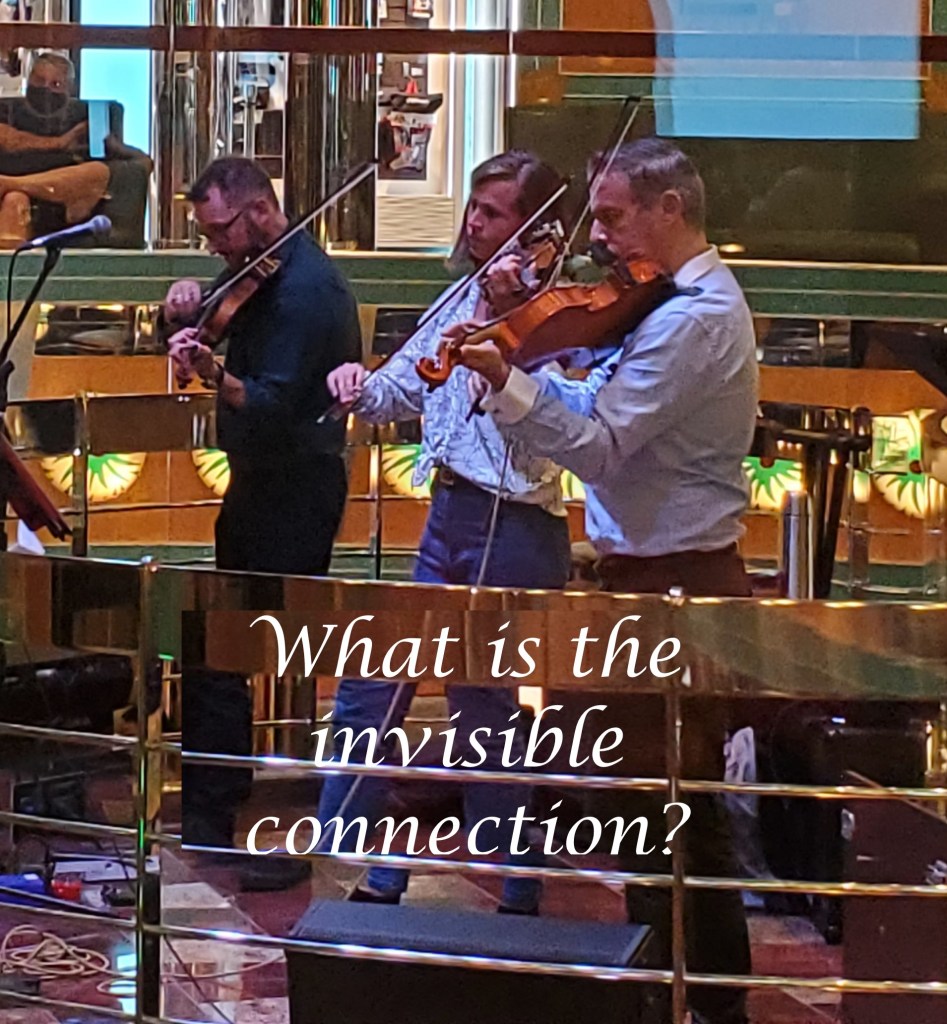
    Electric Waves Trio

    On a trip, mesmerized by the pure sounds of a trio of musicians, I approached them, telling them how much I enjoyed their haunting music. We struck up a conversation that wove in and out of days. I learned about their lives which made me appreciate them more. During their performances, I was riveted, connected to their music. Why? What was it about them?

    This makes me think of the connections I’ve had with certain volunteers. And staff and clients for that matter. What was it that drew me to them, and them to me? Did we share similar backgrounds? Heck no. Did we share similar experiences, thoughts, tastes, preferences? Nope.

    Was this connection instant, like a beaker in a lab, that when the mixture was just right, magic happened? Who knows? Science hasn’t yet thoroughly explained the chemistry or psychic connection we have with others. But it’s real. And it’s not always instant. And luckily for us, volunteer managers we get the opportunity to connect with a lot of people.

    I remember Yaz, the student who interrupted me one day because he “had to get this project done ASAP.” I was exasperated with him, but grew to love him like a son. His chaotic life was infectious.

    There’s Manny who always promised to show up, but seldom did. But every time Manny was around, I stopped everything and basked in his stories about growing up in the desert.

    Then there is Marta who I loved like my favorite aunt and I always found myself gravitating to her work station so I could be around her auntie advice and clucking care.

    Or Romero. I have no idea why I grew so close to this gruff, divorced, me-against-the-world patient, but I did and I was devastated when he died.

    Or Helen who irritated the snot out of me, but I couldn’t get enough of her wise cracking humor and her “take” on this pompous staff member who drove me crazy. We used to sneak off to the ladies room to chortle.

    Or Jose, retired military officer who had the best twinkle in his eye and the best darned chocolate chip cookies ever.

    Or Miriam, a patient who taught me how to listen through her barrage of criticisms, but let me into her world. And oh, what a world that was.

    Or Jay, a fellow staff member. We couldn’t be any more opposite in everything but he’s been one of my best friends for over 20 years. We used to tell people that we were brother and sister, (mom got around) and would then laugh at the shocked expressions.

    I believe as volunteer leaders, we learn to open up to people so we can engage them. We appreciate the complexities of fellow human beings. The chance to connect deeply with another person is a gift we receive through our efforts.

    Part of me would love science to explain why there is this magnetic spark, this connection with certain people. But part of me loves the invisible threads that reach out from me to them and from them to me. Those threads are rather magical.

    And frankly, in a complicated, often challenging world, a little magic goes a long way.

    And, when I sighed over not making much money, or not being understood, I felt the invisible strands linking me to others, like humming ribbons, that told me I was given the gift of connection. And those strands encouraged me in complex ways, to be better, to appreciate the gifts I was given, to fight for volunteer recognition and to grow as a human being.

    I can feel the strands humming around me now, connecting me to so many other amazing human beings. I am thankful for them, love that I have the opportunity to know them, and I hope, a better person for sharing in their incredible lives. Like music, our connections to others fill our lives with joy and inspiration.

    -Meridian

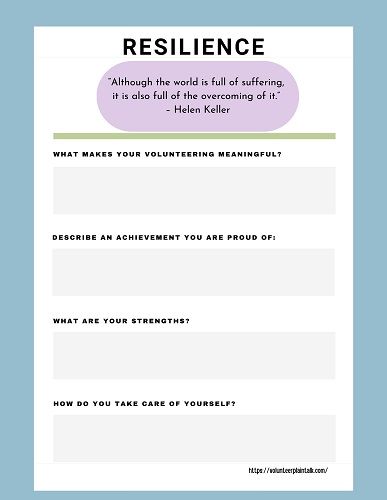
  • A Resilience Worksheet: Free Download

    Dare we ask volunteers, “how resilient are you?” Does nurturing a resilient mindset belong in volunteer meetings or in orientation? Is resilience in the face of change as crucial as policies, ethics, and the most valuable, urgent, significant, important phrase to throw at new volunteers; “by the way, we welcome donations too! And, here’s an envelope to take with you!”

    Discussing resilience and utilizing change scenarios when orienting or constructing workshops lays the groundwork for smooth change management down the road. It’s like a gift to your future self. It doesn’t matter if change is upheaval or small. Change upsets the status quo and we can nurture a “change is not the end of the world” mindset, so that when changes occur, volunteers are prepared to work through them.

    This free worksheet explores resilience and reframes this debilitating response to change: “Nothing will ever be the same.”

    page 1

    Hopefully, it will get your creative juices flowing and you will consider adding Resilience Nurturing to your volunteer mentoring.

    -Meridian

  • Never Forget, You Have a Hand in This

    Photo by Jacob Kelvin.J on Pexels.com

    Do you matter? Does the work you do matter? Are you feeling (mainly because there’s this pandemic going on) like “what difference does all this make?” Sometimes there are days like that, even weeks. That’s why I have stories that I clutch to my heart for times like these. Here’s one of mine in brief:

    There was something so familiar about her. Her eyes crinkled as she spoke. I’d seen that chin before, but it was her mannerisms that gave me deja vu. She was like reuniting with a good friend after a long absence.
    “I’m Bree,” she said, holding out her hand and we shook, a familiar warmth cursing through my arm. We walked back to my office and she sat down, her eyes taking in everything as though she had seen it before in another life.

    “My name is Bree Phillips and I want to volunteer here.” I didn’t recognize her name, but she continued. “I just moved here to be near my mother. Mom is getting older, and I need to take care of her. But I have some free time to give, and really, I’m here because of my father. He volunteered here many years ago.”
    “No kidding,” I said, still puzzled over the name Phillips, “who is your father?”
    “George Keenon,” she said.
    My mouth dropped open. “Your dad is George Keenon?”
    “Yes,” she answered, “do you remember him?”

    I knew him so well

    It suddenly dawned on me, those eyes, her chin, the mannerisms, I was looking at a clone of George. In that instant, I felt like I was sitting with him again, enjoying his stories of growing up on a farm, his love for family and helping others. George roamed the halls of the hospice care center, complementing the nurses and stopping to acknowledge a broken heart. I remember one day, when a patient asked to see Frank Sinatra, George agreed to “be Frank” and when he entered the room, she looked at him with a smirk and said, “whoa, you really let yourself go!” After that, our little inside joke was, “whoa, you let yourself go.” George was light and air and life itself all in one.


    Bree told me that before her father died, he told her to go volunteer at a hospice. “He was always talking about his experiences here,” she said. ” I swear, he had this long, great career in business, but he spoke more fondly about his connections to the patients.” Bree’s eyes brimmed with so much emotion. “I want to honor my father by following in his footsteps. I want to do something that lights me up the way it lit up my dad.”

    Do we ever really know?

    We, Leaders of Volunteers, operate in the intangible world: Goodness, Hope, Love, Charity, Personal Growth, Awareness, Connection, Discovery. Trying to measure these intangibles is like explaining why your dog loves you. He just does.

    We invest in people. But we don’t often measure our investment’s growth. We’re too overwhelmed with daily work to stop and take stock of our positive influence on volunteers and our missions. So, when these incidents like the Bree story occur, we stop spinning and realize that all of our work has far-reaching effects.

    You will never hear all the positive influence you’ve had. You’ll hear about some, but not all. That’s why I cling to my stories and quotes and even the look a volunteer gives me when they know, I mean really know that they have touched another person’s heart. I cling to the tears, the restarts, and the joyous celebrations. I fiercely hold the deep ache of volunteers’ souls when they share why they volunteer or their fears of inadequacy, or a pain from their youth.

    What we do know

    Maybe filling out a report doesn’t change the world. So, ok, making a quick phone call doesn’t alter the history of mankind. And sure, conducting a zoom meeting doesn’t solve societal ills. But look at all the good you produce. Look at your sphere and see what you radiate: Kindness, understanding, encouragement, belief in the goodness of others, acceptance, hope, inspiration, a willingness to listen and learn.

    You matter. Big time. And, do me a favor, ok? Forget for a moment the idea that you have to have earth-shattering successes to matter. Instead, feel contentment at how much you matter to so many people who may not say so. Feel satisfied that so much of your life is spent doing something meaningful. Feel fulfillment in how you engage and encourage people to be better. Embrace the satisfaction of knowing you’ve changed lives for the better. Feel privileged to have found something that fills your soul with meaning. Feel gratified that you are strong enough to go on.

    You matter to all of us

    We, volunteer managers are fighting for professional recognition, for more meaningful volunteer involvement, for seats at the planning table, and for volunteerism to be recognized as a society-changing force for good.

    Yes, we fight. But even the fighter has a moment alone, when the enormity of the fight presses down on wearied shoulders. Contentment comes, not from being complacent, but from understanding you matter.

    Let your “Bree” stories fill your heart to fight another day.

    -Meridian

  • #LoVols, You Are Growing Branches

    I’m guessing you don’t own the 32,000 page book, “Everything You Must Know About Engaging Volunteers, Part 1.” I have a copy, but I’m only on Chapter 73, “Volunteers who ask questions that are not really questions and how to address the criticisms hidden within.”

    (for my take on this thorny issue, see when a question is not a question)

    How do you describe our jobs? Engaging volunteers is in many ways like a growing tree. At first we struggle to understand the job. We’re green and new and easily blown by the wind. But then we grow, fed by the profound differences we see volunteers make, the sunlight of possibilities and the nutrient rich experiences our volunteers bring, not only to the work, but to us personally.

    When one has taken root, one puts out branches

    Jules Verne

    We grow, stronger in our conviction, taller in reaching for the sky, broader in understanding. And then, we develop branches that reach in all directions, adding to the living ecosystem that supports a thriving community.

    What a teddy bear taught me

    I think about volunteer Cara, who sewed memory bears for grieving survivors (memory bears are made from a garment the survivor provides that belonged to the loved one who died). A young man had died while serving in the military, and his family requested a bear be made from his Marine Corps dress blues. I immediately thought of Cara because she was an expert seamstress and her work was impeccable. She accepted, but a few days later, Cara called me with a concern. I assumed her concern had to do with the difficulty in working with the dress blues’ fabric.

    Cara came to see me and sat, tears welling in her eyes and told me that when she picked up the scissors and made the first cut into the uniform, she broke down and couldn’t go on. Her father was a Marine. So was her brother. She deeply understood what the uniform represented and cutting into it brought home the devastation the young man’s family was feeling. It was personal for her.

    From experience, comes growth

    In that moment, I realized that the volunteers who made memory bears didn’t just sew a bear. Through sewing, they entered a person’s life and pain when they cut into the cherished garment. They held a person’s grief in their hands, and stitched a lifetime of memories together in a teddy bear shape that could be hugged and talked to through tears. Those selfless volunteers experienced the aching loss a survivor felt for their loved one. And yet, they continued to sew.

    After that day with Cara, I asked a grief counselor to attend our memory bear volunteer meetings. Not only did the grief counselor share the recipients reactions to receiving the bears, she was able to help the volunteers process their feelings. Had Cara not been brutally honest with me, I might never have thought beyond the volunteers’ ability to sew a stitch. Thanks to her, I began to look at not only the memory bear volunteers and their well-being, but it opened me to look for other ways to support volunteers. I sprouted a branch.

    Hands-on learning grows branches

    Experiential learning teaches us to apply knowledge from doing. It forces us to experiment until we get things right. It propels us to take initiative to solve challenges. It makes leaders of volunteers think like visionaries. It gives us branches that reach high.

    Embrace your experiences. It feels like 2020 has given us way more experiences than we can handle, but it has also caused us to:

    • ask the hard questions
    • rethink systems and procedures and reimagine them in strategic ways
    • take initiatives to keep what is working and redesign what is not
    • be curious
    • look beyond the status quo to find better solutions
    • connect in new ways with peers, with staff, with the community
    • expand possibilities
    • examine our pre-conceived notions about the way things have always been done
    • evaluate our role in leading volunteers

    As I thumb through “Everything You Must Know About Engaging Volunteers, Part 1,” I notice there’s no chapter on “World-wide pandemics and the disruption of volunteering.”

    Maybe that will be addressed in Part 2.

    -Meridian

    P.S. I will be posting twice a month instead of weekly starting January 2021. Happy New Year all. I hope this year brings new joy, new experiences and new hope for our wonderful, complex and growing profession.

  • Yay, Another Holiday Card From a NonProfit!

    https://gratisography.com/

    So, last week, I posted a sharable holiday card for volunteers. Nice, huh, cause volunteers love getting cards from organizations, right? Cards mean we care, we appreciate (and we all know volunteer appreciation, no matter what it consists of, especially if it involves balloons, is the key to volunteer retention), we go the extra mile to engage our volunteers. What could be wrong with that?

    Volunteers love getting cards, right?

    Funny thing. Ironically, as I was sitting at my desk, on my laptop, posting the volunteer card, I was also looking at a pile of holiday cards I received from various nonprofits I’ve volunteered for. And my reaction to some of them? I just laughed. (Not the intended reaction, I’m sure)

    I laughed because I’ve been inactive at some nonprofits. I’ve not been contacted, surveyed, or asked what I’d like to do or heaven forbid, why I am not volunteering anymore. I’ve not been offered any “opportunities.” I basically sit on a list, like countless other volunteers. My name is a number.

    But, it’s my job, isn’t it?

    I have to admit, I’ve been mindlessly guilty of thinking cards mean the same thing to every volunteer. I’d think “hey, I HAVE to keep in touch with each and every person that even so much as breathed the words, “what’s this volunteering about?” I’d think, “how can I keep my hooks into this prospective volunteer?” And I also thought, “if I send this pretty card, surely that will make this inactive (or grieving or ill or suffering or unsure) volunteer whip out their phone and give me a jingle.”

    I could picture that volunteer, gazing at the glittery goodness, thinking, “wow, I’ve been so selfish. I need to contact Meridian. It doesn’t matter that the department she assigned me to never followed through. She’ll get me something better, I just know it!”

    So what if the message doesn’t resonate, it’s a pretty card!

    I knew a CEO who thought that volunteers would feel special getting cards signed personally by her. Never mind she rarely interacted with volunteers during the year.

    As a volunteer, I look at the cards from certain organizations as a waste of time and money. I actually feel that instead of connecting me to the organization, it has the opposite effect. The tone-deaf mindset alienates me further.

    So, don’t send cards? No, send them, but not mindlessly. Some of the cards I received included timely messages about the organization’s work. I find that more engaging than a simple signature. But a message to me as an active volunteer when I’m not, is tone-deaf.

    If I haven’t volunteered of late, messages such as “and thank you for volunteering this year,” reinforces the perception that the organization does not know me, nor cares to. Do I want to volunteer for them now? Eh, probably not, especially if I’ve not felt engaged when I did volunteer.

    In simple math, more volunteers=more work

    Once there are more than 30-40 volunteers, the ability to track them personally diminishes, which is why every volunteer manager needs his/her own volunteer administrative help to keep track of each volunteer’s status. Then, cards can work when a more personal message is included.

    And you know what? If one of the holiday cards I received had simply said, “We miss you,” I’d have felt like they were talking directly to me. I’d have felt guilty, intrigued, pleased, and motivated by those 3 simple words. Keep your glittery goodness. I want to be acknowledged as a human being.

    Glitter or Connection? Um, connection please!

    I’m involved with a start-up. I’m not getting a card from them. They have no regular meetings, no luncheon and drat, there are no balloons, ever. Everything is chaos. But you know what? They know me. That’s my glittery goodness.

    Managing personal connections with volunteers is not easy. It’s not simple. It’s not perfect. However, we can chip away at tone-deaf messages by looking at the causes and by forming solutions such as,

    • I have too many volunteers to keep track of personally: It’s easy to connect with volunteers who are outgoing, give a lot, are dependable, communicate, ask questions etc. Connecting with the rest of the volunteer team is challenging. Get volunteer administrative help now. Once I did that, things got better. A whole heap better. Here’s my complicated math equation. Every 25-50 volunteers=1 part-time volunteer administrative helper. I also had one designated volunteer to manage prospective volunteers. (she was so busy, she came in twice weekly. But you know what? More prospective volunteers followed through, thanks to her communication skills)
    • I’m unsure of volunteer preferences: Use surveys, whether informal or formal. Explain why you are surveying the volunteer-“because we want your experience to be a meaningful one. It’s a win-win for us, for you and for the people we serve.”
    • volunteers come and go, so I don’t know who is active, inactive, temporarily unavailable and I can’t create personal messages for everyone: Fair enough, so pay attention to language. What message would resonate or at least not sound tone-deaf? What would an active volunteer, an inactive volunteer and a volunteer who wants to be active, but can’t, all want to hear? Maybe scrap “thank you for volunteering,” and say something like, “every volunteer has contributed to our successes in our fight to eradicate homelessness” or “volunteerism is at the heart of our work and we want to acknowledge your contribution, past, present and hopefully, future.”
    • I can’t always know that a volunteer is sick, or their loved one died, or they got laid off: We can’t, and although it pains us, all we can do is be honest. “I didn’t know. You are valuable and we want to know your status, not because we want something from you, but because you are one of us.”
    • some volunteers are not returning calls, emails etc: This goes against every fiber of our volunteer manager hearts, but send the volunteers who are MIA a letter/email/card/call letting them know that they are welcome back anytime they wish to rejoin, but you are removing them from further volunteer updates. Then, remove them from the volunteer list. (OMG, it hurts to type “remove” and volunteer in the same sentencenooooooooooooo.) Keep them on general lists, because you want that volunteer to continue to be an advocate for your organization.

    To send cards, or not to send cards

    Are we sending cards because it’s always been done this way? It’s tradition? I’m not saying don’t send, but how much in volunteer management is done because it’s always been done this way? It’s time to re-think volunteer engagement messaging, language and methods.

    What resonates with your volunteers? 2020 has given us the opportunity to change the way we engage volunteers. As the leader of volunteer engagement and impact, look at everything with a fresh eye. You got this.

    Oh, BTW, here’s the holiday card I’ve always wanted to send:

    let’s be real

    -Meridian