“What can I get my non-profit staff, especially that mysterious volunteer manager, who seems to run around a lot?” You, my dear ED or CEO have come to the right place.
Forget that self help book, “Criticism is Our Way of Showing Our Appreciation.” Forget that subscription to “How to Be a Team Player by Keeping Opinions to Yourself” digest. Never Mind that “Quotes to Make You Humble” of the month club. Forget that framed picture of the senior management team at their annual retreat, ziplining over the 4 star resort.
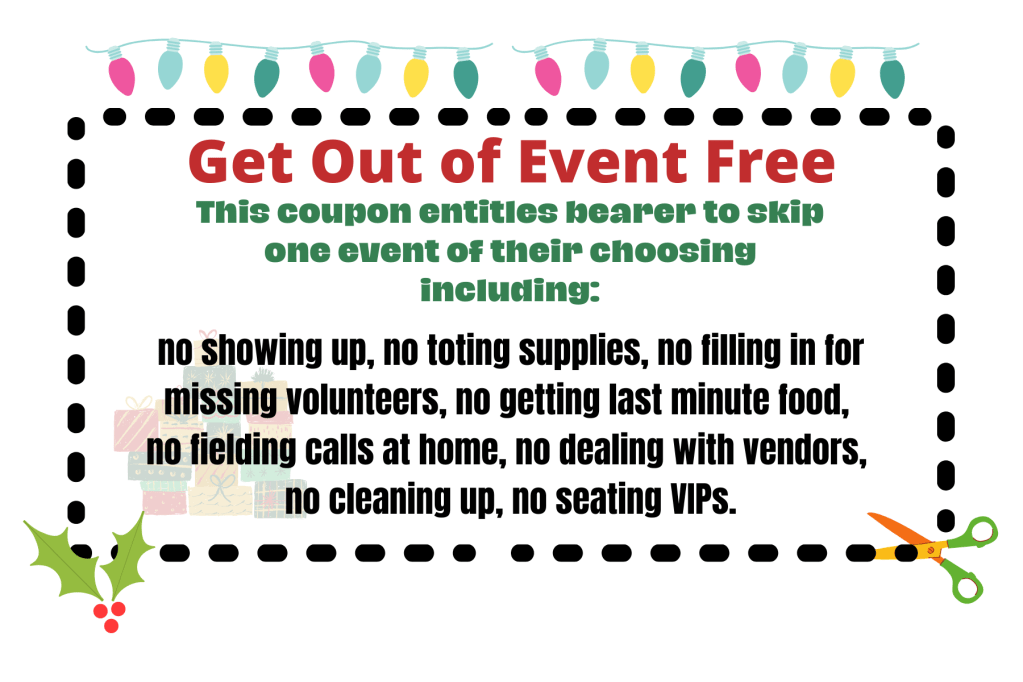
NO! Give a gift that really resonates with your VM. And, the best part is, it doesn’t cost you a thing, only a sheet of paper, a printer and a pair of scissors. And, as a bonus, in typical cooperative volunteer manager style, I’ll even throw in the printable voucher! (what a pal I am, right?)
The Obvious Gift That Every VM Wants:
Be Careful With This One
Oh Yes, Your VM Would Love This
And This, For When Things Normalize a Bit
Well Executive Directors, there you have it, the top four gift coupons for your volunteer manager. A few moments, a pair of scissors and you are done shopping!
And, oh, volunteer managers? Feel free to slip these under the door of your executive director.
Unless you really want another coffee mug that says, “World’s Best Office Worker.” Happy Shopping!
Nineteen year-old Dominick worked at the pizza joint a block away from the thrift store I was managing and needed court ordered community service .
Dom was angry, impatient, and didn’t really care about our cause, but he needed his job, so he sucked it up and came to my door.
I was des-per-ate for any able-bodied human to help me on the box truck I would borrow to pick up donated furniture, our highest ticketed items in the store. (I had anon-existent budget, butyou knew that already, didn’t you?)
Dom agreed to spend a day or two on a ride along and help me haul the furniture. I always made a route to save gas and the day Dom went with me, we talked, or really, he talked and I listened. He told me about growing up in the area, his brothers, some in trouble, his sisters, his mom, his deceased father, his struggles in school. He told me about making pizzas, how he wanted to own a business and gave me some tips on fishing in local retention ponds.
One of our stops was at a woman’s home. She had donated a few knick-knacks before, and called me to say she had some nice furniture to donate. (I only picked up furniture; I asked that all other donations be dropped off)
We arrived at her upscale house and she handed me a plastic bag containing some clothes. “I don’t have furniture for you, but,” she said, “I bought a new mattress set and I’m giving my old one to a friend who lives down the street. Would you mind taking it there?”
I held my tongue, rolled my eyes, said, “fine,” and Dom and I put the pristine mattress and box springs into the truck and headed down the road. When back in the cab, the door shut, I let loose, fuming, literally running at the mouth at the arrogance of this woman who was using a charity to deliver her goods.
Dom just sat there, watching me, my hands flying off the wheel as I vented my anger. He said nothing.
The friend was waiting for us, all smiles, and I kept my mouth shut, gritting my teeth against the hail of words that threatened to burst forth. We retrieved the box spring and she directed us to a bedroom where we deposited it on the empty bedframe.
We went back for the mattress. I could feel Dom’s eyes watching my clenched jaw as we picked it up and brought it inside, laying it atop the box spring, the friend gazing contentedly at her new treasure.
I stepped away, muttered “we’ll be off now,” to the woman and turned to see Dom walk over the mattress, his dirty boot leaving the most perfect outline on the white cover. The woman’s eyes went wide and I pretended I didn’t see it, while scurrying away. (kinda like when I’d noticethe marketing director coming down the hall.) Dom, chin high, sauntered along, without a care in the world.
We got back in the cab and I started the engine. Dom stared straight ahead, an imperceptible smile flickering over his lips. I drove in silence for a few streets, processing in my head what to say to him and then I bust out laughing.
Although I sweated for days, expecting a call from the CEO, none came. The lady never donated again. Dom finished his community service and I signed off on it.
But I did start ordering pizza from Dom’s pizza shop.
Difficult conversations with volunteers is one of our volunteer management things. We are all faced with having to “talk to” a volunteer at some point and we all hate the thought of “reprimanding” that volunteer. So, based on last year’s post, Difficult Conversations With Staff or Volunteers, I’ve condensed the points into a booklet you can download and keep for reference or perhaps you just want a reminder that you are not alone. If we, leaders of volunteers meet challenges head-on, we can turn them into opportunities. Oh, there is also a companion conversation worksheet to help you prepare. I’ve always found that the act of writing down your thoughts and affirmations helps to cement your preparation.
Volunteer managers: We are a sick bunch, aren’t we? We cry during the movie “Ghostbusters” because we feel bad for the ghosts. We stop and get out of our car to shooo a squirrel across the street even though he looks at us like, “hey, I’m walking here, crazy human.” We smile through pain and wonder how we can be better. Sigh. But no, I’m not suggesting using toilet paper to hastily scribble a “things to do list” with that pen tucked behind your ear while you’re..well you get the idea.
Jeez Louise, what extra work can help then, if I don’t mean staying late and spot checking those packets the new volunteer, Kira put together, because, frankly you don’t trust that she did them perfectly and mainly because you’re so tired of hearing that little huff sound from the events planner when she speaks of volunteers?
Burnout can occur when we feel like we’re not in control. Requests are pouring in from all departments. Volunteers need additional training. Recruitment has been spotty lately. There’s that volunteer that “needs a good talking to,” according to the director of operations. It’s overwhelming.
Some things we can ignore or put on the back burner, but they don’t go away, not completely. No, they are still there. That stuff rattles around in our heads along with things like forgetting to give back the dollar a staff member hastily gave you the day when the snack machine ate your money and you started pounding the life out of it.
So why take on more? The key here is to infuse yourself with an emotion other than the one that is crushing your spirit. The key is to be in control of something, something that lifts you up, that sparks your creativity, that gives you satisfaction. Something you own.
I’m convinced that one of the main reasons I stayed in this profession so long was the freedom to create something (and honestly, nobody gave me that freedom, I just took it). For me, volunteer management sometimes felt like trudging down a long, dark alleyway that eventually opened up onto a fertile plot of ground. I could see the fruits of possibilities taking root there: The trees, the flowers, and heck, sometimes the giant fountain of playful dolphins spurting water in all colors (if I had a really ambitious project in mind).
Creating a project that reflects your creativity, your passion, your idea of wonder injects hope into your veins. Just go to Disney World with a small child and look into their face. Magic does exist. We just need to find it in something we can call our own. We need to find it when we’re frustrated we can’t place highly skilled volunteers because there’s no pre-designed role for them. We need to find it when we see the possibilities our volunteers can offer our clients to make their lives better. We need to find it when our volunteers want to do more. We need to find it when the daily grind wears us down.
I recall the rush of emotions at the implementation of new projects. I felt terror, anxiety and doubt. But more than anything, I was exhilarated. And that exhilaration allowed me to view all my other duties in a different light. The mundane or challenging duties lost their power to crush me. And in my new mindset, I was able to find creative solutions to challenges that previously wore me down.
Successful projects you’ve created give you a new perspective, one in which you are a capable leader. Instead of waiting for some miracle day when everyone recognizes all your hard work, take it upon yourself to show how capable you are. How innovative you are. How committed and talented you are. Don’t wait for overwhelmed staff to give you this boost. Give it to yourself.
Because feeling like we’re not in control leads to burnout. All those mundane duties rattling around in our heads drag us down. But you know what else drags us down? Knowing, and I mean really knowing that a project, or a new way of engaging volunteers would work wondrously and then not doing anything about it. That’s the most soul crushing of all.
Sometimes, (not always-I’ve had a few projects fall flatbut I learned from them and started another, better one) a new project, one you own with your passionate heart and creative soul can help put that wonderment back into your life.
It’s ironic. More work = less burnout? Our best hope for encouragement = us?
Yeah, we may be a sick bunch. Wired a little differently. We lift up everyone else. Let’s lift up ourselves. Let’s take control.
“So, you’re a volunteer manager; what do you do, exactly?” We’ve all been asked the question and then that moment follows when we pause and mutter, “ummmmm,” because we really can’t explain volunteer engagement and impact in a few short sentences. Could we explain it in a paragraph or two? A book? An encyclopedia? Probably not, at least not in-depth. So, where does that leave us? Always shrugging our shoulders and feeling misunderstood because no one gets volunteer engagement the way we do?
Maybe we’re approaching this explaining challenge with too many expectations. Maybe we should look at it differently. Instead of an all or nothing approach, i.e. “you get it or you don”t,” why don’t we aim for something more attainable like an appreciation of volunteer engagement and impact. Maybe before we introduce folks to a college course on volunteer management, we should help them appreciate it first.
Think of all the things we appreciate but maybe don’t fully comprehend or understand, such as,
Our vehicles: Sure, we basically get how cars and trucks and SUV’s work, but do we truly understand electric motors versus combustion engines (and what is the four stroke process again)?
A good bottle of wine: Ok, we can pretend all we want, but do we really know what a hint of oakey or buttery (or waxy for all I know-yes I buy wine in the box) means?
Our animal friends: Do we really know why our dog won’t play with the green Frisbee but loves the yellow one or why our cat loudly meows down the hallway at night (jeesh, that can be unsettling) at unseen forces?
No, we pretty much appreciate things without having to know all and everything about them. We can do the same with volunteer management because what do the three examples above have in common? We appreciate transportation and fine wine and animals because they enhance our lives. Vehicles transport us around, open the world to us. Wine gives us pleasure. Animal friends provide us with companionship, entertainment, love etc.
In short, we appreciate the things we deem beneficial. So, the five words to untangle volunteer management from not being understandable to at least being appreciated are: “What’s in it for me?”
The more we show people how they benefit from volunteer involvement, the more appreciation they will have for volunteering, volunteers and the people who make it all happen (that’s us in case you weren’t sure). That’s why I believe we must add volunteer impact into our volunteer engagement conversations because impact holds the key to showing benefits. Instead of continually trying to “educate” others on the complexities of engaging volunteers, let’s show them the “what’s in it for me” volunteer impact first.
Volunteer impact is the concrete result of a volunteer’s time, talents and efforts. And since we, volunteer managers see all the positive results, we can translate these results into impact.
For example, traditional volunteer reporting says to the manager of fundraising, “our volunteer Jenny spent 26 hours last month helping make phone calls and putting together donation packets.” Then we normally add, “we need to keep Jenny engaged so that she continues to do this job.”
But by emphasizing volunteer impact, we point to the benefit of having Jenny volunteer by saying, “because our volunteer Jenny came in regularly last month to make phone calls and put together packets, the fundraising staff was able to spend 26 more hours on cultivating key donors. Last month they brought in 2 new large donations by donors who are now pledging to give regularly.”
Volunteer impact shows a direct correlation between a volunteer’s efforts and beneficial results. A volunteer impact equation looks something like this:
The key here is the addition of outcomes that dive deep into meeting mission goals and objectives.
Instead of skimming the surface by equating hours with money saved or time spent, volunteer impact directly connects a volunteer’s time to the goals of organizational missions. For example:
volunteers create valuable time for staff to accomplish critical work (because volunteer Sheri spent 6 hours this week training event volunteers, our event staff was able to spend 6 more hours preparing for the annual fundraiser, thus assuring a smooth event. The positive comments from attendees include, “such a wonderful event, the volunteer ushers provided us with so much information on the organization. We are impressed.”)
volunteers spend unhampered time working with clients, thus aiding staff in creating an atmosphere in which clinical staff can better do their jobs (because volunteer Juan spent 8 hours last month sitting with our client, Emanuel, clinical staff was able to spend 8 uninterrupted hours with Emanuel’s children, thus equipping the family with the coping tools they need to navigate their situation)
volunteers are “eyes and ears” for busy staff and can alert staff to potential problems, thus reducing valuable staff time spent in fixing problems and free them up to meet objectives (our volunteer Nan, during her docent shift was alerted to a hazard outside an exhibit and due to her quick reporting, saved us from a potential accident with legal implications. This gave staff the ability to quickly rectify the situation in keeping with our objective of providing a safe environment for learning and return to their crucial duties)
Using a volunteer impact equation means going beyond volunteer hours. The equation deep dives and reveals the impact of time donated and is the key to appreciating volunteers. It’s a fundamental shift. Instead of appreciating volunteers for the giving of their time, we are appreciating volunteers for the beneficial impact their volunteer hours have on our missions.
It is up to us to restructure our reporting and connect our volunteers’ time with mission impact. In the examples above, what is the impact?
Jenny’s time resulted in the cultivation of 2 new donors (mission goal: increased donations to continue the work)
Sheri’s time resulted in (documented by comments) a well run event and increased awareness (department objective: well-run event to increase awareness)
Juan’s time resulted in a family’s increased ability to cope (mission goal: equip families with the tools needed to cope)
Nan’s time resulted in a potential accident and lawsuit thwarted (organizational objective: provide a safe environment for learning)
Reporting impact requires a strong connection with staff and departments utilizing volunteer services so that we are privy to goals, objectives and direction. This is actually a good thing, for the more we connect with staff within our organizations, the more we receive helpful feedback, input and suggestions for volunteer involvement. From these connections, we can structure volunteer roles for maximum support. And, when it comes time to report on volunteer hours, we can then show the direct correlation between a volunteer’s time and the attaining of mission goals.
Existing in silos no longer serves us or our volunteers. As leaders, we can demonstrate the way for our organizations to grow is through partnerships between departments. Based on showing how our volunteers meet and exceed objectives and goals, we can then advocate for more volunteer involvement and for better organization wide engagement of our volunteers.
If we work towards an appreciation of volunteerism by answering five simple words, “What’s in it for me,” then, we just might begin to hear 5 other words, “We need to engage volunteers.”
Do you whip out a clever persuasion technique every time you want someone to acknowledge that volunteers don’t sit around by their phones waiting for us to call? Do you have that “special phrase” that always sways people’s opinions like “hey, volunteers don’t grow on trees, you know!”
Being a research junkie, I’ve tried a bunch of persuasion techniques when attempting to explain the complexities of volunteer engagement and impact. I’m not so sure they really work, though.
Some of the persuasion techniques I’ve tried are:
Wear the Power Suit of Authority: My power suit is like a suit of armor and must have been designed by someone who truly hates the human form. It’s uncomfortable, stiff and I sweat profusely in it, so when it came time to stand up at the annual soiree and recount all the glorious volunteer accomplishments, I dropped my notes while walking up to the stage and I tried to bend over to pick them up but the iron power suit wouldn’t budge so I kicked the notes over to the podium, but in the glare of the lights, sweat dripped into my eyes and I couldn’t see the statistics scattered about the floor so I just kinda laughed nervously into the microphone and “winged it” by announcing, “I don’t want to bore you with dry numbers. No, no one wants to hear that our volunteers gave a butt-load of hours last year. And I do mean butt-load! Instead, I want you to channel your inner activist and raise your fists in solidarity of the power of volunteering!” I tried to raise my fist in the air, but the rigid suit sleeve gripped my elbow like a boa constrictor so I ended up doing a weird fist salute which confused the heck out of everyone and they pretty much ended up elbowing each other in the face. Sadly, I got banned from presenting the following year.
Mimic the people you want to persuade: You definitely should use the terms and verbiage that senior management uses when they speak of goals and objectives, but for the love of all that is sacred, don’t mimic a senior manager’s accent or facial ticks or odd mannerisms, because that’s going way too far and you’ll get in trouble. Trust me on this.
Crying: Ok, to be honest, this just happened. This is not a recognized persuasion technique and actually thwarts your attempt to persuade others so maybe just try not to get really upset when people are ignoring you and chatting with each other while you are telling a poignant volunteer story about a cosmic connection that made a huge difference in a client’s life. Yeah, wiping your nose with your sleeve and bursting into tears does make folks notice you, but not in a good way. Oh, and FYI-it will most likely get you a session with one of the counselors.
Enlist Social Influencers: Getting a celebrity to endorse volunteering sounds so wonderfully effective, right? Yep, until that celebrity starts tweeting after a wild night, “Hey, guys, I #LOVEVOLUNTEERING for cash, so send lots to me, LOL! whoooooo!”
Make Volunteers Likeable: Doing a volunteer car wash where volunteers wash staff vehicles can actually do the opposite of making staff appreciate volunteers more. Hard to believe, right? I know because in the budget for the following year, volunteers were penciled in as extra custodial staff and our maintenance man blamed me for his hours being cut.
Use Sensory Imaging: So, misting lavender scented aromatherapy oil around the meeting room while reciting volunteer stats and then asking all the volunteers to wear lavender sprigs does not necessarily make staff remember that volunteers donated 230 hours last month and pretty much got me in trouble because production went down due to the “overuse of relaxing scented influences.”
Make Them Feel Scarcityor Risk Aversion: Uh huh, so maybe standing in front of the building and shouting at incoming staff, “If we don’t appreciate our volunteers more, they will leave! All of them! I’m not kidding!” just might not be the best way to convince someone. But I did get 3 unpaid days off to “go home and think about my actions.”
Compliment Them: Passing out heart shaped notes from grateful volunteers in a staff meeting might normally be effective, but once you stand up and say, “Our volunteers think you guys are the best staff ever, no really, they say that all the other organizations in our town have lousy, rotten staff who don’t love them the way you guys do,” might be going too far. Especially when you are on a roll and excitedly add, “oh, and yeah, you know the soup kitchen on main street? They’re the worst!” Because the CEO of the soup kitchen might turn out to be best friends with your CEO and well, let’s just say going through a “sensitivity training regiment” is pretty embarrassing.
So, how should we persuade others to appreciate volunteer management the way we do? I think I’ve read every book out there on the art of persuasion, including the best selling “Make People Hear You by Shouting Louder Than Everyone Else,” and in all the great advice, I may have found a different take on changing perceptions about volunteers, volunteering and volunteer management. And the funny thing is, it all boils down to 5 words.
Next time: The 5 words that just might hold a key to explainingdescribingillustratingdefining untangling volunteer management (yeah, I know, I’m setting up this big reveal thing and then it’ll be lame and disappointing and well, failure is nothing to be ashamed of–or so they tell me).
Sometimes I wonder if we should automate the volunteer inquiry process. Could we cut corners by creating an answering machine interview system for prospective volunteers? By eliminating the personal touch spent cultivating each new volunteer, I estimate we would save, like 16.9 years of our lives.
And heck, I’ve used every personality questionnaire out there, even the ones guaranteed to weed out “the potentially destructive personality.” I’ve asked “what kind of tree are you,” and “what would you do if you were in charge of the world,” and “who would you save if you had to throw someone off an overcrowded lifeboat.” (Hint: Watch out for the guy that says, “everyone else, including you.”)
So, if someone did create an automated answering machine system, would it sound something like this?
“Hello, you have reached the volunteer hotline. Please listen carefully with the listening skills you would hopefully use with our clients and select the number that best describes your desire to volunteer. Someone will get back with you shortly. As demand for our super duper meaningful volunteer positions is at an all time high, your expected wait time is 3 minutes.” (this is a blatant lie, but c’mon, it’s just the old marketing scheme that makes people think the volunteer positions are so popular that they’d better get one now before they run out). After some peppy music, “thank you for your interest in volunteering for our organization. Please select from the following options.”
“Press 1 if you have a sincere desire to help. You have no underlying reasons to volunteer other than you want to give back. You listen to directions, offer constructive criticisms and are punctual. You communicate well, take your volunteer position seriously and love being part of a team. Your expected call back time is 5 minutes or less. Actually, don’t hang up! A volunteer manager will pick up right now ’cause we can’t lose you! Hang on!”
“Press 2 if friends always tell you you’re a good person. Sometimes they tell you you’re too good for your own good. Maybe you are a bit hesitant, unsure of what you are getting into, but want to give us a try. You would love to socialize in a helping atmosphere. Your expected call back time is 20 minutes or less so stay put and start brewing a celebratory latte because you sound perfect!”
“Press 3 if you are saying you want to help because you think our volunteers are all nicey-nice and that’s what we want to hear. If you’re brutally honest, you need to be needed. Pressing the “like” button on socially relevant issues makes you happy, but only when you get a “like” for your “like.” Phrases such as “we couldn’t have done it without your help” make you tingly all over. Taking selfies with people in need ups your cred. Your expected call back time is 5 days or more. You might get bored in those 5 days and move on to something else, but, we’ll take that chance.
“Press 4 if you are the leader of a group such as a club, team or corporation. Now go back and press 1 if you sincerely want to partner with us and help because we would love to partner with you. You can do team building and everything. We’re down with that. If you kinda just want to use use us for PR and you expect us to accommodate all of your expectations because hey, it’s free help and we should be grateful, right, then stay on the line and listen to our canned music for awhile. Your expected call back time is 2 weeks or maybe a bit more.
“Press 5 if you have court ordered community service and you’re angry about it and will make sure to take it out on us or if you are under 18 and your mom is making you do this cause you were suspended from school and she is fooling herself into thinking this will actually help you get into college to learn something useful. You really hate the idea of being forced to endure all this feel good hokum and you laugh at us non-profit types because we are full of sh… sugary sweet stuff that gags you and robs you of your edginess. Your expected call back time is 10 weeks or more. A lot more.
“Press 6 if you can’t wait to get in here and straighten us out. You have the need to control and criticize and really want to run the show. You are unwilling to apply for a job in this organization, but would rather back door yourself in as a volunteer, cleverly thinking that we would never fire a volunteer, no matter how destructive they might turn out to be. You sling passive-aggressive phrases like a boomerang of hurt, saying “helpful” things such as, “no wonder it’s chaos in here,” and “who set up this god-awful training, I didn’t learn a thing!” You burrowed into your last volunteer position and waited, spider style until an unsuspecting staff member or other volunteer got tangled in your verbal stings. Your expected call back time is, well, let’s just say your information will just magically get lost in a trash web of our own. But thanks for calling!””
I suppose we could cut corners and just automate the upfront work we put into developing volunteers, but it wouldn’t work. No robotic system can come close to how good we are at fleshing out volunteer motivations and personalities. Maybe someday AI can learn to match volunteers with the role that will create a synergy between meaningful work that keeps the volunteer coming back while making a profound difference in the lives of those we serve. Maybe someday, but not today.
Maybe we are a lot more valuable than we think.
-Meridian
this is an update from an old post. Like almost 5 years ago…woah.
Well, I’ve been laid off. My organization just ordered 2 new robot volunteers. it’s a budget thing. See, the ‘roboteers’ don’t need lengthy policy orientation, or need someone to listen to their robot vacation stories, or need to call me for directions because staff mixed up Hunter Street with Gunter Lane.
Introducing, Compassion Nate 3000, and Evie Efficient XP. They have been carefully programmed by senior management to mimic what they believe real human volunteers say and do. Let’s look at their volunteering debut.
On his first day, Compassion Nate 3000’s eyes open and he hums, “I am the ultimate extra hands of helping.” Several pairs of robot claws unfold. He’s dropped off at a nursing home to visit Miss Aida where he scurries about, tidying up her room, throwing away the pictures her grandchildren drew because he mistook them for trash. Miss Aida wakes to see a metallic face peering down at her and she screams. Compassion Nate grabs her wrists and arms with several robot hands and holds her down, repeating in his electronic voice, “calm down human, I am your extra layer of caring.” Miss Aida continues to scream until one of the nursing home robots, Facility Friend 800 appears and puts Compassion Nate in a robot choke hold. Nate releases Miss Aida and turns, saying, “I am here to hold a hand.” He gives Facility Friend a crushing bear hug of loving support, turning her into scrap. A traumatized Miss Aida is subdued by real humans.
On Evie Efficient’s first day, she replaces all the volunteers who were scheduled to help at the walk/run. Assigned to the water station, she waits in the middle of the road. Her heart-shaped red light pulsating with robot love, she hands out water to the runners. As the startled runners make a wide arc to avoid her, she chases them, repeating in her robot voice, “I’m the cherry on top of our compassion sundae.” Frightened runners leave the course and run away in all directions, Evie zipping behind, throwing bottles of water at them. Her heart light morphs into a frustrated emoji face as she increases speed. “There’s no I in team but there’s a U in Roboteer, so let me care for you,” she emotes as she grabs the leg of a slow runner, tripping him. She uncaps a bottle of water and pours it over his horrified face, saying “I don’t get paid, because I’m priceless!” Law enforcement is called to quell the riot and an officer tasers Evie, who powers down, muttering, “Two hands….. one………. big…………………………. heart………………………………………… Daisy………………………….daisy…give me your answer true.”
Ahhhh, robot volunteers, such a great idea. But I think I’m going to sit by my phone tomorrow. I just might get a call.
“Coffee break again?” Clara laughs. “Yeah, this is my 6th coffee break today and I’m wired from all the caffeine. But each so called ‘break’ is with a volunteer who needs my attention. I’m not on break, I’m sustaining volunteers.”
Volunteer managers universally struggle with showcasing the complex work involved in the 3 “ainings:” Attaining, Training and Sustaining volunteers. We keep stats on all sorts of volunteer activities. We may even include anecdotal stories to illustrate volunteer impact. But how do we show everything we bring to the 3 “ainings” table? (Sometimes it feels like bringing a kiddie pool filled with water to describe the ocean.)
What if we had a report form that showcased the soft work required to attain, train and sustain volunteers? It would explain why our hard stats (shown in bold) are fluid, like an oceanic ecosystem:
DAY 1 at 9AM:Trusted my instincts to spend extra time with a 5 year volunteer whose partner has just been diagnosed with cancer. I can see he needs to take some time off and I have placed him on the inactive list thus reducing the number of active volunteers. He may or may not resume volunteering, but, due to his positive experience so far, will remain an advocate forever. I will be spending time to check in on him periodically because I hope he returns to volunteering, but also, because I care about him as a person (and make no mistake, our volunteers know the difference between sincerely caring about them versus giving them lip service). My personal attentionto volunteer needs increases the overall number of active volunteers. It also creates satisfied volunteers who will advocate for us no matter whether they continue volunteering or not.
Day 2 at 2PM: Realized that a situation requiring a volunteer was overwhelming for just one volunteer so took the extra time (three days) to find and enlist the right two volunteers who could support one another while dealing with a very difficult and challenging assignment. Did not meet goal of finding a volunteer in 24 hours, but instead, created a better outcome that avoided placing an excellent volunteer in a difficult situation. I retained two key volunteers, ensured our client received excellent care and thwarted a potential misstep.
Day 3 at 11AM:Temporarily removed a marketing volunteer from staffing events because of recent health challenges. Although volunteer insists that he is physically able to carry boxes, his wife informed me that his doctor has prescribed no lifting or standing for three months. As a result, I reduced the number of available marketing volunteers but salvaged this volunteer’s future potential and eliminated the substantial risk for a workman’s comp claim should this volunteer injure himself while under his doctor’s orders. More importantly, we sent a message to all volunteers that their health and well-being is important to us and we view them as valuable assets, thus increasing overall volunteer sustainability. I am currently exploring other areas with this volunteer and he is interested in moving into a deeper volunteer experience, so with additional training, we will have a new client volunteer who, BTW already hasproven himself to be a great volunteer.
Day 4 at 3:15pm: Spent 45 minutes with a prospective volunteer who admittedly can’t volunteer until sometime next year. This prospective volunteer’s father was helped by our organization and she is interested in giving back, although current commitments are preventing her from taking training. I have set reminders in my calendar for scheduled contact with her throughout the year as I perceived her as an excellent future volunteer. Rushing her at this time will only increase her overload of responsibilities and will cause her to quickly quit. As a result, no new volunteer stat has increased but time spent will pay off in the future because this potential volunteer also belongs to several key civic groups that I have been recruiting.She’s already booked a speaking engagement for me next month.I expect several new volunteers from forging a relationship with this group.
Day 5 at 6pm: Attended funeral of long-term volunteer who retired due to health reasons more than two years ago. No stat will be affected, but I did it because this is the right thing to do. *Addendum: Received a phone call from the volunteer’s son whom I spoke with at his mother’s funeral. He is a VP at the largest investment firm in our area and is very interested in setting up a corporate volunteer program with me. There will be substantial work involved. And, BTW, he and the firm will be donating in his mother’s name.
The soft work we do is an ocean compared to the kiddie pool stats we report. Our instincts flow like a current, over and under the waves of volunteer requests. We create an ecosystem in which results are symbiotic and may take up to weeks or months, sometimes years to see. We nourish relationships that reach beyond volunteering and affect donations, future staff, community standing, and so much more.
It’s time we begin to connect the hard results from the ocean of our soft work.
I answered the phone one day to hear, “Yes, this is Juan, the son of Adelia and I just received an invitation in the mail for my mom to this year’s volunteer luncheon. She died. Last year. I thought I’d let you know.”
“Ohhhhhh, crap.”
I also vividly remember sitting at a sign-in table for an invitation only event attended by donors, volunteers and dignitaries. And I looked up to see the volunteer we dismissed two months before presenting the invite we sent him.
Countless volunteer managers have said that the first thing they had to do when they came on-board at their organizations, was purge hundreds of volunteer names off the list.
We have a difficult challenge because we don’t manage employees. Employees are either in or out. They’re working or they’re not. They don’t get paid once they quit, move, get fired or die. They are removed from rosters and lists and don’t get official invitations or phone calls. They don’t get calls asking them to “please, just come in for a few hours because we need extra help this week.” Nope, doesn’t happen. We can’t do that. Our volunteers don’t get paid. They exist in a grey area. And we work hard to keep our volunteers engaged enough in this grey area so they return again and again.
We worry that if we remove a volunteer due to temporary inactivity, we will forget to contact them and therefore, lose them permanently. I remember the thought of forgetting good volunteers was more horrifying to me than leaving my stove on.
But when can we remove volunteers from an active list? After six months, two years, death? The problem with keeping volunteers who are not active on an active list, is we can’t give an accurate volunteer count. If we say we have 125 volunteers, then staff assumes we have 125 volunteers to choose from when they make a request. That’s far different from choosing from 60 currently active volunteers.
So, how can we keep volunteers, yet not confuse temporarily inactive volunteers with active ones?
Enlist the help of a key volunteer. Ask your volunteer to help maintain a current list by making check-in phone calls. Not only will you be able to distinguish who is active at the moment, you can ask the key volunteer to conduct an informal survey on satisfaction, training, communication or any other topic. And this periodic “checking in” will flesh out problems before they get out of hand.
Send the volunteer newsletter to all volunteers. Keep everyone in the loop. Newsletters are great for showcasing new projects, calls to action and for encouraging inactive volunteers to get involved again.
Remove the “quitting” stigma. Assure volunteers that you don’t view stepping back as quitting. Show them you have other volunteers on a temporarily inactive list and explain there are many reasons for volunteers to step back. Encourage them to take time they need and let them know you will be checking in with them periodically because they are valued.
Keep several lists or use templates that allow you to sort. I’m a big proponent of categorizing volunteers by locale, assignment, training completed, and current availability. It gives a much clearer picture than putting all names on one list. We wouldn’t expect all staff to be listed as substitutes for social workers or accountants. (“Hey, call accounts payable and see if one of their staff can come and do wound care for a day.”) It’s no different with volunteers. If your volunteers need specialized training for an assignment, then just like staff, only those volunteers who have had the training should be in that category.
















 volunteerplaintalk