
 Coretta is a striking 85-year-old artist. As she enters a room, images of her as a young, startlingly beautiful woman trail her like ethereal mists. Her blue eyes take one in from a perfect face and I feel like a mouse scrutinized by an eagle. Her husband Glenn, is a commercial artist and they have shown me pictures of his artistic product designs for major companies, most of them from the 1960’s. They shared these pictures to show me they are legitimate. Luckily, they seemed to like me.
Coretta offered to design a journal for our use. The journals would be given to patients or family members who would like to record their thoughts. The journal would have poetic prompters to help them visualize things to say. Coretta has written short haiku poems to be incorporated into the sides of the pages, giving the journal a professional quality. She and I corroborated often about how to distribute the journal, types of patients and methods of discovering how the journals were utilized.
As we worked together, Coretta told me in her breathy voice that she had gone to another agency and was initially welcomed with enthusiasm. She was going to paint a flowering vine for their lobby that would be filled with pictures of the clients served. She mused that it would be not only a lovely welcoming addition, but also a therapeutic exercise for the participants. Trouble is, as with many short-staffed, overworked organizations, no one at that agency could take the time to help her get started.
Frankly, if I let myself say it, I’m also too busy for the fluffy projects. But, there was something about those blue eyes that compelled me to scratch out the time from somewhere. And besides, I have gotten a bit self-serving. I need breaks from all the minutiae that weigh me down. Coretta let me float for just a bit.
My plan was to ask some very crafty volunteers to put these journals together and to begin by distributing them to select patients. Over the years, I’ve found that asking for permission to do a project takes forever, so by experimenting and proving that a project works, it makes it easier to sell. Anyway, we finalized her designs, complete with a Coretta sketch of a rose adorning the cover.
She stopped in the other day to talk to me. As we were chatting, she said, “I have been thinking about this whole project. I’m certain that other organizations would like to have it for their clients too, so I think that I would eventually like to market it. That is, after we’ve seen how it is received here and after some modifications.”
Boom, the eagle swooped in and ate me as I was nibbling some cheese. “Oh, how interesting,” I managed. Now, at that point, my brain started shrieking at me, “What!!!! Are you kidding???” And as I let those initial thoughts burst and flutter like confetti in my mind, I looked back into those blues and said, “Coretta, that is your prerogative. This is your work, your ideas, your poetry and art. You own that.”
She nodded with an artist’s smile and I continued, “if you want to do that, then we absolutely can’t use it here and stamp our logo on it. It is yours and you are entitled to keep it and protect it. But I cannot in good faith continue with this project.”
She studied me for a bit and said, “yes, well, I appreciate your honesty.” I could feel her talons caressing me, the me that spent precious time helping her. “I appreciate all your hard work and have thoroughly enjoyed learning about your organization.”
I didn’t say anything to anyone, especially anyone (well, everyone if you must know) who has been making fun of me for wasting my time with this pompous (their words) lady. Honestly, they wanted nothing to do with her.
See, here’s where I sometimes get myself into big trouble and then sometimes I uncover a golden volunteer nugget. I have to do more than just get to know people who want to volunteer. I have this weird side that feels like I’m digging for the next great volunteer. I’ll bet you have a side like that too.
While I’m not sure what will happen, because Coretta may rethink and decide to give her works to us, but really, I doubt that will happen. Did I waste my time with her and did she just want to use me to develop a product to sell? Maybe, but I’m choosing to think not. I’m choosing to think that she had good intentions, at least at the start. And we all know that there are plenty of volunteers with good intentions that don’t continue for some reason. We can only move on.
So, the question becomes, do we continue to dig, oftentimes alone for those volunteer nuggets even though we occasionally come up empty-handed? Until the day volunteer nuggets rain from the sky, I guess we’ll have to.
-Meridian
Tag: managing volunteers
-
If It is Too Good to Be True…
-
The Door Shuts
 This is a tough story to tell, partly because it’s hard to find those keeper nuggets of truth that help the rest of us navigate our jobs. Sometimes, I think things just are and maybe really these experiences are like everyday life. You can’t predict them and the only way to prevent them is to stop living.
Cara is a wonderful volunteer coordinator with a big heart as almost all volunteer coordinators are. She’s been doing this for years, has mentored and seen at least a thousand volunteers come and go. She has wisdom and has honed her instincts like a blacksmith with a prized sword.
Several years ago, Cara met a young woman, Gwen, who showed an interest in volunteering. Gwen was hesitant, but hopeful and Cara encouraged her, letting Gwen take small steps to find her niche. Gwen rapidly blossomed into what Cara describes as “one of the most gifted volunteers I have ever encountered.” Gwen was magic with clients and had a presence that allowed even the most downtrodden individual a voice. Words such as “angel,” “like my own grandchild,” and “my confidante” came floating back on waves of gratitude.
Cara quietly mentored Gwen, preferring to stand back and let Gwen’s innate ability flourish. As they spent more time together, Cara learned that Gwen had a difficult childhood. She was estranged from her mother and Cara, ever the professional, did not step in to fill those missing shoes. Instead, she listened and encouraged, much the same as she did with all of her volunteers. But this one, this one was like the Derby winning horse in the stable. Gwen was worth the extra effort because the clients deserved the best volunteer help.
As the years went on, Cara heard more and more about Gwen’s chaotic life outside the organization. She had a family and a job and troubles seemed to swirl around her in a cacophony of drama. But Gwen still had that touch with clients, and although Cara’s radar now went up, she carefully kept watch on Gwen’s volunteering.
Occasionally, Gwen would drop in and cry for twenty minutes. Illness, fights with her husband, disagreements with her boss, run-ins with parents of her children’s classmates would knock her world out of orbit. Concerned, Cara suggested counseling and one day Gwen came into the office sobbing about her counselor. Cara immediately removed Gwen from any and all volunteering. She told Gwen to please concentrate on herself for a change. What Cara did not say was that she now thought Gwen an inappropriate volunteer.
Their relationship morphed into Cara’s trying to help Gwen but with none of the volunteering. I asked Cara why she continued with Gwen and she said, “you know, it’s not that easy, just giving up on someone who hasn’t done anything wrong. Clearly she needed help and I had forged a relationship with her. I couldn’t just turn my back on her. And besides, when you see flashes of brilliance in someone, you can’t help but think that they are salvageable.”
At some point, Gwen became angry with Cara, and stayed away for a bit, but then came back and Cara tried to help again. At this point, it had been two years since Gwen had done any volunteering. The second time Gwen got mad, Cara shut the door and now has no plans to re-open it. “I’m done,” she says. Does she miss the opportunity to help Gwen reclaim greatness? Not as much as you might think. She says, “it was like I could feel the flutter of a page turning. I feel finished, and I’ve done all I can. Besides, I have other volunteers to mentor.”
I asked Cara if she thought once Gwen got her life under control, would she be able to return? “Honestly, no. I think that was a time in her life when volunteering fit and made sense. It will be impossible to recapture.”
I’ve always thought that volunteers have a shelf life. Whether illness, moving away, disinterest or inability to function in the best interests of the client are the reasons, it won’t matter. When it’s time for a volunteer to stop, either by our request or theirs, then it’s time.
Can we compare volunteering to art? I think so. Some genius is tempered with madness. I don’t think it’s a stretch to apply that to our brightest volunteers. I’ve seen them. Brilliant volunteers who paint masterpieces like van Gogh but are burdened with issues that often become too much. It’s sad and we walk a fine line between encouragement and interference. We want not only what’s best for those we serve, but also what’s best for the volunteers. Sometimes, even we can’t make that happen. We can only do the best we can with what we have to work with. And who knows how well service fits within a volunteer’s view of the themselves and the world. We have to be able to let that door shut when volunteering no longer works for the clients and for the volunteers.
If we can’t, then we’ll go mad.
-Meridian -
I Wish She Had a Volunteer
 A story that is circulating about a terminally ill woman, known as the Layaway Angel, really made me start to think about all the clients we serve.
Layaway AngelAn excerpt from the story reads:
“Everybody wants to go back to school with new clothes,” said Store Manager Joyce Beane. “Now 16 more families can do that.”The families had all fallen behind on their payments.
Enter the Back to School Angel.
“She was here about 15 minutes. She paid off 16 the layaways in cash, about $3,000. Then she said I’m not feeling well I need to leave,” recalled Beane.
My first thought, (as a manager of volunteers) was, wow, I hope she is on hospice and I hope she has a volunteer. It sounded like she entered the store alone and I immediately pictured in my head a smiling volunteer accompanying her, helping her walk up to the counter. I thought about this lady’s last days, maybe sans family and friends and how a caring volunteer could sit with her, reminiscing about her life and doing, well, what a volunteer does best.
I thought about that until I stopped thinking like I had my office phone in one hand and the computer keyboard in another.
It’s ingrained (and I mean cemented!) into our cranium that we “see” the potential for a volunteer. Scrape a knee? A volunteer can bandage that right up. Need some Twinkies? I think a volunteer can run through that Quickie Mart just fine. See, that’s how we view the world. How do our volunteers fit in to help?
But then I don’t know this woman. I don’t know her condition, her life history, her wants, needs, pet peeves or personality. Maybe she wouldn’t want a volunteer. Maybe she’s super independent and wants to be alone. Maybe she’s a person who doesn’t need help. (Whoa, that’s not possible, is it?).
Then I started thinking about all the volunteers who tell me how much they learn from the people they serve. Maybe a patient is using a volunteer, Jose to just sit with him while his wife goes to the store. Jose, who is trying to perfect his English, ends up learning that the patient emigrated from Italy and struggled to learn English, but managed to raise six kids who all became successful. Or Claudia, who while visiting a patient learns that the patient lost a child many years before. And Claudia, who had also lost a child, finds a deep connection with this patient, finding solace in her visits. Or the volunteer, Karen, who was just laid off, volunteers with clients who survived the great depression.
Honestly, who benefits more from the relationships that are formed between volunteer and client? Volunteers always say they get more than they give and they are probably right. Those who volunteer doing the one on one work get hooked and want to do it again and again. It’s an addiction to soul candy. And ironically, the ones who get the most from their volunteering are not the needy ones nor the selfish ones. No, the ones who get the most are the ones who approach it with humility, by putting the focus on the client. The more they do that, the more they reap the rewards. Those who go looking for soul candy are usually so distracted by their own needs they miss the trail of candy bits that leads them to the dish. So, when I look at that story, and think like a volunteer manager, I wish she had a volunteer because I try to imagine the help a volunteer can lend to her journey. I have to admit though, I don’t know what that might be.
But can that Layaway Angel teach a person lucky enough to volunteer for her something profound about life? Hmmm, it sure seems so.
Therefore, I stand by my original wish. I wish she had a volunteer: But maybe someone to teach. I kinda wish it were me.
-Meridian -
The $100 Tip
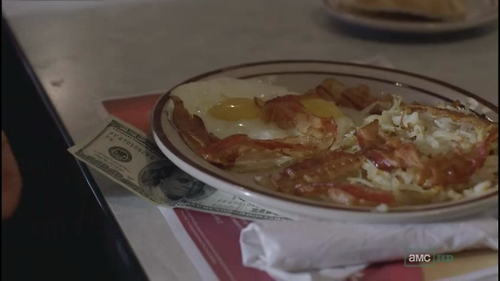
 A friend of mine who is going to school and waitressing on the side messaged me a picture of an $89 food tab with a $100 tip written in. I asked her what she did differently to garner such a lavish reward and she said, “Nothing really, I just did my job.” As we talked, laughingly speculating whether it was a mistake, a “bucket list” checked off, a stalker and other hosts of wildly imaginative scenarios, we finally left it at “one of those special out of nowhere moments that cannot be explained, not fully. It’s the sun peeking out of the clouds, glorious and full, the five dollars you find in your pocket when you’re talking yourself out of that latte, and man who chases you down after you’ve dropped your new phone.
It got me to thinking. Volunteer managers work tirelessly, mainly without praise. We can empathize with the mom who drags herself out of bed at 5 each morning to drive her son to hockey practice, then puts in a full day of work. The Stanley Cup will go to him as she stands, far back in the crowd, her tears borne from sleepless dreams.
But then, there’s the $100 tip. It comes when you least expect it, but need it most. A volunteer wins an award and someone thanks you for mentoring that volunteer. A project that took you years to finally iron out takes off and someone claps you on the back. You’re at a general assembly and something you initiated years ago is highlighted and the speaker finds you in the crowd and says, “you started that way back, didn’t you?”
Or, a volunteer phones you to tell you that he broke through to a client that everyone wanted to help but couldn’t seem to find the right phrase or the perfect moment.
Why does that moment show up when we’ve just told ourselves that we could make more money with less work selling jewelry? Why does it seem to know exactly what we need when we need it? And how often do we need it?
I’m always struck by how volunteer managers are not driven by praise or someone else’s definition of accomplishment. It seems our measure of success lies internally from the instinctive knowledge that accompanies each and every volunteer assignment. Although “big” accomplishments are nice, we revel in the day to day small accomplishments of each and every volunteer. It’s like standing on a bluff and looking at the beauty of the forest below. It takes each tree to create the breathtaking scene.
This doesn’t mean that I don’t like getting an unexpected tip now and again. Nope, I love it, and frankly need it as much as the next person. But I also have to realize that I’m not working for $100 tips. I’m working because I know that the forest of things volunteers accomplish mean a lot to the people they are helping. It’s not flashy nor opulent. But then, neither are my expectations.
-Meridian -
The Mulligan Volunteer
 If a Mulligan is a “freebie”, then Phil is my Mulligan volunteer. All right, I actually have more than one, so don’t tell anyone. I keep Phil on the active volunteer list even though he hasn’t done any volunteering for ten years. Yeah, he’s active only in my mind. Why do I hold on to him?
Well, let me tell you about Phil. I have known Phil now for oh, about 17 years. He came to volunteer when I was just an idealistic blob of volunteer coordinator tissue to be molded by good old-fashioned experience and opinionated volunteers. I was hopeful, scared and curious all at the same time. But I digress.
When I first met Phil, he was an old pro at volunteering. A retired executive, Phil had smarts, energy and that electric smile. I leaned on Phil a bunch. He took difficult cases. He made me laugh and learn. He once drove 30 miles to bail me out on an assignment. I never, once, heard a negative breath come out of that man. Inspirational? I’ll put him up against Gandhi in the Inspiration Olympics. Caring? Let him get in the Care ring with Mother Teresa, cause she better look out for his right hook. Willing? Well, you get the idea.
Phil has been getting older. He’s had to pare down his volunteering activities to about seven. No kidding, that’s how much he does. And, as he weighs what he can do, it all boils down to convenience. At his age, that’s a huge consideration. So, the fact that he can’t really help us out anymore is no reflection on our mission or treatment of him. This, I understand.
But let me tell you the real reason I keep him on the active list. Phil takes in homeless people. Yep, takes him into his home to live. Homeless vets, homeless families, he quietly takes them in to let them get back on their feet. His friends (and even some of our volunteers) have warned him that he could be inviting trouble, but Phil just shrugs. “Someone has to help.”
How do you measure a man like that? I’m always astounded at how Phil lives his life. He’s not going to be featured on any news show. He wouldn’t want it anyway. He’s not going to be elected Mayor of his town. He’d hate that. He lives his life by serving. I was just lucky to have him cross my path for a while. He’ll always be “active” to me.
I think we all need our Mulligan volunteers. In my organization, we have emeritus volunteers. These are volunteers who can’t help anymore, but they are invited to every function we have. They’ve earned it. Phil earned it the first week he volunteered. I think of so many of them, who give their all and when they can’t anymore, have to bow out. For the sake of my own soul, I cannot let them fade away. They love to teach others, speak to orientations, mentor newbies, write policy and mainly just chat. Although the chatting part takes a lot of precious time, after a conversation with one of them, I always end up feeling like I’m home. And because I’ve been doing this so long, I fear that no one else will remember. I sense these valuable volunteers slipping away like forgotten stories never written down.
I think of all the phone calls I need to make and it’s overwhelming. But I have to find the time and energy. If Phil can open his home to homeless strangers, I can certainly open my heart to emeritus volunteers. They are a as much a part of volunteering as the fresh face. I can’t let them feel anything but honored and never forgotten.
And though I won’t get any productivity out of the time spent reconnecting with emeritus volunteers, I know it is the right thing to do. And how much of our jobs is about doing the right thing?
I think I’ll start with Phil.
-Meridian -
Volunteering: Well-being Gained or Brought?
 Jess is a petite brunette who brings a tranquil aura to her volunteering. She is positive, sensitive and gracious. That is, until a few weeks ago. I noticed something slightly askew when she complained about not having enough forms to fill out. She seemed irritated and preoccupied. I caught her a week later staring vacantly into space, and when spoken to, uninterested in the conversation. I had to ask her what was wrong and she reluctantly confided that her son just entered drug rehab. Ahhh, of course. Personal problems push aside tranquility like a schoolyard bully with the new kid.
Jess just wasn’t here, not 100%, and I suspect not even 50%. So, how does volunteering fit in with Jess’ definition of well-being?
As I pondered Jess’ circumstance and wondered if her volunteering gave her some sort of welcome distraction or if it just crowded her thoughts, I started thinking about how we “sell” volunteering by talking about how good it is for the participants. This caused me to reflect on the thousands of conversations with volunteers about their personal circumstances. It occurred to me that the vast majority of volunteers came with well-being already intact. We didn’t create well-being for them. We may have enhanced it, we may have filled a void, added a dimension, helped with grief, paved a way, helped fill time, boosted self-esteem, and maybe even helped mend a heart.But in all those cases, we added, not created. This was a sobering thought for me. I’ve had volunteers who were forced to come, whether by a parent, spouse, school, court or a friend. The door for them is often shut. I think I’m kidding myself if I believe that I can make them a volunteer in spite of their resistance. They have to give just a little.
I remember Jana, a crushed human being. She came out of real desperation. She took over a year to start actually volunteering. Her beginning was spent healing. She made it with real determination. But the point is, she made it because she always wanted to make it and was willing to open up and find how she could. This becomes a tightrope walk for volunteer managers. How do you encourage someone to volunteer without letting them “experiment” on clients? It takes a great deal of patience and time and effort. It can be exhausting, especially since you have so many other volunteers to mentor. I think volunteer managers take personal pride in helping someone through volunteering. But I think, too, we don’t kid ourselves into thinking that volunteering will “fix” anyone.
I think of Antoinette, whose grown son had died 12 years before. She had hoped that by volunteering, she would find a way to fill the hole in her heart. She volunteered for 3 years, and it never happened. She spent the vast majority of her volunteer time talking to me about how her son’s wife was a negligent mother. She hurt, and no amount of volunteering helped. As a matter of fact, very early on in her volunteering, I once found a family member comforting Antoinette. After that, I kept her away from clients. Antoinette’s volunteering was exhausting. Other volunteers asked me why I put up with it. Honestly, I don’t know, but I suspect that somehow, I thought volunteering had this magical quality to it. I’m not so sure anymore.
I’ve had people tell me that volunteering has changed their life. What I think now, is that volunteering opened the door for a part of them that was always there. And if that’s the best we can do, then I’m pretty proud of that. Because it also means that we don’t have to continue to blame ourselves if volunteering doesn’t work for everyone. It’s not a salve or an elixir or a magic pill. It is an act of putting oneself aside to help someone else in their time of need. It takes a certain amount, even if it is miniscule, of well-being to volunteer. We, volunteer managers, can usually find that well-being fiber that allows someone to give selflessly. We love to cultivate it and make it grow.
But we don’t have drawers full of magic pills to hand out. Our drawers are full of the stuff that helps us do our job, like listening skills, discernment, patience and good, sound judgement.
And so, I now think that I’ve always been looking for volunteers to come and be well, not come and get well. Our clients certainly deserve that.
-Meridian -
The Robot Volunteer
 If you’re a sci-fi fan or even just a fan of good old science, you know the advances being made in robotics. From the robot vacuum to the automated assembly line, we are seeing robots take over repetitive jobs. They’re everywhere; their little stiff knees are walking them into all aspects of our lives.
So, I know you’ve imagined it. I know you’ve thought about it: The day when they create a robot that takes the place of volunteers. Here’s how it goes. You just program in exactly what task you want the Roboteer to perform and voila! The task is completed with no calling in sick, no lengthy vacations, no listening to it talk about it’s Roboteer life, no questions, and no job that you have to re-do.
You need a Roboteer to mentor a child? Just program it to have a digitally compassionate voice. You need it to help set up an event? Just program it to go all day and never sit down for a glass of water. What about meals on wheels? Well, just program it to not only deliver the meals, but to spend 15 minutes giving the shut-in some socialization. And when the 15 minutes are up? It shuts down on that needy shut-in so that it is never off schedule. What a perfect solution it is. Why not? You wouldn’t have to pay volunteer managers and besides, volunteers are ancillary anyway, right? And they do repetitive jobs, don’t they?
I’m picturing it right now. Somebody (not me, I’ve been laid off) gets a request for a volunteer to visit a patient in a nursing home. That somebody opens the closet, turns the key on a spiffy metal pal with a name like Compassion Nate 3000, and programs the coordinates in. The eyes open and it hums, “I am ready to serve”. Then it’s off to the nursing home, where it zips into the patient’s room. Our patient, Miss Aida, who has been dozing, wakes to see a metallic face peering down. Miss Aida starts screaming as Compassion Nate grabs her wrist and in a soothing electronic voice says “calm down, I am here to serve you” over and over. The patient continues to scream until one of the nursing home robots, Facility Friend 800 comes in and tries to remove Roboteer Compassion Nate. Nate, being the newer model, pulverizes Facility Friend, turning her into scrap. Miss Aida, now traumatized, is subdued by real humans.
Well, if it comes to that, I’d like to offer a suggestion. I’d rather they make cyborg volunteers, you know, those creatures that are a combination of robot and human. And for the human parts, I’d like them to clone some of the volunteers I know. So if they can make the Cybunteer, here’s what I want them to do:
Take a piece of Dottie, who will mentor any new volunteer. She just mentored two yesterday, at different times in different locations. “It’s important.” she says matter of factly.
Add a piece of Bryan, who will drop everything and make sure a dying veteran gets a visit.
Throw in a hunk of Jules, who calmly says “don’t worry, I can handle it.”
Then put in a pinch of Anna, who always asks for detailed instructions, because “I want to do the right thing.”
Maybe take some of Jerry, who although only 16, says, “I need to give back. I really believe we all should.”
Oh, and steal some of Glynn who always arrives on time and asks if she can do anything extra.
But don’t forget Jose, who always fills out his paperwork because “I know this is crucial to your reporting.”
Top it off with a bit of Cara, who simply glows when she is with patients and families.
If they can do that, we may have a suitable substitute for our human volunteers. Gone will be the mistakes, the anxiety of learning a volunteer role, the need for reassurance. Gone will be our jobs making sure that it all runs smoothly. Our great grandchildren will ask, “what’s a volunteer coordinator?”
Ahh, the future. Or maybe, just maybe, volunteering will go the way of kneading pie dough, painting a waterfall on canvas or sewing a quilt. Machines can do those things, but we choose to do them, because they invoke feelings of connection and accomplishment. Which then makes me wonder. Can we separate the task portion of volunteering from the reward portion? Or is volunteering more about breathing in unison with a dying patient to establish that perfect moment of imperfect human connection? I’d like to see Robopanion 200 do that!
-Meridian -
What Do Our Desks Say About Us?
 One of the steady stream of little articles that I just got via my work email (you know all the “stuff” you get, especially from volunteers-old age funnies, dog pictures, IQ tests, heartwarming stories, riddles, cartoons, even the occasional inappropriate joke) was an article on desks. What does your desk say about you? Hmmmmmm. Messy? Maybe you’re too disorganized. Inspirational quotes? Maybe you’re a bit neurotic. Personal odd objects? Maybe you’re a kook. Occasional protein bar wrappers? Maybe you’re a slob. Old mismatched furniture? Maybe you don’t care.
Now here’s the best part. Any of the above can keep you from being taken seriously and being promoted.
Well.
If you were to look at my desk, right now, here’s what you would see:
Two nice chairs for volunteers to sit down on. My chair is ripped. Clutters of papers everywhere. I’m working on all of them and will get to them sometime today, I hope. A few inspirational sayings in frames. For the volunteers of course. Several open calendars. Each one is color coded for different areas and projects. Post it notes in purple. The purple ones were on sale. A really old phone. I’m used to it and it has several lines, picking capabilities and sometimes the speaker phone works. My desktop. Not bad, really. My business cards on a funky doggie card holder given to me by a volunteer. They are at the corner because I knock them over constantly.
Under my desk is: My laptop (Trying to get a newer version). My camera (it actually is now stuck on playback, mainly because it has been dropped multiple times, so I pretty much use my I phone for pictures). A manual for volunteer orientation (I’m constantly scribbling in it as I want to “update” orientation so that it is fresh). A tote bag with pens, papers, brochures, business cards (for that last-minute invite). A pile of papers that don’t fit on the desk (seriously, desks are not big enough). An old, old Rolodex (do you even know what that is?-ok, it’s sentimental, left over from no data base days).
Now, as you scan all this, you may notice on or about the desk and walls:
a small worry doll from Nicaragua, a gift from a volunteer who thinks I worry too much
a dusty dolphin screen saver, a gift from a volunteer who loves anything sea related
a tiny carved coconut monkey, a gift from a patient who carved-he was one of my favorites
a Gemini key chain, a gift from a volunteer whose wife shared my birthday
a watercolor of a… well, I’m not sure what it is but it was a gift from a volunteer’s daughter who loves to paint
a trio of small glass elephants from a volunteer who thinks I forget too many things
a hand painted rock paper weight from a volunteer-flowers adorn one side, on the flip side is a finger flipping me off-our joke
a mug that says, “I survived volunteering”-inside joke from a volunteer
a beautiful inlaid box from India-gift from a volunteer from India who was incredibly inspirational
a picture of a Cocker Spaniel-a volunteer’s beloved dog that died
a “soul saver” pack-a joke gift from my stand-up comedian volunteer-it’s guaranteed to save my soul she says
a Murano glass paperweight from Italy, a gift from a world traveling volunteer-I live vicariously through him a lot
an engraved shell casing from a, well I’m not sure which rifle -a gift from a veterans group who is now volunteering
a USB aromatherapy plug-in, guaranteed to make you calm-gift from an office volunteer-is she trying to say something?If you look into my top desk drawer you will find all the items from volunteers who have died or left, some office supplies, my favorite stapler (the kind that looks like pruning shears). Maybe I’m an office hoarder, I don’t know. And maybe that volunteer sent me that article because he was trying to tell me something. And maybe, yes, I’m a bit neurotic (hey, I’ve got lots on my mind), a tad kooky (Ok, so I sometimes just burst into maniacal laughter), and a great deal disorganized (hey, I can find that form for changing a volunteer’s address-just give me a minute).
Well, maybe I’ll not get that promotion or be looked at as someone going places. Maybe my work space looks like I’m not trying. Or maybe, just maybe, it looks like the daily workload of a volunteer manager.
-Meridian -
Walt: In Memorium, My Favorite Dance Partner
 Walt died Saturday, after a very long battle with cancer. He was 87. Funny thing is, he volunteered up until about a week ago when he became too weak to get himself out of bed. But before that, he would come in, his clothes hanging off his body like busted balloons. He ended up using a cane and sat down often for longer and longer periods of time. None of that mattered, because he was “working.”
I remember when he first came in seventeen years ago. His wife, Grace, who was a volunteer at the time thought it would be good for him. And so he came to orientation. I noticed in class how his silver hair curled just so over his perfect collar. He listened politely, asked methodical questions while taking copious notes.
Grace informed me that Walt had been a very successful trial lawyer. It showed in his dissecting approach to volunteering. “Give me the facts. Tell me what to do and it’s done.” Trouble was, Walt wanted to work with patients. That’s what his wife did and he wanted to do the “top job.” But patients aren’t cases and working with them is about nuances, not facts, although Walt at first thought that by studying a few facts, he then knew them. Oh, how he struggled and how I struggled with him.
We spent that first year together, doing a sort of schizoid tango, Walt telling me that he wasn’t comfortable, me assuring him that he would eventually get it. Often I thought he would quit and numerous times I ran out of ways to tell him not to. I felt frustrated that I couldn’t find the words to make him comfortable. Other volunteers helped in guiding him, but ultimately he had to find his own comfort. As the first year passed, he began to let go of his authoritarian role and started to sit down next to patients as he talked to them. He began to find pleasure in bringing a cup of coffee and enjoyed the less direct ramblings of life stories.
Our frenzied dance slowed to a waltz and he mixed into the routine like a French vanilla creamer in a perfect cup.
Several years ago, his beloved wife, Grace died. Burdened by grief, he insisted on continuing to volunteer, never sharing his heartache with patients, preferring supportive roles. Year after year his reason to be slowly returned as he immersed himself in helping others. He spent more and more time volunteering, but this time he greedily sat at bedsides. It was right for him, and soon the staff began to know and appreciate his humble spirit. And so Walt became a great volunteer.
At his service, his son said that Walt changed for the better by volunteering and that he got to see a side of his father that was truly inspiring. He voiced his gratitude to the organization for helping his Dad become a better man. There wasn’t a dry eye. See, we all knew things about Walt, things he had chosen in his new humility to share, things like struggles with alcoholism and infidelity. We could only imagine the Walt of old. We knew the deep Walt, the one we watched become a humble servant to others. He was as much a part of us as we were a part of him.
As we left the service, I realized how much I would miss our dance, But then, I pictured Walt dancing with Grace and hoped she would be proud of the man he had become. I know we are.
Cheers Walt. Thank you for showing me that by patient practice, we can all do a mean two-step.
-Meridian -
The Open Door Policy for the Organic Farmer in Us
 Yes, we have an open door policy. Being accessible for the volunteers is crucial. Some staff will shake their heads and say, “why don’t you make the volunteers stick to appointments?” No, because that would make me, well, inaccessible. Yesterday, however, was one of those days that just made open door more like the fourth of July parade on steroids. All day long a steady stream of volunteers kept replacing each other in the office and each time, I would have to put down the one item I was working on and listen. Each time they left, I tried to gather my thoughts and continue but as the day wore on, I realized that on paper, I was going to accomplish nothing. I did manage to sneak a couple of phone calls in. At one point, a staff member stuck his head in, saw that I had a volunteer sitting there, motioned to me that he would see me later and left. Within three minutes he called me on my cell phone.
I told the volunteer I had to take the call and answered. (dumb mistake I admit). I actually answered and said, “hello, Jay, I am still with my wonderful volunteer that you saw me talking to a minute ago.” To which he replied, “I know, but I really had to ask you this question.” Ahhh, I apologized to the volunteer who was telling me about the sale in the mall and she said, “Boy, those social workers really monopolize your time!”
It went pretty much like that all day. I heard about a sick mother and everything that was being done to place her in a nursing home. I listened to the in depth recounting of an Alaskan cruise. I saw pictures from a grandson’s wedding. I heard about a granddaughter’s graduation, the home oven that wasn’t working and was just purchased, the progress on a bathroom remodel that was taking longer because parts were on back order, the reason a haircut was bad-the hairdresser had had carpal tunnel surgery recently. I tried a new bar cookie and heard about the recipe that came from a friend who loves to copy famous recipes, looked at a large bruise from a recent fall, petted the family dog that was out for a ride in a new car, admired the blouse that was gotten at a thrift store for two bucks, discussed the upcoming football season with a sports fan, went out to meet a visiting niece who was home from college, walked around with a former volunteer who missed us horribly, and learned that you can’t ever leave sweetened condensed milk boiling in cans on a stove unattended. Wow, who knew!
I felt like I was in some coffee shop, having an eight hour latte. But you know, it really wasn’t non-productive, if you look at it in perspective. For those who have never worked with volunteers, you must have a really hard time understanding what we do. You cannot possibly know the relationships we forge and how we nurture those relationships. A brand new volunteer started opening up and I listened to him talk about his retirement and how he enjoyed staying busy and helping people. I watched him as he spoke and with no words in my head, felt him becoming a part of us.
I kept returning to that project in between visits and by the time I mentally engaged, another volunteer would peek in. Hmm, so what? For every ten minutes I spent talking with a volunteer, I can multiply that by fifty in the amount of service hours they will provide. So, my time was never in jeopardy of being wasted. Each volunteer will perform the critical work that needs to be done.
I think, for me at least, I get frustrated with days like that because I am conditioned to think work has to be something plainly visible, like charts and stats and well, something to show for my day. Cultivating volunteers looks to an outsider like fun and games. Staff poke their head in and see me (Horror alert) looking like I’m having a good time. That can’t be work, can it? But then, I go home bone tired. And I’ll bet you do too.
Making each volunteer feel as though their time and lives are the most important thing at any given moment is work that’s as hard as grinding out facts and figures. We tend to our volunteers like an organic farmer caressing tender shoots. “Grow, my friend, grow into a great volunteer.” And like that nurturing farmer, we look to the day when we can stand back and admire the strong, capable volunteer in front of us.
Do we really have the time for an open door policy? Not according to time managers; their heads would explode if they saw what we did. But according to volunteer management 101, we must make the time.
The neglected work? It’ll be there tomorrow.
-Meridian




 volunteerplaintalk