Tag: NGO

  • Resting on Nonprofit Laurels

    Resting on Non-Profit Laurels
    courtesy of gratisography.com

    I don’t remember the date, but I remember the conversation. It was the first time I’d heard the word “competition” in relation to volunteer organizations. I was in a community meeting and nonprofit experts were discussing the impact of a newly formed non-profit in the area.

    “They’ll be looking for the same resources,” one expert said.

    “Yes, we now have competition,” another added.

    Huh, competition. That’s one way to look at it. But here’s the kicker statement from the CEO of one of the established titan organizations. It’s a statement that stuck with me. “I wouldn’t worry too much, because we’ve been in this community for years and the public knows us and knows we care.”

    I might add that the start-up organization did very well.

    Do established nonprofits have a monopoly on compassion? Or on knowledge on how to solve societal challenges? I have always suspected that the underlying reason volunteers are not fully integrated is because they are seen as outsiders. By that I mean there is this nonprofit clutching to caring and knowledge as if volunteers or donors are cat burglars and they are sneaking in to try and steal it away.

    I have always suspected that this is the reason volunteers are not requested by senior management nor included in planning. You know what I’m talking about, right? You introduce a highly accomplished volunteer to senior management and you get that look. That subtle grind of the jaw that says, “who is this interloper and what will they discover, or take from me or change?”

    I remember being so excited about a volunteer, Serena. She was taking a year off work and staying in town with her mom. She came from a prestigious marketing firm in New York and I couldn’t wait to get her started helping our marketing team as a volunteer consultant.

    But they didn’t engage her. They didn’t even grab a cup of coffee and sit down with her to explore the treasure trove of experience she was willing to share. They simply sniffed and said there wasn’t that much for her to do. They clung to their area of expertise like it was a chest of gold and marauding pirates were landing.

    I’ve heard nonprofit staff disparage corporate volunteers, dismissing them as “not understanding what we do.” But, you know what? Some of these corporate volunteers exhibited more compassion on their one day of volunteering than some staff members showed all month.

    Society is rapidly evolving. What used to be exclusively in the realm of the nonprofit and even faith-based sectors is now front and center. Corporations are practicing “conscious capitalism.” Individuals are creating foundations (Bill Gates is a prime example) to tackle societal challenges. Citizen helpers are bypassing volunteer organizations.

    This is a quote from an eye opening article posted by Cureo on a philanthropic Millionare’s rant.

    They never ask me to help in ways that don’t involve a check? I know, I’m not going to volunteer at their race, but I’m sure there are other opportunities for me to help!

    And believe me, I have offered a number of times. I’ve asked for more frequent, and more relevant data. Maybe I can make new connections. Maybe I can assemble a volunteer team of some of my super talented staff to riff on a problem or deliver a solution of some kind — in areas of marketing, HR, capital projects, operational expansion — whatever!

    What are we so afraid of? That we’ll lose control? That we might not be as smart as our corporate counterparts? That we’ll admit we need help in planning and executing, not just in stuffing envelopes? That we’ll actually put our mission ahead of our own personal need to be the most compassionate person in the room?

    Now, don’t get me wrong. I’ve had these feelings too. I remember sitting in a peer group meeting and listening to another volunteer manager talk about a successful volunteer initiative and I felt jealous. Not inspired, not happy that people were being served. How selfishly insecure of me. I remember mentoring a new volunteer coordinator and feeling that twinge. “What if volunteers like him better than me and then, gasp, I won’t be the most loved volunteer coordinator ever to roam the earth!” (I still have that fantasy picture in my head-yeah, I know, seek help)

    You’ve heard the term, “founder’s syndrome.” It generally means a non-profit founder keeps their non-profit from growing by clinging to power. We don’t have to be founders to suffer from treating our work like it’s our baby and we are the only one who can sing it to sleep.

    Maybe we proudly wear the shiny sweat on our foreheads from having labored for so long at being selfless that we can’t imagine some giggly newcomer bouncing in and outperforming us. Maybe we cling to a martyr notion that caring people work for non-profits while the rest of the selfish world drowns baby animals for money. Maybe we suffer from “Non-Profit Insulation Syndrome.”

    But these insulating emotions keep us from learning something new, from moving forward, from expanding and from finding better ways to help the people we profess to help. And sadly, we become the kid in the sandbox who won’t let the other kids try the best toy truck. A very wise volunteer scolded me one day, arguing that my self-esteem had nothing to do with anyone else but me. (I fired him on the spot-just kidding)

    That’s when I began to detach myself from other people’s talents and discovered what my job really was about. Was a volunteer more compassionate than me? Heck yeah. Did another volunteer coordinator create a much better program than me? Good grief, yes. Was there any place for clinging to a warped sense of my own need to be perfect? No. (I’m still roaming the earth, though)

    We should actually be excited that more people want to get involved. We should be opening doors for them, eager to share the joy we clutch. But what I fear is, the nonprofits who rest on their laurels and continue to close their doors to all this amazing outside help will be left behind.

    I fear that cornering the market on compassion or empathy or knowledge will cause generous donors like the one quoted above, skilled volunteers and philanthropic businesses to give up or find another way. I fear they will leave us behind, raising our fists to the skies and bemoaning the unfairness of it all.

    And then, again, maybe that’s what needs to happen.

    -Meridian

  • Volunteer Motivation: Past, Present and Future

    architecture building city concrete
    Photo by Juhasz Imre on Pexels.com

    Alana clicked the wireless presenter and the slide advanced. “Here,” she said, “we have a list of awards our volunteers have won.” Photos of volunteers holding certificates popped up on the screen. “As you can see,” Alana said, “the work we do is impressive.”

    A young trainee in the front row raised his hand. “When did they win those awards?” He pointed at the picture of a smiling lady, her silver hair shining in the stage lights.

    Alana glanced at the screen. “I wasn’t here at the time, but Marge won that award in 1999 I believe.”

    For some volunteers, 1999 might as well be 1899. Past performances are the equivalent of telling your children that “when I was your age, I walked to school. Five miles. Uphill. In the snow. Both ways.”

    It’s old news. But woah, hold on, wait a minute. So, when recruiting and on-boarding volunteers, should we just ditch mentioning our volunteer awards and heck while we’re at it, should we just forget about talking about our accomplishments too, because that stuff happened last week? Should we hide our best volunteers in the closet because hey, they’re so yesterday?

    No, that’s not even close to what I mean. I am all for showcasing awards and accomplishments and sharing volunteer achievements with anyone and everyone. I am all for nominating volunteers for awards. In a previous post, Awards: The Bridge to Inspire I listed reasons for nominating inspiring volunteers. I am all for exposing new volunteers to passionate and inspiring experienced volunteers. So, what do I mean?

    Past awards and achievements are like a building’s foundation. They illustrate the strength of mission worth and goals achieved. They show the new volunteer that your organization has a solid base and has worked hard to lay down an infrastructure on which to continue building.

    One thing I discovered when parading “accomplished” volunteers through training sessions was, there seemed to be a growing sense among the new volunteers of “what do the accomplishments of this seasoned volunteer mean for me? Am I supposed to duplicate their ways or will I have my own volunteering path and is there anything left to be done?”

    The modern volunteer needs to get excited about their volunteering journey. Much more than in years past, volunteers are looking at the future instead of being content with the present. It’s a subtle, but significant shift.

    What does that mean for us then, when it comes to recruiting, retaining and on-boarding new volunteers? It means balancing past volunteer awards and accomplishments with present goals and visions of the future. It means setting the foundation and then inspiring new volunteers to put up the walls, or decorate the interior or construct another floor. It means focusing on continually moving forward.

    Getting in on the ground floor of any enterprise is always exciting. There’s a sense of ownership, of possibilities, of seeing an idea take flight. As a society, we love start-up successes because those stories are filled with grit and vision and frankly, we imagine that those people could be us.

    Even though we may not work for a start-up organization, we can capture that feeling by introducing expansion, new programs and future vision to the new volunteer who may be sitting there wondering, “why, exactly do you need me when you already have all these great volunteers doing all this great work?”

    By balancing accomplishments with future goals, we infuse a sense of organizational history with a vision for the future. And nothing is more infectious than an inspiring vision. It gives new volunteers their own identity. It means that they won’t feel as though they have to mimic past volunteers in order to win an award. Instead, they will look forward to making their unique mark.

    Past infused with future looks something like this:

    “As you can see, our volunteers have won numerous awards for their work, something we are extremely proud of. Now, let me tell you about the exciting direction and future plans for our organization, which needs your passion and help to accomplish.”

    “Our volunteers have given over 70,000 hours in the past 5 years. It’s a testament to their belief in our mission. That’s why we are expanding our programs. These new programs are innovative and we’re really psyched about all the future possibilities. That’s where you come in.”

    “Thank you for listening to our volunteer, Kenya. She has been instrumental in getting that program off the ground. You may choose to volunteer in her area, or we have some new and I think, pretty out-of-the-box opportunities in the infancy stage you may find suit your skills and interests.”

    New volunteers learn a great deal about mission work and goals from the past, but they are motivated by the excitement of what’s to come and how they fit into visionary plans.

    They want to own the future. Let’s make sure we give it to them.

    -Meridian


  • Just What is the Value of a Volunteer?

    Just what is the value of a volunteer

    Do organizations value volunteer Luis because he has this rare ability to look into the eyes of someone and open his being to receiving their pain? Do organizations value volunteer Mary because she drops everything and comes in when there’s an immediate need? Are all volunteers valued strictly for their volunteering? Or, do you sometimes get the uncomfortable feeling that certain volunteers are more highly thought of than others in your organization?

    It’s kinda true that some volunteers are more likable than others and volunteer managers have a challenge to overcome when staff doesn’t like a volunteer (see When Staff Doesn’t “Like” a Volunteer). But, besides likability, are there other reasons some volunteers are regarded more highly behind the closed wooden doors of organizational structure?

    Does a senior manager get all giddy when a volunteer bequeaths money to the organization (and then stands at your desk with a big smile spreading across her amazed face and says something like, “well, we would have gone to his funeral, but we didn’t know, why didn’t you tell us he died,”) or when a volunteer pays for that new tech equipment or that fridge for the employee lunch room?  Does the board go all a-twitter when they find out one of your volunteers is the mother-in-law of a famous actor and they are high-fiving each other because they just know your volunteer will use her mother-in-law powers to badger this actor into endorsing the organization? (I always kept this type of information buried deep in the secret compartment of my brain, it’s the one where I picture myself as the first officer aboard the star ship Enterprise, ooops – what I mean is they couldn’t pry it out of me if they tried)

    What if a volunteer is married to a prominent lawyer or a politician, or someone who owns the swanky hotel where they have that fabulous banquet hall? Or what if a volunteer has loads of money? Does that volunteer suddenly get the VIP treatment?

    Maybe it’s subtle, but it’s there. Does the volunteer who is an absolute master at soothing clients’ hearts rate the same status or visibility as the volunteer who donates substantial money?

    Ok, ok, I’m being critical, and this is really all about human nature anyway, aka, the “what can you do for me,” expectations we all have. So, if volunteers who donate or bequeath or have connections seem to get better treatment, why don’t we, volunteer managers just use that to our advantage?

    Here’s what I propose:

    Let’s equip every volunteer with a name badge that teases their potential value beyond the amazing volunteer work they are doing.  For example:

    badge3

    “Oh Mary,” a fund-raising specialist would say after reading the name tag, “I heard you just had a birthday. If you don’t mind me asking, I mean, you look so wonderful, how old are you again? Eighty-seven? Perfect.”

    or maybe this one…

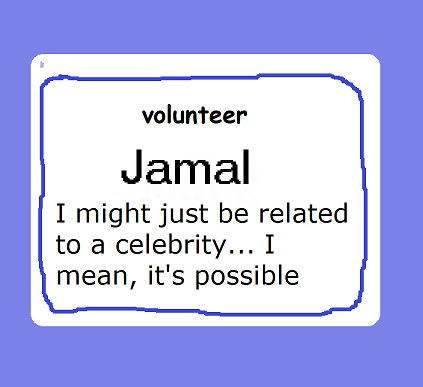
    badge4

    “Oh, Jamal,” the social media expert would say as he stopped Jamal in the hallway,” tell me about your family. That’s nice that you have an older brother…. what does he do? Really? In Hollywood? I mean, your last name is, and well, you couldn’t be related to…oh, what, really you’re HIS brother? Bam! I knew it! I mean, how nice…”

    or even this one…

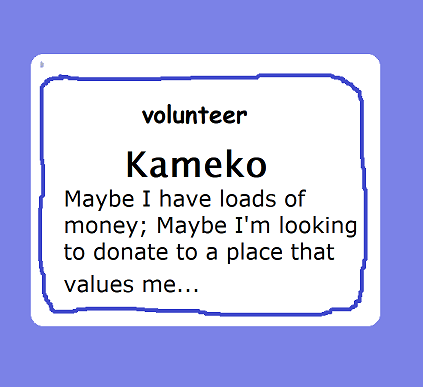
    badge5

    “Kameko,” the harried chief financial officer would coo after going over the financial report, “what adorable shoes you have on. From Italy, oh? You bought them the last time you went there? You travel extensively, I see… and your lovely engagement ring, it is so, so enormous…”

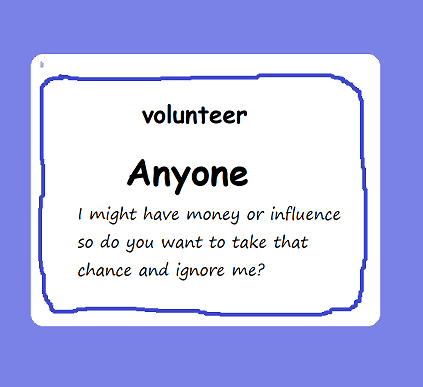
    or maybe a general one might just do:

    badge6

    I remember the day my organization got a sizable donation from the best friend of the recipient of our help. It turned out that the best friend was a well-known celebrity. Everyone was surprised at the gift and then a bit relieved that we all had done a good job. I mean any one of us, volunteers included, could have blown receiving that donation.

    There was the usual, “you never know, the person you are serving just might turn out to be someone famous,” talk as if the result of good work is not the work itself, but what it can produce.

    Organizations might get more excited when volunteers have a little extra something to give. Do they donate? Do they have influential contacts?  Will they leave money when they die?

    We, volunteer managers need to remind everyone that volunteers are there to further the mission, whether or not that volunteer has money or influence.

    But the takeaway is this: Volunteers who experience meaningful volunteer engagement and feel integrated into the organization always give more than their volunteer hours. Always.

    That means treating all volunteers as if they have money or influence lest they go elsewhere. And organizations might not want to take that chance.

    -Meridian


    This is an update from a 2016 post: Eureka, I’ve discovered the value of a Volunteer!


  • Is Making Volunteers Likable Our Objective?

    black haired man in white crew neck t shirt
    Photo by YesManPro on Pexels.com

    I remember my first days as a volunteer coordinator. There was this one volunteer, Addie. She was a tiny, fit ball of northeastern, direct confrontation, piercing eyed judgmental “I’ve been here since the forefront” terror. Staff couldn’t stand her. But she roamed the halls wielding her trusty sword “Gotcha,” slicing apart our ineptness. She was your crusty grandmother, your 87-year-old history teacher and your noisy neighbor all rolled into one, and oh, with a grip of steel. I know because she would grab my arm to make a point. Yep, I still have phantom bruises there.

    I danced lightly around her. Although staff didn’t like her, she was, I thought, untouchable. They didn’t ask that I do anything about her, so I figured their eye-rolling was the way we dealt with disliked volunteers. After all, she’d earned her right to be a disruption, to be tolerated, to interpret our policies as anything that suited her purpose. She was, (da da daaaaahhhh) emeritus!

    So, what crippling reasons cause us to hide under our desks instead of addressing volunteer behaviors?

    • Lack of specific policy indicators? (for example, policy states theft or inappropriate language is an offense. Policy doesn’t include arrogance or chatty-ness as an official offense)
    • Fear that delivering feedback to a volunteer will be misinterpreted as criticism and the volunteer will quit?
    • Our general fear of confrontation?
    • Volunteer status, such as emeritus? Or staff seems to “put up” with volunteers?
    • Our belief that volunteers are giving of their time, so we should be more accepting of their behavior?
    • The perception that a volunteer is older, wiser, more accomplished, more educated or skilled than we are?
    • Our belief that our jobs are no more than coordination?

    The above reasons hold power over us, power that cripples us and prevents us from truly leading volunteers. How can we then make adjustments so we don’t simply going to continue to sidestep situations that can be remedied?

    The first step is to prioritize the why. Why is this volunteer here? We know there are multiple underlying and nuanced reasons, all of which we take into consideration when matching volunteers to assignments.

    But what is the primary, down to basics reason a volunteer shows up? To complete a task, or fill a role that furthers the mission they believe in. How is this being accomplished?

    Taking the focus off of staff’s and volunteer’s personalities allows us to examine the work being done and by doing so we can analyze how behaviors are affecting work quality.

    Communicating mission focus to everyone, staff and volunteers alike, lays the groundwork for intervention. How do we do that?

    In volunteer orientation or onboarding, emphasize the expectation of excellence. While creating a welcoming atmosphere, stress the importance of volunteers being able to fit within a busy organization. Illustrate the enormous workloads put upon staff. Make clear that while staff appreciates volunteers, the work is most important. Ask your most productive volunteers to speak to and hopefully mentor new volunteers.

    Create policy that gives you an opportunity to mediate. Although we obviously can’t write policy for every little behavior, especially if behavior is opinion based. (one staff member believes a volunteer chats too much) We can, however include six month probationary periods, infractions for inappropriate behavior and the specific understanding that it is in the power of the volunteer manager to determine fit. Fit means that a volunteer’s performance will be evaluated on fit within a specific department and the volunteer can be moved to another position. (This is a two-way street; it also protects the volunteer from being stuck with very demanding or uncooperative staff)

    Communicate your commitment to supporting staff. Before placing a volunteer, speak with staff about your readiness to intervene if a volunteer is behaving in ways that hinder production. Get the idea out in the open that your focus is on helping staff be more productive and you are leading volunteers, not simply placing them.

    Ditch the idea that volunteers will stay because we are nice to them. Instead, remind yourself that volunteers will stay because they are doing work that is meaningful and in order to engage in meaningful work, behavior must align with mission centric goals.

    Bravely follow-up and be willing to intervene. Feedback is not always criticisms that will drive a volunteer away. Mediation means taking into consideration the needs of both sides and finding solutions that best benefit the organization. Being on top of situations ensures that volunteers are valued, not tolerated. Ask both sides questions that direct them towards accomplishments, such as “what path do you envision us adapting to increase our survey input results,” or “what small thing right now will help us improve our client satisfaction?”

    Be willing to be a leader who can do the hard stuff. Just because a volunteer is emeritus, or wiser, or more accomplished does not mean that you are their subordinate. Your volunteer program is a reflection on you. In your organization, are volunteers valued or are they simply considered a necessary nuisance? Are volunteers given juicy tasks or are they relegated to boring minutia? With courageous leadership comes respect for the program.

    Educate staff on working with volunteers. Humanize the volunteers. Stress their character and commitment to the mission. Emphasize their desire to help staff, not hinder them. Highlight volunteer accomplishments with a caveat to staff who embraced them. The more we make staff feel as though they “have to accept volunteers,” the less they will actually accept them. Instead, as leaders, we need staff buy-in and it takes some staff ego massaging to get that buy-in.

    Listen to other volunteers. If volunteers are complaining about a volunteer’s behavior, or worse, quitting because of behavior, there’s a clear problem. How many good volunteers are we willing to lose because we would rather not engage in mediating destructive behavior?

    And most importantly, act quickly. Intercepting a problem before it becomes messy and unmanageable will keep those sleepless nights at bay. Regularly surveying staff and volunteers can unearth budding challenges. Following up on those challenges early gives a higher rate of successful mediation versus allowing patterns of behavior to cement. And, by showing your commitment to creating an excellent program, your leadership value will exponentially rise.

    By focusing on mission goals, we can more clearly see the big picture. Mediating and creating volunteer fit has the following tremendous potentials for a huge return on that investment.

    • More satisfied and engaged volunteers
    • Staff who will champion volunteer engagement
    • Openings to more volunteer roles
    • More recognition for volunteers
    • Respect for the volunteer manager voice
    • More leverage for negotiating new programs, ways to integrate volunteers or eliminating outdated volunteer roles

    While confronting behavioral disputes is down right hard and uncomfortable, we will reap enormous results by bravely tackling this challenge. Each successful attempt at mediation will move the needle closer to a professional and more respected volunteer program.

    Leading is doing the challenging stuff well. It gets easier once you burst that tension bubble and see how satisfying it is to get results.

    After all, we’re not volunteer coordinators who shrug because staff doesn’t seem to like volunteer Addie. We are leaders of vibrant, contributing volunteer programs.

    -Meridian


  • When Staff Doesn’t Like a Volunteer Part 2: A Success Story

    adult art conceptual dark
    Photo by Pixabay on Pexels.com

    What happens when staff doesn’t like a volunteer? Does the volunteer quietly quit because they never get called or do staff begrudgingly put up with a volunteer they dislike and work suffers? What can we, the volunteer program leader do in these situations?

    A leader of volunteers, who is a good friend and colleague recently shared this experience with me:

    I remember one of our volunteers, Steven. Staff would run the other way when Steven came in because Steven always had an idea or a plan to improve our organization and the way we operated. It would frustrate already overworked staff to listen to all these critical ideas.

    But what they didn’t know about Steven was he would take the assignments other volunteers wouldn’t take. He actually volunteered for a lot of shifts, ones that needed filling. He was both annoying and indispensable at the same time.

    It was exhausting, knowing how dependable Steven was and yet being frustrated at his frequent sharing of plans to improve our organization. But then one day, a solution came in a most unexpected way.

    A staff member, Allie who was in charge of a large project involving the creation of a detailed cataloging system needed volunteer help. The assignment meant working in a basement on a very cranky machine. Most volunteers wouldn’t want to tackle such a cumbersome project in a dingy basement so I thought of Steven. I asked my boss if I could approach him with the proposal and fortunately, she agreed.

    The staff member in charge of the project was willing to give Steven a try so I approached him, saying, “look, Steven, saying no is ok. I’m asking you to work on a temperamental machine in a basement here, but it is crucial work that needs to be done.”

    To my surprise, Steven replied, “I would love to do that.” And the interesting thing that happened, was Steven got to see behind the scenes at our organization and by working directly with staff, began to realize how little time they had for all these ideas and projects he had been pushing on them.

    I knew that pairing Steven with this assignment was a success when all on his own, he recruited another one of our volunteers to help with the project. I even overheard him one day pipe up when hearing a group of volunteers grouse about how slow it was taking to get an answer to a question and say, “you don’t realize how busy the staff is here.”

    With Steven I knew that I could either sit back and just let him drive me crazy or I could understand how much he cared about the mission. I realized his complaints and ideas came from his desire to support our mission, not from some need to complain.

    I remembered something I heard from a very wise peer that stuck with me: “That one unhappy worker might be the lone voice in the wilderness telling us something we need to hear. We need to ask: Why are they miserable? Maybe, they have a point.”

    When dealing with complaining volunteers, we have to examine whether or not it is the message or the way it is presented that irks us. And staff must realize that a volunteer’s role is not to make staff happy.

    Just as every staff member needs direction from their supervisors, volunteers need direction from the person supervising them. We can’t expect volunteers to read our minds, so as leaders of volunteer programs, we need to train staff and show them that volunteering is a two-way street. That’s where the successes lie.

    So, from this experience, we know we can salvage a staff/volunteer relationship that has soured. Let’s look at the volunteer manager toolbox and pick out some tools that work in these types of situations:

    Mediation: One of the most important tools a volunteer manager possesses. Stepping back and thinking about three basic things helps us to mediate.

    1. What is the best outcome for our mission?
    2. How will volunteer A satisfactorily arrive at the outcome?
    3. How will staff member B satisfactorily arrive at the outcome?

    By focusing on outcome, (a capable volunteer and a reasonable staff member will find a way to work together to further mission goals) we can then create a mediation plan.

    Look for the interests of each party. For a volunteer, it may be they believe they have good ideas and need to be heard. For a staff member, it may simply be they need quiet time to get their work done. How then, can these two interests be addressed to the satisfaction of each party?

    Picture a continuum: On one end the staff member would give the volunteer complete attention at all times. On the other end the volunteer would work in silence at all times. Begin to move the ends toward the middle-what would that look like? Maybe staff could spend 5 minutes with the volunteer when they arrive and update the volunteer while listening to any new thoughts. Maybe the volunteer could be instructed to bring all new ideas to the volunteer manager who would present the ideas in official ways.

    The point is to craft the movement of the two sides towards one another, keeping the mission as the goal.

    Story crafting: A skill that serves volunteer managers well. In the above Steven story, our volunteer manager deftly created a story. By thinking of volunteers and staff members as stars of a story, we can more clearly ‘write’ the ending in our heads. We can envision ‘reading’ that volunteer Steven was paired with staff member Allie which resulted in a mutually beneficial relationship. It helps us to step back from the situation and look at it logically with a positive outcome or ending in mind.

    Another use of story crafting is to present each side in mediation with the story of the other side’s point of view. Telling Steven how much work needed to be done was a story meant to educate him on the enormous work load on staff. Telling Allie how volunteer Steven would take assignments no one else would take was a story meant to inform Allie that Steven was committed to getting the job done.

    Positive identification: The tool volunteer managers use daily. Let’s look at Steven’s success story. How did staff view Steven? They saw him as a hypercritical, over-simplifying volunteer who continually offered up unwanted ‘solutions’ to problems that either did not exist or were being addressed in other ways. What did they not see? They did not see Steven’s passion for the mission, his willingness to help in any manner, nor his desire to more fully understand organizational workings.

    Tapping into volunteer’s motivations will yield clues to their behavior. Maybe the needy volunteer just went through something tragic and is hurting. Maybe the talkative volunteer is isolated. As volunteer managers, we can humanize our volunteers so that staff sees them as more than just temporary help. We can highlight the volunteer’s character by sharing the positives we witness. Sometimes our humanization needs to use the word ‘but.’ For example:

    Volunteer Millie lost her husband of 45 years a few months ago and is a little raw but she is so grateful for her husband’s care that she is committed to learning our system so she can further our work. She wants to be a help to us, not a burden.

    Volunteer Asher lost his job due to cutbacks but he is passionate about helping end hunger and actually considers this an opportunity to make a difference in the world. He says he feels privileged to learn from our staff.

    Matching: The volunteer manager tool that is always sharp. By pairing Steven with staff insiders, he was able to see first hand how overburdened staff were. He was able to integrate into the bigger picture and thus became a champion for not only the mission, but for the very staff that had rebuffed him before. And by choosing a staff member who was willing to work with Steven and most likely had a personality that would benefit Steven, our volunteer manager made a successful match.

    Now here is the really interesting part in all of this. Experts say that behavior is the outward expression of attitudes, but that if behaviors are modified, attitudes can change. Look at the Steven example. His attitude changed. And as his behavior changes, staff’s attitude towards him and possibly other volunteers will slowly change as well. So, if we can mediate behavior changes in staff and volunteers, we may just end up with attitude changes.

    Next time: Part 3. Laying the groundwork for volunteer engagement that takes into consideration personalities, character, attitudes and behavior.

    -Meridian

  • Should Our Volunteer Ads Be More “Real?”

    Should Volunteer Ads Be More Real
    courtesy of https://gratisography.com/

    Opening her laptop, Yvonne peered at a tiny picture in the daily feed. She studied the photograph of the child in a hospital bed and something inside of her clicked so she opened a new tab and searched for “hospital volunteers needed.” Numerous volunteer ads popped up.

    “Volunteer with us, bring your caring heart.”

    “The life you change may just be your own.”

    “Our volunteers are priceless.”

    “Take that first step and volunteer to help.”

    Yvonne took in the photos of volunteers working together, triumphant smiles on their busy faces. She imagined how dynamic these volunteers must be, and here she was, shy, insecure, and full of doubts. She wasn’t like them. They were so…amazing and who was she kidding, she was just stumbling through life. With a wistful sigh, Yvonne closed the tab and moved on.

    Social comparisons: How do we know if we’re good, or smart or accomplished? We compare. We look for people who are similar to us or are in a similar arena. We look at our lives and the lives of others around us and sometimes we win and sometimes we fail miserably. (all in our heads of course)

    There are a huge variety of reasons folks don’t volunteer. Heck, volunteer managers twist into knots trying to make everything perfect to attract volunteers. Beyond the changing volunteer needs such as flexible schedules, meaningful experiences and episodic or virtual opportunities, is Yvonne’s reason another one to consider?

    I remember a conversation I had a while back with a friend, Judy. I had been trying to get Judy to volunteer for years. She would be perfect, I always thought. Funny, no-nonsense, industrious, she would bring an air of authenticity.

    “No,” she said emphatically. “I’m not volunteering. You guys are all so, I don’t know, smiley.” At the time I laughed, but Judy’s perception stayed in my head. And it made me wonder if there were others like Judy out there.

    Do they think “That’s not me. I’m not that selfless, or happy or giving or whole. I look at volunteer pictures on websites, or Facebook and see volunteers, arms around each other as they pose in front of the playground they built or the building they painted or the kids they saved and I think, “I can’t be that. I’m flawed.”

    Do they read the newspaper and see volunteers receiving awards and think, “Good for them. They must be perfect. It’s too hard for me.”

    Does posting pictures of our photographic moments set up some people to fail at social comparison? Do we sometimes erroneously assume anyone who looks at the pictures will automatically want to be one of those volunteers? Maybe we could add in some other words or images to connect with hesitant prospective volunteers.

    Today in advertising, real people have mostly replaced the old, stereotypical perfect people. Is there a way to re-imagine popular volunteer slogans to appeal to the “I’m not perfect like them” prospective volunteer?

    • Volunteering, a Work of Heart = Volunteering is not easy, it can be sad and frustrating and exhilarating all at the same time. Nothing is perfect, not the work, not the clients, not the organization, and we don’t expect you to be perfect either. That’s the real beauty of it. It’s real, just like you.
    • Help Others, Help Yourself or The Life You Change Might Be Your Own = We kinda think volunteering can be a great experience, but we can’t promise it. We can promise though, that we’ll work with you to make sure you get something pretty awesome from it. It’s sort of like a treasure hunt, we don’t exactly know what you’ll get out of it, but it could be pretty great like meeting some fascinating new people, finding out some neat stuff about yourself, or discovering how people, even thought they may seem vastly different are pretty much alike when you boil it all down. 
    • Volunteers are Priceless = Yeah, this is pretty meaningless, we know. We do pledge however, to not waste your time because your time is valuable and we want to make sure that you feel as though your time was spent wisely.
    • A Volunteer Journey Begins With a Single Step = Ok, this is true. We all took that first step. It wasn’t easy, we were scared, and didn’t know what to expect. But once we took that step, it got a little easier. You can bail out anytime, so keep that in mind. We’re not superhuman and don’t expect you to be either. Trust me, you’re not alone, we will take that first step with you. 
    • Just Bring a Caring Heart = Look, it’s a fallacy that all these volunteers are so perfect and love everybody all the time. We all do rotten things once in a while, have lousy thoughts, get mad and grumpy too. But together we can figure it out because we are humans, flawed and imperfect and maybe that’s the point.

    I’d like to offer another ad here. This one isn’t based on some traditional volunteer slogan. It’s based on something I’ve observed over many years of on-boarding volunteers: The new volunteer who is hesitant, unsure, somewhat nervous about his/her abilities, the one who took a little longer to feel comfortable usually turned out to be an outstanding volunteer. So this “pitch” is for them.

    Hello you. I’m speaking to you. You may see yourself as inadequate, unable and unworthy. What do we see? We see someone who is open and thoughtful and considerate.

    You may imagine that you’ll fail at volunteering because there’s some magical skill you need and you don’t have it. What do we imagine? That you’ll bring a unique perspective to our mission, that you’ll fit in because all of us here are unique too. A lot of us are downright quirky and stumbling if you want the honest truth.

    You may think we want you to be perfect. What do we want? We want to do some good in this crazy world and we don’t have all the answers. We’re not looking for perfection. We’re looking for you.  

    So, should we now just post pictures of volunteers milling around looking lost and unhappy? (maybe snap a few pics of volunteers trying to find where they’re supposed to be stationed at the next big function)

    No, but just as we don’t view ourselves as one-dimensional, prospective volunteers see themselves as complex too. And a few of them might need to know that volunteers aren’t these super human people who have it all together all the time.

    There might just be a message for prospective volunteers like Yvonne: We want you-imperfect and quirky and full of potential.

    Kinda like the rest of us.

    -Meridian

    This is an update from a post in 2015: Dieting, Models and Volunteering

  • Volunteering and the Goldilocks Margins

    Volunteering and the Goldilocks Margins
    photo courtesy of https://gratisography.com/

    Do volunteers wander from organization to organization, sampling the volunteer porridge or sitting in different volunteering task chairs, looking for the opportunity that is “just right?”

    Some volunteers do exactly that, while others might taste a cold volunteer encounter and walk away for good, equating all volunteering with their one, less-than-perfect experience. Some volunteers are undeterred and will continue searching for an opportunity that fits. The point is, the more we set a foundation for finding a “just right” volunteer experience, the more volunteers will at least try us out.

    Our earth exists in the Goldilocks zone, the habitable area around the sun. In this zone, conditions are optimal to sustain life such as presence of liquid water, luminosity of the central star, gasses etc. In other words, there are variables, which when combined, create the optimal backdrop for life to form and thrive.

    Can this be applied to volunteer engagement? Do we need more than a friendly face to recruit volunteers, and to sustain them?

    Well, let’s examine these common statements about “getting volunteers”:

    • “Just ask.”
    • “There are lots of people out there with time on their hands.”
    • “You can’t tell me that a few hours on a Saturday is a big deal.”

    What is so wrong with the above statements? For one thing, they are simplistic extremes (like hot and cold porridge) and do not take into consideration the conditions that must exist for volunteer engagement. Volunteering conditions, like the Goldilocks principle have to fall within certain margins in order to attract and sustain volunteers.

    Just as distance from star, liquid water and atmosphere are the major conditions for a habitable planet, there are major conditions for engaging volunteers. When our volunteer programs fall within the optimal margins in the following three conditions, we have created a volunteering Goldilocks zone.

    1. Volunteering must be seamless. Not easy, but seamless: A prospective volunteer needs a response within 24 hours (48 on weekends) or else our “urgent need” is meaningless. Steps to volunteering must be clear, relatively simple and able to be completed in a timely manner. Any glitches, or unreasonably long waiting periods will dim a volunteer’s enthusiasm. This doesn’t mean we need to accept any person without reservation, vetting or orientation. It means the process must make sense to the volunteer and not fraught with unnecessary obstacles. If we proclaim we want volunteers, we have to show it by a seamless onboarding process. We must not advertise volunteer roles and then use bait and switch to get volunteers to fill roles we need to fill. We can’t over-onboard or under-onboard volunteers. We need a system that is practical, understandable and frankly adaptable.
    2. There must be meaning in the volunteer work: Volunteers want to make a difference. Every task or role needs a direct connection to the mission. Every task or role must be explained so volunteers clearly understand why their help is crucial, why their time is valuable and why we wanted them in the first place. Even less exciting volunteering roles support the mission. It is imperative we convey the impact roles and tasks have on furthering our work. Not enough conveying of meaning drives volunteers away, but so does gushing over them and treating them as though anything they do is the most amazing thing in the history of volunteering. Volunteers need meaning that focuses on the work and how they have contributed.
    3. Communication is crucial: This is probably the most basic condition. Volunteer communications must be clear and on point. Impact on mission, appreciation for their time, clear instructions, organizational policies, changes in org policies are all examples of the areas that volunteers need clear and direct communication. Obviously too little communication begets disaster but bombarding volunteers with too many emails, or phone calls also can turn them away.

    These margins are only the beginning. Just as in the Goldilocks zone where other, more subtle influences determine if and how life can be supported, there are unique volunteering influences that can impact whether a volunteer decides to share his/her time with us. Some of these variables are:

    • Does the task fit within an acceptable time frame?
    • What skills are necessary to do the task?
    • How far away is the task site?
    • Is the task recurring, one time or sporadic?
    • What support can be expected?
    • How much training is involved?
    • What responsibility level is involved?

    Each one of the above variables contributes to a volunteer’s commitment. When the “just right” foundation is in place, then the above variables can be adjusted for an optimal experience.

    Volunteering needs a Goldilocks zone, one in which careful planning creates the favorable conditions for engagement. It’s not about luck, or happenstance or just asking anymore. It’s about the creation of an engaging atmosphere, followed by attention paid to all the other, unique conditions that might drive a volunteer away.

    It takes a knowledgeable, experienced and fearless volunteer manager to push an organization into the volunteer Goldilocks zone. Optimal margins for volunteer engagement require the participation and buy in from the entire organization, not just the volunteer department.

    So, as we consider the conditions in which volunteering engagement is optimal, we can begin to lay our Goldilocks foundation.

    Let’s be a habitable volunteer planet. Let’s be just right.

    -Meridian

  • Do Volunteers say ‘they’ or ‘we?’


    baseball bleachers chairs close up
    Photo by Bahram Jamalov on Pexels.com

    Niko looked down at her t-shirt that read “Children’s Zoo Volunteer.” She forgot that she still had it on. The older lady in front of her in the checkout line, had turned and smiled. “I like your shirt. Have long you volunteered there?

    “Thank you.” Niko shyly replied. “It’s been about three years.”

    “I take my grandkids there all the time,” the lady said as she put her groceries on the conveyor belt. “They especially love the polar bear habitat. I’m excited about the new interactive childrens’ corner. Do you know when that opens?”

    Niko moved up. “I think they’ve scheduled it for this fall.”

    “Maybe we’ll see you there sometime.” The lady pushed her carton of orange juice forward. “It really is a wonderful zoo.”

    “It is.” Niko returned. “They do a great job, don’t they?”

    Do our volunteers use the term “we” when referring to our organizations? Do they include themselves when speaking of organizational accomplishments, or fielding praise and questions? Or do these words come out of them? “I’m just a volunteer.”

    We, volunteer managers often say, “we want our volunteers to feel included.” This is a little bit like saying, “I want my child to think I love him.” Creating an atmosphere in which someone feels something does not guarantee those feelings are based on something tangible. Rather, those feelings could be based on surface ideas and token gestures instead of deeply ingrained truths.

    Maybe instead, we should state, “we want our volunteers to know they are included,” or “we want our volunteers to be included.” It’s a subtle, but important difference.

    Perpetuating outdated ways of thinking will not move volunteer engagement forward. Inclusion is not about the emotions involved and whether or not we imagine that volunteers feel included. It’s about knowing they are included. It’s about stepping up and putting words into action and creating a foundation of inclusion versus symbolic gestures.

    It’s about a commitment to shifting our paradigm.  It’s about going beyond the appearances of inclusion that typically include:

    • Yearly volunteer thank you luncheons (as a separate group)
    • Volunteer mentions in the newsletter (as a separate group)
    • Volunteer awards (as a separate group)

    If volunteers are part of the “team,” then we have to ask: Why are they always referred to as an aside? Just for the heck of it, let’s look at a different kind of team and consider this recap of a baseball game.

    The Otters beat the Pelicans 5-4 in a wild game on Saturday. Addison (Shortstop) and Javier (Second Base) turned an incredible double play with the bases loaded, robbing the Pelicans of a chance to take the lead in the 9th inning. Two of the Otters’ starting lineup hit home runs in the 5th: Jason (Right Field) and Billy (Left Field). In the 7th, Ron (Third Base) dove headfirst ahead of the tag into home plate on Ernie’s (First Base) perfectly placed bunt. The pitcher, Fergie had 11 strikeouts and credited his catcher, Wilson for calling a great game. Afterwards, manager Leo said of his team, “We got the job done. I’m proud of the way the team worked together.”

    So, what does this baseball analogy have to do with volunteering? Well, what if each position on a baseball team was treated as a separate entity? The reporting would look like this:

    • In shortstop news, Addison made an incredible play.
    • In second base news, Javier made a great play.
    • In Right Field news, Jason hit a home run in the 5th.
    • In Left Field news, Billy hit a home run in the 5th.
    • In Third Base news, Ron scored a run.
    • In First Base news, Ernie executed a perfect bunt.
    • In Pitching news, Fergie had 11 strikeouts.
    • In Catching news, Wilson called a great game.

    Doesn’t sound so much like a team effort anymore, does it?

    Truly integrating volunteers into the team means including them as partners in our accomplishments. Sure, we can identify them as volunteers, just as we identify a baseball player’s position. And including them in our accomplishments in no way detracts from the accomplishments of hard-working staff.

    It simply indicates that our organization is a team, working together. It shows we are generous with our credit and that we want to expand our support in the ongoing effort to accomplish our goals. It shows that outcomes are the objective, not ownership or martyrdom or personal praise. Inclusion shows potential volunteers, staff members, board members, clients and even donors that we are the very essence of charitable.

    When we send out our glossy newsletters, is there a volunteer spotlight within or are the volunteers incorporated into the meaty stories about how the team has made inroads into stopping illiteracy, or providing meals to vulnerable populations? Do volunteers’ names appear in the same sentence as staff members or donors?

    We can plead that “our volunteers should feel included,” until we are hoarse, but until our volunteers are included, we will be stuck with balloons and t-shirts and volunteers who say “they.”

    -Meridan


  • Mono or Multi? Voluntasking is the Answer

    office mail business work
    Photo by Tookapic on Pexels.com

    Greta’s hand was shaking. Three recent volunteer requests needed her attention. One of her volunteers, Serena, was on the phone with a major problem. End of month reports were due at 5pm and Greta hadn’t gotten the chance to record all the available volunteer hours. Matt, a recent graduate of the latest volunteer orientation was standing in her doorway. He needed a dose of her encouragement. She could feel her heart racing. How would she be able to do it all?

    Multi-tasking vs. single or mono-tasking. A 2009 study of heavy media multitaskers versus light media multitaskers from the Proceedings of the National Academy of Sciences of the United States of America revealed that heavy media multitaskers are more likely to be affected by random, non-essential stimuli. And here’s the surprising results. Heavy media multitaskers performed worse than light media multitaskers on a task-switching ability test, instead of performing better as expected. It seems as though multi-tasking actually hinders our ability to concentrate.

    There is one tremendous benefit we seldom speak of in describing volunteer contributions. Volunteers are more able to focus on a single task than harried staff who are juggling multiple duties at one time. We, volunteer managers know this from experience. Take Greta in the example above. Can she possibly bring her best to each task in front of her? Will she be able to give her undivided attention to Matt, or to Serena? Will she find the concentration necessary to fill the volunteer tasks? Can she actually clear her mind to gather and record the volunteer hours for her report, not to mention adding the additional stats and stories she knows will make her report more impactful? Or will her attention dart back and forth, splitting her cognitive abilities into tiny, unusable pieces?

    No, not with all the external stimuli that fractures her attention. This inability to do superhuman multitasking is one of the reasons we, volunteer managers ask for volunteer help with our workload. We realize that a competent volunteer can do a job that might take us ten times as long to do, because we are in a constant state of being distracted.

    We’ve seen it so many times. Give a volunteer a desk and a light and they will power through an assignment. Volunteers possess the trifecta of task accomplishment:

    • The will or passion
    • The time
    • The focus

    We need to highlight this overlooked asset and properly showcase it as a benefit derived from embracing volunteer help . We can start by asking staff and senior management these questions:

    • If you had two hours a day to focus on one task without interruption, what could you accomplish?
    • Do you often feel like you are being pulled in multiple directions and you can’t concentrate?
    • What would it mean to you if you could offload a portion of your work so that you could give your attention to the tasks you feel are critical to your job and our mission?
    • Do you feel that being pulled in so many directions actually helps or hinders your ability to reach your goals?

    And here’s the kicker question:

    Do you really think that someone who is passionate about helping, can sit and actually focus on the task at hand and is willing to devote the time to getting it done will do a much poorer job than the person who is continuously pulled in every direction?

    If you want to have some fun, at the next staff meeting, ask staff to take out a piece of paper. Announce a phrase, such as “volunteers are great.” Ask staff to spell the phrase out loud while writing their names and addresses on their piece of paper. You’ll get laughs and groans, but it will take a good chunk of time as their brains switch back and forth between tasks. And it won’t help that they are being distracted by the reactions of their fellow staff members around them.

    Now point out that this is their reality. Ask them (in all seriousness) why they wouldn’t want a volunteer, one who is capable, and has the will, time and focus to accomplish tasks more quickly and efficiently, helping them.

    Non-profits are notoriously understaffed and overburdened. The reluctance to seek volunteers’ help is holding missions back from great accomplishments. The mind-destroying multi-tasking world in which non-profit staff find themselves can be alleviated by the help of focused volunteers.

    We can encourage our organizations to take advantage of volunteer help for many reasons, all of them sound. One simple, but overlooked reason is voluntasking: the passion and ability of volunteers to devote the time it takes to focus on one task, thus accomplishing it faster and with more accuracy and freeing up staff to concentrate on mission centric goals.

    Or, we can all continue to cling to our workloads and keep multitasking. But, if we do, we’d better learn to love mediocrity and burnout.

    -Meridian


  • Horrors! Can a Volunteer Manager Say No?

    close up photography of person s eye
    Photo by Tookapic on Pexels.com

    Carlos took a deep breath and regarded Marty, a long term volunteer who stood before him. “Mr. Jansen really wants to visit his son in Philadelphia.” Marty said. “It’s only a four hour trip from here and I don’t mind taking him. We can do it in a day.”

    Carlos thought about the organizational policies, trying to recall one that forbid volunteers from driving clients on long trips. “I’m not sure that’s such a good idea, Marty,” he said. “I really don’t know if we should do this.”

    Leadership is about doing the right thing, even if it is the hardest thing to do personally and even if it puts you on the spot. As leaders of volunteers, we are faced with doing the right thing every day. We must weigh the right thing for our organizations, for our volunteers, for our vulnerable clients, for our communities and for us.

    Being able to say no is sometimes the right thing to do. While our jobs pretty much paint us as the folks who always say “yes,” we must take into consideration the times we are obligated to say “no.” Some obvious examples are:

    • when a volunteer wants to break policy and jeopardize the safety of himself or a client
    • when a request for a volunteer puts the volunteer at risk
    • when a community service volunteer wants you to sign off on hours not spent volunteering
    • when anyone asks you to embellish volunteer hours

    It’s easier to say no when strict policies back you up, or risk factors are obvious. But sometimes we have to say no, when policy is not a factor and the area is gray. Examples might include:

    • When someone requests a volunteer for a task that volunteers have strongly objected to
    • When a volunteer wants to initiate a project that will take precious time from mission related work
    • When you are asked to fill in for a volunteer on your day off and you already have plans

    How do we artfully say ‘no?’ If we feel pressured to say ‘yes,’ or are backed into a corner, we might stutter and say something like, “I’m not sure.” A weak ‘no’ is really just a soft ‘yes.’ When saying no, you have to actually say no and not want to immediately take it back.

    If you need to, ask for time to think on it. Say, “Let me get back with you on that,” so that you can formulate your response. Getting caught off guard seldom gives you the advantage of putting together a well thought out answer. Remember though, if you don’t get back to the person in a timely matter, they will assume your answer is yes.

    Think of all the reasons you have to say no. It’s not because you just feel like being oppositional, it’s because you know there is a better alternative, or you have information the person asking the question does not have. Listen to your intuition and find all the whys that force you to say no, then explain the whys in decisive terms.

    Present a suitable alternative. Explain why you are saying no, and offer an alternative. If say, a volunteer wants to bring a friend with them on assignment into a client’s home, you can say, “I’m sorry, but that is against our policy. The reason it is against our policy is because no one who has not been background checked and officially entered into our organization can enter the home of our client. (the why you’re saying no) This applies to staff and volunteers alike. I can offer your friend a path to becoming a volunteer so that he can accompany you on assignments. (the alternative) Let’s talk about how to make that happen.”

    Steer the person towards the alternative. If a staff member wants you to find a volunteer for a task the volunteers have repeatedly said no to, you can say, “I will try, but our volunteers have said no in the past so I’m not likely to be able to fill this request. But, we do have volunteers willing to help you in other ways. Let’s discuss the ways they want to be of service and how they can support you.”

    Be clear that a no is not personal. Leadership is about the mission and the team. Point out the mission centric reasons you must say no. “I understand that things change rapidly and that now you are asking for five additional volunteers for tomorrow. I will ask one of our experienced volunteers to make last minute calls and I know that every one of our volunteers who can commit, will commit, so you are in good hands. I however, must continue to work on the annual gala which is next week because volunteers are heavily involved and the gala is extremely important to our organization’s outreach.”

    There’s a reason these responses sound an awful lot like “professional speak.” It’s because they are. Using professional speak is the way to stop others from viewing you as a lightweight, a yes person, a go-fer. Using professional speak forces others to communicate with you on a mission-related level and not on emotional or personal terms.

    Feeling like you can never say no resides on emotional levels. Being able to say no in a professional way resides on logical, thoughtful levels. In order to take control of the conversation, use professional speak that centers on mission centric goals and steer the person away from trying to emotionally manipulate you.

    You can put off a conversation until later when you have the time and energy to discuss it with focus. Take the volunteer who wants to initiate a program that takes time from mission related goals. You can say to that volunteer, “that sounds like an interesting proposal and one that you’ve given considerable thought to. I really want to give you my full attention, so can we set aside a time to discuss it when we can really focus on what you are offering?” Then set aside a time when you are not being bombarded from all directions and can thoughtfully discuss any ideas.

    Saying no is not a failure on our part. It is actually an opportunity to control the direction of our programs and a chance to steer people towards a better way of engaging volunteers by offering more viable alternatives. When done with tact and professionalism, saying “no” can open doors to a better “yes.

    A strong leader is able to say no in a way that assures everyone that the no means listening carefully, then a negotiation, or a revamping or an alternative.  Above all, it indicates a striving for excellence. And that already describes every volunteer manager.

    -Meridian