Tag: non-profit

  • Why Should We Pay Attention to Volunteering Trends?

    adult autumn beauty blue
    Photo by Pixabay on Pexels.com

    Have you ever stopped dead in your tracks and said, “I can sense it, it’s going to rain?” You felt the slight change in barometric pressure, or you heard the leaves in the trees rustle and you knew. You pulled up your collar or searched for an umbrella in your backpack.

    If we could see the coming volunteering trends, we could prepare for them, right? Thirty years ago, were there signs that volunteers wanted more episodic roles? Or did it sneak up on us, causing us to rethink our volunteering strategy? Should we even pay attention to trends? Do we need a volunteer engagement strategy umbrella?

    Can we spot trends by asking our volunteers, “Hey, what are you going to be doing differently 2 years from now?” Oftentimes, the beginning of a volunteering trend bubbles up in some pretty unrelated places. Not all trends first appear in volunteer management articles or blog posts. Rather, they evolve in other sectors and if we aren’t aware of them, these trends can rain down on us, catching us unprepared.

    One such rapidly expanding trend is corporate volunteering. Consider these recent articles, none of which appeared in volunteer management periodicals:

    Starbucks is testing a program that will allow some employees to spend half of their workweek at a local nonprofit

    The 50 Best Workplaces for Giving Back

    Why Paying Employees to Volunteer is Good For Business

    Or this article about a Chick-fil-A store owner who is paying his employees to volunteer while the store is being remodeled:

    Chick-fil-A employees in Plainfield to be paid for community service as location is closed for remodeling

    Or this article on millennial workers:

    Millennials Are Leading a Revolution in Corporate Volunteering Efforts

    The growing CSR (corporate social responsibility) trend greatly impacts volunteer managers, as more and more businesses look for avenues into volunteering for a non-profit. Where do they start? At this point in time, businesses are utilizing partnerships with non-profits to accomplish their corporate volunteering goals.

    If we wish to stay on top of this trend, it is imperative that volunteer organizations develop a corporate volunteering strategy to engage and partner with businesses who wish to increase their standing in communities. Why, we might ask? Why bother with employees who only give a couple of hours? Why take on another project that seems like babysitting? Why engage with people who are really just helping their company “look good?”

    Because, if we turn our self-righteous heads away and refuse to work with corporate volunteers, they will develop their own programs. And they have the money to do it.

    I am not suggesting that we drop everything and drool over any and every corporate volunteering request that comes our way. I’m suggesting that we need to develop a strategy that benefits our mission and works for the company we choose to partner with. By this, I mean:

    • choose a company that has shared goals and values and thoroughly understands what the mission is about
    • start with just one company and learn how to develop a solid partnership with that company before taking on another
    • control the participation as in how many volunteers you can take at a time, what they will do, when they will do it, how much onus is on them to bring any supplies they will need, etc.
    •  make impact on mission goals the primary focus, versus forging a partnership so that fund-raising can hit the company up for money
    • set guidelines or ground rules for participation and stick to them
    • follow-up to cement the relationship and plan for the future

    If organizers of corporate volunteering programs have poor experiences, or are continually turned away or can’t find anyone to partner with, they will quit trying. But here’s the scary thing. If they are really serious about volunteering in the community, they will just bypass us. They will turn their frustration into forming their own internal programs, leaving us in the dust.

    Corporate volunteering may seem like sketchy volunteering to the purist. We can dismiss it as not having pure intent, or not serious enough or existing only for show. But it’s exponentially increasing and we need to stay ahead of the trend and control it. We are the ones to shape it into the meaningful and impactful volunteering purity we wish to see.

    Think about this: When your CEO appears at your door and says, “I just got off the phone with the VP over at Expansion Architectural Designs and he said you told him we didn’t have a corporate volunteer program,” are you going to say, “But, but, corporate volunteering is just not real volunteering?”

    If we strategically embrace corporate volunteering, devise ways to successfully incorporate it into our hectic workloads and use it to further our goals, we will reap the following benefits:

    • increased organizational awareness through the partner company’s newsletter, employee word of mouth, possible press releases, etc.
    • increased donations from the satisfied partner company in the form of money, grants, in-kind donations or corporate matching (but again, donations are a bonus by-product of truly satisfied companies-we should never expect corporate volunteering to be a channel to money because that’s disingenuous)
    • increased positive word of mouth among area businesses
    • increased respect for volunteers in general due to the higher visibility of these corporate volunteers
    • more leverage when asking for an increase in volunteer budget, or additional resources, help, etc.
    • increased acknowledgement for volunteer manager creativity, skills and organizational worth

    We know volunteerism is rapidly evolving. Keeping up with trends can be daunting, so we must craft a strategy to control trend implementation and to work trends to our advantage by formulating a strategy umbrella.

    Because, it’s raining out there.

    -Meridian

    For more in-depth information on corporate volunteering from someone who has been on both sides of the equation and has workable solutions, please see Jerome Tennille’s excellent 2 part post on CSR and volunteering.


    View at Medium.com

    View at Medium.com

  • Volunteer Managers and Decision Fatigue

    adult dark depressed face
    Photo by Pixabay on Pexels.com

    Zack pushed back in his chair and stole a glance at his watch. 1:30. His lunch lay half eaten on his desk. A new volunteer, Karey was on hold, waiting for Zack’s decision on which volunteer would mentor her and what day she could start. Several new emails pinged on his screen. Task force volunteers needed an update on the choice of meeting spaces. In front of him, Nadia, the event coordinator was pointing to the unfilled volunteer slots at the Walk-a-thon this coming weekend.

    Weariness blanketed Zack. He forgot what it was the new volunteer on hold wanted. The subject lines on the newest emails blurred in his vision. He snapped at Nadia, “I told you, I was working on the event. I haven’t heard back from the volunteers I called. I will figure out who else I can call, but I can’t just make volunteers magically appear.”

    Decisions. Volunteer managers are faced with making hundreds, maybe thousands of decisions a day. Think I’m exaggerating? Let’s look at a simple request for a volunteer to fill a task and a sampling of the decisions involved.

    • Do I give this request priority?
    • Do I work on this now or put it in a queue?
    • What volunteers are best suited for this request?
    • Who should I call first?
    • How should I frame this request?
    • Do I ask for more information or do I have enough?
    • How much time should I spend on this?
    • What is the best time to call volunteers?
    • Should I also ask survey questions while I have them on the phone?
    • What points should I stress about the impact this task will have on our mission?
    • What is the best way to plead this case?
    • What recent activities has each volunteer I call been involved in and how can I acknowledge that?

    That’s 12 decisions before even starting. All day long, volunteer managers make decisions that directly impact the success of their volunteer programs. Daily major decisions include:

    • How should I answer this email and get my point across?
    • What tactic should I use when asking for more time finding volunteers for a hard to fill task?
    • How can I better explain this task to a volunteer?
    • What methods should I use when mediating the brewing dispute between a volunteer and a staff member?
    • What questions can I ask on the upcoming survey?
    • What do I want to measure on the next volunteer evaluation?
    • What can I streamline in today’s training to save some time?

    Decision fatigue occurs when the brain has made so many decisions that fatigue sets in, causing a breakdown in ability to make new decisions, or making snap decisions, or a lack of self-control and diminished willpower. It leads to poor decision-making.

    Decision fatigue can show itself with an irritated voice or a curt answer. It can show itself with “giving in” instead of standing ground for principles you believe in. It can show itself with forgetfulness or shutting down. It can show itself when you finally go home and can’t decide what to make for dinner so you order something unhealthy from that expensive take out place down the road because it’s the easiest thing to do.

    The 44th president of the United States, Barack Obama famously said:

    You’ll see I wear only gray or blue suits. I’m trying to pare down decisions. I don’t want to make decisions about what I’m eating or wearing. Because I have too many other decisions to make.

    Beyond filling volunteer tasks, a volunteer manager’s day is fraught with other carefully considered decisions.

    • How do I best approach senior management regarding an issue?
    • How do I politely extract myself from a conversation that is going on too long?
    • How do I mediate between a staff and volunteer or a volunteer and another volunteer?
    • How do I politely answer snarky questions?
    • How do I show volunteer value?
    • How can I manage all my tasks?
    • How can I remember all the small things?
    • How can I find new volunteers?
    • How can I listen to volunteers, genuinely hear them and yet not spend too much of my day in what appears to others as chit-chat?

    Volunteer management is the antithesis of assembly line work. There is no manual outlining each step because each step changes hourly. It involves careful people skills by leaders of volunteers with high emotional intelligence. Decisions are weighed and made in fractions of seconds. No wonder volunteer managers go home exhausted.

    So what can we do?

    Make the important decisions first thing: Before fatigue sets in and while your mind is clear, make your most important decisions early and stick to your decisions. Our minds are equipped to think more clearly and rationally before fatigue sets in so work on your most important projects or challenges when you first arrive. Do you have to counsel a volunteer? Do you have a yearly event? Do you have to give an important report? Work on those tasks first, set a deadline for your decisions and stick to them.

    Limit your decisions: Lay out your work clothes the night before work. Prepare your lunch or decide where you will have lunch the night before. Decide your 5 goals for the next day the night before. Put off making major decisions when you feel yourself losing willpower. There is nothing wrong with telling people you have to think about something and get back with them.

    Realize decisions will not all be perfect ones: Volunteer managers tend to hold themselves to a pretty impossible perfection standard, thinking that every decision must be the optimal one. This unrealistic standard creates paralysis when making decisions, slows down productivity and increases fatigue. Major decisions need time, but lesser decisions can be made more quickly and efficiently. Remember, after mulling over option upon option, we can still make an imperfect decision, so it’s best to leave the agonizing to major decisions.

    Carve out quiet time: Ideally, find an isolated space to work on projects. If you don’t have one, turn your computer monitor to the wall, turn the volume down, let the answering system pick up phone calls and work on your “need to do” list. One hour disconnected from the chaos will reap enormous benefits in not only making better decisions, but in your overall mental health. Two hours would be even better.

    Become a by-appointment office: It’s hard to do when you have an open door policy, but you can slowly begin to change that. Hang signs on your door that keep people from dropping in with questions or information that can wait. Signs that indicate “volunteer interview in progress,” or “volunteer strategy meeting in progress,” clearly announces that you must focus on the crucial task at hand. Having to make a major decision while constantly being interrupted with having to make smaller, snap decisions wears you down. It creates decision fatigue and robs you of any ability to make a good decision. If you find yourself continually putting off big projects, it’s a good sign that you suffer from decision fatigue and probably the effects of a chaotic office.

    Pare down the upfront work and utilize volunteer brains: For projects needing research, input from volunteers etc., ask volunteers to help you by completing the research or polling the volunteers. They can even assist by presenting you with decision options and their recommendations for best choices.

    What’s frustrating about decision fatigue is how it silently chips away at willpower. And a worn down volunteer manager will be ineffective when presenting volunteer contributions or advocating for better volunteer engagement practices.

    People who love us will tell us to take care of ourselves. They’re right. We need to take care of ourselves mentally and physically if we truly wish to create a successful volunteer program.

    So, please, while your brain is fresh and unencumbered, make a commitment to limiting the effects of decision fatigue.

    -Meridian


  • Just What is the Value of a Volunteer?

    Just what is the value of a volunteer

    Do organizations value volunteer Luis because he has this rare ability to look into the eyes of someone and open his being to receiving their pain? Do organizations value volunteer Mary because she drops everything and comes in when there’s an immediate need? Are all volunteers valued strictly for their volunteering? Or, do you sometimes get the uncomfortable feeling that certain volunteers are more highly thought of than others in your organization?

    It’s kinda true that some volunteers are more likable than others and volunteer managers have a challenge to overcome when staff doesn’t like a volunteer (see When Staff Doesn’t “Like” a Volunteer). But, besides likability, are there other reasons some volunteers are regarded more highly behind the closed wooden doors of organizational structure?

    Does a senior manager get all giddy when a volunteer bequeaths money to the organization (and then stands at your desk with a big smile spreading across her amazed face and says something like, “well, we would have gone to his funeral, but we didn’t know, why didn’t you tell us he died,”) or when a volunteer pays for that new tech equipment or that fridge for the employee lunch room?  Does the board go all a-twitter when they find out one of your volunteers is the mother-in-law of a famous actor and they are high-fiving each other because they just know your volunteer will use her mother-in-law powers to badger this actor into endorsing the organization? (I always kept this type of information buried deep in the secret compartment of my brain, it’s the one where I picture myself as the first officer aboard the star ship Enterprise, ooops – what I mean is they couldn’t pry it out of me if they tried)

    What if a volunteer is married to a prominent lawyer or a politician, or someone who owns the swanky hotel where they have that fabulous banquet hall? Or what if a volunteer has loads of money? Does that volunteer suddenly get the VIP treatment?

    Maybe it’s subtle, but it’s there. Does the volunteer who is an absolute master at soothing clients’ hearts rate the same status or visibility as the volunteer who donates substantial money?

    Ok, ok, I’m being critical, and this is really all about human nature anyway, aka, the “what can you do for me,” expectations we all have. So, if volunteers who donate or bequeath or have connections seem to get better treatment, why don’t we, volunteer managers just use that to our advantage?

    Here’s what I propose:

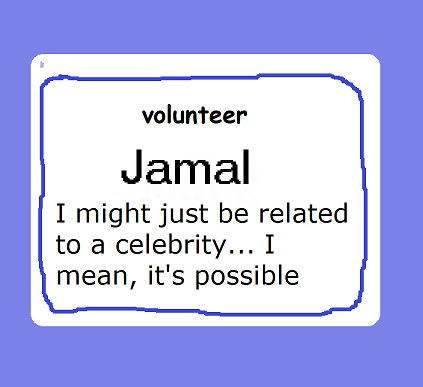
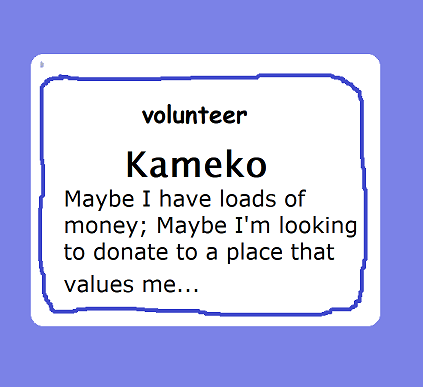
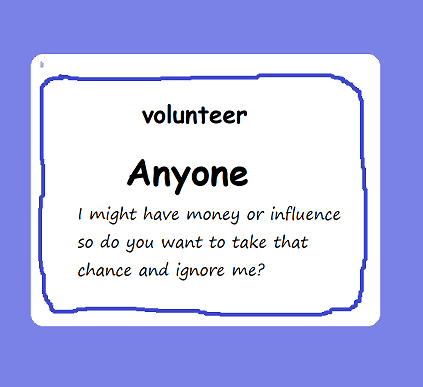
    Let’s equip every volunteer with a name badge that teases their potential value beyond the amazing volunteer work they are doing.  For example:

    badge3

    “Oh Mary,” a fund-raising specialist would say after reading the name tag, “I heard you just had a birthday. If you don’t mind me asking, I mean, you look so wonderful, how old are you again? Eighty-seven? Perfect.”

    or maybe this one…

    badge4

    “Oh, Jamal,” the social media expert would say as he stopped Jamal in the hallway,” tell me about your family. That’s nice that you have an older brother…. what does he do? Really? In Hollywood? I mean, your last name is, and well, you couldn’t be related to…oh, what, really you’re HIS brother? Bam! I knew it! I mean, how nice…”

    or even this one…

    badge5

    “Kameko,” the harried chief financial officer would coo after going over the financial report, “what adorable shoes you have on. From Italy, oh? You bought them the last time you went there? You travel extensively, I see… and your lovely engagement ring, it is so, so enormous…”

    or maybe a general one might just do:

    badge6

    I remember the day my organization got a sizable donation from the best friend of the recipient of our help. It turned out that the best friend was a well-known celebrity. Everyone was surprised at the gift and then a bit relieved that we all had done a good job. I mean any one of us, volunteers included, could have blown receiving that donation.

    There was the usual, “you never know, the person you are serving just might turn out to be someone famous,” talk as if the result of good work is not the work itself, but what it can produce.

    Organizations might get more excited when volunteers have a little extra something to give. Do they donate? Do they have influential contacts?  Will they leave money when they die?

    We, volunteer managers need to remind everyone that volunteers are there to further the mission, whether or not that volunteer has money or influence.

    But the takeaway is this: Volunteers who experience meaningful volunteer engagement and feel integrated into the organization always give more than their volunteer hours. Always.

    That means treating all volunteers as if they have money or influence lest they go elsewhere. And organizations might not want to take that chance.

    -Meridian


    This is an update from a 2016 post: Eureka, I’ve discovered the value of a Volunteer!


  • Volunteers: The Ultimate in Recycling

    alternative alternative energy clouds eco energy
    Photo by Pixabay on Pexels.com

    You know, typically, when we think of recycling, we picture a bulldozer scooping mountains of trash to process for reuse and hmm, this is a really demeaning way to picture volunteers. But the word recycling also has nuanced meanings that have nothing to do with trash and maybe everything to do with the incredible potential volunteerism brings. For instance, some of those nuanced words are:

    reclaim: Think of working or retired teachers, nurses, executives, web designers and every skilled human being out there including social workers, advocates, and parents. Think of the wealth of experience and practiced skills they bring. Reclaiming those skills and putting them to work helping organizations achieve goals is reclaiming at its best.

    restore: Giving volunteers the opportunity to restore and hone their skills after any change in status is one of the things we do best.  Think of the student who is unsure about her potential. Think about the worker who lost his job and confidence. It’s one of those life win-wins that we live for.

    re-purpose: Volunteer skills take many forms and often, volunteers find new uses for their skills by volunteering. Think of the accountant who privately loves to draw and how they added hand-drawn figures to the volunteer stats report that illustrate impact.  Re-purposing talents infuses fresh ideas into our organizations and helps volunteers see their skills in a new light.

    re-imagine: Finding that hidden volunteer talent is one of the greatest feelings of accomplishment for any volunteer manager. By delving into a volunteer’s skills and interests, we can often pair them with a role that brings out that buried talent. Think of the stay at home mom who has mad organizational skills or the retired law enforcement officer who has this incredible ability to get at the heart of things when talking with people.

    There are so many ways in which volunteers contribute their knowledge, skills, talents and ideas. But what about our organizations? How do they reap the rewards from this ultimate in recycling?

    Let’s flip those recycle meanings and apply them to our organizations and see how they benefit.

    reclaim: As organizations grow and adapt to the changing landscape, they can easily lose the original passion for the mission. Competition for donors, risk management, reporting and HR functions all contribute to the more business-like atmosphere. Tapping into volunteer enthusiasm is an organic way to reclaim and keep the passion alive. Volunteers can speak at staff meetings and bring their inspiring message to overburdened employees. We can pass along the praise volunteers share with us about hard-working staff members and infuse some new energy into their work.

    restore: Everywhere organizations are doing more with less. Overburdened staff need help. By offloading projects onto volunteer task forces, organizations can restore staff workloads to a more manageable state. Holding on to every task and function when there are capable volunteers willing to step up keeps organizations mired in minutia and stuck in the last century. We can pilot volunteer programs that take tasks away from staff. We can lead up and out by offering expert volunteer help on projects.

    re-purpose: How many organizational functions are outmoded? Skilled volunteers with fresh ideas can transform stale programs into current and relevant campaigns designed to move organizations forward. We can showcase volunteer accomplishments and if need be, add a dollar value to the volunteer’s expertise, as in “if you paid a consultant in this area of expertise, you would be paying $175 an hour. Our volunteer is willing to weigh in with proven methods and years of experience for free.”

    re-imagine: Volunteers bring fresh perspectives, world experience and have the latest in trends and programs at their disposal. Our organizations can be kept abreast of changing trends by inviting volunteers to serve on task forces, the board and campaigns. By listening to the diverse voices within the volunteer base, an organization can re-imagine policies, direction and focus so that they are positioned for the future. Instead of looking in all directions to find expert voices on marketing or finance, organizations can look within to find expert volunteer voices, ones who already know and believe in the mission.

    The perception of volunteering has to change globally. The outdated notion that volunteers are timid souls that just want to fill whatever mundane role we offer them is gone. Let’s bury it.

    We, volunteer managers are managing the ultimate force in reclaiming, restoring, re-purposing and re-imagining. We have talent, knowledge, skills and passion at our fingertips. We have mission success in our reach.

    We, leaders of the volunteer movement must recreate the perception of volunteerism, from one of volunteers as tools to one of volunteers as the ultimate way for organizations to refresh, to reinvigorate, and to rejuvenate our goals. Ignoring the wealth of recycling volunteer gold organizations have in hand is short-sighted and backward.

    And, in order to cultivate all that potential, organizations must re-invest in volunteer management leadership.

    Let’s get to work and re-frame the image.

    -Meridian


  • When Staff Doesn’t Like a Volunteer Part 2: A Success Story

    adult art conceptual dark
    Photo by Pixabay on Pexels.com

    What happens when staff doesn’t like a volunteer? Does the volunteer quietly quit because they never get called or do staff begrudgingly put up with a volunteer they dislike and work suffers? What can we, the volunteer program leader do in these situations?

    A leader of volunteers, who is a good friend and colleague recently shared this experience with me:

    I remember one of our volunteers, Steven. Staff would run the other way when Steven came in because Steven always had an idea or a plan to improve our organization and the way we operated. It would frustrate already overworked staff to listen to all these critical ideas.

    But what they didn’t know about Steven was he would take the assignments other volunteers wouldn’t take. He actually volunteered for a lot of shifts, ones that needed filling. He was both annoying and indispensable at the same time.

    It was exhausting, knowing how dependable Steven was and yet being frustrated at his frequent sharing of plans to improve our organization. But then one day, a solution came in a most unexpected way.

    A staff member, Allie who was in charge of a large project involving the creation of a detailed cataloging system needed volunteer help. The assignment meant working in a basement on a very cranky machine. Most volunteers wouldn’t want to tackle such a cumbersome project in a dingy basement so I thought of Steven. I asked my boss if I could approach him with the proposal and fortunately, she agreed.

    The staff member in charge of the project was willing to give Steven a try so I approached him, saying, “look, Steven, saying no is ok. I’m asking you to work on a temperamental machine in a basement here, but it is crucial work that needs to be done.”

    To my surprise, Steven replied, “I would love to do that.” And the interesting thing that happened, was Steven got to see behind the scenes at our organization and by working directly with staff, began to realize how little time they had for all these ideas and projects he had been pushing on them.

    I knew that pairing Steven with this assignment was a success when all on his own, he recruited another one of our volunteers to help with the project. I even overheard him one day pipe up when hearing a group of volunteers grouse about how slow it was taking to get an answer to a question and say, “you don’t realize how busy the staff is here.”

    With Steven I knew that I could either sit back and just let him drive me crazy or I could understand how much he cared about the mission. I realized his complaints and ideas came from his desire to support our mission, not from some need to complain.

    I remembered something I heard from a very wise peer that stuck with me: “That one unhappy worker might be the lone voice in the wilderness telling us something we need to hear. We need to ask: Why are they miserable? Maybe, they have a point.”

    When dealing with complaining volunteers, we have to examine whether or not it is the message or the way it is presented that irks us. And staff must realize that a volunteer’s role is not to make staff happy.

    Just as every staff member needs direction from their supervisors, volunteers need direction from the person supervising them. We can’t expect volunteers to read our minds, so as leaders of volunteer programs, we need to train staff and show them that volunteering is a two-way street. That’s where the successes lie.

    So, from this experience, we know we can salvage a staff/volunteer relationship that has soured. Let’s look at the volunteer manager toolbox and pick out some tools that work in these types of situations:

    Mediation: One of the most important tools a volunteer manager possesses. Stepping back and thinking about three basic things helps us to mediate.

    1. What is the best outcome for our mission?
    2. How will volunteer A satisfactorily arrive at the outcome?
    3. How will staff member B satisfactorily arrive at the outcome?

    By focusing on outcome, (a capable volunteer and a reasonable staff member will find a way to work together to further mission goals) we can then create a mediation plan.

    Look for the interests of each party. For a volunteer, it may be they believe they have good ideas and need to be heard. For a staff member, it may simply be they need quiet time to get their work done. How then, can these two interests be addressed to the satisfaction of each party?

    Picture a continuum: On one end the staff member would give the volunteer complete attention at all times. On the other end the volunteer would work in silence at all times. Begin to move the ends toward the middle-what would that look like? Maybe staff could spend 5 minutes with the volunteer when they arrive and update the volunteer while listening to any new thoughts. Maybe the volunteer could be instructed to bring all new ideas to the volunteer manager who would present the ideas in official ways.

    The point is to craft the movement of the two sides towards one another, keeping the mission as the goal.

    Story crafting: A skill that serves volunteer managers well. In the above Steven story, our volunteer manager deftly created a story. By thinking of volunteers and staff members as stars of a story, we can more clearly ‘write’ the ending in our heads. We can envision ‘reading’ that volunteer Steven was paired with staff member Allie which resulted in a mutually beneficial relationship. It helps us to step back from the situation and look at it logically with a positive outcome or ending in mind.

    Another use of story crafting is to present each side in mediation with the story of the other side’s point of view. Telling Steven how much work needed to be done was a story meant to educate him on the enormous work load on staff. Telling Allie how volunteer Steven would take assignments no one else would take was a story meant to inform Allie that Steven was committed to getting the job done.

    Positive identification: The tool volunteer managers use daily. Let’s look at Steven’s success story. How did staff view Steven? They saw him as a hypercritical, over-simplifying volunteer who continually offered up unwanted ‘solutions’ to problems that either did not exist or were being addressed in other ways. What did they not see? They did not see Steven’s passion for the mission, his willingness to help in any manner, nor his desire to more fully understand organizational workings.

    Tapping into volunteer’s motivations will yield clues to their behavior. Maybe the needy volunteer just went through something tragic and is hurting. Maybe the talkative volunteer is isolated. As volunteer managers, we can humanize our volunteers so that staff sees them as more than just temporary help. We can highlight the volunteer’s character by sharing the positives we witness. Sometimes our humanization needs to use the word ‘but.’ For example:

    Volunteer Millie lost her husband of 45 years a few months ago and is a little raw but she is so grateful for her husband’s care that she is committed to learning our system so she can further our work. She wants to be a help to us, not a burden.

    Volunteer Asher lost his job due to cutbacks but he is passionate about helping end hunger and actually considers this an opportunity to make a difference in the world. He says he feels privileged to learn from our staff.

    Matching: The volunteer manager tool that is always sharp. By pairing Steven with staff insiders, he was able to see first hand how overburdened staff were. He was able to integrate into the bigger picture and thus became a champion for not only the mission, but for the very staff that had rebuffed him before. And by choosing a staff member who was willing to work with Steven and most likely had a personality that would benefit Steven, our volunteer manager made a successful match.

    Now here is the really interesting part in all of this. Experts say that behavior is the outward expression of attitudes, but that if behaviors are modified, attitudes can change. Look at the Steven example. His attitude changed. And as his behavior changes, staff’s attitude towards him and possibly other volunteers will slowly change as well. So, if we can mediate behavior changes in staff and volunteers, we may just end up with attitude changes.

    Next time: Part 3. Laying the groundwork for volunteer engagement that takes into consideration personalities, character, attitudes and behavior.

    -Meridian

  • When Staff Doesn’t ‘Like’ a Volunteer

    adult art conceptual dark
    Photo by Pixabay on Pexels.com

    Mimi talks. A lot. About herself, about her trips, and about her grandchildren. She talks about the cashier at the grocery store who had surgery last month and now is having some pain in her side. It’s all harmless chatter, but staff roll their eyes and avoid Mimi when she volunteers. They don’t want to be around her. They don’t really like her.

    But Mimi does her work well. She inputs survey results accurately and efficiently. She’s dependable. She’s smart, and because she’s smart, she sees staff embracing other volunteers, and she wonders why staff seems to avoid her. After all, it’s about doing good work, isn’t it?

    All volunteer managers face the challenge of a capable volunteer who is not liked by staff. Staff scatters when this volunteer arrives. Staff tries not to interact with this volunteer but warmly welcomes other volunteers they like.

    Often the situation is no more than staff reluctantly putting up with the disliked volunteer. Staff may knowingly smile and say, “well, that’s just the nature of working with volunteers,” or may grumble to you in private. Or they may request that you not call  “volunteer Harvey, the one who complains a lot.” And sometimes, staff can push back and isolate the volunteer, lobby to get rid of the volunteer or find faults where none exist.

    It begs these questions: What effect does a volunteer’s behavior and attitude have on their role? Is it different from employees’ roles? And, how far does this behavior scope reach?

    We’ve all had to work with a fellow employee we dislike. But because that employee was on the payroll, we were forced to figure out how to work with him/her. We couldn’t just say, “hey, I don’t like Chenelle, so I’m not dealing with her.” Nope, Chenelle was going to be there, day in and day out so we were left to find a way to work with one another. Figuring out a way to work alongside fellow employees is expected behavior.

    It’s different with volunteers. Volunteers are free to come and go and they’re not volunteering 40 hours a week. (if they are, that’s a whole separate bucket of trouble) They can quit, or take a leave of absence at any time. We, volunteer managers make this fact clear so we can advocate for good volunteer treatment as a retention strategy.

    So, then it isn’t a stretch to take this idea (volunteers are transient and unfettered) a step further. If we expect staff to understand that volunteers will come and go as they please, why shouldn’t staff feel as though they can pick and choose whom they wish to work with because, “hey, you said volunteers come and go as they please?”

    The plea that staff must accept volunteers, work with them and make their experience pleasant makes little sense to them when paired with the idea that volunteers are temporary or fleeting or unfettered by paid positions. The reality is, a staff member is stuck having to get along with a fellow annoying staff member. They’re not so stuck getting along with an annoying volunteer.

    What does your organizational policy say about working with volunteers? Does it mirror policy on working with fellow staff? Most likely it does not. Maybe it says something broad like staff will respect volunteer help. It probably doesn’t make clear that staff will be held responsible for retaining volunteers. And so, disliked volunteers can and will be treated as a temporary nuisance because figuring out a way to work alonside volunteers is not expected behavior. Expected behavior is on the volunteer manager, who is expected to provide volunteers that don’t require any extra work from staff. 

    Where does that leave us then? Back to recruiting volunteers over and over because personalities are intertwined with volunteer success and we must find “non-annoying” volunteers?

    We can rant all we want about the unfairness of treating volunteers differently from staff, but we have to remember that we highlight volunteer uniqueness by reminding staff that volunteers are with us by choice. It’s a conundrum, one worth exploring later, but we need to deal with individual scenarios now. So what to do?

    This is an area in which volunteer managers will utilize every mediation skill they possess. It can be as draining and nuanced as trying to make the haughty family cat “like” your grabby 4 year old niece.

    The first step is to identify the behaviors making staff cringe. What is it about the volunteer that annoys the staff? For many, if not most cases, you, the volunteer manager will already know, because the offending behavior probably annoys you too. Some common offenses are:

    • talking too much
    • sharing or foisting political, religious or other world views on everyone
    • arrogance or criticisms in a patronizing way
    • inappropriate remarks
    • joking constantly
    • pushing to socialize outside the workplace or sharing personal problems
    • arriving late

    Maybe you cringe too, when this volunteer arrives. Maybe you find yourself checking your watch when this volunteer is talking to you. Maybe you find it difficult to “sell” or defend this volunteer to staff.

    But what if this volunteer does a really good job? What if they have mad skills or knowledge and potential? How do we mediate behavior so staff will respectfully work with this volunteer?

    Our first step is to pinpoint the annoying behavior with concrete examples. We can and should include behavioral identification questions when gathering feedback from staff. In addition to questions crafted around the volunteer’s work, we also need to ferret out any potential problems due to behavior. Some behavior questions can include:

    • When volunteer Amy is working in your department, do you see any behaviors that inhibit her ability to get the job done? (she’s often late to the job)
    • When volunteer Juwan is here, does he exhibit any behaviors that impede your ability to get your job done? (He asks too many questions and I can’t concentrate on my work)
    • Does volunteer Stuart fit in with our culture? What behaviors does he exhibit that support your opinion? (He often talks about his religious beliefs) or.. (He always asks how he can help)

    Behaviors are concrete actions and therefore much easier to identify, pinpoint and address than attitudes.

    A volunteer’s attitude is inferred by his/her behavior. A volunteer who talks too much or jokes or complains may appear to think that staff time is not valuable or the work is not important. A volunteer who makes patronizing comments can be seen as someone who is arrogant and condescending. A volunteer who shares personal issues will appear to be “needy” and self-involved.

    These perceived attitudes make the volunteer unlikable.  And that’s where we come in with all of our nuanced mediation skills.

    How do you deal with a disliked volunteer?

    Next time: Part 2, a success story and the volunteer manager toolbox.

    -Meridian


  • Volunteering and the Goldilocks Margins

    Volunteering and the Goldilocks Margins
    photo courtesy of https://gratisography.com/

    Do volunteers wander from organization to organization, sampling the volunteer porridge or sitting in different volunteering task chairs, looking for the opportunity that is “just right?”

    Some volunteers do exactly that, while others might taste a cold volunteer encounter and walk away for good, equating all volunteering with their one, less-than-perfect experience. Some volunteers are undeterred and will continue searching for an opportunity that fits. The point is, the more we set a foundation for finding a “just right” volunteer experience, the more volunteers will at least try us out.

    Our earth exists in the Goldilocks zone, the habitable area around the sun. In this zone, conditions are optimal to sustain life such as presence of liquid water, luminosity of the central star, gasses etc. In other words, there are variables, which when combined, create the optimal backdrop for life to form and thrive.

    Can this be applied to volunteer engagement? Do we need more than a friendly face to recruit volunteers, and to sustain them?

    Well, let’s examine these common statements about “getting volunteers”:

    • “Just ask.”
    • “There are lots of people out there with time on their hands.”
    • “You can’t tell me that a few hours on a Saturday is a big deal.”

    What is so wrong with the above statements? For one thing, they are simplistic extremes (like hot and cold porridge) and do not take into consideration the conditions that must exist for volunteer engagement. Volunteering conditions, like the Goldilocks principle have to fall within certain margins in order to attract and sustain volunteers.

    Just as distance from star, liquid water and atmosphere are the major conditions for a habitable planet, there are major conditions for engaging volunteers. When our volunteer programs fall within the optimal margins in the following three conditions, we have created a volunteering Goldilocks zone.

    1. Volunteering must be seamless. Not easy, but seamless: A prospective volunteer needs a response within 24 hours (48 on weekends) or else our “urgent need” is meaningless. Steps to volunteering must be clear, relatively simple and able to be completed in a timely manner. Any glitches, or unreasonably long waiting periods will dim a volunteer’s enthusiasm. This doesn’t mean we need to accept any person without reservation, vetting or orientation. It means the process must make sense to the volunteer and not fraught with unnecessary obstacles. If we proclaim we want volunteers, we have to show it by a seamless onboarding process. We must not advertise volunteer roles and then use bait and switch to get volunteers to fill roles we need to fill. We can’t over-onboard or under-onboard volunteers. We need a system that is practical, understandable and frankly adaptable.
    2. There must be meaning in the volunteer work: Volunteers want to make a difference. Every task or role needs a direct connection to the mission. Every task or role must be explained so volunteers clearly understand why their help is crucial, why their time is valuable and why we wanted them in the first place. Even less exciting volunteering roles support the mission. It is imperative we convey the impact roles and tasks have on furthering our work. Not enough conveying of meaning drives volunteers away, but so does gushing over them and treating them as though anything they do is the most amazing thing in the history of volunteering. Volunteers need meaning that focuses on the work and how they have contributed.
    3. Communication is crucial: This is probably the most basic condition. Volunteer communications must be clear and on point. Impact on mission, appreciation for their time, clear instructions, organizational policies, changes in org policies are all examples of the areas that volunteers need clear and direct communication. Obviously too little communication begets disaster but bombarding volunteers with too many emails, or phone calls also can turn them away.

    These margins are only the beginning. Just as in the Goldilocks zone where other, more subtle influences determine if and how life can be supported, there are unique volunteering influences that can impact whether a volunteer decides to share his/her time with us. Some of these variables are:

    • Does the task fit within an acceptable time frame?
    • What skills are necessary to do the task?
    • How far away is the task site?
    • Is the task recurring, one time or sporadic?
    • What support can be expected?
    • How much training is involved?
    • What responsibility level is involved?

    Each one of the above variables contributes to a volunteer’s commitment. When the “just right” foundation is in place, then the above variables can be adjusted for an optimal experience.

    Volunteering needs a Goldilocks zone, one in which careful planning creates the favorable conditions for engagement. It’s not about luck, or happenstance or just asking anymore. It’s about the creation of an engaging atmosphere, followed by attention paid to all the other, unique conditions that might drive a volunteer away.

    It takes a knowledgeable, experienced and fearless volunteer manager to push an organization into the volunteer Goldilocks zone. Optimal margins for volunteer engagement require the participation and buy in from the entire organization, not just the volunteer department.

    So, as we consider the conditions in which volunteering engagement is optimal, we can begin to lay our Goldilocks foundation.

    Let’s be a habitable volunteer planet. Let’s be just right.

    -Meridian

  • Difficult Conversations with Staff or Volunteers

    full frame shot of text on wood
    Photo by Pixabay on Pexels.com

    Difficult conversations. We, volunteer managers don’t want to have them, but from time to time, we must. A complaint is lodged against a volunteer and we go numb. This shouldn’t be happening, because well, volunteers are selfless, caring souls who just want to help, right? Won’t we drive them away by reprimanding them?

    To make matters worse, what about when a volunteer has an issue with staff and hopes that you will intervene?  Our hearts skip a beat. We’ve just spent hours recruiting and cultivating this volunteer, and now we imagine all that time evaporating.

    It’s a part of our jobs we wish to avoid because initiating these conversations is uncomfortable. We exist in a world where we inspire and motivate, so correcting is somewhat foreign to us, a skill that needs to be dusted off once in a while.

    But, in order to effectively lead a volunteer program, we have to embrace the difficult duties and look upon them as opportunities.

    Let’s examine difficult conversations with volunteers and difficult conversations with staff. Are these two scenarios really much different from one another?

    So, how do we start a difficult conversation with a volunteer (or staff) after a complaint has been made? And how do we prepare ourselves to have the confidence to do the right thing without melting down into mush? For what it’s worth, here are a few suggestions that I hope help you. Conversations with volunteers appear in non-italicized font and conversations with staff appear in italicized font.

    Remember that you are the best person for this challenge:

    You have spent countless hours recruiting and cultivating this volunteer. You care about them and will do what is necessary to see them succeed. And leaving them to fail is ultimately more cruel than helping them remain on track. No one will be as sensitive, understanding or able to guide this volunteer as you.

    With staff, remember that you are the best person to speak and mediate for your volunteers. You don’t wish to see them quit because you are unable to act, but want to see them succeed and by mediating, you are furthering that goal.

    Tip: Keep reminding yourself that by meeting challenges head-on, you are building excellence. You will get through this and be a stronger, more accomplished leader on the other side.

    Practice your opening line:

    “I wanted to sit down with you today and chat about how things are going,” is fine, but volunteers really need us to get to the point. The more you dance around the topic, the more uncomfortable it becomes for you and the volunteer. It’s better if you state the complaint up front. “Emma, I wanted to meet with you today, because one of the visitors to our museum called us to say that last Friday you were too busy to show their disabled son where the bathroom was located. You are one of our finest docents and have been for over five years now and I want to hear your side of the story. Do you recall this particular incident?”

    It’s no different with staff. Add the longer you tiptoe around the subject, the more time is wasted and the more frustrated the staff member will feel. Get right to the point: “Alex, thank you for taking the time to talk with me today about our volunteer Gavin.” (Now, don’t stop here and list Gavin’s great qualities, but keep going and get it out.) “Gavin came to me and voiced a frustration.” (make frustration non-personal, it helps steer the discussion away from emotions and towards solutions ) “He said that he often misunderstands the instructions he’s given and doesn’t feel he can do the job as well as he’d like.” (emphasis is on getting the job done) “I’m here to help fix this so you get the help you need.” (focus on the work)

    Tip: With a volunteer, tell yourself to use the exact words of the complaint-unless there are personal insults involved-don’t water the nature of the complaint down because the volunteer deserves the opportunity to respond to the exact charges that were brought.

    With staff, you have to frame the complaint into mission specific goals such as “volunteer Deena needs more guidance in order to excel at her job, something she is really committed to doing,” versus “volunteer Deena says you never spend any time with her.”

    Don’t apologize for the conversation:

    Starting out with “I’m so sorry to call you in for this,” or “I hate that we have to talk about this” creates the impression that your organization’s ethical standards are meaningless.

    Same thing with staff. Beginning with “I’m so sorry to take up your time, you know how it is with volunteers,” creates the impression that volunteers’ help is not valuable. Instead reiterate the volunteer’s sincere desire to lend support. “I’m here because volunteer Janus is concerned he is not being the help he wants to be.”

    Tip: Remind yourself that being neutral, not apologetic helps the volunteer think and respond more clearly.

    With staff, this is an incredible opportunity to stress that volunteers are there to support and further the mission.

    Assure the volunteer or staff that you are open-minded and fair but don’t put words in their mouth:

    “Emma, we want to hear your side of the story,” or, “Emma, let’s talk about what happened,” is better than saying, “I’m sure the complaint is unfounded,” or “this must be a misunderstanding.”

    Same with staff. “I know that volunteers can be tricky,” or “I realize you don’t have time for this, but..” sends the message that engaging volunteers is not worth anyone’s time or effort. Instead, thank the staff member for making an effort to engage volunteers.

    Tip: Tell yourself that if the complaint is indeed a misunderstanding, then it will surely become obvious and not to worry. If the complaint is well founded, then you have an amazing opportunity to help this volunteer regain their footing or help the staff member become better at cultivating volunteers.

    Don’t diminish the person(s) who made the complaint:

    Saying, “don’t worry, this person complains about everyone,” or “they probably just had a bad day,” negates the actual complaint.

    It’s the same with staff, don’t diminish the volunteer role.

    Tip: Tell yourself that bridging relationships is one of your strong skill sets and seeing both sides validated is a chance to bring both sides together. Ditto with staff.

    Allow ample time for discussion:

    Here is the area in which you will excel at nice-guy volunteer management. These conversations ebb and flow-but the savvy volunteer manager rides the spoken waves with the recurring message that the volunteer’s time and effort is invaluable and their concerns are worth hearing and discussing, even if their actions are in the wrong.

    Same idea with staff-if they need to, let them express their frustrations with time management, heavy workloads etc. Then, seize the opportunity to sell volunteer help. Assure them that your job includes their satisfaction, that you will address and help with any issues concerning volunteer training, performance etc. This is a time to reassure them that you are on their side and are not dumping volunteers on them, but rather, working diligently to get them skilled, committed volunteers who will help and support them.

    Tip: Trust your instincts to tell you when you know the volunteer or staff member is satisfied their feelings, opinions and aspirations are validated. That is when you can move forward with a resolution.

    Follow up with diligence:

    This step takes you from a manager to a leader. Speak with both parties after your initial conversation to ensure that the resolution works for both and that there are no lingering issues. Following up with volunteers and staff shows your commitment to a successful volunteer program, one in which you don’t take sides, but one dedicated to mission centric goals.

    Tip: Use your best mediation skills to assure both parties that your goal is to provide the finest volunteer involvement possible and that you believe in each person. Reach beyond emotions and center on the good work being done by your organization. Refer to excellence often, while assuring each person that you believe in their abilities to work with one another. Keep following up periodically until you see the resolution has been met.

    We can view difficult conversations in the same way we view traveling to a new place. We can tell ourselves that we will hate the new place by thinking things like “It’s going to be too hot,” “I will hate the food,” “the people are too strange,” etc. That usually becomes a self-fulfilling prophecy. Or, like the person who welcomes traveling somewhere out of the comfort zone,  we can entertain the idea that this new experience will help us grow, both as a manager and leader.

    Choosing to grow and embrace challenging conversations will strengthen not only your program, but yourself as well. So, while it is perfectly normal to dread a difficult conversation, don’t let the opportunity to excel go to waste.

    You’re not the bad guy, or the uncomfortable girl, you’re the leader of volunteering excellence.

    -Meridian

    This post originally appeared in 2016 as The Conversation We Dread: Pain or Opportunity

  • Volunteer Managers: Extroverts or Introverts?

    Are volunteer managers extroverts or introverts

    Are most volunteer managers introverts or extroverts? Does it matter? Is an extrovert a better leader and better able to influence people? Is an introvert more empathetic and better able to get the best out of volunteers? Should we care?

    Sometimes, we need to take an honest look at our personality tendencies in order to understand why we do what we do and how we can become better at our jobs. And by being better at our jobs, I mean not just better for volunteers and our organizations, but also better for our own emotional health so we don’t get stuck in an emotional rut. Understanding our own motivations or personalities can help us analyze our strengths while reviewing the areas that keep us from attaining our goals.

    We are the hub of a complicated volunteer system, one swirling around us. How do we manage all the moving parts? Is it better to be an introvert? Or do we need to have an extrovert’s personality?

    See if this sounds like you:

    • You spend a lot of time carefully planning meaningful volunteer roles and carefully interviewing volunteers so you can skillfully place them where they will do the most good
    • You can easily stand back and let the volunteers shine. You feel proud when viewing their accomplishments
    • You spend a lot of time cheer-leading your volunteers so that they reap the enormous benefits from volunteering because you see the greatness in them
    • You don’t manipulate a volunteer meeting with directives; instead you prefer to encourage volunteers to share, to feel part of something awesome and you take to heart their suggestions and concerns
    • You don’t toot your own horn in front of others and usually try to deflect praise onto the volunteers
    • You make sure all the volunteers are acknowledged. You run from table to table at volunteer functions, chatting with every volunteer present
    • You can be lighthearted around the volunteers and enjoy joking with them and seeing them have a good time

    Does this sound like you? Then you’re basically an introvert. But wait. You also exhibit extrovert behavior. So are you an extrovert? Well, more likely, you fall under the category,  ambivert or outgoing introvert.

    The outgoing introvert (OI) is basically an introvert who is social when circumstances call for being social. They enjoy people, especially on a deeper level. For volunteer managers, this means being a terrific host at functions, feeling comfortable with the volunteers, letting small talk beget deeper conversations, wanting to get to know volunteers on a personal level and feeling exhausted from all the emotional attention you spend on others.

    Sounds like a pretty great way to be, right?

    Especially when you consider how the outgoing introvert (OI) takes the time to position volunteers and volunteer programs for the future. The OIs carefully analyzes situations in order to make the best decisions not only for the organization, but for clients and volunteers.

    But since the OI is primarily an introvert, here is where the frustrations can mount up.

    They get overlooked…. a lot…. and they can be perceived as not moving fast enough, when in reality they are spending the necessary time to craft solid programs, ones that don’t need retooling later.

    Extroverts dominate meetings, dialogue and policies. Introverts struggle to be heard, thinking that their dedication, track record and accomplishments speak as loudly as the extrovert’s voice. Sadly, it doesn’t usually work this way. And since an OI is extroverted when comfortable with the surrounding people (such as volunteers), they may not be comfortable in a staff meeting and therefore, will be less inclined to speak up.

    As an introvert with outgoing tendencies, the volunteer manager is more thoughtful and plans for volunteer staying power. The OI volunteer manager pays close attention to each volunteer’s story, questions and concerns. The OI volunteer manager quietly works to enact meaningful volunteer engagement. The OI volunteer manager listens carefully, in order to formulate intersecting paths benefiting clients, volunteers and the organization. The OI volunteer manager sometimes appears awkward and shy and sometimes bold and full of fun, depending upon the circumstance.

    The frustrations come in when the introverted volunteer manager side thinks no one else sees what they see. After all, isn’t it obvious to everyone how amazing every volunteer is? Can’t everyone see the beauty in volunteering? How can they not see that time and effort must be taken to assure each volunteer is properly engaged?

    Explaining volunteer management is an area where tapping into the outgoing side can help. Since complaining or directing attention to one’s self is not something the introvert is comfortable with, then how can an OI volunteer manager get their points across?

    By shifting focus. Think of the passion you convey when approaching new volunteers. You believe in volunteerism, and the mission, right? You convey the power of volunteering without ever feeling like the focus is on you personally, right?

    Use that same mindset when speaking in front of your peers. Focus on presenting your volunteer program in the exact same way you present volunteering to prospective volunteers. View yourself as the mouthpiece for a program you know is incredible, just as you know volunteering is incredible.

    The introverted volunteer manager side has to feel comfortable in a situation for the outgoing side to emerge. You view volunteers as receptive to your message and perhaps you view staff and upper management as skeptical of your message. Your comfort level can diminish when speaking at staff meetings or with senior executives.

    Imagine that your peers and senior management are actually receptive, just like new volunteers and they are looking for inspiring messages, positive steps and motivating presentations from you. Staff and upper management are people too, and just like volunteers, will respond to a persuasive argument, especially when those arguments showcase how it will benefit them and the mission. With emphasis on benefit, your message will be heard.

    We, volunteer managers tend to hone our communication skills with volunteers in mind. Applying these same skills to interactions with staff and upper management is really not any different. It’s our comfort level that holds us back. We view staff and upper management in a separate category, one we may not feel empowered to engage.

    Speaking confidently about volunteer issues can be a big step for the OI volunteer manager. It’s about removing the personal reluctance hindering our voices and tapping into the outgoing side we use so effectively on volunteers. It’s about focusing on the points we believe deeply in and communicating those points, just as we do with volunteers.

    Confidence is infectious and it grows with each usage. The OI volunteer manager skills are already there, having been sharpened by interactions with volunteers. These skills are waiting to be fully unleashed.

    We are who we are, personality, tendencies, foibles and all. But, when you start to analyze how each personality trait can aid in attaining your goals, then those traits will work for you, instead of holding you back.

    Whether or not you’re an extrovert, introvert or an OI, your people skills bring out the best in your volunteers. These same skills can bring out the best in you, too.

    -Meridian


  • Do Volunteers say ‘they’ or ‘we?’


    baseball bleachers chairs close up
    Photo by Bahram Jamalov on Pexels.com

    Niko looked down at her t-shirt that read “Children’s Zoo Volunteer.” She forgot that she still had it on. The older lady in front of her in the checkout line, had turned and smiled. “I like your shirt. Have long you volunteered there?

    “Thank you.” Niko shyly replied. “It’s been about three years.”

    “I take my grandkids there all the time,” the lady said as she put her groceries on the conveyor belt. “They especially love the polar bear habitat. I’m excited about the new interactive childrens’ corner. Do you know when that opens?”

    Niko moved up. “I think they’ve scheduled it for this fall.”

    “Maybe we’ll see you there sometime.” The lady pushed her carton of orange juice forward. “It really is a wonderful zoo.”

    “It is.” Niko returned. “They do a great job, don’t they?”

    Do our volunteers use the term “we” when referring to our organizations? Do they include themselves when speaking of organizational accomplishments, or fielding praise and questions? Or do these words come out of them? “I’m just a volunteer.”

    We, volunteer managers often say, “we want our volunteers to feel included.” This is a little bit like saying, “I want my child to think I love him.” Creating an atmosphere in which someone feels something does not guarantee those feelings are based on something tangible. Rather, those feelings could be based on surface ideas and token gestures instead of deeply ingrained truths.

    Maybe instead, we should state, “we want our volunteers to know they are included,” or “we want our volunteers to be included.” It’s a subtle, but important difference.

    Perpetuating outdated ways of thinking will not move volunteer engagement forward. Inclusion is not about the emotions involved and whether or not we imagine that volunteers feel included. It’s about knowing they are included. It’s about stepping up and putting words into action and creating a foundation of inclusion versus symbolic gestures.

    It’s about a commitment to shifting our paradigm.  It’s about going beyond the appearances of inclusion that typically include:

    • Yearly volunteer thank you luncheons (as a separate group)
    • Volunteer mentions in the newsletter (as a separate group)
    • Volunteer awards (as a separate group)

    If volunteers are part of the “team,” then we have to ask: Why are they always referred to as an aside? Just for the heck of it, let’s look at a different kind of team and consider this recap of a baseball game.

    The Otters beat the Pelicans 5-4 in a wild game on Saturday. Addison (Shortstop) and Javier (Second Base) turned an incredible double play with the bases loaded, robbing the Pelicans of a chance to take the lead in the 9th inning. Two of the Otters’ starting lineup hit home runs in the 5th: Jason (Right Field) and Billy (Left Field). In the 7th, Ron (Third Base) dove headfirst ahead of the tag into home plate on Ernie’s (First Base) perfectly placed bunt. The pitcher, Fergie had 11 strikeouts and credited his catcher, Wilson for calling a great game. Afterwards, manager Leo said of his team, “We got the job done. I’m proud of the way the team worked together.”

    So, what does this baseball analogy have to do with volunteering? Well, what if each position on a baseball team was treated as a separate entity? The reporting would look like this:

    • In shortstop news, Addison made an incredible play.
    • In second base news, Javier made a great play.
    • In Right Field news, Jason hit a home run in the 5th.
    • In Left Field news, Billy hit a home run in the 5th.
    • In Third Base news, Ron scored a run.
    • In First Base news, Ernie executed a perfect bunt.
    • In Pitching news, Fergie had 11 strikeouts.
    • In Catching news, Wilson called a great game.

    Doesn’t sound so much like a team effort anymore, does it?

    Truly integrating volunteers into the team means including them as partners in our accomplishments. Sure, we can identify them as volunteers, just as we identify a baseball player’s position. And including them in our accomplishments in no way detracts from the accomplishments of hard-working staff.

    It simply indicates that our organization is a team, working together. It shows we are generous with our credit and that we want to expand our support in the ongoing effort to accomplish our goals. It shows that outcomes are the objective, not ownership or martyrdom or personal praise. Inclusion shows potential volunteers, staff members, board members, clients and even donors that we are the very essence of charitable.

    When we send out our glossy newsletters, is there a volunteer spotlight within or are the volunteers incorporated into the meaty stories about how the team has made inroads into stopping illiteracy, or providing meals to vulnerable populations? Do volunteers’ names appear in the same sentence as staff members or donors?

    We can plead that “our volunteers should feel included,” until we are hoarse, but until our volunteers are included, we will be stuck with balloons and t-shirts and volunteers who say “they.”

    -Meridan