Tag: organizations

  • ProPer Tweets and Other Social Media

    twitterIsabella couldn’t wait to get back to the volunteer office and tweet. It had been a long day at her organization and 17 volunteers showed up at 5am to prepare packets, man booths, hand out water, snacks and awards at the annual Run for Awareness campaign. Staff members complimented her on the volunteers’ professionalism and how much they had contributed.

    She thanked each volunteer as they helped with cleanup and then, thoroughly spent, she returned to her office where she shut the door and collapsed into her chair.  She then pulled out her phone, accessed her account, @IsabellaVolMgr77 and tweeted:

    #VoteYesOnProp37 Just met a guy at our 5K He is organizing a 5K next year to support Prop37 more details later!

    What you ask? What does this have to do with her volunteers? Exactly! See, Isabella is very passionate about an upcoming election issue in her community and she tweets about her support for proposition 37 frequently.

    So, all right, big deal, what’s the harm? Well, prop 37 is a divisive issue in her town and half of the towns’ folks are strongly opposed to it. (which means half of her active volunteers and prospective volunteers could be put off by her sharing of support for this cause.)

    In another part of town, Randy, a volunteer manager for a small start up charity checked his twitter account @RandyHelpforNeedyOrg and smiled. His last series of tweets were pretty clever he thought. His tweets were:
    #firstdatesareevil Getting ready for first date. Perspiration stains on shirt oh no!
    #firstdatesareevil Almost there, salmon on grill, I’m feeling flaky too!
    #firstdatesareevil Burned the salmon, dropped a drink, I’m doomed!

    Am I getting picky here? Maybe. Because our jobs require emotional intelligence, we can understandably view volunteers as friends, compatriots and even followers on social media. It’s easy to regale them with our personal lives and our passions because they look to us as their bosses. But how much do we really want to draw our volunteers into our personal lives and views?

    I’ve noticed over the years that there is a segment of the volunteer population, albeit a small one, that really wants to operate on a strictly professional level. They are the volunteers who are not interested in my family, my funny mishaps or my secret passions. I take no offense, because it’s literally not personal. They’re the ones who discreetly roll their eyes in orientation when I get too “cutesy” and want me to stick to the professional task at hand.

    But back to tweeting and social media. Is there a fine line that we walk between acting in a professional manner and allowing our warm, engaging personalities to still come through? Can Pro(professional) and Per(personal) ever be ProPer? Absolutely. Let’s look at some examples of Per (personal) tweets and ways to seize an opportunity to rephrase them for volunteers and therefore make them do double duty and more Pro (professional):

    Per tweet: Sigh, 3 car accident made me late to work today.
    ProPer Tweet: Accident made me late to work today, makes me appreciate all the vols who consistently show up on schedule!

    Per tweet: Hey guys, here’s my favorite funny cat video!
    ProPer Tweet: Here’s my favorite funny cat video, humor is a great stress relief, don’t forget to take care of yourselves!

    Per tweet: I’m voting for Candidate Jones!
    ProPer tweet: Met volunteers at a candidate Jones rally, they are passionate and committed, reminded me of our volunteers who btw are the best!

    Per tweet: Guy in line just argued with cashier who wasn’t fast enough. #jerksareeverywhere
    ProPer tweet: Guy in line just argued with cashier for being slow. Reminds me to again thank our vols for being so patient when I forget to call back!

    The sharing of ourselves-our humor, our love, our very humanity is a great way to connect with volunteers. And if you turn the personal (Per) into a message about them (Pro), you’ve successfully engaged the volunteers once again, which is a very proper thing to do.
    -Meridian

  • Success is Everywhere

    This was a post from three years ago and I just wanted to update it:

    I had an open house the other evening for folks who wanted to find out about volunteering in a “no strings attached” forum. You know the drill; people ask questions, hear other volunteers speak, see videos and generally get a feel for what it would be like to volunteer. I’m finding that those who are just a step away from crossing the volunteer threshold will come, have their questions answered and some of their fears allayed.

    There were a good number of people, all asking “How much do time do you require” and “do I have to work directly with patients?” Amongst the crowd was one gentleman who stood out. He was young and dressed quite well, GQ actually. Most people come casual. He was very quiet. Most people ask questions and talk to one another. He sat and listened intently, more than most. What really made him stand out was his intense gaze. He had that look like he was waiting for a magic word or phrase that would free him from his hesitancy.

    Open houses and orientations are great ways to get to know people you are going to manage. They talk about themselves, what they believe, and how they view the world. It gives me some sense of where they are in life and why they want to volunteer. Managing people without pay is hard enough, but not knowing why they are volunteering is just too difficult.

    So, as I’m looking around the room, answering questions, getting a sense of everyone, I’m still at a loss with this young man who by his demeanor, seems to be out of place. And when you manage volunteers, it helps to have everything in place. Chaos is our world, so we appreciate some sort of control.

    After a seasoned volunteer spoke of her experiences, I told a story to piggy back on her explanation of service. I told the group about another volunteer who simply offered a caregiver a cup of coffee. The caregiver who was sitting vigil at the bedside of her dying husband, had said with heartfelt appreciation, “No one has ever brought me a cup of coffee before.”

    I wanted to expound on that idea, the age-old notion that one act can change everything, so I said to the group, “You never know when you will be the one at the very right moment to do the very right thing.”

    At that, the young man became animated and spoke. He told the group that he worked in the corporate world and that he was responsible for keeping some very high profiled executives on schedule. He said that his world was very demanding, moved quickly and there was not much room for connection and gratitude. He simply ended with, “What you just said, that’s the feeling I want.”

    Ahhhhhhhhhhhhhh. While I believe that everyone possesses more than one reason to volunteer, there are always those who sometimes know their reasons, sometimes guess their reasons and sometimes can’t quite put their finger on why volunteering will be something worthwhile.

    When I see that light bulb go off, I know then that I can help steer that person in the direction that hopefully will give him what he is seeking. Getting to know volunteers is a lengthy process. With this gentleman, the surface is only scratched. It will take trial and error to see where he “fits” and where he gets what he searches for. Don’t get me wrong, it will be interesting and I am looking forward to learning more about him and his journey.

    Do we know volunteers well? I’d say we know them intimately, because we are nurturing their very beings. I’m curious and excited to know this person and curious and excited to see him receive what he came for.

    Update: After a good amount of trial and error, he did settle into volunteering, so much so that he tells me he is keeping a journal about his experiences. He says he has found a balance between work and his desire to have “that feeling” and has brought both worlds together which has made him feel more whole.

    -Meridian

  • Click, Click, Clique!

    Don’t you just hate it when everything becomes such a fine line? I’ve never encountered more fine lines than in volunteer management, except maybe when trying to decide a reasonable curfew for a teenager.

    Cheryl is new to volunteering. She took a job that afforded her some free time so she wanted to give back. Scouring online ads for the perfect volunteer place, she decided to take training at a local chapter of a large organization. “I was excited, really excited, because I could picture myself actually helping people in my community. I never volunteered before, never had time before and I was nervous because I didn’t know what to expect. So I went to training which was pretty good and then I went to my first volunteer meeting. It was in the evening, and as I looked around at the volunteers coming in, I saw people who looked like they worked too, so that made me feel a bond with them. I took a seat in the back. It was fairly crowded and I spoke briefly to the man next to me. He said he was relatively new too, hadn’t gotten an assignment yet, but was looking forward to starting. The meeting began with the chapter’s director showing a power point highlighting the stats from a previous quarter. Then there were general announcements. I noticed that the same small group of volunteers spoke up with stories or questions and they seemed to continually refer to each other. I figured they were the long-term volunteers. Then they asked one of those volunteers to come up and talk about the upcoming needs. She listed several events and assignments and asked for folks to volunteer. I started to raise my hand, but she pointed at her group and before I knew it, they had all laughingly worked out the assignments. I looked at the man next to me and he rolled his eyes. I guess I should have been more forceful, I don’t know. I thought they wanted new volunteers, but now I’m not sure.”

    Ahhh, the volunteer clique. It happens because of that fine line. When we need groups of volunteers to take on assignments, especially on-going assignments, we work extra hard to find personalities that will mesh. We introduce hand picked volunteers to each other and hope that the team will “click.” I know I get all tingly when I drop in on a group and they are chatting away, enjoying themselves and each other. It’s a real perk to volunteering. You can almost hear the team bonding as each person joins. Click, click, click. It’s wonderful. But then, because of that fine line, some teams, not most thankfully, will click so well that they become exclusive. They shut new volunteers out. They become suspicious of and sometimes actually sabotage the newbies.

    New volunteers are as varied as long-term volunteers. Some are forceful, some are timid. But even under the best of circumstances, being new is challenging. So, what to do when introducing a new volunteer to an established group of seasoned volunteers in order to prevent cliquish behavior?
    Here are a few things I learned by making mistakes with group culture. I hope these observations help you too.

    1. Do not just drop the new volunteer into the group, even if it is only temporary. Talk about getting stiff behavior-I brought a new volunteer into a group one day and I thought I had walked into a meat locker, the response was so cold. Alert the group beforehand, talk to them in person, or call to keep from putting them on the spot.
    2. Talk about the awesomeness of the group to the newbie and vice versa. Let the group know that this new person considers it an honor to join such a fantastic well-functioning group.
    3. Appeal to the group’s sensibilities. I’ve said to groups, “I wanted Doug to join you because he’s anxious to do well and I couldn’t think of a volunteer group better able to show him the ropes.”
    4. Make it temporary at first. I’d say, “Doug will be learning from you and then I hope that he can join a group of his own once he’s ready.” Sometimes the group will just love the newbie and take them in because the decision was their’s to make. If a newbie is not forced upon them, the group is often more receptive.
    5. Check in often. Observing the dynamics of the group will tell you everything about how well the integration is working. Check in to let the group and the newbie know that you care about their success and how they feel about each other.
    6. Reiterate that the organization wants to be inclusive of new folks. I’ve used phrases like, “we don’t want to be the best kept secret,” and “we want everyone to be able to have a meaningful experience. With your help, we can do that with our new volunteers.”

    But what happens if all else fails? I’ve had groups that, when a member or two is out for extended periods of time get angry because the temporary newbie doesn’t operate just like good old Janet or Bob or whomever is missing. Then, when several newer volunteers tell me that they won’t work with that group because of the way they are treated, I know I have a problem, and it’s time for a heart to heart. And here’s where one of the biggest lessons I’ve learned comes into play: Don’t ignore a problem. Ignoring a problem only makes it fester.
    The group and I will have a chat about change. (On their time and turf is best I’ve found so I “drop in”). Change and volunteers is like buying a smaller size skirt and hoping it will be good enough to wear at a presentation. Something usually pops.
    So, we chat. The group may be worried that their missing member is sick and will never return. They may think that new volunteers will come in and critique them. They may feel like they’re not doing a good enough job, because if someone new needs to come in, what does that say about them?

    But back to Cheryl and her experience. As volunteer managers, it’s our responsibility to monitor who gets called to service. We need to especially look out for new people and integrate them into the team. It’s better to look at everyone in the room when speaking and not appear to have favorites by chuckling over inside jokes or discussing past events in front of new people without explaining the context to them. Everything can be an inclusive and teachable moment.
    It’s a shame that Cheryl’s volunteer coordinator did not approach the long-term volunteers prior to the meeting and ask if they would “show the ropes” to the newer volunteers. He/she could have asked, “is there anyone here tonight that is new and would like to join our wonderful seasoned volunteers who are happy to help you acclimate here?”

    Then, Cheryl and maybe the man next to her would have had an assignment. And that organization would be one step closer to having another enthused ready to go volunteer.
    -Meridian

  • The Evolution of Thought

    2014-09-29 11.46.26

    All things evolve, says science and who am I to disagree although I frankly wish scientists would figure out how the brain can answer emails during REM sleep. (Don’t bother me now with your question, I’m flying! Hey! Is that a pig?) Anyway, it’s interesting to note how much volunteerism has evolved over the years and keeping up with trends is now a large part of a volunteer manager’s job. I often think back to how I viewed things twenty years ago and compare that to how I view things today. For better or worse, you can’t help but marvel at how your thoughts evolve with the times. In particular, I’m referring to the concept of good old risk management.

    Risk management is one of those things that we must pay attention to, like it or not. It’s kinda like the caloric information on a caramel smoothie or your mother’s voice in your head when you’re about to follow that stray dog down a dark alley. (“But ma, he might need a home!”)

    I’ve learned to view everything through the lens of risk management, no matter how corporate and sell-out it seems.  I was never too happy being hauled up into the CEO’s office because a volunteer stole a client’s credit cards and went to Vegas. Nope, would rather not have to explain that one.

    So, I looked back at my years as a volunteer manager and here’s how risk management evolved in my thought processes.

    20 years ago: “Wow, you want to volunteer, that is so amazing, thank you, thank you, thank you! I can’t tell you how thrilled I am you chose us. My gosh, look at you, you are so wonderful! What? You want to bring your gun with you when you volunteer? Ummm, I don’t see the harm in that, the point is, you want to volunteer, I am so happy!! And have I said thank you?!”

    15 years ago: “Hello and thank you for volunteering, we certainly can use a person with your skills. You are going to do so well here, I am convinced of it. What’s that? You wanted to tell me about your recent incarceration for grand theft? That is so honest of you, thank you for sharing that with me. Well, yes, we do a teensie background check, but we really want you to volunteer, so I will make sure that we get you started.”

    10 years ago: “Welcome to our volunteering orientation. According to our volunteers, it is a privilege and honor to work with our clients and I trust you will feel the same. Now let’s learn a little about you. Uh huh, uh huh, what was that? Oh, you have made some mistakes in the past, I see, well, let’s move forward and I must tell you that we do background checks, but we will see what happens and deal with it when we have to. But now, let’s talk about how excited we are to have you volunteer.”

    5 years ago: “Hello and welcome, I am so glad you are taking this first step towards volunteering with our great organization. Why don’t we take this opportunity to go over our rules and regulations. Because our volunteers are crucial members of the team, we do require them to pass background checks, fingerprinting and abide by the guidelines that allow all of us, myself included, to work with our clients in a professional manner. We are so glad you are here and want you to be at your best because that’s what our clients deserve and what will make your experience memorable.”

    1 year ago: “Hello and let me preface this by saying that we only take squeaky clean volunteers here. You will be put through a rigorous screening, including drug testing, psychological profiling and searches every time you come on property. You will obey the rules at all times. Any infraction will require immediate termination. Do you understand? Now give me some hair strands for the drug test. You heard me, pull ’em out!”

    All right, that last one was a bit exaggerated. And even though I still cringe when my first thoughts are, “what is the risk involved here,” I have learned to live with my corporate shill side. I still am thankful for each and every volunteer, and still feel warm and fuzzy towards the magic of volunteering.

    I’ve just learned that when you expect excellence from volunteers, they step up and provide it. And any risk in striving for excellence is well worth it.

    Hmmm, evolution doesn’t have to hurt so much.
    -Meridian

  • The Shackles of Compassion

    My favorite patient at hospice was George. I don’t have any idea why. Maybe it was because he and I discussed sports comfortably. Maybe it was because he was so young and had a brain tumor and it was so darn unfair. Maybe it was because he would forget the name of the pitcher or linebacker or hockey center he was referencing, and then would remember the name the minute I left the room, so he would wheel out and shout down the hallway, “I remember, it was Stan Mikita!” Then the staff would shush him and I would chuckle, and give him a thumbs up. And maybe there’s just no reason why I felt so connected to him.

    George was divorced and had a twelve year old daughter whom he saw infrequently. We talked about his inability to see her grow up. I would leave his room and cry but something made me go back every day. And when his daughter’s birthday approached, a couple of volunteers and I went out and bought presents so that George could give her something. The volunteers had fun wrapping those presents in pink and purple and gobs of glitter.

    I still remember the day George’s daughter was planning to come and see him. I happened to be walking down the hall of the care center, and I peeked in to see if George needed anything else on this joyous occasion. Instead, I saw him sitting in bed, quietly crying, one of the presents at his side. I didn’t want to disturb him, so I looked in for a just a few seconds.

    But in those intimate moments, the veil fell away and I saw the heavy shackles that bound him to us. The massive chains of our compassion tethered him to our desire to help and the heavy links now became visible through his pain.

    shackles

    Were his tears made of joy or sorrow? Did he cry from joy because we helped him or did he cry because he had lost control of everything precious and dear and was now dependent upon the kindness of strangers? Did he feel trapped, allowed to walk only as far as our chains would allow and only in the perimeter of our understanding?

    Do the people we serve once in a while verbally strike out at us and can it be that they sometimes feel shackled to us? Is it kind of like the stranglehold the skydiving instructor has on the newbie skydiver who is strapped in tight and really is just a ride along on the way down? Does our tandem journey through folks’ lives sometimes strap them to our protective helping?

    I went back to my office and closed the door and sat down. I wondered, in all our feel good desire to help, did we rob George of his last shred of dignity? Do we, sometimes in our exuberance, forget that a real person with complex feelings is on the end of that strap?

    I continued to see George until he died. But after that day, I started to see him as more complex, more in charge and more mysterious. I could still see the shackles that bound him to us, but the volunteers and I discussed how to better serve his needs without strengthening the chain.

    It’s true, the shackles were still there, but we tried our darnedest to make sure George had a key.

    -Meridian

  • Top 10 Things Executive Directors Need to Know About Volunteer Services

    cliffsnotes
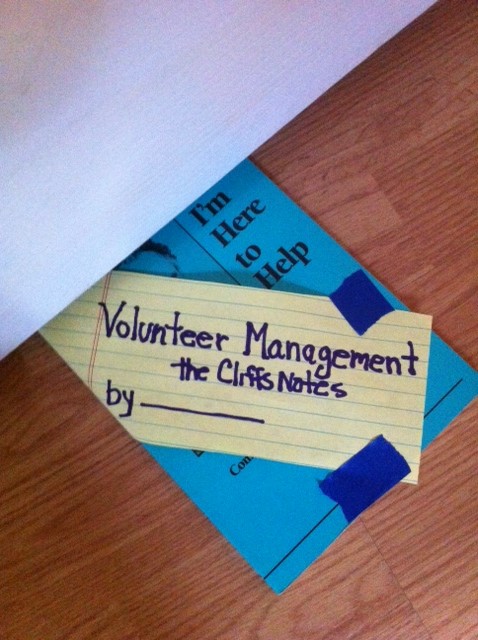
    I’ve always wanted to see a small pamphlet entitled “Volunteer Services for Dummies” or maybe “Volunteer Management, The Cliffs Notes.” Then I could sneak around and slip that bad boy under the door of the executive director while he was at a conference on “How to Get Donors to Donate More.” The pamphlet would have a way to insert whatever author’s name would impress him, like maybe that consultant who he’s recently hired to tell him that he needs to get more donations.

    So, forget the pamphlet. Let’s just list the ten top things that I wish CEOs would understand about volunteer services.

    10. Volunteers do not sit by their phones waiting for us to call. Shocker! We don’t just “order up” volunteers when someone asks for eight volunteers who can work twelve-hour shifts, outside, tomorrow at 8am. Yeah, no one wishes it were that easy more than we volunteer managers. Asking volunteer Charles to prioritize volunteering with us over his other volunteering activities, his trip to Bermuda (that he’s saved years for), his managing of his elderly mother’s affairs, and his scheduled surgery might just be a tad unrealistic. It takes a wise volunteer manager to know how to balance volunteers’ experiences so that volunteering is not burdensome and they look forward to coming in to help.

    9. Managing volunteers is not like managing staff.  Wow, bigger shocker! Unless managing two to ten times the number of very diverse people who only work maybe four hours a week without pay is the same thing. Instead of a paycheck to dangle, volunteer managers must use real leadership skills to inspire and coordinate volunteers. Think of it this way. Volunteers typically spend about 4 hours a week volunteering while you, the Executive Director and your staff spends upwards of 40 or 50 hours a week working for the organization. That’s at least ten times the amount of “plugged in time” you have over volunteers. Do you think that the volunteers spend the other 36 hours thinking about our organization? If not, volunteer managers must be able to “plug-in” volunteers every time they arrive on scene, motivate them to achieve that connection and keep them informed of changes and updates.

    8. Volunteers are everyone’s responsibility.  What?!!! The CEO is thinking, “Then what do I pay YOU, the volunteer manager for?” Staff doesn’t necessarily see working with volunteers as part of their jobs, but any staff can make or break a volunteer’s experience. Look at it this way. What if you, the CEO cultivates a donor by spending your time and sweat to encourage and inform and then another staff member comes along and insults that potential donor? It’s no different with volunteers. We need you, our CEO to set the tone. So if deep down, you are thinking that volunteers are not really time donors but are just fluffy side dishes,  then please stop saying things like “we can’t operate without our volunteers.”

    7. Volunteer managers are real managers. “Hmmm,” the executive director might be thinking, “No way, not in the same way our manager of fund-raising is!” Well, no matter what you call them, coordinators, specialists or team members, volunteer managers are as much a manager as anyone on your staff. The list of skills needed to lead and cultivate a team of volunteers (see #9 and #6 and #4 and #3 and #2 and #1 and oh heck, all of them ) is quite extensive.

    6. Volunteers want meaningful work. “So,” the CEO may be thinking,  “but I often need some meaningless stuff done. Who will do it?” That’s true, but volunteers do not want to just do what the staff doesn’t want to do, they want real jobs that make a difference. And since we don’t pay them, maybe we should consider meaningful work as pay? But, a great volunteer manager with awesome skills can lead volunteers to occasionally do the grunt work if grunt work isn’t all that is offered.

    5. Volunteers want sincere appreciation from more than just the volunteer department. An Executive Director might be thinking, “Hey! I always say that we couldn’t operate without our volunteers, don’t I?” Yeah, you do. But guess what? Volunteers see through the once a year speech at a luncheon that is just lip service. Volunteers want you to make an appearance and say hello, send hand written thank you notes and include their accomplishments the next time you meet with the board of directors. And oh, they would like you to genuinely encourage staff to do these things too. Volunteers are either an integrated valued service or it’s all just talk.

    4. Volunteers are not just little old ladies drinking tea. “But,” a CEO could say, “they sure look like that description ha ha.” Did you know that volunteers are diverse in every way, including age, background, culture and experience and that it takes some major skills to manage a group of very diverse people? But even if some volunteers are older, did you know that they are former executives, professors, leadership experts and full of wisdom and great ideas? And they’re more than willing to share their wisdom for free.

    3. Volunteer managers are not lap dogs.  “Hey,” the Executive Director would protest, “I never said that!” But are the volunteer managers treated that way by staff? Is there an “order up” culture in which volunteer managers are expected to just get volunteers without having any meaningful input into volunteer requests? Volunteer managers have their fingers on the pulse of the organization and are privy to every aspect of the mission via volunteer involvement. Maybe, just maybe, your humble volunteer manager is really a great motivator and leader and not just an order taker. Check them out for some really awesome ideas and managerial skill-sets.

    2. Volunteers are aware and talk. “Sure, so what, that’s great,” a CEO might agree. But, when a volunteer hears negative speak from staff, or sees something less than perfect, guess what? They talk, to each other, to friends, relatives, and the cashier at the Quick-Mart. Volunteer managers keep volunteers motivated and inspired and mediate constantly to make sure the volunteer’s concerns are resolved and their experience is positive. In this world aching for transparency, volunteers are the town criers who can proclaim the worth of an organization or do damage to its reputation.

    1. Volunteers don’t stay forever. “Heresy! They should if the volunteer manager is doing her job,” an Executive Director could counter argue. No, actually volunteers don’t. Does staff stay until they die? No, and neither do volunteers. We should recruit, train and cultivate our volunteers just as we do staff, but not expect them to continue until they’re carted off in an ambulance. And, just like staff, sometimes we don’t want them to stay, so that’s why the professional skill-set of the volunteer manager is so crucial. A volunteer manager’s professional resolution to a challenging situation is an organization’s best chance to avoid negative publicity.

    So, there you have it. I’ll bet you volunteer managers have some really great ideas on other truisms that belong on this list. You have my permission to print out this list, slip it under your leader’s door. Somehow add to it that it was authored by the “Center for Outstanding Management and Maintenance of Organizations and NGO’s” via the report from the “Study on Excellence in Non-profit Structure and Ecosystems” or COMMON SENSE for short.

    -Meridian

  • Your Spotlight Hurts My Eyes!

    In the Spotlight
    In the Spotlight
    I almost spit out my sip of coffee when I ran across this article a week ago. According to the story, a great grandmother was “sacked” from her nearly 30 year volunteer position at a thrift store for her inability to use a computer. The searing negative light this incident turned on made me cringe because as you can see from the selected comments I pasted below the link, non-profits all get lumped into the big barrel of rotten fish when a charity receives bad press.

    http://www.express.co.uk/news/uk/590346/Volunteer-great-grandmother-sacked-charity-shop-cannot-work-computer

    Here are 3 comments from readers:

    JHR16 days ago
    Charities are beginning to stink to high heaven.

    ycjarman17 days ago
    NEVER help a Charity that doesn’t appreciate what you bring to it !

    JBJB116 days ago
    Strikes me a lot of charities have lost sight of what they are supposed to be doing and more concerned in becoming corporate enterprises

    I’m not jumping on the “get the pitchfork and storm the castle” bandwagon because as I read the article, I began to imagine the different scenarios that led to this unfortunate public airing of an incident involving a volunteer. What really happened? We don’t know, so I’ve put together some possible scenarios based on my own experiences with these types of circumstances.

    1) An organization’s resale shop manager is just plain tired of “dealing” with volunteers who can’t work as efficiently as paid staff and so begins to find a convenient reason to dismiss those volunteers, never mind their years of service.
    2) Volunteers become so entrenched in their jobs that no one has the guts to derail their authoritarian and entitled behavior and everyone kicks that can down the road until there is a blowup.
    3) A volunteer becomes increasingly negative for any variety of reasons (health, circumstance, lack of being heard) and no one clears the air. This negativity builds and spreads until big problems arise.
    4) Change is implemented without careful regard to how it will impact the volunteers. Lack of change awareness leads to grumbling, camp-forming and ultimately mutiny.
    5) Repeated staff turnover leaves a new volunteer manager without any basic information about the volunteers he/she manages. Personality clashes balloon into showdowns with staff.
    6) A shop manager/volunteer manager is burnt out, overworked and under appreciated, pressured to increase profit/sales and is unable to properly cultivate the shop’s volunteers.

    This comment from a reader of the article hits at the perceived lack of volunteer management:

    moanalisa16 days ago
    it’s taken 30 years for them to ask Mrs Brooks to leave – if they were so concerned about Mrs Brooks attitude she should have been told to leave years ago

    So, could this negative press have been prevented? Perhaps, but the point is, whether the volunteer is in the right or in the wrong, the proper handling of their exit is challenging but absolutely crucial, especially in the messiest situations. A curt dismissal letter is a weapon in the hand of the offended.
    Sadly, we all are included in the negative stereotypes of charities as witnessed by the comment section of this article. The “pile-on” comments reinforces any perceived notion that “you know, I’m not so sure my local charity is really that nice. Last time I gave them a check, I never got a thank you. Maybe they’re just not who I thought they were.”

    Our microscope is turned to a higher scrutiny than that of businesses. Why? Because the public perception is that charities are run by people who are nice. It’s a simple perception but one that takes a tremendous amount of attention to detail to continue. Who wrote the letter sent to the volunteer? Was it written out of frustration? Acting out of heightened emotions can get us splayed across media. For every 20 volunteers who perceive they are treated badly, one will go to the press or their circle of acquaintances. (And of course their acquaintances live next door to the CEO or the editor of the local newspaper)

    So, what to do? You may never adequately resolve an issue with a volunteer and have to dismiss them. But, taking the extra time and effort to make the volunteer feel heard can go a long way in dousing the fire of their perception of being wronged. I’m not advocating the acceptance of poor behavior, I’m saying that hearing the volunteer’s side without your agreement or disagreement helps diffuse their anger.

    If you’ve inherited a problem volunteer, it is much trickier. A volunteer whose problem behavior has been overlooked has assumed that the organization is fine with that behavior. It takes real skill to dismiss someone who looks at you as the evil newbie when in fact, you are just cleaning up the mess spilled on the floor years ago that now has mold growing on it. I’ve been in these situations and had hours long conversations with entrenched volunteers. Being respectful but firm, complimentary of their positive skill sets while pointing out negative behaviors and reiterating everyone’s commitment to the mission is helpful. While it took an enormous time and emotional commitment, the end result was always worth it. I never left the conversation until I felt that the volunteer and I were at a calm, reasonable point.

    Having written conduct rules, including the steps for dismissal is critical. Every volunteer should sign a copy for their file. I’ve had to go back and look for that copy on several occasions and the presence of the volunteer’s signature on that document has saved me.

    We all lose when folks reading a negative newspaper article generalize about every charity. Charities have to work harder to maintain the perception that we are ethical, caring, and committed to treating everyone, including volunteers respectfully.
    But then, we signed up to be ethical, caring and committed to treating people respectfully, didn’t we?
    -Meridian

  • Looking Back

    I’m on vacation this week visiting family. In typical volunteer manager fashion, I figured I’d be searching the yellow pages for and interviewing volunteer managers in a new and different town. But, I’ve subjected my family to so much work intrusion throughout their lives as I’m sure you have too. It’s time to just simply enjoy them.
    So, I got up before everyone this morning, fired up the coffee and looked back, found this very early post and copied it. I hope you don’t mind. It made me feel good, because I know this visit with family will come to an end and I will be sad because life is not perfect, but it is a balance of work and home, success and failure, joy and pain, curiosity and fear. And in it all lies meaning; meaning for those we serve and meaning for us. Here is the post from four years ago:

    You know how some days just feel wrong?  Today was one of those days. I had been reading some very interesting articles about volunteer management and started getting ideas that I could adopt for the volunteers I work with when a little voice said, “It’s Friday. Who cares? You’re overworked, underappreciated and tired of the struggle. Give it up.” I wasn’t happy to see any of the volunteers today. I wasn’t all that funny or nice or anything. I was blah.

    As I was sitting there, staring at the computer, willing it to make me feel better, the phone rang. I don’t know about you, but when it rings on blah days, I sometimes let voicemail pick it up and then I call back later. It makes me feel more in control I guess. But for some reason I reached for it. Must be habit.

    I answered and it was Monroe calling from Des Moines where he now lives with his mother. Monroe used to volunteer with us. He is 23 years old. He moved to our area with his Mom to look for work. They lived in an apartment a block from my office with no car, no job and little resources except a grandmother who lived in the area.

    He came into my office three years ago and asked to volunteer. He is one of these really, really quiet types; you know the ones who answer in monosyllables. He speaks in a voice that barely breaks a decibel and looks down as he talks. He is covered with tattoos and piercings and wears nothing but black. He has a goatee.

    To be honest, I took one look at him and wondered why on earth he would want to volunteer and would he scare staff, clients and other volunteers? I gave him the information for the next orientation and thought no more about it. Not only did he show up, he came to all six sessions, and participated, albeit in monosyllables. The other volunteers started to like him.

    Monroe started volunteering in the office. He told me a little about his situation. I could lie and say he opened up, but he did give me some tidbits here and there. I happened to be working with some volunteers on a music project and I mentioned that to Monroe. He said he wanted to help. Now this is a project that a very select few volunteers who have extensive musical experience work on, but I brought Monroe along for a meeting and practice. He not only did anything asked of him, he asked to do more. He informed me that music was his passion.

    From that day forward, Monroe became our go to guy for anything musical, whether it be production, setting up, getting snacks or toting heavy equipment. He became one of us very quickly and every single volunteer took him under a wing. I have to admit I drove him a few places and so did other volunteers. He was always very grateful. I got to see his apartment one afternoon when I gave him a ride home. He was very proud of his room.

    His Mom could not find work and so they had to go back to family in Des Moines. I am not lying when I say I really miss him and so do the volunteers who worked with him.

    After I happily greeted him on the phone, I asked him how he was doing and in typical Monroe fashion, he said “good.” I tried to extract more, but I did get that his mom had a job and so did he. He was working on writing music and doing well. He told me that he wanted to keep in touch with us and I was relieved. I asked him if he found a place to volunteer and he said that he had thought about it, but no, it wouldn’t be the same. He then told me that we were family to him.

    We all have the chance to impact the lives of those we serve by providing the best volunteers we can. We all have those nuggets of success when a volunteer does a great job. But this is different. Monroe is a personal slice of joy for me. I don’t know how much his volunteering experience impacted him, but I can guess that we had a very positive impact on his self-esteem and psyche. I hope we did, and I hope that I never forget that everyone has something to offer. Volunteer managers are fortunate enough to be able to discover and cultivate the talents and desires of the folks we manage. The heck with blah. I’ve been reminded that it’s good.

    -Meridian

  • Dialogue? You Call This Dialogue?

    GPS-IIRM wikipediaOne day several wise men were challenging each others thinking over tea. “If you were given the opportunity to sacrifice yourself for world peace,” the first man asked the group, “would you do it?”
    “Yes, of course,” the second man said. The third man agreed. “If I were guaranteed world peace, I would do it, surely as it would be the right thing to do.” The fourth man rubbed his chin. “What do you mean by world peace?”
    “Just that, world peace,” the first man said.
    “Well, if world peace meant only for one day, then no, I wouldn’t do it,” the fourth man said.

    Do we know what staff members, CEO’s, volunteers, and the community mean when they use certain phrases and concepts? And do those concepts mirror what we, volunteer managers define them as?
    One day when I was feeling particularly feisty (or truth be told, downright crabby from hearing that a volunteer was sent home from an assignment at a health fair because a marketer brought her children to man the booth), I heard a staff member say, “we couldn’t do what we do without our volunteers.” Now, I know this is a lovely platitude, but being cranky, I asked, “really, that’s so nice, what do you think would actually happen if we didn’t have volunteers?”
    She looked at me like I was a pompous jerk (and maybe I was). “Well, we probably couldn’t accomplish as much as we do.”
    “Do you think we’d close?”
    “Don’t be silly,” she said and walked away, I’m sure thinking that I was nuts and a pompous jerk.
    But what is meant by common concepts that are continually used? What do some of the phrases we hear actually mean?
    “We love our volunteers.” What does that mean? We love them individually and will bring them soup when they are ill or we love the idea that we have them? Or we love them as long as they don’t create any problems for us or take up our time or ask questions when we are busy?
    “We’re volunteer friendly.” Really? How? Explain that to me. Do we hang out with our volunteers on a Saturday afternoon along with our good friends? Do we let them call us at home? Do we confide in them? Do we smile at them when we walk in but don’t notice that they have a broken arm because we are late for a meeting?
    “Volunteers are the heart of our organization.” Hmm, are we talking about a crucial organ or a warm fuzzy feeling? Do we mean they truly inspire us to be more compassionate or is the term “volunteer” an abstract idea that we cherish, not real, breathing human beings that come in every day?

    See, if you say volunteer engagement to a volunteer coordinator, there is a complex burst of ideas that go off in their heads, including the idea that engagement is a two way street. Ask any random staff member “what is volunteer engagement” and you may get a totally different view that does not include volunteers in leadership roles or the challenges in managing volunteers. And here is where an awful lot of volunteer manager angst lives.

    So, the challenge is, how do we beat the concept of volunteer engagement into everyone’s heads?
    Wait, did I really say, that, whoah, I must have let that rabid little voice take over for a minute. Whew.
    But seriously, we have bent ourselves into pretzel shapes for years trying to “educate” organizations on the true nature of volunteer engagement. Sometimes we’re kinda like the folks who show up at your door unannounced, either selling something, or trying to get you to accept their pamphlets on their religious and political beliefs. I know I have been like that.
    Me: Knock, knock.
    Staff: Who is it?
    Me: Volunteer Services here to educate you on volunteers!
    Staff: Um, I’m really busy, what with just coming from three meetings and my work is piled up. I just attended a seminar last week on fund raising so I’m a bit overwhelmed.
    Me: Well, if you’ll just open the door, it won’t take more than 20 minutes.
    Staff: Can you come back later?
    Me: But this is important. Don’t you want to know about volunteers?
    Staff: I already do, they’re great, gotta go, my phone is ringing.

    Hmmm, if the knock knock method doesn’t work, now what? Well, maybe we should try a dialogue. I know, dialogue is one of those buzz words, but
    we could seriously try asking organizational stakeholders the meaning (in their own words) of concepts that we think are important to bettering communication between volunteer services and staff. And if we do this with sincere intentions to learn where we differ from staff in how we view volunteer services, we might be able to begin work on closing the gap.
    Hearing a senior manager’s explanation of volunteer engagement may make you angry and think, “how can he be so ignorant? How can she think that’s all there is to it?” But, if we put aside that anger and look at the disparity in thought, then perhaps we can begin to free ourselves to analyze how to make volunteer engagement better understood within our respective organizations.
    With the keen desire to understand, we can try asking, “how do you view the volunteers’ role? What does the term volunteer engagement mean to you? What about volunteer involvement?”
    Be prepared to hear some surface answers and some surprise answers and be prepared to question (in a non-judgmental way) those answers. “What makes you think that?”
    We can ask, “what do you think the most important job a volunteer manger does and what are the challenges volunteer managers face?” Hearing the answers may initially make you defensive but in stepping back, may just make you see where the misconceptions lie between what the volunteer department actually does and the perceptions of the rest of the staff.
    Again, this is dialogue, not mandates to change the way we view or do our work. How can we work together with staff to help them learn more about the challenges and organizational responsibilities of volunteer engagement?
    If we want to get to a place where staff view volunteer engagement the way we do in all its complexities, perhaps we need a street map to get there. Discovering the diversity of ideas within our own organizations on common volunteer concepts and terms may just be the first step to the GPS we need to arrive together at that place where volunteer engagement is understood by everyone the exact same way in which we understand it.
    -Meridian

  • Let’s Just Have Tea, Shall We?

    teaMarlene has been a volunteer coordinator for ten years. She’s adventurous, loves rock climbing, extreme sports and her idea of a pleasant evening is a demolition derby. It’s only natural that she would bring her sense of adventure to volunteer management.

    “I like to try new things all the time,” she says with the tiny grin of a child caught in the act. “I like to see the things others are doing and try to incorporate that into my volunteer program. Here at my hospital, it’s easy to get into a complacent stage where you think all people who come to volunteer in a hospital setting are pretty much the same type of person. I’m constantly being told to find retired nurses and health care workers, because they would naturally want to continue their line of work after retiring, wouldn’t they?” She laughs easily. “I mean it’s this kind of thinking that breeds a stale environment. Now don’t get me wrong, I understand that a retired nurse would be easy to train because she knows the system so well and can follow the rules. But,” she adds with a mischievous gleam in her eye, “what about the retired nurse who was so fed up with obeying the rules, and she wants to volunteer to break the constraints wide open? Huh, what about that?”

    Marlene has a great point. Organizational administrations who tend to lump potential volunteers together will most likely also make the mistake of lumping actual volunteers together in a “them” mentality. Ignoring the subtle complexities of volunteer management will foster this stale and outdated thinking.

    “When it comes to interviewing potential volunteers,” Marlene continued, “I’ve tried everything from quizzes to group interviews to structured questions. Sometimes these techniques work, and sometimes they don’t. We’re in an age when background checks are not enough, not if you really want to get to know the motivations of the volunteers working within your system. Do background checks uncover mental illness? Does a quick call to a reference on an application reveal the tendency to get over-involved with children? Will an interview question about the reason a person comes to volunteer actually produce the real answer?” Her grin widens. “And what is the real answer, now that is the question?”

    Marlene has had some experiences she wanted to share with us. “Look, I tried a list of good, solid questions, but what I often found was that I immediately put the volunteer on the defensive. For instance, I asked a man why he wanted to volunteer with us and he shrank back like I hit him with a bat. I could see in his eyes that he was searching for to the correct thing to say, so I knew right then that I wouldn’t be getting an honest answer. Now, mind you, this man became a great volunteer, but that interview question did not help me in any way. Actually, it hindered the rest of the interview and it took some time to get to know him.”

    Marlene looked for the right words. “But, I knew that I wanted answers to certain questions so I started experimenting with peppering the questions into a casual conversation. The whole process took a bit longer, but I found that in the majority of cases, it was well worth it. My mother was born in England and so I began to create in my mind what I termed the ‘spot of tea’ scenario. I would invite potential volunteers in for a twenty-minute chat and a cup of tea or coffee.

    At first I started by asking them simple questions and I found that even that put them a bit on the defensive so I experimented with trying to put them at ease. And now I begin by first explaining our program to them. It works so much better and puts them at ease. I start by introducing myself and talk about how the program works, our volunteer jobs, and some of the benefits of volunteering. I make sure that I tell them how rewarding our existing volunteers find their work to be. Then, and only then, do I start to ask some questions in a conversational manner. I’ll reword the questions every time so that it doesn’t sound so rehearsed.” Marlene laughs. “If you don’t think most potential volunteers can spot a canned question, then you don’t know volunteers!”

    She continued, “when people are comfortable, they will naturally open up, much more than when they are put on the spot by invasive questions like why are you here?” Marlene then recalled an incident during the beginnings of her ‘spot of tea’ interview. “I remember one young man who came in. We were talking, really getting to know one another and he told me that he had been fired from his last job. Because a red flag went up in my head, I carefully asked him what had happened and he told me. I was shocked that he confided in me, but it turned out to be a reason that prevented us from taking him as a volunteer. A background check would not have revealed that information to me. He did.”

    Assessing potential volunteers is something all volunteer managers want to do well. There really is no perfect question, technique or method involved in getting to know volunteers. Whether you have a set of specific questions or not, Marlene advocates first putting prospective volunteers at ease. “Make them comfortable with you so that they can be honest. That way, you’ll not only get some honest answers, but you’ll also have a leg up on figuring out a fit for them. And besides, it’s gratifying learning the volunteers’ stories. It helps you and it makes them feel a part of the organization right from the start.”

    This is why volunteer managers are so incredibly good at their jobs. Even the simplest of tasks such as interviewing a prospective volunteer is viewed as crucial to organizational success. Volunteer managers like Marlene may not try to be perfect, but in striving to do the best possible job in every situation is surely as professional as it gets.
    -Meridian