Tag: organizations

  • Volunteer Chaos Theory: If a butterfly flaps its wings, will Jeremy volunteer?

    pexels-photo-587085.jpeg

    I’m on a short vacation this week, so I’m revisiting a post I wrote in 2015 and tweaking it just a bit.

    Volunteering needs to have its own chaos theory:  You know, the one that starts with “if a butterfly flaps it’s wings in Brazil, will it spawn a tornado in Texas…”  because engaging volunteers can be quite chaotic.
    Have you noticed that a lot of really smart people look at volunteerism in a very linear way? Their volunteering theory in no way takes into account any chaotic variables that affect whether a potential volunteer follows through, or an existing volunteer stays. Instead, it all depends upon how well volunteer managers “sell” the program.
    Their linear theory  goes something like this:
    Volunteer Manager (VM) sitting at desk. A long line of prospective volunteers stand outside the door patiently waiting for their turn to do good.

    VM: Who’s next? May I help you?

    New Volunteer Jeremy (J): Hi, I’m answering your ad for volunteer help. Can you tell me more about it? I really want to do good and I can’t do good on my own so I came here.

    VM: Why yes, we need someone to do good by helping put up supplies.

    J: Oh my gosh, this is unbelievable, I have a Master’s Degree in putting up supplies! I’ve put up supplies for most of my life. I love nothing more than to put up supplies! When can I start to do some good?

    VM: Well, you first have to go through some orientation and training. There’s four sessions starting tomorrow. That might be a bit last-minute.

    J: Tomorrow, huh? Well I had some important surgery scheduled for tomorrow, but I think I’ll reschedule that. To do good by putting up supplies is far more important. I can take the pain a little longer for the chance to volunteer here.

    VM: Wonderful. After that we need to do a background check. It needs to be done before you come to training. That just gives you this afternoon to get it done.

    J: This afternoon, huh? I actually have an interview for the job of my dreams this afternoon. It’s a job in putting up supplies, but hey, I’ll bet they’ll understand if I don’t come. I’m sure another job of my dreams will come along in another decade or so. After we speak, I will go to the police station and do the background check. I’ll pay for that myself. While I’m there, do you want me to pay for some other volunteers?

    VM: No, that’s not necessary, thank you. Let me check the schedule for the all-important supply put-uppers. Are you available to work on Tuesdays?

    J: Wow, Tuesdays, huh? That’s the only day I have to take my elderly Mother out of the nursing home. She really loves our outings, but hey, what the heck, putting up supplies for you guys is so much more important. I can maybe write my mom some letters. I’ll be here every Tuesday doing good! By the way, what kind of supplies are we talking about?

    VM: Well, our organization gets shipments of office paper supplies on Tuesdays. No one here is willing to do that work.

    J: Office paper supplies, huh? I’m violently allergic to office paper, but you know, my college thesis was on the body mechanics of putting up office paper supplies! That’s where I learned I was allergic. But, I’ll just go to my doctor after the background check and get some stronger medication. Is there an emergency room close by here, just in case the medicine doesn’t work?

    VM: There’s a hospital about five miles from here.

    J: That’s fine, I’m sure they have ambulances.

    VM: You do know, Jeremy that you will have to work alone in a hallway closet. There’s not much light or air, but that’s where the supplies are kept. Is that all right?

    J: I do have a fear of the dark, but what the heck! My minor in college was working alone in a closet, where I learned I had a fear of the dark, but I’ll just bring my own flashlight.

    VM: Great, we will see you tomorrow. Thanks so much for volunteering. Next!

    So, in this linear theory, volunteers pretty much show up, then set aside and overcome any and all barriers to volunteering, because nothing will stand in their way. But, in reality, even the most well-intentioned and eager volunteer can be thwarted by outside factors.

    Have you ever recruited the most promising, amazing human being, only to have a change in job status, unexpected move or family circumstance steal them from you before they even get started? It can shake you and make you feel that all your hard work has been wasted.

    Chaos surrounds volunteerism. Unlike a paid position, any extenuating circumstance can interfere with a volunteer’s commitment to follow through. The tenuous bond volunteers establish with us can fray at any moment due to events beyond our control.

    It happens to all of us and when it does, it feels like that chaos butterfly is slapping us in the face with their wings. There’s no point in obsessing over the stories of “the volunteers that got away,” so we dust ourselves off and continue on, hoping that chaos will smile on us and allow the next eager volunteer to actually get a chance to become a valued member of our team.

    We keep that potential volunteer’s information in a drawer. Sometimes we get lucky and the butterfly wings flap in our direction. When the volunteer is able to return, they will, because we didn’t guilt them about a family member falling ill or a child of theirs needing help and instead, made them feel as though we understood that circumstances kept them from us.

    It’s those nuanced moments that can affect the direction our chaos takes us. Treating volunteers as more than bodies to fill tasks leaves a lasting impression on them. And even if circumstance never permits them to return, they will spread the message to others that our program cares about volunteers as people with real lives.

    Maybe we have to endure more chaos than most. And maybe it’s difficult explaining the variables that keep volunteers from following through.

    But maybe, in this chaotic world, the next great volunteer is waiting for us to find them.

    -Meridian

  • Annual Volunteer PerBoreMance Reviews

    Annual Volunteer PerBoremance Review

    “I quit, yeah I did.” Christi poked at her sushi. “I mean, I volunteered there like, a year and everything was fine.” She clicked the chopsticks together in rhythmic thought. “Well, I thought it was, anyway. But at my performance review they told me I wasn’t doing the job all that well and that I needed improvement. You’d think they would have said something before a year, wouldn’t you? Now, I figure, everything I did for them was a waste, so I quit.”

    The Annual Volunteer Performance Review (AVPR). It didn’t help Christi, did it?

    The department Christi volunteered for felt that something had changed with Christi and in the past few months, they had to go behind her and fix all her mistakes. But, did they address it with her? No, they chose to just sigh and throw up their hands while muttering, “volunteers, go figure.” And so, when it was time for Christi’s AVPR, that’s when the department decided to address the issue. And so, she quit. Maybe that’s what they wanted all along, but was that the right way to handle it?

    While the AVPR is set up to deliver constructive feedback, there are a few inherent problems with this model:

    • a yearly review more likely reflects the volunteer’s performance of the past month, not year
    • if a problem has not been addressed with the volunteer before the review, then the volunteer is blindsided when finding out they have not been doing well
    • it takes time to put a review together and because we’re volunteer managers, we agonize over making it just right, which takes more time
    • it gives everyone involved anxiety, i.e., the volunteer and the volunteer manager, especially when the volunteer hasn’t received much feedback up to this point
    • oftentimes it is a requirement, but it doesn’t carry any follow-up or plan of action
    • it can suck the soul from volunteering when everything is boiled down to line items
    • it doesn’t measure the real value of the volunteer’s contribution

    So, should we just throw it away, even if it is a requirement? Ok, well, maybe we can’t get rid of it entirely,  but maybe we can tweak it so that it better fits our needs.

    We know that volunteers need on-going feedback. More so, actually than staff. The longer the time spent away from a job (staff spends about 40 hours a week at their job and volunteers spend on average maybe 4 hours at their volunteer assignment), the greater the learning curve. Volunteers don’t have the on-going repetition of learning a job, don’t have the daily back and forth between co-workers, don’t experience the atmosphere of expectations for hours on end like staff does.  So, volunteers’ feedback needs are exponentially greater than staff’s.

    Besides, they may not stay for a full year, so feedback is vitally important while they are actually volunteering.

    Addressing a problem after it has been ignored for a time, creates this sinkhole of confusion, hurt feelings and anger. Ignoring problematic behavior until you can’t any longer just deepens the hole. How?

    • The volunteer is blindsided
    • You can’t really justify why you let it go on so long
    • You render your policies and procedures meaningless
    • You erode your position as a leader
    • You water down the integrity of the mission

    Performance reviews imply something must be addressed. If everything is going well, then the review is a pat on the back, unless you are compelled to come up with an area that needs improvement (and a lot of performance reviews have this requirement). So, you make something up for the volunteer to work on, which renders the review pretty meaningless.

    So, what can we do instead?

    Give mission related feedback:  “Hey there, you’re doing a great job,” is nice in a broad kind of way, but specifics are much more meaningful. Why is the volunteer here except to further the mission? Mission related feedback can be peppered into conversations. “Thanks so much, Jep for coming out last-minute. Because of your quick response, the wife of our client Ari, was able to get to our support group. She has missed the last three group meetings and they are crucial to providing families with education and support. Do you realize that your actions directly impact our mission to support and educate our patients and their families?” These are the instances that fulfill mission centric volunteering and they need to be recorded, both in the volunteers’ files and for those all important volunteer reports.

    Expect excellence: Expecting nothing more than showing up gets us, well, nothing more than showing up. (and not because the volunteers are lazy, but because the message we are sending is “we don’t expect much because we have nothing meaningful for you to do, it’s all just busywork.”) Being wishy washy nice and afraid to hurt feelings gets us a heck of a mess. Volunteers want to be part of something excellent. Let’s not rob them of that by excusing any and all behavior.

    Volunteers want leaders: Leaders aren’t afraid to lead. If volunteers wanted us to be their best friend, they’d get a dog instead. They want us to inspire them, mentor and coach them to excellence. Look at your feedback in that way-“I want you to be the excellent volunteer I know you can be and by working together, we are going to accomplish great things.” (my dog never told me that, well, not in actual words anyway…)

    Turn the work around: Yep, offload when you can. Instead of wracking your brain to fill out some form, ask the volunteer to come into your review meeting with 2 things they’ve accomplished over the year and 2 mission related goals they have set for the coming year. Discuss their accomplishments, how they achieved them, and then give them any suggestions you have for improvement.

    And here’s the weird thing: Don’t fear that if the volunteer comes in with their perceived accomplishments, you won’t be able to address their shortcomings. Why? Because the accomplishments they point to will always somehow involve the areas in which they need improvement. How can that be? I don’t know, it’s one of those blow your mind physics things like you always hit the stop lights when you’re late. Just trust me.

    After you discuss accomplishments and shortcomings, take a look at their goals.

    The beauty of listening to their goals gives you an opportunity to:

    • learn more about the volunteer, where they are headed, what they value, where they feel they fit in
    • redirect any potential behavior that needs to be worked on
    • discover more about the volunteer program, what volunteers think of it, where challenges might lie, what visions volunteers have for the future
    • discover what the volunteer thinks about the organization, it’s mission, structure, staff, rules etc.
    • recharge your role as the inspirational leader of volunteers
    • re-direct everything back to the mission
    • and finally, for crying out loud, learn what it takes to keep this volunteer engaged

    We can re-purpose annual reviews into goal setting discussions geared towards keeping great volunteers coming back. And then, throughout the year, we can provide the feedback that guides each volunteer towards excellence.

    We can turn a perboremance review around and call it the setting of mission centric volunteer goals. 

    Besides, reviews look backwards, goals look forward.

    And isn’t looking forward the way to progress?

    -Meridian


  • Volunteer News Stories: Does This Good Press Really Help?

    Volunteer News Stories Does this good press really help
    Courtesy of https://gratisography.com/

    Emma set her cup down on the table and opened her laptop. She could hear the kids arguing upstairs as they got ready for school. Jenna needed to be picked up after soccer practice, and Harvey still needed to finish his science project or he’d get an incomplete. Emma’s phone pinged. Her mother’s tests came back. The cancer had returned. Holding back the tears, Emma scrolled through her news feed. She clutched at her life spinning out of control, desperately grasping at something to ground her. She read the headlines. So much political in-fighting. Too many vapid celebrity news stories. One heading came from her local newspaper: Volunteer Receives City Council Award. Emma paused for a second, and then scrolled on.

    For years, I thought that any story on a volunteer would produce a tsunami of people trampling each other to join our team. “I want to be just like Herman, or Zafir, or Maria,” they’d proclaim, their fresh smiling faces eager to give back. “Pick me! OOOOOhhh, pick me!” They’d come in wearing t-shirts sporting the face of my smiling volunteer. It would be cult-like, but so what, my volunteer was a star!

    Having press cover volunteers was so rare, that once a reporter showed up, I was slobbery grateful for any mention at all. I grovelled at the reporter’s Birkenstocks. And so, stories about volunteers receiving some plaque or attaining some milestone were all I could get. I never challenged the content and I always suspected the reporter was being punished by doing a “filler” or “human interest” story and really wanted to get on to digging out news stories about that bank robber wearing the Nixon mask or the mayor’s brother suddenly being awarded a lucrative city contract.

    While scrolling through news-feeds this week, it felt like the I was back in the 90’s. I could hear Alanis Morissette singing in the background. Ironically, the overwhelming majority of volunteer news stories are identical to the ones written about my volunteers 20 years ago. Here are some news-feed headlines from just two days worth of searching articles: (names and places removed)

      • Seniors recognized for volunteer work
      • Doing what comes next: Man keeps working, volunteering
      • Volunteering “immensely rewarding” for local woman
      • Duo shares gifts through volunteering
      • Local woman finds volunteering a positive influence
      • Local man honored for volunteering by Service Center
      • Couple’s love of volunteering keeps them on the go
      • SENIOR SPOTLIGHT: Volunteering can have numerous benefits
      • Volunteer receives medal for dedication
      • These volunteers provide help, friendship

    Have you nodded off yet? And to think I used to titter excitedly, “my volunteer in the newspaper, wow, we’re at the summit of the recruitment mountain! Break out the oxygen!” Seriously, what was wrong with me?

    I’ve been reading targeted news-feeds for years. Anything of real substance I share on my Pinterest site, Volunteer Management Talk. But most articles on actual volunteers by actual reporters are frothy little yawn-fests. Yes, they’re positive. Yes, they paint volunteerism in a good light.

    But where are the meaty stories that outline the results of volunteering? Where are the intriguing headlines that proclaim, “These Volunteers are Alleviating Homelessness,” or “These Volunteers Are Creatively Saving the Wetlands,” instead of “These Volunteers Have Really Big Hearts and Are as Boring as Their Organization’s Website.” (ok, sure, I made up the last part-sorta)

    I was wrong about the recruitment potential of the few articles that were published in my local press. There was no mad rush to volunteer. I didn’t see our phone lines light up, or volunteers stampede in with news that their friends and neighbors were outside, clamoring to join our awesome team. I didn’t yell, “Put more coffee on, guys, it’s going to be a long night!”

    In retrospect, I failed to get the real message out. The real message is the impact.
    Volunteer managers everywhere are fighting to elevate the volunteer role by changing the perception of volunteer contributions and volunteers. If we want volunteers to be recognized for their work, we have to take volunteers out of the “human interest” column and push it into the “news” division. But, how?

    When a reporter shows up to cover that award or story about Jane and Hermione, partners and your volunteers for 10 years, ask the reporter these questions:

        • “Where does this story fit in your publication’s divisions? Why?”
        • “What is the end game of this story? What do you want readers to take away?”
        • “Do you want to know the bigger story, that of the impact on our community?” (be prepared to offer relevant information and if you can, an interview with someone helped by your volunteer)
        • “Can you come back and do a follow-up story on the results of the volunteers’ work? We have some juicy human interest stories to share about the people who have been impacted by our volunteers.
        • If the reporter is doing a story on a particular volunteer or volunteers, (let’s take life partners, Jane and Hermione) prepare some eye-opening stats about them. “Yes, it’s true that Jane and Hermione have been here for 10 years, but here are the stats and stories on the impact they’ve had on our homeless population and by the way, that’s the reason they’ve been here for 10 years. “

    I know you’ve experienced this. A volunteer is chosen as the subject of a local newspaper piece because of an award or milestone. The humble volunteer doesn’t want to be the center of attention. The reporter is just on an assignment. You convince the volunteer to do it because it will inspire others to volunteer. You tell them that whatever they say will be inspiring, because hey, they are a great representative of the work, right? Well, maybe they really don’t know what to say.

    Well, why not take it one step further and plan with the volunteer what he/she will talk about? Pick out real impact stories to focus on and explain to the volunteer that these stories are the impetus for encouraging others to get involved. Tell them to turn the interview message around from “you can be like me,” to “you can impact our clients too, in these ways.” And throw in, “we can sure use more help.”

    Why not help the reporter see that they could turn the story into something more, something with real substance? Plant that “juicy” story in their heads.

    There’s a complex mathematical equation that explains the phenomena surrounding news stories about volunteers: It’s tricky and complicated, but it goes like this:

    Press Stories on Volunteer+Fluff=Where are the new volunteers?

    We have more than just our organizations needing to be convinced that volunteers are not just decorative marshmallows of pillowy goodness. We also have to target press, media and the community.

    I’m disappointed and sorry I didn’t do anything about this disconnect before. But, the perception of volunteer contributions needs to change, both within and without. I think that together, we can change this perception, one story at a time.

    -Meridian.

  • Top 3 Theme Ideas for Volunteer Appreciation Week

    Top 3 Theme Ideas for Volunteer Appreciation Week

    Is it time to buy those cute banners and balloons for the annual volunteer luncheon? Do you wonder which phrase is better, “Volunteers are Priceless,” or “Volunteers Are Helpers Extraordinaire?” Don’t have unlimited resources for volunteer appreciation but need to decorate the halls with messages of thanks? I’m here to help.

    You can scour promotional product websites and find some great posters with nice sayings such as “volunteers, work with heart,” or “volunteers put the care in caring,” or “volunteers, you brighten our day,” but it will cost you. And if you’re a budget conscious volunteer manager, or more likely have only the $13 in change from all the times you were roped into running out to get food for senior management meetings, then you’ve come to the right place.

    And anyway. why use old cliché themes to celebrate the volunteers? Why not actually save money and create the kind of honest theme that will really resonate with your volunteers? Here are my top picks for this year’s themes.

    Volunteers, Love the Box You’re In! Ask friends and family to give you their old boxes, like shoeboxes, used gift boxes, cardboard shipping boxes, etc. Place them in strategic areas under a banner that reads, “We love our volunteers so much, we are keeping them safe in a pretty box!” Plaster copies of your rules and policies on the walls and play games such as “pin the broken rule on the volunteer.” If you’re lucky and can score an appliance box, decorate the inside and create a photo booth. Take pictures of your volunteers and create memes, adding text quotes such as “It’s cozy and safe inside my organization’s box,” and “the mission needs me to adhere to the rules so I don’t run amok!”

    Volunteers are the Plastic Bags of Charity.  Who doesn’t have a thousand of these grocery bags stuffed into a closet? Tape them all over the walls next to a huge sign that proclaims, “Volunteers are for using, like plastic bags-we stuff ’em in a closet and yank ’em out for whatever we need!” You can even fill some plastic bags with leftover garbage and picked up dog poop to scatter about the room for effect. (see, these bags have many uses) Give out the golden plastic bag award for the volunteer who completed the lousiest assignment without complaint.

    Volunteers, Thanks For the Time, But It’s About Donations! This one is easy. Buy a pack of construction paper and cut out dollar (or pound sterling) signs and tape them all over the place. Invite the fund-raising arm of your organization to hover around the meeting room and hit up volunteers for money. Instead of reading out stats on volunteer hours given, (pffft, who cares anyway, right?) read out the names of volunteers who haven’t donated money lately. Then, play pass the basket. You might even want to enlist your cousin Dwayne, who is an amateur body builder, to stand at the exit door and look menacing.

    No matter what theme you choose, volunteer appreciation week can be a real source of stress and frustration for any leader of volunteers. Do all these sweet messages printed on candy hearts and breast of chicken lunches really convey true appreciation for volunteer contributions? Do you feel the burden of making the volunteers feel valued fall onto your shoulders? You’re not alone.

    This week creeps up on every volunteer manager. I know, I used to scramble to make appreciation meaningful. There’s not enough time nor brain power to do the job of the volunteer manager and plan mind-blowing events at the same time.

    So, I’d end up relying on silliness, weird dancing and my general refusal to be embarrassed. We always had fun. And sometimes, that can be enough. Fun is a bonding experience.

    Please don’t stress yourself too much. (I know, easy to say) Try to have some fun with your volunteers. Try not to wonder if it’s all enough.

    And maybe, we, volunteer engagement professionals, will all keep moving collectively towards pushing organizations into strategically recognizing volunteer contributions. As one strong voice, we will keep pulling organizations into the twenty-first century and move them to abandon outmoded ideas on volunteer services so that you don’t have to scramble during this week every year and volunteer appreciation becomes organic. We will keep advocating as a tightly knit body of experience, so that leaders of volunteers are an integral piece of strategy planning and volunteer recognition is woven into all organizations’ grand schemes.

    Now, that would be something worth celebrating.

    -Meridian


  • 5 Things Your Volunteer Manager Isn’t Telling You


    1. I’m the one who convinces volunteers to stay after they are ignored or are treated poorly. Yep, that’s me calling volunteers to convince them that it was just a one-off or that a staff member had a bad day. It’s me you see when you walk by my office, sitting and having a long heart-to-heart with a volunteer. You may think that I’m just socializing, but in reality, I’m doing my job. I’m retaining a good volunteer who is on the verge of quitting.
    2. I may look like I’m just having fun but I’m hard at work ensuring the volunteers are connected to our mission. Uh, huh, it may look easy, but creating an inclusive, welcoming atmosphere is exhausting. I can’t have a down day; I have to be “up” and empathetic and positive at all times, no matter how I feel. I’m the one running all over town to get the balloons, ordering a cake, creating signs with positive messages that I say come from staff, but really it’s just me making them up because staff is too busy. I make sure I learn about every volunteer, their motivations and interests. I keep dates of volunteers’ birthdays in my head, along with their favorite books, or the heartfelt stories they tell me about clients. I juggle so much information because each volunteer wants to personally connect with our organization and most of the time, I am that connection.
    3. You may think I work 9-5, but actually, I’m recruiting volunteers and answering their questions at all hours, everywhere I go. Um, yes, I recruit at my kids’ soccer game when I meet a dad who has a big heart, at the gym when I meet a lady who is organized, and at my place of worship when I see a person who makes everyone feel welcomed. Besides, my open door policy means I am available to the volunteers whenever they need me. I’m not complaining, but don’t ever think that I’m not working at all hours towards creating an excellent department. I am. I just don’t broadcast all the things I’m doing. It’s not about me, but know I’m doing so much more than you can imagine.
    4. I can’t make volunteers do what they don’t want to do. Sigh. Nope, I can’t. Don’t forget, they’re not paid and I can only encourage, beg, convince, cajole, or promise so much. If your request is something they don’t want to do, well, they won’t. They know when I’m trying to “sell” them on an assignment. Volunteers are quite perceptive and I teach them to have boundaries and to not say yes to everything because it keeps them from burning out and we need them for mission centric work. I’d truly appreciate help with making sure volunteer assignments are worthy of our volunteers’ interests and skills so that we don’t drive them away. And actually, my time is better spent engaging our volunteers with meaningful work than trying to get them to do something no one wants to do.
    5. I know our volunteers’ potential and you need me to plan their involvement. Yes, it’s time you understand this. I know the volunteers inside and out and if you want them to support our mission, then I’m the one who can shape their roles so that it’s a win-win for all. The reality is, only I can design the roles our volunteers want to fill. I can create positions that make volunteers want to do more. I want our organization to succeed, and engaging our volunteers is a leap towards excellence. Let me be of greater service by planning our volunteers’ involvement together, with you.

    There, I said it.

    -Meridian

  • Let’s Design Mission Centric Volunteer Engagement

    Let's Design Mission Centric Volunteer Engagement

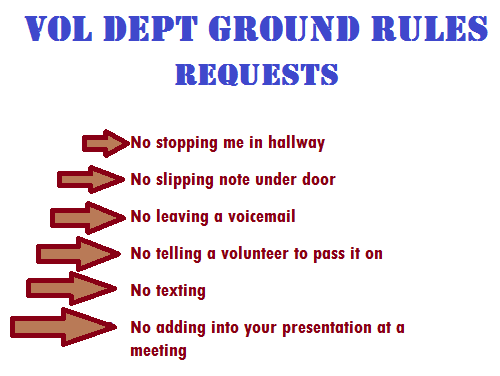
    Strategizing priorities when receiving volunteer requests ensures that volunteers are engaged in meaningful, mission critical work. (see Attention: The Volunteer Department Now Has Ground Rules )  By creating a weighted system around organizational priorities, volunteer services becomes focused on mission centric volunteer engagement. But there is one huge caveat that needs to accompany the priorities for volunteer requests. One very big one.

    After strategizing mission centric volunteer engagement priorities, the areas that rise to the top are most likely:

    • working directly with clients
    • supporting the smooth day-to-day running of the organization
    • supporting work with key stakeholders

    These three areas are where organizations spend the vast majority of their time, resources and efforts and the areas where volunteers’ contributions create the biggest impact.

    So, why a caveat in these three areas? What is missing?

    It is the inclusion of the volunteer manager in the planning, creation and continued input into the volunteer positions within these areas. Edicts, directives and mandates that exclude the input of leaders of volunteers are doomed to be ineffective or worse, fail.

    Creating volunteer positions without the volunteer manager’s input is like a team showing up to a baseball game without bats, balls or gloves.  The players just stand there, unable to hit home runs and unable to catch a ball. The gear is integral to playing the game with success. We, volunteer managers possess the gear.

    We, the equipment holders have to take a stand. Our volunteers need us to champion their involvement. Our organizations need our knowledge. Our clients need the excellence only we can provide. When advocating for a seat at this planning table, continually refer to the benefit of having you there.

    My knowledge of our volunteers’ skills and motivations is necessary to strategize the most effective volunteer involvement. I bring our volunteers’ passion and will elevate the ways we can move forward while saving time, money and effort. I will shape these positions so that our volunteers are invested and will not only stay, but want to do more. I have the experience necessary to design each position in order to boost volunteer interest.

    The most important volunteer positions must be defined by the person who leads volunteers, not only to maximize program results, but in order to ensure volunteer satisfaction and sustainability. Volunteer managers have the equipment needed to unlock volunteer potential while increasing results and retaining volunteers.

    What happens when organizations fail to include the volunteer manager in planning volunteer engagement?

    • skilled volunteers quit due to lack of meaningful roles
    • potential game changing programs never get created
    • a vicious cycle of recruiting volunteers as “warm bodies” is perpetuated
    • the organization is viewed as archaic and out of touch
    • highly motivated volunteer managers quit
    • clients are denied excellent support
    • a toxic negativity borne from frustration prevails
    • organizations become stuck in outmoded ways

    We, volunteer managers have to be willing to lobby for our seat at the planning table, not only for ourselves, but for our volunteers, clients and communities. Our organizations promise to deliver quality service and it is up to us to ensure that the volunteer piece provides excellence.

    Mission Centric Volunteer Engagement means strategizing the priorities that further the mission, deliver the most bang for the buck, and ensure volunteer sustainability. None of this can happen without volunteer manager input at the planning table.

    I’ll take my seat now, thank you.

    -Meridian


  • Attention: The Volunteer Department Now Has Ground Rules

    Ground Rules for Volunteer Departments

    “I need 8 volunteers or maybe 9, no wait,” she says, grabbing your arm in the hallway, “yeah, make it 10, the more the better, right?” Her attention is on the person down the hall, but she glances over her shoulder. “Have them at the Reed Center at 9 tomorrow.”

    Well, hello ground rules. Continuing the conversation from last week, (and a big shout out to everyone who weighed in here and on LinkedIn with great ideas on their excellent ground rules) here are two ways to look at setting them up.

    MY OWN PERSONAL FANTASY GROUND RULES:

    Three staff members request volunteers. Count the number of letters to determine which request gets top priority: The smallest number of letters wins.

    Amy: A

    Roz: R

    Herschel: H


    Ground Rules

    As you can see, Herschel clearly wins even though he only gave 3 days’ notice to find volunteers versus the week Roz gave.  And Amy, well, it will be a cold day in Honolulu before she gets a volunteer, unless it’s the guy that has to do court ordered volunteering, the one that talks incessantly about how he only had two beers when he crashed into that tree. Yep, Amy, I got your back.

    Ok, now for real. What are some of the priorities that can actually be weighed against less important requests? When proposing the adoption of priorities versus non-priorities to upper management, bring a few examples of how you look at prioritizing volunteer engagement.

    And don’t be afraid to drop the “S” word: Strategy. As in, “in order to better serve the mission, let’s strategize our priorities.”

    Your list of examples will spur senior management to adopt a “Priority Principle.” Setting priorities means asking the following questions and assigning a weight to each one. Weight determines priority status.

    Do the clients come first, no matter what? What does the mission say? Clearly, the client’s needs are the reason we exist. This is a great place to start, because weight should be the highest.

    What does the organization need to run smoothly? Volunteers are vital in keeping the organization running. Do volunteers fill in for staff when they are absent? Do volunteers take weekend shifts? Do volunteers occupy roles that must be filled in order to serve clients? The weight here has to be really high.

    Which stakeholders count the most? Donors, dignitaries, potential clients and influencers all carry weight. What events or strategies involve the most bang for the buck? This is where weight will flesh out low priority requests. Staffing a booth at a last-minute  weekend fair carries little weight against an annual festival with high visibility attended by key stakeholders.

    Is the time frame reasonable? Weight needs to balance up and down between last-minute and timely requests.

    Is the request feasible? It may be hard to define feasibility, because we typically entertain all requests. (which does not imply all requests will be met) Having a listing or report outlining the skills, availability and interests of the volunteers can be applied against requests. Weight is equal to feasibility. For example, you can say…

    At this time, we do not have any volunteers who have an interest in washing the board members’ cars as a ‘thank you.’ Time spent trying to convince our volunteers that this activity is more meaningful than engaging with clients or keeping the reception desk staffed will deplete precious time from requests that further our mission.

    What is the amount of work involved when enlisting volunteers? Work=time=there’s only so much, even if you work sixty hour weeks. How many volunteers are requested? How specialized are the skills needed?

    Are any of the following factors within the request out of the norm? (timeframe, location, ability to get to assignment, duties, weather, duration, stress level, etc.) Complicated requests require additional time and if the complicated request holds a high priority, then the weight of other requests is reduced by a factor reflecting the extra effort needed to obtain volunteers.

    How does this engage volunteers? We must add this one into the mix. Volunteer retention or sustainability is directly related to engagement. Strategizing retention must be highly weighted and given top priority.

    We may not agree with all of the decisions made when administration strategizes priorities, but we have to be flexible because having administration’s ‘stamp of approval’ will be worth it the next time a flurry of requests are dropped on your desk.

    Volunteer services is not a buffet of ordering without end. Actually, even buffets have a limited number of choices if you think about it. I can’t get Tantanmen at any of the buffets in my area, although I crave it. So, why should anyone be able to “get” a volunteer to sit outside the chapel “just in case an upset family member should enter?”

    Professional, efficient volunteer departments need ground rules in order to ensure the priority requests are met. After all, at year-end, the organization is no better off because you ‘got’ five volunteers to dress up like clowns at some poorly attended event, right?

    -Meridian


  • Non-Profits, Your Volunteer Manager Wanted Ads Say A Lot About You

    The Volunteer Manager wanted ads out there remind me of a fish market.  Some offerings are fresh, appealing and beautifully displayed and some just, well, stink.

    Let’s ask some questions, then look at recent ad excerpts and what they say about the organization posting them. How do these organizations view the volunteer manager’s role?

    Do you view your volunteer manager as a leader? Or as someone who simply fills tasks?

    Here is one ad that gets it:

    Your role as an executive overseeing volunteer management is thus an important one as you will be there to work with volunteers and support them in their projects. You will also explore ways to help volunteers grow personally and professionally (e.g. as volunteer leaders) so as to enhance their giving experience.

    This is an exciting opportunity for you to shape an emerging culture and to inspire impactful collaboration, kickstart new projects and ultimately enable better care with and for seniors in our home.

    But then there’s this uninspired ad:

    Manages volunteer scheduling, activities, and screening. Processes incoming volunteers to ensure they meet requirements. Maintains volunteer files and matches volunteers with projects suited to their skills. Manages all aspects of volunteer appreciation events and assists with developing the annual budget. Manages volunteer office to include scheduling, providing information, maintaining records, ordering office supplies and generating appropriate reports.

    Do you understand the skills needed to engage volunteers? Or do you believe it’s about having tea parties?

    In this ad, the appreciation of engagement skills is clearly non-existent: Do they think the leader of volunteers is just one of the volunteers? Or do they mean the VM will not supervise staff, so that tells you something right there, doesn’t it?

    SUPERVISORY RESPONSIBILITIES

    None

    But then, here is an ad for a Director of Volunteer Engagement:

    LEVEL OF AUTHORITY :

    Operates with direction from the President / CEO and is given appreciable latitude for independent action and decisions corresponding with the demonstrated ability for following policy guidelines, department objectives, and applicable laws, rules, and ordinances.

    Are you forward thinking? Or are you content with outdated programs?

    This ad just sounds so dreary: (And they want 5 years of experience-why? Wouldn’t someone with 5 years experience want to take on more leadership?)

    Essential Duties and Responsibilities:

    • Oversee the recruiting, interviewing, hiring, training, and scheduling of volunteer workers.
    • Respond to inquiries, schedule, and train volunteers.
    •  Coordinate volunteers by organizing, planning, and managing the volunteers’ assignments.
    • Coordinate with staff in order to ensure all programming has appropriate and timely volunteer coverage.
    • Manage volunteer software and train volunteers on software usage.
    • Solicit and answer volunteer questions and evaluate volunteer performance and provide constructive feedback and positive recognition.
    • Plan, prepare, and conduct volunteer meetings/continuing education and training seminars at least once annually for volunteers to enhance skills.
    • Manage communications and notifications to volunteers.
    • 5 years of experience in high-level volunteer management.

    But then, look at this ad. Lead STAFF and volunteers? Be still my heart:

     3. Lead staff and volunteers in building a plan of action, including effective service and serving an increased number of clients 4. Involve staff and volunteers in ways that will bring high visibility and public esteem. 5. Cultivate, develop and maintain a close working relationship with the key leadership in each department to help them effectively achieve their goals and objectives. 

    Do you appreciate how passionate and creative volunteer managers are? Or does your volunteer manager take a back seat?

    This ad hints at understanding how dedicated VMs are:

    • Passion for a mission of civic engagement
    • Demonstrates a high level of professionalism at all times across a variety of business sectors
    • Demonstrated ability to build relationships and communicate with a variety of stakeholders and cultivate strategic partnerships
    • Strong conflict management skills
    • Entrepreneurial spirit while maintaining the ability to work as part of a team
    • Ability to think outside the box
    • Capacity to develop and implement new concepts and strategies including creating context setting, educational components to enhance existing events and create new program initiatives
    • Able to recognize and successfully navigate the office dynamics of our clients and stakeholders (Political Savvy)

    This one, not so much:

    • Recruit, schedule, and retain volunteers for various tasks within the organization
    • Ensure that all volunteers have viewed the Safety training video
    • Coordinate parking for volunteers when necessary.
    • Schedule and coordinate volunteer recognition and appreciation events.
    • Maintain Volunteer Manual
    • Manage and participate in the goals, objectives, and policies affecting volunteers
    • Maintain a database of volunteer workers and record hours of work; prepare monthly and annual reports as required

    Do you truly believe in the untapped power of volunteerism? Or is volunteer involvement just “fluff?”

    In this ad, one has to wonder if volunteers are just potential donors:

    • Promote T-shirt sales and donations creating a pipeline for volunteers to donors
    • Contribute to development of department budget.
    • Coordinate Volunteer Calendar
    • Responsible for coordination of court ordered volunteers
    • Provide periodic (weekly, monthly, yearly) reports when needed.
    • Submits volunteer data for Annual Activity Report
    • Other duties as assigned.

    But then, here’s an ad that does believe in volunteerism:

    The Volunteer Program Manager is an important role in our organization. Because our organization values and depends on our volunteers in every facet of what we do, the person in this role will be a key collaborator assisting in the delivery of (our) programs and services.

    Want ads say a lot about an organization. Ads reveal the culture, the expectations, the value placed on the skillset of the applicant, the support offered and the perception of the position.

    What does your ad say about you? 

    -Meridian


  • Don’t. Do. This. Ever.

    Don't Do This Ever
    from: floridastateparks.org

    Sometimes misdeeds are huge, indefensible and devastating. Take the ongoing scandal involving Oxfam for instance. It’s big.

    But slippery slopes lurk everywhere, like alligator eyes floating above the river, waiting to take you down. Misdeeds can begin innocently and maybe they won’t make the front pages, but they will ripple through your water when that gator pulls you under.

    Melanie was a volunteer coordinator who cared deeply for her volunteers. She personally interviewed each one to get to know them and understand their strengths. She attended birthdays, took volunteers to appointments and helped when volunteers needed assistance.

    One of her volunteers Dorothy, was a widow, her husband having died a few years before. Melanie invited Dorothy over for dinner a few times a month and introduced her to her husband and children. They welcomed her, making Dorothy an honorary family member. Taking care of Dorothy made Melanie feel really good about her role as a volunteer manager.

    But one day, Melanie came to work and was called into the CEO’s office. It seems that Dorothy’s daughter, who lived out-of-state, came to visit her mother and went through some of her mother’s finances. She discovered Dorothy had loaned Melanie money to pay for a soccer clinic for the kids. Innocent, right? Melanie was put on probation, paid the money back and more tragically, never recovered her exuberant spirit. She became cautious, bitter, not sure how she could ever be close to her volunteers again. She quit.

    What is your gift/loan/money policy at work? Does it include volunteers? We tend to make sure our volunteers know their boundaries, but do we have policy regarding staff’s (including us, the volunteer manager) boundaries with them? (for an example of employee gift policies, see the balance)

    While we seek to forge deep relationships with our volunteers, we have to keep this in mind: We are the volunteers’ supervisor. Not a peer, not a friend, not a counselor, not a family member, not the fixer of their lives. We are their boss.

    As their boss, we must define gifts to and from a volunteer. Is a card ok? A cup of tea? Seriously, these items all have a monetary value and defining value helps to create policy and creating specific policies regarding gifts between staff and volunteers will save any misinterpretation down the road.

    If a volunteer offers money, or a gift card, tickets to an event, a new blouse they bought but don’t like, say no. All of these items are alligator eyes peering at you from beneath the water. They all have monetary value. Instead, ask that volunteer to donate the money or item to the organization in your name and for heaven’s sakes, ask them to write a note accompanying the donation saying how awesome and ethical you are.

    But NEVER take money from a volunteer for any reason. It’s the grand poobah of slippery slopes. And having that policy in writing gives you all the backup you need to say a polite but firm “no.”

    Some misdeeds will be headline news, will damage a charity’s reputation and set the great work done by so many other dedicated staff and volunteers back by years. That’s a tragedy. These misdeeds may be so egregious that they are obviously wrong to the rest of us, but, then, there are the minor little innocently begun misdeeds that also damage good intent in subtle, but very real and lasting ways. Every day simple mistakes ruin good careers.

    Be involved with and care about your volunteers, but when it comes to money, Don’t. Do. This. Ever.

    -Meridian


  • It’s 38 Degrees Outside, But It Sure Feels Like 19

    Its 38 degrees outside but it sure feels like 19

    Brrr, when its bitter cold outside, we dress for the “feels like” temperature index, right? This apparent temperature takes into consideration the way wind speed, relative humidity and actual temperature feel like on the human body. If humidity is low and the wind is strong, 38 degrees feels like 19 degrees.

    Maybe we, volunteer managers need our own “feels like” index based on the “feels like” temperature index utilized in weather forecasts. Let’s call it the “Intent Index.”

    Our “feels like” intent index is based on the addition of tone, (TO) and preconceived notions (PN).

    So, in other words, what someone says to us can feel quite different from their words alone convey, based on their tone and preconceived notions. We, volunteer managers are really used to hearing these underlying intents.

    Some examples are:

    Volunteer Todd: So, that was an interesting assignment. I suppose you had a good reason for putting Humphrey in charge of us.  (did you just feel the temperature drop?)

    click to hear what Todd is really saying:

    Marketing staff member Zoe: Thank you for getting those five volunteers last-minute. We managed to muddle through. (get your coat, it’s getting colder in here)

    click to hear what Zoe is really saying:

    Corporate volunteering partner Dana: I’ve already been told by other volunteer coordinators that volunteer organizations can’t accommodate fifty people on short notice. I guess we can send twenty. I’m sure our CEO will understand. (oh my, the temperature just plummeted!)

    click to hear what Dana is really saying:

    When you feel the tone and preconceived notions at play, the question then becomes, should we ignore the intent index and just let these things go? Or, just as we dress for the “feels like” temperature outside, shouldn’t we be prepared to address conversations that have underlying messages?

    What to do? Well, when we feel someone utilizing tone and preconceived notions as a not so subtle message, it’s ok to ask about it, to get these intents out in the open so as to find their origin, dispel the myths and clear the air.

    We can counter with statements and questions such as:

    • “Thank you for that feedback, but I’m hearing something else too. Can you tell me what you felt went wrong?”
    • “That’s very helpful. But I’m wondering about your other statement which seems to imply something else. Did you experience something or hear someone’s negative experience that makes you think that?”
    • “I’m glad you brought that up. I’m perceiving some dissatisfaction and it’s my goal to provide excellent volunteer experiences. I’d love for you to share with me the reasons you are dissatisfied.”

    Now, none of these responses mean that we have to fix or agree with everything we hear. These are simply meant to open a dialogue so as to understand these underlying intents. From openness, we can begin to show, educate, resolve and repair.

    When it feels like 19 degrees outside, we get out the gloves and mittens. There’s no reason we can’t also prepare ourselves for the drop in meaning when confronted with the “intent index,” and take charge to address the intent.

    Feels like something a leader of volunteers would do.

    -Meridian