It’s time for resolutions, optimism and time to drop the pounds from all the volunteer homemade goodies, including Anna’s cheese blintzes scarfed down during full stressed-out mode.
Ahhhh, the new year. It’s full of hope. We seldom hope for a year that’s exactly like the one we just completed, right? Instead, we hope for a better year. So, do we look forward or backward or both ways?
Actually, we can do both and connect the past year with a better future. Looking back can be so much more than feeling good or bad about the year. It can be extremely instructive.
Looking back to move forward gives us an action plan, one that ensures a brighter 2019.
Begin by looking back at accomplishments to formulate a plan to continue those accomplishments. Then build upon methods to expand accomplishments in 2019. What went right? What is the blueprint? For example:
Last year, hours by volunteers who were trained to interact with clients increased from the previous year by 10%: So, for 2019, I will fortify and increase training. And for a new accomplishment, I will create a training that can be introduced to increase hours in other areas.
Last year, advocating for more resources produced a recruitment budget increase: So, for 2019, I will hone that method of advocating and for a new accomplishment, present supporting statistics to ask for more resources in other areas.
Last year, several highly skilled volunteers were recruited through networking: So, for 2019, I will continue networking opportunities and for a new accomplishment, I will look for new networking opportunities to find other volunteer skills.
On the flip side, what disappointing things happened? Instead of trying to forget about these instances, analyze them because they can also be valuable in planning for the coming year. It may take longer and you may have to dig deeper to find causes, but there are reasons for the disappointment. What went wrong? What is the blueprint for avoiding something similar? Unlike accomplishments, disappointments will take more effort to root out the cause (without assigning blame) and more work to change future outcomes. For example:
The volunteer appreciation event was kind of lame. Volunteers were once again not properly recognized: For 2019, how can I better show the value of volunteer contributions? How can I set a tone for sincere recognition?
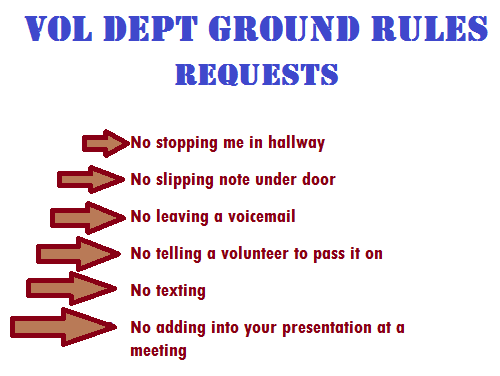
Our huge donor gala was a gigantic headache. Last minute volunteer requests and changes to requests kept me scrambling: For 2019, what systems or ground rules can I put into place to avoid this in the future? (For my take on setting ground rules, see Volunteer Department Ground Rules and the follow-up Attention: The Volunteer Department Now Has Ground Rules.)
Senior management dropped a new “role” for volunteers onto my lap because we are cutting back. New tasks or jobs for volunteers are created without consulting me for any input: For 2019, how can I educate administration on volunteer engagement? How can I present volunteer feedback that shows volunteers want meaningful experiences?
It’s nice to hope that 2019 will be a better year but we can take control of that hope and create blueprints to ensure it will be a better year. By looking back at accomplishments to continue the momentum and looking back at disappointments to formulate a change strategy, we will move our programs forward into the year we wish to see.
I remember my first days as a volunteer coordinator. There was this one volunteer, Addie. She was a tiny, fit ball of northeastern, direct confrontation, piercing eyed judgmental “I’ve been here since the forefront” terror. Staff couldn’t stand her. But she roamed the halls wielding her trusty sword “Gotcha,” slicing apart our ineptness. She was your crusty grandmother, your 87-year-old history teacher and your noisy neighbor all rolled into one, and oh, with a grip of steel. I know because she would grab my arm to make a point. Yep, I still have phantom bruises there.
I danced lightly around her. Although staff didn’t like her, she was, I thought, untouchable. They didn’t ask that I do anything about her, so I figured their eye-rolling was the way we dealt with disliked volunteers. After all, she’d earned her right to be a disruption, to be tolerated, to interpret our policies as anything that suited her purpose. She was, (da da daaaaahhhh) emeritus!
So, what crippling reasons cause us to hide under our desks instead of addressing volunteer behaviors?
Lack of specific policy indicators? (for example, policy states theft or inappropriate language is an offense. Policy doesn’t include arrogance or chatty-ness as an official offense)
Fear that delivering feedback to a volunteer will be misinterpreted as criticism and the volunteer will quit?
Our general fear of confrontation?
Volunteer status, such as emeritus? Or staff seems to “put up” with volunteers?
Our belief that volunteers are giving of their time, so we should be more accepting of their behavior?
The perception that a volunteer is older, wiser, more accomplished, more educated or skilled than we are?
Our belief that our jobs are no more than coordination?
The above reasons hold power over us, power that cripples us and prevents us from truly leading volunteers. How can we then make adjustments so we don’t simply going to continue to sidestep situations that can be remedied?
The first step is to prioritize the why. Why is this volunteer here? We know there are multiple underlying and nuanced reasons, all of which we take into consideration when matching volunteers to assignments.
But what is the primary, down to basics reason a volunteer shows up? To complete a task, or fill a role that furthers the mission they believe in. How is this being accomplished?
Taking the focus off of staff’s and volunteer’s personalities allows us to examine the work being done and by doing so we can analyze how behaviors are affecting work quality.
Communicating mission focus to everyone, staff and volunteers alike, lays the groundwork for intervention. How do we do that?
In volunteer orientation or onboarding, emphasize the expectation of excellence. While creating a welcoming atmosphere, stress the importance of volunteers being able to fit within a busy organization. Illustrate the enormous workloads put upon staff. Make clear that while staff appreciates volunteers, the work is most important. Ask your most productive volunteers to speak to and hopefully mentor new volunteers.
Create policy that gives you an opportunity to mediate. Although we obviously can’t write policy for every little behavior, especially if behavior is opinion based. (one staff member believes a volunteer chats too much) We can, however include six month probationary periods, infractions for inappropriate behavior and the specific understanding that it is in the power of the volunteer manager to determine fit. Fit means that a volunteer’s performance will be evaluated on fit within a specific department and the volunteer can be moved to another position. (This is a two-way street; it also protects the volunteer from being stuck with very demanding or uncooperative staff)
Communicate your commitment to supporting staff. Before placing a volunteer, speak with staff about your readiness to intervene if a volunteer is behaving in ways that hinder production. Get the idea out in the open that your focus is on helping staff be more productive and you are leading volunteers, not simply placing them.
Ditch the idea that volunteers will stay because we are nice to them. Instead, remind yourself that volunteers will stay because they are doing work that is meaningful and in order to engage in meaningful work, behavior must align with mission centric goals.
Bravely follow-up and be willing to intervene. Feedback is not always criticisms that will drive a volunteer away. Mediation means taking into consideration the needs of both sides and finding solutions that best benefit the organization. Being on top of situations ensures that volunteers are valued, not tolerated. Ask both sides questions that direct them towards accomplishments, such as “what path do you envision us adapting to increase our survey input results,” or “what small thing right now will help us improve our client satisfaction?”
Be willing to be a leader who can do the hard stuff. Just because a volunteer is emeritus, or wiser, or more accomplished does not mean that you are their subordinate. Your volunteer program is a reflection on you. In your organization, are volunteers valued or are they simply considered a necessary nuisance? Are volunteers given juicy tasks or are they relegated to boring minutia? With courageous leadership comes respect for the program.
Educate staff on working with volunteers. Humanize the volunteers. Stress their character and commitment to the mission. Emphasize their desire to help staff, not hinder them. Highlight volunteer accomplishments with a caveat to staff who embraced them. The more we make staff feel as though they “have to accept volunteers,” the less they will actually accept them. Instead, as leaders, we need staff buy-in and it takes some staff ego massaging to get that buy-in.
Listen to other volunteers. If volunteers are complaining about a volunteer’s behavior, or worse, quitting because of behavior, there’s a clear problem. How many good volunteers are we willing to lose because we would rather not engage in mediating destructive behavior?
And most importantly, act quickly. Intercepting a problem before it becomes messy and unmanageable will keep those sleepless nights at bay. Regularly surveying staff and volunteers can unearth budding challenges. Following up on those challenges early gives a higher rate of successful mediation versus allowing patterns of behavior to cement. And, by showing your commitment to creating an excellent program, your leadership value will exponentially rise.
By focusing on mission goals, we can more clearly see the big picture. Mediating and creating volunteer fit has the following tremendous potentials for a huge return on that investment.
More satisfied and engaged volunteers
Staff who will champion volunteer engagement
Openings to more volunteer roles
More recognition for volunteers
Respect for the volunteer manager voice
More leverage for negotiating new programs, ways to integrate volunteers or eliminating outdated volunteer roles
While confronting behavioral disputes is down right hard and uncomfortable, we will reap enormous results by bravely tackling this challenge. Each successful attempt at mediation will move the needle closer to a professional and more respected volunteer program.
Leading is doing the challenging stuff well. It gets easier once you burst that tension bubble and see how satisfying it is to get results.
After all, we’re not volunteer coordinators who shrug because staff doesn’t seem to like volunteer Addie. We are leaders of vibrant, contributing volunteer programs.
Carlos took a deep breath and regarded Marty, a long term volunteer who stood before him. “Mr. Jansen really wants to visit his son in Philadelphia.” Marty said. “It’s only a four hour trip from here and I don’t mind taking him. We can do it in a day.”
Carlos thought about the organizational policies, trying to recall one that forbid volunteers from driving clients on long trips. “I’m not sure that’s such a good idea, Marty,” he said. “I really don’t know if we should do this.”
Leadership is about doing the right thing, even if it is the hardest thing to do personally and even if it puts you on the spot. As leaders of volunteers, we are faced with doing the right thing every day. We must weigh the right thing for our organizations, for our volunteers, for our vulnerable clients, for our communities and for us.
Being able to say no is sometimes the right thing to do. While our jobs pretty much paint us as the folks who always say “yes,” we must take into consideration the times we are obligated to say “no.” Some obvious examples are:
when a volunteer wants to break policy and jeopardize the safety of himself or a client
when a request for a volunteer puts the volunteer at risk
when a community service volunteer wants you to sign off on hours not spent volunteering
when anyone asks you to embellish volunteer hours
It’s easier to say no when strict policies back you up, or risk factors are obvious. But sometimes we have to say no, when policy is not a factor and the area is gray. Examples might include:
When someone requests a volunteer for a task that volunteers have strongly objected to
When a volunteer wants to initiate a project that will take precious time from mission related work
When you are asked to fill in for a volunteer on your day off and you already have plans
How do we artfully say ‘no?’ If we feel pressured to say ‘yes,’ or are backed into a corner, we might stutter and say something like, “I’m not sure.” A weak ‘no’ is really just a soft ‘yes.’ When saying no, you have to actually say no and not want to immediately take it back.
If you need to, ask for time to think on it. Say, “Let me get back with you on that,” so that you can formulate your response. Getting caught off guard seldom gives you the advantage of putting together a well thought out answer. Remember though, if you don’t get back to the person in a timely matter, they will assume your answer is yes.
Think of all the reasons you have to say no. It’s not because you just feel like being oppositional, it’s because you know there is a better alternative, or you have information the person asking the question does not have. Listen to your intuition and find all the whys that force you to say no, then explain the whys in decisive terms.
Present a suitable alternative. Explain why you are saying no, and offer an alternative. If say, a volunteer wants to bring a friend with them on assignment into a client’s home, you can say, “I’m sorry, but that is against our policy. The reason it is against our policy is because no one who has not been background checked and officially entered into our organization can enter the home of our client. (the why you’re saying no) This applies to staff and volunteers alike. I can offer your friend a path to becoming a volunteer so that he can accompany you on assignments. (the alternative) Let’s talk about how to make that happen.”
Steer the person towards the alternative. If a staff member wants you to find a volunteer for a task the volunteers have repeatedly said no to, you can say, “I will try, but our volunteers have said no in the past so I’m not likely to be able to fill this request. But, we do have volunteers willing to help you in other ways. Let’s discuss the ways they want to be of service and how they can support you.”
Be clear that a no is not personal. Leadership is about the mission and the team. Point out the mission centric reasons you must say no. “I understand that things change rapidly and that now you are asking for five additional volunteers for tomorrow. I will ask one of our experienced volunteers to make last minute calls and I know that every one of our volunteers who can commit, will commit, so you are in good hands. I however, must continue to work on the annual gala which is next week because volunteers are heavily involved and the gala is extremely important to our organization’s outreach.”
There’s a reason these responses sound an awful lot like “professional speak.” It’s because they are. Using professional speak is the way to stop others from viewing you as a lightweight, a yes person, a go-fer. Using professional speak forces others to communicate with you on a mission-related level and not on emotional or personal terms.
Feeling like you can never say no resides on emotional levels. Being able to say no in a professional way resides on logical, thoughtful levels. In order to take control of the conversation, use professional speak that centers on mission centric goals and steer the person away from trying to emotionally manipulate you.
You can put off a conversation until later when you have the time and energy to discuss it with focus. Take the volunteer who wants to initiate a program that takes time from mission related goals. You can say to that volunteer, “that sounds like an interesting proposal and one that you’ve given considerable thought to. I really want to give you my full attention, so can we set aside a time to discuss it when we can really focus on what you are offering?” Then set aside a time when you are not being bombarded from all directions and can thoughtfully discuss any ideas.
Saying no is not a failure on our part. It is actually an opportunity to control the direction of our programs and a chance to steer people towards a better way of engaging volunteers by offering more viable alternatives. When done with tact and professionalism, saying “no” can open doors to a better “yes.”
A strong leader is able to say no in a way that assures everyone that the no means listening carefully, then a negotiation, or a revamping or an alternative. Above all, it indicates a striving for excellence. And that already describes every volunteer manager.
Strategizing priorities when receiving volunteer requests ensures that volunteers are engaged in meaningful, mission critical work. (see Attention: The Volunteer Department Now Has Ground Rules ) By creating a weighted system around organizational priorities, volunteer services becomes focused on mission centric volunteer engagement. But there is one huge caveat that needs to accompany the priorities for volunteer requests. One very big one.
After strategizing mission centric volunteer engagement priorities, the areas that rise to the top are most likely:
working directly with clients
supporting the smooth day-to-day running of the organization
supporting work with key stakeholders
These three areas are where organizations spend the vast majority of their time, resources and efforts and the areas where volunteers’ contributions create the biggest impact.
So, why a caveat in these three areas? What is missing?
It is the inclusion of the volunteer manager in the planning, creation and continued input into the volunteer positions within these areas. Edicts, directives and mandates that exclude the input of leaders of volunteers are doomed to be ineffective or worse, fail.
Creating volunteer positions without the volunteer manager’s input is like a team showing up to a baseball game without bats, balls or gloves. The players just stand there, unable to hit home runs and unable to catch a ball. The gear is integral to playing the game with success. We, volunteer managers possess the gear.
We, the equipment holders have to take a stand. Our volunteers need us to champion their involvement. Our organizations need our knowledge. Our clients need the excellence only we can provide. When advocating for a seat at this planning table, continually refer to the benefit of having you there.
My knowledge of our volunteers’ skills and motivations is necessary to strategize the most effective volunteer involvement. I bring our volunteers’ passion and will elevate the ways we can move forward while saving time, money and effort. I will shape these positions so that our volunteers are invested and will not only stay, but want to do more. I have the experience necessary to design each position in order to boost volunteer interest.
The most important volunteer positions must be defined by the person who leads volunteers, not only to maximize program results, but in order to ensure volunteer satisfaction and sustainability. Volunteer managers have the equipment needed to unlock volunteer potential while increasing results and retaining volunteers.
What happens when organizations fail to include the volunteer manager in planning volunteer engagement?
skilled volunteers quit due to lack of meaningful roles
potential game changing programs never get created
a vicious cycle of recruiting volunteers as “warm bodies” is perpetuated
the organization is viewed as archaic and out of touch
highly motivated volunteer managers quit
clients are denied excellent support
a toxic negativity borne from frustration prevails
organizations become stuck in outmoded ways
We, volunteer managers have to be willing to lobby for our seat at the planning table, not only for ourselves, but for our volunteers, clients and communities. Our organizations promise to deliver quality service and it is up to us to ensure that the volunteer piece provides excellence.
Mission Centric Volunteer Engagement means strategizing the priorities that further the mission, deliver the most bang for the buck, and ensure volunteer sustainability. None of this can happen without volunteer manager input at the planning table.
“I need 8 volunteers or maybe 9, no wait,” she says, grabbing your arm in the hallway, “yeah, make it 10, the more the better, right?” Her attention is on the person down the hall, but she glances over her shoulder. “Have them at the Reed Center at 9 tomorrow.”
Well, hello ground rules. Continuing the conversation from last week, (and a big shout out to everyone who weighed in here and onLinkedInwith great ideas on their excellent ground rules) here are two ways to look at setting them up.
MY OWN PERSONAL FANTASY GROUND RULES:
Three staff members request volunteers. Count the number of letters to determine which request gets top priority: The smallest number of letters wins.
Amy: A
Roz: R
Herschel: H
As you can see, Herschel clearly wins even though he only gave 3 days’ notice to find volunteers versus the week Roz gave. And Amy, well, it will be a cold day in Honolulu before she gets a volunteer, unless it’s the guy that has to do court ordered volunteering, the one that talks incessantly about how he only had two beers when he crashed into that tree. Yep, Amy, I got your back.
Ok, now for real. What are some of the priorities that can actually be weighed against less important requests? When proposing the adoption of priorities versus non-priorities to upper management, bring a few examples of how you look at prioritizing volunteer engagement.
And don’t be afraid to drop the “S” word: Strategy. As in, “in order to better serve the mission, let’s strategize our priorities.”
Your list of examples will spur senior management to adopt a “Priority Principle.” Setting priorities means asking the following questions and assigning a weight to each one. Weight determines priority status.
Do the clients come first, no matter what? What does the mission say? Clearly, the client’s needs are the reason we exist. This is a great place to start, because weight should be the highest.
What does the organization need to run smoothly? Volunteers are vital in keeping the organization running. Do volunteers fill in for staff when they are absent? Do volunteers take weekend shifts? Do volunteers occupy roles that must be filled in order to serve clients? The weight here has to be really high.
Which stakeholders count the most? Donors, dignitaries, potential clients and influencers all carry weight. What events or strategies involve the most bang for the buck? This is where weight will flesh out low priority requests. Staffing a booth at a last-minute weekend fair carries little weight against an annual festival with high visibility attended by key stakeholders.
Is the time frame reasonable? Weight needs to balance up and down between last-minute and timely requests.
Is the request feasible? It may be hard to define feasibility, because we typically entertain all requests. (which does not imply all requests will be met) Having a listing or report outlining the skills, availability and interests of the volunteers can be applied against requests. Weight is equal to feasibility. For example, you can say…
At this time, we do not have any volunteers who have an interest in washing the board members’ cars as a ‘thank you.’ Time spent trying to convince our volunteers that this activity is more meaningful than engaging with clients or keeping the reception desk staffed will deplete precious time from requests that further our mission.
What is the amount of work involved when enlisting volunteers? Work=time=there’s only so much, even if you work sixty hour weeks. How many volunteers are requested? How specialized are the skills needed?
Are any of the following factors within the request out of the norm? (timeframe, location, ability to get to assignment, duties, weather, duration, stress level, etc.) Complicated requests require additional time and if the complicated request holds a high priority, then the weight of other requests is reduced by a factor reflecting the extra effort needed to obtain volunteers.
How does this engage volunteers? We must add this one into the mix. Volunteer retention or sustainability is directly related to engagement. Strategizing retention must be highly weighted and given top priority.
We may not agree with all of the decisions made when administration strategizes priorities, but we have to be flexible because having administration’s ‘stamp of approval’ will be worth it the next time a flurry of requests are dropped on your desk.
Volunteer services is not a buffet of ordering without end. Actually, even buffets have a limited number of choices if you think about it. I can’t get Tantanmen at any of the buffets in my area, although I crave it. So, why should anyone be able to “get” a volunteer to sit outside the chapel “just in case an upset family member should enter?”
Professional, efficient volunteer departments need ground rules in order to ensure the priority requests are met. After all, at year-end, the organization is no better off because you ‘got’ five volunteers to dress up like clowns at some poorly attended event, right?





 volunteerplaintalk