Tag: staff and volunteers

  • Gobble, Gobble, Good God I’m Frazzled!

    pumpkin2
    Willow, a new volunteer manager for a small organization providing aid to the homeless population in her town, answered her phone the day before Thanksgiving. She had spent long hours that week, organizing and recruiting volunteers to help prepare the annual meal held at a local high school auditorium. Exhausted, her brain overloaded, she tried to muster up enough energy to sound human on the incoming call.

    The caller identified himself as Harry, the coach of a soccer team consisting of 15-year-old boys. “I’d like to get these boys involved in helping others,” he told Willow. “We’d like to come out and feed the homeless tomorrow.”

    Willow felt a throbbing in her forehead. “How many players are we talking about?”

    “Not the whole team, mind you, about 7 or 8.”

    Tears filled her eyes like the bubbles in a natural spring. The volunteer slots were set in stone. It had taken every fiber of her new volunteer manager being to accomplish that. She was bone weary and wondered, why did this man wait until now to call? How could he think that there was no coordination in putting together something so incredibly complicated? Why does no one understand?

    It’s happened to all of us. Often, people call at the last moment to help, especially at holiday times. After it happens, you begin to expect it and it is incredibly frustrating to have to tell a group of willing helpers that they are not needed because they procrastinated or called on a whim. They are, after all, potential volunteers. Granted, most might never volunteer again, but there’s always that little voice in our heads that sneers, “there goes a group that might just have been the greatest group of volunteers known to man. And you denied them. Tsk, tsk.”

    So, what to do if you are not able to just dust off those last-minute potential holiday volunteers? If you feel that a part of your job is to give people the chance to experience the deep, satisfying joy in volunteering, then you will feel a twinge of guilt or sadness when having to refuse someone, even if they called too late. We all know that holidays bring out the desire to help and that each “drop in” volunteer might become an advocate for our organizations.  Can we accommodate those late comers without making the holidays a nightmare for ourselves?

    Yes, there is a way. It’s not perfect mind you, but it’s better than feeling overwhelmed and guilty at the same time. And it takes implementing now.

    So that the future you is not caught in a holiday trap, prepare for the season right now. Before the holidays creep up on you, create some projects that last-minute folks can do. Don’t save the work that must be done but be ready with some extra projects that are off premises and not in direct contact with clients. (No background checks needed). You can invite these one time volunteers to become official volunteers at a later time.

    Start now by asking everyone in your organization for fantasy projects. Ask, “If you had 3 or 5 or 10 volunteers over the holidays, what could they do?” Does marketing fantasize about hundreds of distributed holiday flyers? Does the thrift store secretly salivate over a huge deep cleaning and resorting for the season? Does finance have a tired office that cries for a fresh coat of paint? Is there a corner where an extra decorated tree would look lovely? Do you partner with other agencies and can you ask them if they have projects? I’ve always been able to find a nursing home that was extremely grateful for some extra help during the season.

    You can also create your own meaningful projects. Go to social workers and ask if they have a family that needs Christmas presents because of financial need and then create a “gift tree” with the ages and sizes of family members on paper ornaments. Buying a gift for someone who is going through a tough time is a very satisfying introduction to volunteering. Don’t be afraid to create a project in which the participants will have to spend a bit of money. That never seems to matter.

    One time volunteers can certainly write holiday cards and wishes to older clients or children. They can have a card writing party off premise. Ask a willing volunteer to attend to explain how much these cards mean to your clients. The point is to be creative. You know the difference between meaningless work and projects that can actually enhance the holidays. Have an extra tree to decorate, or paper place mats to color (good for youth groups to do). Ask your existing volunteers if they would be willing to mentor a group when necessary. Stock up on craft supplies now.

    Then, when someone calls last-minute, instead of having to say, “sorry, but there’s nothing I can give you,” you can invite the late comers to get their feet wet by tackling a small but worthwhile project. If the latecomer says no, at least you offered something. I’ve had folks tell me that my organization was the only one  who even tried to place them. That good feeling can translate to future volunteers.

    You, by virtue of being a volunteer manager, take care of everyone around you. Take care of yourself this holiday season by preparing now for those inevitable 12th hour but sincere calls to help. Your future self will thank you.

    -Meridian
  • Top 10 Things Executive Directors Need to Know About Volunteer Services

    cliffsnotes
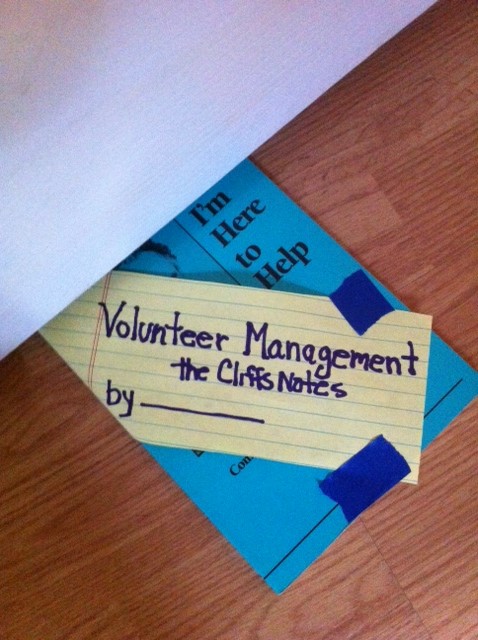
    I’ve always wanted to see a small pamphlet entitled “Volunteer Services for Dummies” or maybe “Volunteer Management, The Cliffs Notes.” Then I could sneak around and slip that bad boy under the door of the executive director while he was at a conference on “How to Get Donors to Donate More.” The pamphlet would have a way to insert whatever author’s name would impress him, like maybe that consultant who he’s recently hired to tell him that he needs to get more donations.

    So, forget the pamphlet. Let’s just list the ten top things that I wish CEOs would understand about volunteer services.

    10. Volunteers do not sit by their phones waiting for us to call. Shocker! We don’t just “order up” volunteers when someone asks for eight volunteers who can work twelve-hour shifts, outside, tomorrow at 8am. Yeah, no one wishes it were that easy more than we volunteer managers. Asking volunteer Charles to prioritize volunteering with us over his other volunteering activities, his trip to Bermuda (that he’s saved years for), his managing of his elderly mother’s affairs, and his scheduled surgery might just be a tad unrealistic. It takes a wise volunteer manager to know how to balance volunteers’ experiences so that volunteering is not burdensome and they look forward to coming in to help.

    9. Managing volunteers is not like managing staff.  Wow, bigger shocker! Unless managing two to ten times the number of very diverse people who only work maybe four hours a week without pay is the same thing. Instead of a paycheck to dangle, volunteer managers must use real leadership skills to inspire and coordinate volunteers. Think of it this way. Volunteers typically spend about 4 hours a week volunteering while you, the Executive Director and your staff spends upwards of 40 or 50 hours a week working for the organization. That’s at least ten times the amount of “plugged in time” you have over volunteers. Do you think that the volunteers spend the other 36 hours thinking about our organization? If not, volunteer managers must be able to “plug-in” volunteers every time they arrive on scene, motivate them to achieve that connection and keep them informed of changes and updates.

    8. Volunteers are everyone’s responsibility.  What?!!! The CEO is thinking, “Then what do I pay YOU, the volunteer manager for?” Staff doesn’t necessarily see working with volunteers as part of their jobs, but any staff can make or break a volunteer’s experience. Look at it this way. What if you, the CEO cultivates a donor by spending your time and sweat to encourage and inform and then another staff member comes along and insults that potential donor? It’s no different with volunteers. We need you, our CEO to set the tone. So if deep down, you are thinking that volunteers are not really time donors but are just fluffy side dishes,  then please stop saying things like “we can’t operate without our volunteers.”

    7. Volunteer managers are real managers. “Hmmm,” the executive director might be thinking, “No way, not in the same way our manager of fund-raising is!” Well, no matter what you call them, coordinators, specialists or team members, volunteer managers are as much a manager as anyone on your staff. The list of skills needed to lead and cultivate a team of volunteers (see #9 and #6 and #4 and #3 and #2 and #1 and oh heck, all of them ) is quite extensive.

    6. Volunteers want meaningful work. “So,” the CEO may be thinking,  “but I often need some meaningless stuff done. Who will do it?” That’s true, but volunteers do not want to just do what the staff doesn’t want to do, they want real jobs that make a difference. And since we don’t pay them, maybe we should consider meaningful work as pay? But, a great volunteer manager with awesome skills can lead volunteers to occasionally do the grunt work if grunt work isn’t all that is offered.

    5. Volunteers want sincere appreciation from more than just the volunteer department. An Executive Director might be thinking, “Hey! I always say that we couldn’t operate without our volunteers, don’t I?” Yeah, you do. But guess what? Volunteers see through the once a year speech at a luncheon that is just lip service. Volunteers want you to make an appearance and say hello, send hand written thank you notes and include their accomplishments the next time you meet with the board of directors. And oh, they would like you to genuinely encourage staff to do these things too. Volunteers are either an integrated valued service or it’s all just talk.

    4. Volunteers are not just little old ladies drinking tea. “But,” a CEO could say, “they sure look like that description ha ha.” Did you know that volunteers are diverse in every way, including age, background, culture and experience and that it takes some major skills to manage a group of very diverse people? But even if some volunteers are older, did you know that they are former executives, professors, leadership experts and full of wisdom and great ideas? And they’re more than willing to share their wisdom for free.

    3. Volunteer managers are not lap dogs.  “Hey,” the Executive Director would protest, “I never said that!” But are the volunteer managers treated that way by staff? Is there an “order up” culture in which volunteer managers are expected to just get volunteers without having any meaningful input into volunteer requests? Volunteer managers have their fingers on the pulse of the organization and are privy to every aspect of the mission via volunteer involvement. Maybe, just maybe, your humble volunteer manager is really a great motivator and leader and not just an order taker. Check them out for some really awesome ideas and managerial skill-sets.

    2. Volunteers are aware and talk. “Sure, so what, that’s great,” a CEO might agree. But, when a volunteer hears negative speak from staff, or sees something less than perfect, guess what? They talk, to each other, to friends, relatives, and the cashier at the Quick-Mart. Volunteer managers keep volunteers motivated and inspired and mediate constantly to make sure the volunteer’s concerns are resolved and their experience is positive. In this world aching for transparency, volunteers are the town criers who can proclaim the worth of an organization or do damage to its reputation.

    1. Volunteers don’t stay forever. “Heresy! They should if the volunteer manager is doing her job,” an Executive Director could counter argue. No, actually volunteers don’t. Does staff stay until they die? No, and neither do volunteers. We should recruit, train and cultivate our volunteers just as we do staff, but not expect them to continue until they’re carted off in an ambulance. And, just like staff, sometimes we don’t want them to stay, so that’s why the professional skill-set of the volunteer manager is so crucial. A volunteer manager’s professional resolution to a challenging situation is an organization’s best chance to avoid negative publicity.

    So, there you have it. I’ll bet you volunteer managers have some really great ideas on other truisms that belong on this list. You have my permission to print out this list, slip it under your leader’s door. Somehow add to it that it was authored by the “Center for Outstanding Management and Maintenance of Organizations and NGO’s” via the report from the “Study on Excellence in Non-profit Structure and Ecosystems” or COMMON SENSE for short.

    -Meridian

  • Your Spotlight Hurts My Eyes!

    In the Spotlight
    In the Spotlight
    I almost spit out my sip of coffee when I ran across this article a week ago. According to the story, a great grandmother was “sacked” from her nearly 30 year volunteer position at a thrift store for her inability to use a computer. The searing negative light this incident turned on made me cringe because as you can see from the selected comments I pasted below the link, non-profits all get lumped into the big barrel of rotten fish when a charity receives bad press.

    http://www.express.co.uk/news/uk/590346/Volunteer-great-grandmother-sacked-charity-shop-cannot-work-computer

    Here are 3 comments from readers:

    JHR16 days ago
    Charities are beginning to stink to high heaven.

    ycjarman17 days ago
    NEVER help a Charity that doesn’t appreciate what you bring to it !

    JBJB116 days ago
    Strikes me a lot of charities have lost sight of what they are supposed to be doing and more concerned in becoming corporate enterprises

    I’m not jumping on the “get the pitchfork and storm the castle” bandwagon because as I read the article, I began to imagine the different scenarios that led to this unfortunate public airing of an incident involving a volunteer. What really happened? We don’t know, so I’ve put together some possible scenarios based on my own experiences with these types of circumstances.

    1) An organization’s resale shop manager is just plain tired of “dealing” with volunteers who can’t work as efficiently as paid staff and so begins to find a convenient reason to dismiss those volunteers, never mind their years of service.
    2) Volunteers become so entrenched in their jobs that no one has the guts to derail their authoritarian and entitled behavior and everyone kicks that can down the road until there is a blowup.
    3) A volunteer becomes increasingly negative for any variety of reasons (health, circumstance, lack of being heard) and no one clears the air. This negativity builds and spreads until big problems arise.
    4) Change is implemented without careful regard to how it will impact the volunteers. Lack of change awareness leads to grumbling, camp-forming and ultimately mutiny.
    5) Repeated staff turnover leaves a new volunteer manager without any basic information about the volunteers he/she manages. Personality clashes balloon into showdowns with staff.
    6) A shop manager/volunteer manager is burnt out, overworked and under appreciated, pressured to increase profit/sales and is unable to properly cultivate the shop’s volunteers.

    This comment from a reader of the article hits at the perceived lack of volunteer management:

    moanalisa16 days ago
    it’s taken 30 years for them to ask Mrs Brooks to leave – if they were so concerned about Mrs Brooks attitude she should have been told to leave years ago

    So, could this negative press have been prevented? Perhaps, but the point is, whether the volunteer is in the right or in the wrong, the proper handling of their exit is challenging but absolutely crucial, especially in the messiest situations. A curt dismissal letter is a weapon in the hand of the offended.
    Sadly, we all are included in the negative stereotypes of charities as witnessed by the comment section of this article. The “pile-on” comments reinforces any perceived notion that “you know, I’m not so sure my local charity is really that nice. Last time I gave them a check, I never got a thank you. Maybe they’re just not who I thought they were.”

    Our microscope is turned to a higher scrutiny than that of businesses. Why? Because the public perception is that charities are run by people who are nice. It’s a simple perception but one that takes a tremendous amount of attention to detail to continue. Who wrote the letter sent to the volunteer? Was it written out of frustration? Acting out of heightened emotions can get us splayed across media. For every 20 volunteers who perceive they are treated badly, one will go to the press or their circle of acquaintances. (And of course their acquaintances live next door to the CEO or the editor of the local newspaper)

    So, what to do? You may never adequately resolve an issue with a volunteer and have to dismiss them. But, taking the extra time and effort to make the volunteer feel heard can go a long way in dousing the fire of their perception of being wronged. I’m not advocating the acceptance of poor behavior, I’m saying that hearing the volunteer’s side without your agreement or disagreement helps diffuse their anger.

    If you’ve inherited a problem volunteer, it is much trickier. A volunteer whose problem behavior has been overlooked has assumed that the organization is fine with that behavior. It takes real skill to dismiss someone who looks at you as the evil newbie when in fact, you are just cleaning up the mess spilled on the floor years ago that now has mold growing on it. I’ve been in these situations and had hours long conversations with entrenched volunteers. Being respectful but firm, complimentary of their positive skill sets while pointing out negative behaviors and reiterating everyone’s commitment to the mission is helpful. While it took an enormous time and emotional commitment, the end result was always worth it. I never left the conversation until I felt that the volunteer and I were at a calm, reasonable point.

    Having written conduct rules, including the steps for dismissal is critical. Every volunteer should sign a copy for their file. I’ve had to go back and look for that copy on several occasions and the presence of the volunteer’s signature on that document has saved me.

    We all lose when folks reading a negative newspaper article generalize about every charity. Charities have to work harder to maintain the perception that we are ethical, caring, and committed to treating everyone, including volunteers respectfully.
    But then, we signed up to be ethical, caring and committed to treating people respectfully, didn’t we?
    -Meridian

  • Dialogue? You Call This Dialogue?

    GPS-IIRM wikipediaOne day several wise men were challenging each others thinking over tea. “If you were given the opportunity to sacrifice yourself for world peace,” the first man asked the group, “would you do it?”
    “Yes, of course,” the second man said. The third man agreed. “If I were guaranteed world peace, I would do it, surely as it would be the right thing to do.” The fourth man rubbed his chin. “What do you mean by world peace?”
    “Just that, world peace,” the first man said.
    “Well, if world peace meant only for one day, then no, I wouldn’t do it,” the fourth man said.

    Do we know what staff members, CEO’s, volunteers, and the community mean when they use certain phrases and concepts? And do those concepts mirror what we, volunteer managers define them as?
    One day when I was feeling particularly feisty (or truth be told, downright crabby from hearing that a volunteer was sent home from an assignment at a health fair because a marketer brought her children to man the booth), I heard a staff member say, “we couldn’t do what we do without our volunteers.” Now, I know this is a lovely platitude, but being cranky, I asked, “really, that’s so nice, what do you think would actually happen if we didn’t have volunteers?”
    She looked at me like I was a pompous jerk (and maybe I was). “Well, we probably couldn’t accomplish as much as we do.”
    “Do you think we’d close?”
    “Don’t be silly,” she said and walked away, I’m sure thinking that I was nuts and a pompous jerk.
    But what is meant by common concepts that are continually used? What do some of the phrases we hear actually mean?
    “We love our volunteers.” What does that mean? We love them individually and will bring them soup when they are ill or we love the idea that we have them? Or we love them as long as they don’t create any problems for us or take up our time or ask questions when we are busy?
    “We’re volunteer friendly.” Really? How? Explain that to me. Do we hang out with our volunteers on a Saturday afternoon along with our good friends? Do we let them call us at home? Do we confide in them? Do we smile at them when we walk in but don’t notice that they have a broken arm because we are late for a meeting?
    “Volunteers are the heart of our organization.” Hmm, are we talking about a crucial organ or a warm fuzzy feeling? Do we mean they truly inspire us to be more compassionate or is the term “volunteer” an abstract idea that we cherish, not real, breathing human beings that come in every day?

    See, if you say volunteer engagement to a volunteer coordinator, there is a complex burst of ideas that go off in their heads, including the idea that engagement is a two way street. Ask any random staff member “what is volunteer engagement” and you may get a totally different view that does not include volunteers in leadership roles or the challenges in managing volunteers. And here is where an awful lot of volunteer manager angst lives.

    So, the challenge is, how do we beat the concept of volunteer engagement into everyone’s heads?
    Wait, did I really say, that, whoah, I must have let that rabid little voice take over for a minute. Whew.
    But seriously, we have bent ourselves into pretzel shapes for years trying to “educate” organizations on the true nature of volunteer engagement. Sometimes we’re kinda like the folks who show up at your door unannounced, either selling something, or trying to get you to accept their pamphlets on their religious and political beliefs. I know I have been like that.
    Me: Knock, knock.
    Staff: Who is it?
    Me: Volunteer Services here to educate you on volunteers!
    Staff: Um, I’m really busy, what with just coming from three meetings and my work is piled up. I just attended a seminar last week on fund raising so I’m a bit overwhelmed.
    Me: Well, if you’ll just open the door, it won’t take more than 20 minutes.
    Staff: Can you come back later?
    Me: But this is important. Don’t you want to know about volunteers?
    Staff: I already do, they’re great, gotta go, my phone is ringing.

    Hmmm, if the knock knock method doesn’t work, now what? Well, maybe we should try a dialogue. I know, dialogue is one of those buzz words, but
    we could seriously try asking organizational stakeholders the meaning (in their own words) of concepts that we think are important to bettering communication between volunteer services and staff. And if we do this with sincere intentions to learn where we differ from staff in how we view volunteer services, we might be able to begin work on closing the gap.
    Hearing a senior manager’s explanation of volunteer engagement may make you angry and think, “how can he be so ignorant? How can she think that’s all there is to it?” But, if we put aside that anger and look at the disparity in thought, then perhaps we can begin to free ourselves to analyze how to make volunteer engagement better understood within our respective organizations.
    With the keen desire to understand, we can try asking, “how do you view the volunteers’ role? What does the term volunteer engagement mean to you? What about volunteer involvement?”
    Be prepared to hear some surface answers and some surprise answers and be prepared to question (in a non-judgmental way) those answers. “What makes you think that?”
    We can ask, “what do you think the most important job a volunteer manger does and what are the challenges volunteer managers face?” Hearing the answers may initially make you defensive but in stepping back, may just make you see where the misconceptions lie between what the volunteer department actually does and the perceptions of the rest of the staff.
    Again, this is dialogue, not mandates to change the way we view or do our work. How can we work together with staff to help them learn more about the challenges and organizational responsibilities of volunteer engagement?
    If we want to get to a place where staff view volunteer engagement the way we do in all its complexities, perhaps we need a street map to get there. Discovering the diversity of ideas within our own organizations on common volunteer concepts and terms may just be the first step to the GPS we need to arrive together at that place where volunteer engagement is understood by everyone the exact same way in which we understand it.
    -Meridian

  • “Is It Too Much to Ask?”

    lock“Is it too much to ask?” Calista queries while wiping grape jelly off the hands of her five-year old. She smiles and pats him on the head as he runs off to join his three older sisters in the yard. She drops the rag on the counter and sits down on the bar stool. “I’m not a high maintenance person, not at all. But, I mean, I do need some consistency and direction.”

    Calista started volunteering for her PTA after some pretty heavy pressure by the PTA officers. “Maybe it’s because I have four kids in that school,” she laughs, “but I became a target for their recruitment. Maybe it’s because I’m a loan officer at the bank which makes everyone assume I’m the goddess of paperwork. And I know every volunteer group has their share of paperwork!”

    Feeling the need for parents to step up, Calista agreed to volunteer and she set aside time for the next meeting. “I’m fortunate because my husband, Josh is great and encouraged me to get involved so I did. After dinner one night, I headed out for my first meeting. I was introduced to the President, a nice lady named Jenna and I met all the other officers as well. They seemed very pleased to have me join the group.” Calista leaned back. “They had quite a number of projects going, including holiday events, fund-raisers and volunteering in the classroom. After the meeting was over, I realized they had gotten me to sign up for a call tree and also as a member of the awards committee.” Calista giggled. “Oh, they were good. I kind of liked the two areas I signed up for. The call tree I could easily do from home and the awards committee sounded fun. At the end of the year there would be awards for students, teachers, parents and even office staff. I have to admit, I was hooked.”

    Calista thought for a moment. “Every month I would faithfully attend the meeting. Jenna, the president took me aside and asked if I would research prices on awards for the award ceremony, present my findings at the next meeting and I agreed. I wasn’t being utilized on the call tree and I just figured that no calls needed to be made, but at the next meeting I was armed with the awards information. I had spent a good amount of free time gathering prices, guarantees, choices, etc. But when I got to the meeting, I found that the president had already contracted with a company to create the awards. When I asked the president about my research, she said that it may come in handy next year, but that she had to act fast on a promotion that someone sent her. I gotta tell you, I was annoyed. She could have emailed me so that I didn’t waste my time.”

    Calista was a victim of Lack of Communication (LOC).

    I’m ashamed to admit it, but I have been guilty of the LOC malady. And I had no good excuse for my lack of communication. Now here’s the thing about committing a LOC on volunteers. A real volunteer’s time and effort is disrespected by misdirection, no call back or no follow through. Running into a volunteer that is awaiting your call is like rounding the cat food aisle to see someone you owe 20 bucks to and forgot to pay. When we see this volunteer do we say, “Yeah, I could have called you to tell you that the project you were so excited to be part of has been scrapped but I chose the cowardly way by ignoring it and you.”

    Being mindful of volunteers’ time and effort is crucial to volunteer retention. We can’t give a volunteer an assignment or tell them we will call them without following through on that promise, because it is a promise, a promise to treat them as a valued member of our team. And, as if we didn’t have enough work, we cannot let other staff members commit a LOC either. We have to be on top of their treatment of volunteers too.

    But what about those conversations in a hallway, or on your day off in the store when you promise something to a volunteer but don’t write it down or store it in your phone? If I had a dollar for every time that happened to me I’d have a nice little nest egg right now. When I’d finally given up on the idea that I could remember everything (yep, you’re right, control issues), I began to be more honest. “Well, Donna, I’m so glad we ran into each other here in the feminine hygiene aisle and we got to talk about your wanting to get involved in that new project. I can’t tell you how excited I am to have you work with us, thank you so much. Can I ask you a favor? I’m afraid that because it’s a Sunday evening and I don’t have a notepad with me, I might let this conversation slip and I would be mortified if I didn’t call you tomorrow with that information. Would you mind calling me tomorrow to remind me? You would? Thank you, you’re the best!”

    Now, when Donna calls the next day, I can chuckle and say, “Thank you for calling me. I was so excited that I was just about to call you, but sometimes I forget. You are unforgettable of course, but now let’s talk about your involvement.”

    If a volunteer calls and says, “I haven’t heard from you…” that is red flag territory. For whatever reason, that volunteer was handed a LOC. Open it with honesty.

    Honesty goes a long way. Sincerity gallops right along with honesty. I’ve had to say, “I didn’t call you because I’m an idiot,” and “I didn’t get that information because I let time get away from me and I sincerely apologize.” Ouch, It’s sobering to realize that I’m not super volunteer coordinator. But, I am human and I do care about volunteers’ time and energies.

    Calista sighed deeply. “You know, it would have been ok had I gotten some sort of acknowledgement that my effort was for naught. An apology, a reason I wasn’t informed, something. That would have gone a long way to make me feel valued.”

    Volunteers do not expect us to be perfect. However, they do expect their time and efforts to be valued. Communicating is about valuing them. And too many sloppy LOCs will produce a volunteer LOC out!
    -Meridian

  • Bursting the Idealistic Bubble

    bubbleburstWhile eating breakfast at our favorite hole in the wall diner, my husband pushed aside his plate of pancakes. “They’re a bit doughy this time,” he said and covered the plate with his paper napkin just as the server walked by. “Finished already?” Her question was a polite accusation, yet she removed the plate at my husband’s nod. That got me thinking aloud. “Does the cook feel badly when food comes back uneaten?”
    “No,” my husband quickly offered, “it’s a job.” But then he thought about it. “Well, maybe so.”

    It reminded me of volunteer manager Brett, who oversees the volunteers that cook meals for patients at a hospice care center. “One of the biggest challenges I have is to handle the volunteers’ disappointment when patients don’t eat the meals prepared for them. The volunteers put their heart into making the meals look and smell appealing from making sure the plate is cleaned of any spillage to the garnish that enhances the look.” Brett continued, “I mean, when a new volunteer starts, I have to really remind them that patients may be too sick to eat. They may order food with every intention of eating it, but their appetites often are just not there anymore and they don’t even try a bite. That is very disappointing to the volunteers who send out food thinking that the patient will enjoy the meal they just prepared with care.”
    “What do you do to quell that disappointment?” I asked.
    “Number one, I’m available. I’m there to gauge the volunteers’ reactions to things, like if they get quiet because they think they were reprimanded by a patient’s family or staff member, or if they seem down because no one is eating or if they act discouraged because no one seems to show any appreciation.”

    Brett is a savvy volunteer manager. He knows the impact and benefits his volunteers bring, but he also realizes that the volunteers don’t necessarily receive continuous positive feedback. And if they do not, then disappointments may just color the way they view their volunteering.
    I remember a volunteer, Jess, who was upset because the client she was working with said to her, “I don’t like you.” She had put her heart and soul into trying to “reach” this gentleman and when he refused to be “reached,” she was devastated. “What did I do?” she asked. “What could I have done differently?” And her very telling question was, “why doesn’t he like me?” At that point, placating her with flippant statements like “well, it’s just him, not you,” would serve no useful purpose. This is where some real volunteer management is necessary. We have to ask, “what are Jess’ expectations of volunteering? What are her methods of working with clients? Did we give her the wrong client, not only for her, but for him as well?”

    When working with volunteers, I was always adamant about telling them that a rebuff or client anger was rarely directed at them personally. The fact that someone didn’t eat a volunteer prepared dinner had almost nothing to do with the meal, but everything to do with the patient’s ability to eat.
    Brett says, “I tell the volunteers that the patient’s family is hyper aware of the meals that are made, that the family is touched by the extra care put into those meals. I tell stories about how a family member will get so excited because their dying loved one tried some creamy mashed potatoes. Because I’m here all the time, I can see the good that is being done. I try to impart that to my volunteers.” Brett connects his volunteers to the overall experience of volunteering, not just their own unique and personal experiences. “I tell them that not only does the family and any visitor notice the great meals, but our staff notices too. And my volunteers absolutely revere the staff, so that means a lot to them.”

    Do the cumulative good experiences outweigh the immediate bad experience? Hopefully so, because if a person comes to volunteer with the thought that they will make a positive impact in another person’s life, then a rebuff or a moment of disappointment can puncture that warm bubble.
    As Morrie Schwartz, the subject of Mitch Albom’s acclaimed book, Tuesdays With Morrie once said while telling the story of a wave who feared crashing onto shore, “you’re not a wave. you’re part of the ocean.”

    Our volunteers are part of an ocean of good work. Helping them see that is one way to soften any disappointment they may encounter. But our work doesn’t stop there in a warm fuzzy ending. Excellent and continued training about clients, situations and how to view volunteering is also in order. I remember a hospice resale shop manager who was having some challenges with her resale volunteers and their brusque nature towards the folks coming to the back door with goods to donate. “They’re not looking at them as people, so much as nuisances,” she lamented. I asked one of the bereavement counselors to do a workshop with the volunteers and she not only agreed, she made a real difference in their attitudes. She offered stories of how bereaved people view the items they are giving away. It sensitized the volunteers to look at donors in a different light. As one volunteer said, “it’s not just unwanted junk people are bringing in, it’s their lives in a box. We need to be mindful of that.”

    Because we can’t offer continuous training every day and every shift, we reinforce the connections in a continuing dialogue with each volunteer. An example would be saying to an assembly line volunteer feeding the homeless, “your work is amazing. Because you were here to prep those potatoes, we actually fed 200 people this time. And one gentleman said to me that this meal reminded him of a Sunday afternoon at his grandmother’s farm.”

    Volunteer work can be wonderful, messy, unpredictable, illuminating, satisfying and sometimes, disappointing.
    It’s the diligent volunteer manager that keeps each volunteer tethered to the mission and to the overall good work which keeps that bubble aloft.
    -Meridian

  • “My Job is Social”

    fort wayne childrens zoo

    I was so impressed by an article I read a couple of weeks ago about the volunteer program at the Fort Wayne Children’s Zoo in Indiana that I just had to call and speak to the volunteer manager, Kathy Terlizzi because something about the article’s description of the program conveyed a specialness about volunteering. Kathy graciously agreed to let me write about our conversation.

    Kathy with Dingo pup
    Kathy with Dingo pup

    http://www.journalgazette.net/news/local/Volunteering-at-zoo-better-than-working-5364666
    I felt so comfortable speaking to her from her first bubbly hello that I imagined all the volunteers, both existing and perspective who are captivated by her passion and dedication. Her program truly is inspirational.

    Kathy has been the zoo’s volunteer manager since August 2009 and was a volunteer at the zoo before joining the staff. “I made changes based on my experiences as a volunteer,” she told me. When she took over, the initial training program for new volunteers occurred either at the end of the season or at the beginning which meant some volunteers had to wait before utilizing their new skills and enthusiasm. Also, the training was a comprehensive training which meant that volunteers, regardless of their comfort level were expected to “get out and do what they were trained for”. Many volunteers, Kathy found, were overwhelmed with the comprehensive training and since there was no practical application (mentoring) along with training, the volunteers were not prepared to roll up their sleeves and jump in to some of the more complicated tasks.

    So, Kathy, seeing volunteers repeatedly become overwhelmed, initiated a stair step training broken into three parts.
    Part one is the basic training for all adult volunteers. This is the ground floor training and volunteers are asked to commit to 18 shift hours before moving up to the next level. Volunteers at the zoo can sign up for shifts online. (the zoo utilizes Volgistics for volunteer management).
    Part two is the Ambassador training which helps volunteers prepare to interact and speak to the general public.
    Part three is the docent training which helps volunteers become comfortable in crowd situations and with handling zoo education animals during animal demonstrations and off site programs for zoo guests.

    This stair step method allows volunteers to take their volunteer training in stages and encourages them to find their comfort level of participation. The more advanced classes may be smaller than the initial basic training, but it ensures that volunteers find their own path and don’t feel pushed into something they are not ready to do. Some volunteers don’t wish to advance while others find that they want to move up. “I believe that volunteers should bloom where they’re planted,” Kathy said.

    I heard real pride and enthusiasm when Kathy spoke about her teen leadership program which is set to kick off in June and July. Daily, 30-40 adult volunteers work in the zoo, but during the summer program an additional 40 teens who volunteer during two-week sessions are incorporated. They too, sign up for shifts online after going through a special teen orientation.
    Teens 13-17 apply for the two-week sessions and the 172 slots are coveted by 250 applicants. Returning teens account for about 99 slots, so the rest are new teens who go through the new application process which includes filling out an online application, answering an essay question and providing a letter of recommendation.
    After the applications are processed and the teens selected comes the logistical nightmare of slotting teens into the program. Kathy spends the entire month of March working on the two-week sessions. Emails and phone calls from interested teens takes over her days as she slots returning teens first and then the new teens are inserted based on gender, age and availability to provide balance. It is an ever evolving schedule as teens find conflicts with their other activities and family obligations.
    But, instead of this monumental task seeming a burden for Kathy, she is stoked about the teen program, and told me that at first, she was intimidated working with teens because of all the negative stereotypes she’d heard about young people. But she found that the teens she works with are wonderful, responsible volunteers. She prides herself as an up front person and speaks to them frankly about dress codes, expectations and sensitive subjects like drugs and weapons. The teens are expected to be professional in their participation, especially in regard to zoo guests. In return, the teens take their responsibilities very seriously and frankly, Kathy says, they “have a lot to say.” Kathy believes in speaking to the teens directly, (although the program is transparent and openly invites parental and guardian involvement) and finds that the teens really step up when given the chance to embrace responsibility.
    One day she discovered some older photographs of teen volunteers doing the same animal handling as the adults, something the zoo had gotten away from over the years, so she advocated a return to letting teens have equal volunteer responsibility. The parents were open to it, she says, mainly because they knew their children were safe within the zoo framework.
    So two years ago, she implemented a two-hour pilot training and 66 teens signed up. At first the teens began with level one animals, bunnies and guinea pigs, but now the teens are handling snakes and tortoises. When the pilot program began, Kathy let the teens know that they were in part responsible for the success of the program and the teens immediately stepped up and showed the professionalism necessary for the program to thrive.

    puzzle feeder
    Puzzle Feeder

    Another success Kathy talked about was increasing the trust level between staff and volunteers. It was a goal she had when she first started and so she spent the first year building a rapport with staff. “I told them (staff) that volunteers will do anything as long as it benefits the zoo. They won’t, however wash your car.” At first the zoo keepers were reluctant, so Kathy took a proactive approach.
    She saw that the giraffe keepers had to prepare food daily for the giraffe puzzle feeders (a hanging feeder with holes that let the food stick out-these feeders simulate the natural foraging of giraffes) and offered to ask volunteers to do the preparation, thus giving the keepers more time to focus on other more pressing tasks. At first the keepers wondered why any volunteer would be willing to do that job, but within five hours after posting the job online, the shifts were all filled. Now volunteers sign up for 2 hour shifts to prepare the giraffe puzzle feeder food.
    Another proactive instance came when the aquarium manager mused about organizing ph data he had been collecting so Kathy offered him a volunteer who was computer savvy in spreadsheets.
    At first he reluctantly turned over a month’s worth of data but when he received his data back in a neatly organized spreadsheet, he quickly turned over much more information to the volunteers.
    That’s how trust is built. Kathy also found a way to incorporate seamstresses into the zoo’s programs. These volunteers make costumes for zoo presentations and also cold weather quilts for the education animal carriers. She also utilizes Spanish-speaking volunteers to help translate signage.

    Kathy has found a great way to work with groups. She says that the community wants to be involved in zoo volunteering so she offers the community the opportunity to participate in Annual Enrichment Workshops (run by a volunteer and his family) where they can do meaningful crafts like make fishcicles or paper mache animals in bulk. These items are requested by keepers and ultimately given to exhibit animals as enrichment. She also utilizes corporate volunteer groups for some of the zoo’s larger events throughout the year.

    But when I asked for Kathy’s advice to new volunteer managers, she grew wistful, “I would tell them to get ready for the ride for it’s all encompassing. It’s fun and rewarding but also sometimes sad because you have this personal rapport with the volunteers and you get involved with their lives.” She also would like a new manager to know that volunteer management is not a 9-5 job, as there are weeknight trainings and weekends spent recruiting or trouble shooting. She says, “there’s one of me and 450 volunteers. And they all want and deserve some of my time. That’s why my job is social.”
    She told me that she had been a manager for many years before working at the zoo and it opened her eyes when she took a personality quiz and found out how high she scored on interacting with people. Volunteer management has fit that bill. Kathy spoke glowingly of being able to put a volunteer in a place where they can grow. Whether it’s a shy, sensitive teen or a senior who is feeling unfulfilled, she derives tremendous satisfaction in seeing volunteers bloom.
    As you can imagine, Kathy is comfortable talking with anyone. She says, “I kid that I need one of those take a number systems outside my door. My office is right across from the volunteer room. Everyone talks to me, volunteers, staff, guests, even family and friends. If I wear my zoo t-shirt to the store, the clerk wants to talk to me about the zoo. So I take the opportunity to ask, how about volunteering for us?”

    For me, it was easy to see why this volunteer program succeeds. Kathy Terlizzi, the volunteer manager, is both passionate and practical. I heard in her voice that she wants every volunteer to succeed, to have a meaningful experience, and to be part of something in which they can take great pride. It’s no wonder the Fort Wayne Children’s zoo is the number one attraction in all of Indiana. This zoo and volunteer program is a success story we can all learn from. I know I’ve taken away these principles from my conversation with Kathy:
    1. Be proactive with staff-analyze their needs and offer volunteer help whenever possible-build that trust that volunteers can help and free up staff to do other pressing matters.
    2. Invest time and thought into your training program-use levels to encourage volunteers to find their niche and don’t overwhelm them with all training at once, instead encourage them to take training in steps. Make sure that the volunteer opportunities are meaningful work.
    3. Model professionalism and responsibility, especially to teens and they will step up to the challenge.
    4. Be prepared to give your time and attention to every volunteer.
    5. Create new opportunities whenever possible to expand your volunteer reach.
    6. Take pride in your work. It’s infectious.

    Thank you so much to Kathy Terlizzi for allowing me a glimpse into this very special volunteer program. It is volunteer managers like Kathy who take volunteering to the next level through dedication and a willingness to believe in volunteers.
    -Meridian

  • I Turned Her Loose

    3d_buildings_and_floor_plans_8_165343I was turning the pages of an actual newspaper when I came across a picture of a former volunteer, Simone. I touched the grainy picture with my forefinger as though able to connect through ink and wood pulp. Simone had that look on her face, one of fierce determination and intent concentration. “I will make a difference, I will.”
    She was actually referred to me by another organization who honestly did not know what to do with her. “Can you take her?” they asked. “We can’t provide her what she needs for the things she wants to do.” I love a challenge so I welcomed Simone. At first, her gravely voice kept me from focusing on her arresting blue eyes and I struggled to hear the things she said. Slender, in her mid eighties, Simone was as easily dismissible as a leaf that alights on a hurried walk down a garden path. But then those eyes, those two blue sponges that soaked up everything in view, made me stop and listen.
    Simone was an architect, a poet, an artist, a tech guru and had created a website featuring photos of urban architecture. With no shouting, she commanded attention if you stopped thinking of her as a brittle autumn leaf.
    She was full of some of the most creative ideas I’ve ever heard from one person. Ideas that spanned reaching the “left brained” or analytical side of patients, working with caregivers, grieving people and traumatic situations. In truth I could have carved out a 40 hour work week just by implementing Simone’s ideas.

    Instead, I tried to focus on one thing at a time and together we started to build a framework by prioritizing our projects. I love projects. They start with a mind sketch and then there are real building plans and then you see the inner skeleton go up and pretty soon you have a frame that becomes a building.
    Right now, every day, I drive past a gas station being built. While a gas station is not glamorous or pretty, I marvel at the thickness of the foundation followed by the steel beams that will hold up the structure and then there’s the walls that give it form. Finally, one afternoon the lights go on and it is open. We stop for gas, never thinking of the hours of labor, the grind of the heavy machinery, and the attention to support.

    That was Simone and I. We donned our hard hats and got our nails dirty as we labored to make something out of her talents as an architect and artist. The foundation took awhile and so did the steel skeleton, but the walls felt good as we put them up. She was creating an art building with elderly patients. It was not a gas station, but a building full of love and patience. I helped her on many occasion and sometimes would stand back and marvel at her ability to soothe and touch as she guided hands to create. It was always those blue eyes, seeing nothing but the person in front of her, and his dabs of color on a paper or a wobbly block structure that would eventually mean something to both of them.

    I found out that Simone had a close friend who was terminally ill and that partially explained her passion. But I think it was more the way she saw life, as a poet who could grasp the tenuous strands of existence and build some meaning with them.

    One afternoon, Simone and I were together and she told me that she was going to write a book of poetry about the people she worked with. A facility that welcomed her was contacting family members to get permission for her to do so. Somehow, like the crumbling of ancient castles and the first flight of birds from a nest, I knew this day would come. I told Simone that there might be some difficulty surrounding her writing a book for publication. I told her that she would experience some push-back from our legal department since she was in fact, representing us at the facility. The question became, were her ideas her own and even if they were, did she not accept all the restraints that volunteering for an organization placed on her?

    We sat and chatted. I wasn’t sure if I appeared to be protecting her or chastising her. Anyway I framed it, she felt the nay-saying voice of impediment. I represented barriers and roadblocks, not encouragement. Being a free spirit, she needed carte blanche to do what pioneers do: Develop new territory. I knew there would be a legal hassle as sure as I knew she would write the poetry anyway. So I did the only thing that I felt was right. I turned Simone loose. I asked her if the facility would support her and if she had legal representation. She assured me she did. I advised her to volunteer for them (leaving out any residents that were patients of our organization) and continue to build her program. See, I couldn’t bear the thought of tying her up with endless red tape and seeing those blue eyes plead with me to help her break free.

    We hugged. I took Simone’s badge and gave her the freedom to create. I’ve always wondered if I could have done something to make it all ok, to run interference but an organization with layers and layers of legality and confidentiality cannot allow personal and financial gain from interactions with clients. I understand this. Clients are protected as they should be.

    So, when I saw a picture of Simone in the paper accompanying an article about architecture and working with the elderly, I smiled. As expected, her eyes were focused on a frail woman hunched over a rudimentary building. Somehow, looking at Simone, if I softened my eyes, I could see her wings.
    -Meridian

  • If Ever There Was a Reason to Support Volunteer Management…

    “Jimmy Savile was given free rein to sexually abuse 60 people, including seriously ill eight-year-olds, over two decades at Stoke Mandeville hospital due to his gold-plated status as a celebrity fundraiser, an inquiry has found.” from the Guardian, February 26, 2015.

    http://www.theguardian.com/media/2015/feb/26/jimmy-savile-abuse-stoke-mandeville-hospital-inquiry

    Also from the article, “Kate Lampard, who carried out an independent review of Savile’s activities, said the activities of the celebrity across the NHS were “scarcely credible”.
    And further in the article, “Lampard said: “Savile’s celebrity and his roles as a volunteer and fundraiser … gave him power and influence within NHS hospitals which mean his behaviour, which was often evidently inappropriate, was not challenged as it should have been.”

    This horrendous case is sadly not a one of a kind. Those instances are out there, whether they are reported or not. When researching volunteerism, I find stories of volunteers who hurt and abuse clients and steal from organizations in all parts of the world. And the question is, who is responsible for watching these people?

    One thing I have learned about volunteer managers is that we take volunteer management seriously. We know the good work done but we also do not fool ourselves into complacently thinking that everyone who wants to volunteer does so with pure motives. There are people who need to work out personal issues, people who need to feel worth, people who need to control, people who have agendas and once in a while, people who are psychologically sick. And the vulnerable population we serve is a perfect place for these people to operate.

    I remember a man who came to volunteer about 20 years ago. He sat on the other side of my desk and with an angelic smile, lied to me. He was so convincing and I was thrilled to have someone who had that passion to volunteer. I was completely oblivious to his odd need to volunteer and fortunately, before any damage could be done, we found out that this person had a history of bilking people out of their savings. (This was in an era before background checks). I felt the sting of being taken in by that slick presentation for many years. For a time, I questioned my ability to read people. But this is how dangerously convincing these folks can be. They can be master manipulators.
    For those of us who have gone through these learning trials, a healthy skepticism takes hold that quietly whispers, “Be careful. Follow up and check and check some more.” None of us believe that we can weed out potential problem volunteers by gut instinct only. But gut instinct becomes one tool that is sharpened over the stone of experience.

    Great volunteer management prevents vulnerable populations from being abused and exploited. Most of us have had “celebrities” or people of note come to volunteer because they need us for something, such as the political hopeful who wants to appear in touch with constituents, the burgeoning business owner who swoops through for publicity, or the local tv star that volunteers once and adds it to a long resume of half truths.

    At hospice, I’ve had a prominent member of the hemlock society (euthanasia advocates) come to volunteer and tell me with a straight face that he had “seen the light” and wanted to volunteer now that he embraced natural death. I’ve had religious zealots swear up and down that they would not try to save people at end of life. I’ve had beauty queen contestants promise to do all kinds of wonderful volunteering, then just record my name as an endorsing mentor on their resume. I’ve had folks addicted to pain killers, teens looking for a way to fool their parents and people who wanted to cashier at a resale shop so they could steal from the till. Each instance sharpened my skeptical blade. (You want to volunteer five days a week? And you want to start tomorrow? WHY?)

    It is true that volunteer managers give people a chance to volunteer while skeptically wondering about their deep motivations. But the point is, volunteer managers do not let down their guard, not for celebrity, not for power brokers, not for smiling people of any background or status. And when the CEO sends us a neighbor’s troubled child or a major donor to volunteer, we say “no.” But if we are forced to take that volunteer anyway, we keep that person away from our clients, near us where we can watch them. It’s a burden on us, but that’s what we do.

    We, volunteer managers are the first line of defense for the people we serve. When we go home, after a day of managing people, we look ourselves in the mirror and we expect to be proud of what we see.  Will we stand idly by while there is a volunteer potentially abusing a client, stealing from the organization or harming in any way one of our vulnerable population? Not on our watch.

    Organizations everywhere need to put resources into volunteer management. They need to hire competent, dedicated and ethical people who will challenge the status quo at times. They need to then support those people with seats at planning meetings, educational opportunities. and recognition of the challenges of managing unpaid staff. Organizations need to recognize that each and every member of a volunteer department is actually a manager of human resources, not just a coordinator or specialist or whatever fluff title they have chosen. Because, every day, these volunteer managers are promoting the good work and capital of volunteer help while ensuring that an organization does no harm to the clients.

    After all, is any amount of fluff thinking worth the abuse of an ill eight year old? Any?

    Not while we volunteer managers are on duty.

    -Meridian

  • Dieting, Models and Volunteering?

    happyI’ve dieted. And sure, I’ve sat there, chocolate cupcake in hand watching a commercial where the svelte people tout how much weight they’ve lost on the low carb or cabbage soup or just buy this little pink pill diet. Heck, I’ve admired the ones who look so freakishly happy because they finally got the weight off. Wow, look at them. That could be me.
    So. why wasn’t it me? What insidious reason came between me and my easily obtainable goal of looking like Tyra Banks strutting down the runway in a Paris trunk show? (I won’t mention that a. I’m ridiculously too old, b. I’m seriously too short and c. I inherited my mother’s plough pulling non-dainty build.)
    Why don’t I want to be one of the twirling, hair tossing, always smiling model thin people? Because I’m not them. That’s not me. Sure, I want to be healthy and I’m taking steps to be that. I want to feel good and I’m working on that too. I want to wear clothes that don’t bind or pinch and I’m trying to stop stress eating. But the folks who represent dieting plans and products look so one-dimensional to me. Look at them, they’re focused. They don’t come home to a pile of throw up in the entryway because the dog pulled a half-eaten cupcake from the garbage. They don’t open the refrigerator as the dishwasher starts making a grinding noise which means washing dishes by hand until the repairman comes. They don’t step on the laptop after an unplanned nap in the recliner. No, their lives are perfect. They must be because how else could they accomplish those tough goals and still smile like that?

    I compare myself to them and they always win. It’s called social comparison. We look at our lives and the lives of others around us and sometimes we win and sometimes we fail miserably. (all in our heads of course)

    There appears to be a lot of reasons folks don’t volunteer. Heck, we all rabidly research and debate the reasons Jessica volunteers and Jorge does not. I’ve tried looking for this magic reason for years, going so far as to include it on a volunteer application and no, it did not give me any insight at all. Instead it annoyed the heck out of people-go figure.
    We, volunteer managers twist ourselves into a bigger mess than the wires behind my computer desk trying to make everything perfect to attract volunteers. We are aware of the changing needs of volunteering such as flexible schedules, meaningful experiences and episodic or virtual opportunities. We’ve reinvented ourselves over and over again. So can there be other reasons Greta won’t knock on our door?

    I remember a conversation I had a while back with a friend, Judy. I had been trying to get Judy to volunteer for years. She would be perfect, I always thought. Funny, no-nonsense, industrious, she would bring an air of authenticity.
    “No,” she said emphatically. “I’m not volunteering. You guys are all so, I don’t know, smiley.” At the time I laughed, but Judy’s perception stayed in my head. And it made me always wonder if there were not some people out there who look at volunteering the way I look at diet models.
    Do they think “That’s not me. I’m not that selfless, or happy or giving or whole. I look at volunteer pictures on websites, or Facebook and see volunteers, arms around each other as they pose in front of the playground they built or the building they painted or the kids they saved and I think, I’m not like them.”
    Do they read the newspaper and see volunteers receiving awards and think, “Good for them. They must be perfect. Well, I’m not.”
    I love to post pictures of volunteers accomplishing awesome things and I automatically assume that anyone who looks at the pictures will want to join in on the super-duper goodness. But don’t diet companies think the same thing about me?
    And so, I’m thinking about some re-imagined volunteer slogans to appeal to the “I’m not perfect like them” prospective volunteer:

    Volunteering, a Work of Heart = Volunteering, it’s a lot of work but it gets worth it at some point and trust me, sometimes I want to scream that’s it’s not what I thought it would be, but there’s some good in there too.

    Help Others, Help Yourself = Heck, I can barely get up in the morning, but at times seeing people worse off than me actually helps a bit.

    Volunteers are Priceless = Yeah, there’s no money in volunteering so you can’t mess it up too much.

    A Volunteer Journey Begins With a Single Step = Ok, we know it’s really hard to take the slippers off, but we take people in pajamas. You don’t even need to comb your hair.

    Just Bring a Caring Heart = Look, it’s a fallacy that all these volunteers are so perfect. We’re all pretty much rotten at times too. But together we can figure it out because nothing is perfect and that’s ok.

    So, should I now just post pictures of volunteers milling around looking lost and unhappy? (I could get quite a few of those at times)

    No, but just as I don’t view myself as one dimensional, I believe prospective volunteers see themselves as complex too. And a few of them might need to know that volunteers aren’t perfect people who have it all together all the time.

    Heck, maybe I’ll post a picture of myself, I could be the poster child for not having it together!
    -Meridian