“Yeah, so, this is Ginny from donor relations,” the voice on the phone sighs. “My next door neighbor’s fourteen year old daughter, April has a volunteer assignment for school. Why they are coming to me, I don’t know but just because I work at a non-profit, they think I’m free to help with all their little projects. When is the next volunteer training, or better yet, you call them. I don’t have time for this nonsense.”
“Hey, I’ve been calling you for an hour. Where are you? Anyway, this is Jazz from administration.” The voice message plays, Jazz sounding out of breath. “I need volunteer stats ASAP for a grant for our project that, oh, never mind, I just need some stats and fast to complete this application. How many hours did volunteers give last quarter? This is the last component on the grant and it’s due today so I need this right away. Call me immediately.”
“Yo, this is Dean in records. The new volunteer, Charles, the one you sent us last month hasn’t been logging any hours, at least I don’t think so. I thought these volunteers knew what they were doing. Anyway, where does he fill out his paperwork again? And should he just make up hours for the time he worked?”
Do you get tired of answering the same questions over and over? While we are conditioned to give that personal touch, our time is pretty precious and continually answering simple questions can eat into our efforts spent cultivating volunteers, forging new recruitment avenues and solving challenges.
Taking a proactive approach can help. Think about all the standard questions repeatedly asked by staff and volunteers. Can these be put into a cheat sheet? Where can these cheat sheets be stored for maximum viewing?
We have to remember that folks don’t necessarily remember something told to them one time. Volunteers will forget specifics taught to them in orientation. Staff is too busy with their own pressing duties to remember the date of the next volunteer training. So, storing these cheat sheets in multiple areas will cut down dramatically on repetitive phone calls.
For volunteers, some visible places to store cheat sheets:
on a designated area of your website
as reminders in your newsletter
posted in your office
included in your welcome packet
given to volunteer mentors to share with newbies
For staff:
on an internal website
sent out as a quarterly email blast
given to department heads to post
at departmental meetings (ask to attend other department’s meetings to answer volunteer related questions, explain policies, intercept issues etc. )
on surveys sent to staff
posted in your office in case you are not at your desk
training dates posted prominently in your office (whiteboard, poster etc)
training dates printed on flyers, cards etc and given to staff (great recruitment tool also)
Besides cutting down on repetitive questions, posting core volunteer information creates an informed team of staff and volunteers who will disseminate correct information to potential volunteers. And, if volunteers have to constantly try to pin you down for simple questions, or if they always receive incorrect information from uniformed staff, they will quit out of frustration.
Elevating our vocation includes creating a comprehensive base of information visible to staff and volunteers. The more we polish the fundamentals of our volunteer programs, the more we can build upwards.
So, go ahead and press “2” for that volunteer question. But press “1” to leave the name and contact information of a prospective volunteer.”
Do volunteer managers possess the skills required to succeed in the corporate world?
I recently had the pleasure of interviewing Sally Garrett, a recent leader of volunteers who has taken a managerial position in the world of retail. Sally was the manager of a St. Vincent de Paul depot, an Australian branded “Vinnies” retail thrift store, the highest grossing and net profit store in Western Australia while under her leadership.
VPT (volunteerplaintalk): Can you briefly describe your current job?
S (Sally): My Current job is as a Retail Manager of a lifestyle super store with 26 paid staff.
VPT: How long have you been in this position?
S: I have been here 1 month.
VPT: Before this position, what was your job as a volunteer manager?
S: I ran a large not for profit processing and pick up depot and retail outlet.
VPT: How long were you in that position?
S: Two and a half years.
VPT: What skills do you feel you developed as a volunteer manager and how did they translate to the position you now have?
S: The biggest skills I developed are empathy, patience, organizing people, time management and being able to teach others that they are more than they believe they are.
VPT: What skills helped you the most in moving into your new position?
S: I guess because I had been rostering and managing large volumes of people all doing small roles, the biggest skill that has helped me in my new role is patience. You can’t rush volunteers and you develop a skill of being able to step back and look at the bigger picture all the time, so it became a habit to stop, look and listen. This has helped so much in my present job, because as I have a lot to learn, I am not at all overwhelmed. I am much more rounded in my approach to my team and I listen a lot more and act less, but it’s action with conviction. This means when I do act, it is for the long-term and not the short-term.
I have already found that many people can sort out problems for themselves and become self autonomous rather than needy. I can quickly detect when people are good at what they do or need better training because I’m watching them and listening. I’m not trying to learn their job so much anymore, but placing acknowledgment in what they can do. This has made my new team feel more confident and then their skills began to shine.
The second skill is having learned to not take credit for what others do, but rather celebrate their gifts and achievements. I don’t feel the need to own others’ successes. I have developed the ability to lead, not manage.
The third, most important skill is that I don’t take anything personal. I am impartial to people because I know it is about them not me, and every action someone takes says things about them, not me. So, if someone is frustrated they may call me names or tell me I am not doing my job but this translates into the fact that they are telling me they need more training and are feeling overwhelmed or vulnerable. This took a long time to learn. I always thought I was doing things wrong in this situation until a volunteer pointed out to me that the other 120 people loved what I did and felt supported, so once this skill kicked in it just meant going back to basics and taking time for a cuppa and a chat and getting to the real problem which was 100% of the time the person left feeling vulnerable for some other reason.
VPT: When you accepted this new position, did you find that your volunteer management experience helped you get the job? Any actual feedback from your new supervisor on your volunteer management experience?
S: When interviewing for the position I applied for, I was calm and confident as I knew I had become a leader and not a manager so the interview process was easy and effortless. I had nothing to prove; they either wanted my skill set or they didn’t. If I wasn’t a good fit, I didn’t want to be there.
I was asked to take on a much larger role than I applied for in the interview; the position was in another shop as they felt I would be of value in that role with a larger team and a busier store. As it turns out I came across as soft and compassionate but with a deep knowledge of people. This is what progressive organizations want. They don’t want bosses anymore, they want team leaders and that’s what you are as a volunteer manager.
VPT: Are there skills that volunteer managers lack, or do not realize are important if they are seeking jobs other than in the world of volunteerism?
S: Acknowledge your value!
I believe a volunteer manager is much more qualified at team leadership than anyone gives them credit for, including themselves. It is a huge task being a volunteer manager and when in the role it doesn’t feel it is that important, but you touch the very core of people when they are a volunteer. Because they aren’t there for money, you find out more of what makes people tick so translating that to paid staff roles, you are able to make your staff really feel cared for when they come to work.
You have developed an ability to shut the work-space out and make eye contact and listen to them and answer their questions. whether it be personal or work related. You have developed the ability to validate people, and that’s what our world needs more of. You are also able to adapt quickly because volunteer management deals with absences regularly. You know how to get work done with few, if any help. Acknowledging the confidence that you know it will get done when the team is there, gives you a calmness and that drives people to help more and work harder. People love that you are in control and that you appreciate their efforts rather than stressing and then making them feel less when they are giving more. All volunteer managers develop this skill.
VPT: How can volunteer managers prepare themselves to enter the world of corporate management?
S: Be the very best version of yourself, it’s really that simple; being authentic and not promising things you can’t deliver, the rest falls into place. When you develop the calmness of self-confidence, you can learn anything; the skill of managing people is the highest of all skills you need in life and work and you have that in the bag once you are a successful volunteer manager.
VPT: Is there any advice you would like to give your fellow volunteer managers?
S: Give them (volunteers) 15 minutes undivided attention and induct, induct, induct!
Make sure when your volunteers start, you have given them your time whether it is 15 minutes at the start or the whole induction if you can, that time is what the volunteer remembers, because volunteers revere you; they know how hard your job is and they see you as their guiding light. If you only knew how powerful you are you wouldn’t worry about a thing. But that’s where volunteer managers are the most successful. We don’t settle for second best because it always has to be the best. Aiming for the stars on every task is what we do. Landing on the moon is not good enough for us, but it’s great to everyone else.
Know you are saving lives! There is a high number of volunteers that are volunteering due to mental illness preventing them from holding down a paying job. Know that you are potentially providing the healthy, stable and compassionate environment that these people need to gain new skills and give their life purpose. It surprised me to be told on three occasions that it was because of me, personally that three people got up and tried again another day rather than ending their lives. It both shocked me and made me seek help myself to understand my role more fully. The knowledge of each person over my time in Volunteer Management truly made me see how I changed lives and how powerful and responsible my role was and how important it was to be transparent in all I did. I had to understand that it wasn’t my responsibility to take this knowledge on board personally and that it was only a part of the role. But the knowledge was confronting and it changed my dealings with people. Compassion isn’t being weak, it is the exact opposite.
Relax more and stress less, develop the ability to tell people they can do it on their own. Softly, gently encouraging and convincing people they are wonderful and able, is the greatest skill ever. It is the most productive management tool in the workplace.
What incredibly inspiring words for leaders of volunteers. Thank you Sally for sharing your wisdom and experience with us. All the best to you in your new position. They are very fortunate to have you on board.
So, the next time all of you volunteer managers feel under appreciated, remember these words from Sally: I was asked to take on a much larger role than I applied for in the interview; the position was in another shop as they felt I would be of value in that role with a larger team and a busier store.
The recent spate of natural disasters has cast a light on incredible volunteers across the globe helping people in need.
Although not always news worthy, volunteers daily walk towards a crisis instead of running away. In organizations everywhere, volunteers are doing the hard work, the emotional work. Because they feel so deeply, they are affected by the tragedies they witness such as in this story: Volunteer shares harrowing account of how Hurricane Irma ripped toddler from woman’s arms
In our training programs, we encourage our volunteers to have empathy (the ability to understand and share the feelings of another) so they can better serve our clients. But can empathy take a toll?
I remember a new volunteer, Jenna and the first time she was present with a patient who died. Jenna had hours of volunteer training. She and I had talked at length about her strengths and capabilities. She was prepared… on paper.
Minutes after she left the room, allowing family members to gather, she sought me out. I was in the middle of some urgent matter that I have long forgotten. I looked up and saw Jenna’s face and I knew. You can’t mistake a face that has been profoundly affected by what was just witnessed. It’s there in the tiny muscles that make up the eyes and mouth. It’s there, deep in the irises that reflect a life altering experience. It’s there in the reverent voice asking for “a moment of your time.”
We found a private spot and sat for several long and quiet minutes while Jenna gathered her thoughts. It was difficult for her to put into words how she felt. She only knew that she felt changed, different, profoundly transformed somehow.
And if you think about it, how does each volunteer cope with the things they witness? Does training and on-boarding take care of the emotional investment our volunteers make when accepting roles placing them in life’s most profound situations?
Volunteers have an amazing resilience and ability to cope when faced with deeply personal scenarios. But what if a situation becomes more personal? In what situations can this happen to a volunteer, even if they have received excellent training?
a volunteer works with a person who reminds them of a family member (child, partner, parent, sibling)
a volunteer witnesses tragedy over and over and it accumulates
a volunteer is dealing with a crisis in their own lives
a volunteer is in a situation in which they perceive their help makes little difference (in outward appearance)
a volunteer gets caught up in the narrative of the situation
a volunteer feels the frustration of the client
We can’t prepare our volunteers for every situation, story and person they will encounter. So, how can we provide extra support for volunteers in order to prevent burnout? A few of the things we can do are:
ask clinical staff to be on the lookout for signs a volunteer needs support
ask clinical staff to be available to speak with volunteers who may be overwhelmed
enlist experienced volunteers to routinely call the volunteers who are working with clients. Experienced volunteers are the perfect candidates to do these check-ins because volunteers are comfortable speaking to other volunteers. (This is a great assignment for volunteers who physically can no longer do the job-instead of “retiring” them, elevate them to mentoring status)
create a monthly coffee klatch or tea time and encourage volunteers to share tips, stories and feelings
use newsletters to offer tips on self care
incorporate stories of volunteers who experienced emotional challenges into training and emphasize that this is not a sign of failure
designate a portion of each volunteer meeting to discuss “what’s going on with you”
intervene when noticing a volunteer experiencing emotional challenges (this can be personal, professional etc.)
If we make it clear that we are serious about supporting our volunteers, we will help them remain emotionally healthy and keep them from burning out.
This is the irony of non-profit work: We want our volunteers to share in our clients’ pain (Empathy) in order to better support the clients. But that empathy can lead to our volunteers experiencing their own emotional pain. Let’s make sure we support them so it doesn’t get out of hand.
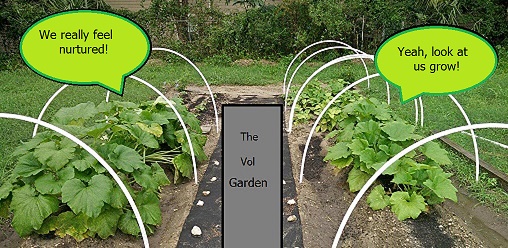
What would sustainable volunteering look like? Besides many of the innovations already being implemented, what would nurturing a volunteer garden shared within our communities involve? Is this a 180 degree leap or is it more of a naturally occurring shift that we have been moving towards all along? Are we, volunteer managers coming together in an organic movement to help one another and therefore all volunteers and all good work?
What can we try? Will this take extra work, headache and heartache to achieve? Just as in gardening, there are necessary steps to achieve a bountiful crop.
I’m going to list some ideas in a season of planting using the gardening metaphor.
TILLING THE SOIL (preparing to garden):
Make a list of agencies and organizations in your area that utilize volunteers and reach out to introduce yourself to each leader of volunteers
Join any clearinghouse agencies such as United Way, and Volunteer Centres in your area
Join a DOVIA (Directors Of Volunteers In Agencies) or a similar group in your area or if none exists, reach out to another volunteer manager and start a peer group
Create a list serve or simple newsletter to share with your fellow volunteer managers in your locale
PLANTING (seeding the way):
Share your volunteer opportunities with other volunteer managers (at your peer group and by list serve) and ask for theirs-regularly check in to gauge the fluidity of roles, etc.
Discuss volunteers’ skills and interests at peer group meetings. Offer other volunteer managers the opportunity to contact one of your volunteers if their mission or opportunity more closely aligns with your volunteer’s passion
Share background checks if you are able in order to cut costs
Pair up with other organizations to conduct a visible volunteer project and involve local media to cover the event
Create volunteer educational conferences with other volunteer managers to benefit all volunteers in area-share space, costs of snacks or printed materials creating more bang for the buck
Share cost of a national speaker with other volunteer programs and invite all volunteers in area-have plenty of information on volunteering opportunities available
FEEDING (nurturing the collective):
Bring your volunteers to another organization on Make a Difference Day or another day of service and help that organization-build that camaraderie, use positive press to show cooperation: Days of service include:
Create a summer circle of volunteering for out of school students so they can sample the various opportunities in your area and participate in a well-rounded service learning experience
Conduct partner training sessions with other organizations
Partner with another organization to create a group of volunteers to cross-volunteer (a really rudimentary example – library volunteers + homeless shelter volunteers = a reading program for school aged children in the shelter. Library volunteers finding appropriate books, shelter volunteers utilizing them and perhaps some library volunteers venturing out to read to the children while shelter volunteers conduct a fundraiser for the library-and no this isn’t simple or easy but it can be a start)
Mentor new volunteer coordinators in your area
Offer your highly seasoned and trained volunteers to train/mentor volunteers at another organization
Partner with other volunteer managers to create a presentation that educates organizational staff on the nuances of volunteer engagement-allow all volunteer managers in your area to utilize
Create partnership recruitment efforts by sharing speaking engagements
Future Bounty (what might come of this?)
Increased satisfaction and sustainability of volunteers
More flexible options for prospective volunteers
Sharing of best practices between leaders of volunteers
The showcasing of cooperation between non-profit agencies
Increased volunteer involvement in organizational planning and innovations
More good work accomplished within communities
Cooperative think tanks springing up
Less stress on volunteer managers
We, volunteer managers are unique, innovative and forward thinking. Why wouldn’t we bond with one another and forge a new, co-operative garden in order to create sustainable volunteerism?
Besides, we are generous and big picture oriented by nature. Let’s co-op.
Part 2 of the interview with Sadie on corporate volunteering-the day of the event.
VPT: So, on the day of the event, you and several other employees met up at the location. How did it go?
S: Well, we had an issue with parking. There were street parking spots, but a sign said ‘two hour parking only.’ We parked anyway. It was a four-hour shift so we figured we would have to come out and move the cars. Later, when we asked, they told us that the city had waived that rule and we could stay in our spots.
VPT: After you parked, you went in and what happened?
S: The building was a warehouse type of building and we had no idea how to get in.
VPT: What did you do?
S: We went around back, found a back door and went in through there.
VPT: And then what?
S: We found the makeshift kitchen where there was coffee and donuts and we announced ourselves to the people in there. They asked if this was our first year and we said yes, so they got another person to come and train us.
VPT: Were they volunteers or staff? How did you know they were part of the event?
S: I honestly don’t know if they were paid or not. But they wore stick on name badges.
VPT: Did they greet you?
S: They seemed stressed. It felt like they didn’t know what to do with us. They consulted the printed out sign up sheet and saw that we were listed so they said they would try to find a spot for us.
VPT: What did the training consist of?
S: About two minutes worth of what we were supposed to do.
VPT: And that was….
S: We were to walk around with the clients. They would have a shopping cart and we would go from station to station where they would pick out toys according to how many children they had and their ages. Then we would escort them to the stations where they would get boxes of donated food. I will say, the person who showed us what to do was very nice.
VPT: How were the stations?
S: The stations were very well set up, and organized. You could tell they had done this many times before.
VPT: Were you given any information on how to act around the clients, anything about sensitivity or confidentiality?
S: (laughs). At one point we were told to try to get stories of hardship from the clients so that we could direct them to a station that had extra toys. They had more toys than they needed, so I guess that’s a good thing.
VPT: Did someone check in with you during your shift to see if everything was ok.
S: Not with me, I don’t know about the others.
VPT: And you were there for four hours.
S: Longer. One of our group, Justin, who was helping at a food station, was told he could not leave until his replacement showed up. After thirty minutes of waiting, we just left. Some of us rode together and had to go.
VPT: Did anyone acknowledge you when you left?
S: No. Justin told his station manager and we left.
VPT: How was it working with the clients?
S: That was great. The people were very grateful and appreciated our being there to help.
VPT: Were you comfortable with the clients, given you had minimal training?
S: Surprisingly, yes. It felt very natural.
VPT: Did your firm get any acknowledgement, thank you, write-up, mention on website, anything?
S: No, nothing that I am aware of. In hindsight, we should have worn company t-shirts or brought something for them to use. They didn’t ask, though.
VPT: Did you have some sort of follow-up meeting with your fellow employees after the event?
S: No, we probably should have done that. But I did check in with them individually.
VPT: What feedback did you get from the other employees?
S: They thought it was worthwhile. They felt like they made a connection with the people being helped.
VPT: Will you be back next year?
S: Yes.
VPT: What will bring you back?
S: As much as I didn’t appreciate how it was run, it is about the people I was helping and it makes me feel good to help them. I wasn’t able to volunteer until I was a point in my life where I felt I was able to help others. Now that I can do that I feel like I’m also able to take on obstacles such as the people running the show. Maybe they started off like me, caring about the people more, and they never transitioned over to caring for the volunteers that help the people in need. I’m not sure, but I do feel like it comes with the territory.
VPT: Anything else?
S: Second reason I’ll go back is because it might not be the best environment to make me feel appreciated, but I’m comfortable now. I do have a busy life and I chose this organization for a reason. To find another one like it is time-consuming and what if it was just the same or worse? I feel comfortable at this organization now and next year I will be able to walk in, do what I came to accomplish and leave.
VPT: Thank you Sadie for sharing your experience with us.
Huh. Well, that was definitely eye-opening. So, I guess the takeaway is we should be relieved when volunteers put up with us because it’s just too darned time-consuming to find another place to spend their time and talents. And luckily for us, that new place might be worse.
And hey, here’s a thought. Maybe we should thank the people we serve for being needy. Maybe we could just give them a reward for keeping our volunteers coming back. We could call it the “Sob Story of Retention” award.
Icebreakers: I could never really get the hang of using them at the first meeting when training hospice volunteers. I usually got eye rolls and polite “oh here we go” smiles so I opted for a more conversational start to training new volunteers who had real expectations for a serious mission.
I did however, develop a few exercises of my own that I introduced into the middle of volunteer training. Admittedly, these were often self entertaining and helped keep me engaged and I tried to deliver them with a twinkle so that the volunteers understood that the subject at hand was not just about doom and gloom. Hopefully they saw a lighter, quirkier side that prepared them to view patients and families with appreciation for the diverse and sometimes absurd situations that might arise.
One exercise for a small group was “two forks.” I asked the volunteers to arrange two identical forks in any setting they wanted. I told them to just arrange them on the table however they envisioned them at the moment. After the volunteers arranged the two forks, I would “interpret” their arrangement with phrases such as, “you are very open minded” or “you are extremely creative.” Teens especially liked this exercise. They would smile wryly and mentally call me out on my “game” but they would play anyway and seemed to enjoy the spoof of psychological testing. (I always did “fess up” and tell the volunteers that it was all made up) But then we would seriously discuss volunteering with various personalities and how to best connect with folks.
Another exercise that I used in group training was the personality test. I downloaded a simple quick personality test with broad results and tweaked the questions to represent volunteering scenarios. I asked the volunteers to record their answers on their paper and then tally up their score. I then read the “results” according to the score ranges. For instance, those with a score within 10-20 were introspective while 90-100 were very outgoing.
But I added my own twist to the test results. I made up silly outcomes for each personality type based on volunteering with a patient or family member such as, “it is said that this personality type because of their bubbly personality ends up talking so much about their recent family cruise that the family member actually experiences seasickness.”
About halfway through the result reading, the shocked looks turned to laughter and relief. “Oh you got us,” the volunteers would say. But it wasn’t just for comedy relief. We then went on to discuss the different ways a well meaning volunteer could over step their boundaries and reiterated how to keep active listening in mind. Those were productive conversations.
One thing I did learn in years of training was that timing is everything. Acting wacky or introducing quirky subjects too soon destroys the trainer’s credibility. Once trust and sincerity is established, then comedy relief and diverse teaching methods will be much more readily accepted. The same goes for introducing deep subjects. Volunteers have to be ready in order to really digest profound information.
My barometer of a class’ comfort level was always predicated on the day the class got up and freely helped themselves to coffee and snacks while chatting warmly with one another. It usually took two sessions to establish that level of comfort and trust. (I always taught six 3 1/2 hour sessions for initial orientation).
But once that comfort level was achieved, then I could introduce really fun activities, and on the flip side, speakers with really deep and profound experiences to share. Classes laughed and cried, but only after we all felt really safe with each other. Honestly, those intimate moments with new volunteers are memories so precious to me, I can’t even begin to describe them. How fortunate I am to have them.
Yes, timing is everything. Volunteers look to us to illuminate the way and we should be honored to own that responsibility. Providing volunteers with deep meaning enhanced with light and laughter takes some sense of timing. But when you get it just about right, it fills your soul with the most amazing moments.
Training volunteers creates a bond with them from the very beginning. We neither have to be just ultra serious nor just silly and entertaining. We only need to make them comfortable and care that they learn and feel a part of our team. This sincerity paves the way for the information you want to present.
So, don’t be afraid to have some fun.(When the timing is right of course) Arrange your own two forks, create a personality test, make up an icebreaker and watch the magic happen!








 volunteerplaintalk