Tag: volunteer management strategy

  • Volunteers and the Game of Complaints

    Photo by Keira Burton on Pexels.com

    I’m revisiting an old post from 2013 because Volunteer Appreciation Weeks are upon us and one way we can appreciate volunteers is to give them the gift of loving the mission. And by that, I mean, shielding them from nonsense.

    Volunteers: A head-pat will do

    I remember this incident vividly, because organizations often view volunteers as “our little helpers” and not as members of a professional team. It’s easy to pat volunteers on the head, and toss the “Boundaries and Good Practices for Dummies” book aside when dealing with volunteers because, hey, they are so cuddly (codeword-ignorant and therefore, harmless), they don’t need to be treated with anything resembling….intelligence and professionalism.

    A few years back, I sat in a meeting with long-term, respected volunteers Darla and Jo, and the supervisor of their department, Cindy. I was shocked when Darla and Jo brought out a list of complaints against Kay, their immediate supervisor. They hadn’t brought any issues to me before this meeting, so I was a bit skeptical, especially when they produced a list of Kay’s shortcomings, including how she treated staff unfairly. (Hmmmmmmmmmm)

    Volunteers: Professional team or pawns?

    During the conversation. Darla and Jo mentioned they often went out for drinks with a couple of staff members under Kay’s supervision. (Really?) And those staff members shared their difficulties with Kay. (Well, how convenient) So, what that means is, when out socially, away from work, these staff members let loose and talked about the organization and other employees in front of volunteers, drawing volunteers into the politics of their department. (What a great way to make volunteers feel part of the team, right?)

    In private, I said to Cindy, “It’s a terrible idea for staff to socialize with select volunteers and air grievances. If staff is going to invite the volunteers to a function, then they’d better invite all of them and they’d better not make the volunteers pawns in some personal battle with their supervisor.”

    So, Cindy, who is the supervisor of all in question, shrugged and said, “they’re on their own time, what can I do?” (Really? How would you like it if the CEO invited a couple of staff members out for drinks and they trashed you?) (oh, and then enlisted volunteers to file a complaint?)

    Go on record…really go on record

    I then said. “I’m going on record as saying that allowing staff members to fraternize with select volunteers on off time and discuss work issues makes for a harmful work environment and should be stopped immediately.” (And, I will be noting this conversation for the time this all goes south, which we know it will.)

    Taking care of the volunteers is everyone’s business, not just the volunteer department’s. Write a policy that says your employees will treat volunteers with respect and will not suck volunteers into conflicts. They don’t deserve that. (And this chess game is what you get. It won’t resolve itself on its own.)

    I had a volunteer who helped me in my office. From day one, I said to her that “it’s not that I don’t want you to be privy to things, it’s that I don’t want you to be burdened with junk. You’re here to do good work and you deserve to be shielded from the nonsense.”  She took that to heart and ever after, when I had a conversation with someone in front of her and it got a bit deep, she excused herself before I had a chance to, and she laughingly said, “I don’t need to be a part of this.” (Bravo to her!) But, you know what? She knew staff had political conflicts, personality clashes, and sometimes back-stabbing incidents, but she chose not to become embroiled in them, which lead to more love for the work.

    Let volunteers love the mission

    The question becomes, “for whom does our volunteer volunteer for? Um, the organization, right? But often, volunteers’ loyalties can be steered away from the mission and to select staff or other volunteers. This is why boundaries exist; to ensure volunteers are connected to mission impact and not to any cult of personality borne from feeling sorry for or loyal to one or more individuals.

    So, when staff thinks they’re being nice or cute or they just want some pawns in their game of complaints, they need to realize that fraternizing might be great for them, but it’s always a bad idea for the volunteers. Let the volunteers see the greatness of the organization, not the back room where stuff is all chaos and disjointed and frankly sometimes back-stabbing. And if staff want to grouse about their jobs, then make sure that volunteers are left out of it.

    -Meridian

    and here’s the old post

  • Are We a Lone Nut or Part of a Movement?

    Everywhere #LoVols are saying, “Volunteerism is evolving and we must adapt to meet today’s volunteer needs.” We’re all saying it. But individually. We hear each other. But our organizations mostly hear us, and a lone voice is rarely heeded.

    I love Derek Sivers’ “How to Start a Movement” Ted Talk. It’s so good: (and only 3 minutes long)

    Are we, volunteer managers lone nuts? Do we whine, cajole, beg, furiously educate, preach, go back and squeeze our stress ball, then start again? I know I did, all the time. (I didn’t squeeze a stress ball though, I preferred sneaking in and turning off the light in the bathroom closest to the senior management offices-yeah, passive-aggressive, I know)

    We need to fix this lone nut conundrum and find the followers who can help create a movement. Let’s move our message outside the volunteer management bubble and get people who are not in our profession to follow our lead. It will not be easy, but we need the first brave followers to help lead change. (if you didn’t watch the video, the first follower is also a leader who has an important role-inviting others to join in)

    Where are these first followers? In your organization, who has benefited from volunteer involvement? Who on staff do the volunteers praise? I had one department in my organization that worked wonderfully with their volunteers. I wish I had tapped into that department’s potential to be the first follower but sadly, I didn’t know the importance of the first follower at the time.

    How do we create a movement within our organizations? Well, can you enlist staff who “get volunteer value” or an entire department who work wonderfully with volunteers to be your first follower? How?

    • equip the FF (first follower) with the phrases that advocate for volunteer engagement. Ask the FF to repeat key words when speaking. (for example, “our volunteers give my staff more time to complete their critical tasks.”)
    • ask a department who works well with volunteers to co-present a volunteer presentation at a staff meeting. (assure them that you will do the majority of work so they’re not bogged down) Ask the department to share success stories and invite others to join. Remember, the FF has a leadership role-inviting others to join.
    • invite your local volunteer manager peer group to speak to your organization. Ask them to share the trends they are seeing and how their organizations are striving to be “cutting edge” by adopting their volunteer manager’s recommendations. Remember, in a movement, no one wants to be left out.
    • share articles on volunteering trends with senior management. Give them the research to back up your advocacy. That makes you the FF, and not the lone nut.
    • find the “what’s in it for me” verbiage to entice followers. A movement is not something we throw at people, it’s something they choose to participate in.
    • join every volunteer management group you can, whether locally, nationally or globally. There’s many groups on social media. Together, we can’t all be lone nuts.

    We know our volunteer programs have so much to offer. We know we’re advocating for a better way for our volunteers, our organizations, the people we serve and our communities.

    We’re not lone nuts. We’re a movement.

    -Meridian

  • Becoming Volunteer to Organization (V2O)

    Let’s pretend volunteers are a type of consumer. They search for a volunteer experience that fits for them, kinda like looking for that certain shirt for the next Zoom meeting. Organizations advertise volunteer jobs in an O2V (organization to volunteer) model. Orgs basically say, “Here’s what we have to offer, take it or leave it. Go ahead, shop around, there’s nothing better out there.”

    But, social media has changed everything. Customers now can buy direct from one another in a C2C (customer to customer) model. We are seeing this shift in our sector as volunteers bypass formal volunteering and mobilize directly through social media. They’ve cut out the cumbersome organizational middle man in an new, V2V (volunteer to volunteer) model.

    But now, businesses are seeing an additional shift to a C2B (customer to business) model. In this model, customers’ value increases. Customers offer businesses talent for hire through numerous websites such as Upwork. Customers with a social media following advertise products. Customers review products online and participate in surveys and by doing so, add value by helping design the next product.

    But how would a V2O (volunteer to organization) model look? Can we adopt this growing trend or are nonprofits stuck in an archaic model that sells their volunteering experiences in a take it or leave it fashion while the world moves on?

    The point of V2O: Recognizing and embracing volunteer value.

    Demonstrating volunteer impact is one way of showing volunteer value. Embracing the additional ways volunteers add value takes us into a V2O model.

    For more on volunteer value also see:

    Older posts such as the volunteer investor or the value of a volunteer is $#.@S

    So, how do we adopt a V2O model without breaking the system?

    Soliciting Feedback:

    Encourage volunteers to review their experience. But wait, what about negative comments? Here’s the interesting thing about negative reviews. Businesses have found that negative comments do not deter customers, it’s the way businesses respond to negative comments that turn people off.

    So, that volunteer comment that states, “I didn’t like my assigned job,” becomes an opportunity for the organization to respond, “thank you for your comment and we are committed to improving volunteer roles. Let us show you other roles that may be a better fit for you.” The negative comment becomes a vehicle for the organization to advertise their dedication to working with volunteers. It’s a powerful opportunity.

    Focus Groups, Surveys and the like

    Volunteers offer diverse opinions. Many volunteered because they also benefited from mission resources and are a wealth of information on the mission experience. (see more in The Disruptive Volunteer Manager) Volunteers have a wide circle of influence and bring in breaths of fresh air from the communities we serve.

    Volunteer In-demand Talent

    Freelancing is here to stay and volunteers are moving from committed volunteering to freelancing. It’s time we sought out volunteer candidates on sites such as Linkedin. Remember the old, but true survey result that the number 1 reason people didn’t volunteer was because no one asked? Well, it’s time we paid attention by searching out the people we feel would add value and ask them to volunteer.

    Volunteer-generated content

    Volunteers are an untapped, rich source of content. In a study by TurnTo, USG (user generated content) bests traditional marketing by influencing 90% of consumer purchasing decisions. Whuh-what?

    Organizations shy away from “letting” volunteers speak on behalf of the organization. “But, we can’t control what they will say.” This iron fist clinging to the message is short-sighted. As with negative comments, organizations can quickly correct any misinformation given by a volunteer (or staff BTW-let’s not pretend staff give out correct information all the time, am I right?) on sites. By holding tight to messaging, organizations are missing the marketing content volunteers provide.

    And think about this for a minute. If a volunteer says their organization is doing good work, it’s more convincing, considering the volunteer is unpaid and not afraid of losing a job (whereas a staff member is perceived as having to be biased).

    V2O is simply embracing volunteer value in ways that sustain volunteering. As leaders of volunteers, we can move towards V2O by:

    • recording and analyzing volunteer impact
    • seeking out volunteer candidates who add value
    • soliciting volunteer opinions, testimonials, quotes, etc.
    • advocating for volunteer voices
    • streamlining volunteer onboarding
    • using volunteer focus groups to create new volunteering opportunities
    • reaching out to volunteer grassroots groups
    • partnering with fellow volunteer leaders in our communities to form coalitions that speak with one, strong voice and share volunteers, volunteer resources etc. (more in the Disruptive Volunteer Manager)

    Leaders of volunteers are tuned in to the ever-changing volunteer mindset and are adapting practices based on what today’s volunteers want. As volunteers leave the organization to volunteer (O2V) model, we can create a volunteer to organization (V2O) environment that engages modern volunteers.

    Or, we can just continue to be a V-Mart. (“go ahead, shop around, we may not have the volunteer experience you’re looking for, but nobody else does either.”)

    -Meridian

  • Moving from O2V to V2V to V2O

    Photo by Pixabay on Pexels.com

    Friends, we are behind the times. Way behind. You can feel movement like cool air that flows down a mountain. Can we define it?

    Businesses are rapidly changing because they feel it and see it. They are moving out of a B2C (business to consumer) model. You know, the “hey, Target has a sale, I’ll see if they have a shirt I can wear during zoom meetings.”

    But there’s nothing I want at Target. So I look at a marketplace like Etsy for something unique. (Etsy is a C2C-consumer to consumer model). I purchase a fun shirt I love directly from a designer.

    What is our current nonprofit volunteer model?

    Organization to Volunteer or Volunteer to Organization?

    Let’s say I’m a volunteer looking to join an organization. My first experience with an organization is reading an ad, or looking at a website. What catches my eye?

    From an actual current volunteer ad:


    Have you ever wanted to do something AMAZING to change the world but didn’t know where to start? Here is an opportunity to help underprivileged children, to help under-served children, to help ALL children displaced from school due to COVID-19, and even to help many adults.

    I then look at this organization’s website and find no volunteer information. No volunteer prompt. No volunteer pictures or information on how volunteering will enhance my life. Just Crickets. But donations are welcomed.

    Above is an example of an O2V (organization to volunteer) concept. It goes like this: “We, the organization, want XYZ from you, the volunteer.” Or, more simply, “buy our product (volunteering). We designed it and you’re going to have to buy it because that’s all you have to choose from.”

    But wait, there are volunteer choices now.

    People are bypassing formal volunteering and exploring solutions through social media on their own. Why choose a volunteer job that is cumbersome and just ok when you can find real satisfaction from joining a group on social media?

    There’s a monumental shift afoot from O2V to V2V (volunteer to volunteer)

    We see this all the time. My last podcast highlighted two amazing young women who started their own organization while in high school. They are now in the process of procuring donations, creating corporate partnerships and recruiting volunteers.

    https://www.buzzsprout.com/605416/4850183-episode-11-interview-with-samantha-and-sydney-high-school-students-who-founded-balance-boxes

    The nonprofit veil has lifted.

    We see this every time a disaster strikes. Volunteers find one another on social media and they band together and act. They bypass formal organizations and change their communities by forming their own grass-roots groups. Nonprofits no longer have the monopoly on solving issues.

    Next time: Businesses are moving from B2C to C2C to C2B. What would V2O look like?

    -Meridian

  • A Good Time to Collect Data: Free Volunteer Survey

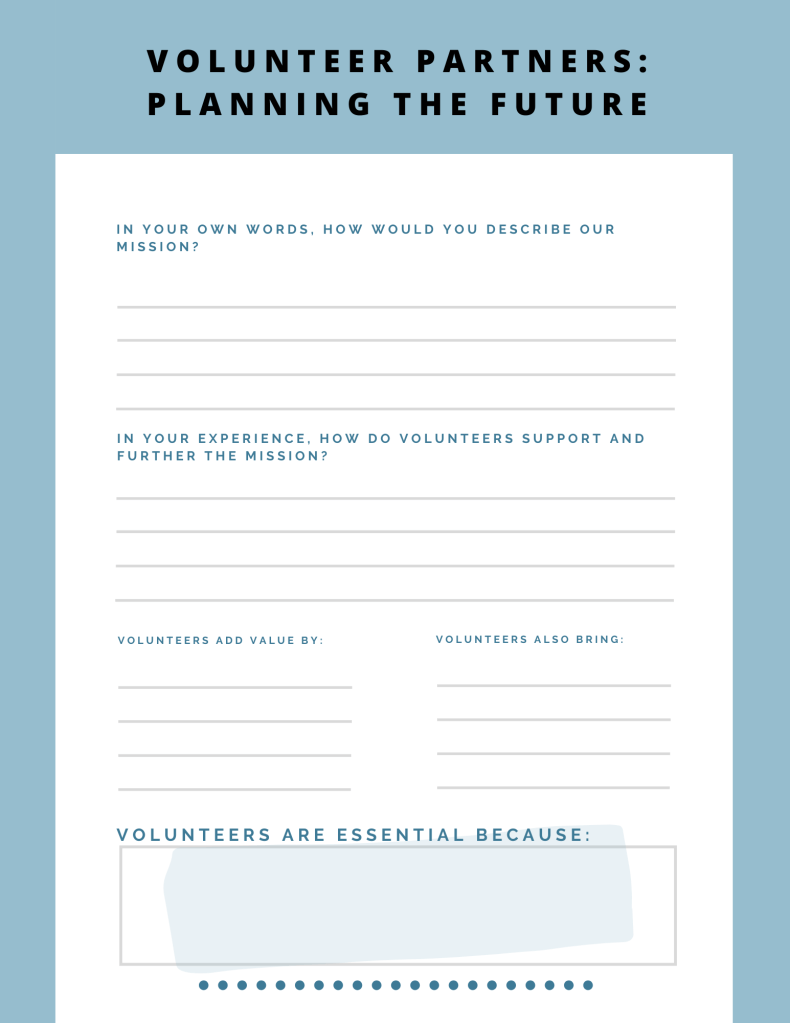
    As we move into a new reality, this is an ideal time to survey volunteers and sort through their thoughts on volunteering past and volunteering future. By gathering their opinions, we can create data that supports our advocacy for a vibrant volunteer initiative.

    Ask volunteers to write down their thoughts on their past volunteering along with their visions for the future. The shorter “list-type” sections help volunteers hone in on specifics. From these survey questions, you can extract key words, phrases and topics and connect the dots.

    For example, under the question “how can technology support your volunteering” on page 5, 80 of 100 volunteers surveyed used the phrase, “keeps us more informed.” On the same page under “volunteers need,” 85 volunteers wrote “training.” Finally, in the box asking, “volunteers feel supported when,” 92 volunteers wrote “when we are included.”

    By connecting the dots, you then can say:

    • 80% of volunteers surveyed will use technology to stay informed
    • 85% of volunteers surveyed want more training
    • 92% of volunteers surveyed feel supported when they are included
    • conclusion: training and technology can be used to help volunteers feel included which supports volunteers and keeps them engaged.

    Hope you can use this, or at least I hope it might stimulate your creative thinking on how to gather data from your volunteers.

    Happy Productive surveying!

    -Meridian

  • Volunteer Flow Strategy

    Volunteers move in and out of our organizations and unlike staff who have defined hours and pay, volunteers ebb and flow like water in an ecosystem. A simple volunteer flow statement is used to track this flow and then predict future flows based on factors that engage volunteers verses factors that block the volunteer flow. Let’s create a basic flow statement for volunteer recruitment efforts.

    simple, but effective

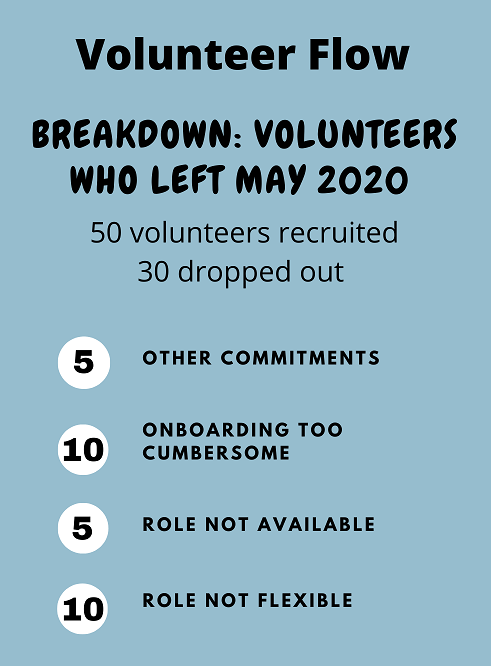
    Example: Month of May: We recruited 50 volunteers who signed up. Of those, 20 volunteers followed through and are now officially volunteering.  The other 30 volunteers did not follow through. The volunteer base has now increased by 20 volunteers. Sounds great if you simply say, “we gained 20 volunteers this month. 

    But let’s go further. What about the 30 volunteers who left after recruitment? Here’s where you can explain the reasons volunteers leave and predict that more volunteers will leave due to these same reasons. Not so great, after all, is it?

    Percentages are calculated from stats gathered – for example, exit surveys or interviews.

    Percentages break down this way:

    • 16% of volunteers who left in May had other commitments
    • 33% of volunteers who left in May found on-boarding too cumbersome
    • 16% of volunteers who left in May did not find a role that suited them
    • 33% of volunteers who left in May needed more flexibility

    When projecting volunteer recruitment in the future, we can now predict:

    For every 10 volunteers we recruit, only 4 (or 40%) will stay. ( based on the above stats, 50 volunteers recruited – 30 volunteers that left = 60% of new volunteers will leave before they even start. Now, 20 new volunteers doesn’t sound so great when the number could have been 45, right? (not 50 because you can’t control the 5 who had other commitments)

    Explain why volunteers leave by showing causation:

    Of the volunteers who left:

    • only 16% left due to unavoidable reasons
    • over 80% left due to factors we can modify or change

    We need to change…

    We can now infer from the statistics that changes will likely increase the number of recruited volunteers who follow through. Changes include:

    • on-boarding needs to be less cumbersome
    • roles need to be more flexible
    • roles need to be expanded

    A strategic Volunteer Flow sheet shows the reasons volunteers leave or stay. (causation). These “causes” are the reasons you have experienced all along and have been advocating for. Volunteer flow is a way to form your knowledge into a measurable report and more importantly, predict the future with statistical information.

    Instead of the notion that a volunteer manager should “work harder” to “get volunteers,” we need to place the reasons volunteers leave or never get started squarely on the outdated systems that no longer work.

    By predicting the same results in the future, you are illustrating that without the changes you are advocating for, volunteers will continue to leave before they even get started. You can use this method to show volunteer retention and causation as well.

    show what you know

    Volunteers flow in and out of our organizations for hundreds of reasons. The reasons we can control must work for the volunteer and by showing causation, we can more effectively advocate for the changes that will increase volunteer engagement.

    Modern volunteers need modern programs that meet their needs. Our communities are ecosystems and volunteers flow in and around looking for the right opportunity to offer their skills and passions.

    Let’s strategically advocate so that when volunteers flow our way, they find a place to stay.

    -Meridian

  • Predicting Volunteer Flow

    Predicting Volunteer Flow

    What freezes the flow of volunteers?

    What is a volunteer flow? It is the movement of volunteers in and out of an organization, much like a cash flow in business. Like any resource, volunteers are a people-resource that is rich in skills, passions, marketing reach, knowledge, experience, dedication, and in ability to procure donations and other desired resources. As such, our volunteers must be viewed as just as valuable a resource as a donation flow.

    Can we, volunteer managers predict our volunteer flow, especially in uncertain times such as we face today? Before we say no way, (mainly because we have all experienced surprises when it comes to who actually will volunteer), let’s ask this question: Would it benefit us, Leaders of Volunteers, to create a volunteer flow statement?

    As a fan of mathematical equations (even when I mangle them), our aim is: UPV (under promise volunteer resources) < OPV (over produce volunteer resources).

    We know that there are thousands of factors that influence volunteer recruitment and sustainability and we know that challenges have increased exponentially due to the pandemic. So, how can we possibly predict how many volunteers we will gain, retain or lose in the next few months?

    We can’t predict with certainty, but we can estimate with causation. And this is actually a good time to introduce the idea that volunteers ebb and flow not only with changing times, but with any negative or positive experiences within our organizational structure. Volunteers aren’t something we “order up” or people who magically appear when needed and never question their assignments. This is the time to introduce the factors that freeze or free up a volunteer flow.

    What is our objective?

    Our aim is to create a consistent flow of highly engaged and productive volunteers who positively impact our organization’s goals, objectives and mission. Our job is to recruit these volunteers, and to develop them into contributing members of our teams. For more on development, see:

    #LoVols, This Needs to Change Now

    What do #LoVols do all day?

    Download Volunteerplaintalk Tools

    Will volunteers return after being furloughed? Will more virtual volunteers sign-up and then we are caught without enough meaningful roles for them? Will corporate and other groups want to continue their philanthropy? How will virtual training affect volunteer sustainability? These are questions we don’t have all the answers for, but based on what we are experiencing, we can create a volunteer flow strategy statement.

    Next time: What goes into this strategy?

    -Meridian

  • Volunteer Past, Meet Volunteer Present and Volunteer Future:

    Volunteer Past, Meet Volunteer Present and Volunteer Future:

    We are at a junction. Volunteer past is meeting volunteer present and volunteer future. How will we treat each one going forward?

    It’s too soon to know what changes will occur, but it is not too soon to start strategizing for a better present and future. Will we recruit new volunteers saying, “It’s a new day folks,” and by sweeping away the past, piss off all the volunteers who have stuck with us? Will we try to force all the new volunteers into old roles and methods and appear to not have gained any innovative insight from this crisis?

    Volunteer past is an organization’s foundation. Honoring volunteer stories and accomplishments from the past means your organization has created a solid base and has laid an infrastructure on which to continue building.

    I discovered long ago, that when seasoned volunteers spoke at volunteer orientation, new volunteers were impressed, but also thought, “Am I supposed to be like this volunteer or will I have my own volunteering path? Is there anything new to be done?”

    Moving forward, modern volunteers need to get excited about their volunteering journey. Volunteers are looking at the future instead of being content with the present. It’s a subtle, but significant shift.

    What does that mean for us then, when it comes to recruiting, sustaining and on-boarding new volunteers? It means balancing past volunteer methods, awards and accomplishments with present goals and visions for the future. It means setting the foundation and then inspiring new volunteers to put up the walls, or decorate the interior or construct another floor. It means focusing on moving forward.

    What if you’re not an exciting start-up organization with endless possibilities? Introduce expansion, new programs and future visions to volunteers who may be wondering, “why do you need me?”

    Nothing is more infectious than an inspiring vision that has movement. It gives volunteers an identity. It means that they won’t have to mimic volunteer past to make their unique mark.

    Volunteer Past infused with Volunteer Future looks something like this:

    “Our volunteers have won numerous awards for their work. But, we want to build on that and we need your unique passion.”

    “Our volunteers gave 70,000 hours in the past 5 years. That’s why we can expand our innovative programs. That’s where you come in.”

    “We’ve used this method for many years because it worked. Now, we are moving forward and you are part of the journey.”

    A well-rounded volunteer understands volunteer past and looks to make their mark on volunteer present and volunteer future.

    Our volunteers want to celebrate and understand the past, but own the future. Let’s give them both.

    -Meridian

    This is a more timely version of a past post: https://volunteerplaintalk.com/2018/10/03/volunteer-motivation-past-present-and-future/

  • Keeping in Touch With Volunteers

    We are in new territory and for many organizations, volunteers are temporarily staying home. What can a volunteer manager do to keep volunteers engaged when we can’t sit down with them, hug them, hear their stories or laugh with them?

    Right now, we can supplement our daily spontaneity with strategy. First, we need to plan the approach. Where do your volunteers see/hear/read/absorb information from you or your organization? Common ways are:

    • emails
    • phone calls
    • website
    • social media
    • meetings

    Next, determine strategies for each information pipeline. Schedule communications (weekly, daily, bi-weekly) so volunteers look for regular updates from you. And, giving yourself a deadline helps keep you on track. Prepare your scheduled messages.

    For those volunteers who only get information through phone or meetings, create a phone tree of volunteers to pass along information and also to encourage those volunteers to choose a tech method in which to stay informed. Not all will, but this is an opportune time to start funneling volunteers into more central avenues of communication such as your website. This is a time to create a new normal in which volunteers expect to learn, be informed, find educational offerings, meeting schedules, inspirational stories etc. from the tech site(s) you find most advantageous. (for example, you would like all volunteers to follow your Facebook page or you would like all volunteers to check your volunteer portal)

    A few ideas for scheduled communications are:

    • provide helpful information on your website. Volunteers trust us, so be the site they go to for correct and factual information-if you give volunteers information, be sure to include the source, don’t re-word the information, quote accurately, don’t opinion-ate on facts.
    • set up a new hashtag for your volunteers specifically during this time ( example: #SpringhillVolsCov19 ) and share what your org and you, as their LoVols are doing during this time. (include your website address to funnel volunteers towards a central spot)
    • post testimonials from past clients, volunteers, etc to celebrate volunteer impact and for inspiration to keep engagement alive.
    • set up Facebook live events to speak directly to your volunteers. You are their anchor and seeing you is reassuring.
    • this is a great time to share the history of your organization. Share old photos, stories of how the mission was created, and the early struggles. If possible, interview your org’s pioneers; those who were there when it began. Connecting your volunteers to the birth of your mission strengthens their engagement.
    • issue a challenge-read a book, exercise, learn a skill. A challenge illustrates that you care about their well-being (which you do) and makes this time about them.
    • ask volunteers to email their favorite volunteering memory and share those memories with the volunteer team. You can also re-purpose the stories to use later as testimonials for recruitment and training purposes.
    • create a quiz. Quizzes are entertaining and can serve an educational purpose at the same time. Add a bit of humor to your multiple choices by making one answer funny.
    • survey your volunteers. What have you always wanted to know? Create a survey with multiple questions to help you plan forward.
    • ask volunteers to share their tips for surviving a shelter in place order and post those tips.
    • Netflix party with your volunteers (through Google Chrome). Pick a comedy, or classic or feel-good movie and watch together with volunteers. You can even chat during the movie.

    This is a stressful time filled with chaos. Strategically planned communication with volunteers helps decrease our stress while continuing their engagement. The immediate future may be uncertain, but one thing has not changed. Volunteers appreciate information and connecting and we, volunteer managers are excellent at keeping our volunteers engaged.

    Uncertainty is less stressful when a plan is in place. Plan your communications and use this time to invest in volunteers, funnel them into a centralized information hub and gather opinions and stories from them to be used now and later.

    Be well. Be safe.

    -Meridian

  • You Can Water Plastic Flowers, But They Won’t Grow

    In a volunteer manager’s chaotic day, volunteer impact is difficult to plan, hard to complete and often impossible to execute. We laughingly describe our chaos in phrases like, “herding cats,” “wearing many hats,” and “controlled chaos.” But, the inability to move ourselves and our volunteers forward due to chaos is no laughing matter.

    I’d like to add another phrase to the lexicon: “Watering plastic flowers,” which means time spent on futile activities. But wait, futile is a strong word; it means “pointless,” or “incapable of producing results.”

    So, let’s eliminate the word futile, because there’s always hope right? As volunteer managers, we hold hope in our hands: Hope for that volunteer who is hurting and wants to help, but keeps canceling. Hope that our impassioned speech about volunteer value changes minds. Hope that today we will fill a role no volunteer wants to do.

    Instead, let’s look at ROI-return on investment. When our time investment does not produce enough results to continue, this doesn’t mean we must stop reaching out to that volunteer who never shows up; it means we have to weigh how much time we spend doing it.

    And remember, for every minute we spend on something with little ROI, we miss spending that minute on something with a large ROI that has impact and moves us in the direction we want to go.

    What steps can we take to determine where we should invest our time?

    • Volunteer ads: Analyze ads’ effectiveness and spend more time on effective ads. Relegate lesser producing ads to your office volunteers to manage. (and if you don’t have a team of volunteers helping you in every aspect of your job description, what the heck are you waiting for?)
    • Volunteers who are unreliable: Set a tolerance number-I will contact a volunteer X number of times and after no response, I will send them a letter/email/message thanking them, inviting them to contact us when ready.
    • Conflict challenges: If a challenging volunteer repeats egregious behaviors, craft a policy on expectations and stick to it. Make sure every volunteer is given a copy, reads and signs the copy and is aware of your policies and the final dismissal step.
    • Educating staff on the many aspects of volunteerism: Start with one important point and repeat, repeat, repeat; then build on that one concept. Too many concepts dilutes the ability to absorb it all.
    • Staff who improperly manage a volunteer’s time: Move the volunteer to a department that effectively engages volunteers. Make no apologies for moving volunteers to departments or positions that meet the volunteer’s needs.
    • Report, speak and substantiate the why: Want change? Infuse the why (specifics) into everything you say and do. For example, “We have an opportunity to partner with a local florist whose employees want to volunteer and potentially donate flowers, fund-raise for us and help advocate for our services. This will lead to other business partnerships so I need support from multiple departments.” Or, “I moved volunteer Tess to finance because her skills were underutilized in client records.”
    • Close your open door: Set aside planning time and remove yourself from distractions. With any repeated behavior, people will grow accustomed to “oh, yeah, Julie’s out right now. It’s planning time. She’ll be back in an hour.”

    Overloaded volunteer managers have no time for weak ROI. Under our careful cultivation, we need flowers that bloom and grow into effective volunteer engagement and impact.

    So, watch out for plastic flowers; they may look colorful, but water them all you want and they still won’t grow.

    Instead, water the flowers blooming with impact and watch your garden grow into a lush volunteer initiative.

    -Meridian