Tag: volunteer management

  • Horror! Should I Pull the Plug on a Volunteer? Part 1

    plug

    Ebony is in charge of a busy thrift store. The only staff member, Ebony manages sales, donations, store appearance, supply ordering, advertisement and the twenty volunteers who help her throughout the week. She has precious little time for drama or nonsense. Because her volunteers are a tight-knit team, when Bernice, a new volunteer signed up, Ebony placed her on the day the most welcoming volunteers worked. But a month later, those volunteers began to openly complain about Bernice’s attitude. Bernice had quit another resale shop volunteer position and was vocal about her perception that Ebony’s shop did not run as efficiently as her former store. Bernice complained about pricing, merchandising, advertising and lack of volunteer perks such as sizable discounts on merchandize.

    Unused to volunteer conflict, Ebony had several heart to heart talks with Bernice and moved her to a different day. The complaints continued. Frustrated, Ebony hoped the volunteers would work things out, but her stalwart volunteers began to call out sick and take longer vacations.  The once hard-working team became listless, negative and unproductive. Two volunteers quit, giving broad reasons. The other volunteers refused to fill in on the day Bernice worked. Ebony found her team crumbling. Too late she realized that one volunteer could destroy months and years of team building.

    When do we pull the plug on a volunteer? How much trying to integrate one person is too much? This is a dilemma that we all face at some point in our careers. And while we may erroneously feel that we have failed if not every volunteer becomes successfully integrated, we have to weigh the time and effort spent working with a volunteer and their impact on other volunteers versus keeping someone just to keep them.

    I remember a volunteer, Dot from my first years as a volunteer coordinator. She was a retired professional and not only belonged to many clubs and organizations but attained leadership roles in most. She was highly intelligent, but authoritarian and demanding. Her air of superiority was off-putting to volunteers and staff. I once complimented her on her outfit and she said, “I have a doctor’s appointment today and I want to make sure he is intimidated by me.” Everyone tiptoed around her because Dot put her own importance above the mission.  Being new to volunteer management, I didn’t think we could dismiss Dot, but I asked. My senior managers were already afraid of what she might do, and sure enough, one day she went to the board of directors to threaten a volunteer walkout over a policy she disagreed with. Eventually the senior managers realized that something had to be done and she was let go. It was messy. She wrote a letter to the other volunteers imploring them to quit in solidarity, which thankfully, they did not.

    What could Ebony or I have done to integrate Bernice and Dot? Did we miss something? Would spending more of our time have helped? Or is there a point when parting ways with a volunteer is the right thing to do? Can we stop blaming ourselves if occasionally, a volunteer does not work out no matter how hard we try?

    The answer is yes, there is a point when the amount of work spent keeping a volunteer is incredibly lopsided against the benefit in having that volunteer. In weighing whether to continue to try to keep a problematic volunteer, you have to ask yourself these questions:

    Do I spend more time on this volunteer than on any other?
    Do I field more negative feedback about this volunteer than positive?
    Do I find other good volunteers and staff refusing to work with this volunteer?
    Do I find myself worrying what might go wrong when this volunteer is present?
    Do I find myself bending rules and expectations in order to avoid confrontation with this volunteer?

    But, hang on, before we can ask the questions above, we have to do some soul-searching of our own deep feelings on the matter to see if there are some personal perceptions that are keeping us unable to meet the challenge head on.

    By being brutally honest with ourselves when working with problematic volunteers, we can move away from emotion based analysis and into logical resolution.

    Am I petrified of confrontation even though I see there is no forward movement with this volunteer?
    Am I afraid that I will just give in and not stick to my convictions?
    Am I looking at this as a failure on my part?
    Am I thinking that this will make me a mean person?
    Am I clinging to my vision that volunteering is perfect? And that I must be perfect?
    Am I just afraid of the unpleasantness of it all? Do I just want volunteering to be sunshine and kittens and not involve the hard stuff like requiring excellence and management?

    The first set of questions refers to the problem at hand while the second set deals with our own emotions. And lets face it, we have feelings too. But, we can learn to acknowledge our feelings so as to view problematic volunteers in a logical and yet kind way. Sure, our stomach feels like the spin cycle of a washing machine when we are faced with unpleasant conversations, but just remember, by avoiding the issue, it only gets worse, not better. And besides, volunteer success or failure should never be about our feelings, but about the volunteer and the mission.

    Next week, part two: FACE It: An acronym to remember when dealing with a challenging volunteer.

    -Meridian

  • Gobble, Gobble, Good God I’m Frazzled!

    pumpkin2
    Willow, a new volunteer manager for a small organization providing aid to the homeless population in her town, answered her phone the day before Thanksgiving. She had spent long hours that week, organizing and recruiting volunteers to help prepare the annual meal held at a local high school auditorium. Exhausted, her brain overloaded, she tried to muster up enough energy to sound human on the incoming call.

    The caller identified himself as Harry, the coach of a soccer team consisting of 15-year-old boys. “I’d like to get these boys involved in helping others,” he told Willow. “We’d like to come out and feed the homeless tomorrow.”

    Willow felt a throbbing in her forehead. “How many players are we talking about?”

    “Not the whole team, mind you, about 7 or 8.”

    Tears filled her eyes like the bubbles in a natural spring. The volunteer slots were set in stone. It had taken every fiber of her new volunteer manager being to accomplish that. She was bone weary and wondered, why did this man wait until now to call? How could he think that there was no coordination in putting together something so incredibly complicated? Why does no one understand?

    It’s happened to all of us. Often, people call at the last moment to help, especially at holiday times. After it happens, you begin to expect it and it is incredibly frustrating to have to tell a group of willing helpers that they are not needed because they procrastinated or called on a whim. They are, after all, potential volunteers. Granted, most might never volunteer again, but there’s always that little voice in our heads that sneers, “there goes a group that might just have been the greatest group of volunteers known to man. And you denied them. Tsk, tsk.”

    So, what to do if you are not able to just dust off those last-minute potential holiday volunteers? If you feel that a part of your job is to give people the chance to experience the deep, satisfying joy in volunteering, then you will feel a twinge of guilt or sadness when having to refuse someone, even if they called too late. We all know that holidays bring out the desire to help and that each “drop in” volunteer might become an advocate for our organizations.  Can we accommodate those late comers without making the holidays a nightmare for ourselves?

    Yes, there is a way. It’s not perfect mind you, but it’s better than feeling overwhelmed and guilty at the same time. And it takes implementing now.

    So that the future you is not caught in a holiday trap, prepare for the season right now. Before the holidays creep up on you, create some projects that last-minute folks can do. Don’t save the work that must be done but be ready with some extra projects that are off premises and not in direct contact with clients. (No background checks needed). You can invite these one time volunteers to become official volunteers at a later time.

    Start now by asking everyone in your organization for fantasy projects. Ask, “If you had 3 or 5 or 10 volunteers over the holidays, what could they do?” Does marketing fantasize about hundreds of distributed holiday flyers? Does the thrift store secretly salivate over a huge deep cleaning and resorting for the season? Does finance have a tired office that cries for a fresh coat of paint? Is there a corner where an extra decorated tree would look lovely? Do you partner with other agencies and can you ask them if they have projects? I’ve always been able to find a nursing home that was extremely grateful for some extra help during the season.

    You can also create your own meaningful projects. Go to social workers and ask if they have a family that needs Christmas presents because of financial need and then create a “gift tree” with the ages and sizes of family members on paper ornaments. Buying a gift for someone who is going through a tough time is a very satisfying introduction to volunteering. Don’t be afraid to create a project in which the participants will have to spend a bit of money. That never seems to matter.

    One time volunteers can certainly write holiday cards and wishes to older clients or children. They can have a card writing party off premise. Ask a willing volunteer to attend to explain how much these cards mean to your clients. The point is to be creative. You know the difference between meaningless work and projects that can actually enhance the holidays. Have an extra tree to decorate, or paper place mats to color (good for youth groups to do). Ask your existing volunteers if they would be willing to mentor a group when necessary. Stock up on craft supplies now.

    Then, when someone calls last-minute, instead of having to say, “sorry, but there’s nothing I can give you,” you can invite the late comers to get their feet wet by tackling a small but worthwhile project. If the latecomer says no, at least you offered something. I’ve had folks tell me that my organization was the only one  who even tried to place them. That good feeling can translate to future volunteers.

    You, by virtue of being a volunteer manager, take care of everyone around you. Take care of yourself this holiday season by preparing now for those inevitable 12th hour but sincere calls to help. Your future self will thank you.

    -Meridian

  • Top 10 Things Executive Directors Need to Know About Volunteer Services

    cliffsnotes
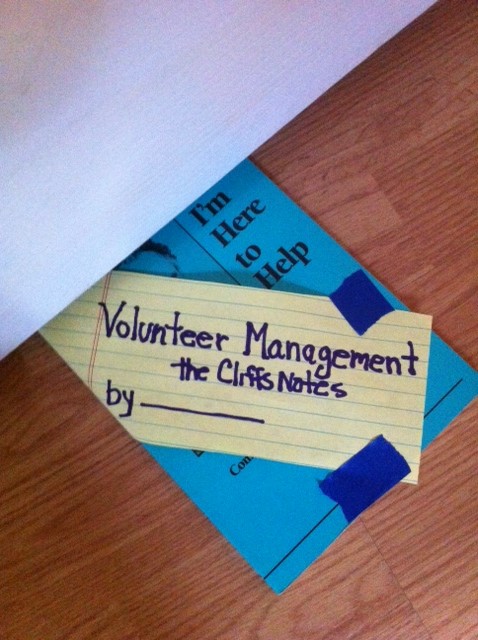
    I’ve always wanted to see a small pamphlet entitled “Volunteer Services for Dummies” or maybe “Volunteer Management, The Cliffs Notes.” Then I could sneak around and slip that bad boy under the door of the executive director while he was at a conference on “How to Get Donors to Donate More.” The pamphlet would have a way to insert whatever author’s name would impress him, like maybe that consultant who he’s recently hired to tell him that he needs to get more donations.

    So, forget the pamphlet. Let’s just list the ten top things that I wish CEOs would understand about volunteer services.

    10. Volunteers do not sit by their phones waiting for us to call. Shocker! We don’t just “order up” volunteers when someone asks for eight volunteers who can work twelve-hour shifts, outside, tomorrow at 8am. Yeah, no one wishes it were that easy more than we volunteer managers. Asking volunteer Charles to prioritize volunteering with us over his other volunteering activities, his trip to Bermuda (that he’s saved years for), his managing of his elderly mother’s affairs, and his scheduled surgery might just be a tad unrealistic. It takes a wise volunteer manager to know how to balance volunteers’ experiences so that volunteering is not burdensome and they look forward to coming in to help.

    9. Managing volunteers is not like managing staff.  Wow, bigger shocker! Unless managing two to ten times the number of very diverse people who only work maybe four hours a week without pay is the same thing. Instead of a paycheck to dangle, volunteer managers must use real leadership skills to inspire and coordinate volunteers. Think of it this way. Volunteers typically spend about 4 hours a week volunteering while you, the Executive Director and your staff spends upwards of 40 or 50 hours a week working for the organization. That’s at least ten times the amount of “plugged in time” you have over volunteers. Do you think that the volunteers spend the other 36 hours thinking about our organization? If not, volunteer managers must be able to “plug-in” volunteers every time they arrive on scene, motivate them to achieve that connection and keep them informed of changes and updates.

    8. Volunteers are everyone’s responsibility.  What?!!! The CEO is thinking, “Then what do I pay YOU, the volunteer manager for?” Staff doesn’t necessarily see working with volunteers as part of their jobs, but any staff can make or break a volunteer’s experience. Look at it this way. What if you, the CEO cultivates a donor by spending your time and sweat to encourage and inform and then another staff member comes along and insults that potential donor? It’s no different with volunteers. We need you, our CEO to set the tone. So if deep down, you are thinking that volunteers are not really time donors but are just fluffy side dishes,  then please stop saying things like “we can’t operate without our volunteers.”

    7. Volunteer managers are real managers. “Hmmm,” the executive director might be thinking, “No way, not in the same way our manager of fund-raising is!” Well, no matter what you call them, coordinators, specialists or team members, volunteer managers are as much a manager as anyone on your staff. The list of skills needed to lead and cultivate a team of volunteers (see #9 and #6 and #4 and #3 and #2 and #1 and oh heck, all of them ) is quite extensive.

    6. Volunteers want meaningful work. “So,” the CEO may be thinking,  “but I often need some meaningless stuff done. Who will do it?” That’s true, but volunteers do not want to just do what the staff doesn’t want to do, they want real jobs that make a difference. And since we don’t pay them, maybe we should consider meaningful work as pay? But, a great volunteer manager with awesome skills can lead volunteers to occasionally do the grunt work if grunt work isn’t all that is offered.

    5. Volunteers want sincere appreciation from more than just the volunteer department. An Executive Director might be thinking, “Hey! I always say that we couldn’t operate without our volunteers, don’t I?” Yeah, you do. But guess what? Volunteers see through the once a year speech at a luncheon that is just lip service. Volunteers want you to make an appearance and say hello, send hand written thank you notes and include their accomplishments the next time you meet with the board of directors. And oh, they would like you to genuinely encourage staff to do these things too. Volunteers are either an integrated valued service or it’s all just talk.

    4. Volunteers are not just little old ladies drinking tea. “But,” a CEO could say, “they sure look like that description ha ha.” Did you know that volunteers are diverse in every way, including age, background, culture and experience and that it takes some major skills to manage a group of very diverse people? But even if some volunteers are older, did you know that they are former executives, professors, leadership experts and full of wisdom and great ideas? And they’re more than willing to share their wisdom for free.

    3. Volunteer managers are not lap dogs.  “Hey,” the Executive Director would protest, “I never said that!” But are the volunteer managers treated that way by staff? Is there an “order up” culture in which volunteer managers are expected to just get volunteers without having any meaningful input into volunteer requests? Volunteer managers have their fingers on the pulse of the organization and are privy to every aspect of the mission via volunteer involvement. Maybe, just maybe, your humble volunteer manager is really a great motivator and leader and not just an order taker. Check them out for some really awesome ideas and managerial skill-sets.

    2. Volunteers are aware and talk. “Sure, so what, that’s great,” a CEO might agree. But, when a volunteer hears negative speak from staff, or sees something less than perfect, guess what? They talk, to each other, to friends, relatives, and the cashier at the Quick-Mart. Volunteer managers keep volunteers motivated and inspired and mediate constantly to make sure the volunteer’s concerns are resolved and their experience is positive. In this world aching for transparency, volunteers are the town criers who can proclaim the worth of an organization or do damage to its reputation.

    1. Volunteers don’t stay forever. “Heresy! They should if the volunteer manager is doing her job,” an Executive Director could counter argue. No, actually volunteers don’t. Does staff stay until they die? No, and neither do volunteers. We should recruit, train and cultivate our volunteers just as we do staff, but not expect them to continue until they’re carted off in an ambulance. And, just like staff, sometimes we don’t want them to stay, so that’s why the professional skill-set of the volunteer manager is so crucial. A volunteer manager’s professional resolution to a challenging situation is an organization’s best chance to avoid negative publicity.

    So, there you have it. I’ll bet you volunteer managers have some really great ideas on other truisms that belong on this list. You have my permission to print out this list, slip it under your leader’s door. Somehow add to it that it was authored by the “Center for Outstanding Management and Maintenance of Organizations and NGO’s” via the report from the “Study on Excellence in Non-profit Structure and Ecosystems” or COMMON SENSE for short.

    -Meridian