Tag: volunteer manager

  • Sustainable Volunteering is Here, but Who is Sustaining The Leader of Volunteers?

    Economist William Forster Lloyd, in his 1833 “Tragedy of the Commons” speculated that when pastureland (the commons) is hoarded, over-grazing occurs, dooming the commons to depletion.

    Volunteer sustainability is radically different from volunteer retention. Sustainability, unlike retention is the ability to maintain a healthy balance while avoiding depletion. Sustainability, as it is being applied to agriculture, economics and ecosystems implementation implies that there is a larger network to be considered. For volunteer management, it implies that resources are hoarded (retention) and depleted by burning out, or alienating volunteers in our quest to hang on to them. For more on sustainability as it applies to volunteers, see my 2017 posts Sustainability and Volunteerism and Innovation and Sustainable Volunteering.

    .

    What about the Leader of Volunteers?

    But wait, what about the volunteer manager? Who sustains us? Who nurtures and supports us? How do we keep from becoming burned-out or depleted?

    The dilemma nonprofits created years ago when setting up the volunteer system extends to volunteer managers. If volunteers are finite resources, we compete with one another to get and keep volunteers. We measure success by numbers of volunteers retained, numbers of hours donated, and money saved, even though we know these are depleting measurements and that volunteer engagement and impact are true indicators of success. Under antiquated notions, we tend to feel like a cog in a wheel, and not the creative drivers of solution-oriented volunteer initiatives.

    Sustainability not only applies to volunteers, it applies to the person leading the volunteers. If the volunteer engagement expert feels like they are choking, begging for sustenance, depleted of energy, starved for nutrients, they will wither and quit. The organization will bring in a new volunteer manager, only to deplete that one, and on and on it will go until real change is enacted.

    Where is our tribe?

    Where do we find nurturing in our profession if it is not readily available at our workstations? Where is our tribe, the people who support and hear us, who accept us and commiserate, who share similar experiences and offer workable solutions? Think of the conferences you’ve attended in-person or online. Did you find sustenance in connecting with other volunteer engagement professionals? Did you feel that nurturing? Did you come away refreshed and not so alone?

    Would the world end if we, Leaders of volunteers detached from viewing ourselves as cogs in an organizational wheel, with duties to serve the needs of the organization, no matter what, even if we offer better and more sustainable solutions? Would we be awful people if we shifted some of our alliance away from our immediate ecosystem and towards the larger network (volunteerism)? Would everything collapse if we stopped being loyal to a fault and started relying more on a tribe that supports us?

    What happens if we shift our perception and think of ourselves as part of a larger network (volunteerism) serving our communities and the world? Would that actually help us in the long run?

    Leader of Volunteers: A desk job or a profession?

    Think of professions that have a unique identity, a brotherhood, a camaraderie, a perception, like firefighters, nurses, teachers, military personnel, actors, accountants and so many more. We lump them together instead of thinking of them as just workers in a setting. We think of them as having unique roles to play, skills to possess and challenges to overcome. We perceive them supporting one another, sharing valuable information and banding together to elevate their profession. These professions are a tribe.

    Our sustainability lies in creating a united front. It lies in tightening our profession by uniting voices with common goals, practices and contributions to our work. How can we band together?

    To change the perception that we are just desk job workers, employed to fulfill the edicts from organizational hierarchy, we must create the larger network, and a purpose higher than slotting volunteers into pre-determined roles. How can we strengthen our tribe?

    Everything is local.

    Local is the starting point.

    • Join every local volunteer manager peer group and start one if you don’t have one.
    • Band together and share volunteers.
    • Share expenses to bring in speakers.
    • Share successes and adopt effective programs, policies and systems.
    • Band together on service days to do a project.
    • Share/refer corporate partners.
    • Make volunteer recruitment a community process, not an “us vs. the rest of the organizations” process and tout how nurtured volunteers do more.

    I know you are already doing these things. So, step 2: We now have to make sure everyone knows we are doing these things, especially every organization’s hierarchy. How?

    • Loudly visit other volunteer managers’ home bases.
    • Ask a volunteer manager from another organization to speak at your team meeting and talk about common challenges and solutions.
    • Refer to successes at other organizations and how you have reached out for help in adopting best practices.
    • Quote other volunteer managers.
    • Show how commonality is beneficial for every mission.
    • Gather examples of successes outside of your walls to illustrate the changes you wish to make.
    • Speak about volunteerism as a community concept instead of just as a means to an organizational end.

    Everything is global

    Just as in local, sustainability is global.

    • Get as many certs as you can such as the CVA.
    • Join national associations like ALIVE, NCVO etc.
    • Adopt information from global authorities, read journals like Engage and share articles with staff and senior leadership.
    • Create a fact sheet with global statistics on volunteering that show your challenges and solutions are not unique, but part of a larger picture.
    • Band together with other local volunteer managers and invite recognized speakers, or pool money and loudly attend webinars together.
    • Use the knowledge out there. Organizations tend to believe an outside source over the expert in the midst, so use it to your advantage. “Hey, look, this expert is saying what I’ve been saying, or “here are some national statistics to back up my ideas.”

    The Leader of Volunteers Tribe

    We, Leaders of Volunteers are a tribe. We support, nourish and share with one another. Beyond personal gratification, our banding together to present volunteering as a sustainable community solution will not only sustain volunteers, but will lead to a better understanding and respect for our role in leading volunteers. We’re not desk workers floundering to get and keep volunteers, we’re a profession with bucket loads of tried and true solutions, policies and procedures already tested by others, visions for the future based on real research, and applicable knowledge forged in years of experience. That’s a heck of a tribe.

    We, leaders of volunteers are a tribe of good people with much to offer the world. Lean on one another, but not in secret. Lean in the light.

    -Meridian

  • What is Volunteer Value, Anyway?

    How do we show volunteer value? In the old days, (way before Covid) we, volunteer engagement professionals, used three basic value indicators:

    • touting number of volunteer hours given
    • listing number of active volunteers
    • calculating money “saved” by incorporating volunteer help

    Since these methods were basically a bunch of numbers without any causality, they never showed:

    • how those volunteer hours supported mission goals
    • how those active volunteers completed mission objectives
    • how the volunteers brought in resources instead of how they saved money (which is a misnomer anyway, because volunteers do not replace paid staff. There are laws about that, BTW)

    The old methods don’t work. Volunteer impact is the way to show the causality between volunteer support and mission goals and objectives. Download the volunteer impact worksheet here.

    Connections are the circulatory system

    But that’s not the complete picture, is it? It’s time we added connections as a companion piece to volunteer impact. Connections are the crucial, desirable, sought after components to successful missions. Why? Because connections bring our organizations the things we need, such as donations, resources, advocacy, awareness, more connections, key advice, skilled help, encouragement, and avenues to grow.

    If impact is the heart of a mission, then connections are the circulatory system’s arteries. Arteries carry the mission goal out and return with the resources the mission needs to grow, thrive and meet objectives.

    But like arteries hidden beneath flesh and bone, connections are difficult to see as they are forming. We may see the results, but we often do not see the veins and arteries at work. We don’t see the volunteer talking us up at their clubs, soliciting donations for us. We don’t see the volunteer at a store who hands the cashier the organizational brochure he carries, telling her that the organization he volunteers for will help her child. We don’t see the volunteer who insists the next neighborhood newsletter feature an article about the good work we do.

    Connections are built, not made

    And here’s the misnomer about “making a connection.” Strategic connections are built, not made. Sending the marketing rep out for a quick “talk” to an interested group may make a short connection, but it does not contain the building blocks to a sustainable, vibrant partnership. Relationship building takes more than flyers dropped off or a quick tour of the facility, or heaven forbid, an invitation to a task force where the participants are subjected to lots of blowhard, uninformed blah, blah, blah. (yep, been embarrassed by those task forces many a time)

    While networking is fine as a starting point, relationship building is strategic partnering. Just as saying “we have 600 volunteers who gave 40,000 hours last year” is way less meaningful than “last year our 50 volunteers kept our doors open,” saying “we gave presentations to 35 clubs and corporate groups last year” cannot hold weight against, “we made 7 strategic connections that proved to be sustainable and brought us…(fill in the blank with the tangible benefits).”

    Our volunteers have a circle of influence (the folks around them) that are NOT acquaintances, but rather people who have some knowledge of the volunteer and therefore will listen with more trust than they will to some unknown speaker who shows up for 30 minutes and prattles on. Trust and familiarity are huge when making connections and our volunteers have trust and familiarity with their neighbors, friends, places of worship, professionals they employ (doctors, real estate agents, accountants etc.), and clubs, etc. to make sustainable connections. Their circle of influence becomes our circle of influence when our volunteers are empowered to advocate for us.

    But, as volunteer managers know, our volunteers don’t wait for the pat on the head, or the “ok, go out, but be careful” talk. They do it anyway, because they are good, smart people. But think about how much more effective they can be when encouraged and supported and supplied with resources.

    Reporting connections

    It may be imperfect, but we can show the connections made and the resources gained by our volunteers. Which takes us to this equation: Volunteer impact + volunteer connections = mission goals achieved, connections made and resources gained. But let’s not stop there. How do volunteer impact and connections happen? Because the volunteer is just a nice person? So, the equation becomes: Meaningful volunteer engagement + training and resources the volunteers need =volunteer impact + volunteer connections = mission goals achieved, connections made and resources gained.

    Using the above example, let’s take this further. 15 neighbors + 250 worship members + 30 club members =295 new connections. Wait, what about the 20 professions and 5 newsletters? Well, because our volunteer spoke to their doctor, their financial advisor, their lawyer, their children’s teacher, their real estate agent about the services we provide and the great work we do, we can safely assume those people will pass it on, so it becomes immeasurable.

    You can create a “connections” report, like the one above, or in whatever manner you think will show the work being done by volunteers. All you need is one volunteer to tell you the extra advocacy they do while away from your site. It’s pretty impressive.

    Present the report and ask for the resources your volunteers need, so that they can more easily make these connections. Give them marketing training, phone numbers to pass out, business cards to carry. When treated like valuable members of the outreach team, they will forge connections we now only dream about.

    Why wouldn’t any organization welcome additional help via our volunteers? Why do they prefer volunteers to “stay in their lanes?” Why aren’t volunteers typically mentioned in vision statements and future goals as contributing team members who add value by not only impacting the mission, but by forging connections that sustain us?

    Just what the heck are organizations afraid of?

    -Meridian

  • Volunteerism Lip Service

    Photo courtesy of Gratisography

    Lip service. Gotta admit, I’ve been guilty of patting myself on the back by parroting all the great things I believed in to further volunteerism and volunteer management. But, was some of it lip service? Did I just spout stuff without backing it up with actions? For instance:

    I believe in the glorious future of volunteering:

    Well, give me a medal. But what about kids volunteering? Did I actively engage young people, give them leadership opportunities? Or did these words actually come out of my mouth: “I’m not a babysitter.” (the words came out of me, but, in my defense because I was babysitting a senior manager’s kid one summer, oh, and the boyfriend who tried to sneak in through the back door.) But then, I started to involve kids, and students, and it opened up a whole new world of innovation and creativity. Going to schools and engaging students. Setting up parent/child volunteer opportunities. Introducing young people to the mission and stepping back while they came up with ideas.

    I want all volunteering to be recognized/honored/respected:

    Sure, I do. But then, what did I do when hearing about volunteer successes at other organizations? Did I graciously praise them, promote them, or did I feel jealous? (did I actually huff, “well it’s easy volunteering there with all those cute animals, instead of with sick people.-Um, yeah, I did.) But once I realized other volunteer program successes helped all programs in our community, I could let go of the me vs. them mentality and do some partnering.

    I believe in engaging volunteers to the fullest:

    Well, did I send them to another organization when their skillset wasn’t being fully embraced, or did I hang onto them like that expensive outfit I can’t fit into anymore? Sadly, the amount of volunteer potential wasted by keeping skilled and willing volunteers tethered to our mission when they could have done so much good by going elsewhere is astronomical. (Oh, selfish, thy name is me.) Once numbers stopped being a goal, then quality beat out quantity every time. And by partnering/supporting other volunteer organizations in my community, a whole new world of possibilities opened up.

    I want staff to accept volunteers:

    Nice fighting words, right? Well, did I invite staff to be part of volunteer strategy upfront, or did I just grumble that staff didn’t get it? (I suppose if you consider the names I called staff in private, like “they’re just pig-headed” you could say I missed the opportunity to involve them, thus missing out on a collaborative atmosphere…sigh) If staff is part of the upfront planning, even if we don’t accept everything they propose, we still establish a cooperative environment.

    All volunteers are valuable:

    Oh, this one’s good. Well, did I have favorite volunteers, AKA, the ones I called on first because I needed to get a position filled? I knew Trevor would always say yes, so what did I do? I called Trevor. (Hey Trev, my buddy, my pal) Sure I filled the request. But in doing so by constantly calling on “reliable” volunteers, I fostered the idea that the number of volunteers I proclaimed we had was actually false, that it was far less because the same volunteers kept showing up. (We have 738 volunteers. On paper.) By taking the easy route, I gave little attention to newer, or more selective volunteers. And you know that’s not the way to engage anyone.

    Volunteers have the right to say no:

    Well, sure, I was really vocal about that one. Proud of it, too, but what did I model to them when I ignored my own boundaries? Did I take some sort of warped pleasure that I was overworked, willing to take calls at all hours, never really off, never on vacation? How could I tell them their well-being was important when mine obviously was not? (But see, I cared more than everyone else, and my commitment, er my availability at all hours, proved it.)

    I don’t take volunteers for granted:

    Well, go back to calling on that “reliable” volunteer over and over, because they always said yes. Not taking volunteers for granted means an extra effort to give all volunteers a chance to participate. It means taking care to not pigeon-hole volunteers into roles because it’s what’s needed when maybe a volunteer wants something new. It means giving needed breaks, not letting staff overwork their favorite volunteers, not sharing organizational politics or personal frustrations with volunteers who come with an unburdened heart. It means being professional, not hanging out with some volunteers while ignoring others. I’ve mistakenly done all of that. It was easy to do when I was swamped, struggling and in need of that awesome volunteer who patted me on the head and told me everything was ok.

    I want my volunteers to be treated with respect.

    Well, what about that opportunity to push back in the staff meeting, the one where I just sat there and said nothing?(They just don’t get it so I’ll sit here and brood. Yeah, I’m sending the stink-eye their way, that’ll show em!) I was tired of repeating myself, frustrated at the time I was losing by being there, ok, feeling dejected, wondering if my fellow staff were just too stubborn to change. Then I realized advocacy was not tied to my emotional state, but something strategic and planned. The notion that it was not about me and my precious feelings was very freeing and let me concentrate on a plan to show volunteer value.

    I believe in accountability

    Ok, sure, but then what about all the times I did not want to confront a volunteer on behavior and instead, just hoped things would work out? Well, those times never worked themselves out and frankly, got a lot worse. I learned the hard way to meet challenges head-on, to mitigate disasters before they occurred, to mediate before things got out of hand. And you know what,? Handling difficult situations got better/more efficient/more satisfying with practice.

    I want the world to know how great my volunteers are:

    But then, whenever a news source came around to do a story on the volunteers, did I just go along with the whole “Volunteer Betty is still going strong at 99?” I did, cause I was just so grateful to have any published recognition. Here’s the thing. Those stories never brought in throngs of volunteers. It is volunteer impact, not personality sketches that motivate others to volunteer, or donate or inquire about services. I wrote a blog post on this subject back in ancient times (well, 2018 anyway) entitled Volunteer News Stories: Does This Good Press Really Help?

    Ok, so maybe my New Year’s resolution is to recognize and correct my mistakes. (Again). Maybe I need to think about the stuff that comes out of my mouth and whether it’s just lip service or whether I believe it enough to put it into action.

    So, please learn from my shortcomings so you don’t have to think you’re guilty of volunteerism lip service.

    -Meridian

  • It’s Time for Volunteer Fresh

    Is there a soft bias towards volunteers because they only volunteer once a week or month? Volunteers can’t be as committed, as knowledgeable, as valuable or impactful as staff who labor 40 (wait, who are we kidding, like 60-80, most uncounted) hours a week? But in reality, less time spent by volunteers is a gift.

     Volunteers are not burdened by the stress of working for us full-time.

    Volunteers who show up once a week or month are like opening the window. They come in, trailing currents of fresh air. They bring with them new experiences, a taste of outside ideas, and rejuvenated enthusiasm to our stale environments

    What factors contribute to a stale environment?

    Well, for starters, the pandemic for cryin’ out loud! Compassion fatigue, burnout, overwork, repetition, familiarity, slow to change movement, it’s always been done thus mentality, funding worries and stress. Each of these freshness killers lurks in the halls of non-profits, waiting to blow their stale breath into our lungs.

    Pedestal of Perpetual Caring

    There is a pressure on non-profit staff to be “on” at all times. This Pedestal of Perpetual Caring implies that every moment is as intensely compassionate as the first one. Who can live up to that standard when change is everywhere, workloads are increasing, reports are due, projects need attention and budgets are withering?

    Enter Volunteer Fresh

    What benefits do we reap because our volunteers are NOT with us 24/7?

    • Our volunteers, because they are not on a pedestal of caring and are not burdened by the stresses of working with us full-time can and do exhibit the intense compassion every client needs.
    • Our volunteers can focus on a single, crucial task, because they are not being pulled in 50 directions.
    • Our volunteers are out there in the world 98% of the time and bring with them outside opinions, trends, ideas and methods.
    • Our volunteers bring infectious enthusiasm and continually remind us why we love our work. They plug us back into our missions.

    Volunteer Fresh is Circular

    Volunteers are not tools They are living, breathing human beings. They do not volunteer in a vacuum. Instead, they trail portions of us when in the community and bring portions of our community to us every time they volunteer. They bring our mission to the community and the freshness of our communities to us. They are a continuous pipeline or bridge that directly connects us with not only the people we serve, but with the people we want to reach out to for support.

    Some questions to ask your organization when talking about volunteer fresh.

    • Do you want unbiased opinions from the community or do you want the same stale reports?
    • Do you want new, untapped donation streams? (yep, that will get some attention)
    • Do you want to give our clients stress-free compassion or would you rather send in someone who is overworked?
    • Do you actually want diversity or are you just mouthing the desire to be inclusive?
    • Do you want free word of mouth marketing or do you want to stretch the budget?
    • Do you want free expertise or do you want to bring back last year’s consultant who just told you what you wanted to hear? (and charged a hefty fee)
    • Do you want to put together another task force made up of staff who are already overworked, or would you like to hear some diverse opinions? (including thoughts from volunteers who have been recipients of mission services)

    Ok, non-profit people. We’re tired of being indoors. It is time to open the window.

    -Meridian

    in case you want a copy of the volunteer fresh diagram:

    this is an update from a 2017 post

  • Hey Non-profit CEOs! Holiday Gift Ideas for Your Volunteer Manager.

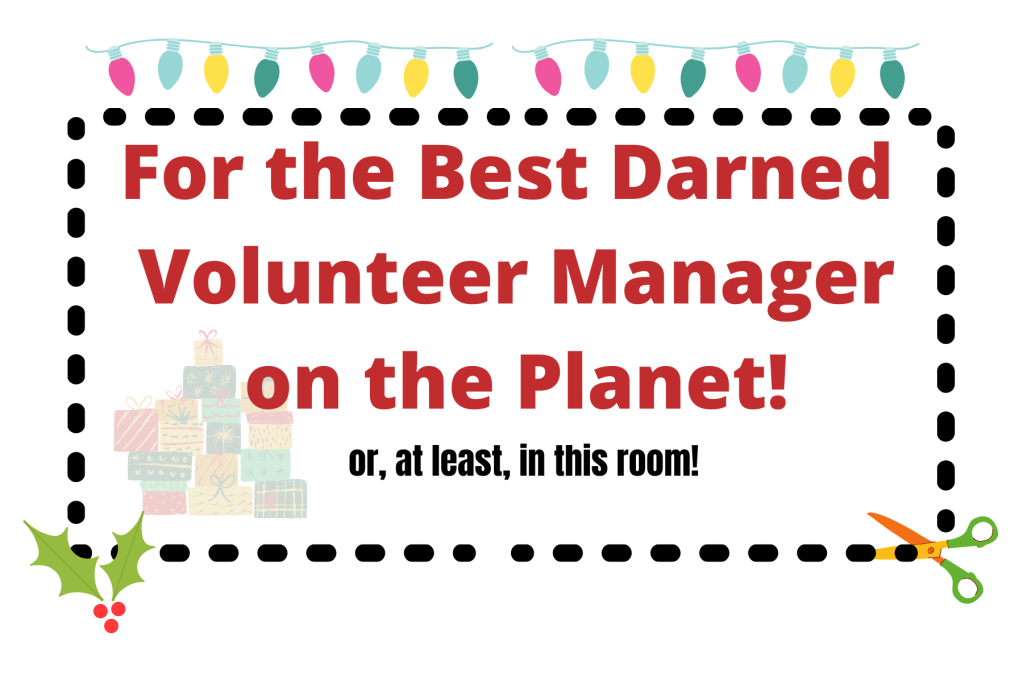
    “What can I get my non-profit staff, especially that mysterious volunteer manager, who seems to run around a lot?”  You, my dear ED or CEO have come to the right place.

    Forget that self help book, “Criticism is Our Way of Showing Our Appreciation.” Forget that subscription to “How to Be a Team Player by Keeping Opinions to Yourself” digest. Never Mind that “Quotes to Make You Humble” of the month club. Forget that framed picture of the senior management team at their annual retreat, ziplining over the 4 star resort.

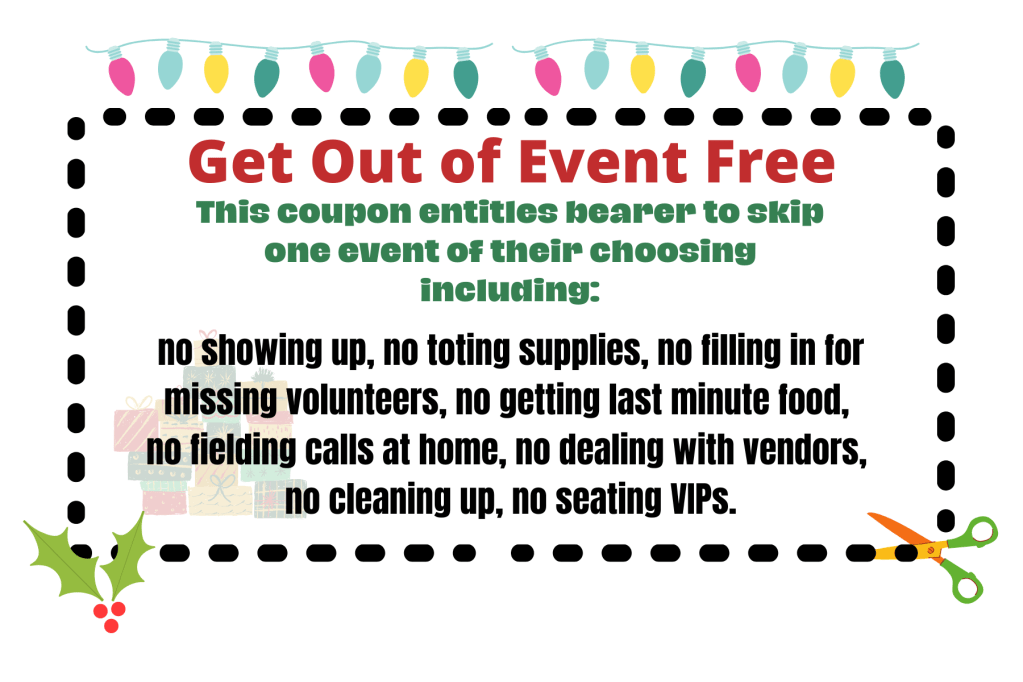
    NO! Give a gift that really resonates with your VM. And, the best part is, it doesn’t cost you a thing, only a sheet of paper, a printer and a pair of scissors.  And, as a bonus, in typical cooperative volunteer manager style, I’ll even throw in the printable voucher! (what a pal I am, right?)

    The Obvious Gift That Every VM Wants:

    Be Careful With This One

    Oh Yes, Your VM Would Love This

    And This, For When Things Normalize a Bit

    Well Executive Directors, there you have it, the top four gift coupons for your volunteer manager. A few moments, a pair of scissors and you are done shopping!

    And, oh, volunteer managers? Feel free to slip these under the door of your executive director.

    Unless you really want another coffee mug that says, “World’s Best Office Worker.” Happy Shopping!

    You’re welcome!

    -Meridian

  • Who Gets to Define Excellence? IVMDAY

    Happy IVMDAY 2021! November 5th is International Volunteer Managers Appreciation Day. The theme this year is “What is Excellence? Pushing Us Beyond the Ordinary.

    What a great question! What is volunteer manager excellence anyway, and more importantly, who gets to define it? Volunteers? Staff? Community? Your neighbor?

    Whose excellence are we seeking?

    Would I, a volunteer manager tell a neurosurgeon (I can’t even spell it, I had to use spell checker) what defines their excellence? Would I dare tell a poet their sonnet lacks emotion or a fireman their gear is improper? Not unless I want to be a fool.

    What is an expert, anyway? According to Dictionary.com, an expert is: a person who has special skill or knowledge in some particular field; specialist; authority, Woah, wait a minute. Authority?

    Authority: the power to determine, adjudicate, or otherwise settle issues or disputes; jurisdiction; the right to control, command, or determine.

    The Power to Determine

    You know where this is going, so I’ll be brief. As experts, we have the power to determine. What we need is the confidence and conviction to wield that power. We need strategies to build programs in this new reality.

    The people who have formerly determined excellence in volunteer engagement and impact (organizational founders, senior management, organizational boards) are not super beings. They are human, just like we are, and as such, can be persuaded, can be convinced, can be appealed to, can be shown. By no means is this easy or simple or done in a day. But with a vision and a strategy to implement the vision, things can change.

    Small wins can lead to bigger wins. It’s nearly impossible to change minds with broad, sweeping concepts. You need specifics and outcomes to back up your vision. Bite-sized wins are more easily digested by those we seek to convince.

    Beyond the Ordinary

    Ordinary to me is this: Accepting the systems we’ve inherited and complaining about them. Yep, did a lot of that in my time. Until I realized I was holding myself back. By taking things personally, I was failing the volunteers and the projects. And the good news? In this chaotic upheaval caused by the pandemic, change is now a norm. We can use change to set forth our vision of excellence. Change = need for new vision = new excellence as defined by you the authority = better outcomes/better value/better benefits.

    Excellence should feel excellent. The thrill of accomplishing something excellent is like nothing else. With that feeling in your heart, be confident, have conviction, be the authority. Let go of the personal frustrations and strategize. Go for small wins and build. Go beyond the ordinary.

    Happy IVMDay 2021 to all you EXPERTS in our field. You have the power to determine. You got this.

    -Meridian

  • Volunteer Time Donor or Time Investor?

    Just revisiting this post about volunteer investors from 2017. Semantics aside, we need to change the deep conceptions/misperceptions surrounding volunteers.

    Why Time “donors”

    Time=Money. We all say it and that’s why we call volunteers “time donors.” They donate their time, skills, expertise, talents etc. But is that what they really are? Donors? Maybe there’s a more descriptive word for our volunteers. And what is the difference between the terms donate and invest anyway?

    donate: to present as a gift, grant, or contribution

    invest: to use, give, or devote (money, time) as for a purpose or to achieve something:

    Hmmmm, there’s a subtle, but profound difference in the two definitions.

    Volunteers don’t just show up, give a few hours and walk away. But outdated thinking categorizes them in this way. Doesn’t it feel like investing is closer to what volunteers do? Maybe we should start to rethink this whole time donor idea.

    Why Investors?

    Let’s take this further and examine investors. Investors invest money, right? But why? Why do they invest money in startups. non-profits, real estate, stock markets and other ventures. To make more money? Or is it more than that?

    Money is a currency. So what do investors really invest? Many things. They invest their future, hoping to be financially secure. They invest their dreams, hoping to achieve a goal. They invest their essence, hoping to give back. They invest their good name, hoping to attach to a cause that is worthy of their currency. They invest employee engagement, hoping to attract great employees. They invest their clout, hoping to further a cause that supports their vision.

    Investors invest so many intangibles, and their currency is money. They don’t give startups or organizations money, they devote their money in order to achieve a goal.

    How would this apply to volunteers?

    If money=currency, then time=currency.

    So if volunteers’ currency is time, then what exactly do they invest?

    They invest all of the above and their humanity(the quality or condition of being human)

    Volunteer managers everywhere instinctively know this. We feel this every day when hearing and observing our volunteers’ intangibles. How do we feel this?

    • by the rewards volunteers tell us they personally feel
    • by their belief in us and our missions
    • by the passion exhibited by volunteers
    • by the camaraderie volunteers forge when bonding with like minded citizens
    • by the commitment volunteers show
    • by the enrichment volunteers gain by volunteering with us
    • by the sense of pride volunteers feel in their work
    • by the support and love they extend to us and other staff
    • by the initiative they take when doing word of mouth marketing in their communities
    • by the care they wrap around strangers in need
    • by the desire they exhibit in wanting us to grow and succeed
    • by the pure joy they infuse into our lives
    • by the amount of time they spend away from us helping us off the clock by recruiting, marketing. finding resources, donating, improving themselves, etc.

    What do we get from these Investors?

    • Additional time spent off the clock
    • Additional resources
    • Free marketing-the best kind, word of mouth
    • Support, both organizationally, and personally for any staff member lucky enough to work with volunteers
    • Information from the outside world-pretty darned important when you exist in a non-profit bubble
    • Expertise-think all the accomplished volunteers who willingly give their expertise to help us
    • Fresh ideas
    • Recruitment of like-minded individuals
    • Learning from all walks of life/education
    • Diversity and the ability to make real diverse change
    • Transparency and the ability to proclaim that transparency
    • A chorus of voices and a wide circle of influence

    Investors, according to experts, want the following things from the areas in which they invest:

    • they want to build a relationship
    • they want to partner
    • they want to invest in a “team”
    • they want to see a better future
    • they want to grow
    • they want to understand concepts

    Sounds an awful lot like the wants of our volunteers, doesn’t it? Calling volunteers “time donors” implies that they give time and walk away and are mostly disconnected from us. Nothing could be further from the truth.

    So, do volunteers donate their time or devote their time if devote implies giving for a purpose? I think devote wins hands down.

    For years and years, we have been trying to equate time donation with money donation. Time and money are simply two different types of currencies. And besides, we all know that volunteers do so much more than give their time to a task. They also raise money, find resources, advocate, broadcast, recruit, and market for us. They have chosen to invest a huge chunk of themselves in our missions. They have chosen to connect to us.

    Let’s stop constantly trying to shove volunteers into the round money hole by equating time spent with dollars saved, which isn’t a true measuring stick at all. Let’s erase the idea that volunteers have no more connection with us than a few hours here and there.

    time donors=minimal involvement

    volunteer investors=fully engaged

    Instead, let’s elevate the volunteers’ role as investors. Investors who devote their time, money, skills, talents, resources, passion, commitment, expertise, experience, knowledge, drive, zeal, perspective, and so much more to helping us further our causes.

    Investors.

    What could be more important than that?

    -Meridian

    originally appeared September 2017 here

  • Lies and well, more lies

    I think we, leaders of volunteers hold ourselves to this inner higher standard. Not that we think we’re better or more noble, but because we believe the volunteers and our missions deserve a steward who believes in higher purposes. But sometimes, well…

    So, there’s senior managers and then there’s favored senior managers, right? Maybe they’re legacy managers because they’ve been around so long and they’re like pets now, or maybe they tell the CEO exactly what needs to be heard, like “no one gets how brilliant you are, but me.”

    I recall one favored senior manager (FSM) had some questionable taste in decorating. (not my words, but pretty much everyone else’s). She loved to decorate our main care center. (Actually everyone did, can you say teal and mauve explosion?) One day, some pretty influential donors were coming for a tour and my boss asked if the volunteers (which was me, really) to tidy up the front lobby. I went the extra mile and did the communal bathroom too. Someone had placed this hideous arrangement of faded silk flowers on the sink, so I took them out and tossed them in the dumpster.

    Not more than 20 minutes later, the FSM burst into my office asking where the flower arrangement in the bathroom went. “Did the volunteers disturb it?” Uh oh. Turns out these pale flowers were given to her by her dear, late mother and they meant the world to her. (why she didn’t keep them at home, but rather, subjected the rest of us to them, who knewwait, they had a teal container, oh, now I get it ). Mouth hanging open, I stuttered, “I’ll take a look, maybe the volunteers are washing them, you know to make a good impression on the donors.”

    That seemed to satisfy her. So, I bolted out the back door and crawled into the dumpster while staff went by, watching me throwing garbage around, but I managed to find the arrangement under a load of lunch leftovers. I went back inside and washed the flowers, loaded with spaghetti sauce in the sink, scrubbing the sauce away. (yeah, white flowers were now pinkishwas that mauve I was seeing?) I put the arrangement back into the bathroom and hurried off to find the FSM. “That’s what happened,” I said, breathless, as she got up to go meet the arriving donors. “The volunteers wanted everything to look wonderful, so they washed the arrangement.”

    Satisfied, she waved me off. I went back to work, breathing a sigh of relief. However, an hour later, the FSM was in my office again. “While I appreciate the volunteers washing my arrangement, one flower is missing. Do you know where it is?”

    Yes, I knew. It was in the dumpster. “Ahhh, I think they said it broke when they washed it.” I lied. “They said they were really, really sorry because it is just so beautiful.”

    “Well, next time, have them ask before they touch the decorations.” She turned. “The volunteers are well meaning, but sometimes they think they know better than the actual people who work here.”

    I stared at her for a long moment, a tick on my eyelid pulsing. “You know, you are so right. I just hate it when they think they know more than us.”

    So, this is my formal apology. Uh, sorry volunteers, I threw you all under the bus.

    -Meridian

  • Are You a Steel Trap, A Sieve or A Spigot?

    Working for a nonprofit, I quickly learned that unless stuff was written in a memo, information was pretty much filtered through the staff person or volunteer sharing it. I also learned the hard way, whom I could trust and who blabbed upon leaving my office. I actually identified 734 different types of info spreaders, which I compiled into a book entitled “The Industrial Psychology of Spreading Information:” but since I am not a clinical psychologist, the book was widely rejected. Anyway, we’ll only look at the top 5. Which ones do you recognize?

    The Sieve

    The Sieve leaks information in a nice way, to share good news, etc. but they are often misguided. The Sieve is a good person and when the sieve hears someone being maligned, they will step in with any information entrusted to them to “help that person out.”

    Sieve Example:

    Staff person: “Volunteer Doris was 30 minutes late again. Is she really reliable?”

    Sieve: “Well, did you know that Doris is late sometimes because she takes in stray cats. She has like 136 cats in her home that she has to take care of, so she’s kinda busy with fighting the city, because they’ve condemned her home, so let’s give Doris a break, OK? Oh, and you might want to take some allergy medication with you when you work with Doris.”

    The Spigot

    The tap is always on with the spigot. They broadcast everything to everyone because they….wait, honestly, I don’t know why they do it. But they are always lurking, ready to share, so never, ever tell them in a moment of weakness that you wear Groot jammies to bed.

    Spigot Example:

    Volunteer Manager (noticing a staff member still at their desk): “Hey, c’mon, there’s a fire in the microwave in the breakroom, so let’s go, we gotta exit the building.”

    Spigot: (getting up) “I’ll bet it was Betta; she’s burned 4 microwave popcorn packs this month. Did you know she has this weird idea that eating popcorn makes you concentrate more?” (Volunteer manager grabs spigot’s arms, yanks them to the door) “Speaking of fire, did you know that Monty in accounting’s son is serving time for arson?”

    The Mold Maker

    With the mold maker, information goes in raw, comes out according to how the mold maker perceived it. Remember the old kids’ game telephone where you would whisper a message in the ear of the kid next to you and by the time it got to the end it was mangled? The mold maker perceives everything according to their world view or whether they’re constipated, I’m not sure which.

    Mold Maker Example:

    Volunteer Manager: “I’ll set up a meeting with our finance director to discuss that new program. Right now I believe he’s in a meeting.”

    Mold Maker Volunteer: “Oh, yes, the poor finance director; he’s probably talking to his divorce lawyer. I heard from Janey in records that he was going through a nasty divorce. You know,(Mold Maker Volunteer whispering) his wife left him because he works too much, stays here so late. Let that be a lesson to you. You shouldn’t work so much, tsk, tsk.”

    The Shredder

    The Shredder massacres the message because the shredder does not listen well, or at all, so you can never, ever expect the message to arrive in the same condition you sent it.

    Shredder Example:

    Volunteer Manager: “Look, this is extremely important. Please tell the CEO that the volunteers are willing to dress up as wait staff and serve at that black-tie donor event, but they would need gas money reimbursement to drive the 87 miles to the country club at Lake Hilda.”

    Shredder to CEO: “Yeah, Madame CEO, the volunteer manager said something about the volunteers wanting you to serve them Thai food at the banquet. Oh, and they’re afraid of falling into an 80 foot deep lake and for some reason, they think your name is Hilda.” (shrugs). “Volunteers, jeesh, they’re a funny bunch, right?”

    The Steel Trap

    For a Steel trap, everything in, nothing out. I tried to be a steel trap at work. I always viewed information shared in confidence as akin to a possession. That info is not mine. It’s belongs to the person sharing. If I spread it, I’ve stolen it.

    And here’s the thing about being a steel trap-you get to hear all kinds of helpful stuff. When you’re a trusted source, people will seek you out, because sometimes, they just gotta share, right? So, you hear things like “there’s going to be a huge change to policy, no one knows it yet.” Or you might hear something that is a key to someone’s motivation. Or that there’s a backlog in finance or marketing is fighting with one another. Since we, LoVols are typically info junkies, there’s quite the upside to being a steel trap.

    Steel Trap Example

    Staff Member: “Hey, Lazo talks to you all the time. What’s going on with him leaving for an hour at lunch?”

    Steel Trap: “That’s Lazo’s business. Go ask him.”

    Or:

    Volunteer: “What’s going on with volunteer Jemma? I heard she’s sick.”

    Steel Trap: “Thanks for your concern. What Jemma shared with me is confidential. I’m sure if you shared confidential information with me, you would expect me to respect your wishes.”

    Information is a valuable commodity. For us, volunteer engagement professionals, knowing the filter in which you hear information can save a lot of time and trouble. And being a trusted steel trap can just be your ticket to hearing all the stuff that gives you a leadership edge.

    Happy Listening!

    -Meridian

  • If You Love What You Do, It’s Not Work…Wait, Really?

    Photo courtesy of Gratisography

    There’s a quote out there I hear all the time, attributed to different sources that basically says, “if you love what you do, it’s not work.”

    Sigh. I’ve always detested that saying/quote.

    Clearly, whoever said this, never followed a leader of volunteers around for a day.

    What we do, what YOU do, is hard, hard work. It’s not easy. It’s not fun a lot of the time, like when a haughty senior manager sniffs at the notion that volunteers are capable of running a program. It’s not predictable, or easily explained or rote. It’s a constant “all hands on deck” mental and often physical challenge. It’s WORK.

    And heck, it never stops, because when you’re not “there,” you are thinking about it, planning, worrying about a volunteer, or creating new engagement strategies in your head. It occupies the spaces in our brains, nagging at us to “work harder.” Especially now, since we’re in a pivotal time of change, so more work is required to navigate the shifting landscape.

    And when well-meaning staff or friends giggle about how we get to plan parties and chat all day, we stoically smile and politely try to explain all the various skills it takes to engage volunteers, determine impact, create a sustainable volunteer team, mitigate conflict and everything else while they look off into the distance, their eyes glazing over. And frustrated again, we go on.

    Steve Jobs once said, “You’ve got to find what you love.”

    For us, Love is backwards

    Most of us didn’t seek out volunteer management because we loved it, but stumbled into volunteer management and fell in love with the work. Like a slow-burning romance, we discovered how much it filled us with joy, how much we thought about our new passion, late at night; how much we enjoyed the challenges and envisioned ourselves, holding hands with volunteer engagement as we aged.

    For us, Leadership is seldom a title

    “Leadership is not a title,” according to Vijay Eswaran. You can read his inspiring post here .

    Leading volunteers will probably not become the most coveted job in the world in my lifetime. I’m ok with that. But much progress is being made and that’s where true leadership comes in, because Volunteer Engagement is probably not going to “go viral” anytime soon. True leadership is the day-to-day hard work you do. It’s the passion you feel, the challenges you accept, the example you set, and the belief you have in yourself and your peers that what you love is essential in making our world a better place.

    Leadership is going beyond, by educating yourself, attending conferences, helping your peers, sharing best practices, crafting reports that show volunteer value, demonstrating volunteer value and impact whenever and wherever you are. It’s furthering our profession by caring about it, with all its warts and stinky body odor.

    So, do I agree with the saying, “It’s not work if you love it?” Nope, nope, never. Maybe try this: “It’s a lot of work, because you love it.”

    -Meridian