
 It is painful to hear the words. “I don’t recognize my organization anymore.” Dillon is not a volunteer manager, but he works for a major hospice in a huge metropolitan area. As a social worker, he has direct contact with volunteers and is a champion of volunteer involvement. As he said over the phone, “I love communicating with the volunteers and each patient I see, I’m always trying to figure out how volunteers can be of benefit to them.” Dillon has worked in the industry for 25 years, most of it in hospice. He settled into this current job about 10 years ago. “I loved that the manager that hired me asked me how I felt about working with volunteers. I realized that this was an organization that truly cared about their patients and their volunteers. I was all in!”
But Dillon’s organization underwent some major changes four years ago. A new CEO, new marketing team, restructuring of disciplines and new logos and slogans all shook up the norm. “The perspective changed,” he mused, “and as competition heated up, I saw my organization shift dramatically, away from patient care to marketing and capturing demographics. It’s a business now and frankly I didn’t sign up to be a businessman.”
Dillon sighed. “And now, trying to get a volunteer is much harder. The volunteers are being asked to do things like find speaking engagements, set up health fair after health fair. And any volunteer that can sing or play an instrument? Forget it, they are being asked to perform. It’s all about the public seeing what the volunteers do rather than the volunteers actually doing it! It’s like we are advertising who we used to be, not who we are now, because who we are now is something I don’t recognize anymore.”
I could hear the chattering of staff in the background as Dillon continued. “I’m not saying that we don’t need marketing or we don’t need to compete. I’m saying that this shift is doing damage to the volunteer department. I already hear the rumblings of the volunteer staff as they stretch their volunteers more and more. On one hand, I need a volunteer to play the harp for my patients. On the other hand, they need that same volunteer to play the harp at a nursing home function. There’s only so much a volunteer will do. And I see the anxiety of the volunteer coordinators. They know which job is the right one for the volunteer, but when they continually say no to marketing, they are perceived as negative or uncooperative. They are in a no win situation here. The only thing they can do is recruit more advertising volunteers, but seriously, how many volunteers are out there wanting to do that?”
Dillon paused. “This puts me in a terrible position. I don’t want to ask for a volunteer because I know what stress the department is under. So, my patient suffers. At least though, the patient doesn’t know what he is missing. But I do. I talk to the coordinators frequently and some are new but the ones who have been here with me this long, they are sick about how their jobs are changing. Every time they try to explain why volunteers might not want to call bingo for a nursing home with no hospice patients in it, they get labeled as negative and uncooperative. Instead of listening to their coordinators, management listens to marketers, who have no idea how to work with volunteers. I’m seriously thinking about retiring and the sad part is, I think management would be happy to see me go.”
I asked him why he would think that and Dillon added wistfully, “one of the nurses who has been here longer than I have told me the other day that she thinks they want to get rid of everyone who has been here for a while. Not because of money or age, but because we know how it was in the old days and we are constant reminders that we are not that organization anymore.”
After we hung up, I felt an incredible sadness. I know that organizations need to morph to survive. But one has to wonder; once all the heart and soul has morphed out, then what exactly is left?
-Meridian
Tag: volunteer manager
-
The Organization of Dorian Gray
-
Of Course I Remember You, Mr. Uh…
 Yes, I can blame getting older or I can blame having too much in my head or I can blame Earth’s shifting magnetic poles. But it doesn’t matter because I have to face the reality. I can’t remember every name, every conversation and frankly, every thing I was supposed to check up on. Gobs of information filter in and then just fall out. Sometimes I feel like an old junk wagon rolling down the road, stuff flying off the top and into the street because it was never properly tied down.
That’s the nature of volunteer management to me. We are like trucks and we have so much piled in the beds that no matter how we rearrange and organize, we can’t ever quite get it all sorted out unless we stay in our garages. I know when I leave my desk, I have people stop me everywhere to ask a question, tell me an important tidbit, invite me to a meeting, request a favor, pass on a message and so on. When you forget why you left your desk two minutes after leaving it, that’s volunteer management.
But stubborn pride tells me on many occasion not to let on that I did not remember the fact that you asked me to check on your name badge yesterday or that you introduced me to your grandchild last year when she was visiting. “My, how she’s grown!” And changed a whole bunch, I might add.
So, here’s a conversation I had recently with a volunteer I haven’t seen for two years.
“Hi Rita, er, Freda! So nice to see you again! We missed you. Welcome back, its been what, four, no two, yes, right, two years already. My it seems longer! How’s your son, George, oh…, right, Craig and his family? Really, that’s great! And your granddaughter… no grandson, is he good? Doing well in school… no right he’s only three, wow, sure, and your husband Sidney? Oh, Rod, right, how’s Rod? Excellent. Are you feeling better… no wait, no you were not sick, right, you moved, yes, I remember now, was it cold in Canada …no, right, Bermuda. Not cold there, huh, ha ha! Well, we have your job visiting nursing home patients… what’s that, no you never did that right! But you wanted to… no, you wanted to do office work. Well we have many jobs here for you and would love for you to come back. Are you still living on the river…or, yes, the golf course, right, it’s River Crest, no, right Spruce View, nice place, I’ve always loved their clubhouse, they have the restaurant where you cook your own steaks, no, no it’s a breakfast place, right, love it. Well, miss you, you’ve always been a great volunteer and would love you back!”
Yes, I can’t admit I don’t remember. I do, however remember running into a volunteer one time in the hall when I ventured from my desk and she asked me, “So, did you find anything out regarding our conversation last week?”
I remember staring at her as if she had landed from Neptune. My brain froze. I thought, did we have a conversation about something? Was I in it? I know that I know you because your face is very familiar, but if my life hung in the balance, I have NO idea what we talked about. So pride of course stepped in and I hedged. “Well, now, I’m glad you brought that up, I was just thinking about it. As a matter of fact, I thought about it a lot and was wondering if you thought more about it too. Uh huh, yes, well, since we’ve both been thinking about it, tell me your thoughts on it now.”
Ok, I got really lucky and her response jogged my memory, or should I say reached into the bed of the truck and pulled out the item underneath the pile. Of course I hadn’t done anything about what we had talked about in the hallway last week. I had forgotten 30 minutes later.
I can carry a notepad or a smart phone and most of the time I write on my hand. I have post its on my desk, two calendars, and multiple pads and binders of projects in varying stages of design.
I think of the adage, if we could put a man on the moon…, but that’s not it. If we could design a truck with a huge, huge bed and all these little gnomes inside who would organize things as we drove down the road, then yes, I could get a handle on remembering things.
Until then, I’ll sneak a peek at your name tag or ask a co-worker to discreetly go up and ask who you are and report back, or cough as I say your name, or hide behind the laxatives at the drugstore to avoid the embarrassment of not knowing you.
Or maybe I’ll just have to admit I can’t remember. Nah.
-Meridian -
We Should Have a Day of Our Own
 I was just thinking that with all the upcoming holidays, you know, we volunteer managers should have a day of recognition. It could be called “National Volunteer Manager Day of Recognition”. Or maybe “Day of Multitasking with Unpaid Help While Being Grossly Underpaid” or perhaps “Thanks to Those Who Herd Cats Day.” But then a little tiny flash of remembering hit me. It was sort of a dull toothache kind of a brain pain. There already is a day for us. November 5th is “International Volunteer Manager Appreciation Day. IV Mad. IV MAD, really? Now why did I forget that, I wonder?
Was it in effect last year? Yep, according to the website, http://volunteermanagersday.org/, we had a day last year and the year before.So, why did I forget that? I mean I forget things like paying my bills or where I left my footed pajamas. I might have just banished it from my memory like the night that pimply Dave stood me up for the homecoming dance. Shudder, I can’t hear “Wooly Bully” without tearing up but that’s another conversation.
I decided to sit down and try to recall last year’s IVMAD. What I remember is something like this.
I got up that day and immediately started thinking about what to wear. I wondered, should I be understated so that I could act surprised when everyone came to thank me? I’d just look up from behind the pile on my overloaded desk and gush, “Oh my, I’m just doing my job, but thank you everyone so much you’re making me blush.” Or should I dress up, look my very best and be the consummate professional? Be all aloof and corporate and well, above lowly celebrations? How patrician. I decided to wear my best dress, the one that zips all the way up. Id have to skip lunch but it would be worth it. Maybe I’d put on some power high heels. I’d have to sit down for most of the day, because the last time I had to dress up, I fell while getting into the elevator and knocked over a cart full of files.
On the way to work, I practiced my responses to all the praise I was about to receive. I certainly wanted to be gracious, but amusing so that everyone would later talk about how clever I was. I decided on a simple “thank you, this is my dream job. And believe me, I dream about it every night.” Ha Ha, I was thrilled with my cleverness. I could almost hear them talking about me. “She looks so fresh for being as overworked as she is.” “She’s so clever and droll, I’m always uplifted when I see her.” “My, I wish I had her enthusiastic spirit and did you see those fabulous shoes?”
When I arrived, I discreetly backed my car up to the side door so that it would be convenient to haul out all the flowers and balloons after work. There would probably be left over cake too.
I walked in, confident that it would be a wonderful day. Even though there were no balloons with WE LOVE YOU and all the staff yelling “Surprise” to greet me, I did not despair. They were all probably still out picking up my gifts, trying to decide whether to get red or pink balloons. As I sat down and got to work, I knew that my organization and system would come through. Why wouldn’t they? I thought back over the year to all the recognition days we celebrated so that everyone had at least one day to feel appreciated.
We had an ice cream social for Administrative Professionals Day in April. I made sure I told one of the secretaries that I loved the artistic way she made spreadsheets.
We had a pot luck for Pride in Food Service Week in February. I brought some Dunkin Donuts.
For National Nurses Appreciation Week we had a big party complete with catered food. I wore white that day.
And during National Social Workers Month there were coffee and muffins every morning for a week. I tried to not act too crazy around the counselors.
I loved National Nursing Assistants Week in June because we ate all week and most of them are really nice.
I especially like Payroll Appreciation Week in September. You can’t be too nice to the payroll people.
There’s even crabby coworker day (Oct 27)which is so much fun until you come back from lunch and find some dead flowers on your desk. “Hey whoever put them there, I’m not crabby, I’m just stressed out!”
The day wore on, my feet hurt and I was tired of holding my stomach in. I watched the door for the balloons or cake or dancing clowns, but finally a co-worker came in and said,”hey, tell your volunteers thanks from me.”
Like I said, we should have a day of our own. Maybe it could be called, “Hey, for once, just throw me a bone day”
But, maybe this year will be different. I’m not going to dress up, but will practice a surprised look. Actually, good news, I won’t have to practice that!
Have a happy International Volunteer Manager Appreciation Day everyone!
-Meridian -
The $100 Tip
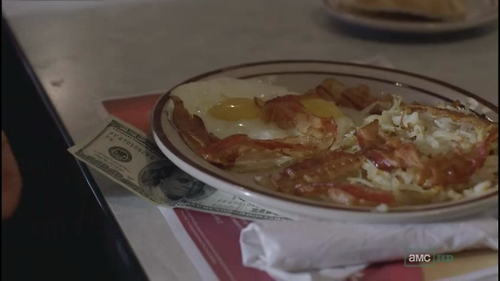
 A friend of mine who is going to school and waitressing on the side messaged me a picture of an $89 food tab with a $100 tip written in. I asked her what she did differently to garner such a lavish reward and she said, “Nothing really, I just did my job.” As we talked, laughingly speculating whether it was a mistake, a “bucket list” checked off, a stalker and other hosts of wildly imaginative scenarios, we finally left it at “one of those special out of nowhere moments that cannot be explained, not fully. It’s the sun peeking out of the clouds, glorious and full, the five dollars you find in your pocket when you’re talking yourself out of that latte, and man who chases you down after you’ve dropped your new phone.
It got me to thinking. Volunteer managers work tirelessly, mainly without praise. We can empathize with the mom who drags herself out of bed at 5 each morning to drive her son to hockey practice, then puts in a full day of work. The Stanley Cup will go to him as she stands, far back in the crowd, her tears borne from sleepless dreams.
But then, there’s the $100 tip. It comes when you least expect it, but need it most. A volunteer wins an award and someone thanks you for mentoring that volunteer. A project that took you years to finally iron out takes off and someone claps you on the back. You’re at a general assembly and something you initiated years ago is highlighted and the speaker finds you in the crowd and says, “you started that way back, didn’t you?”
Or, a volunteer phones you to tell you that he broke through to a client that everyone wanted to help but couldn’t seem to find the right phrase or the perfect moment.
Why does that moment show up when we’ve just told ourselves that we could make more money with less work selling jewelry? Why does it seem to know exactly what we need when we need it? And how often do we need it?
I’m always struck by how volunteer managers are not driven by praise or someone else’s definition of accomplishment. It seems our measure of success lies internally from the instinctive knowledge that accompanies each and every volunteer assignment. Although “big” accomplishments are nice, we revel in the day to day small accomplishments of each and every volunteer. It’s like standing on a bluff and looking at the beauty of the forest below. It takes each tree to create the breathtaking scene.
This doesn’t mean that I don’t like getting an unexpected tip now and again. Nope, I love it, and frankly need it as much as the next person. But I also have to realize that I’m not working for $100 tips. I’m working because I know that the forest of things volunteers accomplish mean a lot to the people they are helping. It’s not flashy nor opulent. But then, neither are my expectations.
-Meridian -
The Mulligan Volunteer
 If a Mulligan is a “freebie”, then Phil is my Mulligan volunteer. All right, I actually have more than one, so don’t tell anyone. I keep Phil on the active volunteer list even though he hasn’t done any volunteering for ten years. Yeah, he’s active only in my mind. Why do I hold on to him?
Well, let me tell you about Phil. I have known Phil now for oh, about 17 years. He came to volunteer when I was just an idealistic blob of volunteer coordinator tissue to be molded by good old-fashioned experience and opinionated volunteers. I was hopeful, scared and curious all at the same time. But I digress.
When I first met Phil, he was an old pro at volunteering. A retired executive, Phil had smarts, energy and that electric smile. I leaned on Phil a bunch. He took difficult cases. He made me laugh and learn. He once drove 30 miles to bail me out on an assignment. I never, once, heard a negative breath come out of that man. Inspirational? I’ll put him up against Gandhi in the Inspiration Olympics. Caring? Let him get in the Care ring with Mother Teresa, cause she better look out for his right hook. Willing? Well, you get the idea.
Phil has been getting older. He’s had to pare down his volunteering activities to about seven. No kidding, that’s how much he does. And, as he weighs what he can do, it all boils down to convenience. At his age, that’s a huge consideration. So, the fact that he can’t really help us out anymore is no reflection on our mission or treatment of him. This, I understand.
But let me tell you the real reason I keep him on the active list. Phil takes in homeless people. Yep, takes him into his home to live. Homeless vets, homeless families, he quietly takes them in to let them get back on their feet. His friends (and even some of our volunteers) have warned him that he could be inviting trouble, but Phil just shrugs. “Someone has to help.”
How do you measure a man like that? I’m always astounded at how Phil lives his life. He’s not going to be featured on any news show. He wouldn’t want it anyway. He’s not going to be elected Mayor of his town. He’d hate that. He lives his life by serving. I was just lucky to have him cross my path for a while. He’ll always be “active” to me.
I think we all need our Mulligan volunteers. In my organization, we have emeritus volunteers. These are volunteers who can’t help anymore, but they are invited to every function we have. They’ve earned it. Phil earned it the first week he volunteered. I think of so many of them, who give their all and when they can’t anymore, have to bow out. For the sake of my own soul, I cannot let them fade away. They love to teach others, speak to orientations, mentor newbies, write policy and mainly just chat. Although the chatting part takes a lot of precious time, after a conversation with one of them, I always end up feeling like I’m home. And because I’ve been doing this so long, I fear that no one else will remember. I sense these valuable volunteers slipping away like forgotten stories never written down.
I think of all the phone calls I need to make and it’s overwhelming. But I have to find the time and energy. If Phil can open his home to homeless strangers, I can certainly open my heart to emeritus volunteers. They are a as much a part of volunteering as the fresh face. I can’t let them feel anything but honored and never forgotten.
And though I won’t get any productivity out of the time spent reconnecting with emeritus volunteers, I know it is the right thing to do. And how much of our jobs is about doing the right thing?
I think I’ll start with Phil.
-Meridian -
Go Ahead, Be Brutal
 No, I’m not masochistic. Not even close. My little world is filled with kittens and marshmallows shaped like flowers and moonbeams streaming through the forest. (after all, why else would I be in this job?) But, I also don’t want volunteers to lead me on. You know, tell me that I’m wonderful, that you want to spend time with me, buy me flowers… (oh wait, that’s a different conversation, oops).
But in volunteer management, I court the volunteer, right? I woo them with tales of how wonderful it will be, I walk beside them, listen, adjust, mentor, guide, run interference, and heck, put a bunch of time in, making sure volunteering will work for individual rewards. After all, it’s what volunteers want, right?
So, here, I think is my biggest frustration. I’m thinking of Yancey who had/has such potential. She is young and vibrant and full of compassion. She paid strict attention in training, and bright eyed, couldn’t wait to start. She was mentored by seasoned volunteers, and is truly magical with patients. She writes comprehensive reports. She passed every background test. She is perfect. Well, was. That is, until she just stopped.At first, I assigned Yancey to a volunteer friendly nursing home. Both of the two current volunteers were leaving, but for different reasons. They had built a great relationship with the nursing home staff and together, they introduced Yancey to the patients and the employees. It seemed like a good fit. Yancey was excited. I called her frequently, answered any questions and assumed things were working out.
Two months later, she stopped sending in reports. She did not return my calls, nor did she answer emails. Then an email I sent bounced back at me. Still no word. I checked with the facility and they had not seen her in weeks. I finally, reluctantly removed her name from our list and started searching for another volunteer to take her place.
Was I mad at her for not wanting to volunteer anymore? No. This is, after all, volunteering. Would I judge her for her reason to stop? Absolutely not. If volunteering isn’t adding to someone’s life, they shouldn’t be doing it. Did her stopping ruin my life? C’mon.
But, do I wonder what happened? Would I rather hear the reason even if it means finding out I failed her somehow? Absolutely. How else can I correct a situation or behavior if I don’t know about it? I suspect that Yancey couldn’t fit volunteering into her busy lifestyle, or more accurately, volunteering with those patients wasn’t rewarding enough to fit into her busy lifestyle.I could have told her that this is not my first experience. I’m used to volunteers leaving for so many different reasons. At least for some, I know why. That helps. For others, they float away like an unfinished manuscript dropped in a river. If only….
I may pen her a letter but I truly wish I could have spoken to her and offered her something else or a more flexible schedule. It may have worked. But if not, at least I could have assured her that she was welcome back at any time in the future. I could have told her that she was a good volunteer and that she needn’t be embarrassed about quitting. I suspect that may be the case.
But I don’t know. I wish I did.
-Meridian -
What Do Our Desks Say About Us?
 One of the steady stream of little articles that I just got via my work email (you know all the “stuff” you get, especially from volunteers-old age funnies, dog pictures, IQ tests, heartwarming stories, riddles, cartoons, even the occasional inappropriate joke) was an article on desks. What does your desk say about you? Hmmmmmm. Messy? Maybe you’re too disorganized. Inspirational quotes? Maybe you’re a bit neurotic. Personal odd objects? Maybe you’re a kook. Occasional protein bar wrappers? Maybe you’re a slob. Old mismatched furniture? Maybe you don’t care.
Now here’s the best part. Any of the above can keep you from being taken seriously and being promoted.
Well.
If you were to look at my desk, right now, here’s what you would see:
Two nice chairs for volunteers to sit down on. My chair is ripped. Clutters of papers everywhere. I’m working on all of them and will get to them sometime today, I hope. A few inspirational sayings in frames. For the volunteers of course. Several open calendars. Each one is color coded for different areas and projects. Post it notes in purple. The purple ones were on sale. A really old phone. I’m used to it and it has several lines, picking capabilities and sometimes the speaker phone works. My desktop. Not bad, really. My business cards on a funky doggie card holder given to me by a volunteer. They are at the corner because I knock them over constantly.
Under my desk is: My laptop (Trying to get a newer version). My camera (it actually is now stuck on playback, mainly because it has been dropped multiple times, so I pretty much use my I phone for pictures). A manual for volunteer orientation (I’m constantly scribbling in it as I want to “update” orientation so that it is fresh). A tote bag with pens, papers, brochures, business cards (for that last-minute invite). A pile of papers that don’t fit on the desk (seriously, desks are not big enough). An old, old Rolodex (do you even know what that is?-ok, it’s sentimental, left over from no data base days).
Now, as you scan all this, you may notice on or about the desk and walls:
a small worry doll from Nicaragua, a gift from a volunteer who thinks I worry too much
a dusty dolphin screen saver, a gift from a volunteer who loves anything sea related
a tiny carved coconut monkey, a gift from a patient who carved-he was one of my favorites
a Gemini key chain, a gift from a volunteer whose wife shared my birthday
a watercolor of a… well, I’m not sure what it is but it was a gift from a volunteer’s daughter who loves to paint
a trio of small glass elephants from a volunteer who thinks I forget too many things
a hand painted rock paper weight from a volunteer-flowers adorn one side, on the flip side is a finger flipping me off-our joke
a mug that says, “I survived volunteering”-inside joke from a volunteer
a beautiful inlaid box from India-gift from a volunteer from India who was incredibly inspirational
a picture of a Cocker Spaniel-a volunteer’s beloved dog that died
a “soul saver” pack-a joke gift from my stand-up comedian volunteer-it’s guaranteed to save my soul she says
a Murano glass paperweight from Italy, a gift from a world traveling volunteer-I live vicariously through him a lot
an engraved shell casing from a, well I’m not sure which rifle -a gift from a veterans group who is now volunteering
a USB aromatherapy plug-in, guaranteed to make you calm-gift from an office volunteer-is she trying to say something?If you look into my top desk drawer you will find all the items from volunteers who have died or left, some office supplies, my favorite stapler (the kind that looks like pruning shears). Maybe I’m an office hoarder, I don’t know. And maybe that volunteer sent me that article because he was trying to tell me something. And maybe, yes, I’m a bit neurotic (hey, I’ve got lots on my mind), a tad kooky (Ok, so I sometimes just burst into maniacal laughter), and a great deal disorganized (hey, I can find that form for changing a volunteer’s address-just give me a minute).
Well, maybe I’ll not get that promotion or be looked at as someone going places. Maybe my work space looks like I’m not trying. Or maybe, just maybe, it looks like the daily workload of a volunteer manager.
-Meridian -
Excalibur, the Makin It Look Easy Sword
 Those words, “make it look easy.” Are they a compliment, or a curse? In the dictionary of English phrases, is there a picture of a volunteer manager next to the phrase, ” but you make it look easy”? How do you respond to that-a smile, a shrug, a muttered, “gee that’s what I’ve always wanted to hear?” Is making it look easy a lethal double-edged sword? How do you wield such a mighty weapon?
Rhonda is a volunteer coordinator whose organization went through some major revamping and as they looked for ways to cut costs, they called in a professional consultant. This consultant combed through the status quo, looking at each aspect of the organization’s ability to do more with less. When the consultant, Eric, spent a four hour stint with Rhonda, he shook his head. “I can’t believe you do all this in these conditions,” he said. “you really make it look easy from the notes I’ve been given.”
His notes consisted of statistics about the volunteer department. Rhonda supervizes 118 volunteers, who pretty much run a thrift store six days a week. The volunteers also sit at fairs, stuff envelopes, fill in for a lunching receptionist, file reports and make calls. Rhonda’s phone rings non-stop. Volunteers filter in and out of her office and she pretty much oversees them all. Rhonda sometimes fills in for volunteers when they call out sick. She is swamped. After four hours, Eric told her that she was one of the busiest staff members in her organization. “But,” he mused, “no one knows how hard you work.”
Rhonda did not know how to respond. Frankly, she was too overwhelmed to spend much time thinking about how to use her double edged sword.Although Rhonda would like more help, she struggles with how to present her challenges. “Do I talk about the difficulties? Will I harm the image of the volunteers if I honestly speak about those that are a challenge? If I complain, will they just do away with volunteers all together? Do I just burn myself out and let the next volunteer coordinator figure it out?”
As volunteer managers work hard behind the scenes and let the praise go to the volunteers, do we not cut ourselves on the back swing with our mighty sword? By making it look so easy, what are we doing to our profession? Are we contributing to the perception that managing volunteers is no more than hosting tea parties and chatting with willing participants?
Rhonda is too tired to do much about her situation. I suspect she is not alone. Hard, hard work can lead to exhaustion and eventually burn-out. Our jobs are rewarding, complex and difficult. We should not be afraid to admit this.
Otherwise, our arms will be too tired to lift that hulking double edged sword.
-Meridian -
Well, This is How it is…
 So I was trying to explain my job recently to a female executive at a chamber dinner. She was sincerely curious as to what volunteer managers really do. As you know, our jobs can’t be explained in a couple of sentences; not really well, anyway. I started off badly, talking about numbers and demographics and motivations. My new friend looked at me blankly. Because I was losing ground fast, I tried talking about motivations and demographics and return on investment. After all, she lived in that world, right? She did want to understand and I am normally not tongue-tied, but here I was, stumbling over theory, slicing my job with a clinician’s knife. It sounded so meaningless and I pictured a trained monkey pointing at a chalkboard. “Oooo oooo aaahh aaahh, volunteer number one, volunteer number two.”
As she shifted position, I felt myself start to let go of the stats and graphs and the desire to impress and I said, “you know, let me tell you a story.” She leaned forward as I thought of a current volunteer I have the pleasure of working with right now.
“There’s this volunteer, Sharon,” I relaxed. “She was in a group that I spoke to a couple of years ago. At the time, her husband was critically ill, so she could not volunteer, but she kept one of our brochures in her desk drawer. About a year and a half after her husband died, she was just starting to think about what she could do that held some meaning for her and she happened to look for an old photo album in her desk when she came upon our brochure. Sharon turned that pamphlet over in her hand and felt that was a sign so, brochure in hand, she decided to come and see me. She was hesitant, closed up really. Her words were so heavy that they bent her over as she told me about losing her husband. I wondered if she was ready to do the work, but she was already one thought ahead and she wondered aloud if she could work with terminally ill people, but she had to at least try. As I gently explained that my first priority was to the patients, she looked down and said that she would not put her grief on them. Her painful sincerity made me want to give her a chance.
Sharon came to training. She sat in the back, said little, but did participate in group exercises. She seemed embarrassed at times, a bit reserved or maybe just wounded. After training I put her with a no-nonsense volunteer who promised to keep an eye on the ‘newbie.’ Sharon started to visit patients in a care center setting, never alone, always with another volunteer.
She spent many an hour in my worn chair by my desk, talking about what she observed, what she felt and what she couldn’t bring herself to do. It was always apologetic with a nervous tilt of the head. I wondered if this could work. But as the weeks went on, she started to look me in the eye. Sharon began to gingerly speak to family members, ever so humble, ever so timid. They started to tell her things, deeply personal things and she swallowed them up like prescribed medicine. The patients thanked her for listening and she found herself not needing her mentors.
A few weeks ago she came into my office and sat in the chair. Sharon shared a journal that she had been keeping. She wanted to read her latest entry to me. She wrote, ‘I never thought I would feel worth again, but I feel it now. I feel it the minute I walk in the door. I know I am needed. I had my heart-broken and I feel it beginning to mend. I am really truly helping people and it fills me up with such joy, a joy that I thought could not be mine. I love these people, their stories, their courage, their life experiences, good and bad. I am so glad I decided to take this step. It saved my life.’”
My new friend, this powerful female executive was listening intently. She nodded, absorbing all the nuances of our job. From recruitment, to screening to placement to cultivation, to motivation, to managing, to the retention, to the personal satisfaction when we see volunteers blossom.
Sharon is a microcosm of our jobs. Take Sharon and multiply her by all the volunteers you have mentored. Then add in the educational in services, the recognition events, and the speaking in front of staff about volunteer accomplishments. Sprinkle in the remembering of names of children, grandchildren, pets, places they love to vacation, their birthdays and their pet peeves. Throw in a dose of advocating, cleaning up misunderstandings and checking in and re checking in. Mix in those hours spent at home pondering where to put a talented new volunteer and how to gently extract an aging one from a tough job. And don’t forget the tension lifting laughs and antics when a volunteer is down.
I believe this executive went away with a better sense of volunteer management. I hope she has a new appreciation for all of you.
I hope she knows that “this is how it is”… and yet, there’s so much more.
-Meridian -
Lisa is Livid
 Lisa, a volunteer manager for a large museum is livid. See, she recruited this really great volunteer, Jarrell, over a year ago. Jarrell happens to be a business owner in the community who heard Lisa speak at a Rotary luncheon. He approached her and offered to create an awareness event to help showcase the museum in the business community. Lisa jumped at the chance and so together, Jarrell and Lisa, along with several of Jarrell’s associates, created a modest sidewalk event showcasing the museum’s exhibits, events and community partnerships. The awareness day was a success; new members joined, the feedback from the community was positive and Jarrell was very pleased. He said he would be glad to make it a yearly event and Lisa could see the growth possibilities. She was excited that she had brought in not only a creative new venue, but also the potential for several new highly connected volunteers.
As the planning began for this year’s event, Jarrell had some ideas for ways to expand and improve, ideas that ultimately had to be discussed with the marketing manager. The marketing manager, Cheryl is new and was hired after the last awareness event. Lisa contacted Cheryl and asked for a meeting with Jarrell. Cheryl dragged her feet. Lisa stopped in to see Cheryl, explaining that Jarrell was a volunteer willing to put everything together, but that he just needed a go-ahead to proceed. It wouldn’t take but just a few minutes, Lisa reasoned. Cheryl said she would get back to Lisa. Lisa met with Jarrell, explaining that she was waiting on marketing for direction and that the marketing person was new and trying to get up to speed. Lisa tried several times to set up a meeting with Cheryl and Cheryl countered with, “well, maybe we need to push the event back. I’m pretty swamped with other things right now.” In a panic, Lisa enlisted her boss, who went to Cheryl’s boss who promised to speak with Cheryl.
One morning, Lisa opened her email to find Jarrell’s message. He said that he was extremely busy at work and really couldn’t spend the time needed to make this year’s event work. He penned that too much time had elapsed and that they should have gotten started earlier. Lisa instinctively knew his cryptic statement was an indictment of marketing’s dismissive behavior. Lisa was crushed and angry. But she calmly replied and assured Jarell that she supported his decision. As she tapped the send button, she knew this was the end, the way volunteer managers just know. Jarrell was swallowed up by marketing arrogance.
Volunteer retention is everyone’s responsibility. Volunteer managers know only too well that, when other staff members take volunteers for granted, dismiss volunteers’ busy and important lives or do not take them seriously, it begets the retention axe. It’s painful to know we can’t control everyone and everything and occasionally, our hard work is negated by other staff who have no interest in cultivating volunteers. (that is, until they need one)
Lisa feels beaten and her creative enthusiasm has been badly bruised. She is not going to work outside of the box for a while. She would however, like to scream because two days after she emailed Jarrell, she received a voicemail from Cheryl. “I can meet with you and your volunteer next Tuesday about your, what was that little event again, the shareness? Anyway, give me a call.”
-Meridian






 volunteerplaintalk