What costume should we wear this year? My worn-out magician or wizard costume is just so yesterday and last year the executive assistant said to me, “you think you have to perform magic in finding volunteers, ha, try hiding the donation report from our CEO when donations are down.” Hmmm, maybe one of these costumes might work.
donor fatigue: dress in pajamas and randomly pin on a few dollar bills. Yawn and mutter, “so what exactly did you do with the last $300 I gave?” Make it more realistic by pinning on a volunteer name tag and say, “you didn’t even thank me when I came in last week and put 453 packets together, but you were quick to send me 6 email requests for the new funds campaign.”
background check: wear black pants, a night sky t-shirt and a huge red check mark. Say things like, “I found out about your speeding tickets in college,” or, “are you sorry for shoplifting when you were a kid?” Sneak up behind people and whisper, “I know everything about you….muahahaha.”
budget cuts: cut out financial statements, pin them to a t-shirt and slash through them with red ink. For more realism, carry a tray of half-eaten sandwiches and dried-up carrot sticks. Say things like, “because of drastic budget cuts, our volunteer luncheon will feature left-over food from board meetings. I’m not bitter; I can re-snack with the best of them.”
team building exercise: wear exercise clothes and tape pictures of buildings to your outfit. Write the names of the departments on each building but be sure to choose a giant castle for fund-raising and place it on top of your head. Do weird things, like don a blindfold and snort like a pig while calling out, “where’s my pig partner,” or loudly share a humiliating experience, or randomly fall backwards and yell, “hey, why didn’t anyone catch me, you call this a team?”
time off: dress in your normal office clothes, carry your phone, a pad of post-it notes and a spreadsheet. Say things like, “I’m having a great time at my son’s soccer game, but sure, I can answer the volunteer’s question, put her on,” or “wow, the Grand Canyon is truly spectacular this time of year, I’ll just get off the donkey and call for a replacement volunteer from here!”
the volunteer luncheon: tape balloons and streamers to the front of your outfit. Add in a banner that reads, “we can’t function without our volunteers,” On your back, tape a sign that says, “the rest of the year,” and leave your outfit blank. Or, if you’re feeling really snarky, tape little quotes to your back like, “send a volunteer to the store, that’s why they’re here,” and “no, no a volunteer can’t do that, they’re not qualified!”
Maybe I’ll just make a large sign that says “appreciated” and I’ll stand under it. What are you going to go as?
What can we learn from a volunteer turned activist turned founder of her own non-profit organization? Turns out, a heck of a lot. Listen in as Elizabeth Robinson, founder of Community Cats of Palm Coast shares insights on effective social media, creating roles that engage volunteers, and the problem with silos. Please visit Community Cats of Palm Coast, give them a like and check out their interactive posts that get the community involved.
Oh, the feels, right? We’re swimming in them. We empathize, listen and experience the roller coaster emotions of our volunteers, our clients and our staff all the while living our own emotion-filled lives. The last thing we need is a ride full of destructive emotions.
Have you experienced these passive-aggressive behaviors?
staff make snide comments about volunteers’ abilities
emails are copied to department heads in a tattle-tale way
lack of volunteers is a scapegoat for poor planning
staff make side comments about your management
How do we get off this ride? I finally got tired of a few passive aggressive staff who routinely dragged me onto their cart of fun because their manipulative behavior left me tense and angry and unable to empathize with my volunteers. So, I refused to ride along by using these 5 ways to combat passive-aggressive behavior.
Check your emotions and ask why. Why are some folks passive-aggressive? To deflect feelings of inadequacy? To make you act out their anger? To manipulate? Remember, a snarky comment is their way to make you defensive. Don’t go there. Be neutral and professional. Don’t give the passive-aggressive person satisfaction and they will seek other prey. Instead, calmly ask, “why did you say volunteer Ann is always late, and then you rolled your eyes. If this is a problem, I need to know so I can address it.”
Don’t strike back. Emails are like theme parks for passive-aggressive people. If an obviously unreasonable email request for volunteers is copied to department heads and meant to bait you, reply with a cool, unruffled, “Thank you for your confidence in the volunteer department. It is our goal to provide the very best volunteers for each request and to treat our clients with the respect and professional service they deserve. I will keep you posted on our progress.” The passive aggressive staff member is goading you into complaining that the request is unreasonable, so get out of line for that ride.
Prove it. When a staff member complains, “it always takes forever to get a volunteer,” reply with, “Please give me examples of requests that were not met on time. Without specifics, I really cannot make improvements and it is my job to continually improve volunteer services. So, what are those examples?” Broad statements without factual backup are g-force coasters to passive aggressive staff. Make them give you examples you can work with. Arm yourself with your Excalibur Sword-like phrase and wield it with might such as, “Our volunteer program is committed to our mission, therefore….”
Deflect unwarranted blame in a professional way. Called out in a meeting because a staff member did not get something done and they want to blame lack of volunteers? Ugh, the roller coaster that plunges into a dark tunnel. Pick the right moment to stand up and say, “With a day’s notice, we provided 3 outstanding volunteers. I would like to take this opportunity to reiterate that volunteer services takes pride in supplying the right volunteers for all requests. The sooner we get a request, the more time we have to engage our volunteers. Last minute requests will be treated with high importance, but often we have more than one last minute request.” Don’t get into finger-pointing but take the opportunity to educate staff on how to request volunteers.
Counter with the positive. Negativity is the passive-aggressive track of choice so counter with positive stats, stories and mission supporting evidence. Flip the narrative; say, “did you know that last month our volunteers donated a staggering 850 hours which is more than having an extra 5 full time staff?” Or, “last week alone, our volunteers served 300 meals, impacting 80 families in our community?” Or, “because our 4 volunteers came in last minute to help with the event, our mission was able to reach 200 influential community leaders.”
While roller coasters are meant to be fun, a passive-aggressive roller coaster is meant to derail your positive work. Don’t get on one.
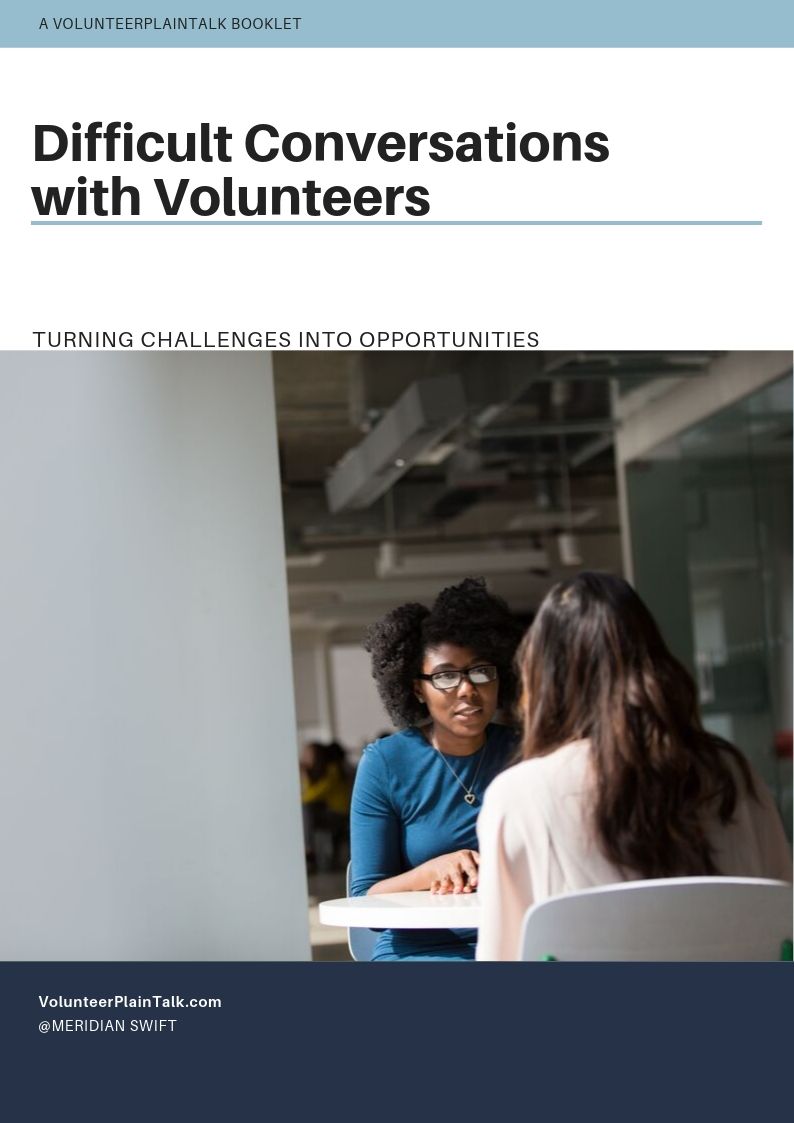
Difficult conversations with volunteers is one of our volunteer management things. We are all faced with having to “talk to” a volunteer at some point and we all hate the thought of “reprimanding” that volunteer. So, based on last year’s post, Difficult Conversations With Staff or Volunteers, I’ve condensed the points into a booklet you can download and keep for reference or perhaps you just want a reminder that you are not alone. If we, leaders of volunteers meet challenges head-on, we can turn them into opportunities. Oh, there is also a companion conversation worksheet to help you prepare. I’ve always found that the act of writing down your thoughts and affirmations helps to cement your preparation.
Pssssst. Guess what? We, leaders of volunteers (through no fault of our own, or wait, let’s be real here. We never even asked for this..) possess an enviable set of life skills.
Hmmmm. So I’m thinking, maybe to offset our low wages, we should
develop an immersion self-help class by charging people to come manage
volunteers with us for a week. Like a “boot camp.” I can see the ad now:
“Volunteer Manager Life Lessons Boot Camp-Volunteer Now For a Boot in Your
Psyche.”
What life lessons should we advertise on the pamphlet? You know,
the life skills that people want and we developed (mainly out of survival mode but we won’t mention that) through
managing volunteers. Just how exactly does volunteer management prepare us for
a productive life?
Volunteer management (VM) forces you to
confront the status-quo: You will learn to rely on your own
expertise and your creativity to navigate a job that is more complex than you
could ever have imagined and were never told when you applied (mainly because the person interviewing you
probably didn’t know either).
VM shows you how to live without envy and look
at the world in terms of concepts bigger than your ego: You
will learn to experience personal gratification from others’ successes and take
pride in seeing others soar. You will honestly begin to experience a profound
shift (almost zen-like) in the way
you view the world.
VM teaches patience and persistence: You
will learn that amazing projects take a long, long, long time and an
unbelievable amount of hard work, even though people may want results immediately.
You will learn to see the interconnections that make projects work and develop
an intuitive eye for creating lasting results.
VM teaches you that not everything is as it
appears: You will learn that every circumstance is unique and can
surprise, delight and sometimes disappoint you, but won’t deter you from being
optimistic. You will learn to probe deeply into people’s motivations for the
keys to being prepared.
VM teaches you that people are complex,
amazing creatures: You will learn to love getting to know people, to hear
their stories and to immerse yourself in their life’s ambitions,
disappointments and triumphs, because you realize this is what makes you human.
VM teaches you that being a martyr is a waste
of time: You will learn that as you become more proficient, people
will expect more and more of you. But you will also learn that being a yes
person prevents you from doing your best work.
VM teaches you the necessity of remaining
neutral: You will learn mad mediation skills and be able to resolve
issues in a respectful, productive manner that honors your mission. These skills
will solidify your confidence in becoming a leader who can keep personal
emotions in check for the greater good.
VM teaches you that real passion is
infectious: You will learn how to use your inner enthusiasm to bring
out the best in others. No phony “rah-rah” types here.
VM teaches you efficient critical thinking: You
will learn to analyze situations and resolve problems quickly. Your busy
schedule will force you to become hyper-efficient.
VM
teaches you that you are more: You will quickly
dig deep within and find that you are stronger, better and more capable than
you could ever have imagined. You are more.
And this is just the “Volunteer Manager Life Lessons Boot Camp”
beginner’s class.
“So, you’re a volunteer manager; what do you do, exactly?” We’ve all been asked the question and then that moment follows when we pause and mutter, “ummmmm,” because we really can’t explain volunteer engagement and impact in a few short sentences. Could we explain it in a paragraph or two? A book? An encyclopedia? Probably not, at least not in-depth. So, where does that leave us? Always shrugging our shoulders and feeling misunderstood because no one gets volunteer engagement the way we do?
Maybe we’re approaching this explaining challenge with too many expectations. Maybe we should look at it differently. Instead of an all or nothing approach, i.e. “you get it or you don”t,” why don’t we aim for something more attainable like an appreciation of volunteer engagement and impact. Maybe before we introduce folks to a college course on volunteer management, we should help them appreciate it first.
Think of all the things we appreciate but maybe don’t fully comprehend or understand, such as,
Our vehicles: Sure, we basically get how cars and trucks and SUV’s work, but do we truly understand electric motors versus combustion engines (and what is the four stroke process again)?
A good bottle of wine: Ok, we can pretend all we want, but do we really know what a hint of oakey or buttery (or waxy for all I know-yes I buy wine in the box) means?
Our animal friends: Do we really know why our dog won’t play with the green Frisbee but loves the yellow one or why our cat loudly meows down the hallway at night (jeesh, that can be unsettling) at unseen forces?
No, we pretty much appreciate things without having to know all and everything about them. We can do the same with volunteer management because what do the three examples above have in common? We appreciate transportation and fine wine and animals because they enhance our lives. Vehicles transport us around, open the world to us. Wine gives us pleasure. Animal friends provide us with companionship, entertainment, love etc.
In short, we appreciate the things we deem beneficial. So, the five words to untangle volunteer management from not being understandable to at least being appreciated are: “What’s in it for me?”
The more we show people how they benefit from volunteer involvement, the more appreciation they will have for volunteering, volunteers and the people who make it all happen (that’s us in case you weren’t sure). That’s why I believe we must add volunteer impact into our volunteer engagement conversations because impact holds the key to showing benefits. Instead of continually trying to “educate” others on the complexities of engaging volunteers, let’s show them the “what’s in it for me” volunteer impact first.
Volunteer impact is the concrete result of a volunteer’s time, talents and efforts. And since we, volunteer managers see all the positive results, we can translate these results into impact.
For example, traditional volunteer reporting says to the manager of fundraising, “our volunteer Jenny spent 26 hours last month helping make phone calls and putting together donation packets.” Then we normally add, “we need to keep Jenny engaged so that she continues to do this job.”
But by emphasizing volunteer impact, we point to the benefit of having Jenny volunteer by saying, “because our volunteer Jenny came in regularly last month to make phone calls and put together packets, the fundraising staff was able to spend 26 more hours on cultivating key donors. Last month they brought in 2 new large donations by donors who are now pledging to give regularly.”
Volunteer impact shows a direct correlation between a volunteer’s efforts and beneficial results. A volunteer impact equation looks something like this:
The key here is the addition of outcomes that dive deep into meeting mission goals and objectives.
Instead of skimming the surface by equating hours with money saved or time spent, volunteer impact directly connects a volunteer’s time to the goals of organizational missions. For example:
volunteers create valuable time for staff to accomplish critical work (because volunteer Sheri spent 6 hours this week training event volunteers, our event staff was able to spend 6 more hours preparing for the annual fundraiser, thus assuring a smooth event. The positive comments from attendees include, “such a wonderful event, the volunteer ushers provided us with so much information on the organization. We are impressed.”)
volunteers spend unhampered time working with clients, thus aiding staff in creating an atmosphere in which clinical staff can better do their jobs (because volunteer Juan spent 8 hours last month sitting with our client, Emanuel, clinical staff was able to spend 8 uninterrupted hours with Emanuel’s children, thus equipping the family with the coping tools they need to navigate their situation)
volunteers are “eyes and ears” for busy staff and can alert staff to potential problems, thus reducing valuable staff time spent in fixing problems and free them up to meet objectives (our volunteer Nan, during her docent shift was alerted to a hazard outside an exhibit and due to her quick reporting, saved us from a potential accident with legal implications. This gave staff the ability to quickly rectify the situation in keeping with our objective of providing a safe environment for learning and return to their crucial duties)
Using a volunteer impact equation means going beyond volunteer hours. The equation deep dives and reveals the impact of time donated and is the key to appreciating volunteers. It’s a fundamental shift. Instead of appreciating volunteers for the giving of their time, we are appreciating volunteers for the beneficial impact their volunteer hours have on our missions.
It is up to us to restructure our reporting and connect our volunteers’ time with mission impact. In the examples above, what is the impact?
Jenny’s time resulted in the cultivation of 2 new donors (mission goal: increased donations to continue the work)
Sheri’s time resulted in (documented by comments) a well run event and increased awareness (department objective: well-run event to increase awareness)
Juan’s time resulted in a family’s increased ability to cope (mission goal: equip families with the tools needed to cope)
Nan’s time resulted in a potential accident and lawsuit thwarted (organizational objective: provide a safe environment for learning)
Reporting impact requires a strong connection with staff and departments utilizing volunteer services so that we are privy to goals, objectives and direction. This is actually a good thing, for the more we connect with staff within our organizations, the more we receive helpful feedback, input and suggestions for volunteer involvement. From these connections, we can structure volunteer roles for maximum support. And, when it comes time to report on volunteer hours, we can then show the direct correlation between a volunteer’s time and the attaining of mission goals.
Existing in silos no longer serves us or our volunteers. As leaders, we can demonstrate the way for our organizations to grow is through partnerships between departments. Based on showing how our volunteers meet and exceed objectives and goals, we can then advocate for more volunteer involvement and for better organization wide engagement of our volunteers.
If we work towards an appreciation of volunteerism by answering five simple words, “What’s in it for me,” then, we just might begin to hear 5 other words, “We need to engage volunteers.”
Do you whip out a clever persuasion technique every time you want someone to acknowledge that volunteers don’t sit around by their phones waiting for us to call? Do you have that “special phrase” that always sways people’s opinions like “hey, volunteers don’t grow on trees, you know!”
Being a research junkie, I’ve tried a bunch of persuasion techniques when attempting to explain the complexities of volunteer engagement and impact. I’m not so sure they really work, though.
Some of the persuasion techniques I’ve tried are:
Wear the Power Suit of Authority: My power suit is like a suit of armor and must have been designed by someone who truly hates the human form. It’s uncomfortable, stiff and I sweat profusely in it, so when it came time to stand up at the annual soiree and recount all the glorious volunteer accomplishments, I dropped my notes while walking up to the stage and I tried to bend over to pick them up but the iron power suit wouldn’t budge so I kicked the notes over to the podium, but in the glare of the lights, sweat dripped into my eyes and I couldn’t see the statistics scattered about the floor so I just kinda laughed nervously into the microphone and “winged it” by announcing, “I don’t want to bore you with dry numbers. No, no one wants to hear that our volunteers gave a butt-load of hours last year. And I do mean butt-load! Instead, I want you to channel your inner activist and raise your fists in solidarity of the power of volunteering!” I tried to raise my fist in the air, but the rigid suit sleeve gripped my elbow like a boa constrictor so I ended up doing a weird fist salute which confused the heck out of everyone and they pretty much ended up elbowing each other in the face. Sadly, I got banned from presenting the following year.
Mimic the people you want to persuade: You definitely should use the terms and verbiage that senior management uses when they speak of goals and objectives, but for the love of all that is sacred, don’t mimic a senior manager’s accent or facial ticks or odd mannerisms, because that’s going way too far and you’ll get in trouble. Trust me on this.
Crying: Ok, to be honest, this just happened. This is not a recognized persuasion technique and actually thwarts your attempt to persuade others so maybe just try not to get really upset when people are ignoring you and chatting with each other while you are telling a poignant volunteer story about a cosmic connection that made a huge difference in a client’s life. Yeah, wiping your nose with your sleeve and bursting into tears does make folks notice you, but not in a good way. Oh, and FYI-it will most likely get you a session with one of the counselors.
Enlist Social Influencers: Getting a celebrity to endorse volunteering sounds so wonderfully effective, right? Yep, until that celebrity starts tweeting after a wild night, “Hey, guys, I #LOVEVOLUNTEERING for cash, so send lots to me, LOL! whoooooo!”
Make Volunteers Likeable: Doing a volunteer car wash where volunteers wash staff vehicles can actually do the opposite of making staff appreciate volunteers more. Hard to believe, right? I know because in the budget for the following year, volunteers were penciled in as extra custodial staff and our maintenance man blamed me for his hours being cut.
Use Sensory Imaging: So, misting lavender scented aromatherapy oil around the meeting room while reciting volunteer stats and then asking all the volunteers to wear lavender sprigs does not necessarily make staff remember that volunteers donated 230 hours last month and pretty much got me in trouble because production went down due to the “overuse of relaxing scented influences.”
Make Them Feel Scarcityor Risk Aversion: Uh huh, so maybe standing in front of the building and shouting at incoming staff, “If we don’t appreciate our volunteers more, they will leave! All of them! I’m not kidding!” just might not be the best way to convince someone. But I did get 3 unpaid days off to “go home and think about my actions.”
Compliment Them: Passing out heart shaped notes from grateful volunteers in a staff meeting might normally be effective, but once you stand up and say, “Our volunteers think you guys are the best staff ever, no really, they say that all the other organizations in our town have lousy, rotten staff who don’t love them the way you guys do,” might be going too far. Especially when you are on a roll and excitedly add, “oh, and yeah, you know the soup kitchen on main street? They’re the worst!” Because the CEO of the soup kitchen might turn out to be best friends with your CEO and well, let’s just say going through a “sensitivity training regiment” is pretty embarrassing.
So, how should we persuade others to appreciate volunteer management the way we do? I think I’ve read every book out there on the art of persuasion, including the best selling “Make People Hear You by Shouting Louder Than Everyone Else,” and in all the great advice, I may have found a different take on changing perceptions about volunteers, volunteering and volunteer management. And the funny thing is, it all boils down to 5 words.
Next time: The 5 words that just might hold a key to explainingdescribingillustratingdefining untangling volunteer management (yeah, I know, I’m setting up this big reveal thing and then it’ll be lame and disappointing and well, failure is nothing to be ashamed of–or so they tell me).
Sometimes I wonder if we should automate the volunteer inquiry process. Could we cut corners by creating an answering machine interview system for prospective volunteers? By eliminating the personal touch spent cultivating each new volunteer, I estimate we would save, like 16.9 years of our lives.
And heck, I’ve used every personality questionnaire out there, even the ones guaranteed to weed out “the potentially destructive personality.” I’ve asked “what kind of tree are you,” and “what would you do if you were in charge of the world,” and “who would you save if you had to throw someone off an overcrowded lifeboat.” (Hint: Watch out for the guy that says, “everyone else, including you.”)
So, if someone did create an automated answering machine system, would it sound something like this?
“Hello, you have reached the volunteer hotline. Please listen carefully with the listening skills you would hopefully use with our clients and select the number that best describes your desire to volunteer. Someone will get back with you shortly. As demand for our super duper meaningful volunteer positions is at an all time high, your expected wait time is 3 minutes.” (this is a blatant lie, but c’mon, it’s just the old marketing scheme that makes people think the volunteer positions are so popular that they’d better get one now before they run out). After some peppy music, “thank you for your interest in volunteering for our organization. Please select from the following options.”
“Press 1 if you have a sincere desire to help. You have no underlying reasons to volunteer other than you want to give back. You listen to directions, offer constructive criticisms and are punctual. You communicate well, take your volunteer position seriously and love being part of a team. Your expected call back time is 5 minutes or less. Actually, don’t hang up! A volunteer manager will pick up right now ’cause we can’t lose you! Hang on!”
“Press 2 if friends always tell you you’re a good person. Sometimes they tell you you’re too good for your own good. Maybe you are a bit hesitant, unsure of what you are getting into, but want to give us a try. You would love to socialize in a helping atmosphere. Your expected call back time is 20 minutes or less so stay put and start brewing a celebratory latte because you sound perfect!”
“Press 3 if you are saying you want to help because you think our volunteers are all nicey-nice and that’s what we want to hear. If you’re brutally honest, you need to be needed. Pressing the “like” button on socially relevant issues makes you happy, but only when you get a “like” for your “like.” Phrases such as “we couldn’t have done it without your help” make you tingly all over. Taking selfies with people in need ups your cred. Your expected call back time is 5 days or more. You might get bored in those 5 days and move on to something else, but, we’ll take that chance.
“Press 4 if you are the leader of a group such as a club, team or corporation. Now go back and press 1 if you sincerely want to partner with us and help because we would love to partner with you. You can do team building and everything. We’re down with that. If you kinda just want to use use us for PR and you expect us to accommodate all of your expectations because hey, it’s free help and we should be grateful, right, then stay on the line and listen to our canned music for awhile. Your expected call back time is 2 weeks or maybe a bit more.
“Press 5 if you have court ordered community service and you’re angry about it and will make sure to take it out on us or if you are under 18 and your mom is making you do this cause you were suspended from school and she is fooling herself into thinking this will actually help you get into college to learn something useful. You really hate the idea of being forced to endure all this feel good hokum and you laugh at us non-profit types because we are full of sh… sugary sweet stuff that gags you and robs you of your edginess. Your expected call back time is 10 weeks or more. A lot more.
“Press 6 if you can’t wait to get in here and straighten us out. You have the need to control and criticize and really want to run the show. You are unwilling to apply for a job in this organization, but would rather back door yourself in as a volunteer, cleverly thinking that we would never fire a volunteer, no matter how destructive they might turn out to be. You sling passive-aggressive phrases like a boomerang of hurt, saying “helpful” things such as, “no wonder it’s chaos in here,” and “who set up this god-awful training, I didn’t learn a thing!” You burrowed into your last volunteer position and waited, spider style until an unsuspecting staff member or other volunteer got tangled in your verbal stings. Your expected call back time is, well, let’s just say your information will just magically get lost in a trash web of our own. But thanks for calling!””
I suppose we could cut corners and just automate the upfront work we put into developing volunteers, but it wouldn’t work. No robotic system can come close to how good we are at fleshing out volunteer motivations and personalities. Maybe someday AI can learn to match volunteers with the role that will create a synergy between meaningful work that keeps the volunteer coming back while making a profound difference in the lives of those we serve. Maybe someday, but not today.
Maybe we are a lot more valuable than we think.
-Meridian
this is an update from an old post. Like almost 5 years ago…woah.
Do we, leaders of volunteers suffer from a tortured volunteer manager syndrome? Or, are all our frustrations something we made up?
The tortured artist syndrome loosely refers to an artistic person who becomes frustrated at the lack of understanding and appreciation for what they deem important-i.e., their art. And I’m convinced that what we, leaders of volunteers do is an art.
Does this syndrome sound like us? Are we frustrated because others don’t understand or appreciate volunteerism and all its beauty and complexities the way we do?
Here’s the crazy thing. All the volunteer managers I’ve worked with or spoken to are super creative people. We have to be. No, seriously, we have to be incredibly, artistically creative in order to succeed at our jobs. Sure, we need to be organized. Sure, we need to multi-task. Sure, we need to keep good records. But the bulk of our jobs takes an artist’s touch.
As volunteer engagement artists, our frustrations come from the perception of our jobs. Our jobs are generally viewed as desk jobs, as coordination jobs, as simply making a phone call to a willing volunteer who agrees to do organizational bidding. It’s like saying a teacher just grades papers.
And you know what? We most likely went into our jobs expecting them to be coordination jobs, because that’s what we were told. That’s what the job description said. That’s what everyone assumed. We were told that our jobs consisted of scheduling and keeping track of volunteers. In my first volunteer coordinator interview, I was asked if I could “get along with senior citizens.”
I was never asked if I could create complex programs, or if I understood deep motivations. I was never asked if I could inspire a person who was lonely or discouraged because they’d lost a loved one or a job or a place to be. I was never asked if I could listen intently to hear what was behind the desire to help someone else. I was never asked if I had the skills to match a person to a sensitive position. I was never asked if I could diffuse a potentially ugly situation between a volunteer and our organization. I was never asked if I could diplomatically introduce change to a seasoned volunteer team. I was never asked if I could explain the deep impact each volunteer role had on the mission. I was never asked if I could convince a volunteer that they were truly appreciated when it wasn’t overtly obvious. I was never asked if I could diplomatically answer probing questions or if I could balance organizational policies with volunteer needs. Nope, it was more like, “can you relay information and keep a schedule?”
“Sure,” I thought, “I can do that.” But then, once I got into my job, I was struck by how much creativity and engagement skills the job required. I found that to do the job, I had to dig deep into every people skill I possessed while mastering new skills. I discovered that my job description (like keeping stats, schedulingand getting along with seniors) took up less than 10% of my day and the other 90% was the art of volunteer engagement. I discovered that my job was nothing like the job description.
Most of us volunteer managers were on our own to figure it out. Our jobs literally forced us into this tortured syndrome as we began to see the skills and talents our volunteers brought to our organizations, how complex engaging volunteers could be and how vast were the possibilities for volunteer contributions. We came to understand that engaging volunteers was about as much a desk job as composing a symphony is a transcribing job. We figured out that volunteer engagement is its own art form.
We discovered, through hard work and the desire to produce something great, that volunteers and volunteering is a complex ecosystem. It is naturally miraculous. But it needs the right combination of elements so that it can thrive. It needs a skilled and creative hand (that’s us) to put all those factors into place and when all elements sync, wondrous things happen. Just like art.
And in the process of discovering this artistic ecosystem, we naturally get excited and want to share it with others. When others don’t quite see the complex beauty of it all, we get frustrated. We want everyone to appreciate this wondrous art we’ve discovered.
How could they not see it? Well, I look back and realize that even with 40-60 hours a week, it took me a while to fully get volunteering. So, how could I expect someone who spends the majority of their time away from volunteers to automatically get it? I wondered, “how could they look at this art form and just see a bunch of random colors?” Because volunteer engagement and impact is complex, understanding it is complex. It takes time and a willingness to really see it.
That’s where we come in. Being tortured and frustrated isn’t going to change anything (except burn us out). We have to adapt new strategies or else the 2030 volunteer conferences will be the “Time for Change” conferences again.
We need to take a step back and assess where we can grow stronger. Is it in our communication and the way we frame volunteering? Is it forging a united front? Is it in creating a strong alliance of volunteer managers locally so there are unified voices advocating for volunteerism? Is it in showcasing our successes and then using the capital gained from those successes to advocate for change? Is it in altering our approach and stopping the attempts to “educate” others and instead, trying to forge symbiotic relationships within organizations?
I believe each of us can create change within our own organizations by shedding the “tortured volunteer manager syndrome” and adopting the leader of volunteers mantel. Rooted, permanent change doesn’t happen overnight. But, it can happen with consistent messaging and by showcasing results. It can happen when we successfully show how the art of volunteer engagement is necessary to vibrant organizations and to communities in general. It can happen when we demonstrate how everybody wins through the impact our volunteers have on mission goals.
Then we can look forward to real systemic change when we are not frustrated any longer because everywhere we look, the art of volunteer engagement and the impact of volunteer contributions are celebrated.
Yes, it’s time for change. It’s time we made volunteer engagement and impact understood.
We, volunteer managers (Leaders of Volunteers) are misunderstood. Sigh, tell me something I haven’t heard over and over, right? I’ve bemoaned it for years like an alarm clock set for eternity.
So, in the fault derby of life, who can we pin this misunderstanding on? CEO’s? Non-profit staff? The volunteers themselves for being so darned accommodating? Media? Our parents, for not making us more lovable? The eternal great red fireball that is the mystery of life? (that’s where I pretty much assign blame to everything anywayso take that red fireball).
I’m only going to explore MY experience here. I cannot begin to imagine your experiences nor can I pretend to know your circumstances. And I’m sharing my experience in hopes that it may in some small way give you a perspective on yours.
I can look back now and say with confidence, that it was my fault. Much as I hate to admit it, it was. Why? Because I did not explain volunteers and volunteer management well enough. Not really. Oh yeah, I shook my fist at the sky and preached to everyone I happened upon (funny,they never liked it much when I followed them into the bathroom, still rambling on about volunteer needs, but that’s another story). I did formal educational pieces, pop-up vignettes, wrote emails, and trotted volunteers of every shape and size out (“see, this is volunteer Rhoda, she does so much for us but did you know that Rhoda is also studying biophysics?”) all aimed at “educating” staff on engaging volunteers. It felt like describing the ocean and its ecosystem by bringing in a kiddie pool as an example. Wait, I think I did a post on that….yep, it’s Volunteer Management: A Kiddie Pool or an Ocean. It felt overwhelming. How do you explain something so all encompassing?
But, there was one critical element that I missed and I’m hoping you don’t miss it too. I thought the magic of volunteer wonderfulness was obvious and that my job was to cattle prod others into acknowledging it. By prod I don’t mean physically shaking someone, although my fingers would twitch a lot when explaining for the tenth time that volunteers have lives outside our organization.
Here’s the thing I’ve learned. People don’t like being harped at (shocking, I know). They don’t like being hounded about their shortcomings. Non-profit people are overworked and incredibly busy. Being reminded that you “don’t get it” is an additional wearisome burden. And who responds well to an additional burden? ….(ok, I KNEW you were going to say “we always do!“)
What could I have done differently ? So much. That’s why I’ve spent the past couple of years sorting it out. What I discovered is the basis for my book, “The Disruptive Volunteer Manager.” (I know, it’s a shameless promotion, I suppose).
Sometimes we can get so wrapped up in our emotions that we can’t see the logic. We, volunteer managers work in complex human emotions like Reese’s works in peanut butter, so it’s no surprise our own emotions are at a continual heightened state. It’s hard to be empathetic all day long and turn off all those emotions in order to look at things logically. But we have to. For our own sanity. For our ability to get things done. For the good of our programs.
I finally began to turn off my own personal emotions and deal with things in a constructive manner. I functioned so much more efficiently and felt so much clearer for it. It really wasn’t all about me and my tender feelings. It was about advancing the program by separating my feelings from the work.
We have to take the people skills we employ when engaging volunteers and use them to engage our organizations. We have to treat fellow staff in the same engaging manner we use to interact with volunteers. How? By asking the same type of questions we ask when working with volunteers:
What drives staff motivations? (and how can we use that to get our message across?)
How does staff and management best receive a message? (and how can we frame our messages in the way they will welcome them?)
How can we best show the benefits of volunteering? (and show how clients, staff and our organizations benefit from a strong volunteer presence.)
How can we eliminate the us vs. them mindset and forge an alliance? (and establish a workable partnership within our organizations?)
When we look at where our frustrations come from, we then see where we need to enact different approaches. What is your reaction to these challenges?
A volunteer showed up late for an assignment.
The head of fund-raising and events never mentioned the volunteers who worked at the gala, but praised everyone else.
A civic club is dragging their heels on a promise to volunteer.
A staff member suggests that “volunteers are not qualified to work with clients.”
You’ve arrived at a remote location to give a presentation to a large group of potential volunteers and find that the audio-visual equipment they provided does not work.
In a meeting, you present stats on volunteer involvement and the CEO cuts you off because the meeting is running too long.
Ok, for me, scenarios 1, 3, and 5 are annoying. I’d laugh about them later and move on. But 2, 4 and 6……frustrating to the point where I’d let it fester and build up. I’d sneak into the restroom, hunched over and muttering, then come out of the stall and snap, “what are you lookin at,” at the person who just walked in. Which of the above challenges do you think would fester with you and why?
What happens when we emotionally cling to the idea that we are misunderstood? We can suffer from a confirmation bias which means we look at everything for evidence that supports our theory. Any time someone doesn’t praise volunteers becomes an “aha, it’s true, they don’t get it” moment. And this can push us further into feeling underappreciated. Then, our goal morphs into “force them to understand,” versus “help them understand.”
Which of these two strategies would a LoVols (leader of volunteers) employ with a volunteer who was struggling to fit into the program?
Get frustrated and mad. Think about that volunteer at night right before going to sleep and wonder if that volunteer is purposefully trying to make life harder. Fantasize about leaving that volunteer to figure things out on their own while murmuring, “oh yeah, I tried to tell you that you only sign in for the hours you’re here, but noooooo, you don’t think I have anything worthwhile to say!”
Think about how to best reach the volunteer. Ask, what does this volunteer need from me to succeed? How can I best show this volunteer what they need to know so that they contribute meaningful work and reap personal benefits?
Well, if you chose the first one, I’m not sure you are in the right profession.
Leaders of volunteers are passionate people. We are passionate about volunteerism, the volunteers themselves, the possibilities for good to great work and the idea that we can and do make a difference. We want everyone to be passionate about volunteers.
Honestly, it’s head-throbbing trying to figure all this out, isn’t it? Why do we feel we are so misunderstood? Why does every volunteerism conference use a catchy title such as, “It’s Time for a Change” and then we lament that nothing ever changes?
I think we may very well suffer from our own form of the “tortured artist syndrome.” You know, like Vincent Van Gogh. Because I’m no clinician and have no business analyzing anybody, (I was once told by a friend’s therapist to stop practicing without a license, so yeah, I knowI have a problem) I’m going to call it, “the tortured volunteer manager syndrome.”
In actuality, we are artists. We paint in volunteerism. We write in helping others. We sculpt in engaging volunteers to find themselves. We strum the strings of magically pairing human beings to meaning. We design programs from human potential. We perform in possibilities. What we do is an art. It’s not coordination, it’s not traditional management and it’s not easily discernible or explained. It’s the art of volunteer engagement.
Next time: Must we cut off an ear and pump our fists at the sky?























 volunteerplaintalk