Tag: volunteering

  • Warm Bodies, Cold, Hard Facts

    Qtips

    “What a massive responsibility, being a moral creature”
    Isaac Marion, Warm Bodies

    Does this line of questioning sound oh so familiar?  “Why don’t we have enough volunteers to be an Emergency Buddy? How hard can it be to find people willing to be called in the middle of the night to come by our headquarters to get the emergency plan for the district, drive out to the emergency shelter and then get a shelter spot ready for arrival? I mean c’mon, do you not know how important this volunteer job is? Have you actually tried targeted recruiting? There must be scads of retired emergency personnel who would love to use their talents to help us.”

    Well, huh. Why didn’t I think of that the last twelve times I tried targeted recruiting, or maybe I was wrong to try and think out of the box by recruiting those great college students.  Perhaps I should lie to potential volunteers so that they don’t know what the job entails? I’m sure that once they realize we lied to them, they’ll forgive us and won’t do a lousy job just because we trained them improperly .

    There’s a study that indicates companies spend more resources  weeding out lousy employees than they do cultivating superior talent. This lopsided approach often applies to organizational views on volunteer recruitment.

    toxic workers are more expensive than superstar hires

    The more important the volunteer role, the more up front work is required in order to place excellent and ready volunteers. Proper vetting, orientation and training takes time and effort by hard working volunteer managers.

    Sure, warm bodies can fill roles, but cold, hard facts say that

    Warm bodies ultimately:

    Leave abruptly, usually within the first three months

    Do not sync with the organization and remain on the outside

    Can do irreparable harm to clients

    Volunteer managers understand how much effort it takes to cultivate a qualified volunteer. Because we abhor the “warm body” theory, we will continue to be accused of not providing “enough” volunteers for critical roles.

    When pressured by senior management to magically produce more bodies, point to the lack of  harmful behavior by your competent volunteers. Remind them that properly vetted and trained volunteers do not damage the very people we serve and oh, yeah, properly vetted and trained volunteers take time and skill to implement.

    And maybe ask the person this question: “Would you want a hastily recruited and insufficiently trained volunteer working with your mother, father or child?”

    Neither would we.

    -Meridian


  • It’s 2pm and Everyone is Leaving for the Holidays Except…


    laptop

    I’m just going to say it: Volunteers are expected to work holidays. Every single holiday, every single time. No exceptions.

    Sonia, the volunteer coordinator for a busy health care clinic was approached on December 21st last year by the CEO. “We need you to round up a few volunteers to man the front desk on Christmas day so that our receptionists can be with their families. Thanks.”
    Sonia stammered, “But the volunteers want to be with their families too. I don’t know that I can find anyone. A great number of them are going out of town.” The CEO just stared at her and so she hurriedly added, “but I will do my best as always.”

    Ahh, the holidays or as I like to call them, the “hol the heck in the world will I find all these volunteers days”.
    I remember one year being asked to “get” volunteers to go into nursing homes on Christmas day to deliver  baskets of goodies for the staff  who were working that day.

    When suggesting that volunteers could deliver the baskets on Christmas eve or another day, I got a peevish look. “We want it to be for the staff working that day and we want them to you know, remember us for thinking of them on the actual holiday.”

    Oh, so you want the volunteers to spend their holidays marketing, is that it? Then, why are you paying a marketing specialist? And why are we thinking of everyone else on the holidays except our volunteers?

    But back to Sonia who sighed and said, ” I do not ever remember being told to give the volunteers a day off on holidays. Rather, I was always asked to find more so that they could fill in for the droves of staff that took the holidays off. I guess I just wish that organizations would realize our volunteers are people with lives and family. I wish volunteers would be the first ones thought of when my organization considers family needs during special occasions.  And I wish that organizations would properly thank the volunteers who give up their day to help out on holidays with true recognition or a gift or something special. I know my volunteers see through the gifts I buy and pass off as being from the entire staff.”

    It’s frustrating to hear organizations say they value volunteer contributions but fail to treat volunteers as real people who have lives beyond their commitment to us. And really, volunteer managers shouldn’t have to “educate” our management on that fact. Organizations’ managers should have enough people skills to realize that volunteers deserve to also be thought of when planning holiday coverage.

    As management clears out for the holidays, they will turn off the lights and shut their doors. Their laptops and phones and tablets will sit on their desks through the holidays, ready to be utilized, for machines never require time off. Machines are tools without needs, made to be used without consideration.

    But volunteers aren’t just tools now, or are they?

    -Meridian


  • Staff Are From Mars, Volunteers Are From Venus, and We Are Earth-in the Middle

    from www.space.com
    from http://www.space.com

    “‎” when men and women are able to respect and accept their differences then love has a chance to blossom ”
    ― John Gray, Men Are from Mars, Women Are from Venus.

    Jay, the volunteer manager for a disaster relief organization walked into the monthly staff meeting and took the last seat near the back of the crowded meeting room. The two managers in front of him were snarking about the “annoying always perky operations manager” who stepped forward to give a report on the number of clients served during a recent flood. Jay began to grumble to himself. “Where are the volunteers in this meeting,” he said under his breath. “They are a huge part of these statistics and would love to feel a real bonafide part of this organization. They do everything for us, so why can’t they ever be included in staff meetings?”

    I don’t know about you, but I’ve felt like Jay. Why aren’t volunteers included in staff meetings, celebrations and outings. (and no, having them decorate the Christmas Tree in the staff lounge doesn’t count) Why are we the only ones who think of involving volunteers as equals? Then, when my head was about to blow from my fantasies about never providing another volunteer for you ingrates again, I had a quiet staff member tell me that she felt her job was threatened by a dynamic volunteer. What?????

    Do staff have needs different from volunteer needs and how can we, volunteer managers be the grounded terra firma middle men who are able to intuitively understand both sides? And will thinking about the vastly different needs give us better insight into helping staff and volunteers to integrate? Let’s look at some of these separate needs:

    1. Volunteers need to feel included and valued. Staff need to feel that volunteers will not take their jobs.
    2. Volunteers want to do meaningful work. Staff want help so they too, can do meaningful work instead of laboring over boring paperwork and attending endless meetings.
    3. Volunteers need flexibility. Staff needs a paycheck.
    4. Volunteers want to utilize their skills. Staff wants to feel that their skill-set is not upstaged.
    5. Volunteers want to help. Staff is afraid to let go.
    6. Volunteers want to engage with staff. Staff has deadlines and wants time to work.
    7. Volunteers need teamwork. Staff needs alone time.
    8. Volunteers may be in awe of staff. Staff may be jealous of volunteers.

    We spend a great deal of time trying to educate staff on the treatment of volunteers. Perhaps we can look at staff’s needs as well and take those needs into consideration when introducing volunteers into the mix. Can we reassure staff that we get that they too, have wants and needs when working with volunteers so that they in turn, welcome volunteers?

    I think yes, if we look at it through their eyes. Staff can be intimidated by a highly educated or talented volunteer. Overworked staff just slogging through the day may feel inadequate next to an enthusiastic volunteer who is fresh and able to leave whenever they choose. Staff may have a deadline and not be able to chat with volunteer after volunteer. Staff may have worked hard on a project and may be reluctant to just turn it over to someone who only comes in once a week. So, taking this into consideration, we might:

    Talk to staff before introducing a new volunteer. The old Venus me would have sold a new volunteer by saying, “I’m bringing in Sally, a former CEO and a published expert on human resource management. She brings a wealth of knowledge and experience and will be awesome at working with our clients. She’s a very busy young retiree with lots of energy and talents. I know you will love her!”

    But what Mars staff heard me say was, “Move over, idiot. I’m bringing in Sally, a way better worker than you. She’s smarter and will probably point out every thing you are doing wrong and that’s a lot from what I hear through the grapevine. You’ll have to spend all your time answering questions and listening to her glory day stories and you’ll fall behind in your work. As a matter of fact, they’ll probably hire her which is ironically kinda funny, don’t you think?”

    Eeeck! Maybe I, as Earth should say, “I have this wonderful new volunteer Sally. She is a retired professional who wants to get to know our organization from a starting point and I thought of you and all your skills and knowledge. I am hoping that she will be a good fit for your tasks but I will be checking in with you frequently, especially during her first few times volunteering to make sure that you are getting the kind of help you need. I want you to alert me to any issue you might have with this new volunteer because I know your time is valuable and I want to make sure this is a help, not a hindrance. I know from experience that you will treat her with the respect that will make her a long term volunteer. Thank you for giving her this opportunity.”

    Let’s face it, we volunteer managers are good ol’ Earth, in the middle of staff and volunteers. And since we want to ensure that volunteers are integrated into organizational culture, we may have to mediate that integration in a balanced way by taking into consideration the needs of not just our Venus volunteers but also our Martian staff.

    It can be a tough, mud-filled, seemingly bleak task for us-being the planet in the middle. But, take a moment and look at Earth from space. It is a bright blue haven of all things possible, creative and vibrant. I’ll take being Earth any day.

    Have a wonderful Thanksgiving!

    -Meridian

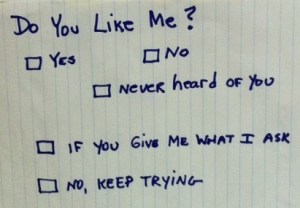
  • If I Say No Will You Stop Liking Me or Can We Negotiate?

    like me
    Taylor, a petite millennial, manages volunteers for an agency that pairs mentors with children struggling in elementary school. Taylor recruits, schedules and places the reading buddies who help seven and eight year olds improve their reading skills. One staff meeting day, she was asked to provide volunteers at an upcoming cocktail party given for the mayor and several dignitaries and key donors. Taken aback, Taylor said she didn’t think that her group of volunteers would want to serve drinks.
    “The senior managers looked at each other as if I had declared a mutiny. One snidely asked me if it was too much for me to try or if I was too busy. I couldn’t believe it, but I kind of stammered that I would ask.” Taylor adjusted her glasses and paused. “Ever since that day, they have treated me differently. It’s subtle, but I can feel a coldness about them. It’s as if I committed the ultimate betrayal, although they seem to have no problem questioning each others’ ideas. I guess it’s ok for them, but not for me.”

    Ahh, I can still remember twenty years ago being told that I got the job as a volunteer manager mainly because I was so nice. “Yes!” I shouted in my head.(but not too loudly so as to offend my other thoughts) “I am nice,” I pumped my fist (not too threateningly, more like a sweet hello wave). I prided myself on being nice and after all, that’s what was expected of me, wasn’t it? Yep, what a great job, can’t wait to be nice to some volunteers!
    Well, it didn’t take too long for me to figure out that nice was a personality trait and not a skill. I found I needed some mad skills to actually manage volunteers. “Dang,” my nice self said over a cold beer, “this is much more complicated than I thought!”
    And after a few years, I began to wonder if those random “you’re so nice” comments might just be code for some other concept. Are the following definitions of “nice” the secret meanings of the word?
    Nice=invisible
    Nice=doormat
    Nice=timid, placid, submissive, weak, docile, spineless, wishy-washy
    Nice=quiet, never offering opinion, robotic
    Nice=unable to see the big picture like those in charge.

    Hmm, can nice volunteer managers say no as in “no, the volunteers will not go out in the blizzard to put flyers all over town for your event because you forgot to mail them out?” And, if we say no, will we be disliked?

    Well, it’s not about whether senior management likes us (and really, we know deep down that doormats are not liked, they’re used), it’s about doing our jobs. It’s about being a team player but also an expert in our volunteer base. We know our volunteers and their capabilities and we should not be afraid to voice our opinions on utilizing them. So, in between Dolly Doormat or Negative Ned, is the logical negotiator.

    For example, Negative Ned might shout, “No way dude! Seriously, you want me to round up volunteers right now? Do I look like I have nothing else to do? If you honestly think volunteers just sit around waiting for me to call, then you’re nuts!”
    Or Dolly Doormat might nod her head and smile. “Yes, ma’am, I’ll cancel that presentation at the Ladies’ Auxiliary I had lined up for this afternoon and get right on it. I’m sure those 200 potential volunteers won’t mind my last minute no-show. I’ll just apologize profusely to them and try to explain in my monthly report why there are no new recruited volunteers.”

    Instead, here’s how Noble the Negotiator would answer: “Let me see if I understand this correctly. You need five volunteers in two hours to man a booth at a last minute fair. (re-state the request) That sounds like an important task.(acknowledge that the requester feels the request is important) I have an important presentation today that could possibly give our organization an ‘in’ with the Ladies Auxiliary and have put a lot of effort into making this happen so you can see that I have to be there. (nicely point out that you have work you must do and why it’s important) But let’s figure this out. Can a staff member set up the fair and stay until our first volunteer arrives? (involve the requester or offer alternatives if the request can’t be wholly fulfilled) I will put a trusted volunteer on the phone right now and give him a list to call. Since I will be out in the field, I will have that volunteer keep you updated until I return.” (fulfill the request without owning the lateness or mistake or circumstances that make the request difficult to fulfill)

    There is a danger when we, volunteer managers look at requests from our own emotional prism. When we deem requests “stupid” or “unreasonable,” we lose the objectivity needed to operate in a professional manner. Besides, volunteers deserve to make up their own minds as to whether to drop everything and come in or to subjugate themselves to what we may perceive as a demeaning task. It’s their choice.

    But if we are seeing patterns of refusal, then we can arm ourselves with the data to justify a “no volunteer will do that job” scenario. Keep detailed records of volunteer responses to requests. It can be as simple as “when we call during the day, 82% of our volunteers are already engaged in other activities and cannot come in,” or “of the 43 volunteers called, 100% said no, they were not comfortable serving drinks to donors at a party. Five of them even called it and I quote, ‘inappropriate’.”

    Data always trumps vague, emotional claims such as, “volunteers don’t want to do that!” Knowledge and data are the capital with which to negotiate. We don’t have to be afraid to voice our expert opinion in such a way that we are not perceived as pushing-back or lazy or negative.

    If we become a noble negotiator, we may or may not be liked, but we will be respected.
    -Meridian

  • Face It: Fit, Attitude, Change, Expectations, by Intervention within a Timeline Part 2

    “Tenderness and kindness are not signs of weakness and despair, but manifestations of strength and resolution.”
    …Kahlil Gibran

    You have a volunteer that is problematic and you are at the point where you believe you have done everything possible to integrate that volunteer. You’ve examined your personal feelings on the situation and feel that you have removed emotion from the equation and are dealing with the challenge in a logical way. So, now what to do?
    Well, think of this acronym- Face It:  Fit, Attitude, Change Adaptability, and Expectations through Intervention within a Timeline. I know it’s a mouth and mindful but hopefully it will help in remembering how to go about working with challenging volunteers. When integrating a volunteer becomes difficult, use this acronym to see if, after interventions within a timeline, there is improvement. Let’s look at each letter in FACE IT.

    Fit: How well does the volunteer fit, not only within the organization, but in her role, with other volunteers, and in the mission? Is the job just the wrong fit or does her philosophy not mesh with the organization’s mission? Does her personality clash with all other volunteers and staff? Is she there for some underlying agenda?

    Attitude: Does the volunteer have a troublesome attitude? Does he incessantly complain? Does he undermine? Is he excessively negative? Is he disrespectful to his supervisors and co-workers? Does he feel that he is superior to the tasks and to the mission?

    Change Adaptability: Is the volunteer able to weather change? Does she dig in her heels when faced with a new policy? Does she refuse to adjust and claims that because it was always done a certain way, you have no right to progress? Does she subvert the mission because she cannot accept new ways and new people?

    Expectations: Is the volunteer meeting clearly defined expectations? Is he chronically late or a no-show? Does he ignore rules and regulations? Does he do whatever he wants without regard to organizational needs? Does he feel that it is not important to communicate with you? Is he a Lone Ranger, but without the white hat?

    These are four pillars of excellent volunteering. When one or more pillars become troublesome, an intervention with that volunteer is necessary. Sometimes it’s just life’s stress that causes great volunteers to go off course. Intervention is never mean but instead, indicates that you notice a change in the volunteer’s behavior and that you respect this volunteer’s contributions and want to help him succeed.

    But help without clear objectives and timelines is futile, so let’s look at the second word in the acronym and the steps of implementation.

    Intervention:
    1. Meet with the volunteer to discuss the area(s) that need(s) improvement.
    2. Point to your rules and regulations, policies and procedures to illustrate your concerns.
    3. Present your evidence, but emphasize your desire to help the volunteer succeed. While note keeping on volunteers may seem underhanded, without details on egregious behavior, your “case” is broad and hearsay.  Besides, specifics help a volunteer see the exact behavior that needs improvement.
    4. Reiterate your commitment to working with this volunteer and then lay a course for how the volunteer can improve.

    Timeline: I can’t emphasize this enough-Timelines are critical. How long do we give a volunteer to improve? Having a clear deadline is effective. Having some random phantom goal in the future will doom your intervention every time.
    1. Set follow up meetings at intervals to monitor improvement.
    2. Make sure you collect evidence of the volunteer’s performance for further steps.
    3. Always meet on premise.
    4. Have at least one other staff member present. This not only gives you another set of eyes and ears, but limits the “he said, she said” aspect and shows the volunteer that you have the support of the organization.
    5. Always leave interventions after asking if the volunteer understands the steps outlined, because if you don’t, that volunteer can easily say that he did not comprehend what was being discussed.

    Interventions are usually enough to motivate a volunteer to succeed, especially if the volunteer is new (having a clear six month probationary period for all new volunteers helps too). But for the minute number of volunteers who do not improve, a “parting as friends” and a “wishing you well” is in order.

    Without upfront, clear instruction and expectations, no manager can assume that volunteers know what is expected of them.
    Rules, job descriptions, termination policies and the steps of intervention must be written and signed by each and every volunteer.
    Infractions must be recorded and addressed immediately with volunteers.
    Often, we view ourselves as too nice to point out egregious behavior. But really, we are not being too nice, we are just practicing confrontation avoidance.
    Instead, the nice thing to do is to help a volunteer excel, not languish, unable to improve, isolated and ostracized by staff and peers.
    The nice thing to do is to create an atmosphere of excellence, of lofty expectations, of volunteer quality so that your volunteers are proud to contribute and your clients are served by the very best.

    Yes, I want to be tender and kind, and I will by being strong and resolute.
    -Meridian

    Oh, next time: Collecting Evidence

  • Gobble, Gobble, Good God I’m Frazzled!

    pumpkin2
    Willow, a new volunteer manager for a small organization providing aid to the homeless population in her town, answered her phone the day before Thanksgiving. She had spent long hours that week, organizing and recruiting volunteers to help prepare the annual meal held at a local high school auditorium. Exhausted, her brain overloaded, she tried to muster up enough energy to sound human on the incoming call.

    The caller identified himself as Harry, the coach of a soccer team consisting of 15-year-old boys. “I’d like to get these boys involved in helping others,” he told Willow. “We’d like to come out and feed the homeless tomorrow.”

    Willow felt a throbbing in her forehead. “How many players are we talking about?”

    “Not the whole team, mind you, about 7 or 8.”

    Tears filled her eyes like the bubbles in a natural spring. The volunteer slots were set in stone. It had taken every fiber of her new volunteer manager being to accomplish that. She was bone weary and wondered, why did this man wait until now to call? How could he think that there was no coordination in putting together something so incredibly complicated? Why does no one understand?

    It’s happened to all of us. Often, people call at the last moment to help, especially at holiday times. After it happens, you begin to expect it and it is incredibly frustrating to have to tell a group of willing helpers that they are not needed because they procrastinated or called on a whim. They are, after all, potential volunteers. Granted, most might never volunteer again, but there’s always that little voice in our heads that sneers, “there goes a group that might just have been the greatest group of volunteers known to man. And you denied them. Tsk, tsk.”

    So, what to do if you are not able to just dust off those last-minute potential holiday volunteers? If you feel that a part of your job is to give people the chance to experience the deep, satisfying joy in volunteering, then you will feel a twinge of guilt or sadness when having to refuse someone, even if they called too late. We all know that holidays bring out the desire to help and that each “drop in” volunteer might become an advocate for our organizations.  Can we accommodate those late comers without making the holidays a nightmare for ourselves?

    Yes, there is a way. It’s not perfect mind you, but it’s better than feeling overwhelmed and guilty at the same time. And it takes implementing now.

    So that the future you is not caught in a holiday trap, prepare for the season right now. Before the holidays creep up on you, create some projects that last-minute folks can do. Don’t save the work that must be done but be ready with some extra projects that are off premises and not in direct contact with clients. (No background checks needed). You can invite these one time volunteers to become official volunteers at a later time.

    Start now by asking everyone in your organization for fantasy projects. Ask, “If you had 3 or 5 or 10 volunteers over the holidays, what could they do?” Does marketing fantasize about hundreds of distributed holiday flyers? Does the thrift store secretly salivate over a huge deep cleaning and resorting for the season? Does finance have a tired office that cries for a fresh coat of paint? Is there a corner where an extra decorated tree would look lovely? Do you partner with other agencies and can you ask them if they have projects? I’ve always been able to find a nursing home that was extremely grateful for some extra help during the season.

    You can also create your own meaningful projects. Go to social workers and ask if they have a family that needs Christmas presents because of financial need and then create a “gift tree” with the ages and sizes of family members on paper ornaments. Buying a gift for someone who is going through a tough time is a very satisfying introduction to volunteering. Don’t be afraid to create a project in which the participants will have to spend a bit of money. That never seems to matter.

    One time volunteers can certainly write holiday cards and wishes to older clients or children. They can have a card writing party off premise. Ask a willing volunteer to attend to explain how much these cards mean to your clients. The point is to be creative. You know the difference between meaningless work and projects that can actually enhance the holidays. Have an extra tree to decorate, or paper place mats to color (good for youth groups to do). Ask your existing volunteers if they would be willing to mentor a group when necessary. Stock up on craft supplies now.

    Then, when someone calls last-minute, instead of having to say, “sorry, but there’s nothing I can give you,” you can invite the late comers to get their feet wet by tackling a small but worthwhile project. If the latecomer says no, at least you offered something. I’ve had folks tell me that my organization was the only one  who even tried to place them. That good feeling can translate to future volunteers.

    You, by virtue of being a volunteer manager, take care of everyone around you. Take care of yourself this holiday season by preparing now for those inevitable 12th hour but sincere calls to help. Your future self will thank you.

    -Meridian

  • Success is Everywhere

    This was a post from three years ago and I just wanted to update it:

    I had an open house the other evening for folks who wanted to find out about volunteering in a “no strings attached” forum. You know the drill; people ask questions, hear other volunteers speak, see videos and generally get a feel for what it would be like to volunteer. I’m finding that those who are just a step away from crossing the volunteer threshold will come, have their questions answered and some of their fears allayed.

    There were a good number of people, all asking “How much do time do you require” and “do I have to work directly with patients?” Amongst the crowd was one gentleman who stood out. He was young and dressed quite well, GQ actually. Most people come casual. He was very quiet. Most people ask questions and talk to one another. He sat and listened intently, more than most. What really made him stand out was his intense gaze. He had that look like he was waiting for a magic word or phrase that would free him from his hesitancy.

    Open houses and orientations are great ways to get to know people you are going to manage. They talk about themselves, what they believe, and how they view the world. It gives me some sense of where they are in life and why they want to volunteer. Managing people without pay is hard enough, but not knowing why they are volunteering is just too difficult.

    So, as I’m looking around the room, answering questions, getting a sense of everyone, I’m still at a loss with this young man who by his demeanor, seems to be out of place. And when you manage volunteers, it helps to have everything in place. Chaos is our world, so we appreciate some sort of control.

    After a seasoned volunteer spoke of her experiences, I told a story to piggy back on her explanation of service. I told the group about another volunteer who simply offered a caregiver a cup of coffee. The caregiver who was sitting vigil at the bedside of her dying husband, had said with heartfelt appreciation, “No one has ever brought me a cup of coffee before.”

    I wanted to expound on that idea, the age-old notion that one act can change everything, so I said to the group, “You never know when you will be the one at the very right moment to do the very right thing.”

    At that, the young man became animated and spoke. He told the group that he worked in the corporate world and that he was responsible for keeping some very high profiled executives on schedule. He said that his world was very demanding, moved quickly and there was not much room for connection and gratitude. He simply ended with, “What you just said, that’s the feeling I want.”

    Ahhhhhhhhhhhhhh. While I believe that everyone possesses more than one reason to volunteer, there are always those who sometimes know their reasons, sometimes guess their reasons and sometimes can’t quite put their finger on why volunteering will be something worthwhile.

    When I see that light bulb go off, I know then that I can help steer that person in the direction that hopefully will give him what he is seeking. Getting to know volunteers is a lengthy process. With this gentleman, the surface is only scratched. It will take trial and error to see where he “fits” and where he gets what he searches for. Don’t get me wrong, it will be interesting and I am looking forward to learning more about him and his journey.

    Do we know volunteers well? I’d say we know them intimately, because we are nurturing their very beings. I’m curious and excited to know this person and curious and excited to see him receive what he came for.

    Update: After a good amount of trial and error, he did settle into volunteering, so much so that he tells me he is keeping a journal about his experiences. He says he has found a balance between work and his desire to have “that feeling” and has brought both worlds together which has made him feel more whole.

    -Meridian

  • Click, Click, Clique!

    Don’t you just hate it when everything becomes such a fine line? I’ve never encountered more fine lines than in volunteer management, except maybe when trying to decide a reasonable curfew for a teenager.

    Cheryl is new to volunteering. She took a job that afforded her some free time so she wanted to give back. Scouring online ads for the perfect volunteer place, she decided to take training at a local chapter of a large organization. “I was excited, really excited, because I could picture myself actually helping people in my community. I never volunteered before, never had time before and I was nervous because I didn’t know what to expect. So I went to training which was pretty good and then I went to my first volunteer meeting. It was in the evening, and as I looked around at the volunteers coming in, I saw people who looked like they worked too, so that made me feel a bond with them. I took a seat in the back. It was fairly crowded and I spoke briefly to the man next to me. He said he was relatively new too, hadn’t gotten an assignment yet, but was looking forward to starting. The meeting began with the chapter’s director showing a power point highlighting the stats from a previous quarter. Then there were general announcements. I noticed that the same small group of volunteers spoke up with stories or questions and they seemed to continually refer to each other. I figured they were the long-term volunteers. Then they asked one of those volunteers to come up and talk about the upcoming needs. She listed several events and assignments and asked for folks to volunteer. I started to raise my hand, but she pointed at her group and before I knew it, they had all laughingly worked out the assignments. I looked at the man next to me and he rolled his eyes. I guess I should have been more forceful, I don’t know. I thought they wanted new volunteers, but now I’m not sure.”

    Ahhh, the volunteer clique. It happens because of that fine line. When we need groups of volunteers to take on assignments, especially on-going assignments, we work extra hard to find personalities that will mesh. We introduce hand picked volunteers to each other and hope that the team will “click.” I know I get all tingly when I drop in on a group and they are chatting away, enjoying themselves and each other. It’s a real perk to volunteering. You can almost hear the team bonding as each person joins. Click, click, click. It’s wonderful. But then, because of that fine line, some teams, not most thankfully, will click so well that they become exclusive. They shut new volunteers out. They become suspicious of and sometimes actually sabotage the newbies.

    New volunteers are as varied as long-term volunteers. Some are forceful, some are timid. But even under the best of circumstances, being new is challenging. So, what to do when introducing a new volunteer to an established group of seasoned volunteers in order to prevent cliquish behavior?
    Here are a few things I learned by making mistakes with group culture. I hope these observations help you too.

    1. Do not just drop the new volunteer into the group, even if it is only temporary. Talk about getting stiff behavior-I brought a new volunteer into a group one day and I thought I had walked into a meat locker, the response was so cold. Alert the group beforehand, talk to them in person, or call to keep from putting them on the spot.
    2. Talk about the awesomeness of the group to the newbie and vice versa. Let the group know that this new person considers it an honor to join such a fantastic well-functioning group.
    3. Appeal to the group’s sensibilities. I’ve said to groups, “I wanted Doug to join you because he’s anxious to do well and I couldn’t think of a volunteer group better able to show him the ropes.”
    4. Make it temporary at first. I’d say, “Doug will be learning from you and then I hope that he can join a group of his own once he’s ready.” Sometimes the group will just love the newbie and take them in because the decision was their’s to make. If a newbie is not forced upon them, the group is often more receptive.
    5. Check in often. Observing the dynamics of the group will tell you everything about how well the integration is working. Check in to let the group and the newbie know that you care about their success and how they feel about each other.
    6. Reiterate that the organization wants to be inclusive of new folks. I’ve used phrases like, “we don’t want to be the best kept secret,” and “we want everyone to be able to have a meaningful experience. With your help, we can do that with our new volunteers.”

    But what happens if all else fails? I’ve had groups that, when a member or two is out for extended periods of time get angry because the temporary newbie doesn’t operate just like good old Janet or Bob or whomever is missing. Then, when several newer volunteers tell me that they won’t work with that group because of the way they are treated, I know I have a problem, and it’s time for a heart to heart. And here’s where one of the biggest lessons I’ve learned comes into play: Don’t ignore a problem. Ignoring a problem only makes it fester.
    The group and I will have a chat about change. (On their time and turf is best I’ve found so I “drop in”). Change and volunteers is like buying a smaller size skirt and hoping it will be good enough to wear at a presentation. Something usually pops.
    So, we chat. The group may be worried that their missing member is sick and will never return. They may think that new volunteers will come in and critique them. They may feel like they’re not doing a good enough job, because if someone new needs to come in, what does that say about them?

    But back to Cheryl and her experience. As volunteer managers, it’s our responsibility to monitor who gets called to service. We need to especially look out for new people and integrate them into the team. It’s better to look at everyone in the room when speaking and not appear to have favorites by chuckling over inside jokes or discussing past events in front of new people without explaining the context to them. Everything can be an inclusive and teachable moment.
    It’s a shame that Cheryl’s volunteer coordinator did not approach the long-term volunteers prior to the meeting and ask if they would “show the ropes” to the newer volunteers. He/she could have asked, “is there anyone here tonight that is new and would like to join our wonderful seasoned volunteers who are happy to help you acclimate here?”

    Then, Cheryl and maybe the man next to her would have had an assignment. And that organization would be one step closer to having another enthused ready to go volunteer.
    -Meridian

  • The Evolution of Thought

    2014-09-29 11.46.26

    All things evolve, says science and who am I to disagree although I frankly wish scientists would figure out how the brain can answer emails during REM sleep. (Don’t bother me now with your question, I’m flying! Hey! Is that a pig?) Anyway, it’s interesting to note how much volunteerism has evolved over the years and keeping up with trends is now a large part of a volunteer manager’s job. I often think back to how I viewed things twenty years ago and compare that to how I view things today. For better or worse, you can’t help but marvel at how your thoughts evolve with the times. In particular, I’m referring to the concept of good old risk management.

    Risk management is one of those things that we must pay attention to, like it or not. It’s kinda like the caloric information on a caramel smoothie or your mother’s voice in your head when you’re about to follow that stray dog down a dark alley. (“But ma, he might need a home!”)

    I’ve learned to view everything through the lens of risk management, no matter how corporate and sell-out it seems.  I was never too happy being hauled up into the CEO’s office because a volunteer stole a client’s credit cards and went to Vegas. Nope, would rather not have to explain that one.

    So, I looked back at my years as a volunteer manager and here’s how risk management evolved in my thought processes.

    20 years ago: “Wow, you want to volunteer, that is so amazing, thank you, thank you, thank you! I can’t tell you how thrilled I am you chose us. My gosh, look at you, you are so wonderful! What? You want to bring your gun with you when you volunteer? Ummm, I don’t see the harm in that, the point is, you want to volunteer, I am so happy!! And have I said thank you?!”

    15 years ago: “Hello and thank you for volunteering, we certainly can use a person with your skills. You are going to do so well here, I am convinced of it. What’s that? You wanted to tell me about your recent incarceration for grand theft? That is so honest of you, thank you for sharing that with me. Well, yes, we do a teensie background check, but we really want you to volunteer, so I will make sure that we get you started.”

    10 years ago: “Welcome to our volunteering orientation. According to our volunteers, it is a privilege and honor to work with our clients and I trust you will feel the same. Now let’s learn a little about you. Uh huh, uh huh, what was that? Oh, you have made some mistakes in the past, I see, well, let’s move forward and I must tell you that we do background checks, but we will see what happens and deal with it when we have to. But now, let’s talk about how excited we are to have you volunteer.”

    5 years ago: “Hello and welcome, I am so glad you are taking this first step towards volunteering with our great organization. Why don’t we take this opportunity to go over our rules and regulations. Because our volunteers are crucial members of the team, we do require them to pass background checks, fingerprinting and abide by the guidelines that allow all of us, myself included, to work with our clients in a professional manner. We are so glad you are here and want you to be at your best because that’s what our clients deserve and what will make your experience memorable.”

    1 year ago: “Hello and let me preface this by saying that we only take squeaky clean volunteers here. You will be put through a rigorous screening, including drug testing, psychological profiling and searches every time you come on property. You will obey the rules at all times. Any infraction will require immediate termination. Do you understand? Now give me some hair strands for the drug test. You heard me, pull ’em out!”

    All right, that last one was a bit exaggerated. And even though I still cringe when my first thoughts are, “what is the risk involved here,” I have learned to live with my corporate shill side. I still am thankful for each and every volunteer, and still feel warm and fuzzy towards the magic of volunteering.

    I’ve just learned that when you expect excellence from volunteers, they step up and provide it. And any risk in striving for excellence is well worth it.

    Hmmm, evolution doesn’t have to hurt so much.
    -Meridian

  • Defining Success

    coal miners wikipedia wikipedia

    The first time I met Alex many years ago, I noticed his manicured nails. He had the soft hands of wealth. His was not a gaudy proclaiming wealth, but an understated old mixed with new wealth. A retired corporate lawyer, with his much younger wife still working, he wanted to fill his days with something meaningful to do. He’d not had a hospice experience, but he’d heard that hospice was a good organization to volunteer for and he wanted to try it out.

    He stuck out in orientation. From his formal weekend wear to his lawyer inspired questions, he animated the sessions with his analytical take on things. The rest of the diverse but more laid back class was somewhat intimidated by him. (Me too if you must know- and yes I tell myself that I’m no better and no worse than anyone else, but heck, my clothes wouldn’t keep their shape like his did).

    After the six orientation sessions were over, I met with Alex in my office. He was polite and cerebral and together we formulated that with the help of a seasoned volunteer, he could begin volunteering in our care center.
    Alex called me often to ask questions. He would show up at my office door every time he came in to volunteer. Knowing that he was used to doors always opening  when he knocked, I allotted time for him. Was he smart? Oh my, I think I could have applied for 3 credits at a local college after listening to his measured thoughts.
    Since the care center staff had really never seen anyone quite like him, I was peppered with lots of questions and comments. “One of those successful types,” a nurse said one day. “He asks a lot of questions,” another said and added, “you’ve got your work cut out for you.”

    One day, a new patient, Lester came into the care center. A coal miner from West Virginia, Lester was in his late 80’s. His wife had died young and although he had no children, he had an old phonograph that played bluegrass music day and night. We all were used to walking past his room, hearing the lively strains of banjo, fiddle and mandolin drifting up and down the halls as if over the hills of a coal camp. As thin as a pick axe, Lester spoke of a time when his wife scrubbed his coal stained clothes until her hands bled and the chocking black dust laid upon the ground outside his camp house door.

    Alex began to visit with Lester more frequently. He sat in Lester’s room while the phonograph scratched out “Foggy Mountain Breakdown,” and listened to Lester’s stories of moving from job to job until the mines became more mechanized. As time passed, Alex began to place his chair closer to lean over to hear Lester and I would observe him, elbows on knees, straining to catch the flooding memories. Then, one day, the absence of bluegrass music outside Lester’s door spoke volumes. Lester was actively dying and his phonograph had grown quiet. He had turned it off. Alex came to me and tentatively said, “I have an acquaintance who plays the banjo and knows any number of Lester’s favorite songs. Do you think I could ask him to come in and play for Lester?” We checked with the charge nurse and social worker and Alex was given permission to bring his friend in. By this time, Lester had not stirred from bed, but lay peacefully, quietly slipping away.

    I skipped a meeting that day, shut my office door and crept down to the care center. The stomping good sound of the banjo’s strings was glorious. I peeked into the room and saw Alex’s friend’s frenetic fingers pick that banjo, his eyes smiling at  Lester, who was now somehow sitting upright, a look of bliss on his worn face. Alex nodded to me from the very corner of the room. I wondered if Alex consciously picked the color of his shirt that day to blend in with the wall color.

    Lester died two days later. Alex and I sat in my office, the lack of music deafening. He did tell me that his friend was honored to be able to play for someone who breathed those mountain roots. Alex got up to go. It wasn’t the time to badger him with questions about how he was going to process this experience, not yet anyway. Right then it was time to silently let it all sink in.

    What makes a person successful? I’d say Alex pretty much had it all figured out.
    -Meridian