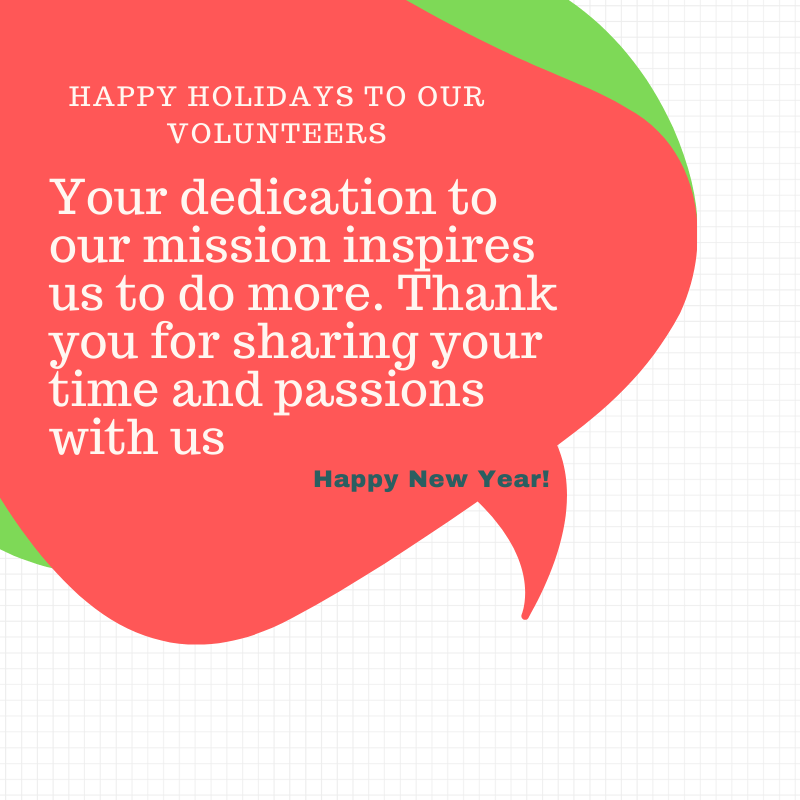
Happy Holidays everyone! Please feel free to use these cards to send to your volunteers as a quick or additional acknowledgement of their dedication to your mission and their impact on your communities.
Yup, holiday gatherings are upon us and everyone fears the inevitable politics-driven shouting between grandpa and cousin Timmy, but guess what? Those conversations are nothing burgers compared to what we, volunteer managers must endure. You know what I’m talking about.
You arrive at a party and the snarky attorney guest of a friend of a friend of a friend is introduced to you. She hears “manager of volunteers” and looks down her nose at the scuffs on your Gucci knockoff shoes that you bought at your organization’s thrift store, because, hey, you have a conscience and want to contribute some money instead of just spending it and besides, recycling is the way to go, but you just keep mum and let her rake you over with her eyes like you’re some bargain basement hobo.
So, in the spirit of defending our #lovols profession, here are some comebacks for those inevitable questions that arise when you are introduced to uppity distant cousin Prunella or your best friend’s very successful investment banker neighbor, Chase who is usually alone on holidays.
Q: “So, you’re a volunteer manager, did you say? I’m confused. Does that mean you volunteer for the job or do you actually get paid to do that?”
A: What a great question. It’s complicated. I don’t get paid in money, but I do get to pick from all the stuff that is donated to my organization. Last week I got a case of lentil soup. The cans were out of date, but that’s ok. I’ve not gotten sick from donated food yet, unless you count that time I was throwing up for a week, but I don’t think it was from that out of date cheese, and heck, I picked off all the mold, but you never know. Anyway, I’m hoping for a toaster oven this week. Mine’s like 20 years old and it only toasts on one side so you have to turn it over and run it again.
Q: “Volunteer manager, you say, what’s that? There’s no degree in that, is there, I mean, you’re basically a party planner, right?”
A: You wouldn’t think we’d need any skills, would you? Actually, I have a Bachelor of Science in cat herding, with a minor in balloon animal engineering. It’s a pretty popular degree but the work is intense. I mean I think I’m still suffering the effects of helium-osis (raise your voice’s octave to a squeak) which makes me speak in a higher than normal voice at times. Currently, I have a scholarship at Nancy’s Nonprofit University for a Master’s degree in Little Old Lady Management. I hear the internship is brutal, you know all that tea drinking and knitting and getting shanked by a wayward knitting needle while scrambling for the ball of yarn the 17 cats ran off with. There’s this one class I hear is really hard, it’s ‘The Symbolism in Grandchildren Stories, or Does Grandma Secretly Despise Her Offspring?’
Q: “You work with people who don’t get paid? That’s not really management, is it?”
A: You got me. Don’t let this get out, but when a volunteer signs up, we pretend to give them a tour of the organization and we usher them into the basement and lock them up in a room until they complete their assignment. We all take turns poking them with a stick until they do what we want. Sometimes, and this is the hilarious part, we just poke them for laughs. I have my own special stick made out of hickory. I call it “Ol’ Persuader.” And you’re correct, it’s not management at all, ha ha, it’s so much easier and more fun.
Q: “So, you work for one of those nonprofits, right? You know, they’re always bothering me for money. Don’t you people just get money from the government? Why are you people hounding me?
A: Ha, ha, awww, we can’t fool you, can we? Don’t let this get out, but we actually get millions and I mean millions from the government but since we don’t need money, we invented this game. We like to see if we can get gullible people to donate and we give a prize at the end of the year to the staff member with the most lucrative sob story campaign. And I shouldn’t be telling you this, but do you know what we do with all those extra donations? One word. Stock market. Hey, it’s almost the end of the year. I wonder if I won the award with my “Life Sucks, Give Me Cash, You Cheapskate” campaign.
Q: “Wow, managing volunteers, that must be really easy, right, I mean how hard could that be?”
A: Oh, you, you are so perceptive. It’s hands down the easiest gig I’ve ever had. I’ve got volunteers who bring me coffee in the morning and volunteers who clean the office while I just sit back and watch YouTube videos. I even have volunteers who do my laundry, can you believe that? And, don’t tell anyone but I even have a volunteer who rubs my feet in the afternoon. Yeah, crazy, isn’t it? Crazy good! I’ve been told the foot rubbing and come to think of it, the volunteer who pays my bills violates some sort of fair labor practices, but hey, they volunteered, right? They’re not protected by anything, ha ha ha ha ha!
Well, there you have it. Use these answers in good, holiday health and don’t stress about those absurd questions.
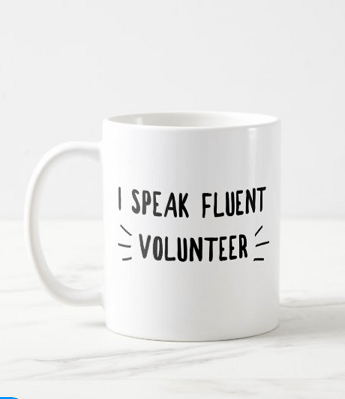
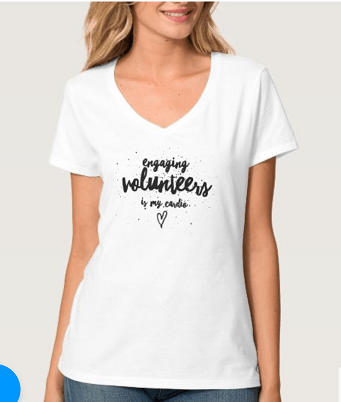
I always loved giving gifts that capture the quote a person loves, or features the phrase a person uses a lot. It’s about recognizing that person as a unique individual.
A few folks have encouraged me to share some of this stuff and it got me to thinking. We, volunteer managers are all working hard to bring volunteer management into the 21st century. As a unique profession, we should be proud of who we are and have some lighthearted fun.
And so, VolunteerPlainTalk is now on Zazzle. There are more new designs and as they become available, I will add them to the sidebar and to a new page in the top menu.
Who are we? We are fun-loving, believers in good, inspired by the smallest gestures, able to see the potential in everything, fans of complex human beings, inquisitive thinkers and just plain great folks to be around. Thanks and happy gifting!
I am profoundly grateful that we, volunteer managers are finding one another. Together, we are shaping volunteerism for a better future. Happy Thanksgiving to all.
Volunteer Plain Talk Podcast episode 3 features an interview with Dr. Jesse Bolinger, author of the new book, “Calling All Volunteers which is based on his research into volunteer motivations and needs.” We discuss modern volunteer recruitment, the Happiness project, how generation Alpha will eventually change volunteering, why millennials are being compared to the WWII generation and how mental health, work and education are tools to get to know our volunteers.
Dr. Bolinger can be contacted at his facebook page or at his linkedin page and is in the process of creating a project that encourages changes to volunteer management through conversations with organizational leadership.
How do we show the value our volunteer bring and all they contribute to making our organizations successful? This worksheet is meant to be a quick guide to help create a “volunteer equation” for calculating volunteer impact. By using an equation, we translate volunteer hours into departmental goals and objectives met and then further into organizational mission fulfilled.
It is a deeper dive into volunteer value and contributions in addition to reporting volunteer hours and/or equivalent monetary value. It answers the “what and why” engaging volunteers is critical to mission success. The blog post,5 Words that Might Untangle Volunteer Management describes the equation in depth.
The more we can show how volunteer impact advances departmental goals and objectives, the more we show volunteer value. And by diving further into meeting mission goals, we connect our volunteers, our volunteer programs and volunteer engagement to mission success.
You would never think to put the Mona Lisa in an orange plastic frame, would you? Of course not, because frames should enhance a work of art, not detract from it. The right frame borders the image, complimenting the subject and showcasing the work. The right frame makes sense.
Volunteer added value is a complex and beautiful picture. The stories we share about our volunteers connecting with clients, serving our missions and advocating for our organizations are inspired, and meant to be viewed with appreciation. The value our volunteers bring needs the right frame.
However, without the proper frame, throwing out super positive phrases about our volunteers can be like this board. “Volunteers are selfless,”or “Volunteers give so much,” can be so broad and gooey that the meaning is lost. If every message about volunteers is so wonderful, so inspiring, so amazing, so terrific, the message becomes diluted and nothing is wonderful or inspiring anymore. It’s just noise without form. If we make volunteers seem like magic faeries that just rise from the garden and buzz on over to do good work, we diminish the effort they bring and the work we do to develop and ready them.
We have to be honest about volunteer management and its complexities. We need to share the challenges along with the feel-good stories. Volunteer synergy (those pure mission moments when a volunteer connects with a client or helps a staff member or solves a problem) does not occur by happenstance. Those moments are the result of a volunteer manager’s diligence, practice and experience. Synergy occurs because the volunteer manager vetted the volunteer, oriented the volunteer, matched the volunteer’s skills and needs to an assignment, and courageously stepped in to guide the volunteer on a successful path.
We, volunteer managers are the frame. We are the right frame, the best frame, the correct frame. Our attentiveness, our tenacity, our persistence, our determination, our sincerity and our resolve shape the volunteer experience. We surround our volunteers with the knowledge, tools and encouragement volunteers need to create a complex work of art. We “become” the frame each volunteer needs. For some volunteers, we are the ornate, gold frame and for others we are a simple black band receding into the background.
Without our guidance, volunteers are simply pictures taped to organizational walls. These haphazard pictures curl up; they fall off and they yellow. But, when we frame volunteer engagement and impact, we create an art gallery that has a flow, that makes sense, that is ordered and sustainable.
International volunteer managers day was yesterday (November 5). The theme for this year was Change the Tune. We talk about change all the time and I think we need to ask ourselves, “what exactly do we want to change?” How we engage volunteers? How we encourage, develop, inspire and mentor volunteers? How we drop everything to make sure volunteers are successful? How we put volunteering ahead of our own personal needs? We’ve got all that down.
I think what we need to do is to frame our critical role in volunteer engagement and impact. We need to stop allowing organizational leadership to think that engaging volunteers takes little effort. We need to stop allowing organizations to view volunteers as tools and not as complex human beings that require thoughtful management. We need to stop allowing organizational leadership to assume that volunteers don’t need support from every staff member. We need to stop allowing organizational leadership to plan volunteer involvement without our expert input. We need to stop allowing organizations to operate in an outdated normal and instead embrace the here and now by investing in the volunteer manager frame that surrounds volunteer programs.
We are a profession. We deserve recognition befitting our expertise, our hard work and our skills. No one will just magically give it to us. We must stop glossing over the work we put into developing volunteers (by vetting, onboarding, training, supporting, stepping in when necessary, sustaining and encouraging) who successfully support and further organizational missions.
In Rob Jackson’s latest post, he lays out real solutions that will move our profession forward. You can read Rob’s post here.
So, this International Volunteer Manager Day, the change I want to see is one in which we elevate our critical role and become the “frame” around vibrant, contributing volunteer teams.
We’re leaders of volunteers. We got this.
Happy International Volunteer Manager Day to all of you frames out there.
What costume should we wear this year? My worn-out magician or wizard costume is just so yesterday and last year the executive assistant said to me, “you think you have to perform magic in finding volunteers, ha, try hiding the donation report from our CEO when donations are down.” Hmmm, maybe one of these costumes might work.
donor fatigue: dress in pajamas and randomly pin on a few dollar bills. Yawn and mutter, “so what exactly did you do with the last $300 I gave?” Make it more realistic by pinning on a volunteer name tag and say, “you didn’t even thank me when I came in last week and put 453 packets together, but you were quick to send me 6 email requests for the new funds campaign.”
background check: wear black pants, a night sky t-shirt and a huge red check mark. Say things like, “I found out about your speeding tickets in college,” or, “are you sorry for shoplifting when you were a kid?” Sneak up behind people and whisper, “I know everything about you….muahahaha.”
budget cuts: cut out financial statements, pin them to a t-shirt and slash through them with red ink. For more realism, carry a tray of half-eaten sandwiches and dried-up carrot sticks. Say things like, “because of drastic budget cuts, our volunteer luncheon will feature left-over food from board meetings. I’m not bitter; I can re-snack with the best of them.”
team building exercise: wear exercise clothes and tape pictures of buildings to your outfit. Write the names of the departments on each building but be sure to choose a giant castle for fund-raising and place it on top of your head. Do weird things, like don a blindfold and snort like a pig while calling out, “where’s my pig partner,” or loudly share a humiliating experience, or randomly fall backwards and yell, “hey, why didn’t anyone catch me, you call this a team?”
time off: dress in your normal office clothes, carry your phone, a pad of post-it notes and a spreadsheet. Say things like, “I’m having a great time at my son’s soccer game, but sure, I can answer the volunteer’s question, put her on,” or “wow, the Grand Canyon is truly spectacular this time of year, I’ll just get off the donkey and call for a replacement volunteer from here!”
the volunteer luncheon: tape balloons and streamers to the front of your outfit. Add in a banner that reads, “we can’t function without our volunteers,” On your back, tape a sign that says, “the rest of the year,” and leave your outfit blank. Or, if you’re feeling really snarky, tape little quotes to your back like, “send a volunteer to the store, that’s why they’re here,” and “no, no a volunteer can’t do that, they’re not qualified!”
Maybe I’ll just make a large sign that says “appreciated” and I’ll stand under it. What are you going to go as?
What can we learn from a volunteer turned activist turned founder of her own non-profit organization? Turns out, a heck of a lot. Listen in as Elizabeth Robinson, founder of Community Cats of Palm Coast shares insights on effective social media, creating roles that engage volunteers, and the problem with silos. Please visit Community Cats of Palm Coast, give them a like and check out their interactive posts that get the community involved.
Oh, the feels, right? We’re swimming in them. We empathize, listen and experience the roller coaster emotions of our volunteers, our clients and our staff all the while living our own emotion-filled lives. The last thing we need is a ride full of destructive emotions.
Have you experienced these passive-aggressive behaviors?
staff make snide comments about volunteers’ abilities
emails are copied to department heads in a tattle-tale way
lack of volunteers is a scapegoat for poor planning
staff make side comments about your management
How do we get off this ride? I finally got tired of a few passive aggressive staff who routinely dragged me onto their cart of fun because their manipulative behavior left me tense and angry and unable to empathize with my volunteers. So, I refused to ride along by using these 5 ways to combat passive-aggressive behavior.
Check your emotions and ask why. Why are some folks passive-aggressive? To deflect feelings of inadequacy? To make you act out their anger? To manipulate? Remember, a snarky comment is their way to make you defensive. Don’t go there. Be neutral and professional. Don’t give the passive-aggressive person satisfaction and they will seek other prey. Instead, calmly ask, “why did you say volunteer Ann is always late, and then you rolled your eyes. If this is a problem, I need to know so I can address it.”
Don’t strike back. Emails are like theme parks for passive-aggressive people. If an obviously unreasonable email request for volunteers is copied to department heads and meant to bait you, reply with a cool, unruffled, “Thank you for your confidence in the volunteer department. It is our goal to provide the very best volunteers for each request and to treat our clients with the respect and professional service they deserve. I will keep you posted on our progress.” The passive aggressive staff member is goading you into complaining that the request is unreasonable, so get out of line for that ride.
Prove it. When a staff member complains, “it always takes forever to get a volunteer,” reply with, “Please give me examples of requests that were not met on time. Without specifics, I really cannot make improvements and it is my job to continually improve volunteer services. So, what are those examples?” Broad statements without factual backup are g-force coasters to passive aggressive staff. Make them give you examples you can work with. Arm yourself with your Excalibur Sword-like phrase and wield it with might such as, “Our volunteer program is committed to our mission, therefore….”
Deflect unwarranted blame in a professional way. Called out in a meeting because a staff member did not get something done and they want to blame lack of volunteers? Ugh, the roller coaster that plunges into a dark tunnel. Pick the right moment to stand up and say, “With a day’s notice, we provided 3 outstanding volunteers. I would like to take this opportunity to reiterate that volunteer services takes pride in supplying the right volunteers for all requests. The sooner we get a request, the more time we have to engage our volunteers. Last minute requests will be treated with high importance, but often we have more than one last minute request.” Don’t get into finger-pointing but take the opportunity to educate staff on how to request volunteers.
Counter with the positive. Negativity is the passive-aggressive track of choice so counter with positive stats, stories and mission supporting evidence. Flip the narrative; say, “did you know that last month our volunteers donated a staggering 850 hours which is more than having an extra 5 full time staff?” Or, “last week alone, our volunteers served 300 meals, impacting 80 families in our community?” Or, “because our 4 volunteers came in last minute to help with the event, our mission was able to reach 200 influential community leaders.”
While roller coasters are meant to be fun, a passive-aggressive roller coaster is meant to derail your positive work. Don’t get on one.

















 volunteerplaintalk


