Category: charities

  • Attention: The Volunteer Department Now Has Ground Rules

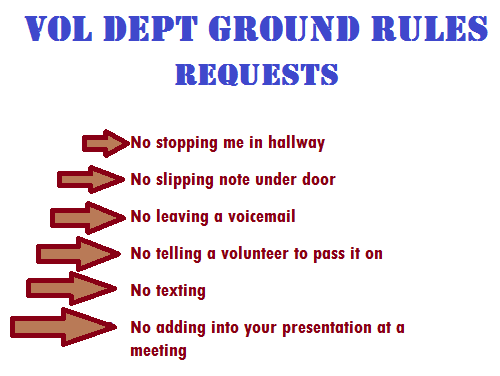
    Ground Rules for Volunteer Departments

    “I need 8 volunteers or maybe 9, no wait,” she says, grabbing your arm in the hallway, “yeah, make it 10, the more the better, right?” Her attention is on the person down the hall, but she glances over her shoulder. “Have them at the Reed Center at 9 tomorrow.”

    Well, hello ground rules. Continuing the conversation from last week, (and a big shout out to everyone who weighed in here and on LinkedIn with great ideas on their excellent ground rules) here are two ways to look at setting them up.

    MY OWN PERSONAL FANTASY GROUND RULES:

    Three staff members request volunteers. Count the number of letters to determine which request gets top priority: The smallest number of letters wins.

    Amy: A

    Roz: R

    Herschel: H


    Ground Rules

    As you can see, Herschel clearly wins even though he only gave 3 days’ notice to find volunteers versus the week Roz gave.  And Amy, well, it will be a cold day in Honolulu before she gets a volunteer, unless it’s the guy that has to do court ordered volunteering, the one that talks incessantly about how he only had two beers when he crashed into that tree. Yep, Amy, I got your back.

    Ok, now for real. What are some of the priorities that can actually be weighed against less important requests? When proposing the adoption of priorities versus non-priorities to upper management, bring a few examples of how you look at prioritizing volunteer engagement.

    And don’t be afraid to drop the “S” word: Strategy. As in, “in order to better serve the mission, let’s strategize our priorities.”

    Your list of examples will spur senior management to adopt a “Priority Principle.” Setting priorities means asking the following questions and assigning a weight to each one. Weight determines priority status.

    Do the clients come first, no matter what? What does the mission say? Clearly, the client’s needs are the reason we exist. This is a great place to start, because weight should be the highest.

    What does the organization need to run smoothly? Volunteers are vital in keeping the organization running. Do volunteers fill in for staff when they are absent? Do volunteers take weekend shifts? Do volunteers occupy roles that must be filled in order to serve clients? The weight here has to be really high.

    Which stakeholders count the most? Donors, dignitaries, potential clients and influencers all carry weight. What events or strategies involve the most bang for the buck? This is where weight will flesh out low priority requests. Staffing a booth at a last-minute  weekend fair carries little weight against an annual festival with high visibility attended by key stakeholders.

    Is the time frame reasonable? Weight needs to balance up and down between last-minute and timely requests.

    Is the request feasible? It may be hard to define feasibility, because we typically entertain all requests. (which does not imply all requests will be met) Having a listing or report outlining the skills, availability and interests of the volunteers can be applied against requests. Weight is equal to feasibility. For example, you can say…

    At this time, we do not have any volunteers who have an interest in washing the board members’ cars as a ‘thank you.’ Time spent trying to convince our volunteers that this activity is more meaningful than engaging with clients or keeping the reception desk staffed will deplete precious time from requests that further our mission.

    What is the amount of work involved when enlisting volunteers? Work=time=there’s only so much, even if you work sixty hour weeks. How many volunteers are requested? How specialized are the skills needed?

    Are any of the following factors within the request out of the norm? (timeframe, location, ability to get to assignment, duties, weather, duration, stress level, etc.) Complicated requests require additional time and if the complicated request holds a high priority, then the weight of other requests is reduced by a factor reflecting the extra effort needed to obtain volunteers.

    How does this engage volunteers? We must add this one into the mix. Volunteer retention or sustainability is directly related to engagement. Strategizing retention must be highly weighted and given top priority.

    We may not agree with all of the decisions made when administration strategizes priorities, but we have to be flexible because having administration’s ‘stamp of approval’ will be worth it the next time a flurry of requests are dropped on your desk.

    Volunteer services is not a buffet of ordering without end. Actually, even buffets have a limited number of choices if you think about it. I can’t get Tantanmen at any of the buffets in my area, although I crave it. So, why should anyone be able to “get” a volunteer to sit outside the chapel “just in case an upset family member should enter?”

    Professional, efficient volunteer departments need ground rules in order to ensure the priority requests are met. After all, at year-end, the organization is no better off because you ‘got’ five volunteers to dress up like clowns at some poorly attended event, right?

    -Meridian

     

  • “We want to work with staff who have drunk the Kool-Aid,” an interview with Laura Rundell, CVA


    An Interview with Laura Rundell, CVA
    Laura Rundell, CVA with a mug of Kool-Aid


    Recently I had the pleasure in chatting with Laura Rundell, CVA, the Volunteer Coordinator at LifeBridge Community Services in Bridgeport, Connecticut.

    VPT: Laura, tell us a little bit about your background in the volunteer management sector.

    L: I’ve been involved in the volunteer sector since 1999.  During grad school where I received my Master’s in History, I worked part-time for the Park service. I have also worked for several other organizations, including the Spellman Museum of Stamps and Postal History in Weston, Massachusetts, the Phipps Conservatory in Pittsburgh. Pennsylvania and I am currently the Volunteer Coordinator at Life Bridge Community Services in Bridgeport, Connecticut.

    VPT: And how long have you been at Life Bridge?

    L: I’ve been here since 2014.

    VPT: What brought you to volunteer services?

    L: It was at the Phipps Conservatory that I began to fall in love with volunteer management. I had come from a smaller organization to Phipps and found out they had over 500 names on their volunteer list, so the scope changed dramatically.

    VPT: And how did you come to be at Life Bridge?

    L: I moved to Connecticut and landed at Life Bridge in 2014.

    VPT: You’ve had a number of experiences thus far. What have they taught you?

    L: Not all my experiences were perfect. An already challenging job is much harder when the goals for the program and the roles for volunteers are less defined.

    I appreciate where I am as a volunteer manager now and loved my time at Phipps because they support the volunteer program and there are clear expectations and specific roles for volunteers.

    VPT: Can you give us an example?

    L: Yes. When I was invited for an interview at Life Bridge, I noted that the person who would be my supervisor had the CVA credential. It was clear they had put thought into their volunteer program and knew what it would take to make it successful. In my third interview, I was sitting at a table with all of the staff who would utilize volunteers in their programs. I was really impressed that they put so much thought and effort into recruiting for this position and knew then it was an organization I really wanted to work for. I was delighted to be offered the position.

    VPT: That is impressive.

    L: And, just recently, our Executive Director asked for a volunteer to be involved in researching best practices for a project. That shows commitment to engaging volunteer help at all levels of our organization.

    VPT: I’ve noticed you are weighing in on articles and blog posts more and more and that is great; we need more voices. What do you feel is the future of volunteer management?

    L: I see so many non-profits stretched thin and need more volunteers to take on a greater role.

    VPT: That’s a good thing for increased volunteer participation, right?

    L:  Yes it sure is, but I think the number one challenge for most volunteer coordinators is recruitment. It will be an even bigger challenge moving forward to keep filling those roles with qualified and committed volunteers. It means we all have to “step up our game”.

    VPT: Are you seeing changes in the volunteers who are stepping forward?

    L: There are more episodic volunteers, more students who are seeking career experience, and more individuals in the midst of a career change seeking resume enhancers and references. There are also more opportunities to recruit corporate and college groups.

    VPT: Are there inherent challenges with episodic volunteers?

    L:  We have had some really great short-term volunteers. Not every role is appropriate for someone who may only be with us a short time though. Some roles require clearances that can take 4 weeks to get back, so we really hope the person in that role can stay with us for at least a year. We’ve also gotten some really great college and corporate groups. However, walking that balance between offering the flexibility large groups may require and making it a meaningful opportunity that adds value to the organization is a challenge.

    VPT: What have you discovered about recruiting volunteers that you can share with us?

    L: You have to respond promptly when an applicant contacts you. When I relocated to Pittsburgh from Massachusetts, I contacted several organizations to volunteer and never got a return call. That was really frustrating.  After that first contact though, the applicant has to be invested — it has to be their choice to move forward. I have learned you can waste a lot of time spinning your wheels if an applicant doesn’t respond to a request to meet with you, doesn’t show up for an appointment or doesn’t follow up afterwards.

    VPT: Changing direction, do you feel as though volunteer managers are starting to build a community with one another?

    L: By the time I became a CVA, I was linked to a community of volunteer managers. But, often, a volunteer manager is a department of one and is isolated. When I was in Pittsburgh, I reached out to similar volunteer organizations and we volunteer managers would get together a couple of times a year to have lunch and share best practices. Here in Connecticut, we have Volunteer Square and they have done a wonderful job in creating a Professional Development Series for volunteer managers. I’m honored to serve on their advisory board.

    VPT: So, there are some steps being taken.

    L:  You know there is an Association of Fundraising Professionals (www.afpnet.org/) for those who are in the fundraising end but we have no association for volunteer managers.  I wish we had one nationwide organization. Not everyone can attend a national conference, but if we had a national association, we could have branches in our areas that we could connect with and could set national standards for our profession.

    VPT: What do you see as future challenges for our profession?

    L: As non-profit funding continues to decline, there will be more and more dependence on volunteer programs to pick up the slack and organizations will be utilizing volunteer services more. As everyone scrambles for a piece of the ever-shrinking pie, we need to have a unified voice instead of competing against one another for limited resources. For instance, if we all required that courts who refer mandated community service applicants to our agencies provide the funding necessary to fully vet, train and supervise these applicants, we might make some real changes in how court mandated service is assigned nationally.

    VPT: What advice do you have for new volunteer managers?

    L: After I moved to Connecticut, I remember talking to a volunteer I worked with in Pittsburgh and the volunteer said, “We want to work with staff who have drunk the Kool Aid.” If staff is unhappy, or does not believe in the work, then volunteers pick up on that. If an agency has a lot of turnover and has difficulty retaining paid staff, than recruiting and retaining volunteers may be an uphill battle.

    L: I would also say, make sure you connect with other volunteer managers in your area. I have learned so much from my colleagues. Just an hour spent talking with another volunteer coordinator over lunch or coffee can be invaluable. You can learn “It’s not just me…others have this problem too” Also, obtaining the CVA (certified volunteer administrator) is very helpful. I feel like the CVA credential has given me more of a standing in my organization. The CVA gives me ethical standards to adhere to and by virtue of my having it, my volunteer program is elevated.

    L: Also, you need to have rules and policies in place and stick to them. If someone wants you to waive the requirements for a new volunteer, remember this: There are bad actors who seek out vulnerable populations. This is why we don’t bend the rules. Make sure you have a volunteer manual, written policies, and an agreement letter for the volunteer to sign.

    VPT: What makes a difference for you?

    L:  I feel blessed to do what I do. Yes, there are challenges, yes there are frustrations, but a well-run volunteer program can leverage the passion and talent of volunteers.

    L:  I’ll leave you with my favorite story about a volunteer. Before I was at Phipps, I was in charge of an exhibition opening of student art work in Pittsburgh. The students, their parents and the artist they worked with were all on their way, along with a volunteer to help at the reception. Right before the event, we had a severe storm warning and most of our staff left the building. Meanwhile, our volunteer drove through the storm to be there. The kids and their parents all had a great time at the exhibition opening because the volunteer made a commitment and the storm wasn’t going to stop her from coming! That is just one of the stories that keeps me motivated and gets me up in the morning.

    VPT: Thank you Laura for your insights and for sharing with us today. We look forward to hearing more of your voice in the volunteer management arena.


  • Sometimes, You Fight the Good Fight and Sometimes, You Go

    Sometimes, You Fight the Good Fight and Sometimes, You Go

    I had a different post all ready to go, and it just didn’t feel right today, not after the lunch I had yesterday with a very good friend and volunteer manager. Ironically, I had just read the brilliant post by Elisa Kosarin on her blog, Twenty Hats about a note to self: When your volunteer mindset needs a boost.

    Elisa talks about the disparity between a volunteer manager’s salary and the value we assign to ourselves. Are we valued? Can we overcome the perception that we are not worth much?

    But back to my friend. She’s done. She’s looking for another job, outside our field.

    And she is one of the most naturally talented volunteer managers I have ever met. She knows people. She understands motivations. She is passionate about her mission. She embraces projects. She works hard.

    She told me she just wants to be in a place where her talents are cultivated. She just wants to stop having to explain over and over her worth and the worth of her program, just to be shot down when she needs resources. She just wants to feel supported by her supervisors. She said she felt like a prop, one in which her caring face hid all the cavalier attitudes behind her. She just wants to be paid a fair wage.

    It hurt to the core to hear how miserable she is and even though a part of me wanted to say, “But the work! The work is why we do this,” I couldn’t. It would have rung hollow, after all she has been experiencing.

    So I agreed with her. Leave. Find a job where they appreciate your talents. If that is at another non-profit, then great, but if not, go where your soul is happy. We talked about how she could help a for profit company invest in community service. With her list of skills, enthusiasm and creativity, she will shine somewhere if just given the chance.

    Thankfully, not all organizations that engage volunteers are as difficult. Most are serious about cultivating volunteers. Sadly, though, some just give lip service to volunteer programs.

    Now, I wish for my friend a position in a company that recognizes her talents and I weep for the volunteers at the non-profit that caused her to feel this way.

    She deserves better. Their volunteers deserve better.

    Our profession deserves better.

    And what’s really sad is that even though we are making great strides in elevating our profession, it’s too little, too late for my friend.

    Sometimes, you just have to go where you will shine.

    -Meridian

  • Non Profit Executive Directors: What to Gift Your Volunteer Manager This Year

    What to Gift Your Volunteer Manager This Year

    “What can I get my non-profit staff, especially that mysterious volunteer manager, who seems to run around a lot?”  You, my dear ED or CEO have come to the right place.

    Let me help you gift your hard working volunteer manager this year with something he or she will actually treasure.

    Forget that inflatable unicorn horn you wear on your head. Forget that sweater that depicts Santa in a magician’s hat. Forget that self help book on “How to Field Criticism and Still Feel Validated.”

    Forget two extra weeks vacation, uh meh. No. Give a gift that really resonates with your VM. And, the best part is, it doesn’t cost you a thing, only a sheet of paper, a printer and a pair of scissors.  And, as a bonus, in typical cooperative volunteer manager style, I’ll even throw in the template!

    Here are my three top picks for a Volunteer Manager Holiday gift:

    Get Out of Event Free Card:

    Get out of event free coupon

    Budget Increase Steal of Choice card:

    Budget Increase Steal of Choice

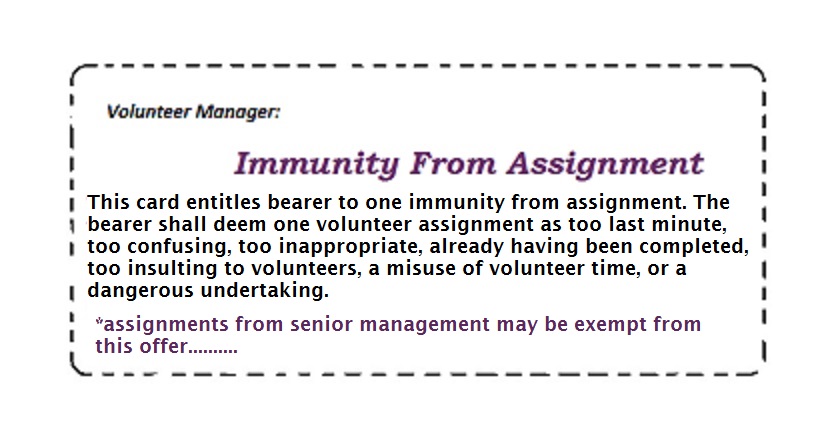
    Immunity from Assignment Card:

    immunity from assignment coupon

    Well Executive Directors, there you have it, the top three gift coupons for your volunteer manager. A few moments, a pair of scissors and you are done shopping!

    And, oh, volunteer managers? Feel free to slip these under the door of your executive director.

    Unless you really want that coffee mug that says, “World’s Greatest Office Worker.”

    -Meridian

  • The Volunteer Ripple Effect


    I’m convinced. We, Leaders of Volunteers (#LOVols) hold in our hands more power to affect positive change than we can even imagine.

    We have the opportunity to impact the world beyond filling tasks and adding to our volunteer base. The intuitive feelings within each of us are spot on: There’s so much more going on than our excel spreadsheets show.

    I remember long ago struggling to find volunteers who could be with clients while loved ones attended church or synagogue or temple or mosque. I would look for volunteers of that same faith and hoped that they would be willing to give up their own attendance to help someone in need. It was the way it had always been done and it was frankly, exhausting.

    Then one day, a volunteer stepped forward. Hannah offered to sit with Christian clients on a Sunday morning. (I’d love to take credit for thinking this solution up, but, no, it came from this wonderful, selfless volunteer.) Bam! The light went on.

    I feared that mixing faiths (or cultures, or beliefs) would be a challenge in itself, but you know what? (Of course you know what comes next) It ended up uniting people in mutual respect and a desire to understand one another. The mere act of reaching across a cultural or spiritual divide created its own sense of wonder.

    And here’s the thing. For the volunteers, it was never about, “oh, I’m so enlightened that I want to transcend these differences.” No, it was, “you know what? I’m free on a Sunday morning and you need someone, so what could be a better fit?”

    The deep meaningful by-products of volunteering are seldom the initial goals. They just naturally evolve because the volunteer ripple brings out the best in everyone: Clients, families, volunteers, volunteer managers, staff, neighbors, community, everyone.

    Think about that. Volunteer programs impact society in rippling positive ways beyond the delivering of meals, or escorting a tour group or passing out information. Our programs share love. Our programs open the doors for unity, connection and understanding to naturally take hold, and not just during holidays.

    We often witness a profound change in people. We glimpse moments of powerful interconnection through the simplest of assignments. We stand, watching that small pebble create ripples of inspiring stories.

    As you are running around this holiday season, scrambling to fill tasks, stop for a moment and think about the societal change you are helping to bring about. Because you value the innate worth of each human being and believe in their ability to transcend, you are spreading that change like a ripple in a vast sea.

    Volunteerism is a rippling movement.

    And leaders of volunteers are tossing the pebble into the water.

    -Meridian

  • Press “2” For That Volunteer Question

    Press 2 For That Volunteer Question

    “Yeah, so, this is Ginny from donor relations,” the voice on the phone sighs. “My next door neighbor’s fourteen year old daughter, April has a volunteer assignment for school. Why they are coming to me, I don’t know but just because I work at a non-profit, they think I’m free to help with all their little projects. When is the next volunteer training, or better yet, you call them. I don’t have time for this nonsense.”

    “Hey, I’ve been calling you for an hour. Where are you? Anyway, this is Jazz from administration.”  The voice message plays, Jazz sounding out of breath.  “I need volunteer stats ASAP for a grant for our project that, oh, never mind, I just need some stats and fast to complete this application.  How many hours did volunteers give last quarter? This is the last component on the grant and it’s due today so I need this right away. Call me immediately.”

    “Yo, this is Dean in records. The new volunteer, Charles, the one you sent us last month hasn’t been logging any hours, at least I don’t think so. I thought these volunteers knew what they were doing. Anyway, where does he fill out his paperwork again? And should he just make up hours for the time he worked?”

    Do you get tired of answering the same questions over and over? While we are conditioned to give that personal touch, our time is pretty precious and continually answering simple questions can eat into our efforts spent cultivating volunteers, forging new recruitment avenues and solving challenges.

    Taking a proactive approach can help. Think about all the standard questions repeatedly asked by staff and volunteers. Can these be put into a cheat sheet? Where can these cheat sheets be stored for maximum viewing?

    We have to remember that folks don’t necessarily remember something told to them one time. Volunteers will forget specifics taught to them in orientation. Staff is too busy with their own pressing duties to remember the date of the next volunteer training. So, storing these cheat sheets in multiple areas will cut down dramatically on repetitive phone calls.

    For volunteers, some visible places to store cheat sheets:

    • on a designated area of your website
    • as reminders in your newsletter
    • posted in your office
    • included in your welcome packet
    • given to volunteer mentors to share with newbies

    For staff:

    • on an internal website
    • sent out as a quarterly email blast
    • given to department heads to post
    • at departmental meetings (ask to attend other department’s meetings to answer volunteer related questions, explain policies, intercept issues etc. )
    • on surveys sent to staff
    • posted in your office in case you are not at your desk
    • training dates posted prominently in your office (whiteboard, poster etc)
    • training dates printed on flyers, cards etc and given to staff (great recruitment tool also)

    Besides cutting down on repetitive questions, posting core volunteer information creates an informed team of staff and volunteers who will disseminate correct information to potential volunteers. And, if volunteers have to constantly try to pin you down for simple questions, or if they always receive incorrect information from uniformed staff, they will quit out of frustration.

    Elevating our vocation includes creating a comprehensive base of information visible to staff and volunteers. The more we polish the fundamentals of our volunteer programs, the more we can build upwards.

    So, go ahead and press “2” for that volunteer question. But press “1” to leave the name and contact information of a prospective volunteer.”

    Let’s make our systems work for us.

    -Meridian


  • Thank You To The Volunteer Who Lied

    Thank You To The Volunteer Who Lied

    Does this sound like you? Thank you to of all the wonderful volunteers who have enriched my soul and believed in my abilities. Ahhh, being thankful, it’s what we volunteer managers do so well.

    But maybe we can also thank the volunteers who taught us lessons and built our characters. You know the ones. Their memories are seared into your psyche because you dropped your phone when you learned a trusted volunteer called a client “dumbo.”  You slunk back to your office when the CEO told you a volunteer tried to sell something to a client’s son. You stayed silent in meetings after a volunteer wrote that wildly incorrect letter to the editor.

    They say that the hard lessons are the ones that stick. Yup, they are the lessons that keep you up at night, and make your hair go grey. (not the pretty kind either)

    But, think about all the clients saved from unscrupulous volunteers because you learned a hard lesson. Think about all the necessary precautions you take because you were put through the wringer. Think about the watchful eye you developed because you were caught unaware.

    In spite of intention, these volunteers give us the gift of experience.

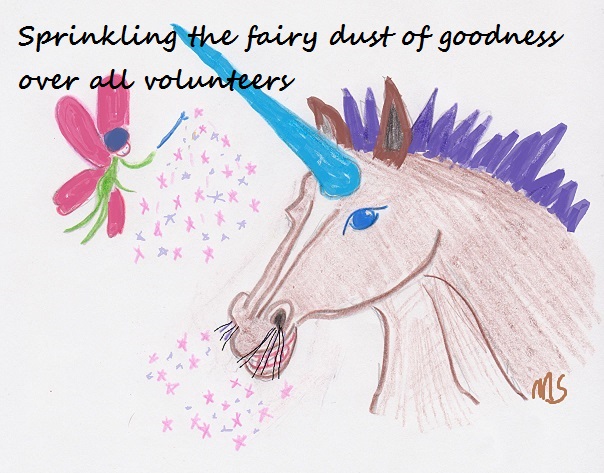
    I remember many years ago, Jacob, who lied to my face. I believed him, not because he was so charming and convincing, but because I wanted to believe him. I believed in the romantic notion that all people could see the light of volunteering and could set aside their personal agendas for the greater good. I dreamed of that world in which unicorns and faeries flitted about, sprinkling the magic dust of goodness upon all.

    Jacob showed me that I had to be realistic if I truly wanted to do right by our clients. He showed me that healthy watchfulness did not diminish my job, but rather elevated it to a higher level of purposefulness.

    You’ve been through this. We struggle to showcase all the carefully measured thought and actions required to match volunteers to clients and programs.  Unicorns and faeries are lovely, but we live in the real world. In the real world, placing volunteers with vulnerable clients takes discerning judgement, careful pairing and keen watchfulness. 

    Luckily I was watchful enough to remove Jacob before any harm was done. So, I thank him and others for giving me a discerning nature, for strengthening my resolve to do right and for teaching me that compassion takes the courage to be a sentry.

    Jacob most likely never intended to teach me anything.

    But he never intended to embrace the mission either.

    -Meridian

    Volunteer Manager Job Update:  Should I Laugh or Cry?

    A couple of months ago, I posted some volunteer manager wanted ads  and most of us pretty much agreed that they were lacking in inspiration. Well, thank you to Laura from Maine for sharing this volunteer coordinator ad with us.  I have not changed one word, but only added (my comments).

    Wanted: Kitchen/Volunteer Coordinator:

    The Kitchen Coordinator/Volunteer Coordinator is a very hands-on position that requires strong leadership skills, responsibility, and enthusiasm.

    Job responsibilities include:

    • Designing healthy menus (uh, registered dietitians actually do this so shouldn’t the job read Kitchen/Dietitian/Volunteer Coordinator?) 
    • Training and supervising a large volunteer crew of cooks and custodians (wait, now the job is Kitchen/Dietitian/Custodian/Volunteer Coordinator)
    • Working with stores and volunteers to manage daily delivery of food donations (whoa, now it’s Kitchen/Dietitian/Custodian/Delivery Manager/Volunteer Coordinator)
    • Recording menus, inventory, and volunteer timesheets (meh)
    • Helping clients find housing and apply for jobs (So, ta da, we have a Kitchen/Dietitian/Custodian/Delivery Manager/Housing Expert/Job Placement/Volunteer Coordinator)

    (I’m going to cry now over a piece of pumpkin pie).

    Happy Thanksgiving, I hope it is wonderful.


  • What’s So Darned ‘Daring’ About Being Different?

    Whats so darned daring about being different

    How does the statement, “Dare to be Different” make you feel? Does it make you want to dye your hair pink and wear Star Wars Jedi gear to work? Do you immediately want to throw away all your volunteer stats and mundane ways of recruiting volunteers?

    Consider these two quotes about being different:

    “I want to be different. If everyone is wearing black, I want to be wearing red.” …Maria Sharapova

    “Be daring, be different, be impractical, be anything that will assert integrity of purpose and imaginative vision against the play-it-safers, the creatures of the commonplace, the slaves of the ordinary.” …Cecil Beaton

    In the first quote, Maria Sharapova talks about the inner pleasure at being different for just being different. In the second quote, Cecil Beaton puts a purpose, an integrity, and an ethic to being different.

    How do you view being different? Does it conjure up images of selfishness? Does it impose the stress of wild creativity for no good reason other than to stand out?

    Volunteer managers don’t have to dare to be different, because we already are. What unique skills and abilities have you acquired due to managing volunteers? What principles have you discovered while leading volunteer programs? What undeniable truths did you learn from engaging with volunteers?

    The tenets embedded deep in our souls are the things that make us different and it is not daring to hold fast to who we are. It’s simply the right thing to do.

    How are we, volunteer managers so darned different?

    • We are highly aware. We consider all that is around us.
    • We have honed communication into an art form. We are communication hubs and can break information down to clear, impacting messages.
    • We are Visionistas. We develop talents, skills and passions, molding volunteer engagement to benefit both the receiver and the recipient.

    But, along with these stand out qualities, there may be a few things differentiating us that we can work on. For instance,

    • We are selfless which may lead to us shrinking into the background and hiding our skill set.
    • We have a coaching mindset which may lead to our contributions being overlooked and therefore, organizations miss out on implementing our methods in other areas that would benefit from our expertise.
    • ‘We are humble, which may lead to being viewed as lacking in confidence. A perceived lack of confidence falsely implies that you have no confidence in your work. 

    Being “different” means we have a unique space in our organizations, one that carries responsibilities and opportunities, not just for our volunteer programs, but for ourselves.

    The challenges we face are opportunities to showcase the fine tuned skills and talents that make us different. Keeping those talents and skills hidden in the background does a disservice to our volunteers and our programs. It is time for volunteer managers to step out onto the non-profit stage and show everyone our amazing contributions and the ways we achieve those contributions. That’s not daring. That’s what’s needed.

    We are different because what we do matters.

    How we do it matters.

    We matter.

    So, do we, volunteer managers dare to be different? No, because we already own it.

    Now we have to dare to show it.

    -Meridian

  • Is Volunteer Management a Science?

    Is Volunteer Management a Science

    In 1959, novelist and scientist, C. P. Snow gave a lecture entitled  The Two Cultures. Essentially Snow argued that the humanities and science were split into opposing cultures, each one not understanding the other.

    Most of us would probably categorize volunteer management as a humanity.  In the post  The Volunteer Investor I likened volunteers to humanity investors.  But while humanity is at the heart of volunteering, isn’t the management of volunteers a science? And, by treating it as a science, does that automatically remove the humanity?

    Well, what if we look at other science based professions that serve humanity?

    • Does the researcher seeking a cure for cancer not dream about the potential millions of people saved?
    • Does the engineer developing a new prosthetic not imagine the first time an amputee puts on that device and walks?
    • Does a safety engineer never think about the children she may keep safe?

    Re-framing volunteer management as a science will not remove the humanity. Instead, it will elevate the skills volunteer managers possess. 

    So, then how can we re-frame volunteer management to reflect the science of it? Do we stop talking about the heartfelt work volunteers do? Do we become invested in cold stats? Or, can we do both? Can we still convey the humanity while highlighting the precise steps taken to achieve outcomes?

    When we, leaders of volunteers separate the volunteers’ incredible outcomes from the systematic steps needed to achieve those outcomes, then we can begin to identify and speak to the science of volunteer management.

    How? Well, we can, as volunteer management professionals begin to:

    • Temper human stories with solution stories and the steps necessary to achieve results
    • Speak in management language when discussing volunteer engagement and challenges
    • Remove emotion when dealing with difficult situations and instead, utilize scientific methods such as observation, gathering of data, testing and logical thinking to solve problems
    • Re-evaluate programs based on priorities, time involved and solutions achieved
    • Re-think in terms of humanely leading volunteers, but managing projects
    • Tout the science of volunteer engagement in terms of strategies, social metrics and road-maps
    • Categorize the skills used to engage volunteers, such as motivating, knowledgeable delegating (not just delegation because anybody can delegate), problem solving, results orienting, relationship building, strategical planning, innovating and big picture thinking
    • Chronicle the methodical steps necessary to engage volunteers
    • Create data that leads to goals, such as maps, diagrams etc
    • Experiment and innovate

    The perception that we coordinate volunteers who require nothing more than a phone call negates the methods required to fully engage these investors in our missions.

    Do we do ourselves a disservice when we blur the lines between the hearts of our volunteers and the hard work we do? Do we sometimes become so emotionally invested in our volunteers’ humanity that we lose our management voices?

    The results of volunteer involvement is humanity’s crowning achievement but the skills, knowledge and sheer hard work is the science of getting to those results.

    If we project our profession as a science with a humanity outcome, we can then elevate the precise, nuanced methodology required to achieve our humanitarian goals.

    Lab coat anyone?

    -Meridian


  • Volunween. What Goes Bump In The Night?

    Volunween What Goes Bump In the Night

    Laurie sat at her desk, her finger running down the list of volunteers. Her watch read 7:30pm and she wasn’t any closer to filling that last-minute volunteer assignment than she had been six hours earlier when the office was humming. She sighed, thinking about the night before. She’d gone to the midnight showing of Halloween with her friends and giggling, they ate popcorn and jumped when Michael Myers’ got back up again and again.

    Yawning, she laid her head on the desk for just a moment. Suddenly, the lights went out. Her computer screen flickered off. It was pitch black. The stillness was unnerving. Laurie looked around, trying to adjust to the dark. As she blinked, the hair on the back of her neck rose. In the corner she could see a shape forming, its wispy outline undulating. Terrified, she watched it drift towards her, a watery face forming in the mist.

    Heart thudding, she pushed back away from the ghostly specter, her chair scraping the floor.  Its dead eyes fixated on her. “Why Laurie,” it whispered and the icy voice brushed her hair. “Why did all these volunteers leave?”

    One by one, transparent faces materialized, hovering in the dark, surrounding her. She recognized Juan, who never had the time to come to orientation. She saw Millie who couldn’t find a job that suited her. In the corner was Yuki, who quit volunteering to care for her sick mother. The faces bobbed and the specter hissed, “What could you have done to keep them? Now they’re gone.” Slowly, the faces dissolved.

    The lights popped back on and the computer rebooted with a whir. Rubbing her eyes, she couldn’t tell if she had been dreaming. She shivered, a cold tingling running down her back. Was there still a mist hovering near the door?

    The phone rang and Laurie jumped. It was a volunteer returning her call, telling her that he could do tomorrow’s assignment.

    Laurie stuffed the volunteer list back into the top drawer and grabbed her purse. “I’m not afraid anymore!” She said aloud as she got up and headed home.

    What is our volunteer manager equivalent of the things that go bump in the night?

    • The Vampire Volunteer who sucks the life out of us?
    • The Frankenstein Assignment where none of the pieces fit?
    • The Freddy Krueger Department who keeps shredding volunteers?
    • The Wolfman Staff who turn on us when volunteers won’t clean closets?
    • The Mummy Marketer who keeps all information under wraps?
    • The Episodic Gremlins, who run all over doing more damage than work?
    • The Corporate Dementor Group who must have contact with clients so they can suck their souls for a feel good experience?
    • The Ghosting Volunteers who just disappear?

    Some volunteer management areas can be scary. But when that cold spector breathes its icy voice of doubt into our ears, just remember: The reluctant hero in the monster movie always prevails.

    -Meridian