Category: Uncategorized

  • The Volunteer Periphery is Expanding

    Photo by Pixabay on Pexels.com

    The Covid pandemic has forced many active volunteers into furloughs. It has put vital in-person training on hold. It has stalled volunteer-rich projects. It has created a giant periphery of volunteers who revolve around organizations like Pluto orbits the sun, not knowing if it’s a planet or a dwarf planet.

    Unlike HR folks, who contend with active staff, volunteer managers are tethered to every volunteer, whether they are actively volunteering or they’re rotating in the periphery. This includes:

    • potential volunteers
    • retired volunteers
    • volunteers on leave
    • sick or injured volunteers
    • episodic volunteers
    • volunteers awaiting training
    • volunteers awaiting placement
    • student volunteers
    • community service volunteers
    • corporate volunteers

    Often, our volunteer periphery exceeds active volunteers. How do we juggle this giant system? And for those naysayers who tell you, “just purge the roster,” that’s not acceptable. Every volunteer has value. Soooooo, what do we do?

    Organize those pesky lists

    Create categorized email lists: Categorize prospective volunteers, group and corporate volunteers, temporarily inactive volunteers etc. Send targeted messages to each group, such as upcoming training sessions, newsletters, notices about volunteer events or vacancies, etc.

    If a volunteer fits onto more than one list, make sure not to count them twice. Slot them into their primary category and color code or asterisk them on other lists. Send general information to all categories, because recurring communication keeps them engaged.

    Get help

    Recruit volunteers to oversee the periphery: Lists are only helpful if they are accurate. It’s humbling when you take a call telling you that volunteer Dave died a year ago and his family keeps getting mail addressed to him.

    A volunteer or volunteers in charge of overseeing other volunteers on the periphery can keep lists up to date. Volunteers can also make phone calls, conduct interviews, do impromptu surveys, offer new opportunities, gather information and compile statistics. The scope of the potential work can fill a full-time volunteer position or several part-time positions. Besides, a personal check-in from a fellow volunteer creates the team feeling.

    For the love of all that is sane, show your work

    Report your time spent managing peripheral volunteers: Don’t let this be one of the duties we shrug about and mutter, “yeah, it comes with the territory.” Managing the periphery requires your expert time, so report it as part of your volunteer recruitment, retention, and cultivation.

    Capture stats from your efforts to engage “prospective volunteers, retain episodic volunteers, build community awareness, increase visibility, maintain relationships, create partnerships, cultivate donors, supporters, etc. This nuanced area of our work is critical, time consuming, and we must account for it.

    Peripheral volunteers have value

    Volunteers who are not actively working still:

    • share experiences with friends, family, neighbors, clubs, co-workers etc.
    • continue to advocate for our work
    • provide us with community resources
    • share the pulse of the community with us

    A volunteer team is fluid. Savvy volunteer managers know that volunteers on the periphery are valuable assets.

    It’s time our organizations realized peripheral volunteers’ worth. It’s time organizations thought about how to engage peripheral volunteers. Oh, wait, there’s someone in the organization already doing just that:

    The leader of volunteers.

    -Meridian

    this first appeared as:

    The Volunteer Periphery

  • Becoming Volunteer to Organization (V2O)

    Let’s pretend volunteers are a type of consumer. They search for a volunteer experience that fits for them, kinda like looking for that certain shirt for the next Zoom meeting. Organizations advertise volunteer jobs in an O2V (organization to volunteer) model. Orgs basically say, “Here’s what we have to offer, take it or leave it. Go ahead, shop around, there’s nothing better out there.”

    But, social media has changed everything. Customers now can buy direct from one another in a C2C (customer to customer) model. We are seeing this shift in our sector as volunteers bypass formal volunteering and mobilize directly through social media. They’ve cut out the cumbersome organizational middle man in an new, V2V (volunteer to volunteer) model.

    But now, businesses are seeing an additional shift to a C2B (customer to business) model. In this model, customers’ value increases. Customers offer businesses talent for hire through numerous websites such as Upwork. Customers with a social media following advertise products. Customers review products online and participate in surveys and by doing so, add value by helping design the next product.

    But how would a V2O (volunteer to organization) model look? Can we adopt this growing trend or are nonprofits stuck in an archaic model that sells their volunteering experiences in a take it or leave it fashion while the world moves on?

    The point of V2O: Recognizing and embracing volunteer value.

    Demonstrating volunteer impact is one way of showing volunteer value. Embracing the additional ways volunteers add value takes us into a V2O model.

    For more on volunteer value also see:

    Older posts such as the volunteer investor or the value of a volunteer is $#.@S

    So, how do we adopt a V2O model without breaking the system?

    Soliciting Feedback:

    Encourage volunteers to review their experience. But wait, what about negative comments? Here’s the interesting thing about negative reviews. Businesses have found that negative comments do not deter customers, it’s the way businesses respond to negative comments that turn people off.

    So, that volunteer comment that states, “I didn’t like my assigned job,” becomes an opportunity for the organization to respond, “thank you for your comment and we are committed to improving volunteer roles. Let us show you other roles that may be a better fit for you.” The negative comment becomes a vehicle for the organization to advertise their dedication to working with volunteers. It’s a powerful opportunity.

    Focus Groups, Surveys and the like

    Volunteers offer diverse opinions. Many volunteered because they also benefited from mission resources and are a wealth of information on the mission experience. (see more in The Disruptive Volunteer Manager) Volunteers have a wide circle of influence and bring in breaths of fresh air from the communities we serve.

    Volunteer In-demand Talent

    Freelancing is here to stay and volunteers are moving from committed volunteering to freelancing. It’s time we sought out volunteer candidates on sites such as Linkedin. Remember the old, but true survey result that the number 1 reason people didn’t volunteer was because no one asked? Well, it’s time we paid attention by searching out the people we feel would add value and ask them to volunteer.

    Volunteer-generated content

    Volunteers are an untapped, rich source of content. In a study by TurnTo, USG (user generated content) bests traditional marketing by influencing 90% of consumer purchasing decisions. Whuh-what?

    Organizations shy away from “letting” volunteers speak on behalf of the organization. “But, we can’t control what they will say.” This iron fist clinging to the message is short-sighted. As with negative comments, organizations can quickly correct any misinformation given by a volunteer (or staff BTW-let’s not pretend staff give out correct information all the time, am I right?) on sites. By holding tight to messaging, organizations are missing the marketing content volunteers provide.

    And think about this for a minute. If a volunteer says their organization is doing good work, it’s more convincing, considering the volunteer is unpaid and not afraid of losing a job (whereas a staff member is perceived as having to be biased).

    V2O is simply embracing volunteer value in ways that sustain volunteering. As leaders of volunteers, we can move towards V2O by:

    • recording and analyzing volunteer impact
    • seeking out volunteer candidates who add value
    • soliciting volunteer opinions, testimonials, quotes, etc.
    • advocating for volunteer voices
    • streamlining volunteer onboarding
    • using volunteer focus groups to create new volunteering opportunities
    • reaching out to volunteer grassroots groups
    • partnering with fellow volunteer leaders in our communities to form coalitions that speak with one, strong voice and share volunteers, volunteer resources etc. (more in the Disruptive Volunteer Manager)

    Leaders of volunteers are tuned in to the ever-changing volunteer mindset and are adapting practices based on what today’s volunteers want. As volunteers leave the organization to volunteer (O2V) model, we can create a volunteer to organization (V2O) environment that engages modern volunteers.

    Or, we can just continue to be a V-Mart. (“go ahead, shop around, we may not have the volunteer experience you’re looking for, but nobody else does either.”)

    -Meridian

  • Moving from O2V to V2V to V2O

    Photo by Pixabay on Pexels.com

    Friends, we are behind the times. Way behind. You can feel movement like cool air that flows down a mountain. Can we define it?

    Businesses are rapidly changing because they feel it and see it. They are moving out of a B2C (business to consumer) model. You know, the “hey, Target has a sale, I’ll see if they have a shirt I can wear during zoom meetings.”

    But there’s nothing I want at Target. So I look at a marketplace like Etsy for something unique. (Etsy is a C2C-consumer to consumer model). I purchase a fun shirt I love directly from a designer.

    What is our current nonprofit volunteer model?

    Organization to Volunteer or Volunteer to Organization?

    Let’s say I’m a volunteer looking to join an organization. My first experience with an organization is reading an ad, or looking at a website. What catches my eye?

    From an actual current volunteer ad:


    Have you ever wanted to do something AMAZING to change the world but didn’t know where to start? Here is an opportunity to help underprivileged children, to help under-served children, to help ALL children displaced from school due to COVID-19, and even to help many adults.

    I then look at this organization’s website and find no volunteer information. No volunteer prompt. No volunteer pictures or information on how volunteering will enhance my life. Just Crickets. But donations are welcomed.

    Above is an example of an O2V (organization to volunteer) concept. It goes like this: “We, the organization, want XYZ from you, the volunteer.” Or, more simply, “buy our product (volunteering). We designed it and you’re going to have to buy it because that’s all you have to choose from.”

    But wait, there are volunteer choices now.

    People are bypassing formal volunteering and exploring solutions through social media on their own. Why choose a volunteer job that is cumbersome and just ok when you can find real satisfaction from joining a group on social media?

    There’s a monumental shift afoot from O2V to V2V (volunteer to volunteer)

    We see this all the time. My last podcast highlighted two amazing young women who started their own organization while in high school. They are now in the process of procuring donations, creating corporate partnerships and recruiting volunteers.

    https://www.buzzsprout.com/605416/4850183-episode-11-interview-with-samantha-and-sydney-high-school-students-who-founded-balance-boxes

    The nonprofit veil has lifted.

    We see this every time a disaster strikes. Volunteers find one another on social media and they band together and act. They bypass formal organizations and change their communities by forming their own grass-roots groups. Nonprofits no longer have the monopoly on solving issues.

    Next time: Businesses are moving from B2C to C2C to C2B. What would V2O look like?

    -Meridian

  • When All You See is Stress

    We are coping with a new normal that creates additional stress on already overburdened volunteer managers. Constant change and adaptation wears your psyche down like balding tires on a cross-country trip. You get no traction; only tires spinning and clouds of that toxic burning rubber smell. Your hard work is on hold. Volunteers are not getting the benefits of volunteering. People are not receiving the loving care from volunteers.

    A recent report from Reset 2020 (https://probonoaustralia.com.au/news/2020/08/new-report-uncovers-covid-19-mental-health-toll-on-nfp-sector/ ) indicates 28% of respondents say staff and volunteer mental health and well-being is impacted by the crisis. And when volunteers’ mental health is impacted, volunteer managers’ mental health is impacted.

    I don’t have some magic pill answer. Sometimes you just have to stop fighting and feel the feelings. (and remember, I am not a mental health counselor, just someone who’s also experienced burnout and dejection and stress).

    When struggling, I would find that fighting the burnout was more exhausting than experiencing it. I found that constantly berating myself for “having those feelings” crushed me. Instead, I began to let my understandably human emotions play out. I’d crawl into the feelings, turn them over, and verbalize how crappy everything was. I’d let the feelings run rampant.

    Then, after I rolled around in the negativity for a bit, something interesting would happen. I’d start to look at challenges without the crushing weight of burnout. Things didn’t seem so bleak. Sure, they were still hard, but they moved into a new perspective.

    I think we, volunteer managers tend to deny our negative feelings because we’re always “on.” We’re looked at as cheerful people with can-do attitudes and we don’t think we can have bad days. But we can. Because we’re human and our human-ness is what makes us so darned effective.

    Our human-ness allows us to empathize, to focus, to sincerely care. It makes us weep, and laugh, act silly and deeply serious. It leads us to connect and retain that connection as if invisible fibers radiated from our bodies to those around us.

    But it also gives us resilience. It gives us the will to get back up. It shows us that life is not always pretty or fun or good. We see the joys and the tragedies as we walk besides fellow travelers in the journey.

    We know that the human experience is filled with wonder, disaster, sadness and light. We know it is as varied as drifting snowflakes, and as vast as drops of ocean water.

    Our jobs require feeling.

    Sometimes we have to feel for ourselves

    -Meridian

  • VPT podcast episode 11: High School Students, Samantha and Sydney create Balance Boxes

    https://www.buzzsprout.com/605416/episodes/4850183

    In this episode, Samantha and Sydney talk about starting their own organization and share their insights on:

    • making volunteering social through packing parties 
    • innovative ways to procure in-kind donations
    • how to use meaningful stats verses volunteer hours
    • using social media effectively
    • the importance of testimonials
    • utilizing networking 
    • using gamification to get the word out
    • how students’ view of volunteering has drastically changed
    • how students view leadership without “adults” in charge
    • how students view social responsibility
    • why creativity is critical to engaging students and the future of volunteering

    Please see Balance Boxes for more information and to donate: https://www.freetorunfoundation.org/balanceboxes
    Instagram: https://www.instagram.com/balanceboxesnp/

    About Samantha and Sydney:
    Samantha Feinberg started Balance Boxes when she was a Sophomore at Deerfield High School (2020). She is very passionate about Balance Boxes and helping underserved children. Samantha explained that, “Sydney and I, developed this idea when the COVID-19 outbreak began. We were looking for a way to help youth in need and we had the time to brainstorm. We believed that Balance Boxes would benefit a plethora of children, both academically and socially.” Beyond Balance Boxes Samantha is involved in, Student Congress (Domestic Bills Research Captain), Human Rights Club, Model United Nations, Teens Stand Against Trafficking (Ambassador and Founder of IL chapter), The North Suburban Legal Aid Clinic Student Board (Founding Member and Event Chair), The Holocaust Teen Executive Committee-USHMM (Secretary), The IL Holocaust Memorial Museum Teen Board, Deerfield High School’s Israel Club, DECA, JUF’s Voices, Learn2Be Mathematics Tutor, Deerfield High School Genocide Commemoration Planning Day Committee, and Voters of Tomorrow (Legislative Outreach Coordinator). Samantha stated, “I am so excited to see the direction Balance Boxes takes me and how it makes a difference in many lives.”
    Sydney Holubow started Balance Boxes when she was a Junior at Deerfield High School (2020). She decided to become a founder of Balance Boxes because she felt a strong passion for giving back to the community. and people around her. Sydney said, “I lived in Chicago when I was younger and the wage gap is very apparent. Samantha and I strongly believe in giving children equal opportunities and we feel that Balance Boxes is a great way to give underprivileged children a great start.” Sydney Holubow is very passionate about STEM and has been on the planning committee of GirlCon Chicago for two years. GirlCon is a one-day tech conference created FOR high school girls in tech BY high school girls. Sydney is also am an advocate feminist. She started a local chapter of Girl Up at her school, uniting girls to change the world. Additionally, she does many other clubs at her school. Sydney is super excited to put her energy into Balance Boxes

    Thank you Sydney and Samantha for sharing your experiences and insights with us.

    -Meridian

  • A Good Time to Collect Data: Free Volunteer Survey

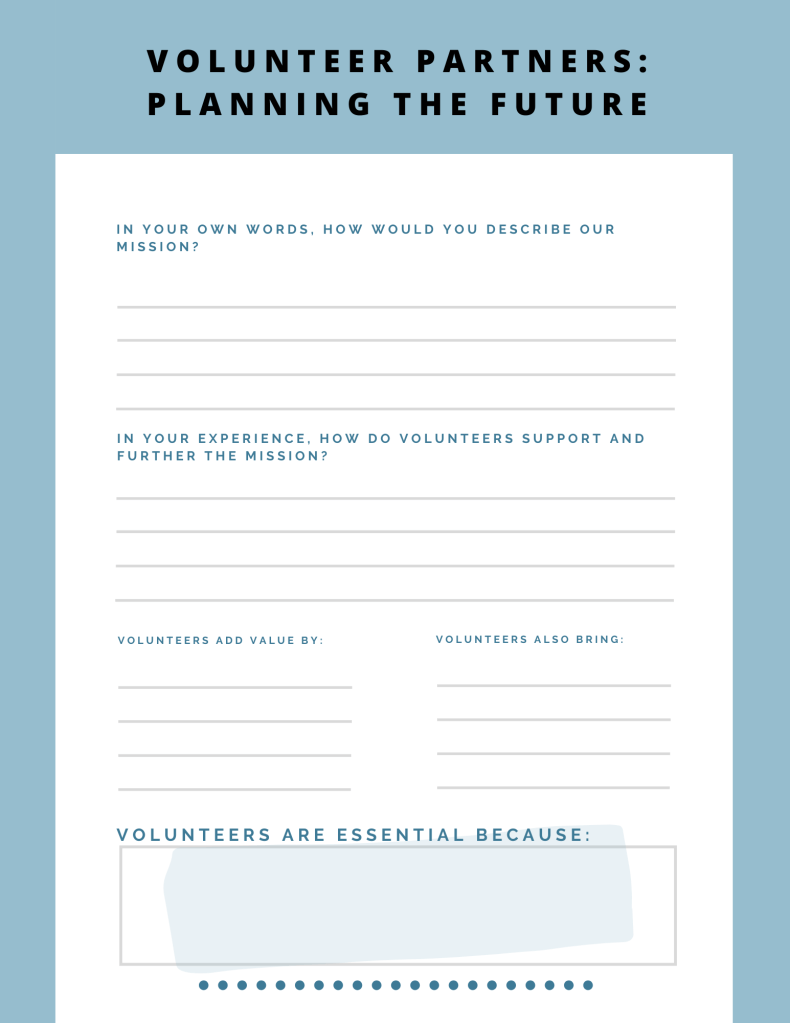
    As we move into a new reality, this is an ideal time to survey volunteers and sort through their thoughts on volunteering past and volunteering future. By gathering their opinions, we can create data that supports our advocacy for a vibrant volunteer initiative.

    Ask volunteers to write down their thoughts on their past volunteering along with their visions for the future. The shorter “list-type” sections help volunteers hone in on specifics. From these survey questions, you can extract key words, phrases and topics and connect the dots.

    For example, under the question “how can technology support your volunteering” on page 5, 80 of 100 volunteers surveyed used the phrase, “keeps us more informed.” On the same page under “volunteers need,” 85 volunteers wrote “training.” Finally, in the box asking, “volunteers feel supported when,” 92 volunteers wrote “when we are included.”

    By connecting the dots, you then can say:

    • 80% of volunteers surveyed will use technology to stay informed
    • 85% of volunteers surveyed want more training
    • 92% of volunteers surveyed feel supported when they are included
    • conclusion: training and technology can be used to help volunteers feel included which supports volunteers and keeps them engaged.

    Hope you can use this, or at least I hope it might stimulate your creative thinking on how to gather data from your volunteers.

    Happy Productive surveying!

    -Meridian

  • Ruts Happen, Even in Fluctuating Volunteer Management

    Photo by Carlos Cu00e9sar on Pexels.com

    We, volunteer managers can get stuck in a rut, even though our days are varied and utterly unpredictable.

    I remember acknowledging I was stuck in a rut when I realized I watched out my open door every morning to see if the marketing director was wearing hose, because our policy attire required hose and she was never reprimanded. Yeah, sad, I know.

    Recognizing a rut

    But it made me recognize I was in a rut. I would arrive, sit down with my coffee, answer emails, make phone calls, then prepare for training, meetings, check ad responses, gather stats and set up interviews. All problems and crazy situations were just bumps in the rut road. Even the volunteer who removed taxidermy from a patient’s home because he couldn’t stand the deer looking at him became a routine challenge.

    Ruts are the dangerous, motivation killing, brain numbing enemy of creative volunteer managers. Ruts destroy our ability to move forward.

    We can be in a rut and not know it. We move slower. We take on nothing new. We look at the volunteer who, without permission, is rearranging the front office every time she comes in and think, “so what.” Every task and every question seems like another stone on our chest.

    Does a pandemic kill a rut?

    Even in a world altering pandemic that changes everything, our new routines can seem like weights because we haven’t fixed our old ruts. The rut just went in a different direction.

    New circumstances don’t automatically alter old perceptions and old inner challenges. New circumstances often add to the burden.

    How did I get here?

    So, how do you get out of a rut? For me, the first thing is dealing with my internal perceptions of the rut I created. By that I mean looking at how I perceive the things I’m doing. For example:

    • Q: why do I care that the marketing manager is not wearing hose?
    • A: because I feel there are different sets of rules for favored staff and I’m being treated unfairly.
    • Q: why do I sit and answer email instead of doing something else?
    • A: because it’s safe and I don’t have to interact personally cause I’m unmotivated.
    • Q: why don’t I care that a volunteer is rearranging the front office without permission?
    • A: I do actually care, but I don’t want to upset the volunteer by having an intervention, it’s so hard.

    Turning the wheel

    To get out of a rut, you have to consciously turn the wheel and find another road. Start small by varying your routine. Read emails at the end of the day. Ask a volunteer to make phone calls. Eat lunch at 10am. Vary your routine so it becomes obvious that it’s not about the order in which you do things, it’s the effort you put into each task.

    Take lots of mental breaks. Lots. Lots. Lots. We, volunteer managers need mental breaks in the best of times. Have your quilting or model airplane or unfinished painting nearby and stop, work for a few minutes on your hobby/project/silly fun doodle/whatever during the day. Clear that brain.

    Take stock of all your successes. Begin (if you haven’t already) to record inspiration-get a notebook and write down the things that inspire you, including quotes, stories, testimonials from volunteers, family, staff, community and your own experiences. Keep these nearby.

    Be un-perfect

    Purposefully forget to do something. Yep, not a typo. Prove to yourself that perfection is not the goal and instead, perfectionism drives you into a rut. Own your less-than-perfect self un-apologetically and don’t hold yourself to a standard you’d never place on a volunteer, other staff member or a person your organization is serving.

    So, I took my own advice and I wrote this post in one sitting, no revisions, re-thinking etc. It’s a mess, I know. Oh well.

    Perfectionism is for rut-dwellers.

    -Meridian

  • Leading Volunteers Takes Both Sides of the Brain

    When a volunteer connects, it’s the best feeling, right? We, volunteer managers love the whole ethereal, elusive, empathetic realm, don’t we? (I can hear meditation music’s lilting strains right now, ahhhhhhhhhhh)

    Wait. I’ve always tried to explain these intangible moments to others. I’ve told stories, dimmed the lights, set the mood, lit candles (yeah, that didn’t go over well, you know, fire code and all) and painted pictures. My audience felt warm and fuzzy. But you know what was missing? No, not wine, I tried that too. Hard data was missing.

    Data is like looking at a night sky. It’s vast and complicated. It’s hard to see patterns and even harder to track. But think about every tech giant out there and how they wrangle data to their benefit. (which is why I keep getting those ads for “look 10 years younger.”) Mining data is hugely important because it shows correlation.

    We, leaders of volunteers exist in a data-starved realm. We typically record volunteer hours, and volunteer numbers. We tell stories. We offer examples. Thankfully most us us are moving into recording volunteer impact. But, there is so much more we can utilize to our benefit.

    Data speaks

    Loudly. Successfully. At a change-making volume. Every minute, data scientists are mining our data to find patterns and formulate paths to harness that data for benefit. (I know, cause I just clicked on “miracle cream guaranteed to erase years.” Woah, only $115?)

    We, leaders of volunteers need to use both the logical and emotional sides of our brain and harness data to successfully advocate for the changes that will further our goals. Let’s look at advocacy language. What argument do you think holds more weight?

    Advocacy language

    “The volunteers I talk to want more flexible ways to volunteers. They will stay longer if we offer them more flexibility.” (mood music and lit candles probably won’t help get the point across)

    “Over 95% of our volunteers stated that flexibility is the number one challenge they face as volunteers and 92% fear that lack of flexibility will force them to resign.”

    Stats and percents are not mathematically difficult to capture. Figuring out what stats to capture is what makes this difficult and finding the patterns to explore is what makes this challenging. (but since when do volunteer managers shrink away from challenges?)

    Begin by checking your gut. (not for digestive reasons-there’s products for that-trust me, I get the ads for those). What nagging issue does your gut instinct rumble about? That volunteers want flexibility? That volunteers don’t feel properly integrated? That volunteers want more meaningful roles?

    Formulate questions on the subject. Be careful not to “lead” volunteers into saying what you want them to say, but rather, explore their opinions.

    Examples of leading questions:

    • Should we get rid of our cumbersome, time-consuming background checks?
    • Should valuable volunteer time be spent on reporting hours?
    • What do you like best about your hard-working volunteer manager? (um, I like this question, but yeah, it’s leading)
    • How unhappy are you with our volunteer appreciation luncheon?

    I’ve been surprised many times by volunteer opinions after I’ve asked open questions and they helped me readjust my thinking to more accurately reflect volunteer needs.

    But avoid just looking for the negative. Both negative and positive results are helpful statistics when you see patterns. For example:

    • 80% of new volunteers stated that orientation helped them integrate. (I can champion orientation based on this)
    • 97% of new volunteers felt having a volunteer mentor made their integration smoother. (I can push for more volunteer mentoring and show correlation between successful volunteering and time spent up-front developing volunteers)
    • 42% of volunteers want online orientation only. (This is a split-needs more exploring)

    Surveys aren’t the only source of data: Participation patterns

    Analyzing recruitment strategies, messaging, successes of additional training all can be done by seeing the patterns in participation. For example:

    • only 13% of new volunteers this month saw that ad in the local newspaper
    • 81% of new volunteers this month scanned the volunteer information on our website (so advocating for more input into the website is warranted here)
    • 37% of volunteers attended an in-person meeting this year
    • 61% of volunteers attended a virtual meeting (so combining virtual with in-person may be the way to go)

    We ask our volunteers’ opinions all the time, because we want to make sure they are engaged. And honestly, our volunteers give us their opinions all the time through their participation. It’s time we analyzed opinions and participation and used the patterns to support our advocating for real change.

    Successfully advocating for your volunteer initiative means ditching broad sentiments like “we have to treat volunteers better.” Instead, hone in on specifics that are backed by hard data you’ve gathered and analyzed. Look for patterns in opinions and participation.

    Connect the dots: For example, 20% of volunteers say the volunteer luncheon makes them want to volunteer more, but 80% of volunteers say additional training makes them want to volunteer more. Spending $750 on the luncheon and only $100 on training makes no sense.

    We have a logical and emotional side and both are essential to a vibrant volunteer program.

    So, once you convince them with stats, then hook them with the mood music and candles.

    -Meridian

  • Benefits of Volunteering: Does Research Miss the Mark?

    “Go volunteer, it’s good for you,” is sorta like looking at a spectacular sunrise and saying, “yep, that’s pretty.” But what exactly does volunteering do for us?

    Many highly respected sources have looked into why volunteering is good for our well-being and their research centers mainly around a given premise.

    Research into volunteering’s benefits on well-being

    One recent article states: “when we help others, we tend to experience what researchers call a warm glow. Second, volunteering is likely to help boost our sense of social connection.”

    https://greatergood.berkeley.edu/article/item/how_volunteering_can_help_your_mental_health

    The premise surrounding volunteering’s benefits typically focuses on our need to belong and the “helper’s high.” Research also concludes there are benefits from sharpening skills that translate into job searching, especially for younger volunteers. And then, researchers conclude that “more research needs to be done.”

    Researchers, here’s my gift to you. Over the years, I’ve witnessed volunteering benefits I haven’t heard anyone talk about. (except other volunteer managers)

    I’m no psychologist and don’t pretend to be one, (unless I can’t get caught) although one time, when I was introduced to a therapist who was seeing a friend of mine, he fixed me in his gaze and said, “stop practicing without a license.” Ok, you got me. But what I’ve seen through the years in volunteering is:

    Volunteering removes a multitude of inner pressures the volunteer feels in everyday life. For instance:

    • Was I paid fairly for my work? Do I make enough money? (when there’s no money involved, guess what? Everyone is paid fairly.)
    • Am I less than any other volunteer? (no, because when I’m connecting with someone who’s hurting, it makes no difference what my title is, how much money I have, how beautiful I am etc.)
    • Is every little thing being criticized/analyzed? (in most cases no-I’m pretty much given encouragement; my volunteer manager is like a coach and has sincere faith in my abilities.)
    • Am I appreciated for what I do or am I just a cog in the wheel? (I feel welcomed when I’m told how needed I am, how much I’m appreciated for showing up. Imagine that happening at my job? Ok, maybe at first, but every time I show up? Ha!)

    But wait, there’s more:

    Volunteering’s additional benefits:

    • There’s a sense of newness/wonder.(I’m excited to come once or twice a week/month etc. and reinvigorate my volunteering.)
    • I can relax and be accepted for who I am. (After my initial nervousness, I realized the organization is pretty chill and a whole heap of pressure came off. I found I’m a lot more talented than I thought.)
    • I’m doing this because I want to. (no one’s making me show up. I’m here because I want to be here. I’m here because I feel good being here. I call it, “my time to be me.” I feel free from the pressures to be a partner, a worker, a parent, a neighbor, and someone’s child. I feel those expectations lift and you know what? I’m a better at all of the above because I’m proving to myself that I’m a good person.)
    • I am doing something meaningful, something altruistic, something free of bringing me money or fame or influence. This has a more pure feel to it. (and thanks to my wonderful volunteer manager, I understand my contributions are really helping. I know my time is valued.)
    • I’ve got a chance to be good on a level playing field. (I feel like my life is kind of a mess right now, but here, I’m told my volunteering is amazing. You know what? I believe my volunteer manager. I can see for myself. My volunteering is amazing and I’m kinda amazing after all.)
    • This is a safe-haven in my storm of life. (wow, how wonderful to have a place to go where I’m encouraged, cared about and can focus on something other than what’s happening in my life. It’s my place of refuge.)
    • My inner skills come out. (I didn’t realize how good I was at relating to people or solving problems or getting things done until I was given the freedom to explore my talents. )
    • I’m connecting with people I’d never get to meet. (New connections open my world, and reinforce my hope that humanity is basically good)
    • I’m learning and growing.

    Research is wonderful, but it needs to look deeper. It needs to ask, “what stifling pressures are lifted when people volunteer? What potentials do people discover when stepping outside their boxes?” And finally, “what well-being benefits are hiding just beneath the surface?”

    In my mind, volunteering is the freedom to be human. It’s complicated, but so basic. Volunteering can peel away the everyday pressures we feel and free us to be our most genuine human selves, the selves we yearn to be.

    who has the answers?

    Maybe researchers could save some time by asking volunteer managers what volunteering benefits they’ve witnessed. You know, expand the research a bit?

    Or wait. Maybe, just maybe, researchers could look into the role a welcoming and vibrant volunteer initiative plays in creating an atmosphere in which a volunteer’s well-being increases. And, oh, yeah, maybe ask what role a competent and knowledgeable volunteer manager who coaches, encourages, mentors, and builds up the volunteer plays in furthering a volunteer’s well-being.

    Hey! Maybe there’s a direct correlation.

    -Meridian

    oh, for more reading (cause ya can’t get enough, right?), here’s an older post on gathering some of these statistics and showcasing them. Maybe researchers would start to take notice.

    Is it Time to Start Selling Volunteer Perfume?

  • Proud of Our Profession

    We are proud of our profession. We are proud of volunteer contributions and of our crucial role in shaping volunteerism. And, in case you want to show it, there are now buttons and stickers available.

    https://www.zazzle.com/collections/volunteerism_buttons_and_stickers-119264092973589463

    For t-shirts, mugs etc., visit the store at

    https://www.zazzle.com/store/volunteerplaintalk

    -Meridian