Category: volunteer retention

  • Volunteer Resilience

    In the last VPT podcast, Laura Rundell wisely chats about resilience, a subject we have been forced to examine in the past year. Laura asks: What is resilience? What masquerades as resilience? How do our volunteers show resilience?

    What can we learn from this year?

    We were unprepared for the magnitude of the pandemic and how it disrupted volunteerism. But, you know what? We, LoVols, deal with disruption all the time. Changes in volunteer assignments, policy tweaks, staff shuffling, new projects implemented, tasks taking precedent over other tasks, organizational restructuring, and then there’s the personal changes in volunteers’ lives that create disruption. We live in the Upheaval Hotel. (Too many volunteers answering that old add you forgot to remove in your room? I’ve got one on the 10th floor with explaining the new policy changes you might like better)

    Because volunteer resilience is key to not only surviving major disruptions, but key to surviving and thriving during more minor disruptions, we are knee-deep in encouraging resilience. Nurturing volunteer resilience is necessary, regardless of a pandemic or a change in policy. So, going forward, what can we learn from this experience?

    I recall a few years back, we had a near volunteer mutiny when a beloved staff member left in a hasty manner. It was not pretty. I was unprepared for the upheaval that followed. But through a series of dialogues, adjustments and extensive follow-ups that centered on resilience, the volunteers stayed. It proved to me that resilience is a mind-set we can help foster.

    How can we help volunteers be resilient?

    • Make change normal: Use change language and lay a foundation that says change is natural and an evolving strategy to move forward. Make the distinction from the need to adapt and pivot (change) on operational issues from the solid core values of your mission that remain foundational and say, for example, “we are adapting and learning to navigate the changes we must make to grow, but we never lose sight of our mission which is the foundation on which we operate.” Make sure volunteers know that the mission is their anchor.
    • Present change as an opportunity: Present change in a positive light by encouraging volunteers to think about opportunities such as, “now that we have to re-think our in-person services, let’s look at the opportunities to utilize different skills, find new talents.” Get volunteers to brainstorm, be part of the process. Change is received more readily when volunteers are part of the change process.
    • Connect to purpose: Offer stories of how the volunteers’ can-do attitude helps those being served. Tell volunteers how they inspire staff and clients to keep going. Use humor and inspiration as stress relief.
    • Debrief and reflect: Always elicit feedback. In change management, feedback is key to navigating change. Not once, but repeatedly, so when you hear the volunteers say, “We get it, you’re always asking how are we doing with these changes,” you’re on the right track. Reflection is a way to embrace the difficulties, to acknowledge the loss of status quo. Reflection is nonjudgmental and healing and allows for the volunteers to express their frustrations and loss. When I experienced the volunteer near mutiny, reflection gave the volunteers a space to grieve over losses without feeling judged. I learned so much by just listening to them.
    • Survivor attitude: Make surviving a badge of honor. We tell volunteers how special they are, so add surviving into that mix.
    • Introduce scenarios into training: I love scenarios because they apply knowledge to real situations. Adding a change scenario is a great way for volunteers to think about how they might act when change is inevitable and a great way to encourage resilience.
    • Admit the struggle: As a volunteer manager, you are good at being honest. Admit the “work in progress” because it’s easier to be resilient when you know everyone else is struggling to be resilient too. It’s the team mentality. We will get through this together.

    Resilience is not…

    Resilience is not forcing volunteers to accept the unreasonable without question. That’s being a door-mat. And it’s good to let volunteers know that you understand the difference between resilience and being taken advantage of and will work to make sure they are treated with respect. That way, when proper changes occur, they will likely be more resilient.

    Oh, and what about you? How’s your resilience holding up? Do you, as Laura says in the podcast, practice self-care and find joy in our profession? Do you seek out other volunteer professionals to vent to? Laura and I chat often, and I have to say, I get so much out of our chats. We’re not alone. We are strong and resilient. Finding another volunteer engagement professional to chat with, laugh with, cry with, or vent with is one of the greatest ways to steady a wobbling boat, to adjust your sails and take a moment to enjoy the journey.

    And feed your resilience.

    -Meridian

  • Volunteer Programs: Incubators or Coops?

    Carla answered my volunteers wanted ad and arrived for our interview early, her potential shining like the buttons on her business suit. She was one of those “oh my gosh, how did I get so lucky” volunteers. Sadly, my organization wasn’t ready for her extensive management skills, but I happily slotted her at the front desk. Bingo, the front desk had a professional-looking person representing us and, gotta be honest, she made me look good for “finding” her.

    Meanwhile, one of the volunteer managers in my peer group was recruiting volunteers for a start-up. He needed a volunteer who could help manage fledgling projects. I immediately thought of Carla. Did I offer to ask her if she would be interested in helping him? Nope, I kept her to myself. After all, I found her,(yeah, ok, she found us, but hey, I wrote that clever attention grabbing ad) trained her, supported her, right? After all that work? She was mine. And if I sent her away, then, whoa I’d have to put a less polished volunteer on the front desk and suffer the ire of my superiors, so I held on to her like a half-eaten surfboard in a sea of sharks.

    Hatch and keep, right?

    A few years later, when outstanding patient volunteer Yosef started to pass on assignments, I knew he was reaching his shelf life with us. I carried guilt from the whole Carla thing (yeah, I know, guilt is bad, blah, blah, bur we, volunteer managers do feel guilty over stuff at times, and that time I was truly guilty of hoarding) and so Yosef and I started looking for an even more challenging volunteer position (yep, offered him all sorts of leadership roles, but none excited him in the way patient volunteering had). He ended up jumping to child advocacy and thrived. And guess what, I felt great about it because he incubated his volunteering with us (just wished I had put that into my reports).

    Brittany McGarry, who recently shared her wisdoms on the VPT podcast, (you can listen here) does this incredible mapping a volunteer’s journey. We want our volunteers to aspire to do more, to be more and we have to be comfortable with letting them sprout wings in order for them to succeed. We should be proud of them when they leave us because they have become so good at volunteering, they move up, whether that occurs within our organizations, or they join a new mission.

    When a volunteer moves up in our organization, we are understandably proud of our hand in incubating them, but when they move to another nonprofit, we may feel like we’ve failed to retain (I hate the word retention, BTW) them. We can’t record their hours. We can’t rely on them to drop everything and come in when we’re desperate. We feel we’ve lost, because our jobs are to get and keep volunteers, right?

    Volunteers are always temporary

    We have to stop the misconception that volunteers are possessions, and until we throw them out, they will keep coming back up to the moment they wear out or die. Instead, let’s speak of volunteers as temporary from the start. They are with us for the time that benefits us and them, not forever or until we dump them. Let’s speak about the privilege to have them for one event, one week, one season or one year. Never forever.

    Fleeting is more always precious

    If volunteers are viewed as permanent fixtures, why bother working hard to keep them? But if we know they are fleeting, it makes sense to work hard to engage them. Their worth increases because they will leave. We must change the lexicon and use “volunteers are temporary” verbiage to change the perception. Simple shifts in language, such as:

    • “while they are with us, our volunteers will…”
    • “as long as they are engaged, they can…”
    • “we are privileged they are sharing their time with us for now, but it won’t be forever.”
    • “for the time they were here, they did xyz”
    • “they moved to a better fit for them and we had a hand in developing their love for volunteering. What a win for everyone!”
    • “yes, they moved on, but they remain advocates for our mission because we made sure their needs were met on an even par with our needs.”
    • “they haven’t closed the door on us because, as advocates, they will continue to us in other ways.”
    • “we are investing in each volunteer so our community benefits. That makes us leaders in sustainable volunteering.”
    • “volunteers don’t leave us, they just change the way they support us.”
    • “volunteering is only one way someone advocates for our mission.”

    Volunteering teaches volunteers about… volunteering

    Each time a person volunteers, they learn something about volunteering. What might they learn in a coop?

    • They expect me to treat this like a job.
    • I have to wait until they find a fit for me.
    • It’s about their needs, not mine.
    • Supporting the mission means doing the grunt work.
    • There is no upward movement.
    • They like me, but don’t include me in things that matter.
    • I’m not in control of my volunteering.
    • I have to be flexible, but they don’t.
    • Sometimes I’m not important.
    • They talk team, but I’m not included, not really.
    • I’m a commodity.

    Volunteers don’t stop helping because they leave us

    Volunteering is more fluid than in years past. Citizen helpers (think the people who rush to help neighbors during a crisis) thrive because they learn that volunteering means immediate action and immediate results. Then, when they sign up to formally volunteer, they discover that volunteering is cumbersome, drawn out, rigid, and limited. And when a volunteer leaves our organization for those reasons, they don’t stop helping, they just stop formally helping our organization.

    I realize we can’t just scrap all our systems in place. But what we can do, is chip away at archaic conceptions of volunteering. We can point out that fluid volunteers move between informal and formal, between organizations, between activity and inactivity. We can ditch terms such as retention (Bleeeech), permanent (that’s a hoot, right?), even long-term volunteers and move towards fluid terms such as active and inactive, advocate vs. former volunteer (see reject a volunteer, gain an advocate).

    Incubate vs. coop

    We, volunteer managers are good at helping one another. We support each other in peer groups, in forums, in phone calls and zoom meetings. We believe that by helping one another, we help ourselves too.

    Photo by Maria Orlova on Pexels.com

    Our community pool of volunteers is there for us to nurture, engage and incubate. By ending the ancient “My volunteers” sentiment, we let go of the struggle to retain a volunteer at all cost. We put the volunteers’ needs on an even par with organizational needs which creates a symbiotic system that not only sustains volunteers, but creates a replenished garden. (more in my book, The Disruptive Volunteer Manager). And it strengthens our partnerships with our fellow volunteer managers, because we are helping one another regrow our volunteer common. (see Innovation and Sustainable Volunteering).

    We are in an unprecedented change era, so let’s make changes that work for us and our volunteers, are forward thinking and position our profession to lead. It’s time for us to be leaders of a sustainable volunteer movement.

    We’ll thank ourselves later.

    -Meridian

  • Yay, Another Holiday Card From a NonProfit!

    https://gratisography.com/

    So, last week, I posted a sharable holiday card for volunteers. Nice, huh, cause volunteers love getting cards from organizations, right? Cards mean we care, we appreciate (and we all know volunteer appreciation, no matter what it consists of, especially if it involves balloons, is the key to volunteer retention), we go the extra mile to engage our volunteers. What could be wrong with that?

    Volunteers love getting cards, right?

    Funny thing. Ironically, as I was sitting at my desk, on my laptop, posting the volunteer card, I was also looking at a pile of holiday cards I received from various nonprofits I’ve volunteered for. And my reaction to some of them? I just laughed. (Not the intended reaction, I’m sure)

    I laughed because I’ve been inactive at some nonprofits. I’ve not been contacted, surveyed, or asked what I’d like to do or heaven forbid, why I am not volunteering anymore. I’ve not been offered any “opportunities.” I basically sit on a list, like countless other volunteers. My name is a number.

    But, it’s my job, isn’t it?

    I have to admit, I’ve been mindlessly guilty of thinking cards mean the same thing to every volunteer. I’d think “hey, I HAVE to keep in touch with each and every person that even so much as breathed the words, “what’s this volunteering about?” I’d think, “how can I keep my hooks into this prospective volunteer?” And I also thought, “if I send this pretty card, surely that will make this inactive (or grieving or ill or suffering or unsure) volunteer whip out their phone and give me a jingle.”

    I could picture that volunteer, gazing at the glittery goodness, thinking, “wow, I’ve been so selfish. I need to contact Meridian. It doesn’t matter that the department she assigned me to never followed through. She’ll get me something better, I just know it!”

    So what if the message doesn’t resonate, it’s a pretty card!

    I knew a CEO who thought that volunteers would feel special getting cards signed personally by her. Never mind she rarely interacted with volunteers during the year.

    As a volunteer, I look at the cards from certain organizations as a waste of time and money. I actually feel that instead of connecting me to the organization, it has the opposite effect. The tone-deaf mindset alienates me further.

    So, don’t send cards? No, send them, but not mindlessly. Some of the cards I received included timely messages about the organization’s work. I find that more engaging than a simple signature. But a message to me as an active volunteer when I’m not, is tone-deaf.

    If I haven’t volunteered of late, messages such as “and thank you for volunteering this year,” reinforces the perception that the organization does not know me, nor cares to. Do I want to volunteer for them now? Eh, probably not, especially if I’ve not felt engaged when I did volunteer.

    In simple math, more volunteers=more work

    Once there are more than 30-40 volunteers, the ability to track them personally diminishes, which is why every volunteer manager needs his/her own volunteer administrative help to keep track of each volunteer’s status. Then, cards can work when a more personal message is included.

    And you know what? If one of the holiday cards I received had simply said, “We miss you,” I’d have felt like they were talking directly to me. I’d have felt guilty, intrigued, pleased, and motivated by those 3 simple words. Keep your glittery goodness. I want to be acknowledged as a human being.

    Glitter or Connection? Um, connection please!

    I’m involved with a start-up. I’m not getting a card from them. They have no regular meetings, no luncheon and drat, there are no balloons, ever. Everything is chaos. But you know what? They know me. That’s my glittery goodness.

    Managing personal connections with volunteers is not easy. It’s not simple. It’s not perfect. However, we can chip away at tone-deaf messages by looking at the causes and by forming solutions such as,

    • I have too many volunteers to keep track of personally: It’s easy to connect with volunteers who are outgoing, give a lot, are dependable, communicate, ask questions etc. Connecting with the rest of the volunteer team is challenging. Get volunteer administrative help now. Once I did that, things got better. A whole heap better. Here’s my complicated math equation. Every 25-50 volunteers=1 part-time volunteer administrative helper. I also had one designated volunteer to manage prospective volunteers. (she was so busy, she came in twice weekly. But you know what? More prospective volunteers followed through, thanks to her communication skills)
    • I’m unsure of volunteer preferences: Use surveys, whether informal or formal. Explain why you are surveying the volunteer-“because we want your experience to be a meaningful one. It’s a win-win for us, for you and for the people we serve.”
    • volunteers come and go, so I don’t know who is active, inactive, temporarily unavailable and I can’t create personal messages for everyone: Fair enough, so pay attention to language. What message would resonate or at least not sound tone-deaf? What would an active volunteer, an inactive volunteer and a volunteer who wants to be active, but can’t, all want to hear? Maybe scrap “thank you for volunteering,” and say something like, “every volunteer has contributed to our successes in our fight to eradicate homelessness” or “volunteerism is at the heart of our work and we want to acknowledge your contribution, past, present and hopefully, future.”
    • I can’t always know that a volunteer is sick, or their loved one died, or they got laid off: We can’t, and although it pains us, all we can do is be honest. “I didn’t know. You are valuable and we want to know your status, not because we want something from you, but because you are one of us.”
    • some volunteers are not returning calls, emails etc: This goes against every fiber of our volunteer manager hearts, but send the volunteers who are MIA a letter/email/card/call letting them know that they are welcome back anytime they wish to rejoin, but you are removing them from further volunteer updates. Then, remove them from the volunteer list. (OMG, it hurts to type “remove” and volunteer in the same sentencenooooooooooooo.) Keep them on general lists, because you want that volunteer to continue to be an advocate for your organization.

    To send cards, or not to send cards

    Are we sending cards because it’s always been done this way? It’s tradition? I’m not saying don’t send, but how much in volunteer management is done because it’s always been done this way? It’s time to re-think volunteer engagement messaging, language and methods.

    What resonates with your volunteers? 2020 has given us the opportunity to change the way we engage volunteers. As the leader of volunteer engagement and impact, look at everything with a fresh eye. You got this.

    Oh, BTW, here’s the holiday card I’ve always wanted to send:

    let’s be real

    -Meridian

  • Volunteer Motivation: Past, Present and Future

    architecture building city concrete
    Photo by Juhasz Imre on Pexels.com

    Alana clicked the wireless presenter and the slide advanced. “Here,” she said, “we have a list of awards our volunteers have won.” Photos of volunteers holding certificates popped up on the screen. “As you can see,” Alana said, “the work we do is impressive.”

    A young trainee in the front row raised his hand. “When did they win those awards?” He pointed at the picture of a smiling lady, her silver hair shining in the stage lights.

    Alana glanced at the screen. “I wasn’t here at the time, but Marge won that award in 1999 I believe.”

    For some volunteers, 1999 might as well be 1899. Past performances are the equivalent of telling your children that “when I was your age, I walked to school. Five miles. Uphill. In the snow. Both ways.”

    It’s old news. But woah, hold on, wait a minute. So, when recruiting and on-boarding volunteers, should we just ditch mentioning our volunteer awards and heck while we’re at it, should we just forget about talking about our accomplishments too, because that stuff happened last week? Should we hide our best volunteers in the closet because hey, they’re so yesterday?

    No, that’s not even close to what I mean. I am all for showcasing awards and accomplishments and sharing volunteer achievements with anyone and everyone. I am all for nominating volunteers for awards. In a previous post, Awards: The Bridge to Inspire I listed reasons for nominating inspiring volunteers. I am all for exposing new volunteers to passionate and inspiring experienced volunteers. So, what do I mean?

    Past awards and achievements are like a building’s foundation. They illustrate the strength of mission worth and goals achieved. They show the new volunteer that your organization has a solid base and has worked hard to lay down an infrastructure on which to continue building.

    One thing I discovered when parading “accomplished” volunteers through training sessions was, there seemed to be a growing sense among the new volunteers of “what do the accomplishments of this seasoned volunteer mean for me? Am I supposed to duplicate their ways or will I have my own volunteering path and is there anything left to be done?”

    The modern volunteer needs to get excited about their volunteering journey. Much more than in years past, volunteers are looking at the future instead of being content with the present. It’s a subtle, but significant shift.

    What does that mean for us then, when it comes to recruiting, retaining and on-boarding new volunteers? It means balancing past volunteer awards and accomplishments with present goals and visions of the future. It means setting the foundation and then inspiring new volunteers to put up the walls, or decorate the interior or construct another floor. It means focusing on continually moving forward.

    Getting in on the ground floor of any enterprise is always exciting. There’s a sense of ownership, of possibilities, of seeing an idea take flight. As a society, we love start-up successes because those stories are filled with grit and vision and frankly, we imagine that those people could be us.

    Even though we may not work for a start-up organization, we can capture that feeling by introducing expansion, new programs and future vision to the new volunteer who may be sitting there wondering, “why, exactly do you need me when you already have all these great volunteers doing all this great work?”

    By balancing accomplishments with future goals, we infuse a sense of organizational history with a vision for the future. And nothing is more infectious than an inspiring vision. It gives new volunteers their own identity. It means that they won’t feel as though they have to mimic past volunteers in order to win an award. Instead, they will look forward to making their unique mark.

    Past infused with future looks something like this:

    “As you can see, our volunteers have won numerous awards for their work, something we are extremely proud of. Now, let me tell you about the exciting direction and future plans for our organization, which needs your passion and help to accomplish.”

    “Our volunteers have given over 70,000 hours in the past 5 years. It’s a testament to their belief in our mission. That’s why we are expanding our programs. These new programs are innovative and we’re really psyched about all the future possibilities. That’s where you come in.”

    “Thank you for listening to our volunteer, Kenya. She has been instrumental in getting that program off the ground. You may choose to volunteer in her area, or we have some new and I think, pretty out-of-the-box opportunities in the infancy stage you may find suit your skills and interests.”

    New volunteers learn a great deal about mission work and goals from the past, but they are motivated by the excitement of what’s to come and how they fit into visionary plans.

    They want to own the future. Let’s make sure we give it to them.

    -Meridian


  • When Staff Doesn’t Like a Volunteer Part 2: A Success Story

    adult art conceptual dark
    Photo by Pixabay on Pexels.com

    What happens when staff doesn’t like a volunteer? Does the volunteer quietly quit because they never get called or do staff begrudgingly put up with a volunteer they dislike and work suffers? What can we, the volunteer program leader do in these situations?

    A leader of volunteers, who is a good friend and colleague recently shared this experience with me:

    I remember one of our volunteers, Steven. Staff would run the other way when Steven came in because Steven always had an idea or a plan to improve our organization and the way we operated. It would frustrate already overworked staff to listen to all these critical ideas.

    But what they didn’t know about Steven was he would take the assignments other volunteers wouldn’t take. He actually volunteered for a lot of shifts, ones that needed filling. He was both annoying and indispensable at the same time.

    It was exhausting, knowing how dependable Steven was and yet being frustrated at his frequent sharing of plans to improve our organization. But then one day, a solution came in a most unexpected way.

    A staff member, Allie who was in charge of a large project involving the creation of a detailed cataloging system needed volunteer help. The assignment meant working in a basement on a very cranky machine. Most volunteers wouldn’t want to tackle such a cumbersome project in a dingy basement so I thought of Steven. I asked my boss if I could approach him with the proposal and fortunately, she agreed.

    The staff member in charge of the project was willing to give Steven a try so I approached him, saying, “look, Steven, saying no is ok. I’m asking you to work on a temperamental machine in a basement here, but it is crucial work that needs to be done.”

    To my surprise, Steven replied, “I would love to do that.” And the interesting thing that happened, was Steven got to see behind the scenes at our organization and by working directly with staff, began to realize how little time they had for all these ideas and projects he had been pushing on them.

    I knew that pairing Steven with this assignment was a success when all on his own, he recruited another one of our volunteers to help with the project. I even overheard him one day pipe up when hearing a group of volunteers grouse about how slow it was taking to get an answer to a question and say, “you don’t realize how busy the staff is here.”

    With Steven I knew that I could either sit back and just let him drive me crazy or I could understand how much he cared about the mission. I realized his complaints and ideas came from his desire to support our mission, not from some need to complain.

    I remembered something I heard from a very wise peer that stuck with me: “That one unhappy worker might be the lone voice in the wilderness telling us something we need to hear. We need to ask: Why are they miserable? Maybe, they have a point.”

    When dealing with complaining volunteers, we have to examine whether or not it is the message or the way it is presented that irks us. And staff must realize that a volunteer’s role is not to make staff happy.

    Just as every staff member needs direction from their supervisors, volunteers need direction from the person supervising them. We can’t expect volunteers to read our minds, so as leaders of volunteer programs, we need to train staff and show them that volunteering is a two-way street. That’s where the successes lie.

    So, from this experience, we know we can salvage a staff/volunteer relationship that has soured. Let’s look at the volunteer manager toolbox and pick out some tools that work in these types of situations:

    Mediation: One of the most important tools a volunteer manager possesses. Stepping back and thinking about three basic things helps us to mediate.

    1. What is the best outcome for our mission?
    2. How will volunteer A satisfactorily arrive at the outcome?
    3. How will staff member B satisfactorily arrive at the outcome?

    By focusing on outcome, (a capable volunteer and a reasonable staff member will find a way to work together to further mission goals) we can then create a mediation plan.

    Look for the interests of each party. For a volunteer, it may be they believe they have good ideas and need to be heard. For a staff member, it may simply be they need quiet time to get their work done. How then, can these two interests be addressed to the satisfaction of each party?

    Picture a continuum: On one end the staff member would give the volunteer complete attention at all times. On the other end the volunteer would work in silence at all times. Begin to move the ends toward the middle-what would that look like? Maybe staff could spend 5 minutes with the volunteer when they arrive and update the volunteer while listening to any new thoughts. Maybe the volunteer could be instructed to bring all new ideas to the volunteer manager who would present the ideas in official ways.

    The point is to craft the movement of the two sides towards one another, keeping the mission as the goal.

    Story crafting: A skill that serves volunteer managers well. In the above Steven story, our volunteer manager deftly created a story. By thinking of volunteers and staff members as stars of a story, we can more clearly ‘write’ the ending in our heads. We can envision ‘reading’ that volunteer Steven was paired with staff member Allie which resulted in a mutually beneficial relationship. It helps us to step back from the situation and look at it logically with a positive outcome or ending in mind.

    Another use of story crafting is to present each side in mediation with the story of the other side’s point of view. Telling Steven how much work needed to be done was a story meant to educate him on the enormous work load on staff. Telling Allie how volunteer Steven would take assignments no one else would take was a story meant to inform Allie that Steven was committed to getting the job done.

    Positive identification: The tool volunteer managers use daily. Let’s look at Steven’s success story. How did staff view Steven? They saw him as a hypercritical, over-simplifying volunteer who continually offered up unwanted ‘solutions’ to problems that either did not exist or were being addressed in other ways. What did they not see? They did not see Steven’s passion for the mission, his willingness to help in any manner, nor his desire to more fully understand organizational workings.

    Tapping into volunteer’s motivations will yield clues to their behavior. Maybe the needy volunteer just went through something tragic and is hurting. Maybe the talkative volunteer is isolated. As volunteer managers, we can humanize our volunteers so that staff sees them as more than just temporary help. We can highlight the volunteer’s character by sharing the positives we witness. Sometimes our humanization needs to use the word ‘but.’ For example:

    Volunteer Millie lost her husband of 45 years a few months ago and is a little raw but she is so grateful for her husband’s care that she is committed to learning our system so she can further our work. She wants to be a help to us, not a burden.

    Volunteer Asher lost his job due to cutbacks but he is passionate about helping end hunger and actually considers this an opportunity to make a difference in the world. He says he feels privileged to learn from our staff.

    Matching: The volunteer manager tool that is always sharp. By pairing Steven with staff insiders, he was able to see first hand how overburdened staff were. He was able to integrate into the bigger picture and thus became a champion for not only the mission, but for the very staff that had rebuffed him before. And by choosing a staff member who was willing to work with Steven and most likely had a personality that would benefit Steven, our volunteer manager made a successful match.

    Now here is the really interesting part in all of this. Experts say that behavior is the outward expression of attitudes, but that if behaviors are modified, attitudes can change. Look at the Steven example. His attitude changed. And as his behavior changes, staff’s attitude towards him and possibly other volunteers will slowly change as well. So, if we can mediate behavior changes in staff and volunteers, we may just end up with attitude changes.

    Next time: Part 3. Laying the groundwork for volunteer engagement that takes into consideration personalities, character, attitudes and behavior.

    -Meridian

  • Volunteering and the Goldilocks Margins

    Volunteering and the Goldilocks Margins
    photo courtesy of https://gratisography.com/

    Do volunteers wander from organization to organization, sampling the volunteer porridge or sitting in different volunteering task chairs, looking for the opportunity that is “just right?”

    Some volunteers do exactly that, while others might taste a cold volunteer encounter and walk away for good, equating all volunteering with their one, less-than-perfect experience. Some volunteers are undeterred and will continue searching for an opportunity that fits. The point is, the more we set a foundation for finding a “just right” volunteer experience, the more volunteers will at least try us out.

    Our earth exists in the Goldilocks zone, the habitable area around the sun. In this zone, conditions are optimal to sustain life such as presence of liquid water, luminosity of the central star, gasses etc. In other words, there are variables, which when combined, create the optimal backdrop for life to form and thrive.

    Can this be applied to volunteer engagement? Do we need more than a friendly face to recruit volunteers, and to sustain them?

    Well, let’s examine these common statements about “getting volunteers”:

    • “Just ask.”
    • “There are lots of people out there with time on their hands.”
    • “You can’t tell me that a few hours on a Saturday is a big deal.”

    What is so wrong with the above statements? For one thing, they are simplistic extremes (like hot and cold porridge) and do not take into consideration the conditions that must exist for volunteer engagement. Volunteering conditions, like the Goldilocks principle have to fall within certain margins in order to attract and sustain volunteers.

    Just as distance from star, liquid water and atmosphere are the major conditions for a habitable planet, there are major conditions for engaging volunteers. When our volunteer programs fall within the optimal margins in the following three conditions, we have created a volunteering Goldilocks zone.

    1. Volunteering must be seamless. Not easy, but seamless: A prospective volunteer needs a response within 24 hours (48 on weekends) or else our “urgent need” is meaningless. Steps to volunteering must be clear, relatively simple and able to be completed in a timely manner. Any glitches, or unreasonably long waiting periods will dim a volunteer’s enthusiasm. This doesn’t mean we need to accept any person without reservation, vetting or orientation. It means the process must make sense to the volunteer and not fraught with unnecessary obstacles. If we proclaim we want volunteers, we have to show it by a seamless onboarding process. We must not advertise volunteer roles and then use bait and switch to get volunteers to fill roles we need to fill. We can’t over-onboard or under-onboard volunteers. We need a system that is practical, understandable and frankly adaptable.
    2. There must be meaning in the volunteer work: Volunteers want to make a difference. Every task or role needs a direct connection to the mission. Every task or role must be explained so volunteers clearly understand why their help is crucial, why their time is valuable and why we wanted them in the first place. Even less exciting volunteering roles support the mission. It is imperative we convey the impact roles and tasks have on furthering our work. Not enough conveying of meaning drives volunteers away, but so does gushing over them and treating them as though anything they do is the most amazing thing in the history of volunteering. Volunteers need meaning that focuses on the work and how they have contributed.
    3. Communication is crucial: This is probably the most basic condition. Volunteer communications must be clear and on point. Impact on mission, appreciation for their time, clear instructions, organizational policies, changes in org policies are all examples of the areas that volunteers need clear and direct communication. Obviously too little communication begets disaster but bombarding volunteers with too many emails, or phone calls also can turn them away.

    These margins are only the beginning. Just as in the Goldilocks zone where other, more subtle influences determine if and how life can be supported, there are unique volunteering influences that can impact whether a volunteer decides to share his/her time with us. Some of these variables are:

    • Does the task fit within an acceptable time frame?
    • What skills are necessary to do the task?
    • How far away is the task site?
    • Is the task recurring, one time or sporadic?
    • What support can be expected?
    • How much training is involved?
    • What responsibility level is involved?

    Each one of the above variables contributes to a volunteer’s commitment. When the “just right” foundation is in place, then the above variables can be adjusted for an optimal experience.

    Volunteering needs a Goldilocks zone, one in which careful planning creates the favorable conditions for engagement. It’s not about luck, or happenstance or just asking anymore. It’s about the creation of an engaging atmosphere, followed by attention paid to all the other, unique conditions that might drive a volunteer away.

    It takes a knowledgeable, experienced and fearless volunteer manager to push an organization into the volunteer Goldilocks zone. Optimal margins for volunteer engagement require the participation and buy in from the entire organization, not just the volunteer department.

    So, as we consider the conditions in which volunteering engagement is optimal, we can begin to lay our Goldilocks foundation.

    Let’s be a habitable volunteer planet. Let’s be just right.

    -Meridian

  • Attention: The Volunteer Department Now Has Ground Rules

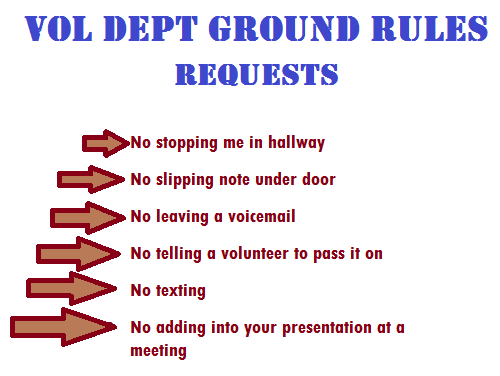
    Ground Rules for Volunteer Departments

    “I need 8 volunteers or maybe 9, no wait,” she says, grabbing your arm in the hallway, “yeah, make it 10, the more the better, right?” Her attention is on the person down the hall, but she glances over her shoulder. “Have them at the Reed Center at 9 tomorrow.”

    Well, hello ground rules. Continuing the conversation from last week, (and a big shout out to everyone who weighed in here and on LinkedIn with great ideas on their excellent ground rules) here are two ways to look at setting them up.

    MY OWN PERSONAL FANTASY GROUND RULES:

    Three staff members request volunteers. Count the number of letters to determine which request gets top priority: The smallest number of letters wins.

    Amy: A

    Roz: R

    Herschel: H


    Ground Rules

    As you can see, Herschel clearly wins even though he only gave 3 days’ notice to find volunteers versus the week Roz gave.  And Amy, well, it will be a cold day in Honolulu before she gets a volunteer, unless it’s the guy that has to do court ordered volunteering, the one that talks incessantly about how he only had two beers when he crashed into that tree. Yep, Amy, I got your back.

    Ok, now for real. What are some of the priorities that can actually be weighed against less important requests? When proposing the adoption of priorities versus non-priorities to upper management, bring a few examples of how you look at prioritizing volunteer engagement.

    And don’t be afraid to drop the “S” word: Strategy. As in, “in order to better serve the mission, let’s strategize our priorities.”

    Your list of examples will spur senior management to adopt a “Priority Principle.” Setting priorities means asking the following questions and assigning a weight to each one. Weight determines priority status.

    Do the clients come first, no matter what? What does the mission say? Clearly, the client’s needs are the reason we exist. This is a great place to start, because weight should be the highest.

    What does the organization need to run smoothly? Volunteers are vital in keeping the organization running. Do volunteers fill in for staff when they are absent? Do volunteers take weekend shifts? Do volunteers occupy roles that must be filled in order to serve clients? The weight here has to be really high.

    Which stakeholders count the most? Donors, dignitaries, potential clients and influencers all carry weight. What events or strategies involve the most bang for the buck? This is where weight will flesh out low priority requests. Staffing a booth at a last-minute  weekend fair carries little weight against an annual festival with high visibility attended by key stakeholders.

    Is the time frame reasonable? Weight needs to balance up and down between last-minute and timely requests.

    Is the request feasible? It may be hard to define feasibility, because we typically entertain all requests. (which does not imply all requests will be met) Having a listing or report outlining the skills, availability and interests of the volunteers can be applied against requests. Weight is equal to feasibility. For example, you can say…

    At this time, we do not have any volunteers who have an interest in washing the board members’ cars as a ‘thank you.’ Time spent trying to convince our volunteers that this activity is more meaningful than engaging with clients or keeping the reception desk staffed will deplete precious time from requests that further our mission.

    What is the amount of work involved when enlisting volunteers? Work=time=there’s only so much, even if you work sixty hour weeks. How many volunteers are requested? How specialized are the skills needed?

    Are any of the following factors within the request out of the norm? (timeframe, location, ability to get to assignment, duties, weather, duration, stress level, etc.) Complicated requests require additional time and if the complicated request holds a high priority, then the weight of other requests is reduced by a factor reflecting the extra effort needed to obtain volunteers.

    How does this engage volunteers? We must add this one into the mix. Volunteer retention or sustainability is directly related to engagement. Strategizing retention must be highly weighted and given top priority.

    We may not agree with all of the decisions made when administration strategizes priorities, but we have to be flexible because having administration’s ‘stamp of approval’ will be worth it the next time a flurry of requests are dropped on your desk.

    Volunteer services is not a buffet of ordering without end. Actually, even buffets have a limited number of choices if you think about it. I can’t get Tantanmen at any of the buffets in my area, although I crave it. So, why should anyone be able to “get” a volunteer to sit outside the chapel “just in case an upset family member should enter?”

    Professional, efficient volunteer departments need ground rules in order to ensure the priority requests are met. After all, at year-end, the organization is no better off because you ‘got’ five volunteers to dress up like clowns at some poorly attended event, right?

    -Meridian


  • And The Gold Medal Goes To…

    And the gold medal goes to

    By any chance, did you watch the Volunteer Manager Olympics last night? Oh my gosh, it was exhilarating. Volunteer managers from all over the globe participated in events showcasing the best practices in engaging volunteers. In case you didn’t get a chance to see it, these are a few of the event highlights:

    Negative News Delivery to a Volunteer Curling: Wow, this is a tough event that takes skill, straight forward delivery, an eye for “spot on” results and messages that stick. Volunteers had to slide their “message stone” onto the button and curl around the “objection stones” in their way.

    Volunteer Manager Juan deftly took gold by sliding his message stone onto the button (bullseye) when he took an errant volunteer aside and showed her a copy of the policies and procedures manual outlining the reasons she couldn’t accept jewelry from the client. He curled around her “objection stone,” her objection being that “the client insists and I don’t want to seem rude.” His stone was spot on because, when he explained the importance of clear boundaries, the volunteer not only understood the policy without getting angry, she vowed to help educate other volunteers on boundaries. Go Juan!

    Volunteer Manager Darise took silver when she curled around a teen volunteer’s snide objection stone (“Don’t forget, my mom’s a senior manager!”) and stood her ground, saying, “no, you are not allowed to bring all your friends to hang out here, this is an organization doing meaningful work and we expect everyone to comply.” Darise said that she often practices in the mirror before having difficult conversations. Sure seems like that practice paid off!

    Avoiding Disruptions and Setting Priorities Giant Slalom: This is an event that rings true for all volunteer managers. Barreling downhill towards a finish line, these Olympians had to get by the gates of distraction.

    Volunteer Manager Gwen took her first gold medal in this event. She deftly navigated around the distraction gates by posting a sign on her closed-door that read, “Volunteer Planning Session 1:00-2:00 in progress. I will be available at 3:00.” This year she added a new skill and only checked her email twice in a day, which meant that she actually got some work done on a project. When Gwen accepted her medal she said, “I’m accepting this for all those volunteer managers out there who are struggling with constant disruptions and want them to know that they too, can set priorities.”

    Volunteer Recruitment Snowboarding Halfpipe: This crowd pleasing event shows off volunteer managers’ creativity and flexibility. On the halfpipe of volunteer recruitment, volunteer managers perform their best tricks.

    The gold went to Volunteer Manager Amir after the judges scored a record 95.7 for his recruitment run. Putting down tricks such as ‘creating a volunteer recruitment task force’ and ‘revamping the organization’s website to include easier access for prospective volunteers’ gave him a solid start. But the biggest cheer was when Amir threw in his signature trick, the “Amir Woo a Volunteer” where he equips staff and volunteers with business cards that read, “We Want You to Volunteer, call this number.” Amir told reporters, “trying new ideas paved the way for my gold medal run. Not everything works, but I’ll try it and see what does.” Thanks Amir, you make me want to try something new!

    Volunteer Sustainability Ice Dancing: In this visually stunning event, pairs of volunteer managers from unrelated organizations perform a volunteer retention ice dance together to inspire volunteer sustainability. It is the epitome of cooperation and working in unison for volunteer engagement.

    Two newcomers and this year’s gold medalists, Volunteer Manager Jason and Volunteer Manager Yumiko took the arena by storm when they ice danced to “We Are Family” by Sister Sledge. Jason, who manages volunteers at a museum and Yumiko, who leads volunteers at a woman’s shelter performed a magical twizzle. They cooperatively shared volunteers by assessing their volunteers’ talents and referring idle volunteers to each other. They also alternated providing training and continuing education to both groups of volunteers which built a camaraderie and inspired volunteers to help both organizations. Jason and Yumiko received a standing ovation.  At the podium, a joyful Yumiko said, “It’s so great to see our volunteers working to help both of our organizations. It makes Jason and I proud when our volunteers get together and share ideas.” Jason agreed as he hugged Yumiko. “We feel it’s about thinking of the volunteers’ needs and not about being selfish.” Congrats Jason and Yumiko, you two are the future of our sport.

    Wow, I’m hoarse from cheering. What a great representation of our sport, er profession. The future of volunteer engagement is looking bright.

    -Meridian


  • The Volunteer Ripple Effect


    I’m convinced. We, Leaders of Volunteers (#LOVols) hold in our hands more power to affect positive change than we can even imagine.

    We have the opportunity to impact the world beyond filling tasks and adding to our volunteer base. The intuitive feelings within each of us are spot on: There’s so much more going on than our excel spreadsheets show.

    I remember long ago struggling to find volunteers who could be with clients while loved ones attended church or synagogue or temple or mosque. I would look for volunteers of that same faith and hoped that they would be willing to give up their own attendance to help someone in need. It was the way it had always been done and it was frankly, exhausting.

    Then one day, a volunteer stepped forward. Hannah offered to sit with Christian clients on a Sunday morning. (I’d love to take credit for thinking this solution up, but, no, it came from this wonderful, selfless volunteer.) Bam! The light went on.

    I feared that mixing faiths (or cultures, or beliefs) would be a challenge in itself, but you know what? (Of course you know what comes next) It ended up uniting people in mutual respect and a desire to understand one another. The mere act of reaching across a cultural or spiritual divide created its own sense of wonder.

    And here’s the thing. For the volunteers, it was never about, “oh, I’m so enlightened that I want to transcend these differences.” No, it was, “you know what? I’m free on a Sunday morning and you need someone, so what could be a better fit?”

    The deep meaningful by-products of volunteering are seldom the initial goals. They just naturally evolve because the volunteer ripple brings out the best in everyone: Clients, families, volunteers, volunteer managers, staff, neighbors, community, everyone.

    Think about that. Volunteer programs impact society in rippling positive ways beyond the delivering of meals, or escorting a tour group or passing out information. Our programs share love. Our programs open the doors for unity, connection and understanding to naturally take hold, and not just during holidays.

    We often witness a profound change in people. We glimpse moments of powerful interconnection through the simplest of assignments. We stand, watching that small pebble create ripples of inspiring stories.

    As you are running around this holiday season, scrambling to fill tasks, stop for a moment and think about the societal change you are helping to bring about. Because you value the innate worth of each human being and believe in their ability to transcend, you are spreading that change like a ripple in a vast sea.

    Volunteerism is a rippling movement.

    And leaders of volunteers are tossing the pebble into the water.

    -Meridian

  • Press “2” For That Volunteer Question

    Press 2 For That Volunteer Question

    “Yeah, so, this is Ginny from donor relations,” the voice on the phone sighs. “My next door neighbor’s fourteen year old daughter, April has a volunteer assignment for school. Why they are coming to me, I don’t know but just because I work at a non-profit, they think I’m free to help with all their little projects. When is the next volunteer training, or better yet, you call them. I don’t have time for this nonsense.”

    “Hey, I’ve been calling you for an hour. Where are you? Anyway, this is Jazz from administration.”  The voice message plays, Jazz sounding out of breath.  “I need volunteer stats ASAP for a grant for our project that, oh, never mind, I just need some stats and fast to complete this application.  How many hours did volunteers give last quarter? This is the last component on the grant and it’s due today so I need this right away. Call me immediately.”

    “Yo, this is Dean in records. The new volunteer, Charles, the one you sent us last month hasn’t been logging any hours, at least I don’t think so. I thought these volunteers knew what they were doing. Anyway, where does he fill out his paperwork again? And should he just make up hours for the time he worked?”

    Do you get tired of answering the same questions over and over? While we are conditioned to give that personal touch, our time is pretty precious and continually answering simple questions can eat into our efforts spent cultivating volunteers, forging new recruitment avenues and solving challenges.

    Taking a proactive approach can help. Think about all the standard questions repeatedly asked by staff and volunteers. Can these be put into a cheat sheet? Where can these cheat sheets be stored for maximum viewing?

    We have to remember that folks don’t necessarily remember something told to them one time. Volunteers will forget specifics taught to them in orientation. Staff is too busy with their own pressing duties to remember the date of the next volunteer training. So, storing these cheat sheets in multiple areas will cut down dramatically on repetitive phone calls.

    For volunteers, some visible places to store cheat sheets:

    • on a designated area of your website
    • as reminders in your newsletter
    • posted in your office
    • included in your welcome packet
    • given to volunteer mentors to share with newbies

    For staff:

    • on an internal website
    • sent out as a quarterly email blast
    • given to department heads to post
    • at departmental meetings (ask to attend other department’s meetings to answer volunteer related questions, explain policies, intercept issues etc. )
    • on surveys sent to staff
    • posted in your office in case you are not at your desk
    • training dates posted prominently in your office (whiteboard, poster etc)
    • training dates printed on flyers, cards etc and given to staff (great recruitment tool also)

    Besides cutting down on repetitive questions, posting core volunteer information creates an informed team of staff and volunteers who will disseminate correct information to potential volunteers. And, if volunteers have to constantly try to pin you down for simple questions, or if they always receive incorrect information from uniformed staff, they will quit out of frustration.

    Elevating our vocation includes creating a comprehensive base of information visible to staff and volunteers. The more we polish the fundamentals of our volunteer programs, the more we can build upwards.

    So, go ahead and press “2” for that volunteer question. But press “1” to leave the name and contact information of a prospective volunteer.”

    Let’s make our systems work for us.

    -Meridian