Tag: charities

  • Resting on Nonprofit Laurels

    Resting on Non-Profit Laurels
    courtesy of gratisography.com

    I don’t remember the date, but I remember the conversation. It was the first time I’d heard the word “competition” in relation to volunteer organizations. I was in a community meeting and nonprofit experts were discussing the impact of a newly formed non-profit in the area.

    “They’ll be looking for the same resources,” one expert said.

    “Yes, we now have competition,” another added.

    Huh, competition. That’s one way to look at it. But here’s the kicker statement from the CEO of one of the established titan organizations. It’s a statement that stuck with me. “I wouldn’t worry too much, because we’ve been in this community for years and the public knows us and knows we care.”

    I might add that the start-up organization did very well.

    Do established nonprofits have a monopoly on compassion? Or on knowledge on how to solve societal challenges? I have always suspected that the underlying reason volunteers are not fully integrated is because they are seen as outsiders. By that I mean there is this nonprofit clutching to caring and knowledge as if volunteers or donors are cat burglars and they are sneaking in to try and steal it away.

    I have always suspected that this is the reason volunteers are not requested by senior management nor included in planning. You know what I’m talking about, right? You introduce a highly accomplished volunteer to senior management and you get that look. That subtle grind of the jaw that says, “who is this interloper and what will they discover, or take from me or change?”

    I remember being so excited about a volunteer, Serena. She was taking a year off work and staying in town with her mom. She came from a prestigious marketing firm in New York and I couldn’t wait to get her started helping our marketing team as a volunteer consultant.

    But they didn’t engage her. They didn’t even grab a cup of coffee and sit down with her to explore the treasure trove of experience she was willing to share. They simply sniffed and said there wasn’t that much for her to do. They clung to their area of expertise like it was a chest of gold and marauding pirates were landing.

    I’ve heard nonprofit staff disparage corporate volunteers, dismissing them as “not understanding what we do.” But, you know what? Some of these corporate volunteers exhibited more compassion on their one day of volunteering than some staff members showed all month.

    Society is rapidly evolving. What used to be exclusively in the realm of the nonprofit and even faith-based sectors is now front and center. Corporations are practicing “conscious capitalism.” Individuals are creating foundations (Bill Gates is a prime example) to tackle societal challenges. Citizen helpers are bypassing volunteer organizations.

    This is a quote from an eye opening article posted by Cureo on a philanthropic Millionare’s rant.

    They never ask me to help in ways that don’t involve a check? I know, I’m not going to volunteer at their race, but I’m sure there are other opportunities for me to help!

    And believe me, I have offered a number of times. I’ve asked for more frequent, and more relevant data. Maybe I can make new connections. Maybe I can assemble a volunteer team of some of my super talented staff to riff on a problem or deliver a solution of some kind — in areas of marketing, HR, capital projects, operational expansion — whatever!

    What are we so afraid of? That we’ll lose control? That we might not be as smart as our corporate counterparts? That we’ll admit we need help in planning and executing, not just in stuffing envelopes? That we’ll actually put our mission ahead of our own personal need to be the most compassionate person in the room?

    Now, don’t get me wrong. I’ve had these feelings too. I remember sitting in a peer group meeting and listening to another volunteer manager talk about a successful volunteer initiative and I felt jealous. Not inspired, not happy that people were being served. How selfishly insecure of me. I remember mentoring a new volunteer coordinator and feeling that twinge. “What if volunteers like him better than me and then, gasp, I won’t be the most loved volunteer coordinator ever to roam the earth!” (I still have that fantasy picture in my head-yeah, I know, seek help)

    You’ve heard the term, “founder’s syndrome.” It generally means a non-profit founder keeps their non-profit from growing by clinging to power. We don’t have to be founders to suffer from treating our work like it’s our baby and we are the only one who can sing it to sleep.

    Maybe we proudly wear the shiny sweat on our foreheads from having labored for so long at being selfless that we can’t imagine some giggly newcomer bouncing in and outperforming us. Maybe we cling to a martyr notion that caring people work for non-profits while the rest of the selfish world drowns baby animals for money. Maybe we suffer from “Non-Profit Insulation Syndrome.”

    But these insulating emotions keep us from learning something new, from moving forward, from expanding and from finding better ways to help the people we profess to help. And sadly, we become the kid in the sandbox who won’t let the other kids try the best toy truck. A very wise volunteer scolded me one day, arguing that my self-esteem had nothing to do with anyone else but me. (I fired him on the spot-just kidding)

    That’s when I began to detach myself from other people’s talents and discovered what my job really was about. Was a volunteer more compassionate than me? Heck yeah. Did another volunteer coordinator create a much better program than me? Good grief, yes. Was there any place for clinging to a warped sense of my own need to be perfect? No. (I’m still roaming the earth, though)

    We should actually be excited that more people want to get involved. We should be opening doors for them, eager to share the joy we clutch. But what I fear is, the nonprofits who rest on their laurels and continue to close their doors to all this amazing outside help will be left behind.

    I fear that cornering the market on compassion or empathy or knowledge will cause generous donors like the one quoted above, skilled volunteers and philanthropic businesses to give up or find another way. I fear they will leave us behind, raising our fists to the skies and bemoaning the unfairness of it all.

    And then, again, maybe that’s what needs to happen.

    -Meridian

  • Mono or Multi? Voluntasking is the Answer

    office mail business work
    Photo by Tookapic on Pexels.com

    Greta’s hand was shaking. Three recent volunteer requests needed her attention. One of her volunteers, Serena, was on the phone with a major problem. End of month reports were due at 5pm and Greta hadn’t gotten the chance to record all the available volunteer hours. Matt, a recent graduate of the latest volunteer orientation was standing in her doorway. He needed a dose of her encouragement. She could feel her heart racing. How would she be able to do it all?

    Multi-tasking vs. single or mono-tasking. A 2009 study of heavy media multitaskers versus light media multitaskers from the Proceedings of the National Academy of Sciences of the United States of America revealed that heavy media multitaskers are more likely to be affected by random, non-essential stimuli. And here’s the surprising results. Heavy media multitaskers performed worse than light media multitaskers on a task-switching ability test, instead of performing better as expected. It seems as though multi-tasking actually hinders our ability to concentrate.

    There is one tremendous benefit we seldom speak of in describing volunteer contributions. Volunteers are more able to focus on a single task than harried staff who are juggling multiple duties at one time. We, volunteer managers know this from experience. Take Greta in the example above. Can she possibly bring her best to each task in front of her? Will she be able to give her undivided attention to Matt, or to Serena? Will she find the concentration necessary to fill the volunteer tasks? Can she actually clear her mind to gather and record the volunteer hours for her report, not to mention adding the additional stats and stories she knows will make her report more impactful? Or will her attention dart back and forth, splitting her cognitive abilities into tiny, unusable pieces?

    No, not with all the external stimuli that fractures her attention. This inability to do superhuman multitasking is one of the reasons we, volunteer managers ask for volunteer help with our workload. We realize that a competent volunteer can do a job that might take us ten times as long to do, because we are in a constant state of being distracted.

    We’ve seen it so many times. Give a volunteer a desk and a light and they will power through an assignment. Volunteers possess the trifecta of task accomplishment:

    • The will or passion
    • The time
    • The focus

    We need to highlight this overlooked asset and properly showcase it as a benefit derived from embracing volunteer help . We can start by asking staff and senior management these questions:

    • If you had two hours a day to focus on one task without interruption, what could you accomplish?
    • Do you often feel like you are being pulled in multiple directions and you can’t concentrate?
    • What would it mean to you if you could offload a portion of your work so that you could give your attention to the tasks you feel are critical to your job and our mission?
    • Do you feel that being pulled in so many directions actually helps or hinders your ability to reach your goals?

    And here’s the kicker question:

    Do you really think that someone who is passionate about helping, can sit and actually focus on the task at hand and is willing to devote the time to getting it done will do a much poorer job than the person who is continuously pulled in every direction?

    If you want to have some fun, at the next staff meeting, ask staff to take out a piece of paper. Announce a phrase, such as “volunteers are great.” Ask staff to spell the phrase out loud while writing their names and addresses on their piece of paper. You’ll get laughs and groans, but it will take a good chunk of time as their brains switch back and forth between tasks. And it won’t help that they are being distracted by the reactions of their fellow staff members around them.

    Now point out that this is their reality. Ask them (in all seriousness) why they wouldn’t want a volunteer, one who is capable, and has the will, time and focus to accomplish tasks more quickly and efficiently, helping them.

    Non-profits are notoriously understaffed and overburdened. The reluctance to seek volunteers’ help is holding missions back from great accomplishments. The mind-destroying multi-tasking world in which non-profit staff find themselves can be alleviated by the help of focused volunteers.

    We can encourage our organizations to take advantage of volunteer help for many reasons, all of them sound. One simple, but overlooked reason is voluntasking: the passion and ability of volunteers to devote the time it takes to focus on one task, thus accomplishing it faster and with more accuracy and freeing up staff to concentrate on mission centric goals.

    Or, we can all continue to cling to our workloads and keep multitasking. But, if we do, we’d better learn to love mediocrity and burnout.

    -Meridian


  • Top 3 Theme Ideas for Volunteer Appreciation Week

    Top 3 Theme Ideas for Volunteer Appreciation Week

    Is it time to buy those cute banners and balloons for the annual volunteer luncheon? Do you wonder which phrase is better, “Volunteers are Priceless,” or “Volunteers Are Helpers Extraordinaire?” Don’t have unlimited resources for volunteer appreciation but need to decorate the halls with messages of thanks? I’m here to help.

    You can scour promotional product websites and find some great posters with nice sayings such as “volunteers, work with heart,” or “volunteers put the care in caring,” or “volunteers, you brighten our day,” but it will cost you. And if you’re a budget conscious volunteer manager, or more likely have only the $13 in change from all the times you were roped into running out to get food for senior management meetings, then you’ve come to the right place.

    And anyway. why use old cliché themes to celebrate the volunteers? Why not actually save money and create the kind of honest theme that will really resonate with your volunteers? Here are my top picks for this year’s themes.

    Volunteers, Love the Box You’re In! Ask friends and family to give you their old boxes, like shoeboxes, used gift boxes, cardboard shipping boxes, etc. Place them in strategic areas under a banner that reads, “We love our volunteers so much, we are keeping them safe in a pretty box!” Plaster copies of your rules and policies on the walls and play games such as “pin the broken rule on the volunteer.” If you’re lucky and can score an appliance box, decorate the inside and create a photo booth. Take pictures of your volunteers and create memes, adding text quotes such as “It’s cozy and safe inside my organization’s box,” and “the mission needs me to adhere to the rules so I don’t run amok!”

    Volunteers are the Plastic Bags of Charity.  Who doesn’t have a thousand of these grocery bags stuffed into a closet? Tape them all over the walls next to a huge sign that proclaims, “Volunteers are for using, like plastic bags-we stuff ’em in a closet and yank ’em out for whatever we need!” You can even fill some plastic bags with leftover garbage and picked up dog poop to scatter about the room for effect. (see, these bags have many uses) Give out the golden plastic bag award for the volunteer who completed the lousiest assignment without complaint.

    Volunteers, Thanks For the Time, But It’s About Donations! This one is easy. Buy a pack of construction paper and cut out dollar (or pound sterling) signs and tape them all over the place. Invite the fund-raising arm of your organization to hover around the meeting room and hit up volunteers for money. Instead of reading out stats on volunteer hours given, (pffft, who cares anyway, right?) read out the names of volunteers who haven’t donated money lately. Then, play pass the basket. You might even want to enlist your cousin Dwayne, who is an amateur body builder, to stand at the exit door and look menacing.

    No matter what theme you choose, volunteer appreciation week can be a real source of stress and frustration for any leader of volunteers. Do all these sweet messages printed on candy hearts and breast of chicken lunches really convey true appreciation for volunteer contributions? Do you feel the burden of making the volunteers feel valued fall onto your shoulders? You’re not alone.

    This week creeps up on every volunteer manager. I know, I used to scramble to make appreciation meaningful. There’s not enough time nor brain power to do the job of the volunteer manager and plan mind-blowing events at the same time.

    So, I’d end up relying on silliness, weird dancing and my general refusal to be embarrassed. We always had fun. And sometimes, that can be enough. Fun is a bonding experience.

    Please don’t stress yourself too much. (I know, easy to say) Try to have some fun with your volunteers. Try not to wonder if it’s all enough.

    And maybe, we, volunteer engagement professionals, will all keep moving collectively towards pushing organizations into strategically recognizing volunteer contributions. As one strong voice, we will keep pulling organizations into the twenty-first century and move them to abandon outmoded ideas on volunteer services so that you don’t have to scramble during this week every year and volunteer appreciation becomes organic. We will keep advocating as a tightly knit body of experience, so that leaders of volunteers are an integral piece of strategy planning and volunteer recognition is woven into all organizations’ grand schemes.

    Now, that would be something worth celebrating.

    -Meridian


  • Let’s Design Mission Centric Volunteer Engagement

    Let's Design Mission Centric Volunteer Engagement

    Strategizing priorities when receiving volunteer requests ensures that volunteers are engaged in meaningful, mission critical work. (see Attention: The Volunteer Department Now Has Ground Rules )  By creating a weighted system around organizational priorities, volunteer services becomes focused on mission centric volunteer engagement. But there is one huge caveat that needs to accompany the priorities for volunteer requests. One very big one.

    After strategizing mission centric volunteer engagement priorities, the areas that rise to the top are most likely:

    • working directly with clients
    • supporting the smooth day-to-day running of the organization
    • supporting work with key stakeholders

    These three areas are where organizations spend the vast majority of their time, resources and efforts and the areas where volunteers’ contributions create the biggest impact.

    So, why a caveat in these three areas? What is missing?

    It is the inclusion of the volunteer manager in the planning, creation and continued input into the volunteer positions within these areas. Edicts, directives and mandates that exclude the input of leaders of volunteers are doomed to be ineffective or worse, fail.

    Creating volunteer positions without the volunteer manager’s input is like a team showing up to a baseball game without bats, balls or gloves.  The players just stand there, unable to hit home runs and unable to catch a ball. The gear is integral to playing the game with success. We, volunteer managers possess the gear.

    We, the equipment holders have to take a stand. Our volunteers need us to champion their involvement. Our organizations need our knowledge. Our clients need the excellence only we can provide. When advocating for a seat at this planning table, continually refer to the benefit of having you there.

    My knowledge of our volunteers’ skills and motivations is necessary to strategize the most effective volunteer involvement. I bring our volunteers’ passion and will elevate the ways we can move forward while saving time, money and effort. I will shape these positions so that our volunteers are invested and will not only stay, but want to do more. I have the experience necessary to design each position in order to boost volunteer interest.

    The most important volunteer positions must be defined by the person who leads volunteers, not only to maximize program results, but in order to ensure volunteer satisfaction and sustainability. Volunteer managers have the equipment needed to unlock volunteer potential while increasing results and retaining volunteers.

    What happens when organizations fail to include the volunteer manager in planning volunteer engagement?

    • skilled volunteers quit due to lack of meaningful roles
    • potential game changing programs never get created
    • a vicious cycle of recruiting volunteers as “warm bodies” is perpetuated
    • the organization is viewed as archaic and out of touch
    • highly motivated volunteer managers quit
    • clients are denied excellent support
    • a toxic negativity borne from frustration prevails
    • organizations become stuck in outmoded ways

    We, volunteer managers have to be willing to lobby for our seat at the planning table, not only for ourselves, but for our volunteers, clients and communities. Our organizations promise to deliver quality service and it is up to us to ensure that the volunteer piece provides excellence.

    Mission Centric Volunteer Engagement means strategizing the priorities that further the mission, deliver the most bang for the buck, and ensure volunteer sustainability. None of this can happen without volunteer manager input at the planning table.

    I’ll take my seat now, thank you.

    -Meridian


  • Non-Profits, Your Volunteer Manager Wanted Ads Say A Lot About You

    The Volunteer Manager wanted ads out there remind me of a fish market.  Some offerings are fresh, appealing and beautifully displayed and some just, well, stink.

    Let’s ask some questions, then look at recent ad excerpts and what they say about the organization posting them. How do these organizations view the volunteer manager’s role?

    Do you view your volunteer manager as a leader? Or as someone who simply fills tasks?

    Here is one ad that gets it:

    Your role as an executive overseeing volunteer management is thus an important one as you will be there to work with volunteers and support them in their projects. You will also explore ways to help volunteers grow personally and professionally (e.g. as volunteer leaders) so as to enhance their giving experience.

    This is an exciting opportunity for you to shape an emerging culture and to inspire impactful collaboration, kickstart new projects and ultimately enable better care with and for seniors in our home.

    But then there’s this uninspired ad:

    Manages volunteer scheduling, activities, and screening. Processes incoming volunteers to ensure they meet requirements. Maintains volunteer files and matches volunteers with projects suited to their skills. Manages all aspects of volunteer appreciation events and assists with developing the annual budget. Manages volunteer office to include scheduling, providing information, maintaining records, ordering office supplies and generating appropriate reports.

    Do you understand the skills needed to engage volunteers? Or do you believe it’s about having tea parties?

    In this ad, the appreciation of engagement skills is clearly non-existent: Do they think the leader of volunteers is just one of the volunteers? Or do they mean the VM will not supervise staff, so that tells you something right there, doesn’t it?

    SUPERVISORY RESPONSIBILITIES

    None

    But then, here is an ad for a Director of Volunteer Engagement:

    LEVEL OF AUTHORITY :

    Operates with direction from the President / CEO and is given appreciable latitude for independent action and decisions corresponding with the demonstrated ability for following policy guidelines, department objectives, and applicable laws, rules, and ordinances.

    Are you forward thinking? Or are you content with outdated programs?

    This ad just sounds so dreary: (And they want 5 years of experience-why? Wouldn’t someone with 5 years experience want to take on more leadership?)

    Essential Duties and Responsibilities:

    • Oversee the recruiting, interviewing, hiring, training, and scheduling of volunteer workers.
    • Respond to inquiries, schedule, and train volunteers.
    •  Coordinate volunteers by organizing, planning, and managing the volunteers’ assignments.
    • Coordinate with staff in order to ensure all programming has appropriate and timely volunteer coverage.
    • Manage volunteer software and train volunteers on software usage.
    • Solicit and answer volunteer questions and evaluate volunteer performance and provide constructive feedback and positive recognition.
    • Plan, prepare, and conduct volunteer meetings/continuing education and training seminars at least once annually for volunteers to enhance skills.
    • Manage communications and notifications to volunteers.
    • 5 years of experience in high-level volunteer management.

    But then, look at this ad. Lead STAFF and volunteers? Be still my heart:

     3. Lead staff and volunteers in building a plan of action, including effective service and serving an increased number of clients 4. Involve staff and volunteers in ways that will bring high visibility and public esteem. 5. Cultivate, develop and maintain a close working relationship with the key leadership in each department to help them effectively achieve their goals and objectives. 

    Do you appreciate how passionate and creative volunteer managers are? Or does your volunteer manager take a back seat?

    This ad hints at understanding how dedicated VMs are:

    • Passion for a mission of civic engagement
    • Demonstrates a high level of professionalism at all times across a variety of business sectors
    • Demonstrated ability to build relationships and communicate with a variety of stakeholders and cultivate strategic partnerships
    • Strong conflict management skills
    • Entrepreneurial spirit while maintaining the ability to work as part of a team
    • Ability to think outside the box
    • Capacity to develop and implement new concepts and strategies including creating context setting, educational components to enhance existing events and create new program initiatives
    • Able to recognize and successfully navigate the office dynamics of our clients and stakeholders (Political Savvy)

    This one, not so much:

    • Recruit, schedule, and retain volunteers for various tasks within the organization
    • Ensure that all volunteers have viewed the Safety training video
    • Coordinate parking for volunteers when necessary.
    • Schedule and coordinate volunteer recognition and appreciation events.
    • Maintain Volunteer Manual
    • Manage and participate in the goals, objectives, and policies affecting volunteers
    • Maintain a database of volunteer workers and record hours of work; prepare monthly and annual reports as required

    Do you truly believe in the untapped power of volunteerism? Or is volunteer involvement just “fluff?”

    In this ad, one has to wonder if volunteers are just potential donors:

    • Promote T-shirt sales and donations creating a pipeline for volunteers to donors
    • Contribute to development of department budget.
    • Coordinate Volunteer Calendar
    • Responsible for coordination of court ordered volunteers
    • Provide periodic (weekly, monthly, yearly) reports when needed.
    • Submits volunteer data for Annual Activity Report
    • Other duties as assigned.

    But then, here’s an ad that does believe in volunteerism:

    The Volunteer Program Manager is an important role in our organization. Because our organization values and depends on our volunteers in every facet of what we do, the person in this role will be a key collaborator assisting in the delivery of (our) programs and services.

    Want ads say a lot about an organization. Ads reveal the culture, the expectations, the value placed on the skillset of the applicant, the support offered and the perception of the position.

    What does your ad say about you? 

    -Meridian


  • It’s 38 Degrees Outside, But It Sure Feels Like 19

    Its 38 degrees outside but it sure feels like 19

    Brrr, when its bitter cold outside, we dress for the “feels like” temperature index, right? This apparent temperature takes into consideration the way wind speed, relative humidity and actual temperature feel like on the human body. If humidity is low and the wind is strong, 38 degrees feels like 19 degrees.

    Maybe we, volunteer managers need our own “feels like” index based on the “feels like” temperature index utilized in weather forecasts. Let’s call it the “Intent Index.”

    Our “feels like” intent index is based on the addition of tone, (TO) and preconceived notions (PN).

    So, in other words, what someone says to us can feel quite different from their words alone convey, based on their tone and preconceived notions. We, volunteer managers are really used to hearing these underlying intents.

    Some examples are:

    Volunteer Todd: So, that was an interesting assignment. I suppose you had a good reason for putting Humphrey in charge of us.  (did you just feel the temperature drop?)

    click to hear what Todd is really saying:

    Marketing staff member Zoe: Thank you for getting those five volunteers last-minute. We managed to muddle through. (get your coat, it’s getting colder in here)

    click to hear what Zoe is really saying:

    Corporate volunteering partner Dana: I’ve already been told by other volunteer coordinators that volunteer organizations can’t accommodate fifty people on short notice. I guess we can send twenty. I’m sure our CEO will understand. (oh my, the temperature just plummeted!)

    click to hear what Dana is really saying:

    When you feel the tone and preconceived notions at play, the question then becomes, should we ignore the intent index and just let these things go? Or, just as we dress for the “feels like” temperature outside, shouldn’t we be prepared to address conversations that have underlying messages?

    What to do? Well, when we feel someone utilizing tone and preconceived notions as a not so subtle message, it’s ok to ask about it, to get these intents out in the open so as to find their origin, dispel the myths and clear the air.

    We can counter with statements and questions such as:

    • “Thank you for that feedback, but I’m hearing something else too. Can you tell me what you felt went wrong?”
    • “That’s very helpful. But I’m wondering about your other statement which seems to imply something else. Did you experience something or hear someone’s negative experience that makes you think that?”
    • “I’m glad you brought that up. I’m perceiving some dissatisfaction and it’s my goal to provide excellent volunteer experiences. I’d love for you to share with me the reasons you are dissatisfied.”

    Now, none of these responses mean that we have to fix or agree with everything we hear. These are simply meant to open a dialogue so as to understand these underlying intents. From openness, we can begin to show, educate, resolve and repair.

    When it feels like 19 degrees outside, we get out the gloves and mittens. There’s no reason we can’t also prepare ourselves for the drop in meaning when confronted with the “intent index,” and take charge to address the intent.

    Feels like something a leader of volunteers would do.

    -Meridian


  • A Volunteer Manager’s Hidden Cupcake New Year’s Resolutions.

    a volunteer managers hidden cupcake new years resolutions


    New Year’s resolutions? Who keeps them? Anybody?

    There’s a whole science out there that studies why we make resolutions and the deep psychological implications of why we don’t keep them. It’s called FeelGoodForOneMinuteAfterMidnightEveryYearology and researchers have forged careers observing this phenomenon.

    There are so many reasons why we fail to keep our resolutions including:

    1. we have unrealistic expectations
    2. we hate being told what to do, even if we are the person doing the telling
    3. our motivations are not in sync with the resolution
    4. habits are very hard to break
    5. we don’t like change or we’re afraid of change, or we’re resistant to change or we can’t change or we don’t know how to change or we think change will actually change us and we’re pretty much ok with who we are at this point in life. (fine, I made that last one up.)

    The point is, there are lots of factors working against us, even if we have the best of intentions. We make resolutions to feel good, at least for the moment. Hmmmmmm, kind of like that second cupcake hidden under the covers…

    So, if we aren’t going to keep our resolutions anyway and the whole resolution thing is about instant gratification, then why don’t we just make enormous impossible, overblown hidden cupcake resolutions and feel super good for an instant, right? Yeah!

    With that in mind, here are my Volunteer Manager New Year’s ENORMOUS, IMPOSSIBLE, OVERBLOWN HIDDEN CUPCAKE resolutions for 2018.

    1. The next time I’m in a staff meeting and the discussion turns to new year housekeeping which means shredding all the reports that are over seven years old and someone says, ‘I know, let’s get a volunteer to do it,” I’m going to flip the table over, spilling all the caramel macchiatos and cinnamon lattes, and storm out, fist raised, yelling, “I’ll bet you want volunteers to clean up this mess too!”
    2. I’m going to wear a Guy Fawkes mask and make my own protest sign that reads, “Volunteers are No Longer the Tools of Your Authoritarian Requests in 2018” and stand in front of my building every day until my list of demands are met. I won’t bathe, so this should end pretty quickly. My list of demands includes designating all the upfront parking spots, “For Volunteers Only, Because Their Time is Valuable Too” and renaming the office building “Volunteer Towers, The Office that Volunteers Built.”
    3. I’m going to put together a “Staff Appreciation Luncheon” this year instead of a Volunteer Appreciation Luncheon. The volunteers will walk around, and they will flippantly throw out phrases such as “we couldn’t do the work without the help of staff,” and “we love our staff, no really, we do.” The volunteers will all sit together at the front table, eat their lunch while chatting and ignoring everyone else and then they will excuse themselves before any awards are given out, claiming that they have “important work to do.”
    4. I’m going to rip up all my ROI reports and next time I have to present stats, I will calmly get up and say, “in lieu of standard reports, I am going to sing a song about volunteers, in hopes that you feel their value in your heart and not on paper, which really does no justice to all the intangibles they bring.” I’ll proceed to sing “You’ve Got a Friend and change the word friend to volunteer. I’ll sing every verse acapella, although I might be able to coerce volunteer Gordie into accompanying me on his harmonica, just for added effect.

    The lyrics go something like this:

    You just call out my volunteer name, if you know what it is, and you know wherever I am like at work or even at my own wedding
    I’ll come running or maybe I’ll drive or take the bus cause the car’s in the shop to volunteer again

    Winter, spring, summer, or fall or during last-minute events that you forgot to tell me about until the morning of
    All you got to do is call or email or even send me a letter where you misspell my name again and I’ll be there to volunteer
    You’ve got a volunteer

    Ahhh, I’m not going to lie, those resolutions felt pretty darn great, at least for the moment, but I know I won’t be keeping them, except for the hidden cupcake, that is.

    So, now what?

    How about, we just make a resolution to work together to keep the momentum from 2017 going.

    We most definitely can keep that one. Cheers to an even brighter 2018.

    -Meridian


  • Michael

    Michael

    Do our volunteers connect us to those unexpected moments, the ones that last?

    Greg had volunteered to help Roy, the brother of one of our hospice patients. Roy’s brother had died and as the only living relative, it was Roy’s job to empty out his brother’s house. It was a hot summer afternoon and I left work early to stop by. “Can you use some help?” I asked.  Greg wiped the sweat from his face and said, “yes.”

    Some of the household items went to our thrift store, the bigger ones were given to neighbors and the rest were placed at the curb for trash pickup. As I was carrying a box to the street, I noticed Roy placing a plastic blow mold snowman in the pile. It must have been the way I studied the old Christmas decoration, because Roy looked at me and said, “would you like to have it?’

    I touched the snowman’s hat, the jaunty band of yellow circling the snow-covered brim. “I would if you don’t mind.”

    “My brother Michael loved Christmas,” Roy said wistfully and looked around at the remnants of his brother’s life scattered in so many directions.

    I lifted the snowman, taking in his smile. “If it is all right with you,” I said, “I’m going to name him Michael.”

    Roy nodded. The cars zipped by us, the garbage bags flapping in their wake.

    “And every year, I will bring him out, light him and I will say, Merry Christmas, Michael. Is that ok?”

    Roy put his hand on my shoulder. “I’d like that.” He touched the old plastic face, his fingers tracing a farewell of sorts. I carried the snowman to my car.

    **********

    Every holiday season, for more than 10 years now, I’ve brought out the snowman with the jaunty hat and lit him up.

    Merry Christmas Michael.

    -Meridian

    Have a very happy New Year.

  • Non Profit Executive Directors: What to Gift Your Volunteer Manager This Year

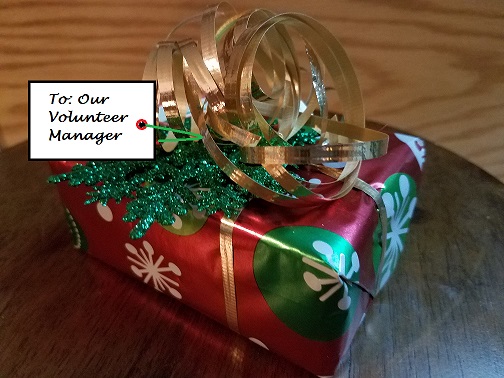
    What to Gift Your Volunteer Manager This Year

    “What can I get my non-profit staff, especially that mysterious volunteer manager, who seems to run around a lot?”  You, my dear ED or CEO have come to the right place.

    Let me help you gift your hard working volunteer manager this year with something he or she will actually treasure.

    Forget that inflatable unicorn horn you wear on your head. Forget that sweater that depicts Santa in a magician’s hat. Forget that self help book on “How to Field Criticism and Still Feel Validated.”

    Forget two extra weeks vacation, uh meh. No. Give a gift that really resonates with your VM. And, the best part is, it doesn’t cost you a thing, only a sheet of paper, a printer and a pair of scissors.  And, as a bonus, in typical cooperative volunteer manager style, I’ll even throw in the template!

    Here are my three top picks for a Volunteer Manager Holiday gift:

    Get Out of Event Free Card:

    Get out of event free coupon

    Budget Increase Steal of Choice card:

    Budget Increase Steal of Choice

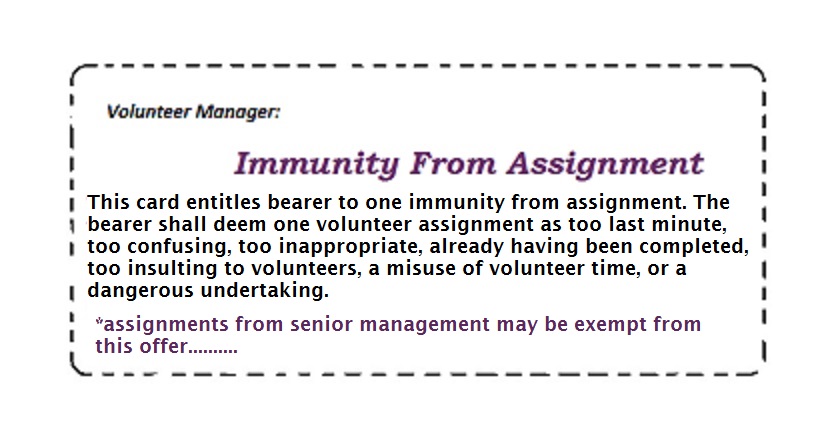
    Immunity from Assignment Card:

    immunity from assignment coupon

    Well Executive Directors, there you have it, the top three gift coupons for your volunteer manager. A few moments, a pair of scissors and you are done shopping!

    And, oh, volunteer managers? Feel free to slip these under the door of your executive director.

    Unless you really want that coffee mug that says, “World’s Greatest Office Worker.”

    -Meridian

  • The Volunteer Ripple Effect


    I’m convinced. We, Leaders of Volunteers (#LOVols) hold in our hands more power to affect positive change than we can even imagine.

    We have the opportunity to impact the world beyond filling tasks and adding to our volunteer base. The intuitive feelings within each of us are spot on: There’s so much more going on than our excel spreadsheets show.

    I remember long ago struggling to find volunteers who could be with clients while loved ones attended church or synagogue or temple or mosque. I would look for volunteers of that same faith and hoped that they would be willing to give up their own attendance to help someone in need. It was the way it had always been done and it was frankly, exhausting.

    Then one day, a volunteer stepped forward. Hannah offered to sit with Christian clients on a Sunday morning. (I’d love to take credit for thinking this solution up, but, no, it came from this wonderful, selfless volunteer.) Bam! The light went on.

    I feared that mixing faiths (or cultures, or beliefs) would be a challenge in itself, but you know what? (Of course you know what comes next) It ended up uniting people in mutual respect and a desire to understand one another. The mere act of reaching across a cultural or spiritual divide created its own sense of wonder.

    And here’s the thing. For the volunteers, it was never about, “oh, I’m so enlightened that I want to transcend these differences.” No, it was, “you know what? I’m free on a Sunday morning and you need someone, so what could be a better fit?”

    The deep meaningful by-products of volunteering are seldom the initial goals. They just naturally evolve because the volunteer ripple brings out the best in everyone: Clients, families, volunteers, volunteer managers, staff, neighbors, community, everyone.

    Think about that. Volunteer programs impact society in rippling positive ways beyond the delivering of meals, or escorting a tour group or passing out information. Our programs share love. Our programs open the doors for unity, connection and understanding to naturally take hold, and not just during holidays.

    We often witness a profound change in people. We glimpse moments of powerful interconnection through the simplest of assignments. We stand, watching that small pebble create ripples of inspiring stories.

    As you are running around this holiday season, scrambling to fill tasks, stop for a moment and think about the societal change you are helping to bring about. Because you value the innate worth of each human being and believe in their ability to transcend, you are spreading that change like a ripple in a vast sea.

    Volunteerism is a rippling movement.

    And leaders of volunteers are tossing the pebble into the water.

    -Meridian