Tag: leaders of volunteers

  • Sustainable Volunteering is Here, but Who is Sustaining The Leader of Volunteers?

    Economist William Forster Lloyd, in his 1833 “Tragedy of the Commons” speculated that when pastureland (the commons) is hoarded, over-grazing occurs, dooming the commons to depletion.

    Volunteer sustainability is radically different from volunteer retention. Sustainability, unlike retention is the ability to maintain a healthy balance while avoiding depletion. Sustainability, as it is being applied to agriculture, economics and ecosystems implementation implies that there is a larger network to be considered. For volunteer management, it implies that resources are hoarded (retention) and depleted by burning out, or alienating volunteers in our quest to hang on to them. For more on sustainability as it applies to volunteers, see my 2017 posts Sustainability and Volunteerism and Innovation and Sustainable Volunteering.

    .

    What about the Leader of Volunteers?

    But wait, what about the volunteer manager? Who sustains us? Who nurtures and supports us? How do we keep from becoming burned-out or depleted?

    The dilemma nonprofits created years ago when setting up the volunteer system extends to volunteer managers. If volunteers are finite resources, we compete with one another to get and keep volunteers. We measure success by numbers of volunteers retained, numbers of hours donated, and money saved, even though we know these are depleting measurements and that volunteer engagement and impact are true indicators of success. Under antiquated notions, we tend to feel like a cog in a wheel, and not the creative drivers of solution-oriented volunteer initiatives.

    Sustainability not only applies to volunteers, it applies to the person leading the volunteers. If the volunteer engagement expert feels like they are choking, begging for sustenance, depleted of energy, starved for nutrients, they will wither and quit. The organization will bring in a new volunteer manager, only to deplete that one, and on and on it will go until real change is enacted.

    Where is our tribe?

    Where do we find nurturing in our profession if it is not readily available at our workstations? Where is our tribe, the people who support and hear us, who accept us and commiserate, who share similar experiences and offer workable solutions? Think of the conferences you’ve attended in-person or online. Did you find sustenance in connecting with other volunteer engagement professionals? Did you feel that nurturing? Did you come away refreshed and not so alone?

    Would the world end if we, Leaders of volunteers detached from viewing ourselves as cogs in an organizational wheel, with duties to serve the needs of the organization, no matter what, even if we offer better and more sustainable solutions? Would we be awful people if we shifted some of our alliance away from our immediate ecosystem and towards the larger network (volunteerism)? Would everything collapse if we stopped being loyal to a fault and started relying more on a tribe that supports us?

    What happens if we shift our perception and think of ourselves as part of a larger network (volunteerism) serving our communities and the world? Would that actually help us in the long run?

    Leader of Volunteers: A desk job or a profession?

    Think of professions that have a unique identity, a brotherhood, a camaraderie, a perception, like firefighters, nurses, teachers, military personnel, actors, accountants and so many more. We lump them together instead of thinking of them as just workers in a setting. We think of them as having unique roles to play, skills to possess and challenges to overcome. We perceive them supporting one another, sharing valuable information and banding together to elevate their profession. These professions are a tribe.

    Our sustainability lies in creating a united front. It lies in tightening our profession by uniting voices with common goals, practices and contributions to our work. How can we band together?

    To change the perception that we are just desk job workers, employed to fulfill the edicts from organizational hierarchy, we must create the larger network, and a purpose higher than slotting volunteers into pre-determined roles. How can we strengthen our tribe?

    Everything is local.

    Local is the starting point.

    • Join every local volunteer manager peer group and start one if you don’t have one.
    • Band together and share volunteers.
    • Share expenses to bring in speakers.
    • Share successes and adopt effective programs, policies and systems.
    • Band together on service days to do a project.
    • Share/refer corporate partners.
    • Make volunteer recruitment a community process, not an “us vs. the rest of the organizations” process and tout how nurtured volunteers do more.

    I know you are already doing these things. So, step 2: We now have to make sure everyone knows we are doing these things, especially every organization’s hierarchy. How?

    • Loudly visit other volunteer managers’ home bases.
    • Ask a volunteer manager from another organization to speak at your team meeting and talk about common challenges and solutions.
    • Refer to successes at other organizations and how you have reached out for help in adopting best practices.
    • Quote other volunteer managers.
    • Show how commonality is beneficial for every mission.
    • Gather examples of successes outside of your walls to illustrate the changes you wish to make.
    • Speak about volunteerism as a community concept instead of just as a means to an organizational end.

    Everything is global

    Just as in local, sustainability is global.

    • Get as many certs as you can such as the CVA.
    • Join national associations like ALIVE, NCVO etc.
    • Adopt information from global authorities, read journals like Engage and share articles with staff and senior leadership.
    • Create a fact sheet with global statistics on volunteering that show your challenges and solutions are not unique, but part of a larger picture.
    • Band together with other local volunteer managers and invite recognized speakers, or pool money and loudly attend webinars together.
    • Use the knowledge out there. Organizations tend to believe an outside source over the expert in the midst, so use it to your advantage. “Hey, look, this expert is saying what I’ve been saying, or “here are some national statistics to back up my ideas.”

    The Leader of Volunteers Tribe

    We, Leaders of Volunteers are a tribe. We support, nourish and share with one another. Beyond personal gratification, our banding together to present volunteering as a sustainable community solution will not only sustain volunteers, but will lead to a better understanding and respect for our role in leading volunteers. We’re not desk workers floundering to get and keep volunteers, we’re a profession with bucket loads of tried and true solutions, policies and procedures already tested by others, visions for the future based on real research, and applicable knowledge forged in years of experience. That’s a heck of a tribe.

    We, leaders of volunteers are a tribe of good people with much to offer the world. Lean on one another, but not in secret. Lean in the light.

    -Meridian

  • Volunteerism Lip Service

    Photo courtesy of Gratisography

    Lip service. Gotta admit, I’ve been guilty of patting myself on the back by parroting all the great things I believed in to further volunteerism and volunteer management. But, was some of it lip service? Did I just spout stuff without backing it up with actions? For instance:

    I believe in the glorious future of volunteering:

    Well, give me a medal. But what about kids volunteering? Did I actively engage young people, give them leadership opportunities? Or did these words actually come out of my mouth: “I’m not a babysitter.” (the words came out of me, but, in my defense because I was babysitting a senior manager’s kid one summer, oh, and the boyfriend who tried to sneak in through the back door.) But then, I started to involve kids, and students, and it opened up a whole new world of innovation and creativity. Going to schools and engaging students. Setting up parent/child volunteer opportunities. Introducing young people to the mission and stepping back while they came up with ideas.

    I want all volunteering to be recognized/honored/respected:

    Sure, I do. But then, what did I do when hearing about volunteer successes at other organizations? Did I graciously praise them, promote them, or did I feel jealous? (did I actually huff, “well it’s easy volunteering there with all those cute animals, instead of with sick people.-Um, yeah, I did.) But once I realized other volunteer program successes helped all programs in our community, I could let go of the me vs. them mentality and do some partnering.

    I believe in engaging volunteers to the fullest:

    Well, did I send them to another organization when their skillset wasn’t being fully embraced, or did I hang onto them like that expensive outfit I can’t fit into anymore? Sadly, the amount of volunteer potential wasted by keeping skilled and willing volunteers tethered to our mission when they could have done so much good by going elsewhere is astronomical. (Oh, selfish, thy name is me.) Once numbers stopped being a goal, then quality beat out quantity every time. And by partnering/supporting other volunteer organizations in my community, a whole new world of possibilities opened up.

    I want staff to accept volunteers:

    Nice fighting words, right? Well, did I invite staff to be part of volunteer strategy upfront, or did I just grumble that staff didn’t get it? (I suppose if you consider the names I called staff in private, like “they’re just pig-headed” you could say I missed the opportunity to involve them, thus missing out on a collaborative atmosphere…sigh) If staff is part of the upfront planning, even if we don’t accept everything they propose, we still establish a cooperative environment.

    All volunteers are valuable:

    Oh, this one’s good. Well, did I have favorite volunteers, AKA, the ones I called on first because I needed to get a position filled? I knew Trevor would always say yes, so what did I do? I called Trevor. (Hey Trev, my buddy, my pal) Sure I filled the request. But in doing so by constantly calling on “reliable” volunteers, I fostered the idea that the number of volunteers I proclaimed we had was actually false, that it was far less because the same volunteers kept showing up. (We have 738 volunteers. On paper.) By taking the easy route, I gave little attention to newer, or more selective volunteers. And you know that’s not the way to engage anyone.

    Volunteers have the right to say no:

    Well, sure, I was really vocal about that one. Proud of it, too, but what did I model to them when I ignored my own boundaries? Did I take some sort of warped pleasure that I was overworked, willing to take calls at all hours, never really off, never on vacation? How could I tell them their well-being was important when mine obviously was not? (But see, I cared more than everyone else, and my commitment, er my availability at all hours, proved it.)

    I don’t take volunteers for granted:

    Well, go back to calling on that “reliable” volunteer over and over, because they always said yes. Not taking volunteers for granted means an extra effort to give all volunteers a chance to participate. It means taking care to not pigeon-hole volunteers into roles because it’s what’s needed when maybe a volunteer wants something new. It means giving needed breaks, not letting staff overwork their favorite volunteers, not sharing organizational politics or personal frustrations with volunteers who come with an unburdened heart. It means being professional, not hanging out with some volunteers while ignoring others. I’ve mistakenly done all of that. It was easy to do when I was swamped, struggling and in need of that awesome volunteer who patted me on the head and told me everything was ok.

    I want my volunteers to be treated with respect.

    Well, what about that opportunity to push back in the staff meeting, the one where I just sat there and said nothing?(They just don’t get it so I’ll sit here and brood. Yeah, I’m sending the stink-eye their way, that’ll show em!) I was tired of repeating myself, frustrated at the time I was losing by being there, ok, feeling dejected, wondering if my fellow staff were just too stubborn to change. Then I realized advocacy was not tied to my emotional state, but something strategic and planned. The notion that it was not about me and my precious feelings was very freeing and let me concentrate on a plan to show volunteer value.

    I believe in accountability

    Ok, sure, but then what about all the times I did not want to confront a volunteer on behavior and instead, just hoped things would work out? Well, those times never worked themselves out and frankly, got a lot worse. I learned the hard way to meet challenges head-on, to mitigate disasters before they occurred, to mediate before things got out of hand. And you know what,? Handling difficult situations got better/more efficient/more satisfying with practice.

    I want the world to know how great my volunteers are:

    But then, whenever a news source came around to do a story on the volunteers, did I just go along with the whole “Volunteer Betty is still going strong at 99?” I did, cause I was just so grateful to have any published recognition. Here’s the thing. Those stories never brought in throngs of volunteers. It is volunteer impact, not personality sketches that motivate others to volunteer, or donate or inquire about services. I wrote a blog post on this subject back in ancient times (well, 2018 anyway) entitled Volunteer News Stories: Does This Good Press Really Help?

    Ok, so maybe my New Year’s resolution is to recognize and correct my mistakes. (Again). Maybe I need to think about the stuff that comes out of my mouth and whether it’s just lip service or whether I believe it enough to put it into action.

    So, please learn from my shortcomings so you don’t have to think you’re guilty of volunteerism lip service.

    -Meridian

  • #LoVols, You Are Growing Branches

    I’m guessing you don’t own the 32,000 page book, “Everything You Must Know About Engaging Volunteers, Part 1.” I have a copy, but I’m only on Chapter 73, “Volunteers who ask questions that are not really questions and how to address the criticisms hidden within.”

    (for my take on this thorny issue, see when a question is not a question)

    How do you describe our jobs? Engaging volunteers is in many ways like a growing tree. At first we struggle to understand the job. We’re green and new and easily blown by the wind. But then we grow, fed by the profound differences we see volunteers make, the sunlight of possibilities and the nutrient rich experiences our volunteers bring, not only to the work, but to us personally.

    When one has taken root, one puts out branches

    Jules Verne

    We grow, stronger in our conviction, taller in reaching for the sky, broader in understanding. And then, we develop branches that reach in all directions, adding to the living ecosystem that supports a thriving community.

    What a teddy bear taught me

    I think about volunteer Cara, who sewed memory bears for grieving survivors (memory bears are made from a garment the survivor provides that belonged to the loved one who died). A young man had died while serving in the military, and his family requested a bear be made from his Marine Corps dress blues. I immediately thought of Cara because she was an expert seamstress and her work was impeccable. She accepted, but a few days later, Cara called me with a concern. I assumed her concern had to do with the difficulty in working with the dress blues’ fabric.

    Cara came to see me and sat, tears welling in her eyes and told me that when she picked up the scissors and made the first cut into the uniform, she broke down and couldn’t go on. Her father was a Marine. So was her brother. She deeply understood what the uniform represented and cutting into it brought home the devastation the young man’s family was feeling. It was personal for her.

    From experience, comes growth

    In that moment, I realized that the volunteers who made memory bears didn’t just sew a bear. Through sewing, they entered a person’s life and pain when they cut into the cherished garment. They held a person’s grief in their hands, and stitched a lifetime of memories together in a teddy bear shape that could be hugged and talked to through tears. Those selfless volunteers experienced the aching loss a survivor felt for their loved one. And yet, they continued to sew.

    After that day with Cara, I asked a grief counselor to attend our memory bear volunteer meetings. Not only did the grief counselor share the recipients reactions to receiving the bears, she was able to help the volunteers process their feelings. Had Cara not been brutally honest with me, I might never have thought beyond the volunteers’ ability to sew a stitch. Thanks to her, I began to look at not only the memory bear volunteers and their well-being, but it opened me to look for other ways to support volunteers. I sprouted a branch.

    Hands-on learning grows branches

    Experiential learning teaches us to apply knowledge from doing. It forces us to experiment until we get things right. It propels us to take initiative to solve challenges. It makes leaders of volunteers think like visionaries. It gives us branches that reach high.

    Embrace your experiences. It feels like 2020 has given us way more experiences than we can handle, but it has also caused us to:

    • ask the hard questions
    • rethink systems and procedures and reimagine them in strategic ways
    • take initiatives to keep what is working and redesign what is not
    • be curious
    • look beyond the status quo to find better solutions
    • connect in new ways with peers, with staff, with the community
    • expand possibilities
    • examine our pre-conceived notions about the way things have always been done
    • evaluate our role in leading volunteers

    As I thumb through “Everything You Must Know About Engaging Volunteers, Part 1,” I notice there’s no chapter on “World-wide pandemics and the disruption of volunteering.”

    Maybe that will be addressed in Part 2.

    -Meridian

    P.S. I will be posting twice a month instead of weekly starting January 2021. Happy New Year all. I hope this year brings new joy, new experiences and new hope for our wonderful, complex and growing profession.

  • Thanks to the volunteers who lied, stole and created havoc

    Photo by Samuel Wu00f6lfl on Pexels.com

    Do you ever gush, “Thank you to of all the wonderful volunteers who have inspired me, enriched my soul and taught me compassion?” Yeah, that’s my go-to line because I mean it and I bet you do, too. Besides, isn’t thanking what we volunteer managers do best? (well maybe next to being annoyingly humble)

    Volunteers shape us and teach us how to be better leaders. So, maybe we should also thank the volunteers who taught us the lessons that strengthen our characters. You know the ones. Their memories are seared into your psyche like the time you dropped your phone when you learned a trusted volunteer called a client “idiot.”  You slunk back to your office when the CEO told you a volunteer tried to sell his daughter’s beat up Chevy to a client’s son. You found a seat way in back and kept your mouth closed in meetings after a volunteer wrote that oddly kind, but wildly misguided letter to the editor, calling your staff “an army of swat unicorns who invade with guns shooting helping dust.”

    Mop-up lessons are hard when they occur

    You never intended a volunteer to try and convert a client’s family to their religious or political beliefs. These are the mop-up lessons. You mop up the mess, apologizing profusely, hoping no one thinks that all volunteers act this way, while explaining that you never gave volunteers permission to move in with a client or take out an ad in the local paper and alter the logo to make it look like it was smiling.

    But, honest mistakes aside, think about all the clients saved from unscrupulous volunteers because you learned a hard lesson. Think about all the necessary precautions you take because you were put through the wringer. Think about the watchful eye you developed because you were caught unaware.

    Mopping up after mistakes equips us with vigilance.

    Many years ago, volunteer Jacob lied to my face. Again and again. I believed him, not because he was charming and convincing, but because I wanted to believe him. I believed in the romantic notion that all people would set aside their personal agendas for the greater good. I lived in a faerie world in which all volunteers understood the mission and eagerly awaited my instructions so they could change the world.

    Jacob showed me that I had to be realistic if I truly wanted to do right by our clients. He showed me that healthy watchfulness did not diminish my job, but rather elevated it to a higher level of purposefulness.

    Matching volunteers to vulnerable clients takes more than kindness

    You’ve been through this. We struggle to explain all the carefully measured thought and actions required to match volunteers to clients and programs.  Faeries are lovely, but we live in the real world. In the real world, placing volunteers with vulnerable clients takes discerning judgement, careful pairing and keen watchfulness. 

    I’ve had volunteers who stole, volunteers who pushed an agenda, volunteers who wanted to take over and volunteers who were just mean. I’m still surprised by volunteers who talk a good game and then cause real harm. I’ve also had volunteers who messed up royally because they did something nice, but so misplaced that it caused real harm.

    So, I thank Jacob and the others for giving me a discerning nature, for strengthening my resolve to do right and for teaching me that compassion takes the courage to be a sentry.

    The volunteers who cause harm never intend to teach us anything. Their intent lies deep within their own needs.

    But every one of these volunteers teach us lessons that mold us into a better leader of volunteers. They teach us to trust, yet verify and to protect the vulnerable people we serve. A successful leader of volunteers must be strong. Conviction means doing what is right, even when it is hard. It means saying no with kindness.

    So, let’s silently thank them for those often painful lessons that shape us into stronger leaders.

    They never intended to teach us something valuable, but they did, so thanks, you guys.

    -Meridian

    This is updated from a 2017 post.

  • Hey #LoVols Reputation, Meet Our Self-Identity

    Photo by Pixabay on Pexels.com

    So, what’s next for leaders of volunteers? #WeGetToRevampEveryVolunteerRoleSoVolunteersActuallyWantToVolunteerWithUsWhatAConcept!

    Ok, maybe we should take it one step at a time. To reframe volunteer engagement and impact, we first need listeners who become supporters who then become advocates for our vision.

    Tall order, right? It’s hard enough to get anyone to listen, much less champion the ideas we are advocating for. This is where reputation comes in.

    And who will listen to us if our reputation paints us as:

    • meek and mild
    • having fun
    • doing easy stuff
    • always apologizing
    • always running around putting out fires
    • reactive versus proactive
    • unable to fill requests
    • babbling on and on about how wonderful the volunteers are
    • in charge of the fluff
    • not involved in the nitty gritty planning work
    • going along to get along

    Being known as proactive vs. reactive

    Taking control of the conversation surrounding your volunteer program begins by taking control of your reputation as the leader of volunteers. Look at it like this: Let’s say you go to a bank to open an account. Two bankers are working that day and as you wait, you listen to them talk to clients.

    A tale of two bankers, or who the heck would you trust with your money?

    One banker is animated, showing her client the various accounts available. She points to stats, but doesn’t rattle off numbers. She explains how each statistic impacts the client’s vision for financial success. She offers multiple paths to success so the client can grow their investments. She explains in detail how each account functions, their positives and their challenges and yet assures the client that with her expert guidance, financial success will come.

    Photo by Frans Van Heerden on Pexels.com

    The other banker looks harried. He fumbles through a stack of papers, dropping them on the floor and apologizes for the lack of available options. He grabs a board he obviously made himself that displays the various colors the client can choose for a checkbook cover and points to the blue one, saying “this color is really pretty, don’t you think? “

    Who would you pick? (and if you picked the banker who spent his time showing checkbook cover colors, you’re most definitely a volunteer manager who has spent a lot of time “rescuing people,” am I right?)

    Perceptions are created in the first few minutes.

    And to make matters worse, once a perception is established, people then look for signs that reinforce the perception. (We all do it BTW, which is why I always gave this one pompous marketing executive the incomplete copy of a report-cause I figured he’d never read it and I always waited for him to ask where the rest of the report was, but he never did) So, if you’re perceived as being in charge of fluff, people will notice anything that reinforces that perception. Boom, you now have a reputation because people talk.

    Establish the reputation you deserve

    Start by doing small things that produce big reputation results.

    • Speak up in meetings in an advocating way-most of us get caught off guard in situations so create a few well-crafted opening statements and memorize them. For example, “Volunteers have contributed a lot to that program and here’s how,” or “This is a great opportunity for our volunteers to contribute, let me show you how,” or “Just a reminder that our volunteers are involved in that initiative and so far, they’ve…” Opening statements make it soooooo much easier to quell any jitters about speaking up. And you know what? Pretty soon, when you open your mouth to speak, others will chime in, “yeah, we know, volunteers are contributing because….” But that’s great, because the phrases will cement themselves and your professional reputation improves.
    • explain how volunteers are having fun because you are working at making a welcoming environment for volunteers. Say, “because we don’t pay our volunteers, their reward for a job well done includes having an enjoyable atmosphere in which to work. That’s why I work hard to create fun around them.”
    • explain the work involved in engaging volunteers (see Not So Fast, Captain Obvious for more on explaining volunteer engagement)
    • NEVER, EVER apologize because a volunteer can’t fulfill an assignment (see Volunteer Managers are better than These 3 Phrases for more about re-framing apologies)
    • flip the perception which means emphasize the positive versus reacting to the negative. When staff say, “I have a last minute request, so not sure if you can get someone,” instead of saying, “I’ll try,” say “Most volunteers are willing to do last minute requests because they want to help us reach our goals.”
    • offer solutions with this caveat: we can do more with me at the planning table
    • stop going along to get along to be liked. Instead aim to be respected as a professional. Being respected has little similarity to being liked. Liked is for your friends, family, dog, hamster, hairdresser, maybe the guy who rotates your tires cause he’ll throw an oil change in for free. Respected is the professional’s goal. Respected means you accomplish stuff and do the hard things without complaint. It means you are fair, mission focused and strong.

    Know it or not, YOU are the face of your volunteer program and the perceptions of how your program is run, lies with you. It can feel overwhelming, but once you take control of the perceptions, you emerge with the reputation as… a leader of volunteers.

    I’m not saying it’s easy and I’m not saying it’s instantaneous. But it is doable.

    And besides, when have you, volunteer professionals ever backed down from a challenge? (Uh huh, thought so)

    -Meridian

  • The Volunteer Periphery is Expanding

    Photo by Pixabay on Pexels.com

    The Covid pandemic has forced many active volunteers into furloughs. It has put vital in-person training on hold. It has stalled volunteer-rich projects. It has created a giant periphery of volunteers who revolve around organizations like Pluto orbits the sun, not knowing if it’s a planet or a dwarf planet.

    Unlike HR folks, who contend with active staff, volunteer managers are tethered to every volunteer, whether they are actively volunteering or they’re rotating in the periphery. This includes:

    • potential volunteers
    • retired volunteers
    • volunteers on leave
    • sick or injured volunteers
    • episodic volunteers
    • volunteers awaiting training
    • volunteers awaiting placement
    • student volunteers
    • community service volunteers
    • corporate volunteers

    Often, our volunteer periphery exceeds active volunteers. How do we juggle this giant system? And for those naysayers who tell you, “just purge the roster,” that’s not acceptable. Every volunteer has value. Soooooo, what do we do?

    Organize those pesky lists

    Create categorized email lists: Categorize prospective volunteers, group and corporate volunteers, temporarily inactive volunteers etc. Send targeted messages to each group, such as upcoming training sessions, newsletters, notices about volunteer events or vacancies, etc.

    If a volunteer fits onto more than one list, make sure not to count them twice. Slot them into their primary category and color code or asterisk them on other lists. Send general information to all categories, because recurring communication keeps them engaged.

    Get help

    Recruit volunteers to oversee the periphery: Lists are only helpful if they are accurate. It’s humbling when you take a call telling you that volunteer Dave died a year ago and his family keeps getting mail addressed to him.

    A volunteer or volunteers in charge of overseeing other volunteers on the periphery can keep lists up to date. Volunteers can also make phone calls, conduct interviews, do impromptu surveys, offer new opportunities, gather information and compile statistics. The scope of the potential work can fill a full-time volunteer position or several part-time positions. Besides, a personal check-in from a fellow volunteer creates the team feeling.

    For the love of all that is sane, show your work

    Report your time spent managing peripheral volunteers: Don’t let this be one of the duties we shrug about and mutter, “yeah, it comes with the territory.” Managing the periphery requires your expert time, so report it as part of your volunteer recruitment, retention, and cultivation.

    Capture stats from your efforts to engage “prospective volunteers, retain episodic volunteers, build community awareness, increase visibility, maintain relationships, create partnerships, cultivate donors, supporters, etc. This nuanced area of our work is critical, time consuming, and we must account for it.

    Peripheral volunteers have value

    Volunteers who are not actively working still:

    • share experiences with friends, family, neighbors, clubs, co-workers etc.
    • continue to advocate for our work
    • provide us with community resources
    • share the pulse of the community with us

    A volunteer team is fluid. Savvy volunteer managers know that volunteers on the periphery are valuable assets.

    It’s time our organizations realized peripheral volunteers’ worth. It’s time organizations thought about how to engage peripheral volunteers. Oh, wait, there’s someone in the organization already doing just that:

    The leader of volunteers.

    -Meridian

    this first appeared as:

    The Volunteer Periphery

  • Becoming Volunteer to Organization (V2O)

    Let’s pretend volunteers are a type of consumer. They search for a volunteer experience that fits for them, kinda like looking for that certain shirt for the next Zoom meeting. Organizations advertise volunteer jobs in an O2V (organization to volunteer) model. Orgs basically say, “Here’s what we have to offer, take it or leave it. Go ahead, shop around, there’s nothing better out there.”

    But, social media has changed everything. Customers now can buy direct from one another in a C2C (customer to customer) model. We are seeing this shift in our sector as volunteers bypass formal volunteering and mobilize directly through social media. They’ve cut out the cumbersome organizational middle man in an new, V2V (volunteer to volunteer) model.

    But now, businesses are seeing an additional shift to a C2B (customer to business) model. In this model, customers’ value increases. Customers offer businesses talent for hire through numerous websites such as Upwork. Customers with a social media following advertise products. Customers review products online and participate in surveys and by doing so, add value by helping design the next product.

    But how would a V2O (volunteer to organization) model look? Can we adopt this growing trend or are nonprofits stuck in an archaic model that sells their volunteering experiences in a take it or leave it fashion while the world moves on?

    The point of V2O: Recognizing and embracing volunteer value.

    Demonstrating volunteer impact is one way of showing volunteer value. Embracing the additional ways volunteers add value takes us into a V2O model.

    For more on volunteer value also see:

    Older posts such as the volunteer investor or the value of a volunteer is $#.@S

    So, how do we adopt a V2O model without breaking the system?

    Soliciting Feedback:

    Encourage volunteers to review their experience. But wait, what about negative comments? Here’s the interesting thing about negative reviews. Businesses have found that negative comments do not deter customers, it’s the way businesses respond to negative comments that turn people off.

    So, that volunteer comment that states, “I didn’t like my assigned job,” becomes an opportunity for the organization to respond, “thank you for your comment and we are committed to improving volunteer roles. Let us show you other roles that may be a better fit for you.” The negative comment becomes a vehicle for the organization to advertise their dedication to working with volunteers. It’s a powerful opportunity.

    Focus Groups, Surveys and the like

    Volunteers offer diverse opinions. Many volunteered because they also benefited from mission resources and are a wealth of information on the mission experience. (see more in The Disruptive Volunteer Manager) Volunteers have a wide circle of influence and bring in breaths of fresh air from the communities we serve.

    Volunteer In-demand Talent

    Freelancing is here to stay and volunteers are moving from committed volunteering to freelancing. It’s time we sought out volunteer candidates on sites such as Linkedin. Remember the old, but true survey result that the number 1 reason people didn’t volunteer was because no one asked? Well, it’s time we paid attention by searching out the people we feel would add value and ask them to volunteer.

    Volunteer-generated content

    Volunteers are an untapped, rich source of content. In a study by TurnTo, USG (user generated content) bests traditional marketing by influencing 90% of consumer purchasing decisions. Whuh-what?

    Organizations shy away from “letting” volunteers speak on behalf of the organization. “But, we can’t control what they will say.” This iron fist clinging to the message is short-sighted. As with negative comments, organizations can quickly correct any misinformation given by a volunteer (or staff BTW-let’s not pretend staff give out correct information all the time, am I right?) on sites. By holding tight to messaging, organizations are missing the marketing content volunteers provide.

    And think about this for a minute. If a volunteer says their organization is doing good work, it’s more convincing, considering the volunteer is unpaid and not afraid of losing a job (whereas a staff member is perceived as having to be biased).

    V2O is simply embracing volunteer value in ways that sustain volunteering. As leaders of volunteers, we can move towards V2O by:

    • recording and analyzing volunteer impact
    • seeking out volunteer candidates who add value
    • soliciting volunteer opinions, testimonials, quotes, etc.
    • advocating for volunteer voices
    • streamlining volunteer onboarding
    • using volunteer focus groups to create new volunteering opportunities
    • reaching out to volunteer grassroots groups
    • partnering with fellow volunteer leaders in our communities to form coalitions that speak with one, strong voice and share volunteers, volunteer resources etc. (more in the Disruptive Volunteer Manager)

    Leaders of volunteers are tuned in to the ever-changing volunteer mindset and are adapting practices based on what today’s volunteers want. As volunteers leave the organization to volunteer (O2V) model, we can create a volunteer to organization (V2O) environment that engages modern volunteers.

    Or, we can just continue to be a V-Mart. (“go ahead, shop around, we may not have the volunteer experience you’re looking for, but nobody else does either.”)

    -Meridian

  • A Good Time to Collect Data: Free Volunteer Survey

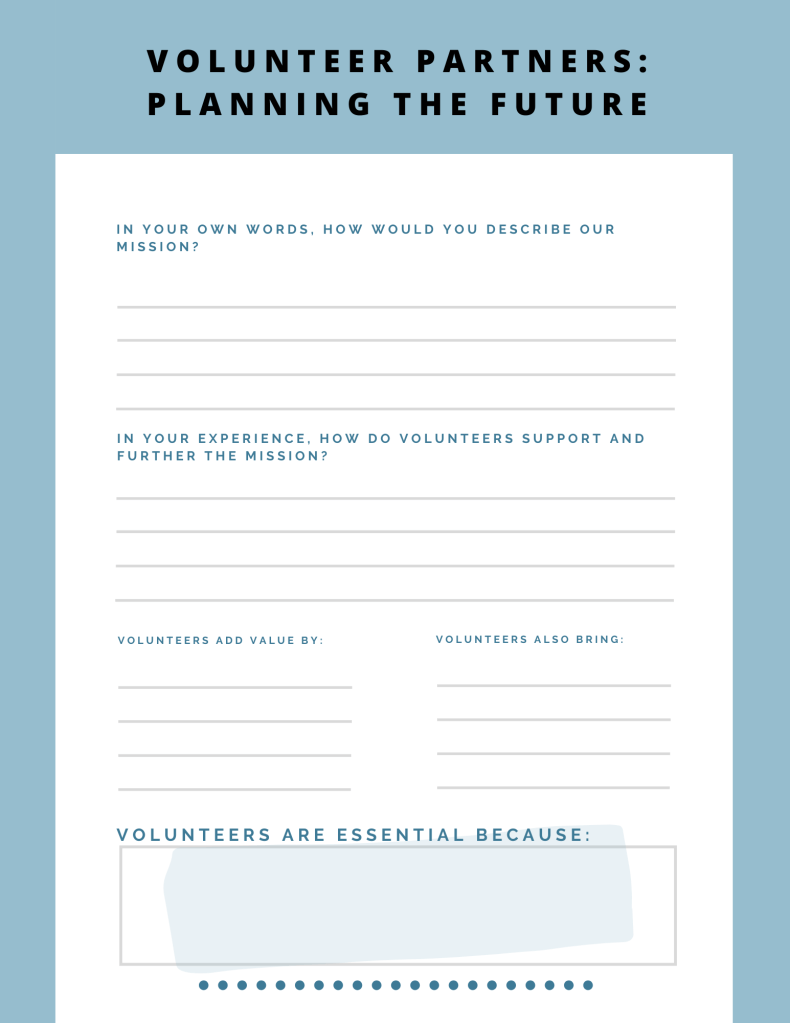
    As we move into a new reality, this is an ideal time to survey volunteers and sort through their thoughts on volunteering past and volunteering future. By gathering their opinions, we can create data that supports our advocacy for a vibrant volunteer initiative.

    Ask volunteers to write down their thoughts on their past volunteering along with their visions for the future. The shorter “list-type” sections help volunteers hone in on specifics. From these survey questions, you can extract key words, phrases and topics and connect the dots.

    For example, under the question “how can technology support your volunteering” on page 5, 80 of 100 volunteers surveyed used the phrase, “keeps us more informed.” On the same page under “volunteers need,” 85 volunteers wrote “training.” Finally, in the box asking, “volunteers feel supported when,” 92 volunteers wrote “when we are included.”

    By connecting the dots, you then can say:

    • 80% of volunteers surveyed will use technology to stay informed
    • 85% of volunteers surveyed want more training
    • 92% of volunteers surveyed feel supported when they are included
    • conclusion: training and technology can be used to help volunteers feel included which supports volunteers and keeps them engaged.

    Hope you can use this, or at least I hope it might stimulate your creative thinking on how to gather data from your volunteers.

    Happy Productive surveying!

    -Meridian

  • Proud of Our Profession

    We are proud of our profession. We are proud of volunteer contributions and of our crucial role in shaping volunteerism. And, in case you want to show it, there are now buttons and stickers available.

    https://www.zazzle.com/collections/volunteerism_buttons_and_stickers-119264092973589463

    For t-shirts, mugs etc., visit the store at

    https://www.zazzle.com/store/volunteerplaintalk

    -Meridian

  • #LoVols, Passing the Time Constructively Like We Always Do

    One thing I realized in all these years, is that leaders of volunteers are never, ever idle. We are always recruiting, talking up volunteering, hatching new ideas, and working a crowd (even if it’s only 1 person in line for a 99 cent taco on Tuesday). We never stop, even during chaotic times. Some of the things we’re doing are:

    We can’t get rusty so we practice training volunteers wherever and whenever we can. It helps to target the audience in practice, just like we do for real. You never know what civic group or club might invite you to give orientation.

    We want to be super-prepared for the time when volunteer fairs are running again, so we pass the time by making give-a-ways – it doesn’t hurt to have something people really want.

    We don’t stop talking about our volunteer initiatives to anyone that might listen. I figured heck, we go to the store anyway, may as well use this opportunity to recruit volunteers. (in theory, but all I experienced was customers making a wide arc around me)

    Leaders of volunteers are creative, innovative people. I’m thinking, we will look back on this time as the most innovative in the history of volunteer management.

    Seriously.

    -Meridian