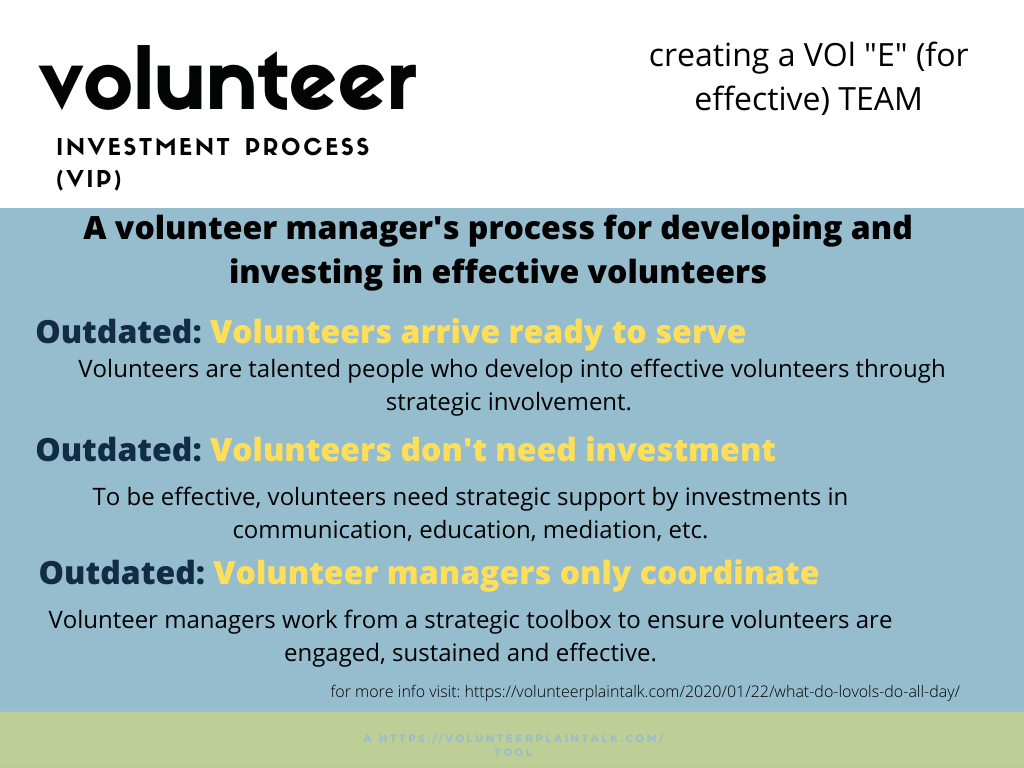
Use this flow chart as a tool when explaining volunteer engagement or keep it in your desk to remind you of all the people-saturated skills you have in your toolbox and remember: Volunteers are wonderful people who develop into effective volunteers through strategic investment. That’s what #LoVols do all day.
Ask an astro-physicist “what do you do all day,” and I’ll bet her answer isn’t “I look through a telescope.” Ask a software developer the same question and it’s doubtful he’d say, “I type on a keyboard.” So why do we, #LoVols say, “I work with volunteers?”
Astro-physicists and software developers have complicated jobs producing impressive results that stretch far beyond the simplest terms. Our jobs as #LoVols?…..most people don’t have a clue as to the skills and strategies we use when engaging volunteers and crafting volunteer impact. We need to change that perception.
This doesn’t mean whining, “volunteer Jenny did that amazing work because I spent extra days training her since our staff couldn’t take the time to show her how to do her work and oh, I listened to all her last-minute questions on a Saturday night when I could have gone to see Star Wars at the movies with my now ex-boyfriend who incidentally went without me and showed up with my best friend Carla and yeah, my life is in tatters, but hey, Jenny did a great job, thanks to my sacrifice, didn’t she?” Hmmmm, maybe that’s not quite the way to show our work.
Instead, we can show our strategies in developing effective volunteer teams and by doing so, dispel the myth that volunteers need nothing more than coordination. By laying out the upfront and continual work in developing effective volunteer teams, we accomplish these objectives:
we ingrain the idea that volunteers don’t magically appear, ready to go.
we show that volunteers are people, not tools, and like employees, need continual mentoring and support.
we reinforce the truism that volunteer initiatives are not “herding cats” but are strategically structured for success.
we support our argument that not every volunteer can be interchanged and that thoughtfully matching volunteers to role creates successful outcomes and prevents disasters.
we show that there are processes in play and that even our chatting with volunteers is structured to mentor them for success.
we point to a volunteer’s progression from first contact to integrated volunteer and reinforce the idea that volunteers require continual support, not just from us, but from the entire organization.
we highlight the creative processes in forming innovative volunteer roles that impact the mission.
The acronym, VOL E TEAMS will do nicely here as in, “Let me show you how I develop teams of volunteers who are effective.” You can substitute excellent or efficient for the “E” but I’ll argue why effective is the best choice when talking about VOL E TEAMS. Let’s look at definitions:
Effective: producing the intended result
Efficient: functioning in the best manner without wasting time
Excellent: possessing superior merit
Say a physician recommends her patient take a medication to alleviate symptoms. The physician could say, “this medication is excellent,” or “this medication is efficient,” or “this medication is effective.” Which word speaks to results? Effective. That doesn’t mean our volunteers are not excellent nor efficient. They are and you could also say, “I’m developing volunteers for an effective, efficient and excellent team.”
As we, LoVols report volunteer impact, effective is a key word to support the contributions our volunteers make. Verbiage is crucial and we must use results-type words to describe volunteer value such as effective, outcomes, results, impact, accomplish, contribute to, produce, achieve, implement, enact, create, effect, etc.
So, what does the acronym VOL E TEAMS stand for? (Hint- it stands for the work #LoVols do to create and sustain the volunteer factor.)
vetting
on-boarding and/or orienting
looping
efficiently and effectively communicating
training to position
educating
adjusting or agile thinking
mediating
structuring
Next time: An effective team requires an effective leader. Looking at the components of VOL E TEAMS or it’s time we show our value as Leaders of Volunteers.
Yup, holiday gatherings are upon us and everyone fears the inevitable politics-driven shouting between grandpa and cousin Timmy, but guess what? Those conversations are nothing burgers compared to what we, volunteer managers must endure. You know what I’m talking about.
You arrive at a party and the snarky attorney guest of a friend of a friend of a friend is introduced to you. She hears “manager of volunteers” and looks down her nose at the scuffs on your Gucci knockoff shoes that you bought at your organization’s thrift store, because, hey, you have a conscience and want to contribute some money instead of just spending it and besides, recycling is the way to go, but you just keep mum and let her rake you over with her eyes like you’re some bargain basement hobo.
So, in the spirit of defending our #lovols profession, here are some comebacks for those inevitable questions that arise when you are introduced to uppity distant cousin Prunella or your best friend’s very successful investment banker neighbor, Chase who is usually alone on holidays.
Q: “So, you’re a volunteer manager, did you say? I’m confused. Does that mean you volunteer for the job or do you actually get paid to do that?”
A: What a great question. It’s complicated. I don’t get paid in money, but I do get to pick from all the stuff that is donated to my organization. Last week I got a case of lentil soup. The cans were out of date, but that’s ok. I’ve not gotten sick from donated food yet, unless you count that time I was throwing up for a week, but I don’t think it was from that out of date cheese, and heck, I picked off all the mold, but you never know. Anyway, I’m hoping for a toaster oven this week. Mine’s like 20 years old and it only toasts on one side so you have to turn it over and run it again.
Q: “Volunteer manager, you say, what’s that? There’s no degree in that, is there, I mean, you’re basically a party planner, right?”
A: You wouldn’t think we’d need any skills, would you? Actually, I have a Bachelor of Science in cat herding, with a minor in balloon animal engineering. It’s a pretty popular degree but the work is intense. I mean I think I’m still suffering the effects of helium-osis (raise your voice’s octave to a squeak) which makes me speak in a higher than normal voice at times. Currently, I have a scholarship at Nancy’s Nonprofit University for a Master’s degree in Little Old Lady Management. I hear the internship is brutal, you know all that tea drinking and knitting and getting shanked by a wayward knitting needle while scrambling for the ball of yarn the 17 cats ran off with. There’s this one class I hear is really hard, it’s ‘The Symbolism in Grandchildren Stories, or Does Grandma Secretly Despise Her Offspring?’
Q: “You work with people who don’t get paid? That’s not really management, is it?”
A: You got me. Don’t let this get out, but when a volunteer signs up, we pretend to give them a tour of the organization and we usher them into the basement and lock them up in a room until they complete their assignment. We all take turns poking them with a stick until they do what we want. Sometimes, and this is the hilarious part, we just poke them for laughs. I have my own special stick made out of hickory. I call it “Ol’ Persuader.” And you’re correct, it’s not management at all, ha ha, it’s so much easier and more fun.
Q: “So, you work for one of those nonprofits, right? You know, they’re always bothering me for money. Don’t you people just get money from the government? Why are you people hounding me?
A: Ha, ha, awww, we can’t fool you, can we? Don’t let this get out, but we actually get millions and I mean millions from the government but since we don’t need money, we invented this game. We like to see if we can get gullible people to donate and we give a prize at the end of the year to the staff member with the most lucrative sob story campaign. And I shouldn’t be telling you this, but do you know what we do with all those extra donations? One word. Stock market. Hey, it’s almost the end of the year. I wonder if I won the award with my “Life Sucks, Give Me Cash, You Cheapskate” campaign.
Q: “Wow, managing volunteers, that must be really easy, right, I mean how hard could that be?”
A: Oh, you, you are so perceptive. It’s hands down the easiest gig I’ve ever had. I’ve got volunteers who bring me coffee in the morning and volunteers who clean the office while I just sit back and watch YouTube videos. I even have volunteers who do my laundry, can you believe that? And, don’t tell anyone but I even have a volunteer who rubs my feet in the afternoon. Yeah, crazy, isn’t it? Crazy good! I’ve been told the foot rubbing and come to think of it, the volunteer who pays my bills violates some sort of fair labor practices, but hey, they volunteered, right? They’re not protected by anything, ha ha ha ha ha!
Well, there you have it. Use these answers in good, holiday health and don’t stress about those absurd questions.



 volunteerplaintalk