Tag: organizations

  • “We want to work with staff who have drunk the Kool-Aid,” an interview with Laura Rundell, CVA


    An Interview with Laura Rundell, CVA
    Laura Rundell, CVA with a mug of Kool-Aid


    Recently I had the pleasure in chatting with Laura Rundell, CVA, the Volunteer Coordinator at LifeBridge Community Services in Bridgeport, Connecticut.

    VPT: Laura, tell us a little bit about your background in the volunteer management sector.

    L: I’ve been involved in the volunteer sector since 1999.  During grad school where I received my Master’s in History, I worked part-time for the Park service. I have also worked for several other organizations, including the Spellman Museum of Stamps and Postal History in Weston, Massachusetts, the Phipps Conservatory in Pittsburgh. Pennsylvania and I am currently the Volunteer Coordinator at Life Bridge Community Services in Bridgeport, Connecticut.

    VPT: And how long have you been at Life Bridge?

    L: I’ve been here since 2014.

    VPT: What brought you to volunteer services?

    L: It was at the Phipps Conservatory that I began to fall in love with volunteer management. I had come from a smaller organization to Phipps and found out they had over 500 names on their volunteer list, so the scope changed dramatically.

    VPT: And how did you come to be at Life Bridge?

    L: I moved to Connecticut and landed at Life Bridge in 2014.

    VPT: You’ve had a number of experiences thus far. What have they taught you?

    L: Not all my experiences were perfect. An already challenging job is much harder when the goals for the program and the roles for volunteers are less defined.

    I appreciate where I am as a volunteer manager now and loved my time at Phipps because they support the volunteer program and there are clear expectations and specific roles for volunteers.

    VPT: Can you give us an example?

    L: Yes. When I was invited for an interview at Life Bridge, I noted that the person who would be my supervisor had the CVA credential. It was clear they had put thought into their volunteer program and knew what it would take to make it successful. In my third interview, I was sitting at a table with all of the staff who would utilize volunteers in their programs. I was really impressed that they put so much thought and effort into recruiting for this position and knew then it was an organization I really wanted to work for. I was delighted to be offered the position.

    VPT: That is impressive.

    L: And, just recently, our Executive Director asked for a volunteer to be involved in researching best practices for a project. That shows commitment to engaging volunteer help at all levels of our organization.

    VPT: I’ve noticed you are weighing in on articles and blog posts more and more and that is great; we need more voices. What do you feel is the future of volunteer management?

    L: I see so many non-profits stretched thin and need more volunteers to take on a greater role.

    VPT: That’s a good thing for increased volunteer participation, right?

    L:  Yes it sure is, but I think the number one challenge for most volunteer coordinators is recruitment. It will be an even bigger challenge moving forward to keep filling those roles with qualified and committed volunteers. It means we all have to “step up our game”.

    VPT: Are you seeing changes in the volunteers who are stepping forward?

    L: There are more episodic volunteers, more students who are seeking career experience, and more individuals in the midst of a career change seeking resume enhancers and references. There are also more opportunities to recruit corporate and college groups.

    VPT: Are there inherent challenges with episodic volunteers?

    L:  We have had some really great short-term volunteers. Not every role is appropriate for someone who may only be with us a short time though. Some roles require clearances that can take 4 weeks to get back, so we really hope the person in that role can stay with us for at least a year. We’ve also gotten some really great college and corporate groups. However, walking that balance between offering the flexibility large groups may require and making it a meaningful opportunity that adds value to the organization is a challenge.

    VPT: What have you discovered about recruiting volunteers that you can share with us?

    L: You have to respond promptly when an applicant contacts you. When I relocated to Pittsburgh from Massachusetts, I contacted several organizations to volunteer and never got a return call. That was really frustrating.  After that first contact though, the applicant has to be invested — it has to be their choice to move forward. I have learned you can waste a lot of time spinning your wheels if an applicant doesn’t respond to a request to meet with you, doesn’t show up for an appointment or doesn’t follow up afterwards.

    VPT: Changing direction, do you feel as though volunteer managers are starting to build a community with one another?

    L: By the time I became a CVA, I was linked to a community of volunteer managers. But, often, a volunteer manager is a department of one and is isolated. When I was in Pittsburgh, I reached out to similar volunteer organizations and we volunteer managers would get together a couple of times a year to have lunch and share best practices. Here in Connecticut, we have Volunteer Square and they have done a wonderful job in creating a Professional Development Series for volunteer managers. I’m honored to serve on their advisory board.

    VPT: So, there are some steps being taken.

    L:  You know there is an Association of Fundraising Professionals (www.afpnet.org/) for those who are in the fundraising end but we have no association for volunteer managers.  I wish we had one nationwide organization. Not everyone can attend a national conference, but if we had a national association, we could have branches in our areas that we could connect with and could set national standards for our profession.

    VPT: What do you see as future challenges for our profession?

    L: As non-profit funding continues to decline, there will be more and more dependence on volunteer programs to pick up the slack and organizations will be utilizing volunteer services more. As everyone scrambles for a piece of the ever-shrinking pie, we need to have a unified voice instead of competing against one another for limited resources. For instance, if we all required that courts who refer mandated community service applicants to our agencies provide the funding necessary to fully vet, train and supervise these applicants, we might make some real changes in how court mandated service is assigned nationally.

    VPT: What advice do you have for new volunteer managers?

    L: After I moved to Connecticut, I remember talking to a volunteer I worked with in Pittsburgh and the volunteer said, “We want to work with staff who have drunk the Kool Aid.” If staff is unhappy, or does not believe in the work, then volunteers pick up on that. If an agency has a lot of turnover and has difficulty retaining paid staff, than recruiting and retaining volunteers may be an uphill battle.

    L: I would also say, make sure you connect with other volunteer managers in your area. I have learned so much from my colleagues. Just an hour spent talking with another volunteer coordinator over lunch or coffee can be invaluable. You can learn “It’s not just me…others have this problem too” Also, obtaining the CVA (certified volunteer administrator) is very helpful. I feel like the CVA credential has given me more of a standing in my organization. The CVA gives me ethical standards to adhere to and by virtue of my having it, my volunteer program is elevated.

    L: Also, you need to have rules and policies in place and stick to them. If someone wants you to waive the requirements for a new volunteer, remember this: There are bad actors who seek out vulnerable populations. This is why we don’t bend the rules. Make sure you have a volunteer manual, written policies, and an agreement letter for the volunteer to sign.

    VPT: What makes a difference for you?

    L:  I feel blessed to do what I do. Yes, there are challenges, yes there are frustrations, but a well-run volunteer program can leverage the passion and talent of volunteers.

    L:  I’ll leave you with my favorite story about a volunteer. Before I was at Phipps, I was in charge of an exhibition opening of student art work in Pittsburgh. The students, their parents and the artist they worked with were all on their way, along with a volunteer to help at the reception. Right before the event, we had a severe storm warning and most of our staff left the building. Meanwhile, our volunteer drove through the storm to be there. The kids and their parents all had a great time at the exhibition opening because the volunteer made a commitment and the storm wasn’t going to stop her from coming! That is just one of the stories that keeps me motivated and gets me up in the morning.

    VPT: Thank you Laura for your insights and for sharing with us today. We look forward to hearing more of your voice in the volunteer management arena.



  • Why are Volunteer Managers So Darned Repetitive?

    I Repeat Why are Volunteer Managers So Darned Repetitive

    “See you then!”

    Oh those 3 innocent words, words we utter in good faith. We’ve made sure the assignment is solid, and we’ve handpicked the volunteer. What could go wrong?

    Yuri, a new volunteer manager excitedly forwarded the city council’s emailed invitation to her volunteer, Chase. He had been chosen to receive the Samuel P. Goldman annual award for charitable work.

    Yuri sent the email, adding that she would meet Chase there. She arrived early that day and took a seat in the audience. When the council meeting got underway, Yuri kept glancing towards the door, watching for Chase. With growing unease, she finally tiptoed out of the room and stood in the outer hall, where she pulled out her address book, and dialed Chase’s number. “Where are you?” She whispered into the phone.

    “I’m here, at the Goldman Center,” Chase answered, “and there’s no one around. Where are you?”

    Ahhhhhhhhhhhhhhhhhh, crap. The email she had forwarded wasn’t particularly clear on details. Chase had assumed that the award ceremony would take place at the Goldman building instead of the city council chamber. Since it was too late for him to get there on time, Yuri accepted the award in Chase’s absence, all the while kicking herself. Not only was there a missed photo opportunity, there was the disappointed council and now she had a dejected volunteer who had lost a chance to be recognized for his hard work. It was a trifecta of volunteer management disasters.

    One lifelong habit learned the hard way from managing volunteers is to be clear and repeat, as often as necessary. Even now, my emails or conversations with friends contain the repetition I developed as a volunteer manager.

    “Hi, Linda, thanks so much, it sounds like fun, would love to get together. I’ll see you next Tuesday the 27th at 3pm at Barnaby’s, the one on Mission street near the stadium. I’ll grab a table if I’m early and let the hostess know you are coming. It’s not a shiny, new, bold idea, but in the back of my mind I can still see the time I arrived at the county building while everyone was at the district court building for the event, over thirty miles away.  Yeah, missed my volunteer’s naturalization ceremony as a new US citizen. Can’t get that back.

    When a pattern of miscommunications pile up, (and it doesn’t matter whose ‘fault’ it is, it just matters that it happens) we, volunteer managers quickly develop a system to prevent miscues and false assumptions. Usually, the system entails:

    • transcribing the volunteer task, repeating it, then emailing the requestor with the details to make sure we have all the correct facts.
    • emphasising each detail with the volunteer, making sure that time, date, place, length of task, expectations and any particulars such as “the front door will be locked, go around to the side entrance,” is understood.
    • repeating the volunteer confirmation back to the requestor, usually by email, with the added benefit of asking for any changes they may have neglected to pass along.
    • a reminder to the volunteer, highlighting the details again, and asking if there are any questions or issues.
    • framing conversations and correspondance to highlight necessary details.

    It only takes a few disasters to force us to find a better way. While repetition may seem old school, it can mean the difference between smooth volunteer engagement and costly missed opportunities or errors.

    Luckily, technology helps.

    Calendar reminders to “check with Giovanni for Wednesday’s event” aids in the process, especially when a volunteer agrees to an assignment more than a few days out.

    Blast emails about a large event with clear, emphasized details in bold can be sent daily, right up to the event, with each new email eliminating fluff and narrowing down to time and place.

    A volunteer making “reminder calls” can intercept problems before they occur. They can go over details with the volunteers or leave messages reiterating the particulars.  When the assignment or event is over, the volunteer can then make “feedback” calls and ask for future availability.

    Good intentions cannot guarantee success. Instead, the habit of clearly stating directions, and repeated checking in may be cumbersome up front, but in the end, it saves us from embarrassment and disastrous outcomes. And when it becomes a routine habit, it doesn’t take much time at all.

    Yep, sometimes old school has its advantages.

    -Meridian


  • A Volunteer Manager’s Hidden Cupcake New Year’s Resolutions.

    a volunteer managers hidden cupcake new years resolutions


    New Year’s resolutions? Who keeps them? Anybody?

    There’s a whole science out there that studies why we make resolutions and the deep psychological implications of why we don’t keep them. It’s called FeelGoodForOneMinuteAfterMidnightEveryYearology and researchers have forged careers observing this phenomenon.

    There are so many reasons why we fail to keep our resolutions including:

    1. we have unrealistic expectations
    2. we hate being told what to do, even if we are the person doing the telling
    3. our motivations are not in sync with the resolution
    4. habits are very hard to break
    5. we don’t like change or we’re afraid of change, or we’re resistant to change or we can’t change or we don’t know how to change or we think change will actually change us and we’re pretty much ok with who we are at this point in life. (fine, I made that last one up.)

    The point is, there are lots of factors working against us, even if we have the best of intentions. We make resolutions to feel good, at least for the moment. Hmmmmmm, kind of like that second cupcake hidden under the covers…

    So, if we aren’t going to keep our resolutions anyway and the whole resolution thing is about instant gratification, then why don’t we just make enormous impossible, overblown hidden cupcake resolutions and feel super good for an instant, right? Yeah!

    With that in mind, here are my Volunteer Manager New Year’s ENORMOUS, IMPOSSIBLE, OVERBLOWN HIDDEN CUPCAKE resolutions for 2018.

    1. The next time I’m in a staff meeting and the discussion turns to new year housekeeping which means shredding all the reports that are over seven years old and someone says, ‘I know, let’s get a volunteer to do it,” I’m going to flip the table over, spilling all the caramel macchiatos and cinnamon lattes, and storm out, fist raised, yelling, “I’ll bet you want volunteers to clean up this mess too!”
    2. I’m going to wear a Guy Fawkes mask and make my own protest sign that reads, “Volunteers are No Longer the Tools of Your Authoritarian Requests in 2018” and stand in front of my building every day until my list of demands are met. I won’t bathe, so this should end pretty quickly. My list of demands includes designating all the upfront parking spots, “For Volunteers Only, Because Their Time is Valuable Too” and renaming the office building “Volunteer Towers, The Office that Volunteers Built.”
    3. I’m going to put together a “Staff Appreciation Luncheon” this year instead of a Volunteer Appreciation Luncheon. The volunteers will walk around, and they will flippantly throw out phrases such as “we couldn’t do the work without the help of staff,” and “we love our staff, no really, we do.” The volunteers will all sit together at the front table, eat their lunch while chatting and ignoring everyone else and then they will excuse themselves before any awards are given out, claiming that they have “important work to do.”
    4. I’m going to rip up all my ROI reports and next time I have to present stats, I will calmly get up and say, “in lieu of standard reports, I am going to sing a song about volunteers, in hopes that you feel their value in your heart and not on paper, which really does no justice to all the intangibles they bring.” I’ll proceed to sing “You’ve Got a Friend and change the word friend to volunteer. I’ll sing every verse acapella, although I might be able to coerce volunteer Gordie into accompanying me on his harmonica, just for added effect.

    The lyrics go something like this:

    You just call out my volunteer name, if you know what it is, and you know wherever I am like at work or even at my own wedding
    I’ll come running or maybe I’ll drive or take the bus cause the car’s in the shop to volunteer again

    Winter, spring, summer, or fall or during last-minute events that you forgot to tell me about until the morning of
    All you got to do is call or email or even send me a letter where you misspell my name again and I’ll be there to volunteer
    You’ve got a volunteer

    Ahhh, I’m not going to lie, those resolutions felt pretty darn great, at least for the moment, but I know I won’t be keeping them, except for the hidden cupcake, that is.

    So, now what?

    How about, we just make a resolution to work together to keep the momentum from 2017 going.

    We most definitely can keep that one. Cheers to an even brighter 2018.

    -Meridian


  • Sometimes, You Fight the Good Fight and Sometimes, You Go

    Sometimes, You Fight the Good Fight and Sometimes, You Go

    I had a different post all ready to go, and it just didn’t feel right today, not after the lunch I had yesterday with a very good friend and volunteer manager. Ironically, I had just read the brilliant post by Elisa Kosarin on her blog, Twenty Hats about a note to self: When your volunteer mindset needs a boost.

    Elisa talks about the disparity between a volunteer manager’s salary and the value we assign to ourselves. Are we valued? Can we overcome the perception that we are not worth much?

    But back to my friend. She’s done. She’s looking for another job, outside our field.

    And she is one of the most naturally talented volunteer managers I have ever met. She knows people. She understands motivations. She is passionate about her mission. She embraces projects. She works hard.

    She told me she just wants to be in a place where her talents are cultivated. She just wants to stop having to explain over and over her worth and the worth of her program, just to be shot down when she needs resources. She just wants to feel supported by her supervisors. She said she felt like a prop, one in which her caring face hid all the cavalier attitudes behind her. She just wants to be paid a fair wage.

    It hurt to the core to hear how miserable she is and even though a part of me wanted to say, “But the work! The work is why we do this,” I couldn’t. It would have rung hollow, after all she has been experiencing.

    So I agreed with her. Leave. Find a job where they appreciate your talents. If that is at another non-profit, then great, but if not, go where your soul is happy. We talked about how she could help a for profit company invest in community service. With her list of skills, enthusiasm and creativity, she will shine somewhere if just given the chance.

    Thankfully, not all organizations that engage volunteers are as difficult. Most are serious about cultivating volunteers. Sadly, though, some just give lip service to volunteer programs.

    Now, I wish for my friend a position in a company that recognizes her talents and I weep for the volunteers at the non-profit that caused her to feel this way.

    She deserves better. Their volunteers deserve better.

    Our profession deserves better.

    And what’s really sad is that even though we are making great strides in elevating our profession, it’s too little, too late for my friend.

    Sometimes, you just have to go where you will shine.

    -Meridian

  • The Best of 2017, Volunteer Manager Style

    The Best of 2017 Volunteer Manager Style

    Goodbye 2017! Hello New Year. But wait, was 2017 just another blah year for volunteer managers?

    The biggest take-away from 2017 I believe, is that volunteer managers across the globe are finding and connecting with one another to share, learn and most importantly, become strong advocates for the profession.

    Some pretty amazing events took place in the volunteer manager sector last year. Here are just a few highlights to give us some real hope for the future:

    November 5th was International Volunteer Manager day: The theme for 2017 was “Be The Voice” and volunteer managers world-wide took the pledge to be the voice for volunteer management. Symbolic gestures of solidarity can be the impetus for real change.

    Lisa Dyer, CVA, in conjunction with International Volunteer Manager day and the theme, “Be the Voice,” hosted a Blog Carnival which featured 12 volunteer manager blogs all advocating for volunteer management. We are learning that we share common challenges and goals, which points to more collaboration in the future.

    In July, the Minnesota Association for Volunteer Administration MAVA hosted the National Summit on Volunteer Engagement Leadership in St. Paul Minnesota. Over 500 professionals gathered to learn, connect and brainstorm the future of volunteer engagement leadership. The need to strengthen connections was one of the many take-aways.

    VolunteerMatch continues to provide free resources for volunteer managers on the blog Engaging Volunteers while providing matching opportunities for prospective volunteers and organizations seeking help. Currently, there are 1.3 million monthly visitors.

    Alive, the Association of Leaders in Volunteer Engagement and VolunteerMatch, two dynamic volunteer leadership organizations, are partnering to further volunteer engagement resources. We are looking forward to the future of this pairing.

    Points of Light Conference on Volunteering and Service was held in Seattle in June, and the volunteer engagement track highlighted five trends.  These trends include ‘volunteer management can make or break an organization’ and ‘everyone has a role in volunteer management.’ It is great to hear these trends discussed on a large platform.

    At the Volunteering New Zealand’s annual conference in Auckland, Rob Jackson’s keynote speech centered on stop being so bloody nice. Rob argues for the advancement of our profession by adopting professional attitudes and practices.

    Over and over, we have learned that millennials are attracted to companies with strong cultures of giving which means volunteerism among millennials is a high priority. This up and coming generation gives us hope for the future of volunteerism.

    A Twitter hashtag campaign gave us #volmgmt and #LOVols to tweet about all things related to creating great volunteer programs.

    Everywhere, our neighbors, friends and fellow volunteers rushed to help those in need.

    After Hurricane Harvey, volunteers rushed to help in historic proportions.

    Goodwill exists: An army of volunteers rush to help.

    After Hurricane Irma devastated Puerto Rico, volunteers are still on the ground.

    People step up and volunteer: They fill the need.

    The above events are just a sampling of the enormous strides being made in volunteer engagement and leadership.

    I’m excited for 2018. I hope you are too.

    -Meridian


  • Michael

    Michael

    Do our volunteers connect us to those unexpected moments, the ones that last?

    Greg had volunteered to help Roy, the brother of one of our hospice patients. Roy’s brother had died and as the only living relative, it was Roy’s job to empty out his brother’s house. It was a hot summer afternoon and I left work early to stop by. “Can you use some help?” I asked.  Greg wiped the sweat from his face and said, “yes.”

    Some of the household items went to our thrift store, the bigger ones were given to neighbors and the rest were placed at the curb for trash pickup. As I was carrying a box to the street, I noticed Roy placing a plastic blow mold snowman in the pile. It must have been the way I studied the old Christmas decoration, because Roy looked at me and said, “would you like to have it?’

    I touched the snowman’s hat, the jaunty band of yellow circling the snow-covered brim. “I would if you don’t mind.”

    “My brother Michael loved Christmas,” Roy said wistfully and looked around at the remnants of his brother’s life scattered in so many directions.

    I lifted the snowman, taking in his smile. “If it is all right with you,” I said, “I’m going to name him Michael.”

    Roy nodded. The cars zipped by us, the garbage bags flapping in their wake.

    “And every year, I will bring him out, light him and I will say, Merry Christmas, Michael. Is that ok?”

    Roy put his hand on my shoulder. “I’d like that.” He touched the old plastic face, his fingers tracing a farewell of sorts. I carried the snowman to my car.

    **********

    Every holiday season, for more than 10 years now, I’ve brought out the snowman with the jaunty hat and lit him up.

    Merry Christmas Michael.

    -Meridian

    Have a very happy New Year.

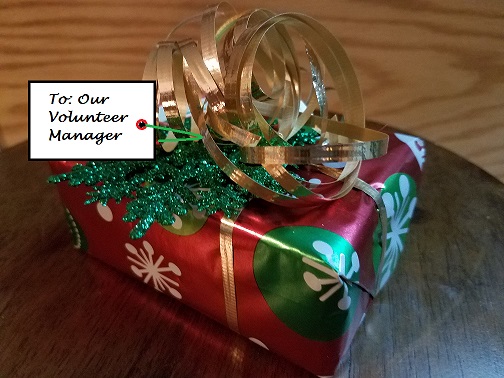
  • Non Profit Executive Directors: What to Gift Your Volunteer Manager This Year

    What to Gift Your Volunteer Manager This Year

    “What can I get my non-profit staff, especially that mysterious volunteer manager, who seems to run around a lot?”  You, my dear ED or CEO have come to the right place.

    Let me help you gift your hard working volunteer manager this year with something he or she will actually treasure.

    Forget that inflatable unicorn horn you wear on your head. Forget that sweater that depicts Santa in a magician’s hat. Forget that self help book on “How to Field Criticism and Still Feel Validated.”

    Forget two extra weeks vacation, uh meh. No. Give a gift that really resonates with your VM. And, the best part is, it doesn’t cost you a thing, only a sheet of paper, a printer and a pair of scissors.  And, as a bonus, in typical cooperative volunteer manager style, I’ll even throw in the template!

    Here are my three top picks for a Volunteer Manager Holiday gift:

    Get Out of Event Free Card:

    Get out of event free coupon

    Budget Increase Steal of Choice card:

    Budget Increase Steal of Choice

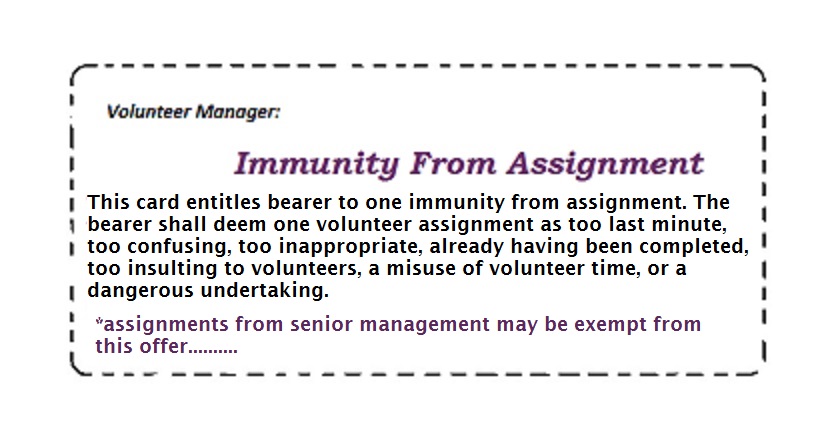
    Immunity from Assignment Card:

    immunity from assignment coupon

    Well Executive Directors, there you have it, the top three gift coupons for your volunteer manager. A few moments, a pair of scissors and you are done shopping!

    And, oh, volunteer managers? Feel free to slip these under the door of your executive director.

    Unless you really want that coffee mug that says, “World’s Greatest Office Worker.”

    -Meridian

  • The Volunteer Ripple Effect


    I’m convinced. We, Leaders of Volunteers (#LOVols) hold in our hands more power to affect positive change than we can even imagine.

    We have the opportunity to impact the world beyond filling tasks and adding to our volunteer base. The intuitive feelings within each of us are spot on: There’s so much more going on than our excel spreadsheets show.

    I remember long ago struggling to find volunteers who could be with clients while loved ones attended church or synagogue or temple or mosque. I would look for volunteers of that same faith and hoped that they would be willing to give up their own attendance to help someone in need. It was the way it had always been done and it was frankly, exhausting.

    Then one day, a volunteer stepped forward. Hannah offered to sit with Christian clients on a Sunday morning. (I’d love to take credit for thinking this solution up, but, no, it came from this wonderful, selfless volunteer.) Bam! The light went on.

    I feared that mixing faiths (or cultures, or beliefs) would be a challenge in itself, but you know what? (Of course you know what comes next) It ended up uniting people in mutual respect and a desire to understand one another. The mere act of reaching across a cultural or spiritual divide created its own sense of wonder.

    And here’s the thing. For the volunteers, it was never about, “oh, I’m so enlightened that I want to transcend these differences.” No, it was, “you know what? I’m free on a Sunday morning and you need someone, so what could be a better fit?”

    The deep meaningful by-products of volunteering are seldom the initial goals. They just naturally evolve because the volunteer ripple brings out the best in everyone: Clients, families, volunteers, volunteer managers, staff, neighbors, community, everyone.

    Think about that. Volunteer programs impact society in rippling positive ways beyond the delivering of meals, or escorting a tour group or passing out information. Our programs share love. Our programs open the doors for unity, connection and understanding to naturally take hold, and not just during holidays.

    We often witness a profound change in people. We glimpse moments of powerful interconnection through the simplest of assignments. We stand, watching that small pebble create ripples of inspiring stories.

    As you are running around this holiday season, scrambling to fill tasks, stop for a moment and think about the societal change you are helping to bring about. Because you value the innate worth of each human being and believe in their ability to transcend, you are spreading that change like a ripple in a vast sea.

    Volunteerism is a rippling movement.

    And leaders of volunteers are tossing the pebble into the water.

    -Meridian

  • Press “2” For That Volunteer Question

    Press 2 For That Volunteer Question

    “Yeah, so, this is Ginny from donor relations,” the voice on the phone sighs. “My next door neighbor’s fourteen year old daughter, April has a volunteer assignment for school. Why they are coming to me, I don’t know but just because I work at a non-profit, they think I’m free to help with all their little projects. When is the next volunteer training, or better yet, you call them. I don’t have time for this nonsense.”

    “Hey, I’ve been calling you for an hour. Where are you? Anyway, this is Jazz from administration.”  The voice message plays, Jazz sounding out of breath.  “I need volunteer stats ASAP for a grant for our project that, oh, never mind, I just need some stats and fast to complete this application.  How many hours did volunteers give last quarter? This is the last component on the grant and it’s due today so I need this right away. Call me immediately.”

    “Yo, this is Dean in records. The new volunteer, Charles, the one you sent us last month hasn’t been logging any hours, at least I don’t think so. I thought these volunteers knew what they were doing. Anyway, where does he fill out his paperwork again? And should he just make up hours for the time he worked?”

    Do you get tired of answering the same questions over and over? While we are conditioned to give that personal touch, our time is pretty precious and continually answering simple questions can eat into our efforts spent cultivating volunteers, forging new recruitment avenues and solving challenges.

    Taking a proactive approach can help. Think about all the standard questions repeatedly asked by staff and volunteers. Can these be put into a cheat sheet? Where can these cheat sheets be stored for maximum viewing?

    We have to remember that folks don’t necessarily remember something told to them one time. Volunteers will forget specifics taught to them in orientation. Staff is too busy with their own pressing duties to remember the date of the next volunteer training. So, storing these cheat sheets in multiple areas will cut down dramatically on repetitive phone calls.

    For volunteers, some visible places to store cheat sheets:

    • on a designated area of your website
    • as reminders in your newsletter
    • posted in your office
    • included in your welcome packet
    • given to volunteer mentors to share with newbies

    For staff:

    • on an internal website
    • sent out as a quarterly email blast
    • given to department heads to post
    • at departmental meetings (ask to attend other department’s meetings to answer volunteer related questions, explain policies, intercept issues etc. )
    • on surveys sent to staff
    • posted in your office in case you are not at your desk
    • training dates posted prominently in your office (whiteboard, poster etc)
    • training dates printed on flyers, cards etc and given to staff (great recruitment tool also)

    Besides cutting down on repetitive questions, posting core volunteer information creates an informed team of staff and volunteers who will disseminate correct information to potential volunteers. And, if volunteers have to constantly try to pin you down for simple questions, or if they always receive incorrect information from uniformed staff, they will quit out of frustration.

    Elevating our vocation includes creating a comprehensive base of information visible to staff and volunteers. The more we polish the fundamentals of our volunteer programs, the more we can build upwards.

    So, go ahead and press “2” for that volunteer question. But press “1” to leave the name and contact information of a prospective volunteer.”

    Let’s make our systems work for us.

    -Meridian


  • Thank You To The Volunteer Who Lied

    Thank You To The Volunteer Who Lied

    Does this sound like you? Thank you to of all the wonderful volunteers who have enriched my soul and believed in my abilities. Ahhh, being thankful, it’s what we volunteer managers do so well.

    But maybe we can also thank the volunteers who taught us lessons and built our characters. You know the ones. Their memories are seared into your psyche because you dropped your phone when you learned a trusted volunteer called a client “dumbo.”  You slunk back to your office when the CEO told you a volunteer tried to sell something to a client’s son. You stayed silent in meetings after a volunteer wrote that wildly incorrect letter to the editor.

    They say that the hard lessons are the ones that stick. Yup, they are the lessons that keep you up at night, and make your hair go grey. (not the pretty kind either)

    But, think about all the clients saved from unscrupulous volunteers because you learned a hard lesson. Think about all the necessary precautions you take because you were put through the wringer. Think about the watchful eye you developed because you were caught unaware.

    In spite of intention, these volunteers give us the gift of experience.

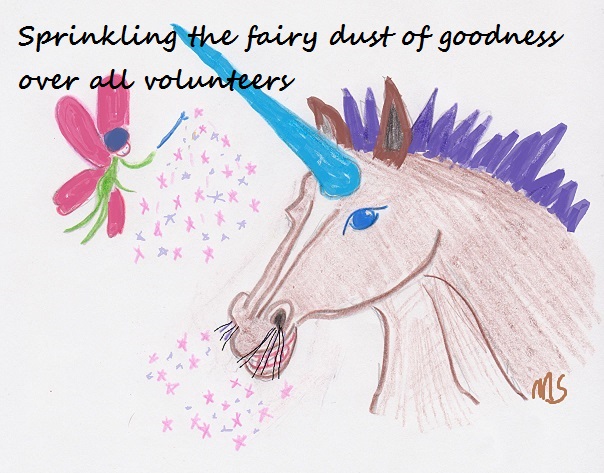
    I remember many years ago, Jacob, who lied to my face. I believed him, not because he was so charming and convincing, but because I wanted to believe him. I believed in the romantic notion that all people could see the light of volunteering and could set aside their personal agendas for the greater good. I dreamed of that world in which unicorns and faeries flitted about, sprinkling the magic dust of goodness upon all.

    Jacob showed me that I had to be realistic if I truly wanted to do right by our clients. He showed me that healthy watchfulness did not diminish my job, but rather elevated it to a higher level of purposefulness.

    You’ve been through this. We struggle to showcase all the carefully measured thought and actions required to match volunteers to clients and programs.  Unicorns and faeries are lovely, but we live in the real world. In the real world, placing volunteers with vulnerable clients takes discerning judgement, careful pairing and keen watchfulness. 

    Luckily I was watchful enough to remove Jacob before any harm was done. So, I thank him and others for giving me a discerning nature, for strengthening my resolve to do right and for teaching me that compassion takes the courage to be a sentry.

    Jacob most likely never intended to teach me anything.

    But he never intended to embrace the mission either.

    -Meridian

    Volunteer Manager Job Update:  Should I Laugh or Cry?

    A couple of months ago, I posted some volunteer manager wanted ads  and most of us pretty much agreed that they were lacking in inspiration. Well, thank you to Laura from Maine for sharing this volunteer coordinator ad with us.  I have not changed one word, but only added (my comments).

    Wanted: Kitchen/Volunteer Coordinator:

    The Kitchen Coordinator/Volunteer Coordinator is a very hands-on position that requires strong leadership skills, responsibility, and enthusiasm.

    Job responsibilities include:

    • Designing healthy menus (uh, registered dietitians actually do this so shouldn’t the job read Kitchen/Dietitian/Volunteer Coordinator?) 
    • Training and supervising a large volunteer crew of cooks and custodians (wait, now the job is Kitchen/Dietitian/Custodian/Volunteer Coordinator)
    • Working with stores and volunteers to manage daily delivery of food donations (whoa, now it’s Kitchen/Dietitian/Custodian/Delivery Manager/Volunteer Coordinator)
    • Recording menus, inventory, and volunteer timesheets (meh)
    • Helping clients find housing and apply for jobs (So, ta da, we have a Kitchen/Dietitian/Custodian/Delivery Manager/Housing Expert/Job Placement/Volunteer Coordinator)

    (I’m going to cry now over a piece of pumpkin pie).

    Happy Thanksgiving, I hope it is wonderful.