Tag: volunteer manager

  • Is Compassion a Velvet Chain?

    This is updated from a post back in 2015:

    The Shackles of Compassion

    compassion has its own frame of reference

    Patients at hospice taught me many things, especially that I come equipped with a frame of reference and I need to put my frame aside and keep learning.

    Our patient George, was long divorced and rarely saw his twelve year old daughter. I was drawn to George. He was an iron worker, loved sports, hated our food and I wanted to “help him.” We would have these talks, and eventually he shared thoughts on his approaching death and the realization that he wouldn’t see his daughter grow up. I would leave his room and cry for his wasting body and diminishing chances at a life.

    When his daughter’s birthday approached, I, along with volunteers, went to our local Target and bought presents for George to give her. The volunteers giggled over wrapping the presents in pink and purple with gobs of glitter. It felt so good.

    I remember the day George’s ex-wife brought his daughter to visit him at our care center. I peeked in to see if George needed anything else on this joyous occasion. I stopped, for instead of seeing happy anticipation, I saw him hunched over in bed, quietly crying, one of the presents at his side. I didn’t want to disturb him, so I tiptoed away.

    In that intimate moment, the veil fell away and I saw the velvet chain that bound him to us. Our “help” tethered him to our compassion and the heavy links became visible through his pain.

    “I have always depended on the kindness of strangers”…Blanche DuBois in A Streetcar Named Desire

    Did he cry because we helped him or did he cry because he had lost control of everything precious and was now dependent upon the kindness of strangers? Did he weep at the ridiculous presents that were as handy as a hot dog stand at a funeral? Did he feel trapped, allowed to walk only as far as our chains would allow and only in the perimeter of our idea of what he needed?

    strapped to feel-good moments

    Do the people we serve feel shackled to us? Is it kind of like the stranglehold the skydiving instructor has on the newbie skydiver who is strapped in tight and really is just along on the way down? Does our tandem journey through folks’ lives sometimes bind them to our feel-good moments?

    I went back to my office and closed the door and sat down. I wondered, in all my desire to help, did I rob George of his last shred of dignity? Do we, sometimes in our exuberance to do good, forget that a real person with complex feelings is on the other end of our help? Do we see them through our feel-good lens and wonder why they are not exuberant with us?

    After that day, I started to see George as more complex, and my desire to help as more self-serving. I continued to visit with him until he died. I still struggle mightily with “trying to help,” “knowing what people need,” “having answers.”

    is “helping people” so great?

    Here’s the thing. I think we must stop telling volunteers that “helping people” will make them feel good. I think that top-down idea inadvertently gives us the power to decide what that help looks like and demeans the person who receives the help. It puts that person at the mercy of our kindness.

    What instead?

    We must stop media from using headlines describing volunteer involvement such as, “volunteers put smiles on the faces of” (fill in the blank here with any group of depressed people who magically forget all their challenges because a fun volunteer showed up) or “volunteers cheer up”… (fill in the blank here with all the sad people who are just waiting for some stranger to come along and make them happy). Oh, and let’s just assume that what people really, really, really want is to become happy when faced with challenging times. Yep, a volunteer with a smile is just what they need.

    When I heard a few volunteers or staff complain that a recipient of help wasn’t grateful, I began to take note. I saw how uncomfortable it was for people to be demeaned by eager “helpers.” I saw that the volunteers (thankfully the vast majority of them extensively oriented to the mission) who were successful, were the ones who wanted to bond, to converse, to be humble. They didn’t want to hold any power over the people they connected with.

    if helping doesn’t make us feel good, what does volunteering make us feel?

    Volunteering does wonders for our well-being. But not because we are “helping” someone in a top-down approach and somehow we feel good because, “gosh, gee, I’m reminded that I have it so much better.” It’s because we are getting out of our bubble, we are connecting with people, we are learning and growing. I truly believe that volunteering makes us more human by connecting us on a one-to-one level.

    so, what do we tell volunteers?

    Instead of advertising that helping people makes us feel good, we can tell our volunteers that volunteering is about connecting, learning, and understanding. We can tell them that it will nurture their soul and teach them to be better people. We can stop encouraging them (even subtly) to “help” people who are “less fortunate.”

    In my experience, the most successful volunteers were the ones who didn’t go home and patted themselves on the back because they “helped” someone. No, the true volunteer spirit goes home and quietly processes everything they’ve experienced. They hope they are not an added burden. They hope they haven’t done any harm. They hope to be better the next day. This is the true volunteer spirit.

    We, leaders of volunteers can be the fearless leaders in the non-profit realm and re-mold the “helper’s high” image into something truer, more ….better. We can orient a volunteer team that understands they have no power over anyone else.

    Because even a velvet chain is still a chain.

    -Meridian

    .

  • Volunteer Flow Strategy

    Volunteers move in and out of our organizations and unlike staff who have defined hours and pay, volunteers ebb and flow like water in an ecosystem. A simple volunteer flow statement is used to track this flow and then predict future flows based on factors that engage volunteers verses factors that block the volunteer flow. Let’s create a basic flow statement for volunteer recruitment efforts.

    simple, but effective

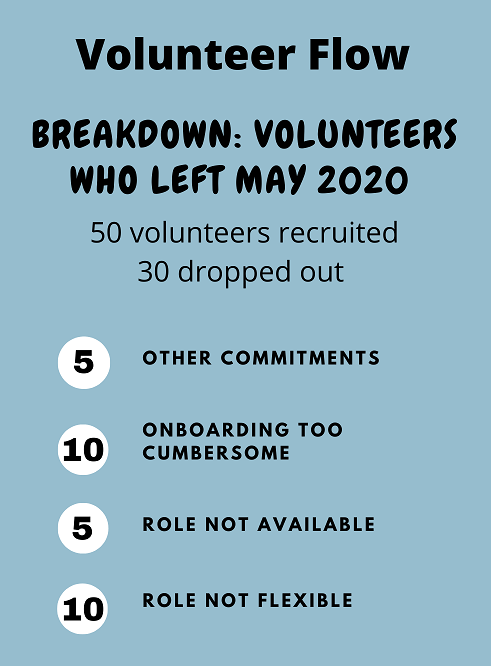
    Example: Month of May: We recruited 50 volunteers who signed up. Of those, 20 volunteers followed through and are now officially volunteering.  The other 30 volunteers did not follow through. The volunteer base has now increased by 20 volunteers. Sounds great if you simply say, “we gained 20 volunteers this month. 

    But let’s go further. What about the 30 volunteers who left after recruitment? Here’s where you can explain the reasons volunteers leave and predict that more volunteers will leave due to these same reasons. Not so great, after all, is it?

    Percentages are calculated from stats gathered – for example, exit surveys or interviews.

    Percentages break down this way:

    • 16% of volunteers who left in May had other commitments
    • 33% of volunteers who left in May found on-boarding too cumbersome
    • 16% of volunteers who left in May did not find a role that suited them
    • 33% of volunteers who left in May needed more flexibility

    When projecting volunteer recruitment in the future, we can now predict:

    For every 10 volunteers we recruit, only 4 (or 40%) will stay. ( based on the above stats, 50 volunteers recruited – 30 volunteers that left = 60% of new volunteers will leave before they even start. Now, 20 new volunteers doesn’t sound so great when the number could have been 45, right? (not 50 because you can’t control the 5 who had other commitments)

    Explain why volunteers leave by showing causation:

    Of the volunteers who left:

    • only 16% left due to unavoidable reasons
    • over 80% left due to factors we can modify or change

    We need to change…

    We can now infer from the statistics that changes will likely increase the number of recruited volunteers who follow through. Changes include:

    • on-boarding needs to be less cumbersome
    • roles need to be more flexible
    • roles need to be expanded

    A strategic Volunteer Flow sheet shows the reasons volunteers leave or stay. (causation). These “causes” are the reasons you have experienced all along and have been advocating for. Volunteer flow is a way to form your knowledge into a measurable report and more importantly, predict the future with statistical information.

    Instead of the notion that a volunteer manager should “work harder” to “get volunteers,” we need to place the reasons volunteers leave or never get started squarely on the outdated systems that no longer work.

    By predicting the same results in the future, you are illustrating that without the changes you are advocating for, volunteers will continue to leave before they even get started. You can use this method to show volunteer retention and causation as well.

    show what you know

    Volunteers flow in and out of our organizations for hundreds of reasons. The reasons we can control must work for the volunteer and by showing causation, we can more effectively advocate for the changes that will increase volunteer engagement.

    Modern volunteers need modern programs that meet their needs. Our communities are ecosystems and volunteers flow in and around looking for the right opportunity to offer their skills and passions.

    Let’s strategically advocate so that when volunteers flow our way, they find a place to stay.

    -Meridian

  • Predicting Volunteer Flow

    Predicting Volunteer Flow

    What freezes the flow of volunteers?

    What is a volunteer flow? It is the movement of volunteers in and out of an organization, much like a cash flow in business. Like any resource, volunteers are a people-resource that is rich in skills, passions, marketing reach, knowledge, experience, dedication, and in ability to procure donations and other desired resources. As such, our volunteers must be viewed as just as valuable a resource as a donation flow.

    Can we, volunteer managers predict our volunteer flow, especially in uncertain times such as we face today? Before we say no way, (mainly because we have all experienced surprises when it comes to who actually will volunteer), let’s ask this question: Would it benefit us, Leaders of Volunteers, to create a volunteer flow statement?

    As a fan of mathematical equations (even when I mangle them), our aim is: UPV (under promise volunteer resources) < OPV (over produce volunteer resources).

    We know that there are thousands of factors that influence volunteer recruitment and sustainability and we know that challenges have increased exponentially due to the pandemic. So, how can we possibly predict how many volunteers we will gain, retain or lose in the next few months?

    We can’t predict with certainty, but we can estimate with causation. And this is actually a good time to introduce the idea that volunteers ebb and flow not only with changing times, but with any negative or positive experiences within our organizational structure. Volunteers aren’t something we “order up” or people who magically appear when needed and never question their assignments. This is the time to introduce the factors that freeze or free up a volunteer flow.

    What is our objective?

    Our aim is to create a consistent flow of highly engaged and productive volunteers who positively impact our organization’s goals, objectives and mission. Our job is to recruit these volunteers, and to develop them into contributing members of our teams. For more on development, see:

    #LoVols, This Needs to Change Now

    What do #LoVols do all day?

    Download Volunteerplaintalk Tools

    Will volunteers return after being furloughed? Will more virtual volunteers sign-up and then we are caught without enough meaningful roles for them? Will corporate and other groups want to continue their philanthropy? How will virtual training affect volunteer sustainability? These are questions we don’t have all the answers for, but based on what we are experiencing, we can create a volunteer flow strategy statement.

    Next time: What goes into this strategy?

    -Meridian

  • #LoVols, Passing the Time Constructively Like We Always Do

    One thing I realized in all these years, is that leaders of volunteers are never, ever idle. We are always recruiting, talking up volunteering, hatching new ideas, and working a crowd (even if it’s only 1 person in line for a 99 cent taco on Tuesday). We never stop, even during chaotic times. Some of the things we’re doing are:

    We can’t get rusty so we practice training volunteers wherever and whenever we can. It helps to target the audience in practice, just like we do for real. You never know what civic group or club might invite you to give orientation.

    We want to be super-prepared for the time when volunteer fairs are running again, so we pass the time by making give-a-ways – it doesn’t hurt to have something people really want.

    We don’t stop talking about our volunteer initiatives to anyone that might listen. I figured heck, we go to the store anyway, may as well use this opportunity to recruit volunteers. (in theory, but all I experienced was customers making a wide arc around me)

    Leaders of volunteers are creative, innovative people. I’m thinking, we will look back on this time as the most innovative in the history of volunteer management.

    Seriously.

    -Meridian

  • Volunteer Past, Meet Volunteer Present and Volunteer Future:

    Volunteer Past, Meet Volunteer Present and Volunteer Future:

    We are at a junction. Volunteer past is meeting volunteer present and volunteer future. How will we treat each one going forward?

    It’s too soon to know what changes will occur, but it is not too soon to start strategizing for a better present and future. Will we recruit new volunteers saying, “It’s a new day folks,” and by sweeping away the past, piss off all the volunteers who have stuck with us? Will we try to force all the new volunteers into old roles and methods and appear to not have gained any innovative insight from this crisis?

    Volunteer past is an organization’s foundation. Honoring volunteer stories and accomplishments from the past means your organization has created a solid base and has laid an infrastructure on which to continue building.

    I discovered long ago, that when seasoned volunteers spoke at volunteer orientation, new volunteers were impressed, but also thought, “Am I supposed to be like this volunteer or will I have my own volunteering path? Is there anything new to be done?”

    Moving forward, modern volunteers need to get excited about their volunteering journey. Volunteers are looking at the future instead of being content with the present. It’s a subtle, but significant shift.

    What does that mean for us then, when it comes to recruiting, sustaining and on-boarding new volunteers? It means balancing past volunteer methods, awards and accomplishments with present goals and visions for the future. It means setting the foundation and then inspiring new volunteers to put up the walls, or decorate the interior or construct another floor. It means focusing on moving forward.

    What if you’re not an exciting start-up organization with endless possibilities? Introduce expansion, new programs and future visions to volunteers who may be wondering, “why do you need me?”

    Nothing is more infectious than an inspiring vision that has movement. It gives volunteers an identity. It means that they won’t have to mimic volunteer past to make their unique mark.

    Volunteer Past infused with Volunteer Future looks something like this:

    “Our volunteers have won numerous awards for their work. But, we want to build on that and we need your unique passion.”

    “Our volunteers gave 70,000 hours in the past 5 years. That’s why we can expand our innovative programs. That’s where you come in.”

    “We’ve used this method for many years because it worked. Now, we are moving forward and you are part of the journey.”

    A well-rounded volunteer understands volunteer past and looks to make their mark on volunteer present and volunteer future.

    Our volunteers want to celebrate and understand the past, but own the future. Let’s give them both.

    -Meridian

    This is a more timely version of a past post: https://volunteerplaintalk.com/2018/10/03/volunteer-motivation-past-present-and-future/

  • What We Do Know

    Uncertainty sucks big time, but guess what? We, volunteer managers deal in uncertainty all the time. Think about it. Everyday we wonder…

    • Will anyone who attends my speech at the local Classic Car Collector’s Guild on Saturday actually sign up to volunteer? Will one or two attendees fall asleep in the back and snore so loudly I have to shout over the noise?
    • Can I trust that Magda in event planning will communicate the revised meet-up spot to the volunteers and not forget again? Will I get a frantic call from a volunteer asking where he should be while I’m at my son’s violin recital and then I get shame-shushed by snarky Heather who always sits behind me?
    • Will volunteer Trevor stop bringing his herbal supplements to clients’ homes or do I have to have another conversation with him? Will he ever stop trying to sell his energy pills to everyone? (huh, maybe that’s why I’m so jittery...)
    • Will I come in to work this morning and find a volunteer has once again written a letter to the editor of the local paper, calling out the lack of volunteer department budget? (after I’ve patiently explained that going to the press ensures WE WILL NEVER GET THE MONEY NOW!)
    • Will the A/V equipment break in the middle of my presentation to the chamber of commerce and then I’m stuck drawing a graph on volunteer impact from memory on a chalkboard? (and I hastily draw a graph that resembles male body parts
    • Will I have to carpool volunteers to the luncheon because finance did not pay for the bus and driver I reserved? (and we arrive late because volunteers have to stop to use the restroom along the way)
    • Will the printing company get this year’s appreciation theme correct and not print 400 balloons saying, “Volunteers have no heart.”

    We, volunteer managers routinely operate in an uncertain world so we’re already positioned to navigate these times.  But wait. Not everything is uncertain so let’s look at what we do know.

    • People want to help: If anything tell us that volunteerism is alive and well, this pandemic proves it. From neighbors helping neighbors to social media groups that mobilize participants to 750,000 people signing up in the UK for the NHS, people are still volunteering. The spirit of volunteering is alive. 
    • We know there will be an end: There’s always an end. Sure, there will be a new normal with new challenges so this is the time to start strategically planning for the new normal in a way that benefits you, your volunteers, and your volunteer initiative. How do you envision yourself coming out of this? Better equipped to speak up and mold your volunteer program for this new normal? 
    • Change is an opportunity. No one is more adaptable than a volunteer manager. We can come out of this with the adaptations that fit the modern volunteer. Change can be an opportunity, so let’s make it work for us.

    • Priorities rise to the top: What does that look like for you? Communicating with volunteers, serving clients or revamping archaic systems? Challenging circumstances have a way of exposing flaws and outdated methods while highlighting the greatness of the things working well. Now is the time to sort through and document what is working, what is not working and why, so that moving forward, you have supporting information that will back-up your plans moving forward. 

    • We are in this together. Yep, we are, because we, volunteer managers have a common purpose. Let’s take this time to find each other, band together and further our goals. Volunteer organizations are forced to stream their volunteer award events. These are the events we can all support by virtually attending or commenting on in a show of solidarity. 

    We are no strangers to uncertainty and the same strength, courage and resolve we employ everyday will see us through these times. We will come out of this stronger, more resilient and more determined to see volunteerism and our volunteers elevated. 

    We will come out of this more connected to one another, more supportive of one another, and more able to speak as unified voices. One thing we can do to create a swell of united support is to stream more. Let’s use this time to record, stream, and create videos showing volunteer impact so we can build an audience that sees the work firsthand. Let’s not relegate volunteer awards to a nice lunch at a moderately priced hotel, seen only by attendees. Let’s share volunteer value and impact with the world. Let’s go big and take our message to everyone. 

    Because our message is crucial.

    Of this, we are certain.

    -Meridian 

  • Keeping in Touch With Volunteers

    We are in new territory and for many organizations, volunteers are temporarily staying home. What can a volunteer manager do to keep volunteers engaged when we can’t sit down with them, hug them, hear their stories or laugh with them?

    Right now, we can supplement our daily spontaneity with strategy. First, we need to plan the approach. Where do your volunteers see/hear/read/absorb information from you or your organization? Common ways are:

    • emails
    • phone calls
    • website
    • social media
    • meetings

    Next, determine strategies for each information pipeline. Schedule communications (weekly, daily, bi-weekly) so volunteers look for regular updates from you. And, giving yourself a deadline helps keep you on track. Prepare your scheduled messages.

    For those volunteers who only get information through phone or meetings, create a phone tree of volunteers to pass along information and also to encourage those volunteers to choose a tech method in which to stay informed. Not all will, but this is an opportune time to start funneling volunteers into more central avenues of communication such as your website. This is a time to create a new normal in which volunteers expect to learn, be informed, find educational offerings, meeting schedules, inspirational stories etc. from the tech site(s) you find most advantageous. (for example, you would like all volunteers to follow your Facebook page or you would like all volunteers to check your volunteer portal)

    A few ideas for scheduled communications are:

    • provide helpful information on your website. Volunteers trust us, so be the site they go to for correct and factual information-if you give volunteers information, be sure to include the source, don’t re-word the information, quote accurately, don’t opinion-ate on facts.
    • set up a new hashtag for your volunteers specifically during this time ( example: #SpringhillVolsCov19 ) and share what your org and you, as their LoVols are doing during this time. (include your website address to funnel volunteers towards a central spot)
    • post testimonials from past clients, volunteers, etc to celebrate volunteer impact and for inspiration to keep engagement alive.
    • set up Facebook live events to speak directly to your volunteers. You are their anchor and seeing you is reassuring.
    • this is a great time to share the history of your organization. Share old photos, stories of how the mission was created, and the early struggles. If possible, interview your org’s pioneers; those who were there when it began. Connecting your volunteers to the birth of your mission strengthens their engagement.
    • issue a challenge-read a book, exercise, learn a skill. A challenge illustrates that you care about their well-being (which you do) and makes this time about them.
    • ask volunteers to email their favorite volunteering memory and share those memories with the volunteer team. You can also re-purpose the stories to use later as testimonials for recruitment and training purposes.
    • create a quiz. Quizzes are entertaining and can serve an educational purpose at the same time. Add a bit of humor to your multiple choices by making one answer funny.
    • survey your volunteers. What have you always wanted to know? Create a survey with multiple questions to help you plan forward.
    • ask volunteers to share their tips for surviving a shelter in place order and post those tips.
    • Netflix party with your volunteers (through Google Chrome). Pick a comedy, or classic or feel-good movie and watch together with volunteers. You can even chat during the movie.

    This is a stressful time filled with chaos. Strategically planned communication with volunteers helps decrease our stress while continuing their engagement. The immediate future may be uncertain, but one thing has not changed. Volunteers appreciate information and connecting and we, volunteer managers are excellent at keeping our volunteers engaged.

    Uncertainty is less stressful when a plan is in place. Plan your communications and use this time to invest in volunteers, funnel them into a centralized information hub and gather opinions and stories from them to be used now and later.

    Be well. Be safe.

    -Meridian

  • We are Human, too

    Pandemic. It’s a worrisome time and we, leaders of volunteers worry. A lot. Like mother hens, we cluck about, gathering masses under our protective wings. “I got you,” we murmur, pulling everyone close.

    We worry about the frail volunteers who are determined to keep volunteering but may become infected with the virus. We worry about the volunteers who stay home and are missing that one, bright, social spot in their lives as they hunker down, alone. We worry about the clients we serve and how they are deprived of that perfect moment, when our skilled volunteer makes a connection, soul on soul.

    We worry we aren’t doing enough, or we’re overlooking a volunteer who needs us. We worry that things will never be the same again, and our volunteers will leave over new regulations. We worry that volunteers may experience a new normal and be reluctant to work directly with clients. We worry that no one will come to the next training class. (although I always worried about that, anyway)

    I’m not going to say, “stop worrying.” Worrying is human. It’s the tough part of being a caring, sentient being. It’s part of a volunteer manager’s drive to be effective.

    But I will offer this: Your worry means you care. Your worry means you are determined to make this world a better place, one volunteer, one client, one program, one training, one speech on volunteer value, one long night of blowing up balloons, one showing up at a volunteer’s swearing in as a new citizen at a time.

    You believe in possibilities. You believe in light. You believe in neighbors stepping up to help neighbors. You believe in people wanting to help. You might even believe that some good will come out of this and volunteering will increase. You are optimistic.

    You’re the very essence of what being human is about. So be human and care about the world. We, volunteer managers are resilient. We adapt, we adjust, we pivot, we overcome. We are always moving, and altering our direction to keep going forward. Our worries are often a map to finding the way. We’ll be all right.

    Believe in your abilities and take care of yourself. We need you.

    -Meridian

  • You Can Water Plastic Flowers, But They Won’t Grow

    In a volunteer manager’s chaotic day, volunteer impact is difficult to plan, hard to complete and often impossible to execute. We laughingly describe our chaos in phrases like, “herding cats,” “wearing many hats,” and “controlled chaos.” But, the inability to move ourselves and our volunteers forward due to chaos is no laughing matter.

    I’d like to add another phrase to the lexicon: “Watering plastic flowers,” which means time spent on futile activities. But wait, futile is a strong word; it means “pointless,” or “incapable of producing results.”

    So, let’s eliminate the word futile, because there’s always hope right? As volunteer managers, we hold hope in our hands: Hope for that volunteer who is hurting and wants to help, but keeps canceling. Hope that our impassioned speech about volunteer value changes minds. Hope that today we will fill a role no volunteer wants to do.

    Instead, let’s look at ROI-return on investment. When our time investment does not produce enough results to continue, this doesn’t mean we must stop reaching out to that volunteer who never shows up; it means we have to weigh how much time we spend doing it.

    And remember, for every minute we spend on something with little ROI, we miss spending that minute on something with a large ROI that has impact and moves us in the direction we want to go.

    What steps can we take to determine where we should invest our time?

    • Volunteer ads: Analyze ads’ effectiveness and spend more time on effective ads. Relegate lesser producing ads to your office volunteers to manage. (and if you don’t have a team of volunteers helping you in every aspect of your job description, what the heck are you waiting for?)
    • Volunteers who are unreliable: Set a tolerance number-I will contact a volunteer X number of times and after no response, I will send them a letter/email/message thanking them, inviting them to contact us when ready.
    • Conflict challenges: If a challenging volunteer repeats egregious behaviors, craft a policy on expectations and stick to it. Make sure every volunteer is given a copy, reads and signs the copy and is aware of your policies and the final dismissal step.
    • Educating staff on the many aspects of volunteerism: Start with one important point and repeat, repeat, repeat; then build on that one concept. Too many concepts dilutes the ability to absorb it all.
    • Staff who improperly manage a volunteer’s time: Move the volunteer to a department that effectively engages volunteers. Make no apologies for moving volunteers to departments or positions that meet the volunteer’s needs.
    • Report, speak and substantiate the why: Want change? Infuse the why (specifics) into everything you say and do. For example, “We have an opportunity to partner with a local florist whose employees want to volunteer and potentially donate flowers, fund-raise for us and help advocate for our services. This will lead to other business partnerships so I need support from multiple departments.” Or, “I moved volunteer Tess to finance because her skills were underutilized in client records.”
    • Close your open door: Set aside planning time and remove yourself from distractions. With any repeated behavior, people will grow accustomed to “oh, yeah, Julie’s out right now. It’s planning time. She’ll be back in an hour.”

    Overloaded volunteer managers have no time for weak ROI. Under our careful cultivation, we need flowers that bloom and grow into effective volunteer engagement and impact.

    So, watch out for plastic flowers; they may look colorful, but water them all you want and they still won’t grow.

    Instead, water the flowers blooming with impact and watch your garden grow into a lush volunteer initiative.

    -Meridian

  • What do volunteers want? f/u.

    “Wait. you caught me off-balance.”

    What? You thought I meant… No, f/u=follow up. Like sending volunteer managers to leadership training, it’s sadly nonexistent these days.

    Lately, as a volunteer, I’ve experienced a rash of major lack of follow/up. Most of the time, follow/up applies to a new idea or project, but it can include things like getting answers on an assignment .

    Truth is, I’m guilty of it too. But when you experience it from a volunteer perspective, it is a motivation killer. No follow/up is like saying to a volunteer, “this is not important or worth my time. YOU are not important or worth my time.”

    When I was confronted by volunteers for not following up, I would feel off-balance and I’d use the excuses, “I’m working on it,” or “I haven’t gotten an answer yet,” (when I hadn’t even asked) or “I was just about to call you.” I’ve strung people along, put them on hold, shelved them, or ran the other way when I saw them coming; all because the follow/up wasn’t there. (But I was trying, so that made me a good person, right?)

    Why do we do this to our volunteers and to ourselves?

    • we have the best of intentions- but the road to the volunteer apocalypse is paved with good intentions
    • we can’t say no-which creates a loop in which we never get anything done
    • we are caught off guard-and we have no comeback prepared
    • we live in a visionary world-but we have no visionary strategy
    • we think we must prop up all volunteers-so we feed a need in some that may not align with our mission work
    • we are “nice” people-but we mistakenly equate nice with doormat

    The bottom line is this: if we can’t follow/up, we have no business engaging in the first place. What are some ways to prevent the volunteer f/u syndrome?

    • Make priorities known: It’s ok to say, “that is an interesting idea. Right now, our priority is to fill these volunteer roles. Can you help us do that first?”
    • Share the responsibility for f/u with the person: “I’m swamped with this event coming up. Will you remind me after the event?”
    • Be honest: “I might forget because we are in the middle of a recruitment campaign and I don’t want you to think I’m just giving you lip service, so can we revisit this at a later date?”
    • Weed out the serious from the non-serious: “That is an interesting concept. We have a volunteer task force that meets monthly and one of their objectives is to choose and implement a new idea. Would you come to the next meeting and make a pitch?”
    • Define the f/u: “What do you need from me? I will put it on my calendar and get back with you on the 20th of next month after I speak with the finance director.”
    • Don’t sugarcoat the no: “I’ve spoken to our CEO and at this time, she is unable to allocate the resources to your idea. It is not because the idea isn’t a good one, but because we are about to implement a new initiative and it’s all hands on deck right now. Try again after we’re successful.”
    • Don’t own the work: “I would like to help with that, but we are in the middle of volunteer appreciation planning. Can you work up a proposal with specifics and examples and get it to me? Without a fleshed-out proposal, I can’t get an audience to hear your idea.”

    I’ll not lie. I’m disappointed in my recent experiences with f/u even though I understand the why because I’ve been there and had those good intentions. But, still, lack of f/u kills motivation.

    So, let’s not make volunteer f/u an actual….F…. well, you know what I mean.

    -Meridian