Tag: volunteer manager

  • #LoVols, Our Secret Sauce

    “…it’s so temptingly good!”

    We, volunteer managers have this rare overview of mission operations because our volunteers are involved in many/all departments and services. We know things other staff don’t know. We know Darcy secretly eats pudding at her desk which is why she always needs to swap out her keyboard. We know Lucas watches ninja videos on YouTube while claiming to do research. We know it was Kelly who jealously sabotaged Degan’s report because Degan got to go to that conference in New York.

    But, we also see how siloed everyone is and how much work is disjointed: For example – marketing sends a rep to schmooze a group of potential donors at a civics meeting. A month later, the CEO asks the education coordinator to “teach” a class at this same group. Meanwhile, you have this detail-loving volunteer and you realize they could help marketing and education efficiently merge their efforts.

    The same holds true for endless organizational meetings about a new project that is left simmering because staff is too overworked to get it going. Meanwhile, you know some amazing volunteers who could run with this idea and implement it.

    All throughout your organization, you see where volunteers can add tremendous value. You know what that makes you? (No, not a busy-body). A Visionary. Yep, it does, so let’s own it.

    We have a unique opportunity to offer volunteer value, although speaking up with authority can be downright terrifying. But remember, what is obvious to you is most likely not obvious to everyone else.

    We see where volunteer involvement can tie things together and how collaboration increases effective efficiency (or efficient effectiveness). We can show volunteer value in ways administration hasn’t thought of, but how should we offer?

    The ineffective way of pointing out volunteer help: (Negative Observation = Need Help)

    • Our volunteer heard a presentation given by Marcus at one of her club meetings and she said Marcus mumbled through the whole thing and nobody at her club could hear him so why don’t we use volunteers instead? We’ve got some real chatty volunteers!
    • Our volunteer overheard Gwen in marketing say she is delaying sending Skip the new marketing plan because she’s mad he won the employee of the month award but we have volunteers who are not petty like that so let’s put them in charge of the plan.
    • A volunteer said Jazmine in finance is afraid she’ll lose her job because she is having trouble learning the software, so hey, let’s give her some student volunteers because they all have computer skills.

    We don’t need to share negative tidbits. The visionary approach is to offer the impact of volunteer involvement and remove the objections to it. This is where the secret sauce comes in: It enhances your proposal with volunteer qualifications and the delicious work you have done to develop wonderful people into effective volunteers.

    Think of it this way: Would you feel confident if a staff member said to you, “I see you look stressed and I have someone to help you manage volunteers. They’re really nice.” No, you wouldn’t feel confident, you’d feel anxious. Why? Because negativity breeds anxiety and besides, nice isn’t a qualification. Neither is smart or honest or fun-these are attributes.

    Qualifications are the specific skills that are suitable to the job. (think office skills, public speaking). It’s imperative to ask questions to find what qualifications staff value in volunteers (able to work quietly, self-starter).

    We must offer volunteer help packaged with the volunteer’s qualifications and the background work we’ve done with each volunteer. Our volunteers are a package deal, not some random nice person off the street. We’ve invested time and knowledge in our volunteers and that investment will help open the silo walls.

    The secret sauce way to present developed volunteer help: (Positive observation + volunteer qualifications + secret sauce = win/win)

    • Volunteer Terrence, who is thoroughly vetted (secret saucevetting), has volunteered for five years in several roles (qualification), including working directly with our clients. He has been instrumental in bringing in 3 new donation streams (qualification) and through numerous training sessions (secret saucetraining), is versed in mission verbiage. Under my and marketing director Gwen’s watchful eyes (secret sauce-looping), Terrence can double the number of presentations given and he is ready to pilot a volunteer presentation program.
    • Volunteer Mizrah has been thoroughly vetted (secret sauce-vetting) and briefed (secret sauce-training) on the role in finance. He understands the importance of team and boundaries (a qualification you learned is important to Jazmine by talking with her) and will take the burden off Jazmine so she can focus on other important tasks. I will monitor their working relationship closely (the secret sauce – your leadership in looping, mediating and adjusting) so Jazmine is confident with the help.

    The #LoVols’ secret sauce is the work we do in the back of the organizational kitchen, mixing volunteer ingredients, stirring the pot frequently, tasting and adjusting so wonderful people are developed into effective volunteers: See The VOL E TEAM (vetting, orienting, looping, effectively communicating, training, educating, adjusting and mediating).

    We have a vision for our volunteer initiatives. Our volunteers are qualified. We have the secret sauce for their success. Let’s not keep our sauce so secret anymore.

    -Meridian
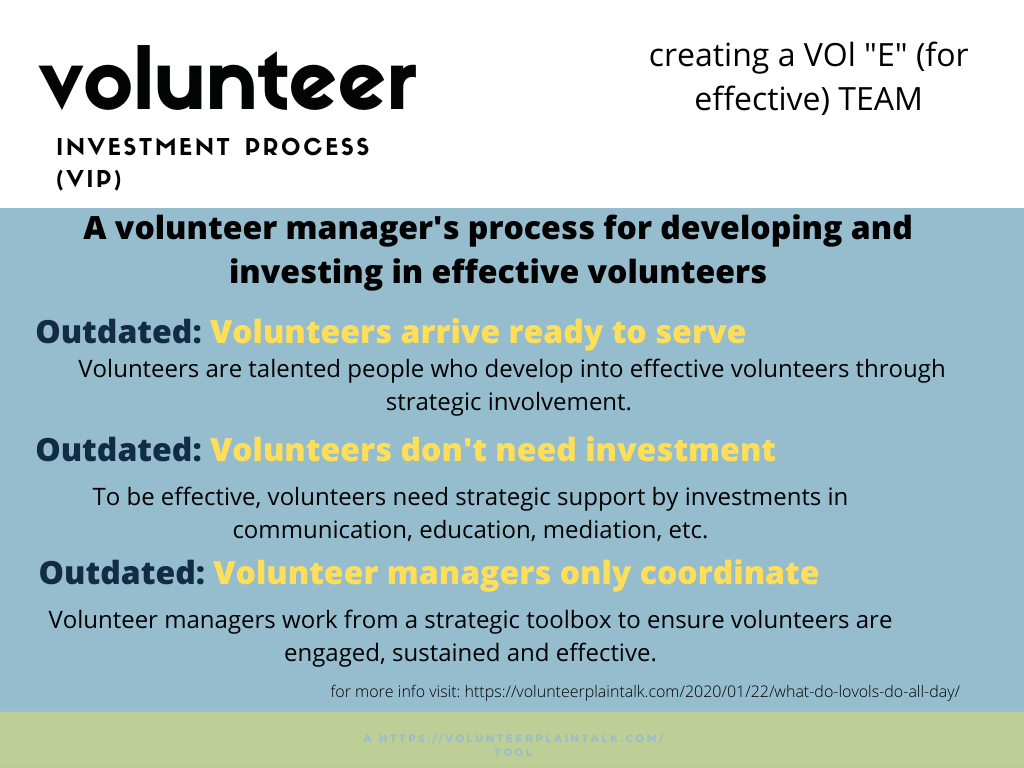
  • VIP-volunteer investment process free download

    Investing in people through strategic engagement is the way #LoVols develop effective volunteers.

    Use this flow chart as a tool when explaining volunteer engagement or keep it in your desk to remind you of all the people-saturated skills you have in your toolbox and remember: Volunteers are wonderful people who develop into effective volunteers through strategic investment. That’s what #LoVols do all day.

    -Meridian

  • What do #LoVols do all day?

    What do #LoVols do all day?

    Do #LoVols chat up potential volunteers, make a few phone calls and then go home to binge watch Mind Hunter while eating Cheetos and petting the rescue cat? What do we do all day, exactly?

    We say things like, “I do a bit of everything,” or “I’m a jack of all trades,” or “depends upon the hour, ha ha,” which gives the impression that we are not in control and have no direction. Here’s the thing though: We are in total control and every portion of our day is devoted to engaging volunteers and creating volunteer impact. It’s time we show the world we are proactive, not reactive. Let’s gather all of our people skills under one term, “volunteer engagement skills” and stop downplaying our role. We’re a Jack of the volunteer engagement trade which consists of all kinds of skills, each one working towards a single purpose: creating an effective volunteer experience and team.

    We wear volunteer engagement and impact gear. Our skill set is people- saturated. What looks breezy is calculated. What looks effortless is deliberate. What looks casual is strategic.

    We may appear to be socializing but we are establishing a welcoming and meaningful atmosphere through the hard work of making it look effortless so volunteers are engaged and add value. There is method to our madness as we strategically create a team of effective volunteers through each people-saturated element:

    • vetting
    • on-boarding and/or orienting
    • looping
    • efficiently and effectively communicating
    • training to position
    • educating
    • adjusting or agile thinking
    • mediating
    • structuring

    let’s look at each element and why it is crucial to volunteer impact:

    • vetting: includes background checks, reference checks, one on one interviews, sit-downs and all other “getting to know a volunteer” tactics.
    • Why is this important? Volunteer engagement professionals (LoVols) weed out potential harmful volunteers and redirect volunteers to a fit that works for all stakeholders ensuring clients and staff work with competent people that do no harm and produce results.
    • onboarding and/or orienting: includes introduction and immersion into the mission. Whether by formal or informal methods, the LoVols connects the new volunteer to the work. Orientation is the emotional glue that binds a volunteer to the organization.
    • Why is this important? Volunteer engagement professionals ensure each volunteer understands organizational purpose and intent and is in sync with mission goals and objectives, thus equipping a volunteer with the necessary emotional connection to embrace the mission.
    • looping: includes checking in and checking back with clients, staff and the volunteer in a continuous loop to ensure satisfaction by all stakeholders.
    • Why is this important? Feedback is key to volunteer, staff and client satisfaction. Continual feedback and adjustments create impactful, working relationships, and prevent missteps, misunderstandings and potential disasters. Unlike employees, volunteers work less time without pay so looping is crucial to volunteer success.
    • efficiently and effectively communicating: includes emails, chats, phone calls, meetings and all other methods providing information to volunteers.
    • Why is this important? LoVols balance inspiration and expectations to ensure volunteers understand expectations and organizational direction while reaping the positive benefits of volunteering.
    • training to position: this includes on the job training for the volunteer role. Unlike onboarding or orientation to mission, this training is specific to job requirements. Whether the LoVols trains personally or has been instrumental in guiding staff to train new volunteers, training to position ensures volunteers are equipped to function within their roles and produce results.
    • Why is this important? Volunteers free staff to accomplish their objectives. Essential training equips volunteers with the confidence to fulfill their roles and allow staff the additional time to accomplish their objectives which becomes a dual benefit.
    • educating: this includes newsletters, seminars, workshops, email blasts and other methods to inform volunteers not only about organizational news, but about topics relevant to volunteers’ lives.
    • Why is this important? Education is high on employee and volunteer lists of desirable perks. Continually educating volunteers equips the volunteer team with correct and current organizational information, especially since volunteers are WOMM (word-of-mouth marketing) ambassadors to the community. Educational offerings speaks volumes about the commitment to the volunteers’ positions within an organization and to their well-being.
    • adjusting or agile thinking: this includes reevaluating volunteer involvement or placement, utilizing innovative methods of retention, matching volunteers to roles, flexible adjustments and any other method to address individual volunteer needs.
    • Why is this important? LoVols balance organizational needs with volunteer needs to create a symbiotic relationship that adds value and furthers mission goals.
    • mediating: this includes intervening when necessary, balancing the advocating for volunteer rights while promoting organizational needs, finding middle ground that satisfies all stakeholders and honors the mission. It includes having difficult conversations with volunteers, putting the mission first, dismissing a volunteer when necessary and advocating for volunteers to be treated with respect.
    • Why is this important? Improving or salvaging a relationship with a volunteer is crucial. Poor experiences affect volunteers, staff and clients. LoVols mediate to ensure all stakeholders are satisfied so that mission goals are achieved.
    • structuring strategically: this includes creating innovative new roles to engage today’s volunteers, revamping outdated volunteer positions, policies, procedures and methods of communication, gathering feedback and involving volunteers in strategies.
    • Why is this important? As volunteerism evolves, LoVols structure volunteer initiatives to sustain and attract today’s volunteers by creating new roles, offering flex scheduling, sharing jobs, ensuring diversity, engaging virtual and one time volunteers and including volunteers in strategic planning. As demand for volunteers grows, LoVols are busy structuring for future growth and laying the groundwork to attract and sustain a team of effective volunteers who add value.

    The next time someone stops and says, “gee, it looks like you’re having a lot of fun,” smile and reply, “I’m actually hard at work because one of my volunteer engagement skills includes making fun look effortless. Thanks for noticing.”

    -Meridian

    Photo by Oladimeji Ajegbile on Pexels.com

    P.S. Feel free to share this with anyone who doesn’t understand your job…your grandpa, your snotty cousin Mildred, all your old college roommates, staff at your organization, your CEO…

  • #LoVols, This Needs to Change Now

    #LoVols, This Needs to Change Now

    Ask an astro-physicist “what do you do all day,” and I’ll bet her answer isn’t “I look through a telescope.” Ask a software developer the same question and it’s doubtful he’d say, “I type on a keyboard.” So why do we, #LoVols say, “I work with volunteers?”

    Astro-physicists and software developers have complicated jobs producing impressive results that stretch far beyond the simplest terms. Our jobs as #LoVols?…..most people don’t have a clue as to the skills and strategies we use when engaging volunteers and crafting volunteer impact. We need to change that perception.

    This doesn’t mean whining, “volunteer Jenny did that amazing work because I spent extra days training her since our staff couldn’t take the time to show her how to do her work and oh, I listened to all her last-minute questions on a Saturday night when I could have gone to see Star Wars at the movies with my now ex-boyfriend who incidentally went without me and showed up with my best friend Carla and yeah, my life is in tatters, but hey, Jenny did a great job, thanks to my sacrifice, didn’t she?” Hmmmm, maybe that’s not quite the way to show our work.

    Instead, we can show our strategies in developing effective volunteer teams and by doing so, dispel the myth that volunteers need nothing more than coordination. By laying out the upfront and continual work in developing effective volunteer teams, we accomplish these objectives:

    • we ingrain the idea that volunteers don’t magically appear, ready to go.
    • we show that volunteers are people, not tools, and like employees, need continual mentoring and support.
    • we reinforce the truism that volunteer initiatives are not “herding cats” but are strategically structured for success.
    • we support our argument that not every volunteer can be interchanged and that thoughtfully matching volunteers to role creates successful outcomes and prevents disasters.
    • we show that there are processes in play and that even our chatting with volunteers is structured to mentor them for success.
    • we point to a volunteer’s progression from first contact to integrated volunteer and reinforce the idea that volunteers require continual support, not just from us, but from the entire organization.
    • we highlight the creative processes in forming innovative volunteer roles that impact the mission.

    The acronym, VOL E TEAMS will do nicely here as in, “Let me show you how I develop teams of volunteers who are effective.” You can substitute excellent or efficient for the “E” but I’ll argue why effective is the best choice when talking about VOL E TEAMS. Let’s look at definitions:

    • Effective: producing the intended result
    • Efficient: functioning in the best manner without wasting time
    • Excellent: possessing superior merit

    Say a physician recommends her patient take a medication to alleviate symptoms. The physician could say, “this medication is excellent,” or “this medication is efficient,” or “this medication is effective.” Which word speaks to results? Effective. That doesn’t mean our volunteers are not excellent nor efficient. They are and you could also say, “I’m developing volunteers for an effective, efficient and excellent team.”

    As we, LoVols report volunteer impact, effective is a key word to support the contributions our volunteers make. Verbiage is crucial and we must use results-type words to describe volunteer value such as effective, outcomes, results, impact, accomplish, contribute to, produce, achieve, implement, enact, create, effect, etc.

    So, what does the acronym VOL E TEAMS stand for? (Hint- it stands for the work #LoVols do to create and sustain the volunteer factor.)

    • vetting
    • on-boarding and/or orienting
    • looping
    • efficiently and effectively communicating
    • training to position
    • educating
    • adjusting or agile thinking
    • mediating
    • structuring

    Next time: An effective team requires an effective leader. Looking at the components of VOL E TEAMS or it’s time we show our value as Leaders of Volunteers.

    -Meridian

  • Volunteer Management in The Past Decade

    Photo by Christina Morillo on Pexels.com

    Ahh, the 2010s. In looking back over the past 10 years, what ideas took hold and where do we need to go?

    I decided to do a look at volunteer management terms and see how often they appeared in a “google search.” I chose to search “news” with a date range. Warning: This is in no way scientific (mainly because I don’t own a lab coat, but I did wear my goats in Santa hats bathrobe during the search so maybe that counts) nor do I claim to be a qualified researcher (more like a nosey, busy body-just ask my neighbor) but anecdotally, I found some interesting tidbits (especially if you count that sale on orthopedic inserts that keeps popping up).

    I researched these terms- “volunteer impact,” “volunteer factor,” “still volunteering at,” “corporate volunteering,” “volunteers impacted the mission,” and “volunteer engagement,” all with quotation marks. The results are:

    still volunteering at

    Photo by Roman Carey on Pexels.com
    • 2010 2 results
    • 2011 9 results
    • 2012 25 results
    • 2013 27 results
    • 2014 28 results
    • 2015 49 results
    • 2016 58 results
    • 2017 95 results
    • 2018 116 results
    • 2019 219 results

    It bugs the heck out of me that a bulk of stories on volunteer activity center around a volunteer who is still volunteering at 99 years old. Before you groan at me, sure, this is great, but where is the focus on the value this 99 year old brings to the mission? Or, better yet, where is the evidence that volunteering benefits this volunteer’s well-being (helping them remain active at 99) which explains why she/he is still able to volunteer at 99? These articles for the most part miss the point and that needs to change.

    corporate volunteering”

    Photo by Fox on Pexels.com
    • 2010 1 result
    • 2011 3 results
    • 2012 10 results
    • 2013 23 results
    • 2014 32 results
    • 2015 50 results
    • 2016 73 results
    • 2017 82 results
    • 2018 123 results
    • 2019 251 results

    There’s a clear direction here; a direction that needs our immediate attention as more companies become involved with corporate volunteering which includes group volunteering and allowing employees paid time off to volunteer. For more information on corporate volunteering, see Removing the Headache from Corporate Volunteering, the second part, Creating Partnerships from Corporate Volunteering. and finally Volunteer Manager Strategy and CSR.

    volunteer engagement

    Photo by Marta Ortigosa on Pexels.com
    • 2010 5 results
    • 2011 8 results
    • 2012 27 results
    • 2013 32 results
    • 2014 50 results
    • 2015 99 results,
    • 2016 140 results
    • 2017 119 results
    • 2018 242 results
    • 2019 245 results

    Ok, so the steady increase in articles mentioning volunteer engagement shows that engaging volunteers is becoming part of our lexicon. Good.

    “volunteer impact”

    Photo by Japheth Mast on Pexels.com
    • 2011 3 articles
    • 2012 3 articles
    • 2013 4 articles
    • 2014 6 articles
    • 2015 7 articles
    • 2016 6 articles
    • 2017 9 articles
    • 2018 28 articles
    • 2019 53 articles

    A bit of an uptick the past two years for the term “volunteer impact” is encouraging but there is much work to do because we are leaders of volunteer engagement and impact. We not only engage volunteers, but we guide and lead the impact that volunteers have on the outcomes. The two terms go hand-in-hand. When volunteers are engaged, they positively impact our missions and vice versa. These two terms have a symbiotic relationship which means one increases the other and to integrate volunteer engagement into our nonprofit culture, we must show volunteer impact in order to expect more volunteer engagement. I’d draw an impressive flowchart, but heck, it’s basically just a circle.

    “volunteer factor”

    Photo by Christina Morillo on Pexels.com
    • 2010 0 results
    • 2011 0 results
    • 2012 0 results
    • 2013 0 results
    • 2014 1 result
    • 2015 1 result
    • 2016 0 results
    • 2017 no results
    • 2018 1 result
    • 2019 9 results

    The term, “volunteer factor” sounds so right for us, doesn’t it? Factor’s definition includes “influence that contributes to a result or outcome.” Bingo! Think X factor. Or the “It” factor. Now think about hearing your CEO tell a reporter, “and now let’s talk about the volunteer factor.” We can make the 2020’s the decade of the volunteer factor.

    volunteers impacted the mission“: no results, when removing quotes 368 results for the entire decade.

    Ok, so there’s work to do here.

    We’re on our way to making the 2020’s the decade when volunteer programs take center stage. The roots of change are already sprouting such as:

    • Research pointing to volunteering as a vital component of wellbeing.
    • Corporate entities looking to be socially responsible.
    • Grassroots volunteering taking hold.
    • Research showing employees want to have paid volunteering time.
    • Volunteers wanting to use their skills and talents in innovative ways.

    Here’s to the next 10 years. We are making inroads, but we have more work to do. And if there’s anything I know in my gut about volunteer managers, it’s that we are not afraid of hard work. As a matter of fact, we eat hard work for breakfast and throw it up by lunchtime. Wait, ewwww, that’s not right, is it?

    What do I wish to see by 2030? I’m convinced that together, our efforts will produce the results we want and all the volunteer manager conference themes for 2029 will no longer be “Time for Change,” but will rather proclaim, “Holy Hell, We Did It!”

    -Meridian

  • Happy New Year! Volunteer Plain Talk Podcast Episode 4

    Happy New Year! Volunteer Plain Talk Podcast Episode 4

    https://www.buzzsprout.com/605416/2382236-episode-4-interview-with-sam-clift-volunteer-resource-manager-london-transport-museum

    How do you evolve your volunteer program for the volunteers of tomorrow whilst meeting the needs of your volunteers today? Sam Clift, Volunteer Resource Manager at London Transport Museum talks through achieving senior management buy-in, involving volunteers in strategy planning, getting volunteers on board with organisational change and using technology and volunteer support to make volunteering more accessible and inclusive. Sam can be contacted at sam.clift@ltmuseum.co.uk or alternatively at his LinkedIn page: http://linkedin.com/in/sam-clift-0363a821
    Tips I learned from Sam:
    Court senior manager buy-in by chiming with their priorities. 
    Keep volunteer value continuously in view.
    Technology can be embraced by volunteers.
    One change can create looking at other ways to change and grow.
    Use incentives to make changes more palatable.
    Involve volunteers in strategic roles.
    Be honest about limitations.
    Elevate volunteers to mentor roles.
    Find new ways to embrace inclusion.
    Meet challenges head-on.

    Thank you to Sam for his hard work and insights and for sharing his program with us. And here’s to an exciting new year.

    -Meridian

  • Volunteer Holiday Cards Free download

    Volunteer Holiday Cards Free download

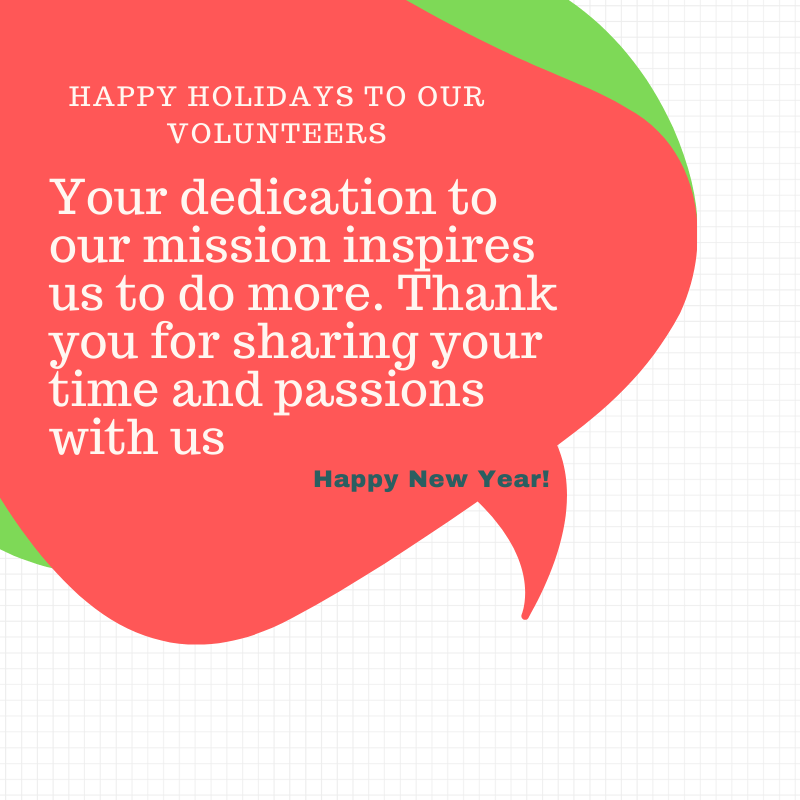
    Happy Holidays everyone! Please feel free to use these cards to send to your volunteers as a quick or additional acknowledgement of their dedication to your mission and their impact on your communities.

    for Social Media

    Have a joyful holiday everyone!

    -Meridian

  • Surviving “that” conversation at holiday gatherings-a guide for volunteer managers

    Surviving “that” conversation at holiday gatherings-a guide for volunteer managers

    courtesy https://gratisography.com/

    Yup, holiday gatherings are upon us and everyone fears the inevitable politics-driven shouting between grandpa and cousin Timmy, but guess what? Those conversations are nothing burgers compared to what we, volunteer managers must endure. You know what I’m talking about.

    You arrive at a party and the snarky attorney guest of a friend of a friend of a friend is introduced to you. She hears “manager of volunteers” and looks down her nose at the scuffs on your Gucci knockoff shoes that you bought at your organization’s thrift store, because, hey, you have a conscience and want to contribute some money instead of just spending it and besides, recycling is the way to go, but you just keep mum and let her rake you over with her eyes like you’re some bargain basement hobo.

    So, in the spirit of defending our #lovols profession, here are some comebacks for those inevitable questions that arise when you are introduced to uppity distant cousin Prunella or your best friend’s very successful investment banker neighbor, Chase who is usually alone on holidays.

    Q: “So, you’re a volunteer manager, did you say? I’m confused. Does that mean you volunteer for the job or do you actually get paid to do that?”

    A: What a great question. It’s complicated. I don’t get paid in money, but I do get to pick from all the stuff that is donated to my organization. Last week I got a case of lentil soup. The cans were out of date, but that’s ok. I’ve not gotten sick from donated food yet, unless you count that time I was throwing up for a week, but I don’t think it was from that out of date cheese, and heck, I picked off all the mold, but you never know. Anyway, I’m hoping for a toaster oven this week. Mine’s like 20 years old and it only toasts on one side so you have to turn it over and run it again.

    Q: “Volunteer manager, you say, what’s that? There’s no degree in that, is there, I mean, you’re basically a party planner, right?”

    A: You wouldn’t think we’d need any skills, would you? Actually, I have a Bachelor of Science in cat herding, with a minor in balloon animal engineering. It’s a pretty popular degree but the work is intense. I mean I think I’m still suffering the effects of helium-osis (raise your voice’s octave to a squeak) which makes me speak in a higher than normal voice at times. Currently, I have a scholarship at Nancy’s Nonprofit University for a Master’s degree in Little Old Lady Management. I hear the internship is brutal, you know all that tea drinking and knitting and getting shanked by a wayward knitting needle while scrambling for the ball of yarn the 17 cats ran off with. There’s this one class I hear is really hard, it’s ‘The Symbolism in Grandchildren Stories, or Does Grandma Secretly Despise Her Offspring?’

    Q: “You work with people who don’t get paid? That’s not really management, is it?”

    A: You got me. Don’t let this get out, but when a volunteer signs up, we pretend to give them a tour of the organization and we usher them into the basement and lock them up in a room until they complete their assignment. We all take turns poking them with a stick until they do what we want. Sometimes, and this is the hilarious part, we just poke them for laughs. I have my own special stick made out of hickory. I call it “Ol’ Persuader.” And you’re correct, it’s not management at all, ha ha, it’s so much easier and more fun.

    Q: “So, you work for one of those nonprofits, right? You know, they’re always bothering me for money. Don’t you people just get money from the government? Why are you people hounding me?

    A: Ha, ha, awww, we can’t fool you, can we? Don’t let this get out, but we actually get millions and I mean millions from the government but since we don’t need money, we invented this game. We like to see if we can get gullible people to donate and we give a prize at the end of the year to the staff member with the most lucrative sob story campaign. And I shouldn’t be telling you this, but do you know what we do with all those extra donations? One word. Stock market. Hey, it’s almost the end of the year. I wonder if I won the award with my “Life Sucks, Give Me Cash, You Cheapskate” campaign.

    Q: “Wow, managing volunteers, that must be really easy, right, I mean how hard could that be?”

    A: Oh, you, you are so perceptive. It’s hands down the easiest gig I’ve ever had. I’ve got volunteers who bring me coffee in the morning and volunteers who clean the office while I just sit back and watch YouTube videos. I even have volunteers who do my laundry, can you believe that? And, don’t tell anyone but I even have a volunteer who rubs my feet in the afternoon. Yeah, crazy, isn’t it? Crazy good! I’ve been told the foot rubbing and come to think of it, the volunteer who pays my bills violates some sort of fair labor practices, but hey, they volunteered, right? They’re not protected by anything, ha ha ha ha ha!

    Well, there you have it. Use these answers in good, holiday health and don’t stress about those absurd questions.

    You are welcome.

    -Meridian

  • Sneak peak at volunteer manager gifts

    Sneak peak at volunteer manager gifts

    I always loved giving gifts that capture the quote a person loves, or features the phrase a person uses a lot. It’s about recognizing that person as a unique individual.

    A few folks have encouraged me to share some of this stuff and it got me to thinking. We, volunteer managers are all working hard to bring volunteer management into the 21st century. As a unique profession, we should be proud of who we are and have some lighthearted fun.

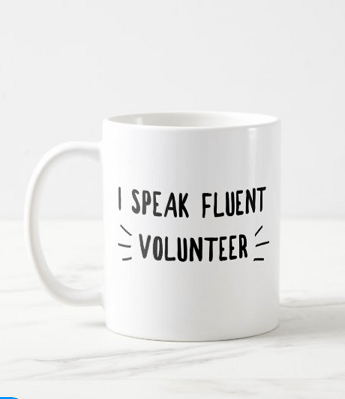
    And so, VolunteerPlainTalk is now on Zazzle. There are more new designs and as they become available, I will add them to the sidebar and to a new page in the top menu.

    Who are we? We are fun-loving, believers in good, inspired by the smallest gestures, able to see the potential in everything, fans of complex human beings, inquisitive thinkers and just plain great folks to be around. Thanks and happy gifting!

    -Meridian

  • Volunteer Impact Worksheet: Free Download

    Volunteer Impact Worksheet: Free Download

    How do we show the value our volunteer bring and all they contribute to making our organizations successful? This worksheet is meant to be a quick guide to help create a “volunteer equation” for calculating volunteer impact. By using an equation, we translate volunteer hours into departmental goals and objectives met and then further into organizational mission fulfilled.

    Volunteer hours (VH) = Goals/Objectives met (GO) = mission fulfilled (M)

    It is a deeper dive into volunteer value and contributions in addition to reporting volunteer hours and/or equivalent monetary value. It answers the “what and why” engaging volunteers is critical to mission success. The blog post, 5 Words that Might Untangle Volunteer Management describes the equation in depth.

    The more we can show how volunteer impact advances departmental goals and objectives, the more we show volunteer value. And by diving further into meeting mission goals, we connect our volunteers, our volunteer programs and volunteer engagement to mission success.

    -Meridian