Tag: volunteer retention

  • Captains of Our Destiny: Captain Obvious Part 2

    Captains of Our Destiny

    Ha, ha, working with volunteers is like herding cats. …non-profit staff member.

    It is time we become captains of our own destiny. It is true that our work is not glaringly evident to all, so we can’t be Captain Obvious.

    So, now what? We can captain our future and redefine our work in terms that befit its importance while illuminating our professional skill set. It’s on us to redefine volunteer services, to flip it from one of cutesy, fluffy extra touches to a dynamic and professional service.

    How? Well, first off, we have to change the loose descriptions of volunteer engagement and instead use the professional terms they deserve. To do this, let’s look at two highly regarded and compensated jobs and re-imagine our profession in those terms and descriptions.

    Instead of volunteer managers, what if we were called Volunteer Account Managers? In reality, volunteers open accounts with us, in the same way as donors or clients. (an account is something of value or worth-in this case a volunteer’s time, expertise, resources, knowledge, sweat equity, donations, word of mouth marketing, etc)

    As such, we would use these terms:

    Volunteer Account Management: the management of volunteer accounts, including the relationship with volunteers and the pursuit of volunteer satisfaction.

    Volunteer expectations: the value a volunteer seeks from our organizations, such as training opportunities, positive feedback, admittance to the team, creative outlets etc.

    Volunteer centric: the emphasis an organization places on volunteer involvement, including timely appreciation, seats at planning meetings, designated volunteer managers who are supported, educational opportunities, partnership opportunities.

    Volunteer journey: the steps a volunteer goes through to become a viable and satisfied member of the organization.

    Volunteer journey mapping: the process by which a volunteer manager maps the journey a volunteer takes from first contact to integration through onboarding-and more importantly, the ability to reconfigure the steps when necessary.

    Volunteer profile: the ongoing process by which a volunteer manager educates staff about volunteers, including their needs, their changing dynamics, their skill levels, their rate of participation and their future involvement.

    Volunteer satisfaction levels: measuring and reporting the satisfaction levels of volunteers through one on one interviews, surveys, questionnaires, etc. And more importantly, the ability to change areas in which volunteers lack satisfaction.

    Volunteer benchmarking: the continual process of improving the relationship with volunteers. There are many methods of benchmarking, such as:

    • do volunteers choose our organization over others and why or why not?
    • do volunteers make time for us over other activities and why or why not?
    • do volunteers recommend our organization to their circle of influence and why or why not?
    • do volunteers increase visibility, donations and resources and how? (we all know instinctively that this is true, but benchmarking will prove it)

    Volunteer benchmarking will then be a tool to change the processes that need change, in the same way fundraising evolves.

    In order to Captain our own destiny, we must begin to flip volunteer services from the outdated idea that volunteers are summoned to fill a job and volunteer coordinators “herd those funny cats around, lol, isn’t that cute.”

    Instead:  Volunteers hold an account with us and we are responsible for cultivating that account by continually improving our relationship with the volunteers. And this is where the highly skilled volunteer account manager comes in.

    Next week: KAVM-the key account volunteer manager-what does this mean for us?

    -Meridian
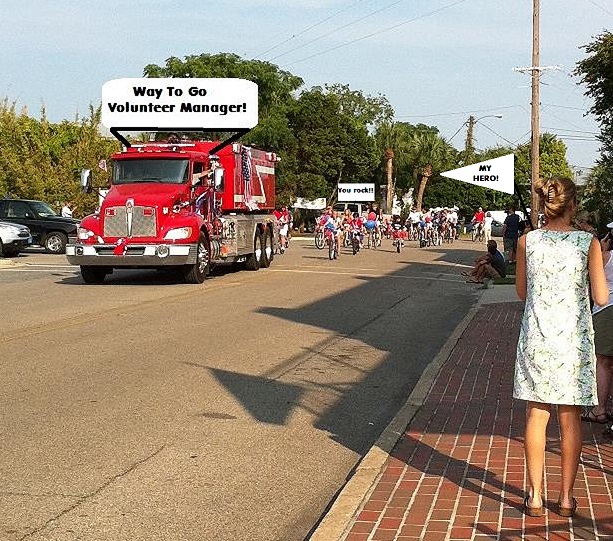
  • Sometimes, There Is No Parade

    Sometimes, There is No Parade
    Awww, you shouldn’t have.


    Not everything volunteer managers do will be visible. Rather, in reality, most of our meaningful work is not about measurable numbers or stats. For this out of view work, there will be no awards, no pay raises and no parades. Yet, when recalling the moments that matter, these are the ones that usually spring into our minds.

    Helga was a volunteer who came to America after WWII. She married an American soldier, left her home in Germany to forge a new life in a new country with her new husband. Helga still retained her German accent. She was a tiny woman with a smile that reached up to her eyes, even after her beloved husband had died. I asked her to take a shift on the reception desk.

    We were in the process of initiating fingerprinting (Level 2) for our volunteers. It is a cumbersome and tedious process and the digital prints are hard to capture. Until this point, I submitted background checks (Level 1), read each report and challenged every anomaly I found. With Level 2, a central system approved or disapproved our volunteers, taking it out of my hands.

    We slowly filtered all of our volunteers, new and existing through the fingerprinting process. And, Helga was rejected. The rationale was that fingerprinting picks up “things” that a level 1 does not. I had to call Helga and tell her. I remember calling her and asking her to come in and talk to me. She knew immediately that it had to do with her fingerprints. She started to cry.

    We made an appointment for the next day. I hung up and felt…….. enraged. I wanted to know why this beautiful lady was being rejected, so I found an empty office and began to call the reporting agency, bouncing from person to person. It took the afternoon to get through to someone who could spend a minute to help me. She put me on hold, then came back on the line. “What’s her social security number again?” she asked. I told her. After another long hold, she came back. “Well, it seems it was a computer error. Your person has a clean record.”

    I called to tell Helga the good news, but something told me to keep our appointment. She did not answer so I left the message to please come in so I could explain in person what had happened.

    Helga came in the next day. I found a secluded spot to talk with her. We sat, knees to knees and I explained to her that it was a computer glitch. She burst into tears, crying deep and long as though a dam had given way. I hugged her. “Are you sure it was a mistake?” She asked.

    I wondered if this was about something other than her volunteering. “It was just a mistake, Helga. Do you trust me?” I said. “I would not lie to you.”

    She nodded and dabbed at her eyes. “I thought you might,” she said, “think I was a Nazi.”

    Suddenly, the present fell away.  I could see her, a young hopeful bride after the war was over, arriving in her new home. I could feel her trying to ignore the suspicions while desperately proving she was a good person. I could imagine that the past did not lie buried.

    We cried together for a good, long time. I called her the next day. “Helga, do you still believe me? Do you really, honestly know how much we love you?” At that point, I did not care how much time I had to spend convincing her.

    “Yes,” she said in a clear voice that removed my doubt. We did not speak of it again.

    That day I learned, for most of the time we spend doing our work, there will be no parade.

    But, my heart does not really want parades. It wants to hug Helga.

    -Meridian

  • Interview With a Volunteer: Ellie Part 2

    contacts

    Part two of an interview with Ellie, a volunteer for 18 years with a hospice.

    VPT: Let’s look at things in retrospect now. What advice do you have for volunteer managers? How can we keep someone like you?

    E: I’d say that having someone a volunteer can count on is important.

    VPT: In what way?

    E: It’s trust. I trusted my supervisor and he trusted me.

    VPT: You moved away. But you stopped volunteering before you moved. Was it because you were contemplating the move?

    E: (pauses) No.

    VPT: What was it then?

    E: Things were changing.

    VPT: In what way?

    E: Well, my supervisor was taking on more and more work. I began to realize that when I needed support or a chance to talk, I may go to his office and he would not be available or at another location.

    VPT: That support was important.

    E: Well, yes, because I wanted to make sure that I was doing the right thing. I did not want to do anything wrong.

    VPT: And so, you saw change happening.

    E: Yes.

    VPT: Ok, I am asking you to be honest here. As volunteer managers, we’ve all done this. We sometimes share our frustrations at the amount of extra work with our volunteers, although we don’t mean to do that. Did your supervisor start sharing his frustrations with you?

    E: No, not at all. See, the type of relationship I had with my volunteer supervisor was so successful. He didn’t have to say a word to me. I instinctively knew that he was overburdened all on my own.

    VPT: Do you think it is harder for new volunteers if they don’t forge that deep relationship with their volunteer manager?

    E: I don’t know because I can’t compare it to anything I experienced. I would ask though, are volunteers getting what they need? I know I had it pretty good, and by the same token, I wonder if volunteers who don’t receive the same vote of confidence will stay.

    VPT: So when did you decide to stop volunteering?

    E: I had this patient, Joy, the sweetest lady you’d ever meet. I would go to her house and take her to do her shopping. We had so much fun together, But one day, I went to her house. I was tired, out of sorts I guess and I felt a bit like I didn’t want to go to the store. Joy said to me, Are you all right? Have I done anything to upset you? Well, I assured Joy that she could never upset me and I apologized over and over. I thought long and hard about that moment.

    VPT: And that had something to do with your leaving?

    E: I knew then, that I was done. How? It was my attitude and reactions that told me. I knew that it was time. I had nothing more to give. And if I can’t give 100%, then I’m not doing any good for the people I’m supposed to be helping.

    VPT: How did that make you feel?

    E: (sighs) It made me sad, because it had been such a good ride.

    VPT: Eighteen years. That’s a long time. Did you feel any guilt over leaving?

    E:  No, no guilt because I gave my all while I was there. It was just time.

    VPT: How do you look back on it, now?

    E: I wouldn’t trade it for the world. It was enlightening, rewarding, and was almost like a second carer.

    VPT: What advice would you give to volunteers?

    E: You get out what you put in. And, it is crucial to ask if you have questions and to share problems and experiences with your supervisor.

    VPT: Any advice for volunteer managers?

    E: Yes. Supervisors need to know that volunteers go through what I went through. They need to realize and look for signs that volunteers are going through a period of ineffectiveness and they need to address that. Nurture the volunteers you have.

    VPT: Would you go back now that you’ve had some time off?

    E: No. That is in the past now.

    VPT: Thank you Ellie, for your honesty, your insights and your incredible volunteering.

    E: My pleasure.

    -Meridian


  • Interview With A Volunteer: Ellie

    contacts

    We all know volunteer feedback is invaluable, during and after projects and assignments. There is also value in gathering feedback from former volunteers who have had the time to process their experiences and take aways.

    Recently I was able to catch up with a retired volunteer, Ellie, and I asked her to look back on her years of volunteering for a hospice.

    VolunteerPlainTalk (VPT): How many years did you volunteer?

    Ellie (E): (laughs) “oh about 18.”

    VPT: That’s a long time.

    E: It was a long time, but it was good.

    VPT: What was your favorite part of volunteering?

    E: Hmmm, my favorite part. I liked the idea of giving and I always felt that I was receiving so much in return, but I guess you hear that a lot.

    VPT: Do you remember the beginning?

    E: Yes. I remember my training. At the end of training, the volunteer trainer handed me my first assignment. She told me that she believed I was ready. And she took me over to the window and pointed to the house of the person I was assigned to. She sort of let me know that it wasn’t far away and I would be close to help if I needed it.

    VPT: How did that go?

    E: I was nervous, but I felt prepared.

    VPT: Was your first assignment the impetus that kept you going?

    E: Actually, it was my first long-term patient, who came right after. We became incredibly close. Before she passed away, she said that she had added one more daughter to her family. And shortly before she died, she called me in and said that she needed to know that I was going to be ok. The extent of our connection was something I never expected.

    VPT: How much of a role did your volunteer manager play in your success?

    E: Oh my goodness, so much. The fact that my trainer and my supervisor, Jim trusted me, had faith that I could do this was huge. And, I always felt that if I had a question, he would be there. I remember I was sitting with one patient whose wife had a part-time job. He had a morphine drip and he thought it wasn’t working and he said to me, I don’t understand why this is not working, can you find out? Now, I have no medical knowledge at all, but I immediately got on the phone and my supervisor got me to the right person. That went a long way to building my self-confidence.

    VPT: So, having someone to contact was hugely important.

    E: Absolutely. I always counted on being able to knock on his door, go in and receive the support I needed.

    VPT: You are also a thirty year now retired school teacher. Why did you volunteer at a hospice and not with children?

    E: (laughs) I think I needed to do something different. After my husband died so young, I felt like I wanted to do something that was meaningful.

    VPT: Did his death influence your decision to volunteer for a hospice?

    E: I don’t think so. It was over three years between his death and my decision to volunteer.

    VPT: How did you find hospice?

    E: I saw this ad, and I knew right then it was a way to fill my life with some meaning.

    VPT: So, there was no magic formula for recruiting you?

    E: Sorry, no.

    VPT: Many people think hospice volunteering is depressing. Were you burdened with sadness?

    E: No. It was quite the opposite. It was fulfilling.

    VPT: Was there any opportunity for fun?

    E: Oh, my yes. I had so much fun with the staff. We let loose all the time. The seriousness of our work was a contrast to the silliness we experienced. I remember the time we made over 100 pumpkin pies for a Thanksgiving dinner in our care center. We laughed the whole time. Having that fun kept us wanting to do more, you know what I mean?

    VPT: I do. Was having fun a good use of your volunteer supervisor’s time do you think?

    E: Absolutely. Life is full of balances. The balance between serious work and letting off steam goes a long way to bond us together. It strengthened our team.

    VPT: I’m pushing here, but I wonder. Have you ever connected your losing your husband, the man you had planned on retiring with, and your work in hospice?

    E: Ehh, no. I just know that I had a lot of years to give and it was a way to fill my life with some meaningful work.  But I do remember one year, I signed up to volunteer at a children’s grief camp.  That day, while driving on the way to camp, I thought about all the little kids who were coming. They had all lost someone important in their lives and I had a little meltdown. I missed my husband.

    VPT: That must have been tough.

    E: I thought about these kids and it occurred to me that I went through this years ago. It brings something home. While I was there, we had a ceremony at night. I was really grieving for my husband. It comes when you least expect it. Sometimes you have an epiphany to a particular circumstance you’ve been through. It was almost like a total realization I had been through a significant loss and I released that.

    VPT: I’m at a loss for words.

    E: I even had grief counseling after his death. But my meltdown shocked me. I thought I had processed the grief.

    VPT: So, in retrospect, did your volunteering have a personal positive impact on you?

    E: Oh my, yes.

    Next time: Part 2 of this interview. Ellie moved away from her hospice, but she stopped volunteering before she moved. Why?

    -Meridian

  • Luncheon and Food for Thought…

    Luncheon and Food for Thought 001

    Get your dancing shoes on! This year, volunteer appreciation week in the US is April 23-29. It’s coming up in May for Australia, and June for the UK and New Zealand.

    If you have a luncheon planned, you’ve long ago selected the venue and contacted the speakers. You’ve ordered the cute online mini calculators for giveaways. (of course your calculators were shipped late because the vendor mixed up your order with one from the company, “Meals on Wheelies” who is actually a pizza delivery joint in Appleton Wisconsin) You will give up your Friday night tickets for the punk concert, “Zombie Brains Munchfest” and instead, you will sit alone, wrapping the calculators in cute purple tissue paper (which serves nicely to dab your tears) because your friends and family say they are tired of being unpaid labor.

    Volunteer appreciation events vacuum up our time and emotional energy like giant tornadoes trailing balloons. Expectations are high. Is the food great? Are the speeches sincere? Will I be able to make each volunteer feel special? But what about the volunteers who are out-of-town or are ill or just can’t come? What about the day after the event? The week? The year? Do the speeches and chocolate fountains last?

    I’m not against events. Not at all. I am though, for grabbing any opportunity to improve volunteer engagement. What if we made volunteer week a kickoff, rather than a stand alone event?

    Why not use volunteer week as a brightly colored launch to enlist staff support for acknowledging volunteers all year-long? It makes sense to jump on the festive events as a springboard for a volunteer recognition calendar. With our orchestration, ongoing volunteer appreciation can become a learned behavior within organizations.

    While the “we heart volunteers” posters are up, the splashy balloons float in the hallways, and the staff is sampling that star shaped cherry cheesecake, it’s time to pounce! As these vibrant visuals draw attention to your volunteers, it’s the perfect time to visit each department and share your recognition calendar for the year.
    A sample calendar can look something like this:

    The Volunteer Department Yearly Calendar of Volunteer Recognition!
    Every first of the month I will pass around birthday cards for the volunteers who are celebrating birthdays. I would appreciate your signature. The cards will then be mailed to the volunteers. These simple but effective cards remind each volunteer that the entire organization appreciates them on their special day. Individual recognition goes a long way towards volunteer retention.

    Every third Wednesday of each month I will visit one department to write down testimonials from staff on the incredible impact volunteers have on supporting our mission. These testimonials will be published in our volunteer newsletter which is shared with all volunteers. In addition, the testimonials will serve to recruit prospective volunteers as well. Here is the list of scheduled departments for the next twelve months. Please be thinking about our volunteers and their contributions. Your testimonials serve to reinforce the volunteer support your department deems beneficial. (Bonus: keep all the testimonials for other purposes such as recruitment ads, speeches to groups etc.)

    Every quarter I will be videotaping several staff members expressing a simple ‘thank you’ to our volunteers and I will be showing the videos at the beginning of our volunteer meetings. These videos will serve to remind the volunteers that they are important members of our team. (Bonus-you can show all of the videos at next year’s luncheon)

    I will remind everyone in an email blast the first of each month. Thank you for participating in our plan to retain our valuable volunteers and to encourage new volunteers. Staff appreciation is a motivating factor in cultivating a supportive team.

    Your written plan can include:
    A-what and when (the schedule)
    B-how (the particulars)
    C-why (the benefit to volunteers and organization)                                                                       D-in addition, your reminder schedule

    Volunteer recognition is meaningful and fun on event day. We serve up praise along with chicken salad and we may even give awards for volunteer of the year. But awards look backwards. Let’s also look forwards. Let’s develop a plan to set the tone of appreciation for the coming year. Heck, maybe announce that at next year’s luncheon, there will be an additional award for the staff members who excel at engaging and recognizing volunteers.

    Now wouldn’t that be something to truly celebrate?
    -Meridian

  • New Words Added to the Volunteer Management Dictionary

    Added to the Volunteer Management Dictionary

    It’s that time of year when the Committee to Define Volunteer Management gets together at a back table in Pete’s Bar, Grill and Bait Shop. Together, these brave members scratch their heads over several pints and attempt to come up with a succinct explanation of volunteer management. This year, they gave up once again after rejecting the phrase “herding cats,” but they decided to add the following words to the dictionary of volunteer management.

    Volvorce: When a volunteer divorces the organization as in “No, I just can’t go get new volunteer Dinesh, because since no one called him back about getting started after I introduced him to finance, he volvorced us.”

    Meetcolepsy: When too many meetings cause you to simply fall into a stupor at the thought of another talk-fest as in “No, I couldn’t make that fourteenth meeting about using the volunteers to stand by the back door in case someone gets confused because I contracted meetcolepsy. Want to see my doctor’s slip?”

    Latespectation: A last-minute request for volunteers that is expected to be filled as if you were given weeks to prepare, as in “Oh, so you need 5 volunteers tomorrow morning for an assignment that you said was extremely important? Your latespectation is showing.”

    Creditjacking: When another staff member takes credit for a successful endeavor that you or your volunteers accomplished as in “Yes, I’m glad you praised that project during the senior managers’ meeting, but let’s not creditjack the volunteers’ work, ok?”

    Duhtistics: Stats that are so incredibly obvious, like volunteers are super nice as in “I won’t bore the board with duhtistics that you’ve heard before. No, instead I want to point out some new and exciting projects we are undertaking.”

    AVOL: A volunteer who inexplicably does not return calls, emails or letters as in “I’m glad you noticed volunteer Myrna has been missing lately. I’m trying everything in my power to get in touch with her. Right now she’s AVOL.”

    Volunteer Lite: A request for a volunteer to do a menial, mindless task as in, “You’re asking me for one of our highly trained volunteers to clean out the storage closet so you can use it for your supplies? You don’t want a full-bodied volunteer, you want a volunteer lite.”

    Miracalls: Calls made to volunteers for an especially challenging or late request as in, “Woah, that’s a really challenging request (or time frame). I’ll be holed up in my office for the rest of the day, making miracalls.”

    Informashunned: (pronounced in-for-may-shunned) Not given the essential information needed to properly place a volunteer as in “I have recruited four of our best volunteers for that assignment, but my pleas for crucial information have been ignored. Right now, our volunteers are informashunned.”

    Nopinion: Volunteers wanted, but not their opinions as in, “I’m glad you were able to use volunteer Mark’s expertise, but he felt rebuffed when he offered additional knowledge. I guess you really want an expert but nopinion volunteer.” 

    Vombie: That volunteer everyone is afraid of and no one wants to council or fire, as in, “I know Janey is a handful and she’s been here for what, twenty years now. I guess she’s been allowed to attain Vombie status and now that I’m here, I will deal with it in a professional manner.”

    Callwaiter: The notion that volunteers sit by the phone just waiting to hear from us as in, “It is Friday afternoon and most of our volunteers have already made plans for tomorrow. I’ll make some miracalls, but our vibrant and diverse volunteers aren’t callwaiters.”

    Marathonitor: The running around, checking, double-checking and rechecking to ensure that volunteers have all the information and tools they need to succeed as in “Our fifteen volunteers are ready for Saturday’s important annual event, but in order for them to excel, I will be marathonitoring their involvement, so I won’t be attending any meetings tomorrow or making miracalls to fill latespectation requests.”

    Well, there you have it. As one of the senior members of the Committee to Define Volunteer Management said after several glasses of Pinot Grigio, “Dang, defining volunteer management is really impifficult.”

    -Meridian

  • Volunteering is All About Helping, Isn’t It?

    Volunteering is About Helping, Isn't It
    Let’s hope for the best

    “No good deed goes unpunished.”   … Oscar Wilde

    “I couldn’t stop, not after I’d been with her for so long.” Volunteer Jill spoke of her decision to keep seeing the client assigned by her volunteer manager, even though the client was no longer on the program. “Aren’t we supposed to be helpful? I mean, I have a strong connection with her and her family. I can’t just pull the plug.”

    “I didn’t see the harm,” said Miranda, Jill’s volunteer coordinator. “I felt it would be cruel to keep Jill from continuing this great connection. But then, my CEO summoned me the day this former client called in to complain. It seems that Jill gave the client some advice and the client thought she was back on our program.”

    What do we do with volunteers who want to stay with clients after the client no longer is receiving our services? If we’ve made a meaningful match between volunteer and client, then we understand how hard it is for the volunteer to pull back. Severing the relationship seems cruel. Besides, don’t volunteers have free will?

    Although this situation appears muddy, it really is crystal clear: The relationship forged with the client belongs solely to the organization. Staff, contractors, and volunteers all participate in the organization’s relationship with a client. None of us would have created a connection with this client on our own, therefore we do not have a personal relationship. When the organization severs that relationship, we are done.

    It is one of those tricky realms where clear boundaries, policies and documentation is crucial. If you no longer provide support for the volunteer’s efforts because the client is not in your care, the volunteer is then free to establish their own boundaries and set their own limitations.

    Here’s the question: Should a mishap occur, will the family have a clear understanding that the volunteer is not representing your organization?  That lack of understanding can become a liability nightmare.

    What steps do we need to take when a volunteer feels they must continue to help a former client or family member?

    • Include organizational ties vs. personal ties during orientation, induction and training. Make sure each and every volunteer is aware that they are part of a team, and not individually forming relationships with your clients.
    • Have a clear policy already on paper. The strictest policy would be to fire the volunteer. Or, you may place the volunteer on a temporary leave. Or you might place the volunteer on suspension. Or, you could trust the volunteer to act in a professional manner and monitor their behavior. The point is, have a policy to follow.
    • Communicate with everyone involved. Communicate your policies and boundaries with your volunteer.
    • Speak to the former client. Explain that your volunteer is continuing to be involved as a private citizen, but this means your organization does not support or back the volunteer’s actions.
    • Explain to staff. Be up front, tell appropriate managers and staff and show them the steps you have taken to ensure no harm will befall the organization, client or volunteer.
    •  Document every step of this process. Draft a letter to the client outlining the conversation you had with them and keep a copy in the volunteer’s file. Have the volunteer sign a statement absolving you of all responsibility concerning their actions.

    Connecting volunteers with clients is one of the most satisfying outcomes of our profession. Witnessing a bond formed between volunteer and client is immensely gratifying. Having to cut those ties can be frustrating and painful.

    But we have to remember that not all aspects of our jobs will be easy. At times, we must do the hard things, the necessary things in order to maintain a professional program.

    Leadership means developing the strength to confront and manage the harder parts of engaging volunteers. And elevating volunteer management means becoming a strong leader.

    -Meridian

  • Induction vs. Orientation: The one year volunteer committment

    Induction vs. Orientation

    Two volunteer managers, Jessup and Chloe were both excited when the brought in new volunteers.

    Jessup, who manages volunteers for a start-up, said, “I was asked to find volunteers to help with our kick off campaign. I brought in a trio of talented volunteers and one of our marketers patiently showed them what needed to be done. The volunteers did exceptionally well, but they didn’t stay with us very long. I had to recruit again and again.”

    Chloe, meanwhile, who manages volunteers at a different start-up said, “I recruited a few volunteers to help with our kick-off. I was a bit worried because the volunteers were from varied backgrounds and had really different talents. But, you know, although it took them a bit to get going, all the staff here helped out. Those volunteers are still with us today.”

    Volunteer retention is a nuanced and complicated concept. Some parts of it can be controlled and some cannot. But one thing we can control is induction and orientation. Why does a seemingly perfect volunteer become disinterested? Why does another volunteer fit in like a glove? How do volunteers gel with the mission?

    Let’s look at induction and orientation: Can we get away with offering one and not the other?

    Induction is the formal process in which to introduce a volunteer to their job. (the mechanics)

    Orientation is the integration of the volunteer into the organization. (the gel)

    Jessup’s organization lost volunteers because they did not orient them. Chloe’s on the other hand, used both induction and orientation.

    As volunteer managers, we need to use both induction and orientation to retain great volunteers. And, our entire organizations must be involved. Here is an example:

    Induction:

    1. Volunteer manager shows volunteer where break room is, supplies are kept, what the policies are, etc.
    2. Staff member who best knows the job shows volunteer how to do the work, where bathroom nearest station is located, etc.

    Orientation:

    1. Volunteer manager welcomes, presents organizational goals, history etc.
    2. CEO welcomes volunteers to organization, emphasizes contributions from volunteers.
    3. A seasoned volunteer is paired with newbie to mentor and encourage.
    4. Staff introduces themselves to volunteer, thanks, offers assistance, assures volunteer they are appreciated and part of team.

    Both induction and orientation are vital to engaging volunteers. If we make them feel a part of the team, but do not give them the knowledge and equipment to do their jobs, they will leave. If we give them all the training in the world, but do not integrate them into our mission, they will also leave.

    And here’s the thing. Most of us toy with the idea of having a volunteer sign a one year commitment. But maybe that’s just backwards. What we might do instead is ask our entire organization to sign a commitment for each and every volunteer. This commitment would look something like this:

    I, the undersigned, ___________________________ commits to do my part in  orienting, inducting and engaging each and every new volunteer for as long as that volunteer is ethically representing our organization and mission.

    Ask the CEO to require each staff member to sign this commitment. And maybe if you are feeling a bit ambitious, you can point out that volunteer engagement should be part of each employee’s yearly evaluation.

    Woah, be still my heart.

    -Meridian


  • We Should Start Our Own Cirque du Vol Show To Raise Money!

    We Should Start Our Own Cirque du Vol Show To Raise Money!

    After Harry closed the door, Rasheem just sat for a moment, allowing himself to refocus. “Harry is one of those volunteers,” he said, “whose brain is constantly on the move. He is forever suggesting ways to improve and ways to reinvent. Often his ideas have nothing to do with the volunteer department. No, often he wants me to bring his ideas to marketing, fund-raising, finance, administration, and just about every other department we have. He’s not critical, but rather a great volunteer and he just wants us to be the best. But, this is exhausting.”

    Some volunteers are their own whirling mini brain trust.  They see a challenge or an area that needs improvement and their minds go into overdrive. Funny thing is, most of the time, they’re right and you can see their point.

    But when they come to you with their ideas, all you feel is the burden that comes with one of these choices facing you:

    1. Present the new idea to the appropriate person/dept and become a stressed middle man/woman.
    2. Tell the volunteer that while the idea is valid, this is not a good time.
    3. Refer the volunteer to the department in question and hope that they do not brush him/her off.
    4. Fib and say you’ll look into it and string the volunteer along for as long as you can.
    5. Quit-which is cowardly, but feels like the easiest thing to do.

    Each choice presents such a VM burden that just hearing the words, “I have an idea,” sends you into a catatonic state. You begin to create little hiding places in your office so that you can slip under your desk, hands over ears, mumbling “If I don’t acknowledge it, it doesn’t exist.”

    The question then becomes: Are volunteers just there to do what is asked or do volunteers bring vast amounts of creativity, knowledge, energy and experience to our organizational table? We, VM’s know the answer. So, what do we do? Besides quit.

    One way to handle a volunteer improvement idea (vii)is to start a volunteer think tank. Gather your most creative volunteers and ask them to sort through each vii. Let them decide which ones are worth pursuing.

    And here’s the thing about vii’s. They take an enormous amount of work to implement. No wonder marketing doesn’t want to hear how a cirque show will bring in loads of publicity. They’re busy with 50 other organizational ideas that they need to implement.

    And while vii’s are lovely concepts, it is the results that matter. A think tank can pilot a program on a small-scale and present the results. Ask them to work on one project at a time to keep from overwhelming the system.

    Your volunteer think tank wants a cirque?  Pare that big vii down to a manageable beginning.  Maybe they can hire a juggling clown for a marketing event so the kids in attendance will be entertained. See how that goes. Tell the think tank to: Start small. Get results. Gather stats. Take pictures. Tell the story. Compile feedback. Then do it all again.

    We all have great ideas. But, ideas without the willingness to do the hard work are worthless. Instead of hiding under your desk, throwing your volunteers to chance, and  passing ideas on to other swamped departments, create a volunteer think tank and put those creative ideas to this test: Are we, the volunteers who believe in this great idea, willing to pilot a smaller project to prove that it is viable? And are we willing to put in the hard work in order to show results?

    If the answer is yes, then who knows? The volunteers may start with a juggling clown. Then they’ll add acrobats. Then a full-blown cirque du volunteer may result. And you may just keep your sanity.

    -Meridian


  • The Dangerous Numbers Game

    the-dangerous-numbers-game

    “So, exactly how many volunteers do we have?” The director of planned giving stopped Penny in the hallway. Penny hesitated for a moment and the director sighed. “It’s a simple question,” she said, clearly growing impatient.

    Oh, but is it that simple? What should Penny say? “We have 300 volunteers.” And then the standard question from the director is, “why can’t I get just one when I need one?”

    Most all organizations that utilize volunteers typically report on their numbers. But, what do the numbers mean? Recently, a CivilSociety article by David Ainsworth questioned the validity of reported volunteer numbers. He has a valid point. Do we all report numbers the same way? Or, because we have no reporting template, is there a perception that we don’t really know how many volunteers we have or that we fudge the numbers?

    It can be a source of pride to claim that “we have over 1200 volunteers. “However, when a staff member requests 60 volunteers for the event next week, well, it’s not so easy. But if we think about this in terms of only numbers, then to that requesting staff member, 60 volunteers is not unreasonable. Why? Because the requested 60 is only .05% of the weighty 1200 volunteers on the books.

    The pressure to report significant numbers of volunteers often stems from the notion that this important recruitment figure indicates the success of a volunteer manager’s program. But, these figures become a double-edged sword when a percentage of these volunteers are active, but temporarily unavailable. And we all know there are myriads of reasons as to why volunteers are unavailable at any given moment.

    Take this request for a volunteer: Event manager Ethan requests a volunteer for a community fair. Volunteer manager Penny has 300 volunteers on the books. Why is it difficult to obtain just one volunteer for next week?

    Well, because:

    35 volunteers are on vacation (265)

    12 volunteers are virtual and live out-of-state (253)

    30 are having health issues (223)

    43 volunteers work during that time (180)

    17 volunteers are physically unable to help at events (163)

    22 volunteers are in limbo-not returning recent messages (141)

    18 volunteers are part of episodic teams only (123)

    12 new volunteers-have not been mentored yet (111)

    This means Penny is essentially looking for 1 volunteer out of 111, not 1 out of 300. However, Penny will look for that 1 volunteer from the 300 because she is a great manager and knows that volunteer circumstances and willingness change daily. She will email blast, use a phone tree and her social media accounts to reach all 300 of her volunteers in hopes that someone has returned from vacation, or has gotten well. Her chances, though, diminish to 1 out of 111 because 189 volunteers are in essence temporarily unavailable for this particular assignment due to the above circumstances.

    How do we report then? Reporting numbers of volunteers without caveats or categories can create huge headaches or the wrong impression. A blanket number (300) is impressive but misleading. A reduced number (111) is less remarkable but more accurate. When reporting numbers of volunteers, it is advantageous to report in categories. These categories can indicate how many volunteers are currently active or temporarily inactive, how many work with clients, how many work in marketing, or how many are virtual, etc.

    Penny must make it clear that she reaches out to every volunteer for requests. She must say that she is fully aware that the volunteer in the client category may just like to do an event once in a while and vice versa. And most importantly, she must make clear that her job as a volunteer manager is not about one vague number, but about how she cultivates, engages and matches each breathing human being within that vague number.

    Numbers can mislead. If it looks like Penny’s recruited 50 new volunteers this year, then yay, she is doing her job. But if 61 volunteers moved or died or got sick or quit, she is now at -11 and by numbers alone, she appears to be going backwards.

    One proactive idea is for Penny to create a centralized location where departments can see the ranks of her volunteer force. Perhaps she has a shared drive, or a bulletin board or newsletter that she can utilize to inform staff on the changing numbers of volunteers. Utilizing the categories that support her narrative will go a long way to educate everyone on real-time availability of the volunteers. And regularly surveying volunteers on their availability not only helps report accurately, but encourages volunteers to branch out and add other areas in which they will help.

    Heck, maybe even she can include this category:

    Number of on-boarded volunteers with specialized skills who have been introduced to departments, but are still awaiting an assignment from said departments. Now that would be an eye-opener, wouldn’t it?

    Maybe another category could be:

    Volunteers who quit because they were not being properly utilized.

    Or how about this one:

    Volunteers who quit because they were not treated well.

    Perhaps a few of these categories peppered in might begin to light a fire under senior management to demand proper volunteer engagement from all staff, and not just the volunteer department.

    When volunteer managers hesitate at being asked “how many volunteers do you have,” it’s not because they don’t know, it’s because it’s a fluid and ever changing figure. Each volunteer assignment is unique and the numbers of available volunteers are unique to that assignment.

    Reporting in categories can be one method to help paint a clearer picture of how many volunteers are available.

    Today. This hour. This moment.

    -Meridian