Tag: volunteer

  • Success is Everywhere

    This was a post from three years ago and I just wanted to update it:

    I had an open house the other evening for folks who wanted to find out about volunteering in a “no strings attached” forum. You know the drill; people ask questions, hear other volunteers speak, see videos and generally get a feel for what it would be like to volunteer. I’m finding that those who are just a step away from crossing the volunteer threshold will come, have their questions answered and some of their fears allayed.

    There were a good number of people, all asking “How much do time do you require” and “do I have to work directly with patients?” Amongst the crowd was one gentleman who stood out. He was young and dressed quite well, GQ actually. Most people come casual. He was very quiet. Most people ask questions and talk to one another. He sat and listened intently, more than most. What really made him stand out was his intense gaze. He had that look like he was waiting for a magic word or phrase that would free him from his hesitancy.

    Open houses and orientations are great ways to get to know people you are going to manage. They talk about themselves, what they believe, and how they view the world. It gives me some sense of where they are in life and why they want to volunteer. Managing people without pay is hard enough, but not knowing why they are volunteering is just too difficult.

    So, as I’m looking around the room, answering questions, getting a sense of everyone, I’m still at a loss with this young man who by his demeanor, seems to be out of place. And when you manage volunteers, it helps to have everything in place. Chaos is our world, so we appreciate some sort of control.

    After a seasoned volunteer spoke of her experiences, I told a story to piggy back on her explanation of service. I told the group about another volunteer who simply offered a caregiver a cup of coffee. The caregiver who was sitting vigil at the bedside of her dying husband, had said with heartfelt appreciation, “No one has ever brought me a cup of coffee before.”

    I wanted to expound on that idea, the age-old notion that one act can change everything, so I said to the group, “You never know when you will be the one at the very right moment to do the very right thing.”

    At that, the young man became animated and spoke. He told the group that he worked in the corporate world and that he was responsible for keeping some very high profiled executives on schedule. He said that his world was very demanding, moved quickly and there was not much room for connection and gratitude. He simply ended with, “What you just said, that’s the feeling I want.”

    Ahhhhhhhhhhhhhh. While I believe that everyone possesses more than one reason to volunteer, there are always those who sometimes know their reasons, sometimes guess their reasons and sometimes can’t quite put their finger on why volunteering will be something worthwhile.

    When I see that light bulb go off, I know then that I can help steer that person in the direction that hopefully will give him what he is seeking. Getting to know volunteers is a lengthy process. With this gentleman, the surface is only scratched. It will take trial and error to see where he “fits” and where he gets what he searches for. Don’t get me wrong, it will be interesting and I am looking forward to learning more about him and his journey.

    Do we know volunteers well? I’d say we know them intimately, because we are nurturing their very beings. I’m curious and excited to know this person and curious and excited to see him receive what he came for.

    Update: After a good amount of trial and error, he did settle into volunteering, so much so that he tells me he is keeping a journal about his experiences. He says he has found a balance between work and his desire to have “that feeling” and has brought both worlds together which has made him feel more whole.

    -Meridian

  • Click, Click, Clique!

    Don’t you just hate it when everything becomes such a fine line? I’ve never encountered more fine lines than in volunteer management, except maybe when trying to decide a reasonable curfew for a teenager.

    Cheryl is new to volunteering. She took a job that afforded her some free time so she wanted to give back. Scouring online ads for the perfect volunteer place, she decided to take training at a local chapter of a large organization. “I was excited, really excited, because I could picture myself actually helping people in my community. I never volunteered before, never had time before and I was nervous because I didn’t know what to expect. So I went to training which was pretty good and then I went to my first volunteer meeting. It was in the evening, and as I looked around at the volunteers coming in, I saw people who looked like they worked too, so that made me feel a bond with them. I took a seat in the back. It was fairly crowded and I spoke briefly to the man next to me. He said he was relatively new too, hadn’t gotten an assignment yet, but was looking forward to starting. The meeting began with the chapter’s director showing a power point highlighting the stats from a previous quarter. Then there were general announcements. I noticed that the same small group of volunteers spoke up with stories or questions and they seemed to continually refer to each other. I figured they were the long-term volunteers. Then they asked one of those volunteers to come up and talk about the upcoming needs. She listed several events and assignments and asked for folks to volunteer. I started to raise my hand, but she pointed at her group and before I knew it, they had all laughingly worked out the assignments. I looked at the man next to me and he rolled his eyes. I guess I should have been more forceful, I don’t know. I thought they wanted new volunteers, but now I’m not sure.”

    Ahhh, the volunteer clique. It happens because of that fine line. When we need groups of volunteers to take on assignments, especially on-going assignments, we work extra hard to find personalities that will mesh. We introduce hand picked volunteers to each other and hope that the team will “click.” I know I get all tingly when I drop in on a group and they are chatting away, enjoying themselves and each other. It’s a real perk to volunteering. You can almost hear the team bonding as each person joins. Click, click, click. It’s wonderful. But then, because of that fine line, some teams, not most thankfully, will click so well that they become exclusive. They shut new volunteers out. They become suspicious of and sometimes actually sabotage the newbies.

    New volunteers are as varied as long-term volunteers. Some are forceful, some are timid. But even under the best of circumstances, being new is challenging. So, what to do when introducing a new volunteer to an established group of seasoned volunteers in order to prevent cliquish behavior?
    Here are a few things I learned by making mistakes with group culture. I hope these observations help you too.

    1. Do not just drop the new volunteer into the group, even if it is only temporary. Talk about getting stiff behavior-I brought a new volunteer into a group one day and I thought I had walked into a meat locker, the response was so cold. Alert the group beforehand, talk to them in person, or call to keep from putting them on the spot.
    2. Talk about the awesomeness of the group to the newbie and vice versa. Let the group know that this new person considers it an honor to join such a fantastic well-functioning group.
    3. Appeal to the group’s sensibilities. I’ve said to groups, “I wanted Doug to join you because he’s anxious to do well and I couldn’t think of a volunteer group better able to show him the ropes.”
    4. Make it temporary at first. I’d say, “Doug will be learning from you and then I hope that he can join a group of his own once he’s ready.” Sometimes the group will just love the newbie and take them in because the decision was their’s to make. If a newbie is not forced upon them, the group is often more receptive.
    5. Check in often. Observing the dynamics of the group will tell you everything about how well the integration is working. Check in to let the group and the newbie know that you care about their success and how they feel about each other.
    6. Reiterate that the organization wants to be inclusive of new folks. I’ve used phrases like, “we don’t want to be the best kept secret,” and “we want everyone to be able to have a meaningful experience. With your help, we can do that with our new volunteers.”

    But what happens if all else fails? I’ve had groups that, when a member or two is out for extended periods of time get angry because the temporary newbie doesn’t operate just like good old Janet or Bob or whomever is missing. Then, when several newer volunteers tell me that they won’t work with that group because of the way they are treated, I know I have a problem, and it’s time for a heart to heart. And here’s where one of the biggest lessons I’ve learned comes into play: Don’t ignore a problem. Ignoring a problem only makes it fester.
    The group and I will have a chat about change. (On their time and turf is best I’ve found so I “drop in”). Change and volunteers is like buying a smaller size skirt and hoping it will be good enough to wear at a presentation. Something usually pops.
    So, we chat. The group may be worried that their missing member is sick and will never return. They may think that new volunteers will come in and critique them. They may feel like they’re not doing a good enough job, because if someone new needs to come in, what does that say about them?

    But back to Cheryl and her experience. As volunteer managers, it’s our responsibility to monitor who gets called to service. We need to especially look out for new people and integrate them into the team. It’s better to look at everyone in the room when speaking and not appear to have favorites by chuckling over inside jokes or discussing past events in front of new people without explaining the context to them. Everything can be an inclusive and teachable moment.
    It’s a shame that Cheryl’s volunteer coordinator did not approach the long-term volunteers prior to the meeting and ask if they would “show the ropes” to the newer volunteers. He/she could have asked, “is there anyone here tonight that is new and would like to join our wonderful seasoned volunteers who are happy to help you acclimate here?”

    Then, Cheryl and maybe the man next to her would have had an assignment. And that organization would be one step closer to having another enthused ready to go volunteer.
    -Meridian

  • The Evolution of Thought

    2014-09-29 11.46.26

    All things evolve, says science and who am I to disagree although I frankly wish scientists would figure out how the brain can answer emails during REM sleep. (Don’t bother me now with your question, I’m flying! Hey! Is that a pig?) Anyway, it’s interesting to note how much volunteerism has evolved over the years and keeping up with trends is now a large part of a volunteer manager’s job. I often think back to how I viewed things twenty years ago and compare that to how I view things today. For better or worse, you can’t help but marvel at how your thoughts evolve with the times. In particular, I’m referring to the concept of good old risk management.

    Risk management is one of those things that we must pay attention to, like it or not. It’s kinda like the caloric information on a caramel smoothie or your mother’s voice in your head when you’re about to follow that stray dog down a dark alley. (“But ma, he might need a home!”)

    I’ve learned to view everything through the lens of risk management, no matter how corporate and sell-out it seems.  I was never too happy being hauled up into the CEO’s office because a volunteer stole a client’s credit cards and went to Vegas. Nope, would rather not have to explain that one.

    So, I looked back at my years as a volunteer manager and here’s how risk management evolved in my thought processes.

    20 years ago: “Wow, you want to volunteer, that is so amazing, thank you, thank you, thank you! I can’t tell you how thrilled I am you chose us. My gosh, look at you, you are so wonderful! What? You want to bring your gun with you when you volunteer? Ummm, I don’t see the harm in that, the point is, you want to volunteer, I am so happy!! And have I said thank you?!”

    15 years ago: “Hello and thank you for volunteering, we certainly can use a person with your skills. You are going to do so well here, I am convinced of it. What’s that? You wanted to tell me about your recent incarceration for grand theft? That is so honest of you, thank you for sharing that with me. Well, yes, we do a teensie background check, but we really want you to volunteer, so I will make sure that we get you started.”

    10 years ago: “Welcome to our volunteering orientation. According to our volunteers, it is a privilege and honor to work with our clients and I trust you will feel the same. Now let’s learn a little about you. Uh huh, uh huh, what was that? Oh, you have made some mistakes in the past, I see, well, let’s move forward and I must tell you that we do background checks, but we will see what happens and deal with it when we have to. But now, let’s talk about how excited we are to have you volunteer.”

    5 years ago: “Hello and welcome, I am so glad you are taking this first step towards volunteering with our great organization. Why don’t we take this opportunity to go over our rules and regulations. Because our volunteers are crucial members of the team, we do require them to pass background checks, fingerprinting and abide by the guidelines that allow all of us, myself included, to work with our clients in a professional manner. We are so glad you are here and want you to be at your best because that’s what our clients deserve and what will make your experience memorable.”

    1 year ago: “Hello and let me preface this by saying that we only take squeaky clean volunteers here. You will be put through a rigorous screening, including drug testing, psychological profiling and searches every time you come on property. You will obey the rules at all times. Any infraction will require immediate termination. Do you understand? Now give me some hair strands for the drug test. You heard me, pull ’em out!”

    All right, that last one was a bit exaggerated. And even though I still cringe when my first thoughts are, “what is the risk involved here,” I have learned to live with my corporate shill side. I still am thankful for each and every volunteer, and still feel warm and fuzzy towards the magic of volunteering.

    I’ve just learned that when you expect excellence from volunteers, they step up and provide it. And any risk in striving for excellence is well worth it.

    Hmmm, evolution doesn’t have to hurt so much.
    -Meridian

  • The Shackles of Compassion

    My favorite patient at hospice was George. I don’t have any idea why. Maybe it was because he and I discussed sports comfortably. Maybe it was because he was so young and had a brain tumor and it was so darn unfair. Maybe it was because he would forget the name of the pitcher or linebacker or hockey center he was referencing, and then would remember the name the minute I left the room, so he would wheel out and shout down the hallway, “I remember, it was Stan Mikita!” Then the staff would shush him and I would chuckle, and give him a thumbs up. And maybe there’s just no reason why I felt so connected to him.

    George was divorced and had a twelve year old daughter whom he saw infrequently. We talked about his inability to see her grow up. I would leave his room and cry but something made me go back every day. And when his daughter’s birthday approached, a couple of volunteers and I went out and bought presents so that George could give her something. The volunteers had fun wrapping those presents in pink and purple and gobs of glitter.

    I still remember the day George’s daughter was planning to come and see him. I happened to be walking down the hall of the care center, and I peeked in to see if George needed anything else on this joyous occasion. Instead, I saw him sitting in bed, quietly crying, one of the presents at his side. I didn’t want to disturb him, so I looked in for a just a few seconds.

    But in those intimate moments, the veil fell away and I saw the heavy shackles that bound him to us. The massive chains of our compassion tethered him to our desire to help and the heavy links now became visible through his pain.

    shackles

    Were his tears made of joy or sorrow? Did he cry from joy because we helped him or did he cry because he had lost control of everything precious and dear and was now dependent upon the kindness of strangers? Did he feel trapped, allowed to walk only as far as our chains would allow and only in the perimeter of our understanding?

    Do the people we serve once in a while verbally strike out at us and can it be that they sometimes feel shackled to us? Is it kind of like the stranglehold the skydiving instructor has on the newbie skydiver who is strapped in tight and really is just a ride along on the way down? Does our tandem journey through folks’ lives sometimes strap them to our protective helping?

    I went back to my office and closed the door and sat down. I wondered, in all our feel good desire to help, did we rob George of his last shred of dignity? Do we, sometimes in our exuberance, forget that a real person with complex feelings is on the end of that strap?

    I continued to see George until he died. But after that day, I started to see him as more complex, more in charge and more mysterious. I could still see the shackles that bound him to us, but the volunteers and I discussed how to better serve his needs without strengthening the chain.

    It’s true, the shackles were still there, but we tried our darnedest to make sure George had a key.

    -Meridian

  • Top 10 Things Executive Directors Need to Know About Volunteer Services

    cliffsnotes
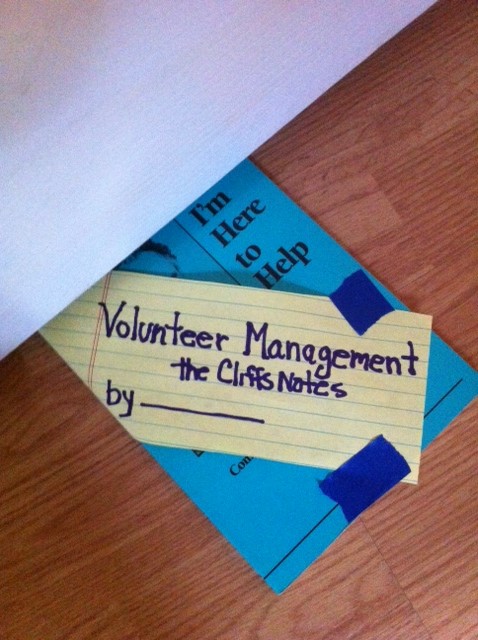
    I’ve always wanted to see a small pamphlet entitled “Volunteer Services for Dummies” or maybe “Volunteer Management, The Cliffs Notes.” Then I could sneak around and slip that bad boy under the door of the executive director while he was at a conference on “How to Get Donors to Donate More.” The pamphlet would have a way to insert whatever author’s name would impress him, like maybe that consultant who he’s recently hired to tell him that he needs to get more donations.

    So, forget the pamphlet. Let’s just list the ten top things that I wish CEOs would understand about volunteer services.

    10. Volunteers do not sit by their phones waiting for us to call. Shocker! We don’t just “order up” volunteers when someone asks for eight volunteers who can work twelve-hour shifts, outside, tomorrow at 8am. Yeah, no one wishes it were that easy more than we volunteer managers. Asking volunteer Charles to prioritize volunteering with us over his other volunteering activities, his trip to Bermuda (that he’s saved years for), his managing of his elderly mother’s affairs, and his scheduled surgery might just be a tad unrealistic. It takes a wise volunteer manager to know how to balance volunteers’ experiences so that volunteering is not burdensome and they look forward to coming in to help.

    9. Managing volunteers is not like managing staff.  Wow, bigger shocker! Unless managing two to ten times the number of very diverse people who only work maybe four hours a week without pay is the same thing. Instead of a paycheck to dangle, volunteer managers must use real leadership skills to inspire and coordinate volunteers. Think of it this way. Volunteers typically spend about 4 hours a week volunteering while you, the Executive Director and your staff spends upwards of 40 or 50 hours a week working for the organization. That’s at least ten times the amount of “plugged in time” you have over volunteers. Do you think that the volunteers spend the other 36 hours thinking about our organization? If not, volunteer managers must be able to “plug-in” volunteers every time they arrive on scene, motivate them to achieve that connection and keep them informed of changes and updates.

    8. Volunteers are everyone’s responsibility.  What?!!! The CEO is thinking, “Then what do I pay YOU, the volunteer manager for?” Staff doesn’t necessarily see working with volunteers as part of their jobs, but any staff can make or break a volunteer’s experience. Look at it this way. What if you, the CEO cultivates a donor by spending your time and sweat to encourage and inform and then another staff member comes along and insults that potential donor? It’s no different with volunteers. We need you, our CEO to set the tone. So if deep down, you are thinking that volunteers are not really time donors but are just fluffy side dishes,  then please stop saying things like “we can’t operate without our volunteers.”

    7. Volunteer managers are real managers. “Hmmm,” the executive director might be thinking, “No way, not in the same way our manager of fund-raising is!” Well, no matter what you call them, coordinators, specialists or team members, volunteer managers are as much a manager as anyone on your staff. The list of skills needed to lead and cultivate a team of volunteers (see #9 and #6 and #4 and #3 and #2 and #1 and oh heck, all of them ) is quite extensive.

    6. Volunteers want meaningful work. “So,” the CEO may be thinking,  “but I often need some meaningless stuff done. Who will do it?” That’s true, but volunteers do not want to just do what the staff doesn’t want to do, they want real jobs that make a difference. And since we don’t pay them, maybe we should consider meaningful work as pay? But, a great volunteer manager with awesome skills can lead volunteers to occasionally do the grunt work if grunt work isn’t all that is offered.

    5. Volunteers want sincere appreciation from more than just the volunteer department. An Executive Director might be thinking, “Hey! I always say that we couldn’t operate without our volunteers, don’t I?” Yeah, you do. But guess what? Volunteers see through the once a year speech at a luncheon that is just lip service. Volunteers want you to make an appearance and say hello, send hand written thank you notes and include their accomplishments the next time you meet with the board of directors. And oh, they would like you to genuinely encourage staff to do these things too. Volunteers are either an integrated valued service or it’s all just talk.

    4. Volunteers are not just little old ladies drinking tea. “But,” a CEO could say, “they sure look like that description ha ha.” Did you know that volunteers are diverse in every way, including age, background, culture and experience and that it takes some major skills to manage a group of very diverse people? But even if some volunteers are older, did you know that they are former executives, professors, leadership experts and full of wisdom and great ideas? And they’re more than willing to share their wisdom for free.

    3. Volunteer managers are not lap dogs.  “Hey,” the Executive Director would protest, “I never said that!” But are the volunteer managers treated that way by staff? Is there an “order up” culture in which volunteer managers are expected to just get volunteers without having any meaningful input into volunteer requests? Volunteer managers have their fingers on the pulse of the organization and are privy to every aspect of the mission via volunteer involvement. Maybe, just maybe, your humble volunteer manager is really a great motivator and leader and not just an order taker. Check them out for some really awesome ideas and managerial skill-sets.

    2. Volunteers are aware and talk. “Sure, so what, that’s great,” a CEO might agree. But, when a volunteer hears negative speak from staff, or sees something less than perfect, guess what? They talk, to each other, to friends, relatives, and the cashier at the Quick-Mart. Volunteer managers keep volunteers motivated and inspired and mediate constantly to make sure the volunteer’s concerns are resolved and their experience is positive. In this world aching for transparency, volunteers are the town criers who can proclaim the worth of an organization or do damage to its reputation.

    1. Volunteers don’t stay forever. “Heresy! They should if the volunteer manager is doing her job,” an Executive Director could counter argue. No, actually volunteers don’t. Does staff stay until they die? No, and neither do volunteers. We should recruit, train and cultivate our volunteers just as we do staff, but not expect them to continue until they’re carted off in an ambulance. And, just like staff, sometimes we don’t want them to stay, so that’s why the professional skill-set of the volunteer manager is so crucial. A volunteer manager’s professional resolution to a challenging situation is an organization’s best chance to avoid negative publicity.

    So, there you have it. I’ll bet you volunteer managers have some really great ideas on other truisms that belong on this list. You have my permission to print out this list, slip it under your leader’s door. Somehow add to it that it was authored by the “Center for Outstanding Management and Maintenance of Organizations and NGO’s” via the report from the “Study on Excellence in Non-profit Structure and Ecosystems” or COMMON SENSE for short.

    -Meridian

  • Defining Success

    coal miners wikipedia wikipedia

    The first time I met Alex many years ago, I noticed his manicured nails. He had the soft hands of wealth. His was not a gaudy proclaiming wealth, but an understated old mixed with new wealth. A retired corporate lawyer, with his much younger wife still working, he wanted to fill his days with something meaningful to do. He’d not had a hospice experience, but he’d heard that hospice was a good organization to volunteer for and he wanted to try it out.

    He stuck out in orientation. From his formal weekend wear to his lawyer inspired questions, he animated the sessions with his analytical take on things. The rest of the diverse but more laid back class was somewhat intimidated by him. (Me too if you must know- and yes I tell myself that I’m no better and no worse than anyone else, but heck, my clothes wouldn’t keep their shape like his did).

    After the six orientation sessions were over, I met with Alex in my office. He was polite and cerebral and together we formulated that with the help of a seasoned volunteer, he could begin volunteering in our care center.
    Alex called me often to ask questions. He would show up at my office door every time he came in to volunteer. Knowing that he was used to doors always opening  when he knocked, I allotted time for him. Was he smart? Oh my, I think I could have applied for 3 credits at a local college after listening to his measured thoughts.
    Since the care center staff had really never seen anyone quite like him, I was peppered with lots of questions and comments. “One of those successful types,” a nurse said one day. “He asks a lot of questions,” another said and added, “you’ve got your work cut out for you.”

    One day, a new patient, Lester came into the care center. A coal miner from West Virginia, Lester was in his late 80’s. His wife had died young and although he had no children, he had an old phonograph that played bluegrass music day and night. We all were used to walking past his room, hearing the lively strains of banjo, fiddle and mandolin drifting up and down the halls as if over the hills of a coal camp. As thin as a pick axe, Lester spoke of a time when his wife scrubbed his coal stained clothes until her hands bled and the chocking black dust laid upon the ground outside his camp house door.

    Alex began to visit with Lester more frequently. He sat in Lester’s room while the phonograph scratched out “Foggy Mountain Breakdown,” and listened to Lester’s stories of moving from job to job until the mines became more mechanized. As time passed, Alex began to place his chair closer to lean over to hear Lester and I would observe him, elbows on knees, straining to catch the flooding memories. Then, one day, the absence of bluegrass music outside Lester’s door spoke volumes. Lester was actively dying and his phonograph had grown quiet. He had turned it off. Alex came to me and tentatively said, “I have an acquaintance who plays the banjo and knows any number of Lester’s favorite songs. Do you think I could ask him to come in and play for Lester?” We checked with the charge nurse and social worker and Alex was given permission to bring his friend in. By this time, Lester had not stirred from bed, but lay peacefully, quietly slipping away.

    I skipped a meeting that day, shut my office door and crept down to the care center. The stomping good sound of the banjo’s strings was glorious. I peeked into the room and saw Alex’s friend’s frenetic fingers pick that banjo, his eyes smiling at  Lester, who was now somehow sitting upright, a look of bliss on his worn face. Alex nodded to me from the very corner of the room. I wondered if Alex consciously picked the color of his shirt that day to blend in with the wall color.

    Lester died two days later. Alex and I sat in my office, the lack of music deafening. He did tell me that his friend was honored to be able to play for someone who breathed those mountain roots. Alex got up to go. It wasn’t the time to badger him with questions about how he was going to process this experience, not yet anyway. Right then it was time to silently let it all sink in.

    What makes a person successful? I’d say Alex pretty much had it all figured out.
    -Meridian

  • Looking Back

    I’m on vacation this week visiting family. In typical volunteer manager fashion, I figured I’d be searching the yellow pages for and interviewing volunteer managers in a new and different town. But, I’ve subjected my family to so much work intrusion throughout their lives as I’m sure you have too. It’s time to just simply enjoy them.
    So, I got up before everyone this morning, fired up the coffee and looked back, found this very early post and copied it. I hope you don’t mind. It made me feel good, because I know this visit with family will come to an end and I will be sad because life is not perfect, but it is a balance of work and home, success and failure, joy and pain, curiosity and fear. And in it all lies meaning; meaning for those we serve and meaning for us. Here is the post from four years ago:

    You know how some days just feel wrong?  Today was one of those days. I had been reading some very interesting articles about volunteer management and started getting ideas that I could adopt for the volunteers I work with when a little voice said, “It’s Friday. Who cares? You’re overworked, underappreciated and tired of the struggle. Give it up.” I wasn’t happy to see any of the volunteers today. I wasn’t all that funny or nice or anything. I was blah.

    As I was sitting there, staring at the computer, willing it to make me feel better, the phone rang. I don’t know about you, but when it rings on blah days, I sometimes let voicemail pick it up and then I call back later. It makes me feel more in control I guess. But for some reason I reached for it. Must be habit.

    I answered and it was Monroe calling from Des Moines where he now lives with his mother. Monroe used to volunteer with us. He is 23 years old. He moved to our area with his Mom to look for work. They lived in an apartment a block from my office with no car, no job and little resources except a grandmother who lived in the area.

    He came into my office three years ago and asked to volunteer. He is one of these really, really quiet types; you know the ones who answer in monosyllables. He speaks in a voice that barely breaks a decibel and looks down as he talks. He is covered with tattoos and piercings and wears nothing but black. He has a goatee.

    To be honest, I took one look at him and wondered why on earth he would want to volunteer and would he scare staff, clients and other volunteers? I gave him the information for the next orientation and thought no more about it. Not only did he show up, he came to all six sessions, and participated, albeit in monosyllables. The other volunteers started to like him.

    Monroe started volunteering in the office. He told me a little about his situation. I could lie and say he opened up, but he did give me some tidbits here and there. I happened to be working with some volunteers on a music project and I mentioned that to Monroe. He said he wanted to help. Now this is a project that a very select few volunteers who have extensive musical experience work on, but I brought Monroe along for a meeting and practice. He not only did anything asked of him, he asked to do more. He informed me that music was his passion.

    From that day forward, Monroe became our go to guy for anything musical, whether it be production, setting up, getting snacks or toting heavy equipment. He became one of us very quickly and every single volunteer took him under a wing. I have to admit I drove him a few places and so did other volunteers. He was always very grateful. I got to see his apartment one afternoon when I gave him a ride home. He was very proud of his room.

    His Mom could not find work and so they had to go back to family in Des Moines. I am not lying when I say I really miss him and so do the volunteers who worked with him.

    After I happily greeted him on the phone, I asked him how he was doing and in typical Monroe fashion, he said “good.” I tried to extract more, but I did get that his mom had a job and so did he. He was working on writing music and doing well. He told me that he wanted to keep in touch with us and I was relieved. I asked him if he found a place to volunteer and he said that he had thought about it, but no, it wouldn’t be the same. He then told me that we were family to him.

    We all have the chance to impact the lives of those we serve by providing the best volunteers we can. We all have those nuggets of success when a volunteer does a great job. But this is different. Monroe is a personal slice of joy for me. I don’t know how much his volunteering experience impacted him, but I can guess that we had a very positive impact on his self-esteem and psyche. I hope we did, and I hope that I never forget that everyone has something to offer. Volunteer managers are fortunate enough to be able to discover and cultivate the talents and desires of the folks we manage. The heck with blah. I’ve been reminded that it’s good.

    -Meridian

  • Dialogue? You Call This Dialogue?

    GPS-IIRM wikipediaOne day several wise men were challenging each others thinking over tea. “If you were given the opportunity to sacrifice yourself for world peace,” the first man asked the group, “would you do it?”
    “Yes, of course,” the second man said. The third man agreed. “If I were guaranteed world peace, I would do it, surely as it would be the right thing to do.” The fourth man rubbed his chin. “What do you mean by world peace?”
    “Just that, world peace,” the first man said.
    “Well, if world peace meant only for one day, then no, I wouldn’t do it,” the fourth man said.

    Do we know what staff members, CEO’s, volunteers, and the community mean when they use certain phrases and concepts? And do those concepts mirror what we, volunteer managers define them as?
    One day when I was feeling particularly feisty (or truth be told, downright crabby from hearing that a volunteer was sent home from an assignment at a health fair because a marketer brought her children to man the booth), I heard a staff member say, “we couldn’t do what we do without our volunteers.” Now, I know this is a lovely platitude, but being cranky, I asked, “really, that’s so nice, what do you think would actually happen if we didn’t have volunteers?”
    She looked at me like I was a pompous jerk (and maybe I was). “Well, we probably couldn’t accomplish as much as we do.”
    “Do you think we’d close?”
    “Don’t be silly,” she said and walked away, I’m sure thinking that I was nuts and a pompous jerk.
    But what is meant by common concepts that are continually used? What do some of the phrases we hear actually mean?
    “We love our volunteers.” What does that mean? We love them individually and will bring them soup when they are ill or we love the idea that we have them? Or we love them as long as they don’t create any problems for us or take up our time or ask questions when we are busy?
    “We’re volunteer friendly.” Really? How? Explain that to me. Do we hang out with our volunteers on a Saturday afternoon along with our good friends? Do we let them call us at home? Do we confide in them? Do we smile at them when we walk in but don’t notice that they have a broken arm because we are late for a meeting?
    “Volunteers are the heart of our organization.” Hmm, are we talking about a crucial organ or a warm fuzzy feeling? Do we mean they truly inspire us to be more compassionate or is the term “volunteer” an abstract idea that we cherish, not real, breathing human beings that come in every day?

    See, if you say volunteer engagement to a volunteer coordinator, there is a complex burst of ideas that go off in their heads, including the idea that engagement is a two way street. Ask any random staff member “what is volunteer engagement” and you may get a totally different view that does not include volunteers in leadership roles or the challenges in managing volunteers. And here is where an awful lot of volunteer manager angst lives.

    So, the challenge is, how do we beat the concept of volunteer engagement into everyone’s heads?
    Wait, did I really say, that, whoah, I must have let that rabid little voice take over for a minute. Whew.
    But seriously, we have bent ourselves into pretzel shapes for years trying to “educate” organizations on the true nature of volunteer engagement. Sometimes we’re kinda like the folks who show up at your door unannounced, either selling something, or trying to get you to accept their pamphlets on their religious and political beliefs. I know I have been like that.
    Me: Knock, knock.
    Staff: Who is it?
    Me: Volunteer Services here to educate you on volunteers!
    Staff: Um, I’m really busy, what with just coming from three meetings and my work is piled up. I just attended a seminar last week on fund raising so I’m a bit overwhelmed.
    Me: Well, if you’ll just open the door, it won’t take more than 20 minutes.
    Staff: Can you come back later?
    Me: But this is important. Don’t you want to know about volunteers?
    Staff: I already do, they’re great, gotta go, my phone is ringing.

    Hmmm, if the knock knock method doesn’t work, now what? Well, maybe we should try a dialogue. I know, dialogue is one of those buzz words, but
    we could seriously try asking organizational stakeholders the meaning (in their own words) of concepts that we think are important to bettering communication between volunteer services and staff. And if we do this with sincere intentions to learn where we differ from staff in how we view volunteer services, we might be able to begin work on closing the gap.
    Hearing a senior manager’s explanation of volunteer engagement may make you angry and think, “how can he be so ignorant? How can she think that’s all there is to it?” But, if we put aside that anger and look at the disparity in thought, then perhaps we can begin to free ourselves to analyze how to make volunteer engagement better understood within our respective organizations.
    With the keen desire to understand, we can try asking, “how do you view the volunteers’ role? What does the term volunteer engagement mean to you? What about volunteer involvement?”
    Be prepared to hear some surface answers and some surprise answers and be prepared to question (in a non-judgmental way) those answers. “What makes you think that?”
    We can ask, “what do you think the most important job a volunteer manger does and what are the challenges volunteer managers face?” Hearing the answers may initially make you defensive but in stepping back, may just make you see where the misconceptions lie between what the volunteer department actually does and the perceptions of the rest of the staff.
    Again, this is dialogue, not mandates to change the way we view or do our work. How can we work together with staff to help them learn more about the challenges and organizational responsibilities of volunteer engagement?
    If we want to get to a place where staff view volunteer engagement the way we do in all its complexities, perhaps we need a street map to get there. Discovering the diversity of ideas within our own organizations on common volunteer concepts and terms may just be the first step to the GPS we need to arrive together at that place where volunteer engagement is understood by everyone the exact same way in which we understand it.
    -Meridian

  • Can I Bottle Your Success, Please?

    dinner and a movieGrace is sparkling champagne in a petite frame, and as she walks through her non-profit halls, bubbles of mirth float with her. She is a volunteer coordinator who has some of the most desirable natural abilities: the ability to make someone feel like they are the most important person in the world (at least at that moment) and the ability to include everyone in the fun and the purpose of the work.

    When I view Grace, if I squint my eyes just a bit, I start to see a humming hub from which emanates all these connectors that run through people, places and things. It’s almost like the wizard behind the curtains in the Wizard of Oz, but not in a creepy way with a booming voice that fools people. No, she is the genuine article. Her desk looks like any other desk, but it almost seems alive with all the activity that buzzes around it. If scientists can ever extract sound from inanimate objects like they predict they will, I want them to start with Grace’s desk-the amount of voices stored in that wood over the years will be deafening.

    I caught up with her recently and just like anyone who wants to bottle success or greatness, I wanted to ask her about her talents in working with volunteers. See, her volunteers are a tight-knit family. They tend to communicate with one another well, tend to be more inclined to say yes to extra work, tend to want to be involved in more ways than they originally signed up for, and tend to want to be around Grace instead of avoiding her. I know what you might be thinking, that this is an example of a personality cult. I don’t think so. I’ve seen personality cults (maybe I’ll write about one I knew of that ended up badly) but Grace is not that. Not that she couldn’t easily herd her volunteers into the “Grace is Our Queen and We are Her Minions” sect, but while she may scrape that precarious line once in a while, she is too smart to cross it and has no problem putting up an arm. elbow locked into place, to stop volunteers from becoming loyal to her instead of the mission.

    Grace is first and foremost a master of communication. She calls, emails, asks volunteers to call, sends newsletters, has an open office policy, makes hourly trips to check on volunteers working, sends cards, visits, has meetings and does every other mode of communication possible in order to keep her volunteers informed and engaged. (Picture the hub humming away).

    But Grace is fun on a stick, a happy birthday balloon in life. It’s a trait that I’ve seen in many long-term volunteer coordinators-Grace has been doing this for ten years. Maybe it’s because we have to create our own fun to diffuse the stress or maybe it’s because we need to see the joy in life to encourage people to work with the pain.

    I asked her about some of her more successful volunteer bonding events and she said, “I’ve tried many things like a game night or having a speaker talk on a worthwhile topic, but one thing I’ve found that works is dinner and a movie. Who doesn’t like dinner and a movie? I saw it as a way to get a crowd in so that they could connect with each other.”
    Grace shows movies in a conference room set up with tables and chairs, and puts out a spread of food on folding tables. It’s nothing fancy, but it is effective. “I wanted volunteers to know how much I appreciate them beyond the organization’s appreciation of them. And even shy volunteers can participate in coming to dinner and watching a movie, because I know that those volunteers that are alone appreciate a place to go and socialize on a Friday night.”

    Grace has a really good point here. If a secondary reason to volunteer (after the first reason-helping someone) is to socialize, then establishing a social gathering for volunteers truly meets that secondary reason to volunteer in a safe environment. Not only did a crowd show up to the first dinner and a movie, Grace added, “I talked it up with everyone. Most of them came, even if they saw the movie. Later, they discussed the movie with each other and that gave them a chance to get to know people they did not volunteer with regularly. And the next time I had a dinner and a movie, the volunteers encouraged each other to come.”

    Grace has this fearless component to her as well. She gets all of the food she serves and the prizes she gives out (sometimes there are winning tickets taped beneath chairs, other times there might be a contest or raffle to win) donated by local businesses. I asked her if she was nervous asking for donated food and goods. After all, asking for someone to donate their time (aka volunteer manager) is not the same as asking for donated money or goods. “Not at all,” she said, “I don’t go with the attitude that I’m begging. I go asking if the business or individual would like to be part of something worthwhile and most of them do. Volunteers are well thought of in the community, and people truly want to support them, so no, I’m not nervous, I’m extending the invitation to join us, to be part of our good work.”
    She’s gotten so good at networking in donated goods that staff seek her out. “If they need something, like a special desk or a staff coffee maker, they come to me first to see if I can get one donated. Usually, I can.”
    I asked Grace what made her volunteers feel so special and included, beyond the social gatherings. Actually I was holding out my bottle, ready to gather up that magic ingredient to take with me. “I was always honest with them,” she said. “I respect them and their contributions to the organization and I genuinely care about each one of them because each one is important and I think they feel that from me. I sort of liken it to water skiing, the feeling that you get when you’re out there…”
    “Exhilaration?” I interjected.
    “Yes, but it’s more like that natural high when you water ski. The volunteers come back for that feeling,” Grace corrected me. “Helper’s high. I believe each volunteer has something good to offer and I want them to see that. I help them find that.”

    After leaving the humming of Grace’s hub behind, I thought about our chat. I can understand a little better why Grace is so special although I’m not ruling out the bit of magic in her along with her skills. I still want to bottle her gifts, but maybe I’d better concentrate on developing my own first.
    Dinner and a movie, anyone?
    -Meridian

  • “Is It Too Much to Ask?”

    lock“Is it too much to ask?” Calista queries while wiping grape jelly off the hands of her five-year old. She smiles and pats him on the head as he runs off to join his three older sisters in the yard. She drops the rag on the counter and sits down on the bar stool. “I’m not a high maintenance person, not at all. But, I mean, I do need some consistency and direction.”

    Calista started volunteering for her PTA after some pretty heavy pressure by the PTA officers. “Maybe it’s because I have four kids in that school,” she laughs, “but I became a target for their recruitment. Maybe it’s because I’m a loan officer at the bank which makes everyone assume I’m the goddess of paperwork. And I know every volunteer group has their share of paperwork!”

    Feeling the need for parents to step up, Calista agreed to volunteer and she set aside time for the next meeting. “I’m fortunate because my husband, Josh is great and encouraged me to get involved so I did. After dinner one night, I headed out for my first meeting. I was introduced to the President, a nice lady named Jenna and I met all the other officers as well. They seemed very pleased to have me join the group.” Calista leaned back. “They had quite a number of projects going, including holiday events, fund-raisers and volunteering in the classroom. After the meeting was over, I realized they had gotten me to sign up for a call tree and also as a member of the awards committee.” Calista giggled. “Oh, they were good. I kind of liked the two areas I signed up for. The call tree I could easily do from home and the awards committee sounded fun. At the end of the year there would be awards for students, teachers, parents and even office staff. I have to admit, I was hooked.”

    Calista thought for a moment. “Every month I would faithfully attend the meeting. Jenna, the president took me aside and asked if I would research prices on awards for the award ceremony, present my findings at the next meeting and I agreed. I wasn’t being utilized on the call tree and I just figured that no calls needed to be made, but at the next meeting I was armed with the awards information. I had spent a good amount of free time gathering prices, guarantees, choices, etc. But when I got to the meeting, I found that the president had already contracted with a company to create the awards. When I asked the president about my research, she said that it may come in handy next year, but that she had to act fast on a promotion that someone sent her. I gotta tell you, I was annoyed. She could have emailed me so that I didn’t waste my time.”

    Calista was a victim of Lack of Communication (LOC).

    I’m ashamed to admit it, but I have been guilty of the LOC malady. And I had no good excuse for my lack of communication. Now here’s the thing about committing a LOC on volunteers. A real volunteer’s time and effort is disrespected by misdirection, no call back or no follow through. Running into a volunteer that is awaiting your call is like rounding the cat food aisle to see someone you owe 20 bucks to and forgot to pay. When we see this volunteer do we say, “Yeah, I could have called you to tell you that the project you were so excited to be part of has been scrapped but I chose the cowardly way by ignoring it and you.”

    Being mindful of volunteers’ time and effort is crucial to volunteer retention. We can’t give a volunteer an assignment or tell them we will call them without following through on that promise, because it is a promise, a promise to treat them as a valued member of our team. And, as if we didn’t have enough work, we cannot let other staff members commit a LOC either. We have to be on top of their treatment of volunteers too.

    But what about those conversations in a hallway, or on your day off in the store when you promise something to a volunteer but don’t write it down or store it in your phone? If I had a dollar for every time that happened to me I’d have a nice little nest egg right now. When I’d finally given up on the idea that I could remember everything (yep, you’re right, control issues), I began to be more honest. “Well, Donna, I’m so glad we ran into each other here in the feminine hygiene aisle and we got to talk about your wanting to get involved in that new project. I can’t tell you how excited I am to have you work with us, thank you so much. Can I ask you a favor? I’m afraid that because it’s a Sunday evening and I don’t have a notepad with me, I might let this conversation slip and I would be mortified if I didn’t call you tomorrow with that information. Would you mind calling me tomorrow to remind me? You would? Thank you, you’re the best!”

    Now, when Donna calls the next day, I can chuckle and say, “Thank you for calling me. I was so excited that I was just about to call you, but sometimes I forget. You are unforgettable of course, but now let’s talk about your involvement.”

    If a volunteer calls and says, “I haven’t heard from you…” that is red flag territory. For whatever reason, that volunteer was handed a LOC. Open it with honesty.

    Honesty goes a long way. Sincerity gallops right along with honesty. I’ve had to say, “I didn’t call you because I’m an idiot,” and “I didn’t get that information because I let time get away from me and I sincerely apologize.” Ouch, It’s sobering to realize that I’m not super volunteer coordinator. But, I am human and I do care about volunteers’ time and energies.

    Calista sighed deeply. “You know, it would have been ok had I gotten some sort of acknowledgement that my effort was for naught. An apology, a reason I wasn’t informed, something. That would have gone a long way to make me feel valued.”

    Volunteers do not expect us to be perfect. However, they do expect their time and efforts to be valued. Communicating is about valuing them. And too many sloppy LOCs will produce a volunteer LOC out!
    -Meridian